Buying. We are actively buying books published by the Takagi Photographic Studio. If you have material to sell, please contact us. All the books below, and any others, are of interest.
Selling. If we have a book in stock, a link to the offering is provided.
"Tamamura the Photographer" Yokohama & Kobe
"T. Takagi" (Takagi Photographic Studio) Kobe
Leaf From the Diary of a Young Lady
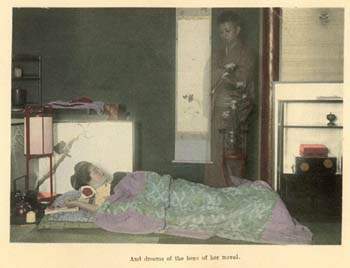
Tamamura (Yokohama)
From Peace to Strife, An Incident of the Bushido Spirit
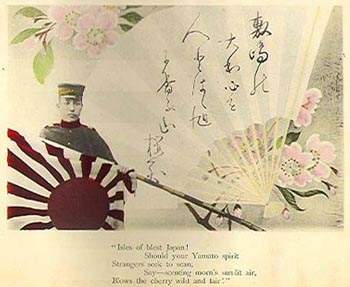
"Tamamura the Photographer, Kobe"
The Chrysanthemums in Japan
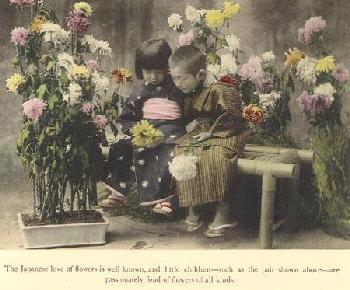
"Tamamura the Photographer, Kobe" and "T. Takagi, Proprietor"
Military Accomplishments of Japan
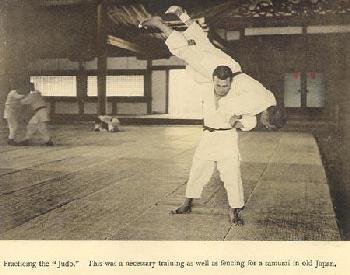
"Takagi Photographic Studio & Art Gallery, Kobe"
This page considers the pictorial books published by K. Tamamura (Yokohama & Kobe) and T. Takagi (Kobe). These books are characterized by the following:
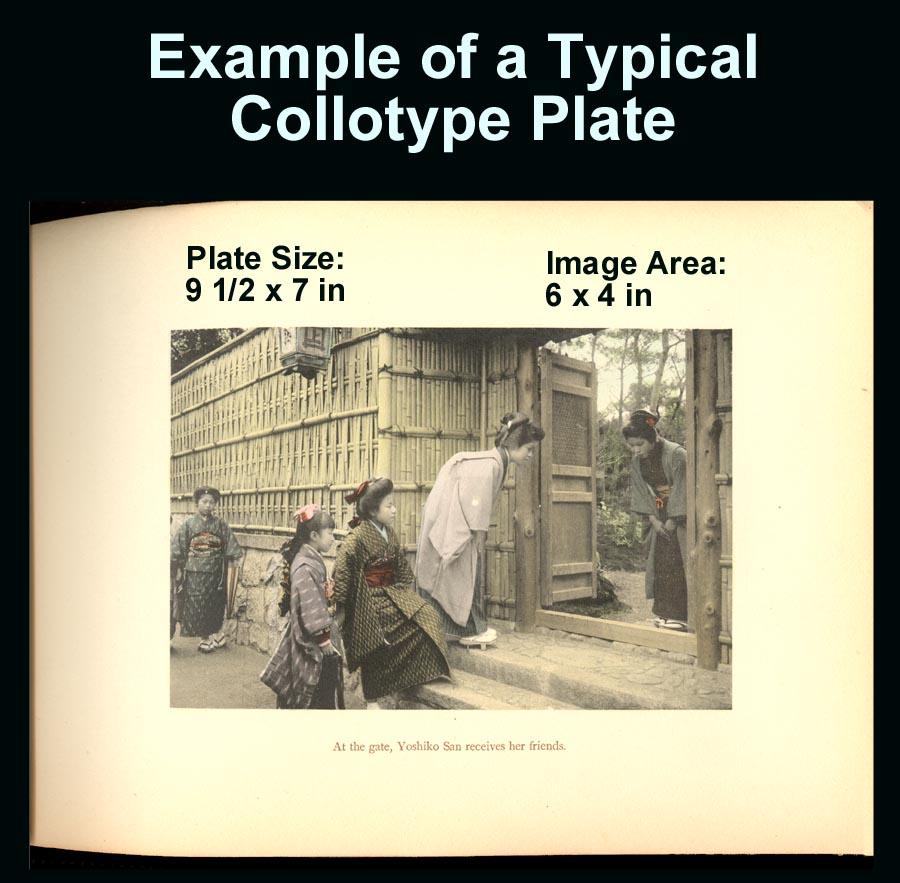
- Plates: Handcolored collotype printed plates (image area ca 4 x 6 in) with descriptive captions in English and printed on one side only.
- Number of Plates: Generally 12 plates but sometimes as many as 50 plates.
- Size: Oblong 8vo (9-10 x 6-7 1/4 in) - horizontal format.
- Boards/Binding: Hard covers (cardboard covered with fabric), ribbon tied.
- Subjects: Each book considers a specific topic, generally with a focus on a distinctive aspect of Japanese culture. Occasionally the books have a geographic or scene place theme but that is the exception.
- Colophons & Attribution: Early K. (Kozaburo) Tamamura collotype plate books do not contain a colophon. With these books the attribution is based upon similarity with known K. Tamamura photographs and the location of Yokohama is presumed as that was Tamamura's primary business location. Later books with colophons (K. Tamamura or T. Takagi) indicate Kobe. There is a definite possibility that all the colored collotype plate books listed on this page were actually produced in Kobe, either by Tamamura or Takagi.
- Deluxe Editions: At this time (late 18th through early 19th century) it was a common practice for a publisher to produce regular and deluxe editions of this type of book. I have personally examined one Takagi book (Japanese Views and Characters, 50 plates), ca 1919, which was in a deluxe format. The basic difference between deluxe and regular format books lies in the covers and not the contents. For more information on deluxe editions, click here.
- Tamamura to Takagi Transition: It appears that Tamamura sold his business operation in Kobe to T. Takagi in late 1903 to early 1904. Starting in 1906, one finds a gradual transition in the colophons in these books away from Tamamura to Takagi. The earliest book I have examined with reference only to Takagi (no mention of Tamamura) was published in 1913. For more information on this, click here.
Confirmed (Verified) Books.
Tamamura, Kozaburo (Yokohama) [Tamamura Shashinkan] :
- c1900, Famous Scenes in Japan, "K. Tamamura, Photographer, Yokohama, Japan," horizontal 4to (12 x 15 in), decorated silk covered padded boards, spine covered, all edges gilt, 57 hand colored collotype plates each with descriptive captions (sometimes with an additional paragraph) on the back of the preceding page,
- c1904, Leaf From the Diary of a Young Lady, Yokohama, Kozaburo Tamamura, c1904, oblong 8vo, black with gold floral/leaf pattern covers with color woodblock tipped to the front cover. The book is composed of 24 hand colored albumen photographs, each tipped to page. Below each photographs is descriptive text. No colophon. Accompanied by folding case. This book (see next listing) was also published with the same images and text but with the images reproduced in collotypes rather than albumen photographs.
- c1904, Leaf From the Diary of a Young Lady, Yokohama, Kozaburo Tamamura, c1904, oblong 8vo (10 x 7 1/4 in), black with gold floral/leaf pattern covers or plain cloth without decoration covers, 24 pp. This book is composed of 24 hand colored collotype plates from photographs by Tamamura. It should be noted that whether this book was produced by Tamamura or Takagi is an open question. Some authorities have attributed it to Takagi and date it c1910. The book does not have a colophon. For more information on this book, click here.
~~ Available - Leaf From the Diary of a Young Lady - Purchase Here ~~
- c1905, The Japan, Yokohama, Kozaburo Tamamura, c1905, 12 black and white collotype plates.
- Japanese Views and Characters, a three volume set, Yokohama, Kozaburo Tamamura, c1910, oblong 8vo, decorative covers, string tied. Volume 1 covers Kyoto, Nara, Osaka, Kobe and Nagasaki. Volume 2 covers Yokohama, Kamakura, Fuji and Nagoya. Volume 3 deals with Tokyo and Nikko. Each volume has 24 hand colored, tissue guarded, collotypes. Since the covers for these books were hand painted, the cover art varies. However, you sometimes find sets with clearly matching cover art. It should be noted that Takagi published a book with the same title ca 1919 (see below). That book contains 50 collotype plates.
As is typical of many Tamamura/Takagi books, these books do not have a colophon nor do they state the publisher. A ca 1909 slip advertisement by Tamamura specifically lists this three book set.
- For more information on Volume I, types 1 & 2, click here.
- For more information on Volume II, types 1 & 2, click here.
- For more information on Volume II, type 3a and 3b, click here.
- For more information on Volume III, types 1a, 1b, 2a and 2b, click here.
- For information on a matched set of Volume I, II & II (type 2) click here.
~~ Available - Japanese Views and Characters, Vol. II (type 3b) - Purchase Here ~~
~~ Available - Japanese Views and Characters, Vol. III (type 1 - Tamamura, Photographer) - Purchase Here ~~
~~ Available - Japanese Views and Characters, Vol. III (type 1b) - Purchase Here ~~
- Glass (Magic Lantern) Slides. The George Eastman House, Still Photograph Archive, once had an on-line gallery of 6 hand colored glass (magic lantern) slides which they attribute to "K. Tamamura." They describe these slides as "transparency, gelatin on glass with applied color." Takagi, Tamamura's successor in Kobe, also produced colored glass slides. Many of the glass slides produced by Takagi were images published in the collotype books.
My price list for Tamamura/Takagi Magic Lantern slides is here.
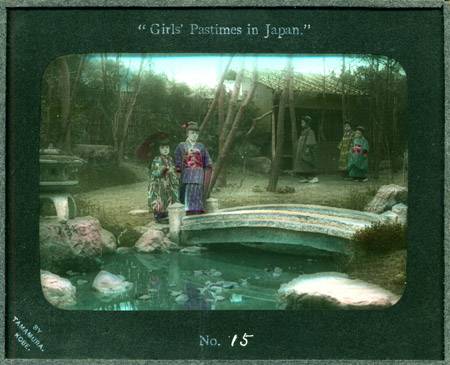
For more information on Kozaburo Tamamura, click here.
Tamamura, Kozaburo (Kobe, ca 1900- ca 1907):
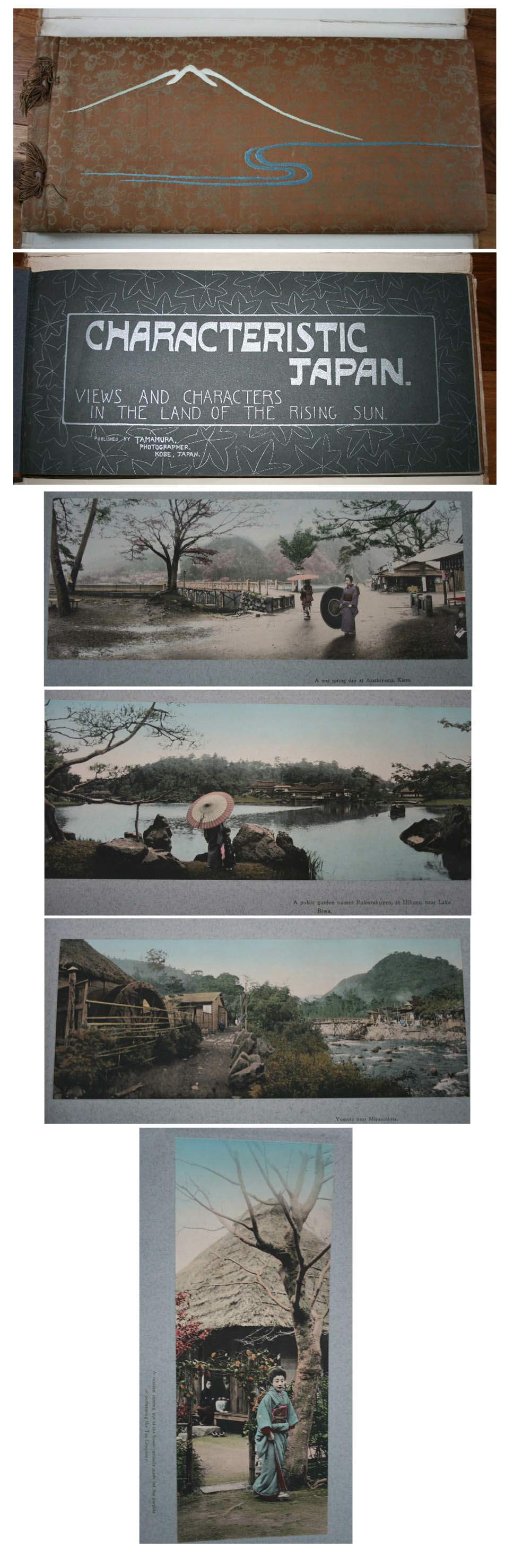
- c1900, Characteristic Japan. Views and Characters in the Land of the Rising Sun, published by Tamamura, Photographer, Kobe, Japan, not dated but c1900, 24 hand colored albumen photographs tipped to page, embroidered silk over padded boards, two stab ties, wraparound case. . Each page has a printed descriptive caption. The individual photographs are 4 x 11 inch. To see the covers, title page and representative pages, click here.
- c1900-c1906, no title (similar to above book), presumed published by Tamamura, Photographer, no colophon, not dated (c 1900-c1906), oblong 7 3/4 x 17 in (20 x 43 cm), cloth covered outer boards with single string tie, no inner cover or title page, free front page, pages unnumbered but 25 hand colored collotype plates. The images are tipped to plate and not printed on the plate. Each photograph has an English caption hand printed in pencil at the bottom left corner below the image. The collotypes plates are protected with tissue guards. There is no colophon. For more information on this book, click here.
~~ Available - 25 Hand Colored Collotype Plates - Purchase Here ~~
- 1904, From Peace to Strife, An Incident of the Bushido Spirit, "Bushido" the Soul of Japan, Kobe, "Tamamura the Photographer, Kobe" Meiji 37 (1904), 1st edition, oblong 8vo (6 1/4 x 9 1/4 in - 16 x 23.5 cm), English language, lithograph title page, 12 hand colored collotype plates with captions, pliable cardboard covered with silk type fabric, single string tie, unpaginated. The actual images are approximately 4 x 6 in (10.5 x 15 cm). This book was published as Japan was engaged in the Russo-Japan War. It is a pictorial account of a young man, "Taro" who was called up from the reserves to active duty. It starts with "Taro" and his mother and father tending the family crops and progresses from his receipt of the call-up letter, to preparations for departure, to his farewell and ends with a letter and poem home from him in Manchuria. For more information on this book, click here. The same book was also published without a colophon.
~~ Available - An Incident of the Bushido Spirit without Colophon - Purchase Here ~~
- 1905-1906, The Ceremonies of a Japanese Marriage, Kobe, "Tamamura the Photographer, Kobe", 1st & 2nd editions published between 1905 and 1906. For more information on the second edition and later editions with the Takagi imprint, click here.
~~ Available - Ceremonies of a Japanese Marriage 2nd Edition, 1906 - Purchase Here ~~
- 1906, February, The New Year in Japan, Kobe, "Tamamura the Photographer, Kobe, Japan" Meiji 39 (1906), oblong 8vo (7 x 10 1/4 in - 18 x 26 cm), English language, hand colored title page, two page introduction, 24 hand colored collotype plates with captions, no tissue guards, hard boards covered with silk type fabric, unpaginated. The actual images are approximately 4 x 6 in (10.5 x 15 cm). Pictorial depiction of New Year activities in Japan. For more information on this book, click here.
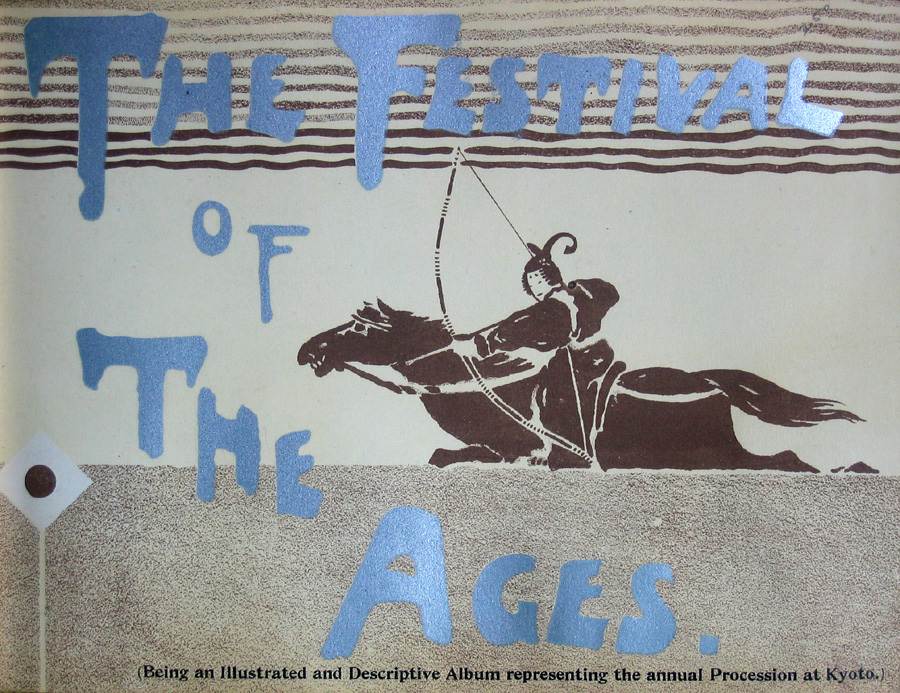
- 1906, February, The Festival of the Ages, "Tamamura the Photographer, Kobe." The colophon states a printing date of Meiji 39 (1906), February. A copy of this book where T. Takagi modified the colophon (see below) and marketed this book under his name has been confirmed. This appears to be the book that marks the transition of the business in Kobe from Tamamura to Takagi.
- 1906, September, The Great Gion Matsuri, published by Tamamura, Photographer, Kobe, Japan, Meiji 39 (1906), 8vo (7 x 9 1/2 in), vertical format, decorated boards, cord tied, 10 hand colored collotype plates, Each plate has printed descriptive text.
- 1906, October, The Fishermen's Life in Japan, Kobe, Tamamura, Photographer, Kobe, Japan, Meiji 39 (1906), oblong 8vo (7 x 10 in - 18.2 x 25.5 cm), English language, color lithographic title page, 20 collotype plates (19 hand tinted, 1 black and white) with captions, tissue guards between plates, hard boards covered with decorated silk type fabric, spine covered with same fabric, unpaginated. The actual images are approximately 4 x 6 in (10.5 x 15 cm). Pictorial representation of various aspects of coastal fishing in Japan. For more information on this book, click here.
- c1906, Views in the Land of the Rising Sun, Japan, "Tamamura the Photographer, Kobe" - large 8vo, 5 1/2 x 15 1/4 in (14 x 39 cm), c1906, brown paper covers, 22 pp. This book is composed of 22 hand colored collotype photographs by "Tamamura." Each photograph has an English caption. The collotype image areas measure 3 1/4 x 11 1/4 inches. The collotypes are protected with tissue guards. There is no colophon. For more information on this book, click here.
- c1906, Artistic Japan, Views in the Land of the Rising Sun, Kobe, Japan, Tamamura, nd (c1906), oblong 5 5/8 x 15 1/2 in (14.1 x 40 cm), cloth covered outer flexible boards with single string tie, thick brown paper inner cover, housed in cloth covered wrap-around case, unnumbered but 22 plates. The title Artistic Japan is printed on the front board. The inner cover page indicates "Collotyped and Hand Painted by Tamamura, The Photographer, Kobe, Japan" and carries the second title Views in the Land of the Rising Sun. This book is composed of 22 hand colored collotype photographs by "Tamamura the Photographer" actually printed on the plate. Each plate has a type set descriptive caption printed at the bottom left of the image. The collotypes are protected with tissue guards. There is no colophon. For more information on this book, click here.
- c1906, Artistic Japan, Views in the Land of the Rising Sun, Kobe, Japan, Tamamura, nd (c1906), oblong 5 5/8 x 14 3/4 in (14.1 x 39.7 cm), cloth covered outer flexible boards with single string tie, thick brown paper inner cover, housed in cloth covered wrap-around case, unnumbered but 24 plates. The title Artistic Japan is printed on the front board. The inner cover page indicates "Collotyped and Hand Painted by Tamamura, The Photographer, Kobe, Japan" and carries the second title Views in the Land of the Rising Sun. This book is composed of 24 hand colored collotype photographs by "Tamamura the Photographer" actually printed on the plate. Each plate has a type set descriptive caption printed at the bottom left of the image. The collotypes are protected with tissue guards. There is no colophon. For more information on this book, click here.
~~ Available - Artistic Japan (24 plates) - Purchase Here ~~
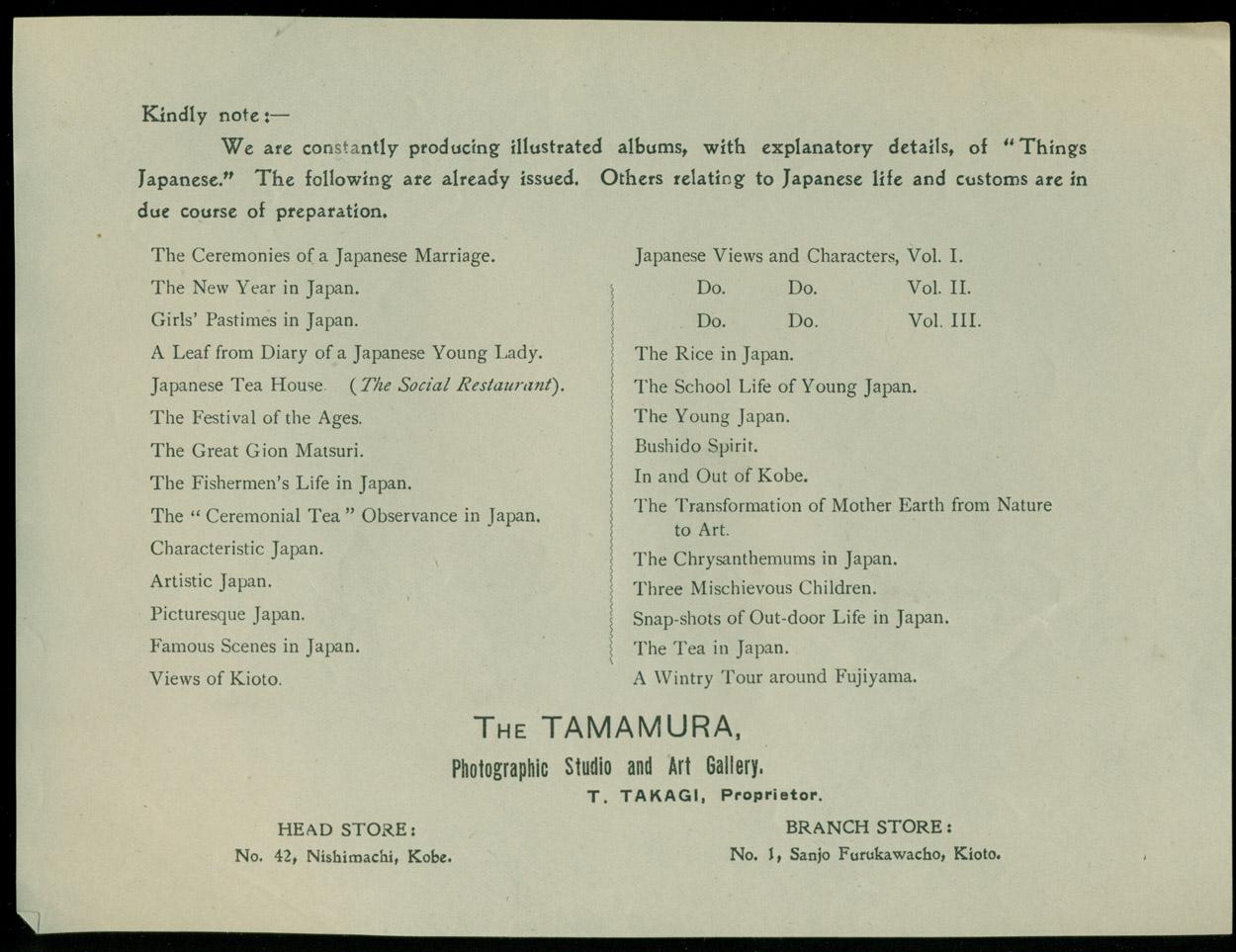
- 1907, February, The School Life of Young Japan, "Tamamura the Photographer, Kobe." The colophon states a printing date of Meiji 40 (1907), February, oblong 8vo (7 x 10 in - 18 x 25.4 cm), English language, hand colored title page, introductions (first part and second part), 20 hand colored collotype plates with captions, tissue guards, hard boards covered with blue silk type fabric, spine covered in same fabric, unpaginated. The actual images are approximately 4 x 6 in (10.5 x 15 cm). Pictorial depiction of various school scenes. The first part (12 plates) depicts scenes in school and to and from school. The second part (8 plates) has plates relating to school sports.. While there is no mention of Takagi in the colophon, the book is sometimes found accompanied by a slip advertisement of other books by Takagi. To see that advertisement, click here. A second edition of this book was published by Takagi in 1916 (see bellow). For more information on this first edition, click here.
- c1912, Snap-Shots of Out-Door Life in Japan, Kobe, ca Taisho 1 (1912), 1st edition, oblong 8vo (7 x 10 1/4 in - 18 x 26 cm), English language, black and white title page, 24 hand colored collotype plates with captions, tissue guards, hard boards covered with decorated silk type fabric, unpaginated. The actual images are approximately 4 x 6 in (10.5 x 15 cm). Various outdoor activity scenes. Information on the 2nd edition (Takagi) is below.
- Many early editions of the books listed under T. Takagi, below, probably contain the Tamamaura, (Kobe or Yokohama) imprint in editions published prior to mid-1906. Likewise, it is likely that later editions of the Tamamura books noted above bear the T. Takagi imprint. It is also possible that both regular and deluxe type editions were produced of some of the titles shown on this web page. The primary distinction would probably be in the covers with the contents being uniform.
-
Silver Print Photographs. Tamamura (and probably Takagi under the Tamamura name) marketed/distributed hand tinted silver print photographs from the Kobe location. These photographs measure 12.3 x 30 cm. The back of these photographs carry adverting for the Kobe operation. On occasion, these photographs are found with the original mailing envelope with a Tamamura, Kobe, return address.
Takagi, T. (Teijiro) (Kobe, ca 1905, Successor to Tamamura the Photographer, Kobe)
- c1905, 3 different, small studio photographs mounted on cards, Tamamura, T. Takagi Proprietor, No. 16, Sannomiya-cho, Kobe, Japan. For more information these studio photographs, click here.
~~ Available - Studio Photographs, K. Tamamura, T. Takagi Proprietor - Purchase Here ~~
- c1905, 3 different, small studio photographs mounted on cards, S. Ichida, Kobe, Japan. For more information these studio photographs, click here. Listed here because they came with similar T. Takagi photographs, above.
~~ Available - Studio Photographs, K. Tamamura, T. Takagi Proprietor - Purchase Here ~~
- 1905, The Ceremonies of A Japanese Marriage, Kobe, T. Takagi, Meiji 38 (1905), with 7 editions published between 1905 - 1920, oblong 8vo (7 x 10 1/4 in - 18 x 26 cm), English language, hand colored title page, introduction, 20 hand colored collotype plates with captions, no tissue guards, hard boards covered with silk type fabric, unpaginated. The actual images are approximately 4 x 6 in (10.5 x 15 cm). Pictorial presentation of several aspects of a Japanese marriage. Spans the sequence of events which include the male meeting with a "match-maker," the actual marriage ceremony (a series of several pictures) and the gifts. Printings 1-7 spanned the period from 1905-1920. The first four editions carried the Tamamura or the Tamamura/Takagi imprint. From the 5th edition on, the books carried the Takagi imprint only. For more information on the 5th edition (1916) of this book, click here.
~~ Available - 7th (1920) Edition - Very Good - Purchase Here ~~
~~ Available - 7th (1920) Edition - Good - Purchase Here ~~
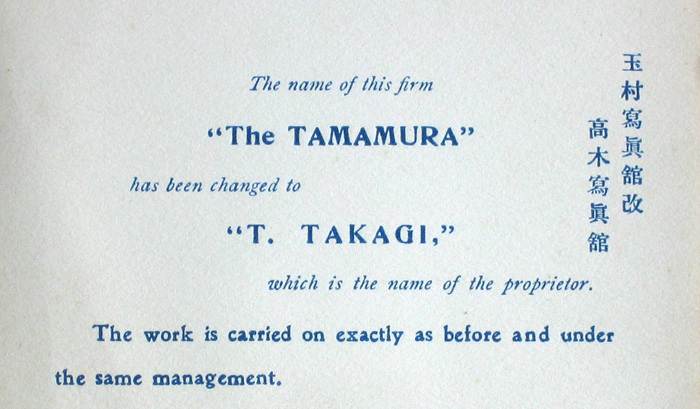
- 1906, The Festival of the Ages, "Tamamura the Photographer Kobe." The colophon states a printing date of Meiji 39 (1906), February. I have not examined a copy of this book but believe it contains 20 plates. A set of magic lantern slides by Takagi with the same title included 20 slides with images of the festival and a final slide (21st) with a young girl bowing and the caption "Good Night! The Best Slides Maker, T. Takagi." The book has been reported with an ink handstamp on the colophon reading "T. Takagi." Further, the book has been reported with a loose business size card reading:
The name of this firm
"The TAMAMURA"
has been changed to
"T. TAKAGI"
which is the name of the proprietor.
The work is carried on exactly as before and under
the same management.
To see this card, click here.
Since the next book published (Meiji 40 - 1907) carried a mention of Takagi actually printed in the colophon, it appears that T. Takagi took possession of the Tamamura stock at some point in early to mid 1906. To see the front cover of this book, click here.
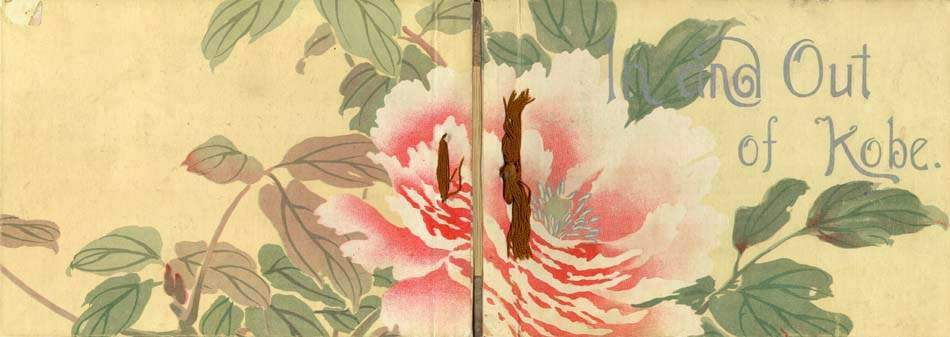
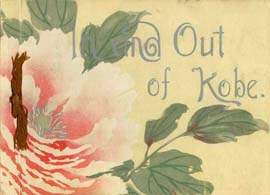
- 1907, In and Out of Kobe, Kobe, "Tamamura the Photographer, T. Takagi Proprietor," Meiji 40 (1907) - first edition and Meiji 42 (1909) - second edition, oblong 8vo (6 1/2 x 9 in - 16.2 x 23 cm), English language, no title page, 20 hand colored collotype plates with captions, decorated silk (1st ed) over cardboard or paper (2nd ed) over cardboard , single string tie, unpaginated. The actual images are approximately 4 x 6 in (10.5 x 15 cm). A pictorial tour of important points in and around Kobe. The colophons establish the first edition was published in Meiji 40 (1907) and the second edition in Meiji 42 (1902). For more information on this book, click here.
- 1907, The Transformation of Mother Earth from Nature to Art, Kobe, "Tamamura the Photographer, T. Takagi Proprietor," Meiji 40 (1907), oblong 8vo (7 1/4 x 10 in - 18.2 x 25.5 cm), cloth over cardboard, two string ties, English language, color lithograph inside cover, no title page, introduction, 16 hand colored collotype plates with captions, no tissue guards, unpaginated. The actual images are approximately 4 x 6 in (10.5 x 15 cm). A pictorial account of the production of pottery from digging the clay to marketing in a factory shop. For more information on this book, click here.
- 1907, The Chrysanthemums in Japan, Kobe, "Tamamura the Photographer, Kobe and T. Takagi," Meiji 40 (1907), 1st edition, oblong 8vo (7 x 10 1/4 in - 18 x 26 cm), English language, hand colored title page, introduction, 10 hand colored collotype plates with captions, no tissue guards, hard boards covered with silk type fabric, unpaginated. The actual images are approximately 4 x 6 in (10.5 x 15 cm). For more information on this book, click here.
- 1907, The Rice in Japan, Kobe, "Tamamura the Photographer, T. Takagi Proprietor," Meiji 40 (1907), 1st edition, oblong 8vo, 20 hand colored collotype plates. A second edition was published in 1913 (Taisho 2). For more information on the 1st edition, click here.
~~ Available - Very Good+ - Purchase Here ~~
~~ Available - Good+ - Purchase Here ~~
- 1907 & 1908, The "Ceremonial Tea" Observance in Japan, Kobe, "Published by Tamamura, Photographer, Kobe, Japan, T. Takagi, Proprietor," Meiji 40 (1907) or Meiji 41 (1908), oblong 8vo (7 x 10 in - 18 x 25.5 cm), English language, hand colored front cover/title page, one page "Introduction," one page "Explanation" of the significance of the tea ceremony by H. Spencer, 15 hand colored collotype plates with descriptive text below each image, plates protected by tissue guards, silk type cloth over cardboard with handcolored illustration recessed in the front board, double string ties, unpaginated. For more information on this book, click here.. These books with "Tamamura" in the colophon have a printing date of Meiji 40 (1907) or Meiji 41 (1908) The 1907 book has been documented with a "T. Takagi" handstamp in English and Japanese on that colophon. I presume that book was issued ca 1907. For a 1917 edition of this book see below. The 1917 edition of this book deletes all references to Tamamura.
~~ Available - 1907 Edition - Purchase Here ~~
~~ Available - 1908 Edition - Purchase Here ~~
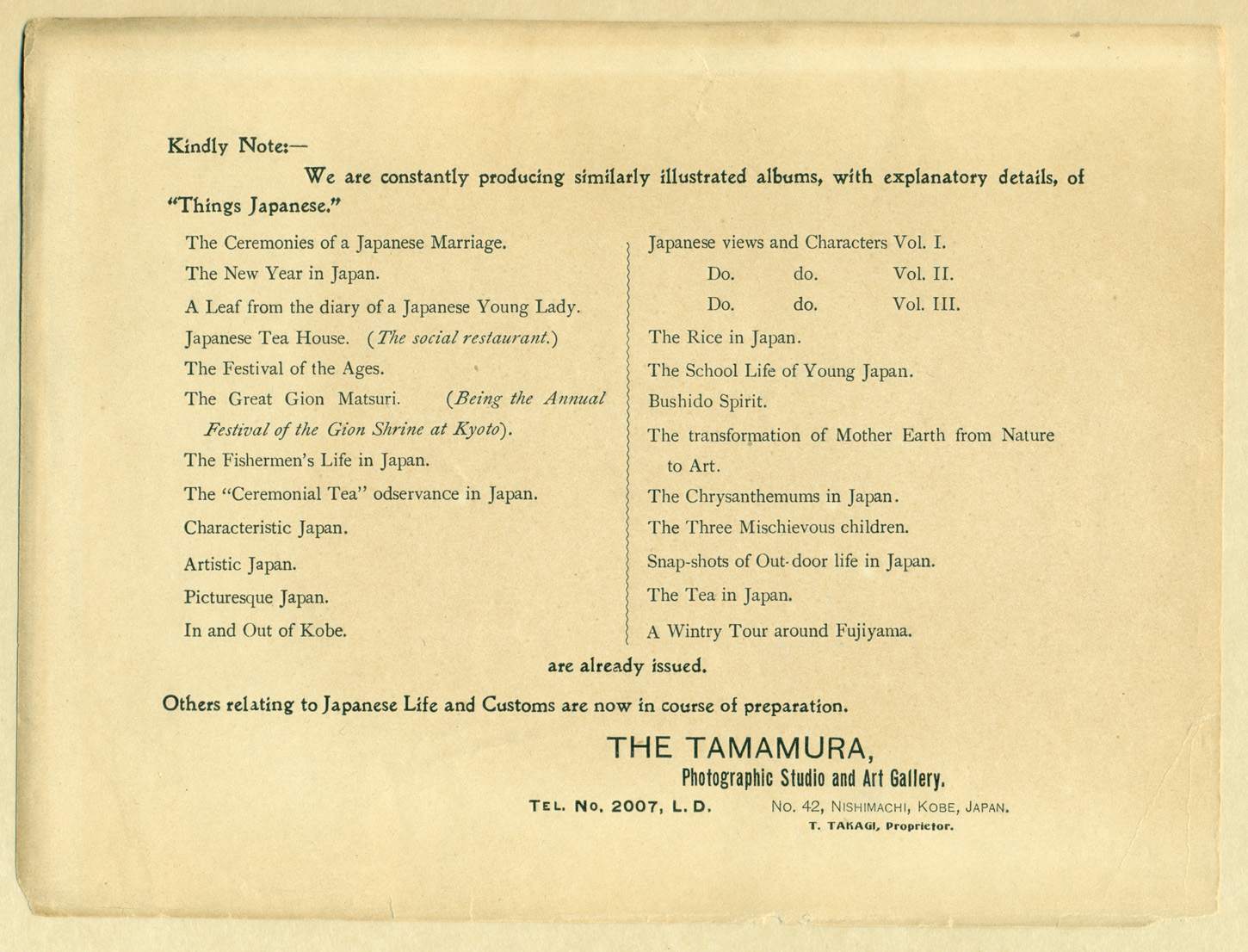
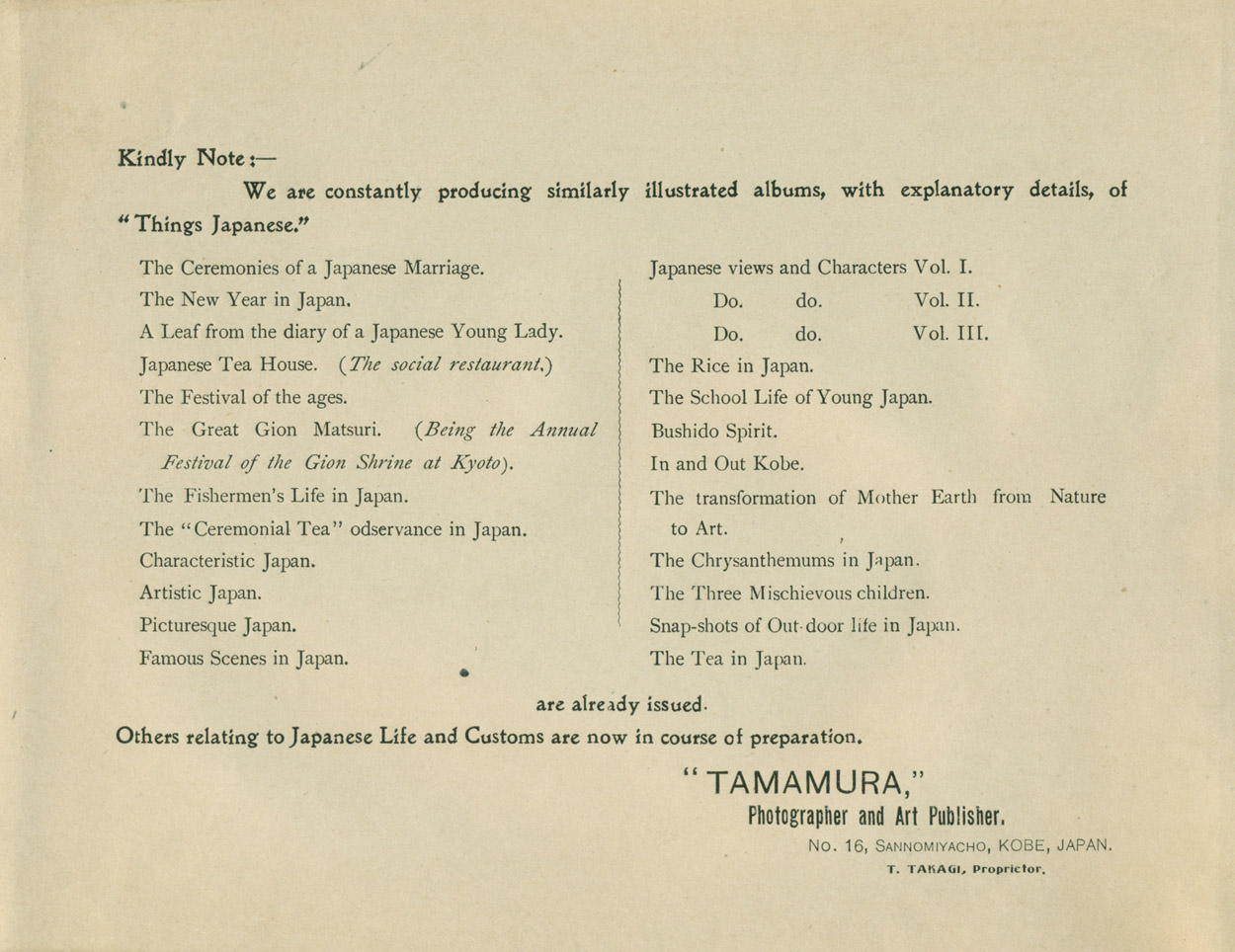
- c1907, booklist, single sheet insert found in 1907 edition of The "Ceremonial Tea" Observance in Japan (above), click here.
- 1908, The Tea in Japan, Kobe, "Tamamura, Kobe, Japan, Photographer and Art Publisher, T. Takagi, Proprietor," Meiji 41 (1908), oblong 8vo (7 x 10 1/4 in - 18 x 26 cm), English language, hand colored title page, one page introduction, 15 hand colored collotype plates with captions, no tissue guards, hard boards covered with silk type fabric, unpaginated. The actual images are approximately 4 x 6 in (10.5 x 15 cm). Pictorial depiction of cultivation, harvesting, manufacture and ceremonial activities associated with tea in Japan. T. Takagi began publishing this book under his name in Taisho 4 (1915). I have recorded three editions under the Takagi name, 1st - Taisho 4 (1915), 2nd - Taisho 9 (1920) & 3rd - Taisho 16 (1927). The Taisho Emperor died December 25, 1926. The T. Takagi 3rd edition published in 1927 appears to be one of the last books the firm published. For more information on this book, click here.
~~ Available - 1927 T. Takagi 3rd Edition - Purchase Here ~~
- 1909, A Wintry Tour Around Fujiyama (24 plates), Kobe, "Tamamura the Photographer, T. Takagi Proprietor," additional ink handstamp of "T. Takagi" in colophon, Meiji 42 (1909), oblong 8vo (7 1/4 x 10 in - 18 x 25.5 cm), English language, lithographed color title page, introduction, 24 hand colored collotype plates with captions and protected by tissue guards, decorated silk boards, double string tie, unpaginated. The actual images are approximately 4 x 6 in (10.5 x 15 cm). An account of two "young farmers" returning home to Gotemba (near Mt Fuji) after a New Year trip. A 19 plate version of this book was also published. For more information on this 24 plate version of the book, click here.
- 1909, A Wintry Tour Around Fujiyama (19 plates), Kobe, "Tamamura Photographic Studio and Art Gallery, Takagi Proprietor," Meiji 42 (1909), oblong 8vo (7 x 10 1/4 in - 18 x 26 cm), English language, lithographed color title page, 19 hand colored collotype plates with captions, no tissue guards, hard boards covered with silk type fabric, unpaginated. The actual images are approximately 4 x 6 in (10.5 x 15 cm). Mount Fuji in the winter. For more information on this 19 plate version of the book, click here.
- 1910, Girls' Pastimes in Japan, Kobe, "The Tamamura, Photographic Studio & Art Gallery, T. Takagi Proprietor." No. 42 Nishimachi, Meiji 43 (1910), 1st printing, oblong 8vo (7 x 9 3/4 in), English language, hand colored title page, introduction, 24 hand colored collotype plates with captions, tissue guards, hard boards covered with silk type fabric, unpaginated. The actual images are approximately 4 x 6 in (10.5 x 15 cm).
- c1912, Three Mischievous Children, Kobe, Tamamura/Takagi. This book is noted in a catalogue published th Tamamura/Takagi ca 1912 (see below).
- c1912, "Art for Arts Sake" - Tamamura's Productions in Esthetic Art, "The Tamamura Photographic Studio and Art Gallery, T. Takagi Proprietory," No. 42 Nishi Machi, Kobe, Japan," undated but ca 1912, sales catalogue/pamphlet, illustrated stiff wraps, 4 x 7 1/8 in (10.4 x 18 cm), English language, 14 pages (including covers). For more information on this catalogue, click here.
- 1913, Snap-Shots of Out-Door Life in Japan, Kobe, "Takagi Photographic Studio and Art Gallery," Taisho 2 (1913), 2nd edition, oblong 8vo (7 x 10 1/4 in - 18 x 26 cm), English language, black and white title page, 24 hand colored collotype plates with captions, no tissue guards, hard boards covered with silk type fabric, unpaginated. The actual images are approximately 4 x 6 in (10.5 x 15 cm). Various outdoor activity scenes. For more information on this book, click here.
~~ Available - 2nd (1913) Edition - Purchase Here ~~
- 1913, The Building in Japan, Kobe, "Takagi Photographic Studio and Art Gallery," Taisho 2 (1913), oblong 8vo (7 x 10 1/4 in - 18 x 26 cm), English language, black and white title page, 20 hand colored collotype plates with captions, no tissue guards, hard boards covered with silk type fabric, unpaginated. The actual images are approximately 4 x 6 in (10.5 x 15 cm). Pictorial representation of various aspects of constructing a house in Japan. Starts with the carpenter determining the lumber required for a house and follows the construction of the house through the final finished state with landscaping (Japanese garden). For more information on this book, click here.
- 1915, The Silk in Japan, Kobe, "Takagi Photographic Studio and Art Gallery," Taisho 4 (1915), oblong 8vo (7 x 10 1/4 in - 18 x 26 cm), English language, black and white title page, 17 hand colored collotype plates with captions, no tissue guards, hard boards covered with silk type fabric, spine covered, unpaginated. The actual images are approximately 4 x 6 in (10.5 x 15 cm). Pictorial representation of various aspects of the Japanese silk industry. A second edition was published in Taisho 9 (1920). For more information on this book, click here.
- 1916, The School Life of Young Japan, Kobe, "Takagi Photographic Studio and Art Gallery," Taisho 5 (1916), 2nd printing, oblong 8vo (7 x 10 1/4 in - 18 x 26 cm), English language, hand colored title page, introduction,(first part), text page introducing second part, 20 hand colored collotype plates with captions, no tissue guards, hard boards covered with silk type fabric, unpaginated. The actual images are approximately 4 x 6 in (10.5 x 15 cm). Pictorial depiction of various school scenes. The first part (12 plates) depicts scenes in school and to and from school. The second part (8 plates) has plates relating to school sports. For more information on this book, click here.
- 1917, The "Ceremonial Tea" Observance in Japan, Kobe, "T. Takagi Photographic Studio and Art Gallery," Taisho 6 (1917), 2nd edition, oblong 8vo (7 x 10 in - 18 x 25.5 cm), English language, hand colored title page, one page "Explanation" of the significance of the tea ceremony by H. Spencer, 15 hand colored collotype plates with captions, plates protected by tissue guards, silk type cloth over cardboard with handcolored illustration recessed in the front board, double string ties, unpaginated. The actual images are approximately 4 x 6 in (10.5 x 15 cm). A pictorial essay on the tea ceremony in Japan at the turn of the 20th century. The colophon indicates the first edition was published in Meiji 41 (1908). An edition of this book with "Tamamura" on the colophon carries a colophon with the date o Meiji 40 (1907). For more information on the 2nd edition (1917) of this book, click here. See 1907, above, for an earlier edition of this book.
- 1917, Girls' Pastimes in Japan, Kobe, "Takagi Photographic Studio and Art Gallery," Taisho 6 (1917), 2nd printing, oblong 8vo (7 x 10 1/4 in - 18 x 26 cm), English language, hand colored title page, introduction, 23 hand colored collotype plates with captions, no tissue guards, hard boards covered with silk type fabric, unpaginated. The actual images are approximately 4 x 6 in (10.5 x 15 cm). Pictorial presentation of various activities of girls and young ladies in Japan. For more information on this book, click here.
~~ Available - 2nd (1917) Edition - Purchase Here ~~
- 1917, The Fujiyama, Kobe, "Takagi Photographic Studio and Art Gallery," Taisho 6 (1917), large oblong 8vo (9 5/8 x 12 1/2 in - 25 x 33 cm), 20 hand colored collotype plates with captions. The actual images are approximately 14.5 x 23 cm.
- 1918, Military Accomplishments of Japan, Kobe, "Takagi Photographic Studio and Art Gallery," Taisho 7 (1918), oblong 8vo (7 x 10 1/4 in - 18 x 26 cm), English language, hand colored title page, introduction, 20 hand colored collotype plates with captions, no tissue guards, hard boards covered with silk type fabric, unpaginated. The actual images are approximately 4 x 6 in (10.5 x 15 cm). Pictorial presentation of various military arts which include Fencing, Archery, the Halberd, Judo and Warriors of Old (samurai, soldiers in armor etc). For more information on this book, click here.
- ca 1918, Views of Kioto, Kobe & Kioto, "T. Takagi Photographic Studio and Art Gallery, Kobe & Kioto," not dated, ca 1918, oblong 8vo (7 x 9 3/4 in - 18 x 25 cm), English language, title page, 20 hand colored collotype plates with captions, no tissue guards, cloth over cardboard, two string ties, unpaginated. The actual images are approximately 4 x 6 in (10.5 x 15 cm). A pictorial tour of important points in and around Kioto. The book has no colophon so the date is approximate and estimated based upon the T. Takagi designation given on the title page. For more information on this book, click here.
- c1918, Hills in Kobe, Kobe, "T. Takagi Photographic Studio and Art Gallery, Kobe," ca 1918, oblong 8vo (6 1/4 x 9 in - 16 x 22.8 cm), English & Japanese language, title page with red lettering, 20 hand colored collotype plates with captions, linen type cloth over cardboard with handcolored illustrations, single string ties, no tissue guards, no colophon, unpaginated. The actual images are approximately 4 x 6 in (10.5 x 15 cm). A pictorial essay on the hills around Kobe. For more information on this book, click here.
- ca 1919 Japanese Views and Characters, Kobe, "By T. Takagi, Kobe, Japan," no colophon - not dated but ca 1919, oblong 8vo (6 1/4 x 9 in - 15.6 x 22.5 cm), English language, illustrated hand colored title page, 50 hand colored collotype plates with captions, tissue guards between places, illustrated cloth over cardboard, single string tie, unpaginated. The actual images are approximately 4 x 6 in (10.5 x 15 cm). For more information on this book, click here. This book is similar to the book below but it does have a significant number of different plates.
- ca 1919 Japanese Views and Characters, Kobe, "Takagi Photo Co., Kobe, Japan," and "By T. Takagi, Kobe, Japan," no colophon - not dated but ca 1919, oblong 8vo (7 x 10 in - 18 x 25.2 cm), English descriptive captions, 50 hand colored collotype plates with captions, no tissue guards, hard boards covered with silk type fabric, tied with one or two string ties, unpaginated. These books have some different views from the books above and below. For more information on these books, click here.
~~ Available - Japanese Views & Characters, 50 Plates - Purchase Here ~~
- ca 1919 Japanese Views and Characters, Kobe, "Takagi Photo Co., Kobe, Japan," deluxe edition, no colophon - not dated but ca 1919, oblong 8vo (7 x 10 in - 18 x 25.2 cm), English descriptive captions, 50 hand colored collotype plates with captions, no tissue guards,boards in silk (padded), all edges gilt, folding case, two string ties, unpaginated. This book has the same images as the book above. For more information on this book, click here.
~~ Available - Japanese Views & Characters, 50 Plates, Extra Deluxe Edition - Purchase Here ~~
~~ Available - Japanese Views & Characters, 50 Plates, Deluxe Edition - Purchase Here ~~
- c1919, Famous Scenes in Japan, Kobe, "Takagi Photo Co., Kobe, Japan," no colophon, not dated but ca 1919, oblong 4to (13 3/4 x 10 in - 35 x 26 cm), English descriptive captions, 50 plates with hand colored collotype prints tipped to plate, no tissue guards, boards in silk (padded), spine covered, two decorative cord ties, all edges gilt, unpaginated. The collotype images are approximately 9 x 6 in (22.8 x 15.1 cm). The actual plates are a pliable textured card stock. It appears that the textured paper is laid down on thin card stock. Views of scenic spots throughout Japan. This book is listed in a Tamamura/Takagi catalogue published ca 1912. I am confident that there were earlier editions of this book. In the ca 1912 catalogue this was the most expensive book and it was priced at 15 yen while other books were generally in the 2 yen to 5 yen price range. For more information on this book, click here.
- 1920 Characteristic Gardens in Japan, Kobe, "Takagi Photo Co., T. Takagi Proprietor," Taisho 9 (1920), oblong 8vo (7 1/8 x 10 in - 18 x 25 cm), undecorated silk over cardboard, single string tie, English language, color lithograph inside cover, no title page, no introduction, 20 hand colored collotype plates with captions, no tissue guards, unpaginated. The actual images are approximately 4 x 6 in (10.5 x 15 cm). A pictorial record of important gardens. The gardens are primarily, but not exclusively, in the Kyoto area. For more information on this book, click here.
~~ Available - Characteristic Gardens in Japan - Purchase Here ~~
- Glass (Magic Lantern) Slides. T. Takagi also produced and marketed hand colored glass (magic lantern) slides. The George Eastman House, Still Photograph Archive, has an on-line gallery of 26 selected images from these slides. To see those images, click here. They describe these slides as "transparency, gelatin on glass with applied color." My price list for Tamamura/Takagi Magic Lantern slides is here.
Unconfirmed (Not Personally Verified) T. Takagi Books.
- 1920, The Silk in Japan, Kobe, Takagi, 25 x 18 cm, 19 black and white collotypes, confirmed with 17 hand colored collotype plates however.
Unconfirmed (Not Personally Verified) Tamamura the Photographer.
- 1906 (Meiji 39), The Japanese Tea-House (The Social Restaurant), Kobe, Tamamura Photographic Studio. . Also reported as 1907 with 12 handcolored collotype plates and part of the "Things Japanese" series by Tamamura.
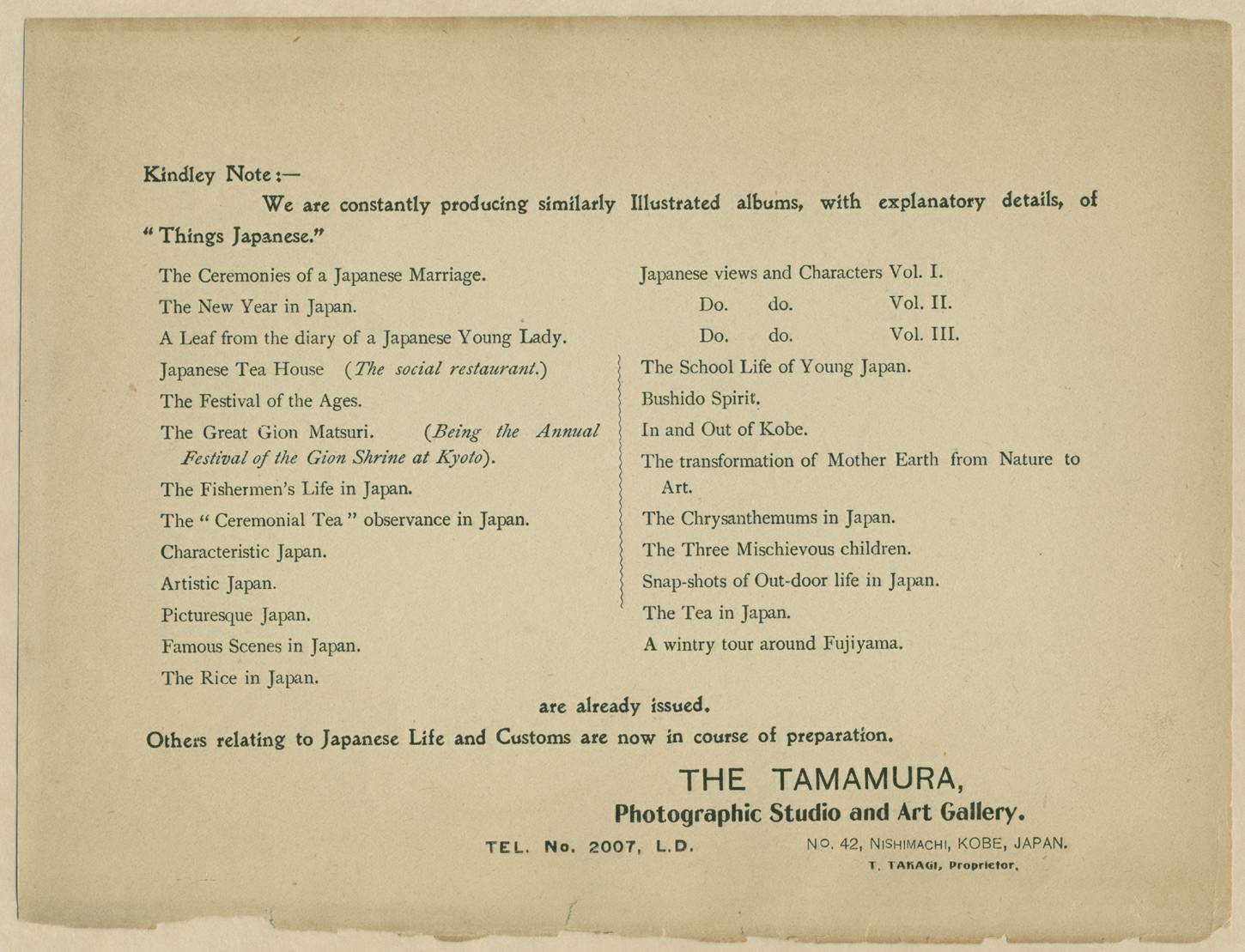
- c1909, Artistic Japan, The Tamamura Photographic Studio, Kobe (See advertisement/list here).
- c1909 Views of Kioto, Tamamura Photographic Studio, 24 handcolored collotype plates and a part of the "Things Japanese" series by Tamamura.
- c1909, Picturesque Japan, The Tamamura Photographic Studio, Kobe (See advertisement/list here).
- c1912, The Three Mischievous Children, The Tamamura Photographic Studio, Kobe (See advertisement/list here).
Some books with the Tamamura Photographic Studio imprint are reported with the designation "Things Japanese."
Books similar to the Tamamura and Takagi books.
- c1910, With Compliments of Geo. H. Macy & Co., oblong 8vo (10 x 7 in), decorated silk covered boards with hand tinted albumen photograph recessed into the front board, single silk tie, head and foot of spine covered, 40 or 42 pages of hand colored collotype plates reproducing photographs, no tissue guards, 40 or 42 pp. The image areas vary but measure 4 3/4 x 5 inches and larger. Below each image is a brief descriptive caption. There are no text pages, title page or colophon and the publisher or printer is not stated. This book is a pictorial review of the various tea production activities of the George H. Macy Company in Japan, China and India. It covers that company's operations in Japan (Kobe & Yokohama) and China (Shanghai, Hankow, Amoy & Taiphei Formosa), Sri Lanka/Ceylon (Columbo) and India (Calcutta). It also includes general interest, not tea related, views of Japan. For more information on this book, click here.
- c1910, With Compliments of Geo. H. Macy & Co., Japan and China, oblong 8vo (8 1/2 x 6 in), straw covered boards with hand painted illustrations on front board, single silk tie, spine covered, 30 pages of black and white collotype plates reproducing photographs, no tissue guards, 30 pp. The image areas vary but measure 4 1/2 x 3 1/2 inches and larger. Below each image is a brief descriptive caption. There are no text pages, title page or colophon and the publisher or printer is not stated. This book is a pictorial review of the various tea production act ivies of the George H. Macy Company in Japan and China. It covers that company's operations in Japan (Kobe & Yokohama) and China (Shanghai, Taiphei Formosa, Hankow & Amoy). It also includes general interest, not tea related, views of Japan. While the book is undated, I believe that it dates from the early 1900s based upon the images. Some images appear to be from the late 1890s. No publisher is stated. However, this book is very similar in nature to the same types of collotype books produced by T. Tamamura of Yokohama and his successor T. Takagai of Kobe. Three images in this book are found in similar T. Tamamura books. For more information on this book, click here.
~~ Available - With Complements of Geo H. Macy, 30 plates - Purchase Here ~~
- c1925, The Silk Industry of Japan, Showing the Various Stages of Silk Production from the Worm to the Finished Article, Tokyo, printed by Uyeda, oblong small 8vo (6 3/4 x 8 3/8 in - 14.5 x 21.2 cm), not dated but ca 1925, Japanese and English descriptive text, no title page or colophon, 20 hand colored collotype plates, each plate is preceded by a page with descriptive text (Japanese and English), stiff wraps with illustrated front cover, staple bound with string tie, spine covered, unpaginated. The actual collotype printed images are approximately 4+ x 6 in (10.5 x 15 cm). Pictorial representation of various aspects of the Japanese silk industry. For more information on this book, click here.
General Comments Regarding Tamamura/Takagi Photographic Studio and Color Collotype Books.
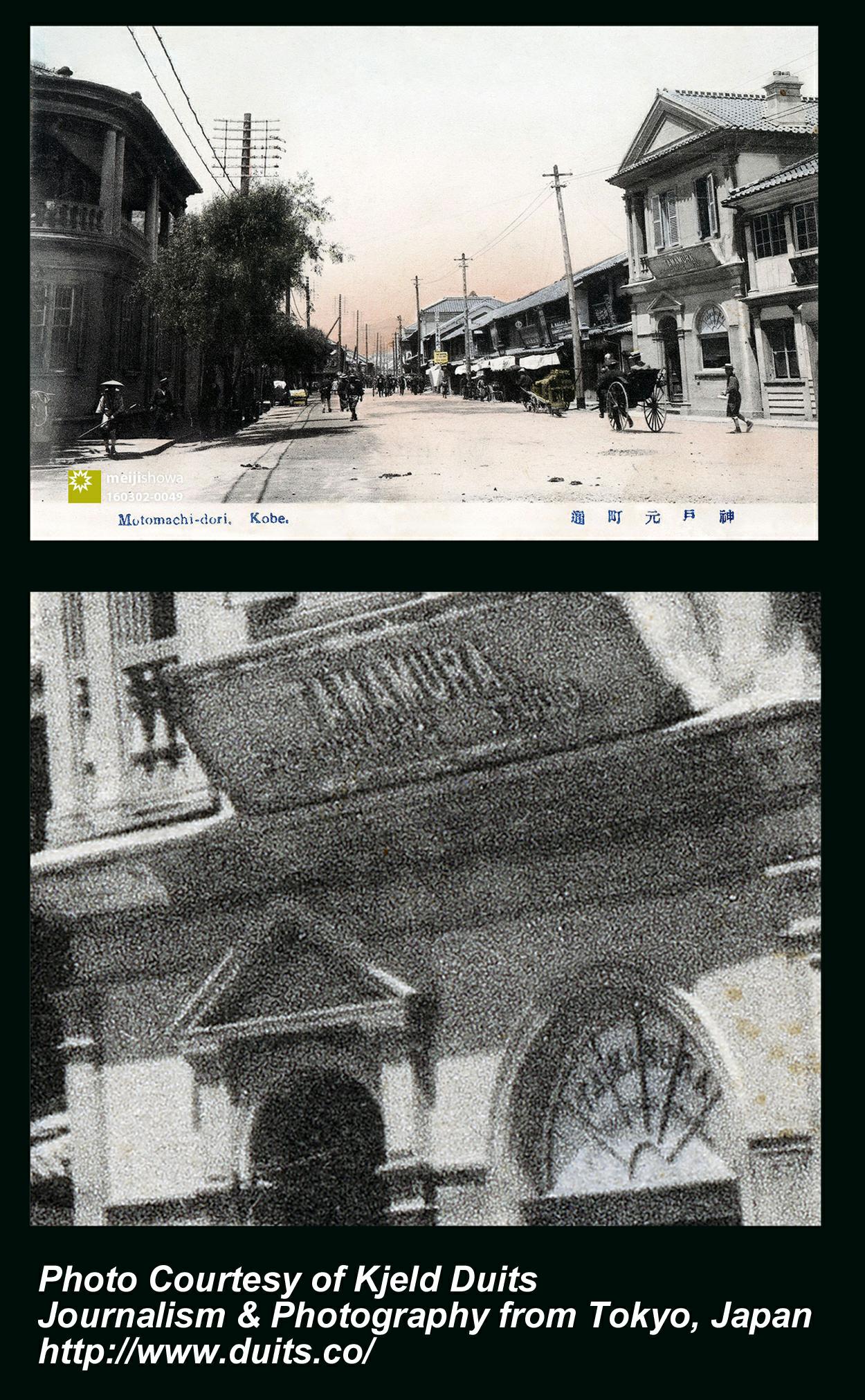
- Tamamura Photography Studio in Kobe ca 1907.
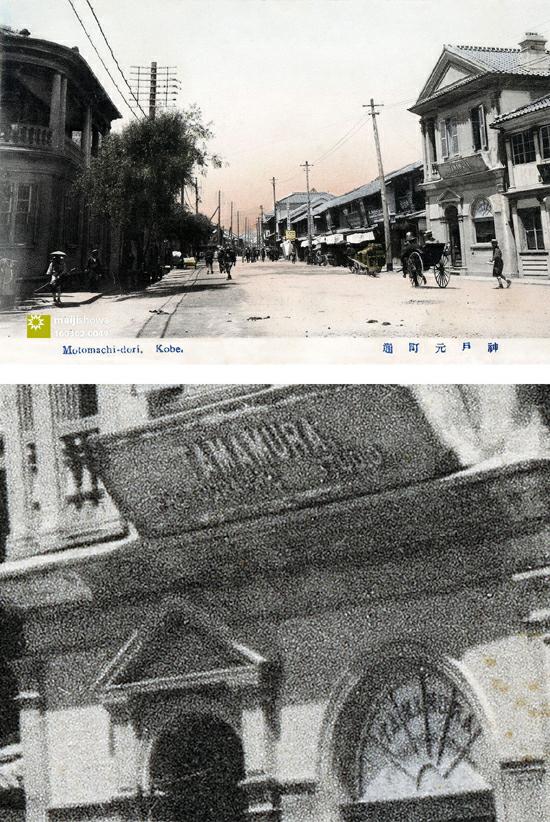
Photo Courtesy of Kjeld Duits
Journalism & Photography from Tokyo, Japan
http://www.duits.co/
- English language attribution statements found in colophons.
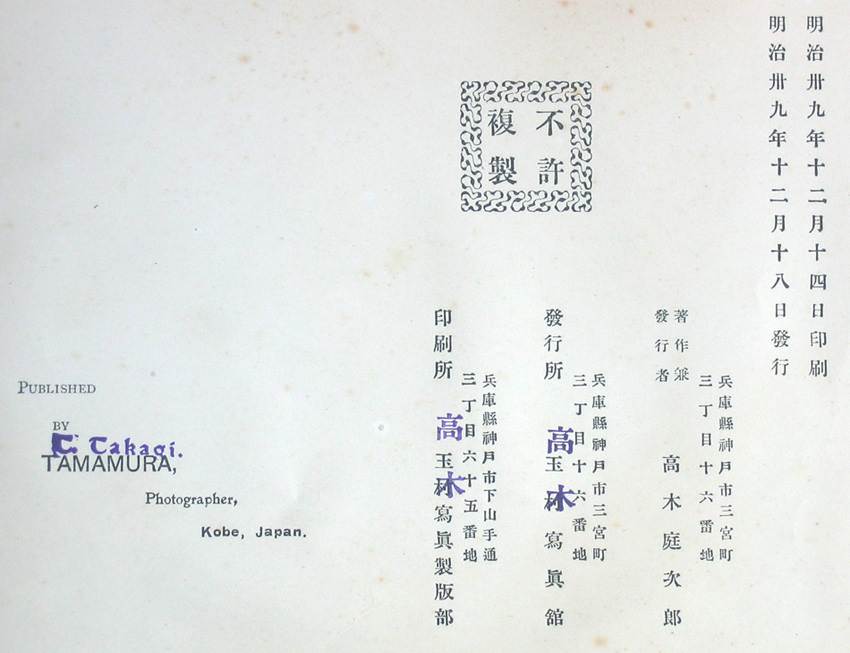
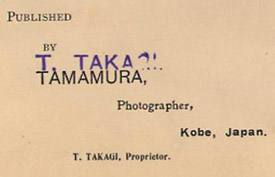
- "Published by Tamamura, Photographer, Kobe, Japan" (first/last confirmed use - 1898/1907 (Meiji 40)).
No. 16. Sannomiya, Kobe, Japan
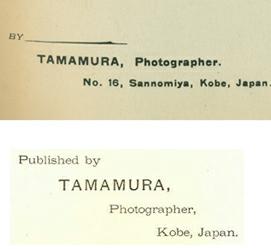
- Tamamura colophon with an ink handstamps reading "T. Takagi." (only confirmed use - 1906 (Meiji 39), February. See: 1906, The Festival of the Ages, above.
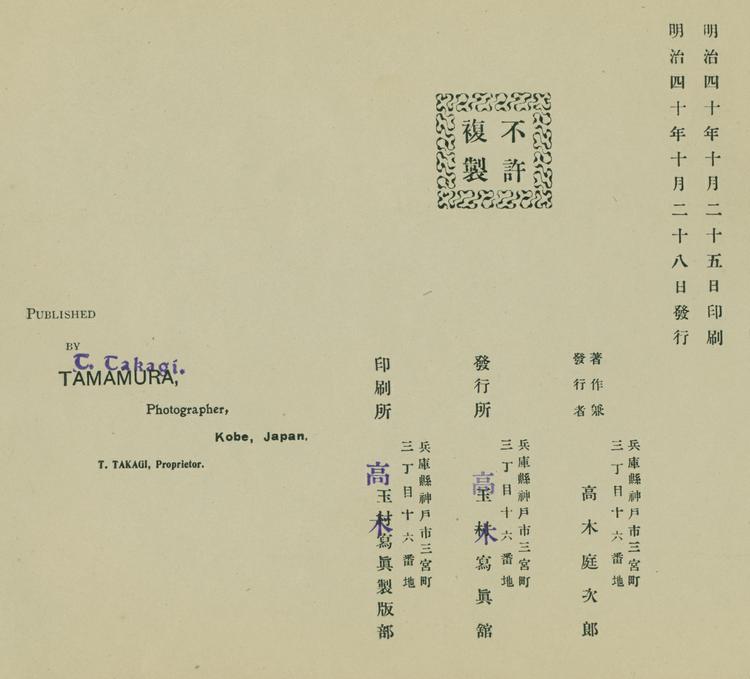
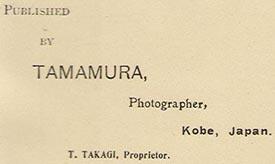
- "Published by Tamamura, Photographer, Kobe, Japan, T. Takagi, Proprietor" (first/last confirmed use - 1907 (Meiji 40)/1909 (Meiji 42)). Colophon sometimes states "(Collotyped and hand colored.)"
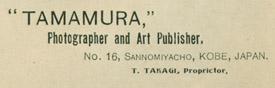
- "'Tamamura,' Photographer and Art Publisher, No. 16, Sannomiyacho, Kobe, Japan, T. Takagi, Proprietor" (first/last confirmed use - c1907 (Meiji 40)). This destignation is also found on booklist slip inserted loose in The Rice in Japan published in 1907.
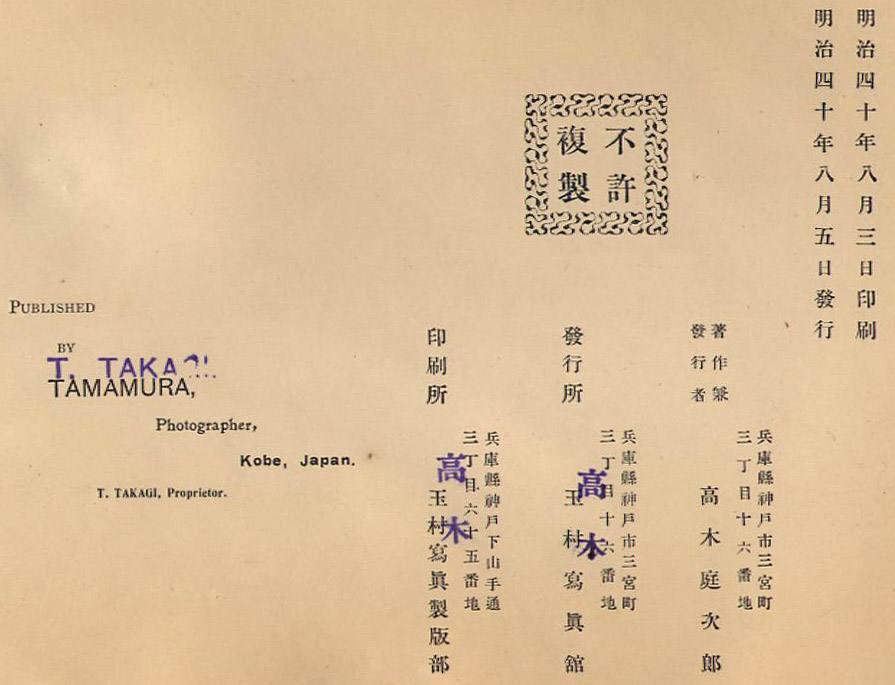
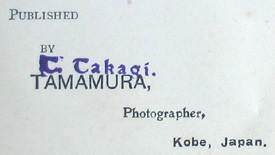
- "Published by Tamamura, Photographer, Kobe, Japan, T. Takagi, Proprietor" with an ink handstamp reading "T. Takagi" (in script letters) (only confirmed use - 1907 (Meiji 40). See: 1907, "The Transformation of Mother Earth from Nature to Art, above.
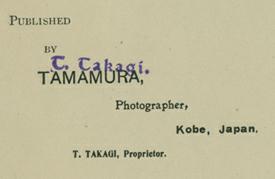
- "Published by Tamamura, Photographer, Kobe, Japan, T. Takagi, Proprietor" with an ink handstamp reading "T. Takagi." (in block letters) (only confirmed use - c1907 (Meiji 40). See: 1907, The "Ceremonial Tea" Observance in Japan, above.
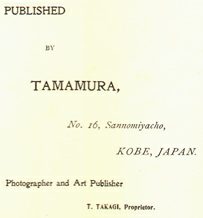
- "Published by Tamamura, No 16, Sannomiyacho, Kobe, Japan, Photographer and Art Publisher, T. Takagi, Proprietor" (first/last confirmed use - 1908 (Meiji 41)/1908 (Meiji 41)).
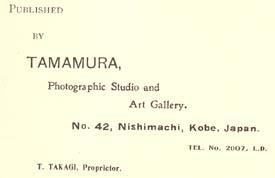
- "Published by Tamamura, Photographic Studio and Art Gallery, No 42, Nishimachi, Kobe, Japan, T. Takagi, Proprietor" (first/last confirmed use - 1909 (Meiji 42)/1909 (Meiji 42)).
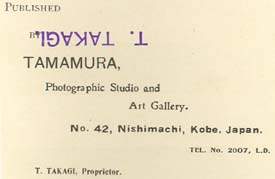
- "Published by Tamamura, Photographic Studio and Art Gallery, No 42, Nishimachi, Kobe, Japan, T. Takagi, Proprietor" with "T. Takagi" ink handstamp in English and Japanese (first/last confirmed use - 1909 (Meiji 42, July)/1909 (Meiji 42, July), A Wintry Tour Around Fujiyama).
- "Published by Tamamura, Photographic Studio and Art Gallery, No 42, Nishimachi, Kobe (Head Store) and No. 1 Sanjo, Furukawacho, Kioto (Branch Store), T. Takagi, Proprietor" (first/last confirmed use - 1912 (Meiji 45, April)/1912 (Meiji 45, April), Ceremonies of a Japanese Wedding, 4th Edition).
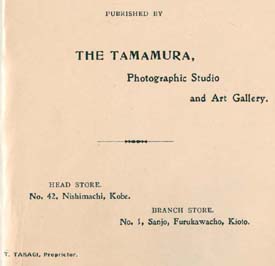
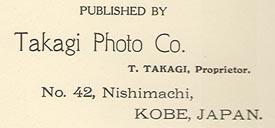
- "Published by Takagi Photo Co., T. Takagi Proprietor, No. 42, Nishimachi, Kobe, Japan" (first/last confirmed use - 1912 (Meiji 45, April)/1912 (Meiji 45, April), Ceremonies of a Japanese Wedding, 4th Edition).
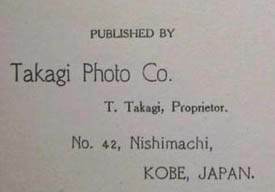
- "Published by Takagi Photographic Studio & Art Gallery, No. 42, Nishimachi, Kobe, Japan" designation with no reference to Tamamura. (first/last confirmed use - 1913 (Taisho 2)/1927 (Taisho 16))
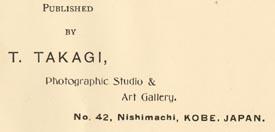
- "By T. Takagi Photographic Studio & Art Gallery" no address (first/last confirmed use - ca 1918). This designation is found on the title page of Hills of Kobe which contains no colophon.

- "By T. Takagi Photographic Studio & Art Gallery, Kobe & Kioto, Japan" contains Kioto as well as Kobe (first/last confirmed use - ca 1918). This designation is found on the title page of Views of Kioto which contains no colophon. It has the only reference to a Takagi operation in Kyoto that I have seen.
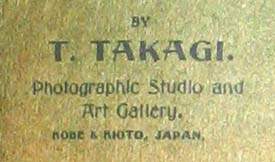
- "Published by Takagi Photo Co., T. Takagi, Proprietor, No. 42, Nishimachi, Kobe, Japan" (first/last confirmed use - 1919 (Taisho 8)/1920 (Taisho 9))
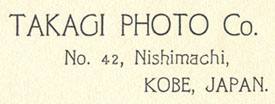
- "Takagi Photo Co., No. 42, Nishimachi, Kobe, Japan" (first/last confirmed use - 1927 (Taisho 16 /Showa 2))
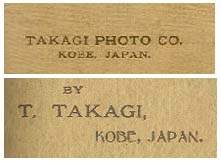
- "Takagi Photo Co., Kobe, Japan" or "By T. Takagi, Kobe, Japan" designation with no address(first/last confirmed use - ca 1919/Unknown). These designations are found on the title page. Found in the 50 plate versions of Japanese Views and Characters which contain no colophon.
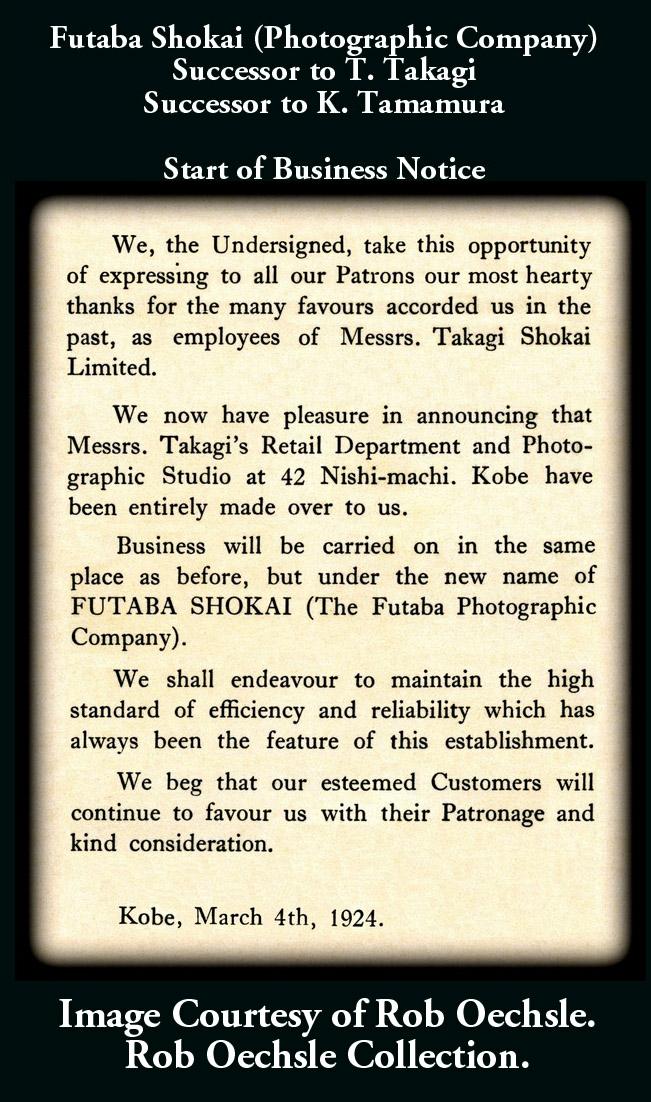
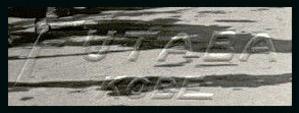
- Sayonara T. Takagi Photo Co. Rob Oechsle's comprehensive research into photography in Japan has established the date that the T. Takagi photographic and book publishing enterprise ceased operation. The date was March 4, 1924 as established by a notice published by the Futaba Shokai (Futaba Photographic Company), Takagi's successor. An image of that notice is here. Rob's website (T-Enami.org) is located here. I have not seen a book with the Futaba Shokai imprint. I have encountered several magic lantern glass slides with the Futaba imprint as well as black and white collotype picture post cards. The post cards carry a colorless embossed "Futaba, Kobe" imprint on the image side. It should be noted that there is an edition of The Tea in Japan which shows 1927 (Taisho 16 - actually Showa 2) as the date of publication.
- Hand colored collotype prints (generally 10 or more per book).
- Book Format/Size. Horizontal format, generally 8vo (7 x 10 1/2 in) but sometimes large 8vo (7 x 16 in). Books are configured in Western format and read from left to right.
- Collotype Format/Size. Generally horizontal format images. Prints in the 8vo books have an image area of approximately 6 x 4 in. Images have English descriptive text printed below them. In some books the plates are separated by tissue guards but that is the exception rather than the rule.
A Typical Collotype Plate
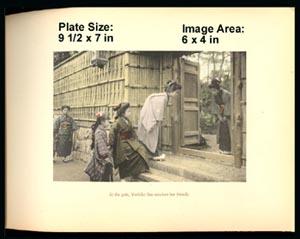
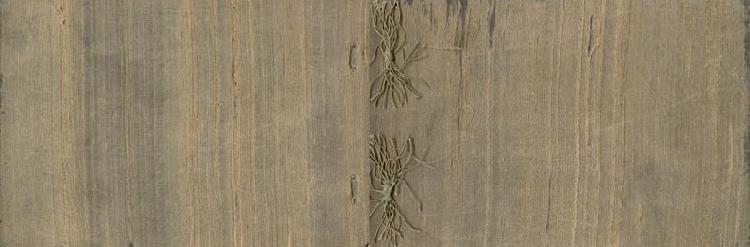
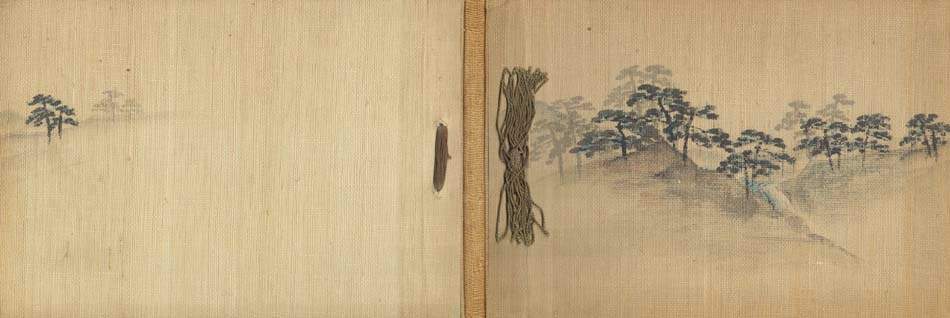
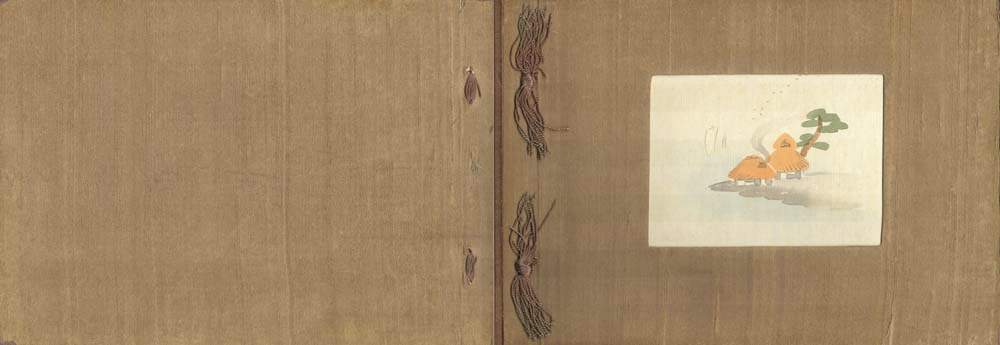
- Covers/Bindings. Covers are generally hard (cardboard) and covered with a silk type fabric. The spine is covered with very thin paper. Often the covers have no illustrations are titling. Binding is generally accomplished by two string ties on the left edge. However, at least one book has been examined with a single string tie holding the covers and two string ties internally.
Typical Cloth Over Cardboard Cover
Double String Tied
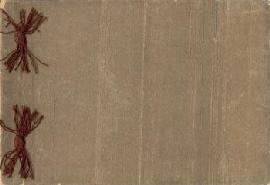
Typical Illustrated Cloth Over Cardboard Cover
Single String Tied
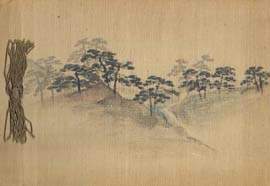
Similar unillustrated covers were also used.
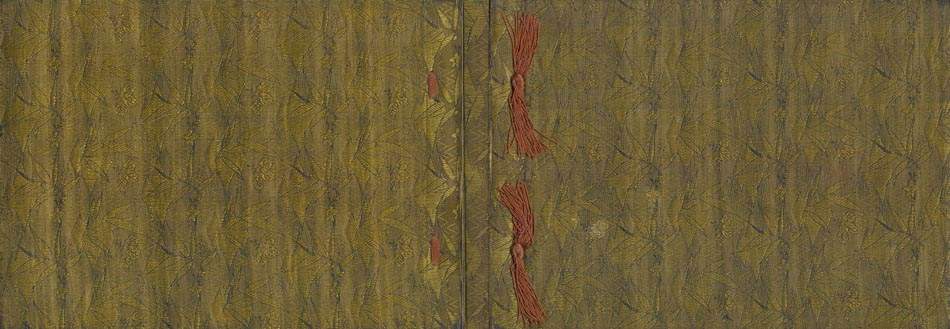
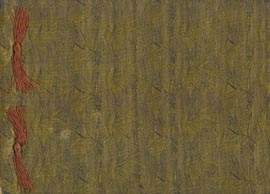
Deluxe Edition, Silk (padded) Over
Cardboard Covers, Double String Tied
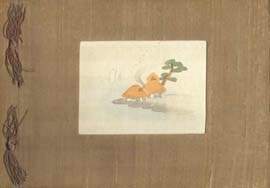
Atypical Cloth Over Cardboards Cover with Recessed
Watercolor Illustration, Double String Tied
Atypical Illustrated Paper Over Cardboard Cover
Single String Tied
- Deluxe Editions. I have examined one book that was issued in regular and deluxe edition format. This is the 50 plate version of Japanese Views and Characters. Information regarding the standard edition book is here and information about the deluxe edition is here. The regular edition has the standard cloth over cardboard covers with a single tie. The deluxe edition has padded decorated silk over cardboard with double ties. The spine of the deluxe edition is covered with the same silk used on the boards and all edges are gilt. Additionally, the deluxe edition comes with a folding cover/case with two ivory type clasps. The contents of the regular and deluxe editions are identical.
- Typical Book Condition. The fabric covering of the boards generally has loss of fabric in areas long the edges. The covers generally have scrapes and small tears. The paper on the spine is almost always badly broken or completely missing. String ties are often loose. I consider these normal conditions and do not rate a book below Good just based on these conditions. Sometimes these books are found with the covers cut back/trimmed leaving only approximately 1 inch on the binding/tie side. In this state the internal title page appears to be the outer cover of the book.
A Cutback/Trimmed Cover

- Who is "Tamamura the Photographer, Kobe"? This is the famous photographer Tamamura Kosaburo. Tamamura Kosaburo was in business during this period but his primary business location was in Yokohama, not Kobe. The K. Tamamura's studio was well know for it's work in hand coloring the albumen photographs (perhaps as many as 180,000) used in the 1897~8 Brinkley books. Tamamura Kosaburo was famous for his photographs which were generally produced as hand colored albumen (but sometime as collotype) photographs and marketed through his shop in Yokohama in the "tourist souvenir" trade. I have seen books with hand colored collotype prints by "Tamamura the Photographer, Kobe" dated as early as 1898. In his book Early Images of Japan, Terry Bennett notes that an advertisement in 1903 indicated that K. Tamamura had a branch office designated "No. 2 Kobe." In Old Japan, Catalogue No. 30, (Nov. 2000) Sebastian Dobson states that Tamamura Kosaburo "...established a branch in Kobe around 1900 (see lot 123)." Based on the information I have available, I confident that Tamamura Kosaburo is the same person as "Tamamura the Photographer of Kobe." This branch office of the Tamamura enterprise appears to have had two major roles. First, it served as a marketing agent for the line of goods that were also offered in Yokohama. Second, and most relevant to this web page, it was the focal point for the marketing (and probably manufacture) of collotype illustrated books.
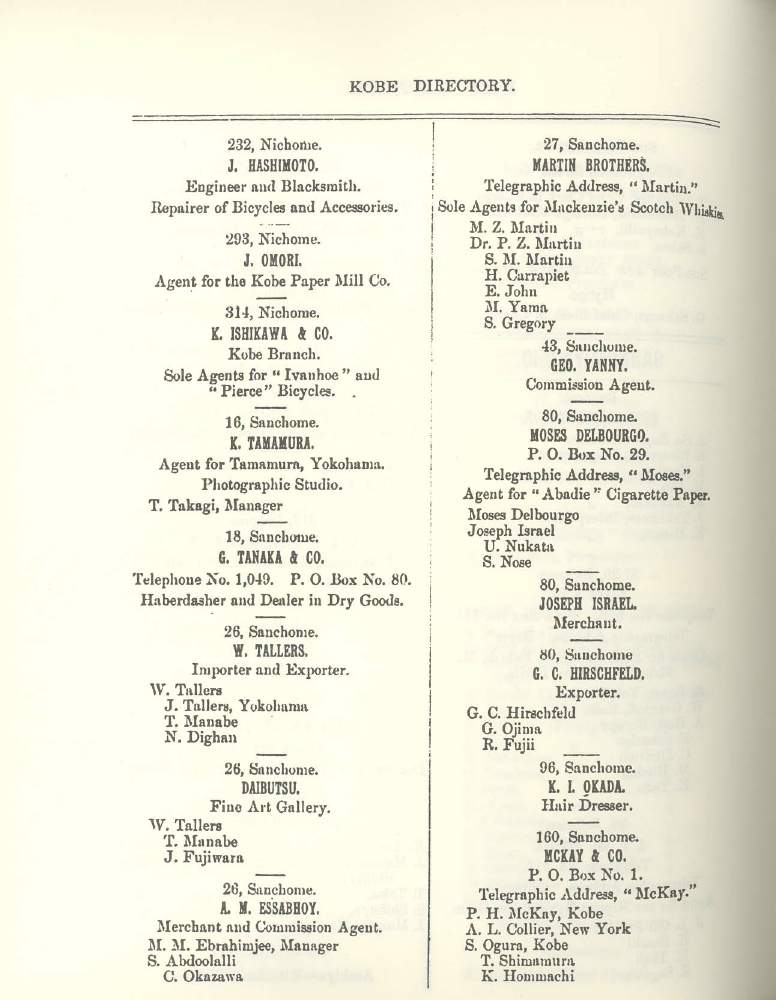
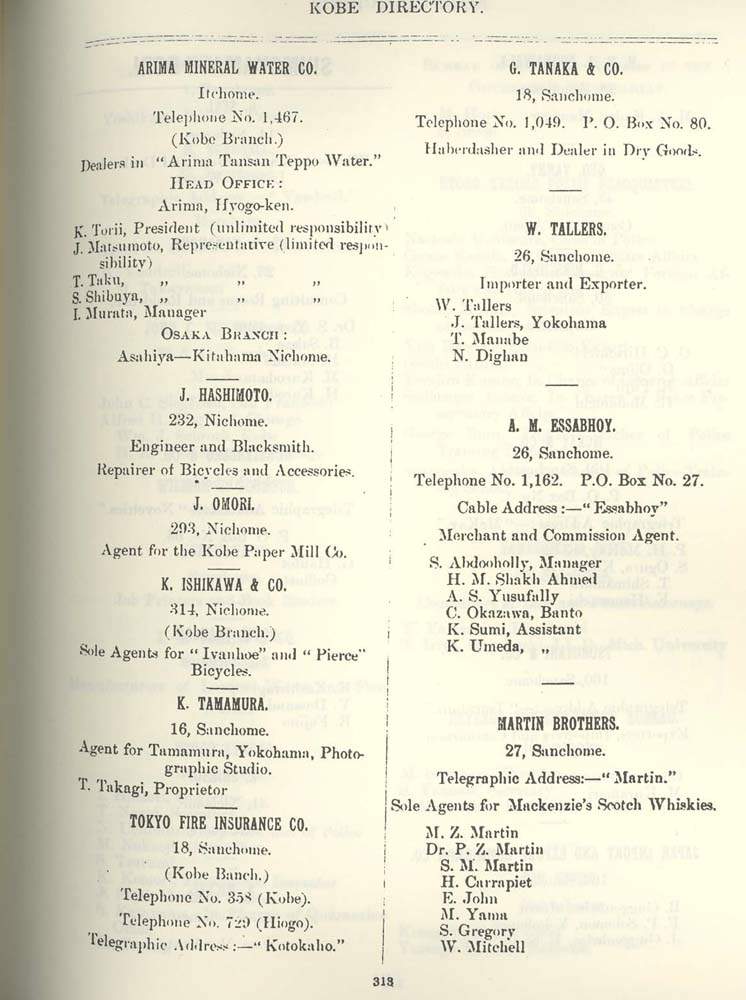
- The Transition from Tamamura, Photographer, Kobe to T. Takagi, Kobe. Terry Bennett has established precise documentation regarding the transition from Tamamura, Kobe to T. Takagi. The Japan Directory for 1903 lists "16, Sanchome (Kobe). K. Tamamura, Agent for Tamamura, Yokohama. Photographic Studio, T. Takagi, Manager." The directory for 1904 lists " K. Tamamura, 16, Sanchome (Kobe), Agent for Tamamura, Yokohama, Photographic Studio, T. Takagi, Proprietor." While the transfer occurred in late 1903 or early 1904, it appears Takagi did not use his own name in the colophons of the collotype books he marketed until around February of 1906 and did not drop the Tamamura name entirely until 1913. Takagi marketed a "Tamamura the Photgrapher, Kobe" book with a colophon date of 1907 (The School Life of Young Japan) with no mention of his name except in a loose slip advertisement. It is clear that Takagi marketed Tamamura's images and books, sometimes with his own imprint and sometimes without, long after he acquired ownership of Kobe enterprise.
- Comparison with Known Kosaburo Tamamura Book. A known color collotype book published by Kosaburo Tamamura is A Leaf From the Diary of a Young Lady. For more information on this book, click here. The format and titling on the collotypes in this book are very similar to the Tamamura/Takagi books.
- Glass Slides. Both Tamamura and Takagi marketed Japanese images on glass (magic lantern) slides. These were hand colored and measured approximately 3 1/4 x 4 in.
- Kelly & Walsh Marketing. I have examined books between 1907 and 1916 which bear a Kelly & Walsh, 78 Main Street, Yokohama, bookseller's label at the upper left on the inside front cover.
Main page for the T. Takagi books, click here
|