This book is available for purchase. For more information, click here.
Serizawa Keisuke:
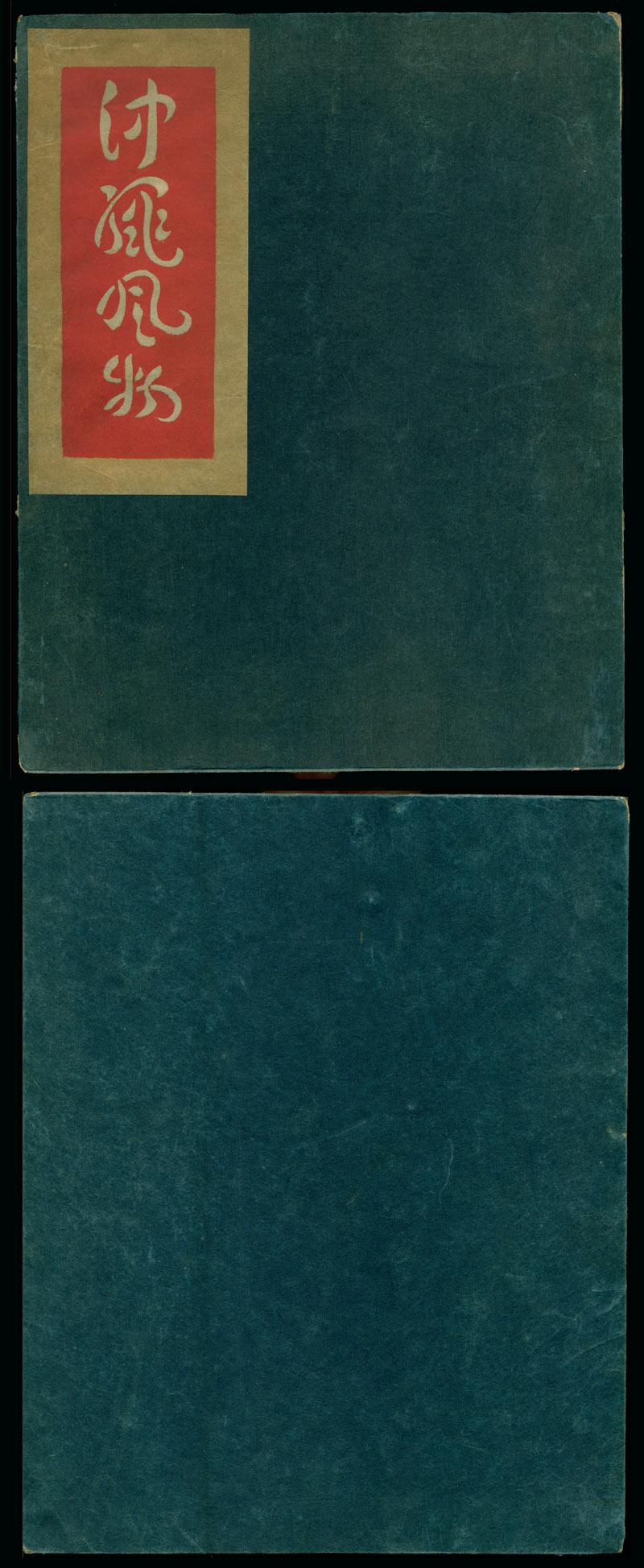
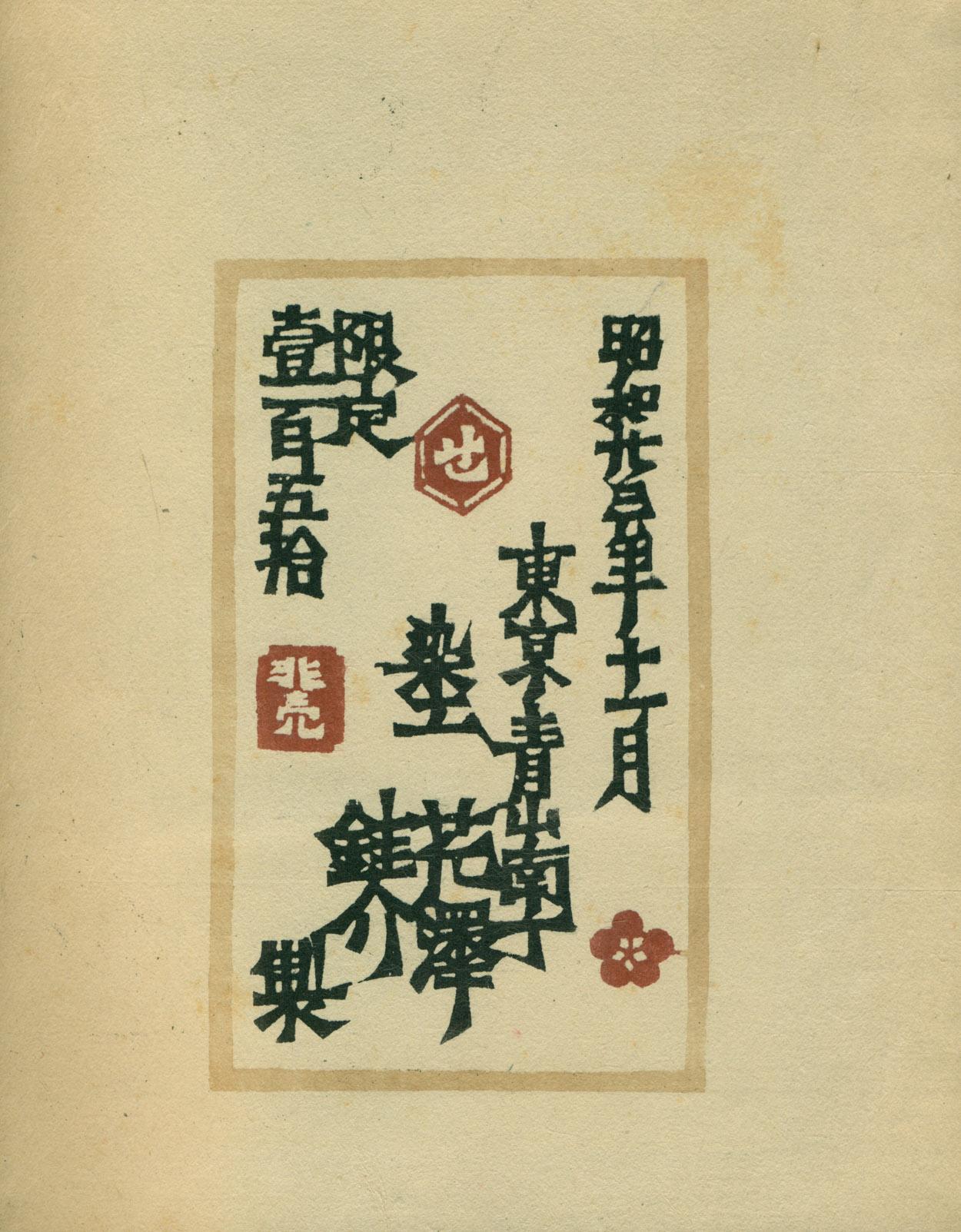
Okinawa Fubutsu (Views of Okinawa), Japan, Showa 23 (1948), 8 1/2 x 10 1/2 in, dark blue covers, continuous sheet foldout (Japanese orihon style) format with a series of panels and a total expanded length of 157 inches (excluding blank pages). There are a total of 22 panels (19 with stencil art and 3 blank). Most images span two leaves but one image spans four leaves. The colophon is a single leaf. The inside of the front and back covers are blank pages and the page opposite the front cover is blank. The book illustrates various folk crafts of Okinawa with the focus on bingata textiles. The illustrations are created through the application of colors using a stencil dying technique which Serizawa was noted for. Serizawa's technique, known as "Katazome" or stencil dyeing, was a pioneering effort in this field of color illustrations. He used paper cutout patterns then applied colors to the stencils. The resulting illustrations appear very similar to the bingata process most often found on textile products of Okinawa. Printed in a very limited quantity of 150 copies (so stated in the colophon).
Binding style. The book is bound in the accordion style where all the pages can be viewed as a panorama when the book is completely unfolded. In this style of binding (nobiru gajo) the printed pages are folded and then tipped together at both edges. In this book the printing is only on one side of the page. The backs of the printed pages are completely blank.
Individual panels from this book were also marketed. The Shuri image which spans two panels in the book has been confirmed stenciled as a single sheet.
Many of the scenes found in this book were depicted in a stencil dyed paper, 61 1/4 x 27 3/4 in, hanging scroll which is known as "The Great Market in Naha City, Okinawa." That work is said to date to 1940.

Panels Folded Out
The book is presented from back to front in Japanese style. Below is a summary of the panels.
Panels*  Each panel is a folded sheet.
A & B    Blank Pages (inside front cover and adjacent page) (42 cm - 16 1/2 in)
1 & 2.   Index with 9 listed items. (42 cm - 16 1/2 in)
3 & 4.   Okinawa dress and ceramic ware. (42 cm - 16 1/2 in)
5 & 6.   Okinawa dress and market. (42 cm - 16 1/2 in)
7 & 8    Okinawa market (lacquer ware, pottery, textiles. (42 cm - 16 1/2 in)
9 - 12   Okinawa market (84 cm - 33 in) - Center Piece of the Book
          Panels 9 & 10 focus on lacquer ware
          Panels 11 & 12 focus on bingata including the dying process
13 & 14  Pottery (42 cm - 16 1/2 in)
15 & 16  Scenes (42 cm - 16 1/2 in)
17 & 18  Scenes, focus on dwellings (42 cm - 16 1/2 in)
19 & C   Colophon (21 cm - 8 1/4 in) and adjacent blank page (inside back cover)

Fully expanded length is 181 1/2 inches / 462 cm (including blank pages)
or 157 (actually 156 3/4) inches / 399 cm excluding blank pages.


* Numbered pages (1-19) have stencil art.  Lettered pages (A, B & C) are blank pages.
Numbers and letters above are mine and not actually printed on the pages.
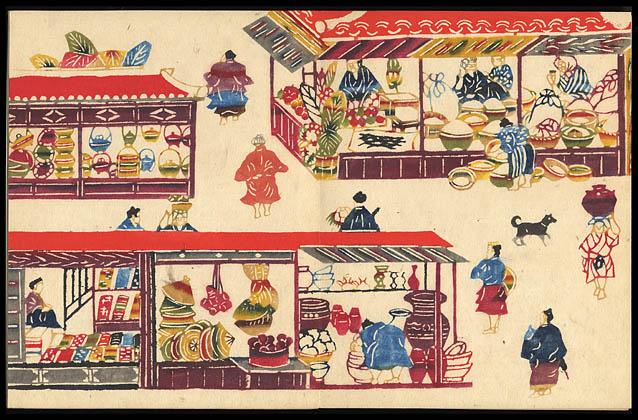
Panel - Spans Two Panels
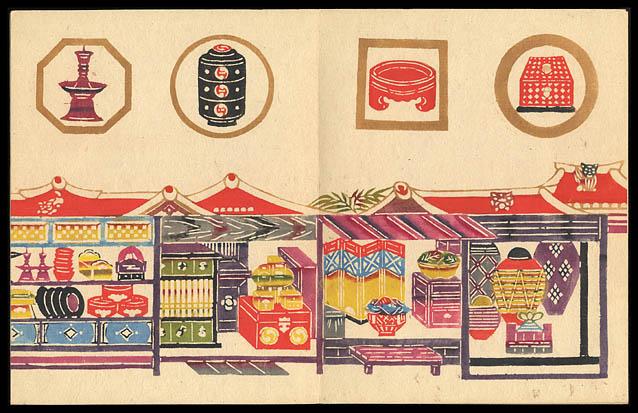
Panel - Spans Two Panels
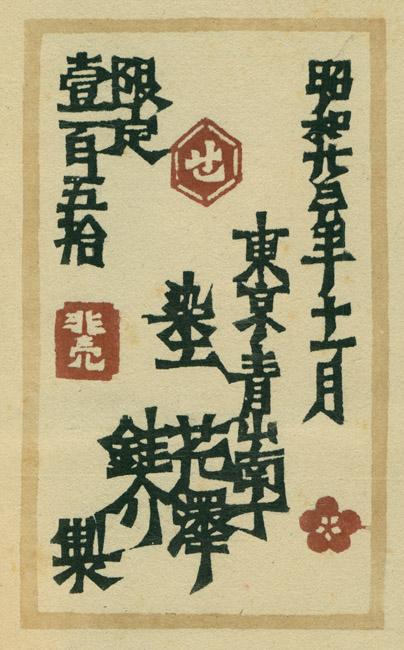
Colophon - One Panel
Keisuke Serizawa (1895-1984)

In 1956 Serizawa was designated by the Government of Japan as a "Living National Treasure" (intangible cultural asset) for his "Mingei" (folk art) work using hand-stenciled dyeing (katazome) techniques. Serizawa visited Okinawa several times and learned the famed Ryukyu bingata method of stencil dyeing. His first visit was in 1938 where he studied bingata techniques under Katatsue-ya in Naha. He carried this traditional technique into his folk art work. Okinawan designs are frequently seen in his work. In addition, Serizawa merged Chinese floral dyeing methods and South Pacific batik methods into his work. Serizawa's works cover an wide field. His designs were reproduced for use as book cover illustrations, and newspaper and magazine illustrations. His folk art applications included kimono and obi cloth, paper prints, wall hangings/scrolls, folding screens, curtains, fans, shochibubai (pine, bamboo and plum blossoms hangings considered to bring good luck) and calendars. A unique feature of his work has been described in these terms:
The distinguishing trait of Serizawa's katazome method is the use of the starch mixture to create, not a colored area as is current in direct-dyeing process, but a blank, undyed one that forms a part of the pattern and that can later be colored by hand in multi-color or monochrome as the designer sees fit. Keisuke Serizawa, the Stencil Artist, Volume 1, 1967
It is my understanding that the stencil dyeing procedures are:
- Using a stencil, areas to be left uncolored are covered with a dye resistant starch paste (nori tsuke).
- Colors are then applied by dipping or brushing, generally from lighter to darker colors. Serizawa generally used traditional vegetable dyes and seldom used chemical dyes.
- After these colors have dried, the key design (key stencil) is used to apply the main design (iro sashi).
- The paste is washed off (mizu ari) and the material dried in the sun (harika).
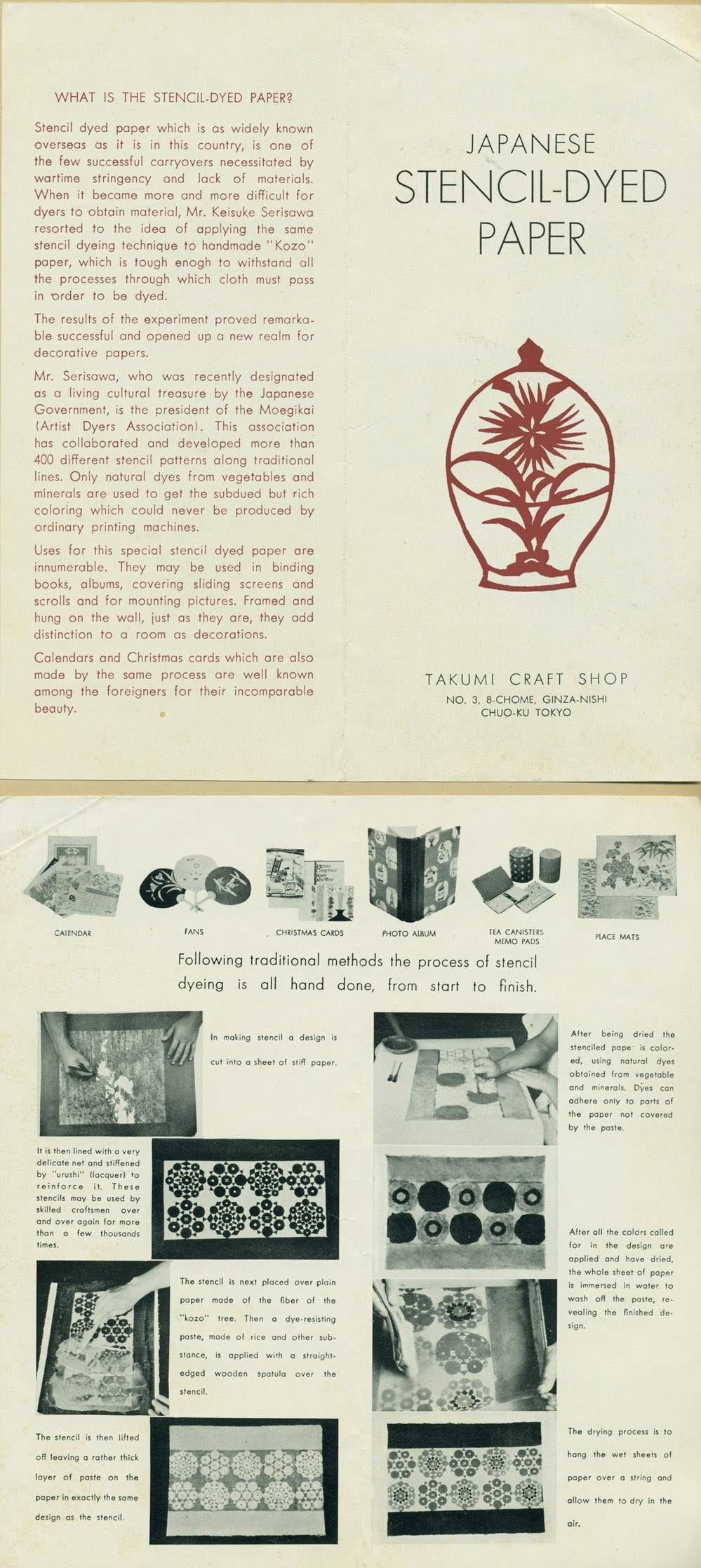
A brochure describing the stencil-dyed paper process published by the Takumi Craft Show, Tokyo, is here.
An interesting aspect of this process is the use of every day items. For example, the dye resistant paste was generally made from boiled rice (combined with lime). The inks (generally vegetable dyes), particularly black were mixed with tofu water, a by-product in the making of curd from soy beans, to give richer color and indelibility.
Serizawa was a leading member of the Mingei (folk craft) movement founded in 1926 by Soetsu Yanagi, Shoji Hamada and Kanjiro Kawai. The Serizawa Keisuke Art and Craft Museum at Tohoku Fukushi University in Sendai has a large and specialized collection of his work. The Mingei International Museum of Folk Art located in Balboa Park, San Diego, California, has an important collection of works by Serizawa. Serizawa also donated several items to the museum which were not his own works but of important cultural significance.
Serizawa Calendars. For information on Serizawa calendar folios, click here.
Books Relating to Keisuke Serizawa
Serizawa Books: In Keisuke Serizawa it is stated that:
Keisuke Serizawa has produced numerous masterpieces in illustrated books sometimes in Japanese and other times in contemporary western style, including Don Quixote, Vincent Van Gogh, A Day at Mashiko, Ainu Art and Butsuge (poems of Soetsu Yangi). Over three hundred limited editions reveal his vast knowledge of human psychology as well as of the natural world and are highly prized among collectors. 1979 Mingei Catalogue at page 9.
Despite the fact that numerous books were apparently produced, they are seldom seen. I am aware of the following books.
- 1936, Ehon Don Kihote (Don Quixote Picture Book) or Don Quixote a La Japonaise, Mukomachi (near Kyoto), Sunward Press, Bunsho Jagaku, proprietor, October 1936, large 8vo (8 1/4 x 11 1/4 in - 20.9 x 28.7 cm), text in Japanese only, high quality Japanese paper in folded sheets, kangxi Japanese style binding, illustrated covers, spine not covered except for 1 inch at the head and foot, 31 illustrations (28 double page illustrations and 3 single page), 34 folded pages for a total of 68 pages. For more information on this book, click here.
- 1948, Okinawa Fubutsu (Views of Okinawa). For more information on this book, click here. This book is available, see below.
- 1943, Ryukyu no Katatsuki (Ryukyuan Prints), Kyoto, Kyoto Shoin, 15 pages with printed cloth samples, 8 photographic illustrations, 11 illustrations of paper stencils, 13 drawings of the textile printing process 67 pages of text.
- 1950, Kami-wo Tsukuru Hitotachi (Papermaking), privately printed in edition of 50 copies, Showa 25 (1950) 28 x 30 cm, 7 pages of katazome prints, paper wirts with printed title label.
- 1954-1962, Keisuke Serizawa's Katazome Shohin Shu (K. Serizawa's Katazome Collection), 4 volumes (No. 1, 2, 3 & 4), published by Moriguchi Taro, Osaka, limited edition books (No. 1 - 100 copies, Nos. 2-4 - 200 copies). For more information on this set, click here. No. 1 and No. 2 are available, see below.
- 1961, Haruo Sato.
- 1967 & 1968, Keisuke Serizawa, The Stencil Artist, Volume 1 and Volume 2, Tokyo, Tsukiji Shokan Publishing Company, Ltd, distributed by Maruzen Co. Ltd, 1967 (Vol. 1) and 1968 (Vol 2), large 8vo (9 x 11 1/2 in - 22.8 x 29.2 cm), tan (Vol 1) and red (Vol 2) textured cloth with gilt decoration on covers and gilt decoration on covers and gilt lettering on spine, issued with cardboard slip cases but no dust jackets. The volumes read Japanese style from back to front except for the pages in English which read front to back. The volumes are unpaginated but the number of pages in both volumes is approximately 264 pages (118 pages in Vol 1 and 146 pages in Vol 2). There are a total of 352 images (22 color and 330 black and white). In this work "plates" are the same as images. The color plates are tipped in and were produced utilizing the color halftone process. The black and white plates are produced by the halftone process also. Many pages have more than one image ("plate") per page and some images span two pages. Each image is assigned a number and has a descriptive caption in Japanese. Several of the images are related to Okinawa. Both volumes have an attached ribbon marker. Each colophon has a small stencil illustration which probably was the work of Serizawa. For information on this set, click here. Volume 1 and 2 are available, see below.
Books with Serizawa Covers/Art Work:
- 1934, Lafcadio Hearn, Letters from Shimane and Kyushu, Kyoto, The Sunward Press, 1934, limited edition of 100 numbered copies privately printed for Dr. Sanki Ichikawa, laid paper, 8vo, 71 pp. Cover is a stenciled design by Keisuke Serizawa.
- 1952, Tindale, Thomas K. & Harriet R., Handmade Papers of Japan, Rutland, Tuttle, 4 volumes. Preface by Dard Hunter. Eight endpapers with stencil illustrations by Keisuke Serizawa.
- 1964, Haruo Sato, Bunka no Hangyaku (Revolt of Cultures), published in the Geise Shimbun.
Exhibition Catalogues:
- 1976, Serizawa, Paris, Grand Palis, 24 x 24 cm, soft cover, 122 pages. Exhibition of Serizawa art from November 23, 1976 - February 14, 1977.
- 1979, Keisuke Serizawa & Martha Longenecker, Keisuke Serizawa, La Jolla, CA, Mingei International Museum of Wold Folk Art, oblong 8vo (9 1/2 x 8 1/2 in - 24 x 21.5 cm), soft covers, frontispiece photograph of Keisuke Serizawa, numerous color and black and white photographic illustrations, 46 pp. Catalogue for an exhibition of Serizawa's art held at the Mingei Museum from June 23 to October 14, 1979. Includes an illustrated discussion of the artist's stencil art techniques. Also includes a detailed "Biographical Notes" section on Serizawa. The catalogue lists all exhibits and pictures several, many full page and in color. Items include images for the artist's illustrated books, kimonos, obis, screens and norens (curtains).
Available - 1979 Mingei Museum Exhibit Catalogue- Purchase Here
- 2001, Serizawa, Master of Japanese Textile Design, Sendai, Japan, Tohoku Fukushi University, Serizawa Keisuke Art and Craft Museum, 2001, oblong 8vo (9 1/2 x 10 in), illustrated stiff paper wraps, illustrated dust jacket, 190+ items pictured in color, Japanese and English text, 133 pp. A catalogue for an exhibition of Keisuke Serizawa's work held August 11 through November 4, 2001 in the National Museums of Scotland. The exhibition items are followed by a biography (chronological listing of key events in Serizawa's life), an essay on "The Art of Serizawa Keisuke" by Hamada Shukuko, an essay on the "Kataezome Technique" and a "List of Works" where each of the 191 numbered items pictured are discussed in more detail including the year produced. A comprehensive illustrated presentation of Serizawa's work spanning all formats including kimono, obi, noren, screens, calendars (1946 calendar shown), stenciled paper (The Great Market in Naha City, Okinawa is shown), wall hangings, scrolls, book type illustrated stories, magazine covers, book covers and cases and paintings on glass. Includes messages from Mark Jones, Sir Hugh Cortazzi, Lord Blackenham, His Excellency Hayashi Sadayui and Serizawa Chosuke. ISBN 4-901459-06-6
Serizawa Art, Items Available for Purchase
Note Regarding Calendar Folio Shipment to Outside the US. While these items are not that heavy they are bulky and the large size
makes them very expensive to ship. A typical calendar folio would cost approximately $75.00 to mail to an address outside the US (2022).
Serizawa Books
1954 & 1955 - Keisuke Serizawa's Katazome Shohin Shu, No 1. & No. 2 (K. Serizawa's Katazome Collection). Available Here
1954 - Keisuke Serizawa's Katazome Shohin Shu, No 1 (K. Serizawa's Katazome Collection). Available Here
1967 & 1968 - Keisuke Serizawa, The Stencil Artist, Volume 1 and Volume 2. Available Here
1952 Calendar Folio - Available Here - Folding Case
1956 Calendars (3) - Available Here - Feb, Mar & Apr monthly calendars
1957 Calendar Folio - Available Here - Folding Case
1958 Calendar Folio - Available Here - Type I - Folding Case - Fine/Fine
1958 Calendar Folio - Available Here - Type I - Folding Case - Fine/Good
1959 Calendar Folio - Available Here - Type II (Year not stated on January calendar) - Folding Case
1962 Calendar Folio - Available Here - Sack
1966 Calendar Folio - Available Here - Folding Case
1967 Calendar Folio - Available Here - Folding Case
1967 Calendar Folio - Available Here - Folding Case - Condition
1968 Calendar Folio - Available Here - Folding Case
1971 Calendar Folio - Available Here - Folding Case - Condition
1972 Calendar Folio - Available Here - Folding Case
1972 Calendar Folio - Available Here - Folding Case
1972 Calendar Folio - Available Here - Folding Case, Missing Jan & May
1973 Calendar Folio - Available Here - Folding Case
1974 Calendar Folio - Available Here - Folding Case
1975 Calendar Folio - Available Here - Folding Case
1976 Calendar Folio - Available Here - Folding Case
1977 Calendar Folio - Available Here - Folding Case
1978 Calendar Folio - Available Here - Folding Case
1982 Calendar Folio - Available Here - Folding Case (Probably Serizawa)
1983 Calendar Folio - Available Here - Folding Case (Probably Serizawa)
1984 Calendar Folio - Available Here - Folding Case
1986 Calendar Folio - Available Here - Folding Case (Probably Serizawa Studio)
Katazome Calendar Folios
1967 Calendar Folio - Available Here - Folding Case
1976 Calendar Folio - Available Here - Sack
1977 Calendar Folio - Available Here - Folding Case
1978 Calendar Folio - Available Here - Folding Case
Serizawa Desktop Calendar Set (Small 9.1 x 14.1 cm)
1959 Desktop Calendar Folio - Available Here
Miscellaneous Works on Paper (Probably K. Serizawa)
c1948 - Shuri Area of Okinawa as Found in Okinawa Fubutsu (Views of Okinawa) - Available Here
c1948 - Common Dress of Okinawa as Found in Okinawa Fubutsu (Views of Okinawa) - Available Here
c1948 - The Art of Paper Making - Available Here
Fuji & NY Theme - 13 x 17 in - Available Here
Castle & Buildings - 13 x 17 1/4 in - Available Here
Children of the Snow - 4 x 5 7/8 in - Available Here
Children of the Snow - 4 x 5 7/8 in - Available Here
Wall Hangings & Furoshiki (On Cloth)
Furoshiki Cloth - 50cm x 50cm - Available Here
Furoshiki Cloth (large) - 142cm x 138cm - Okiniwa/Bingata type motif Available Here
Phonetic Alphabet, Wall Hanging - Small/Mounted - Available Here
Aesops Fables & Headgear/Fan - Wall Hangings - Small (2) - Available Here
Book Covers with Serizawa Art
Shoki Otsu-e (Early Otsu-e), Mingei Sosho, Dai 2 - hen
(Folk Arts Series, No. 2)
Mingei to Seikatsu (Folk Arts and Life) - Available Here
|