George C. Baxley | |||||||||||||||||||||||||||||||||||||||||||||||||||||||||||||||||||||||||||||||||
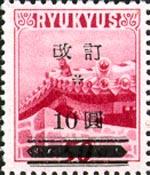
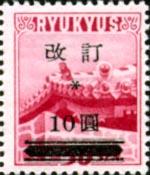
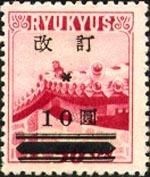
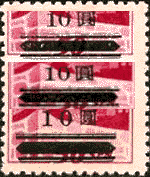
| Scott 16 | Scott 16A | Scott 16B | Scott 16,16A,16B |
|---|---|---|---|
| Second Printing | First Printing | Third Printing | All Three Printings |
 |
 |
 |
 |
|
Forgeries Discovered in 1973 |
|||
Measurements Sheet Layout Varieties & Errors General Comments
Wide Spaced "1 0" - Wide Bars

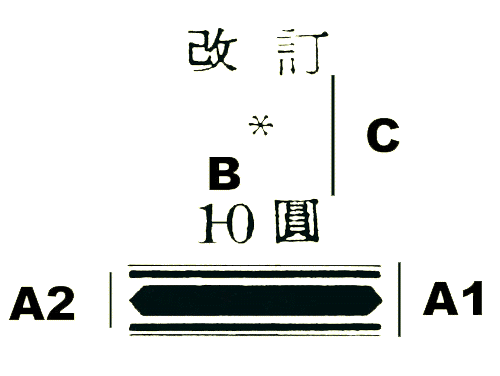
Measurements of Genuine and Forged Overprints.
Genuine Scott 16, 16A & 16B and Forgeries (8, a~h)
| |
|
||||
| Wide Bars | |||||
| Narrow Bars | |||||
| Wide "10" | |||||
| Wide Bars | |||||
| Narrow Bars | |||||
| Wide "10" | |||||
|
Distance Between: A1 - Outside of the Top and Bottom Thin Bars. A2 - Inside of the Inner Thick Bars. B - "1" and "0" using the Vertical Stroke of the 1. C - Bottom of the "Tei" and highest point on the Yen character. |
|||||
There are three distinct sheets of 16B. RPSS calls these stages I, II and II.
The first stage is the printing where all elements were in place.
The second stage is the printing where elements in two stamps are missing.
The third stage is when the mising elements have been re-added.
RPSS:
Sheet - Stage I position 54 (asterisk) and postion 71 ("Kai") present
Sheet - Stage II position 54 (asterisk) and postion 71 ("Kai") missing
Sheet - Stage III position 54 (asterisk) and postion 71 ("Kai") re-sdded
Click below to see a complete Sheet Stage II of Scott 16B
Missing Asterisk and "Kai"
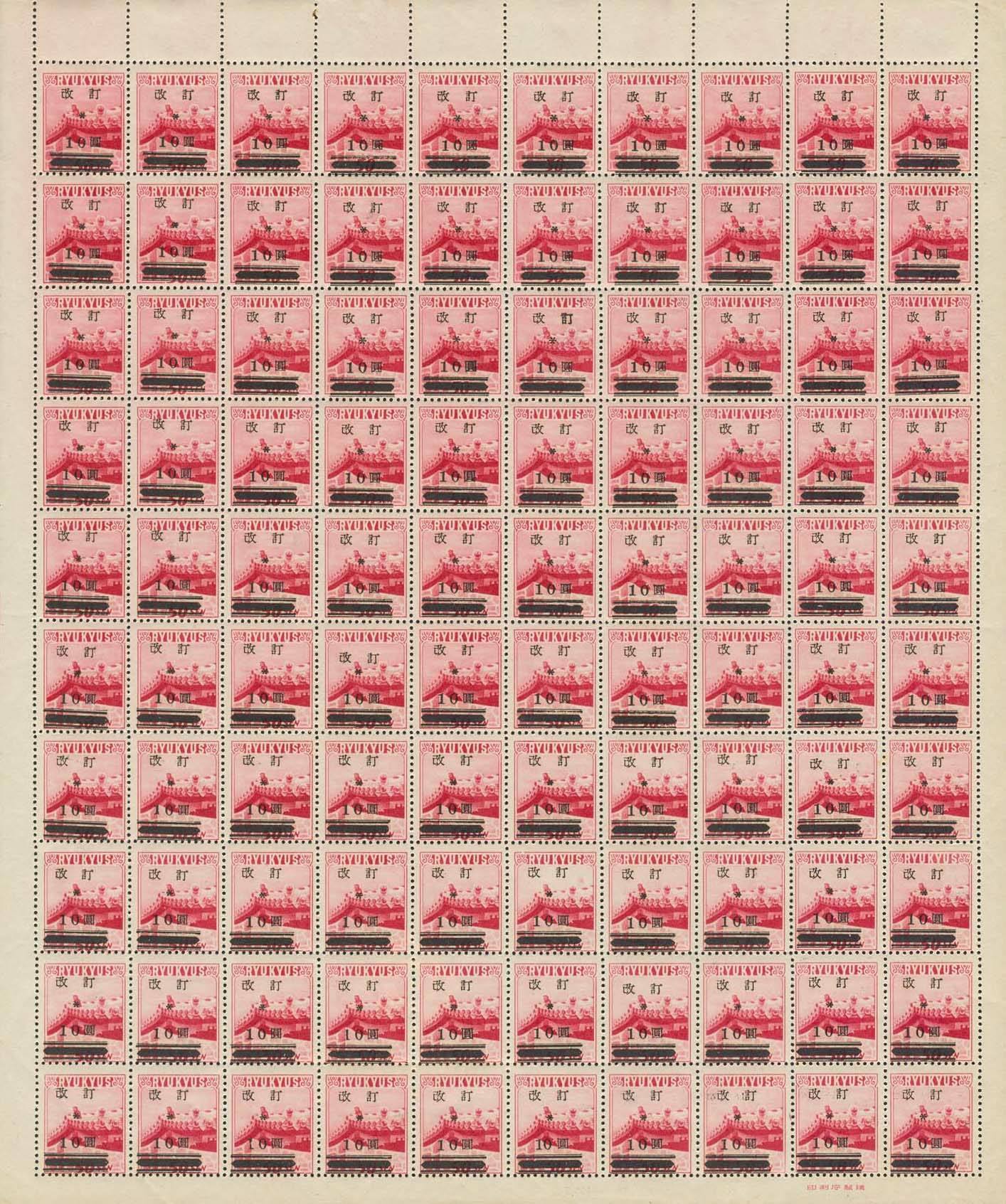
Click below to see a complete Sheet Stage III of Scott 16B
Missing Asterisk and "Kai" re-added
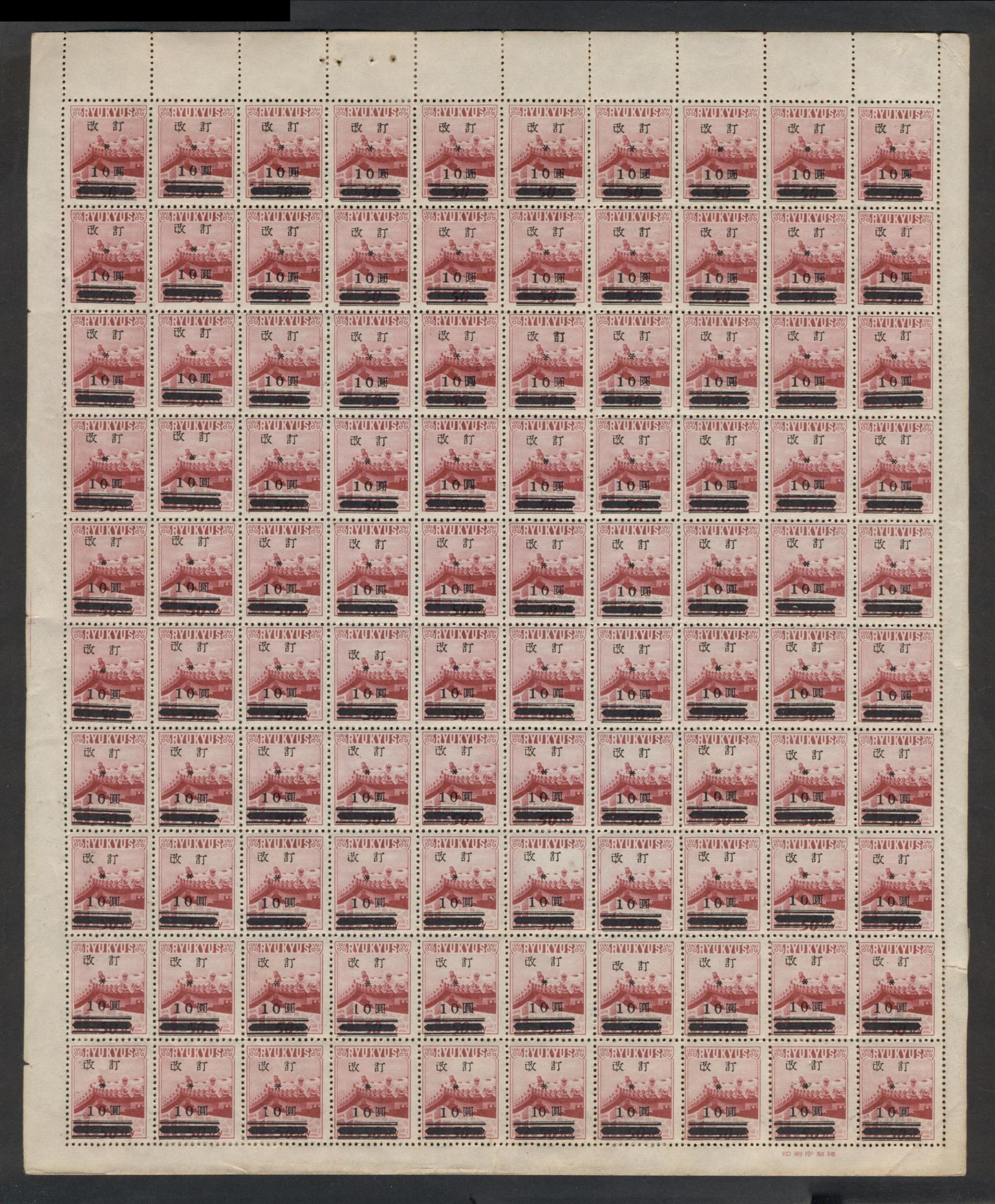
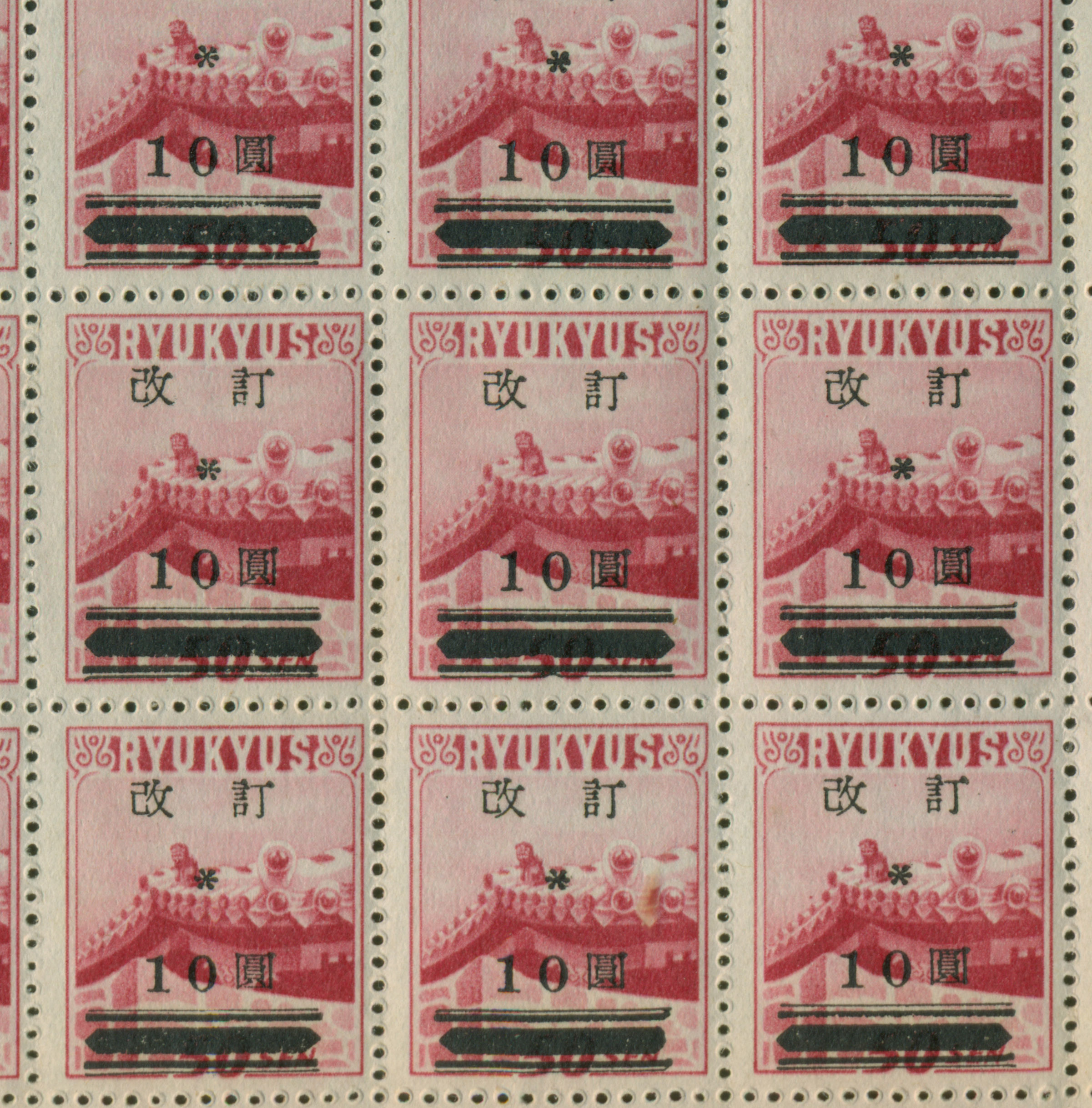
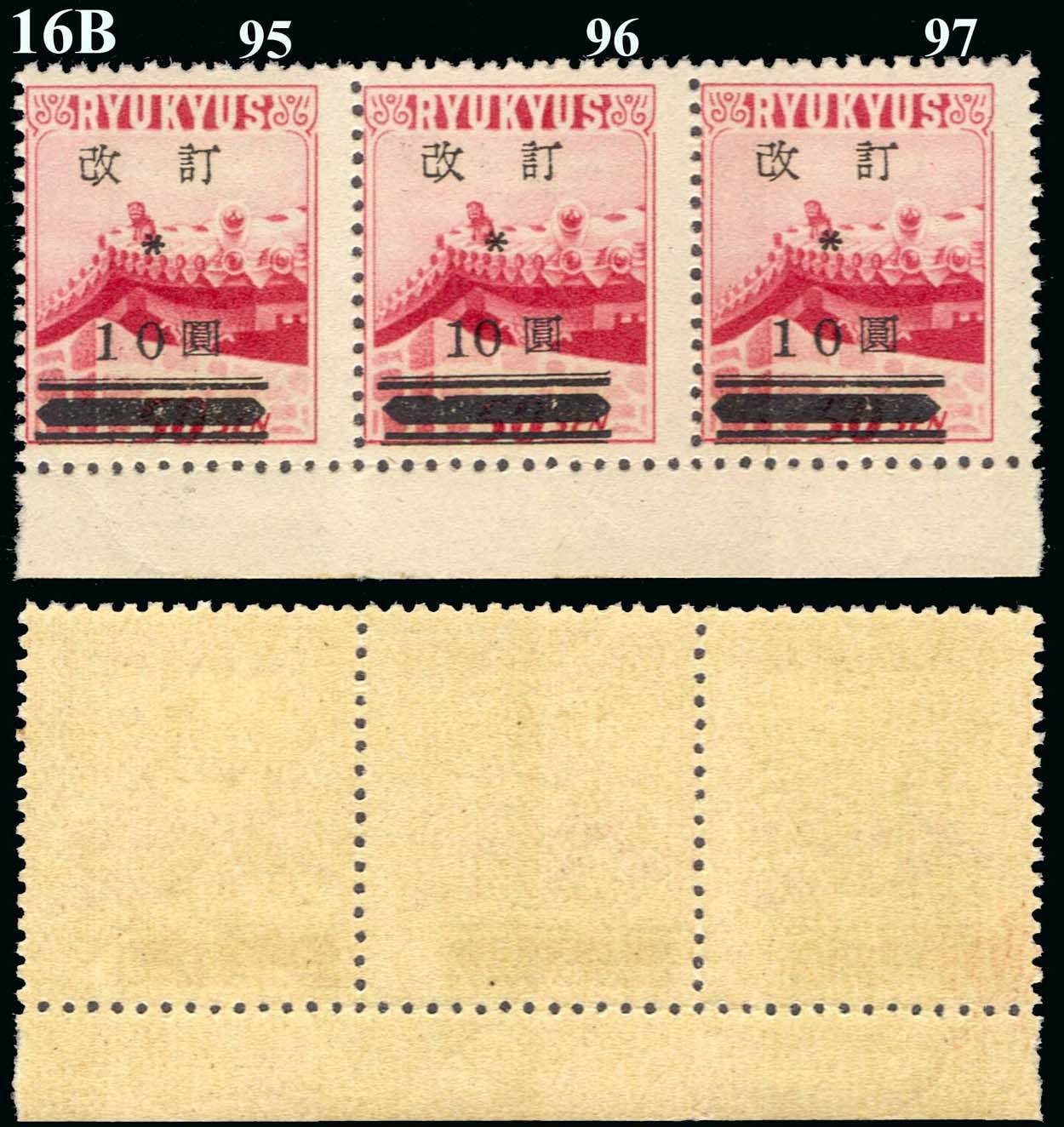
Sheet Layout of Scott 16B (3rd Printing). All stamps have same type font Kai Tei overprint. The font type does not match either the 8pt or 9pt type found on the first and second printing.
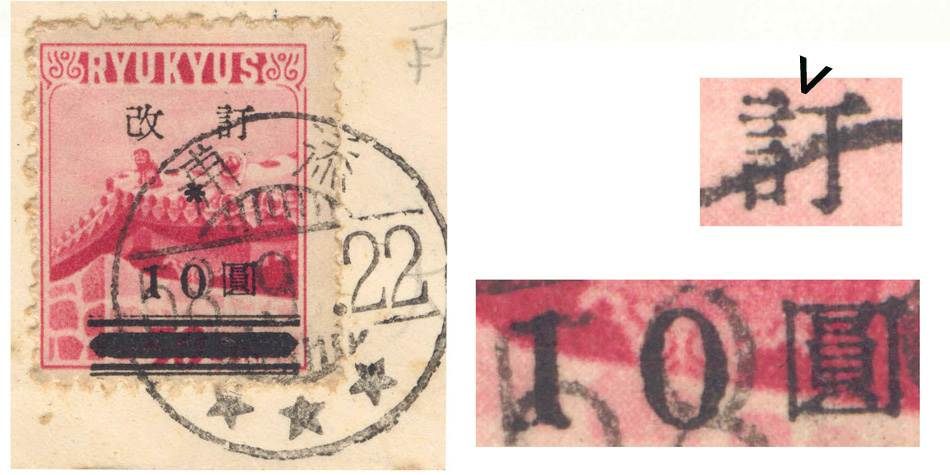
There is one position in the 16B series that looks like a stamp from the 16 (2nd printing) series. That is position 96 where the "10" is narrowly spaced. Standing alone, this stamp could well be classified as a 16. To distinuish it, you need to examine the downward stroke of the second character of the "Kai" as it goes under the first character. In the 16B the stroke is short. In the 16 series, the stroke is much longer.
16B (3rd printing)

Not identical to 8 point or 9 point found in 16 or 16A.
A1 - The bottom gap in the backward five is relatively open (Kai).
A2 - The diagonal downstroke in the adjoining character barely
enters the bottom gap in the backward five (Kai).
B - The long curved diagonal stroke passes under the base of the backward
five and extends approximately 20%~30% the length the base of the  (Kai)
C - The "J" type stroke has a large bump at the end of the upper horizontal stroke (Tei).
(Kai)
C - The "J" type stroke has a large bump at the end of the upper horizontal stroke (Tei).
Position Variation
9 also 30 Top horizontal stroke in "Kai" is short
measuring .4mm versus the normal .8mm
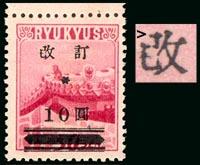 10 also 96 Narrow spaced "10" appears similar to 16 (2nd printing),
distance between "1" and "0" is less than 1mm versus
the norm of 1.5+ mm (not constant in pos 10 & not Scott listed)
14 Thick top diagonal stroke in "Kei" (unconfirmed)
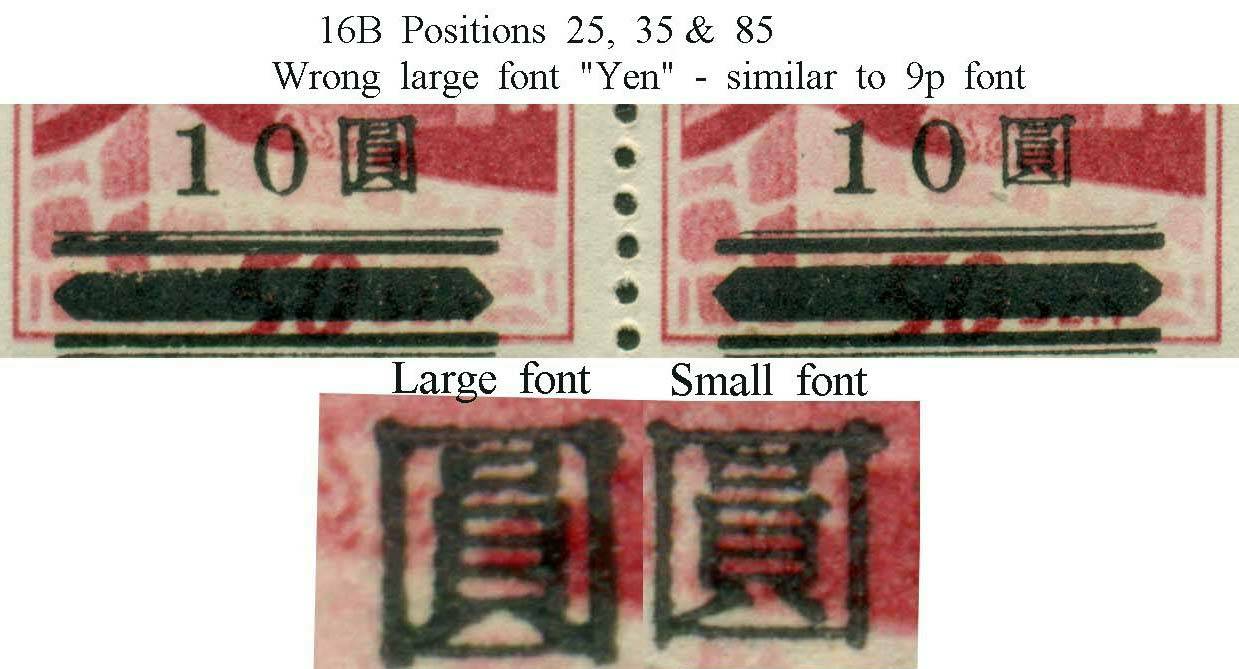
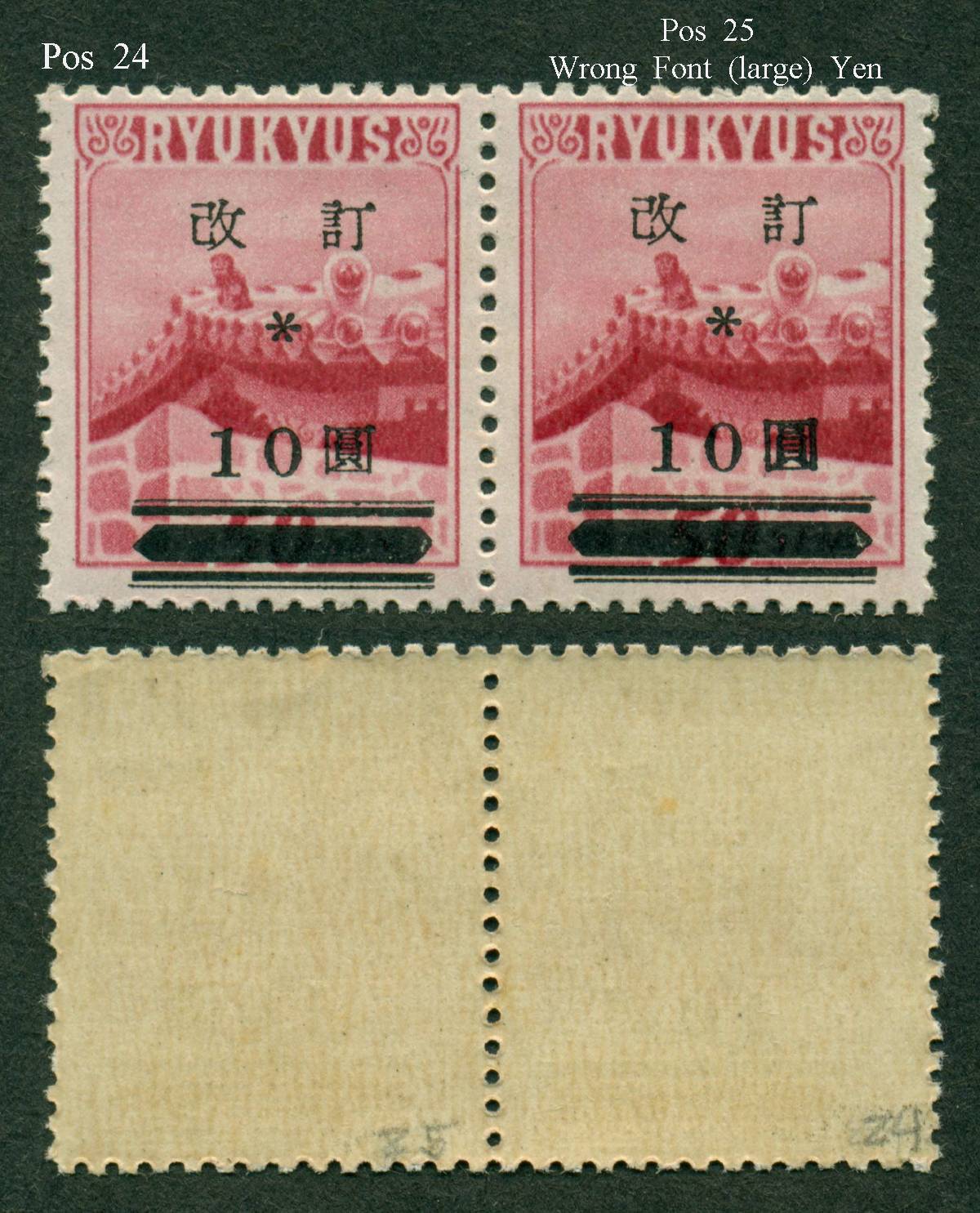
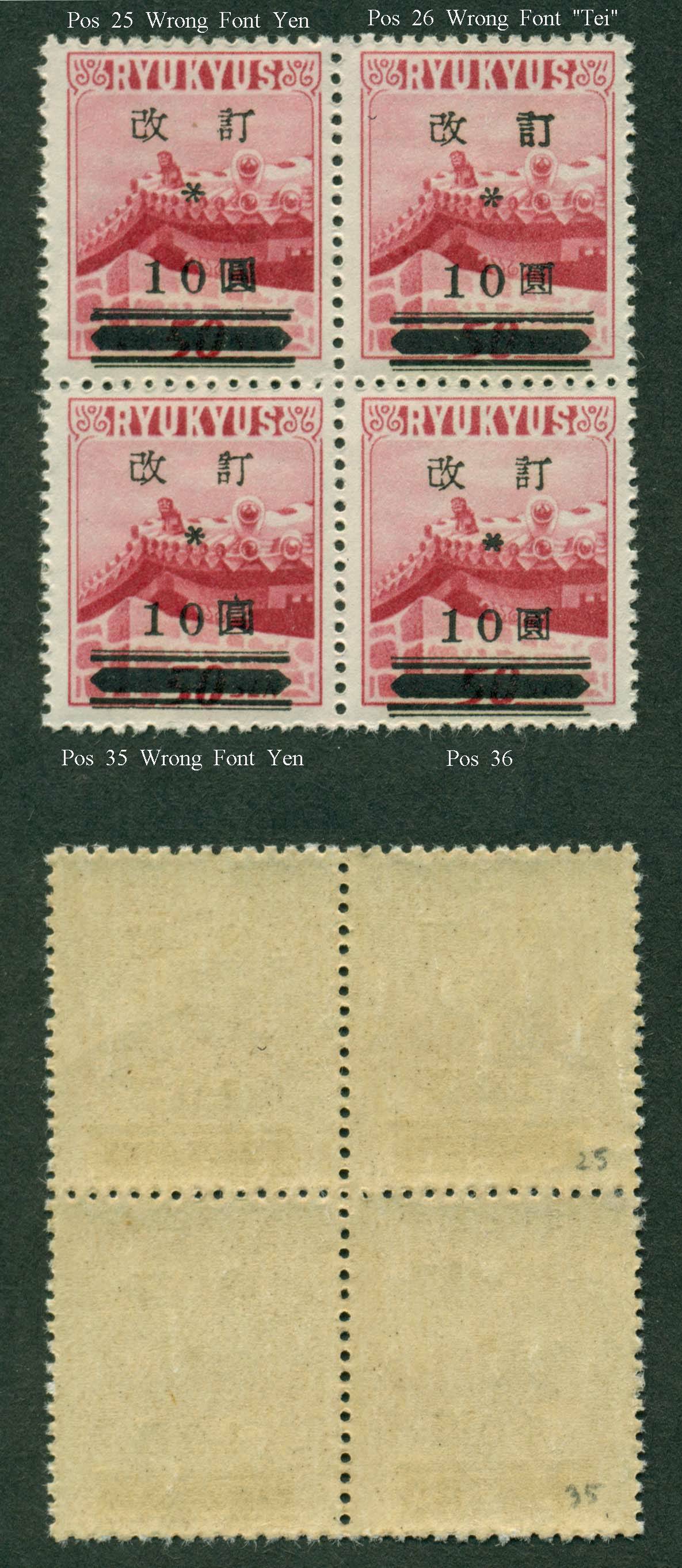
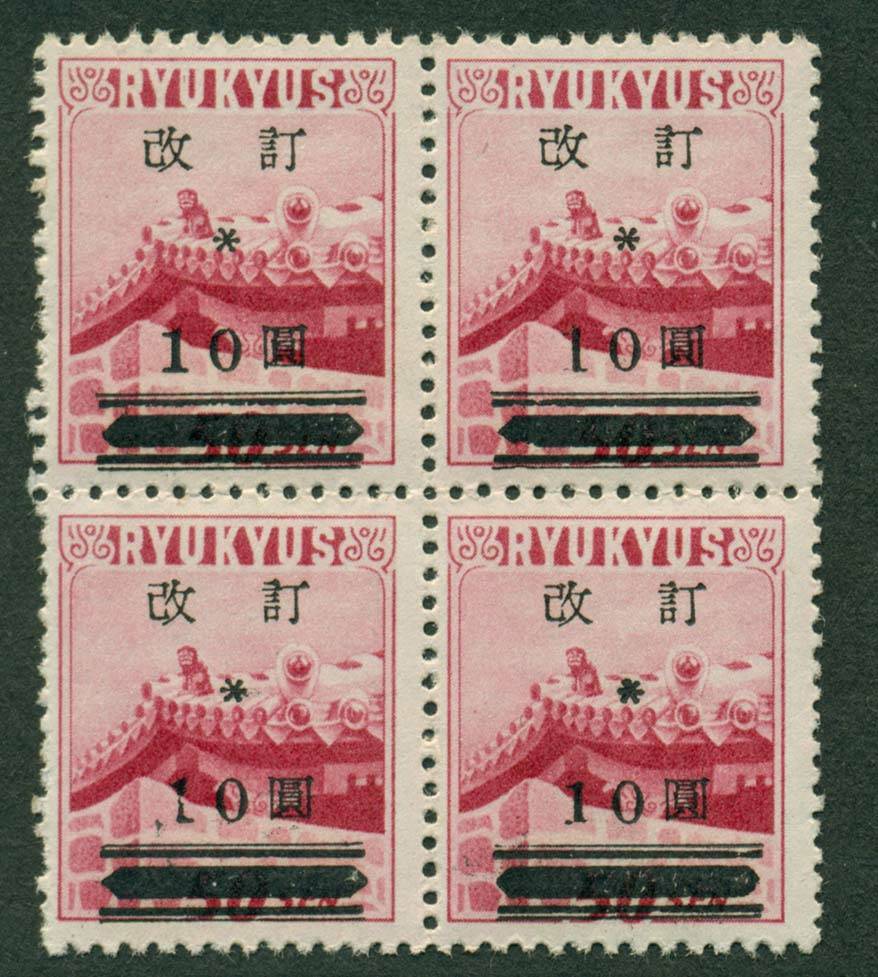
25 also 35,85 Wrong large font "Yen" - similar to 9p font
10 also 96 Narrow spaced "10" appears similar to 16 (2nd printing),
distance between "1" and "0" is less than 1mm versus
the norm of 1.5+ mm (not constant in pos 10 & not Scott listed)
14 Thick top diagonal stroke in "Kei" (unconfirmed)
25 also 35,85 Wrong large font "Yen" - similar to 9p font
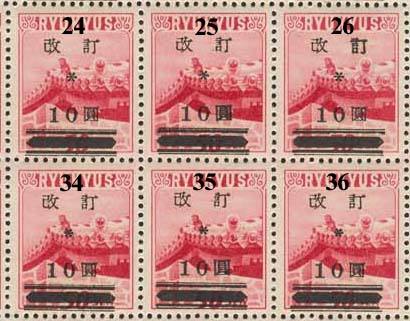
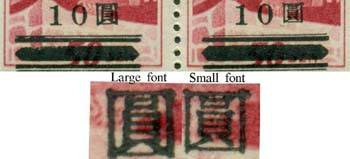 Positions 24 & 25, pic here
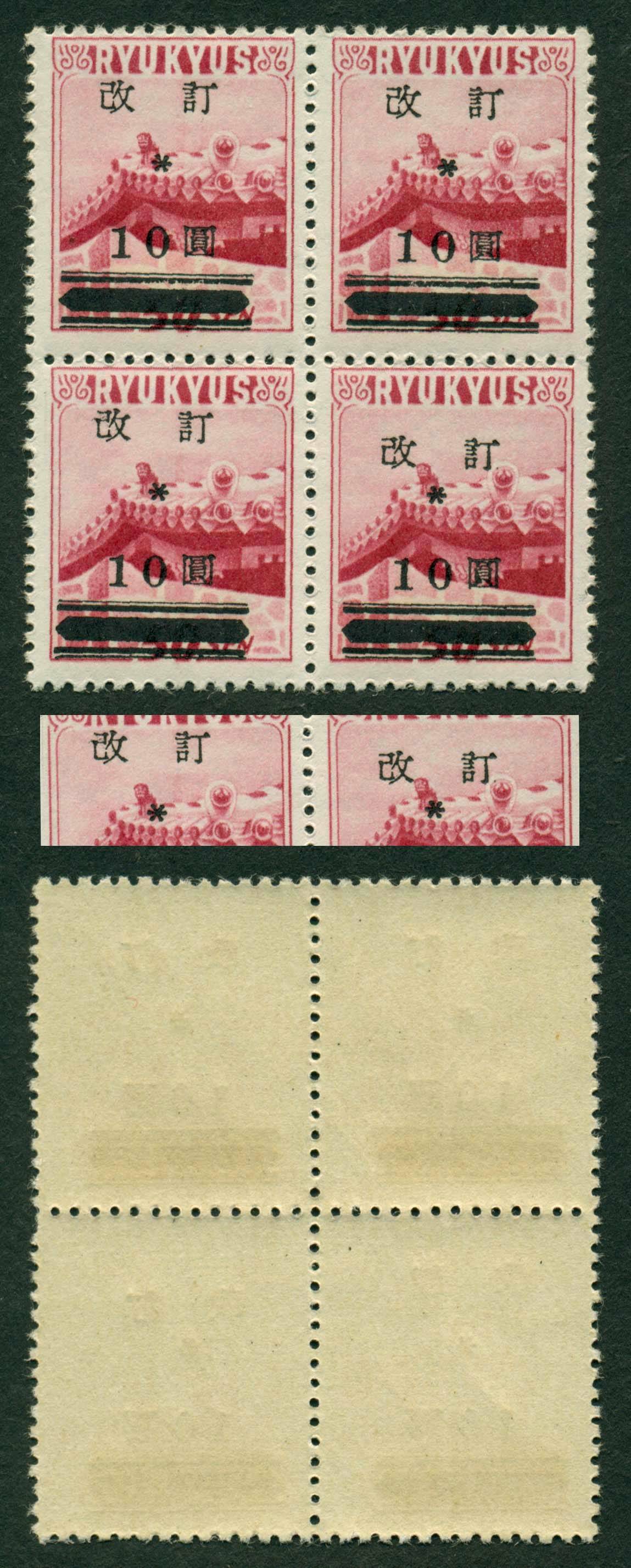
Positions 25-6 & 35-6 in block of 4, pic here
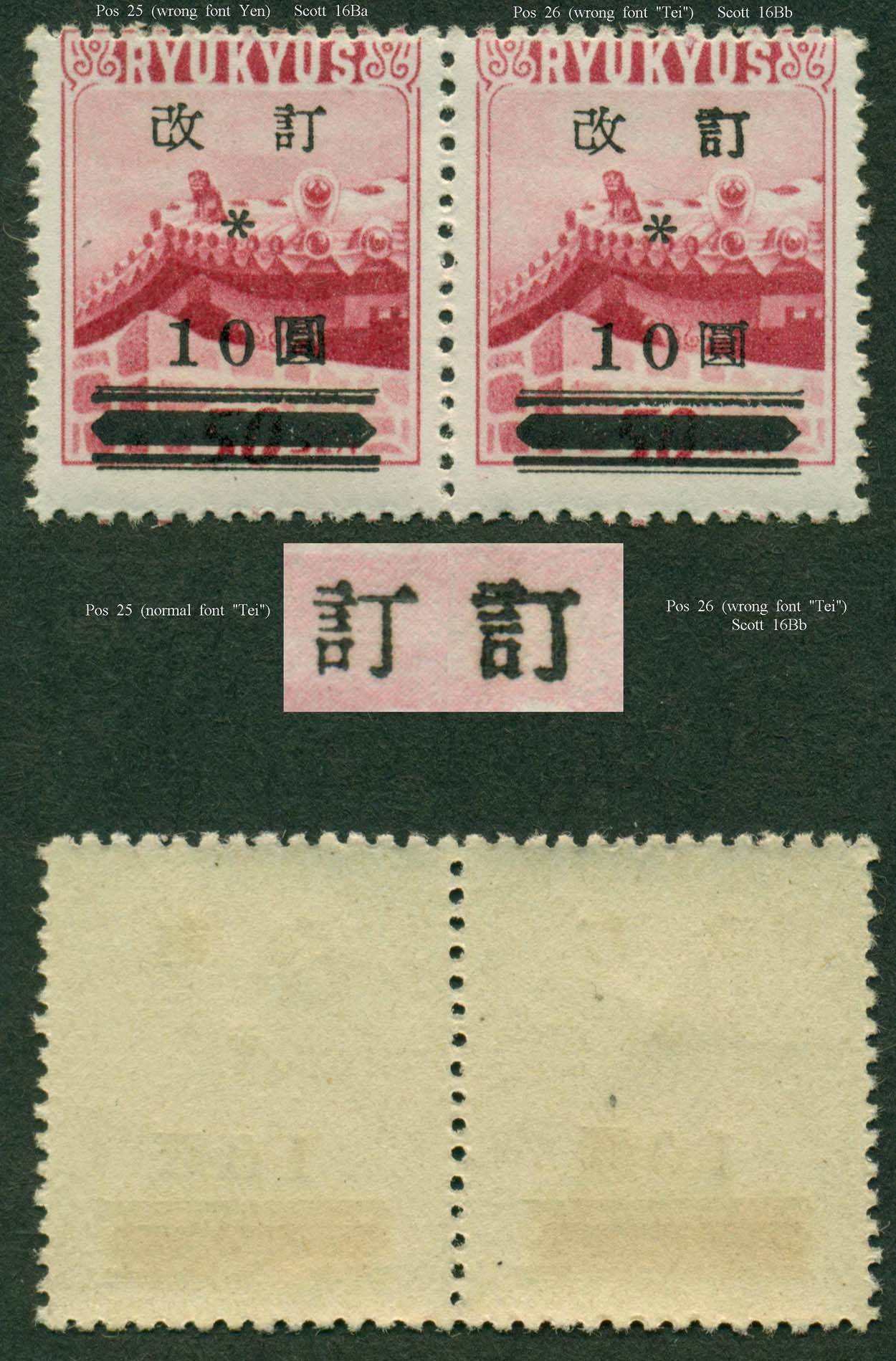
Positions 25 & 26, pic here
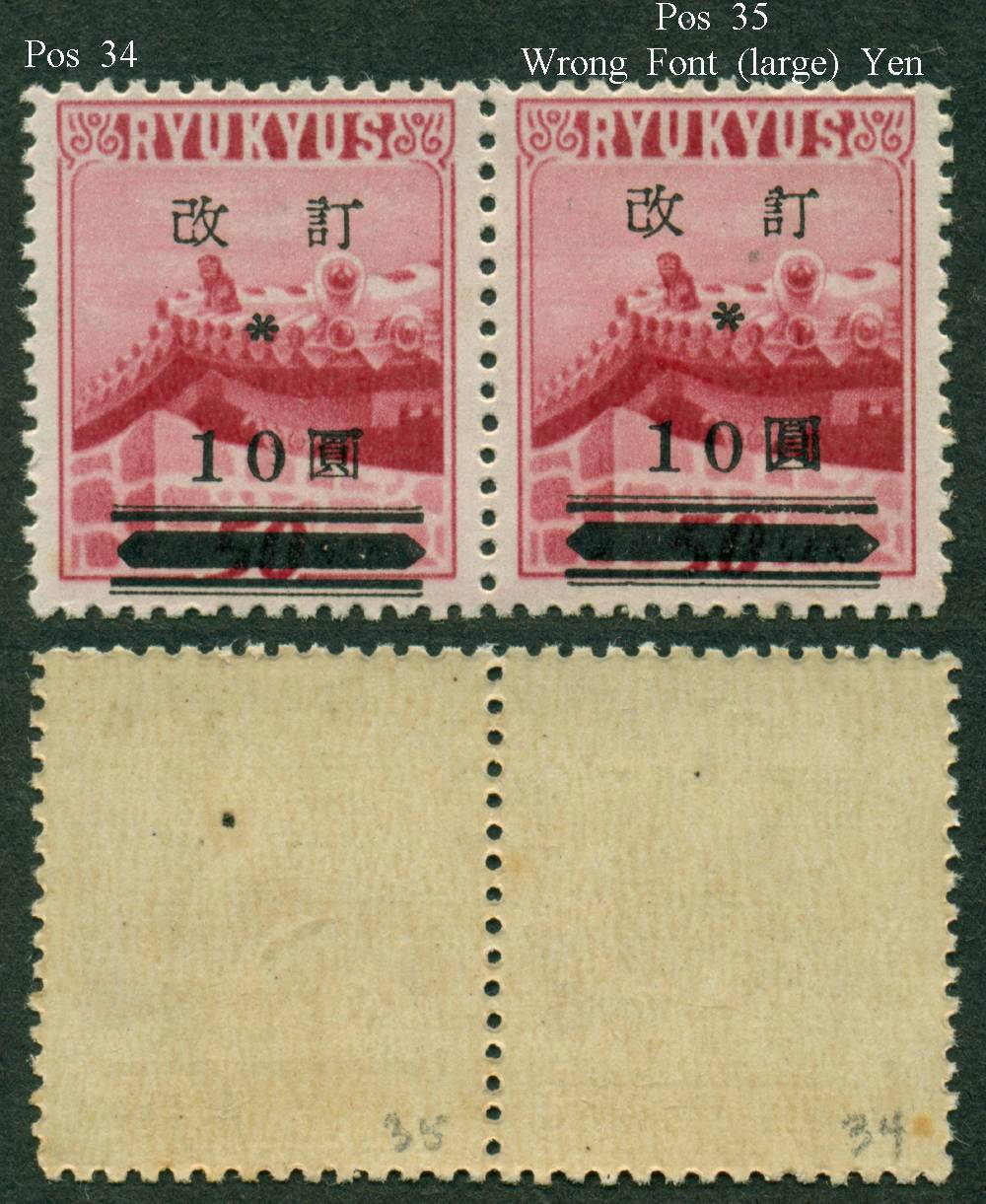
Positions 34 & 35, pic here
9 point - [Variety] Large Font Yen measures 2.5 mm on right, 2.4 mm on bottom,
diagonal measured from bottom left corner to top right corner measures 3.5 mm
8 point - [Normal} Small Font Yen measures 2.3 mm on right, 2.2 mm on bottom,
diagonal from bottom left corner to top right corner measures 3 mm
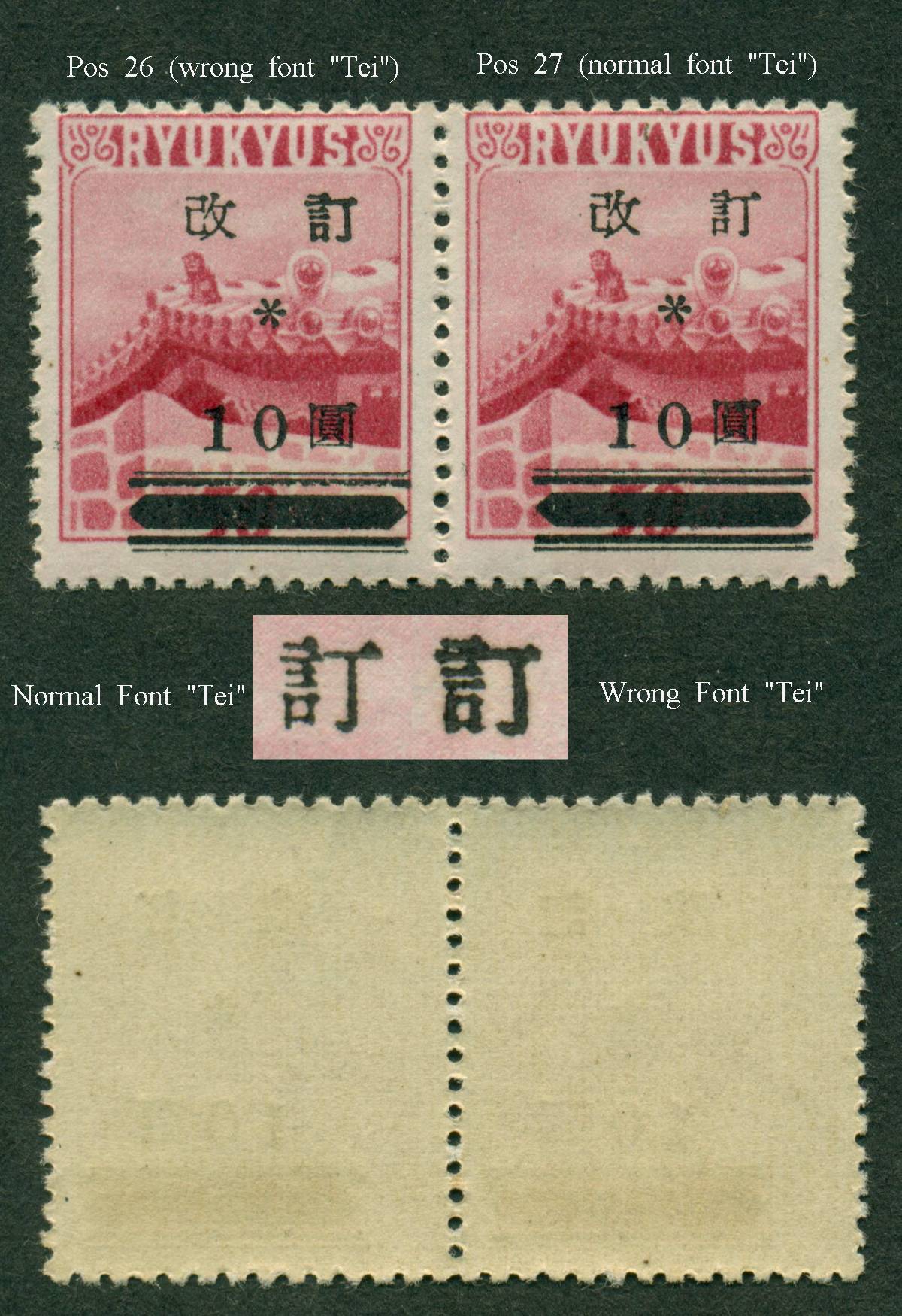
26 Small font "Tei", "j" character appears thick/darker
measuring 2.8mm horizontally by 2.6mm vertically as
compared to 2.6mm x 2.4mm.
Positions 24 & 25, pic here
Positions 25-6 & 35-6 in block of 4, pic here
Positions 25 & 26, pic here
Positions 34 & 35, pic here
9 point - [Variety] Large Font Yen measures 2.5 mm on right, 2.4 mm on bottom,
diagonal measured from bottom left corner to top right corner measures 3.5 mm
8 point - [Normal} Small Font Yen measures 2.3 mm on right, 2.2 mm on bottom,
diagonal from bottom left corner to top right corner measures 3 mm
26 Small font "Tei", "j" character appears thick/darker
measuring 2.8mm horizontally by 2.6mm vertically as
compared to 2.6mm x 2.4mm.
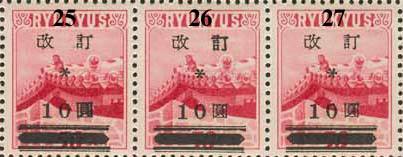 Positions 25-6 & 35-6 in block of 4, pic here
Positions 26 & 27, pic here
30 also 9 Top horizontal stroke in "Kai" is short
Positions 25-6 & 35-6 in block of 4, pic here
Positions 26 & 27, pic here
30 also 9 Top horizontal stroke in "Kai" is short
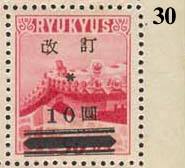 35 also 25,85 Wrong font "Yen"
Positions 25-6 & 35-6 in block of 4, pic here
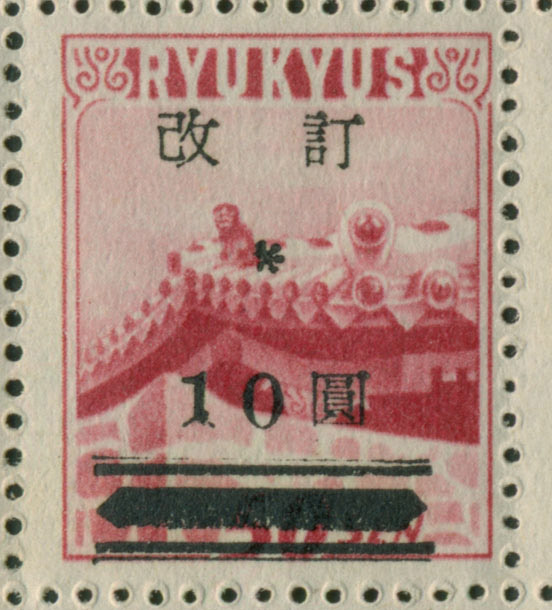
49 White spot (ca 1/3 in from left) on the large heavy bar,
sometimes referred to as "worm eaten bar"
35 also 25,85 Wrong font "Yen"
Positions 25-6 & 35-6 in block of 4, pic here
49 White spot (ca 1/3 in from left) on the large heavy bar,
sometimes referred to as "worm eaten bar"
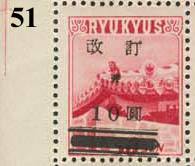
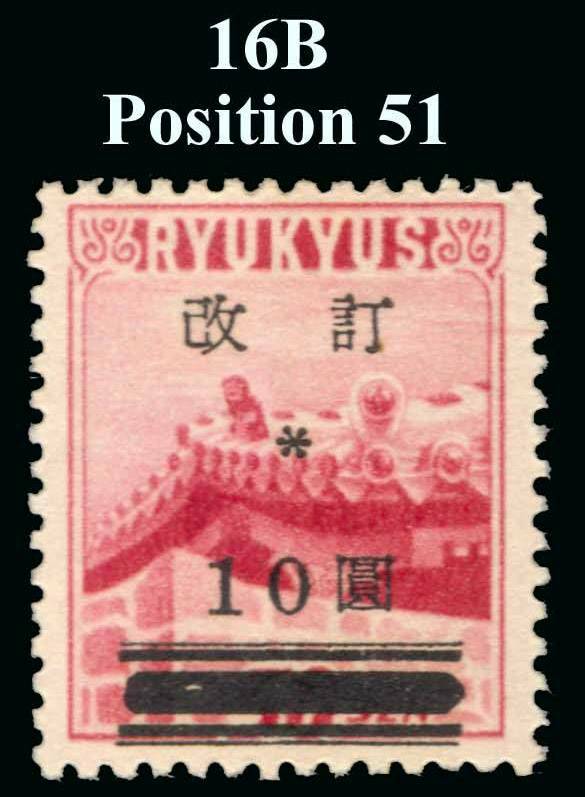
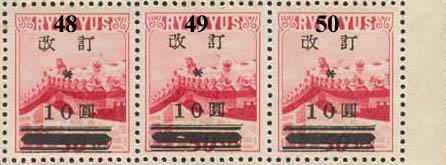 51 Left end of large thick bar rounded rather than pointed
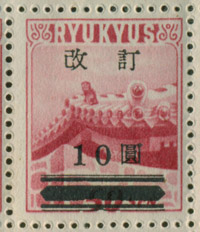
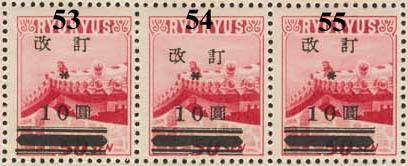
 54 Asterisk omitted -- Major Error - early printing, few
copies (8-11 copies) are known, see 71 below for another
major error.
54 Asterisk omitted -- Major Error - early printing, few
copies (8-11 copies) are known, see 71 below for another
major error.
 54 "Kai Tei" dropped - normal is 3mm between top of "*" and bottom of
"Kai Tei." Pos 54 measures 1.5(-)mm. Vertical dimension from top
of the "Kai Tei" to outside of bottom bar measures 17.5mm vrs the
normal 19.1mm. Scott describes as "Kai Tei" 1.25 above asterisk.
See 87 below for similar variety.
54 "Kai Tei" dropped - normal is 3mm between top of "*" and bottom of
"Kai Tei." Pos 54 measures 1.5(-)mm. Vertical dimension from top
of the "Kai Tei" to outside of bottom bar measures 17.5mm vrs the
normal 19.1mm. Scott describes as "Kai Tei" 1.25 above asterisk.
See 87 below for similar variety.
 Another in block of 4, pic here
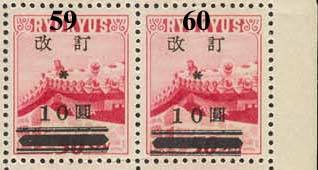
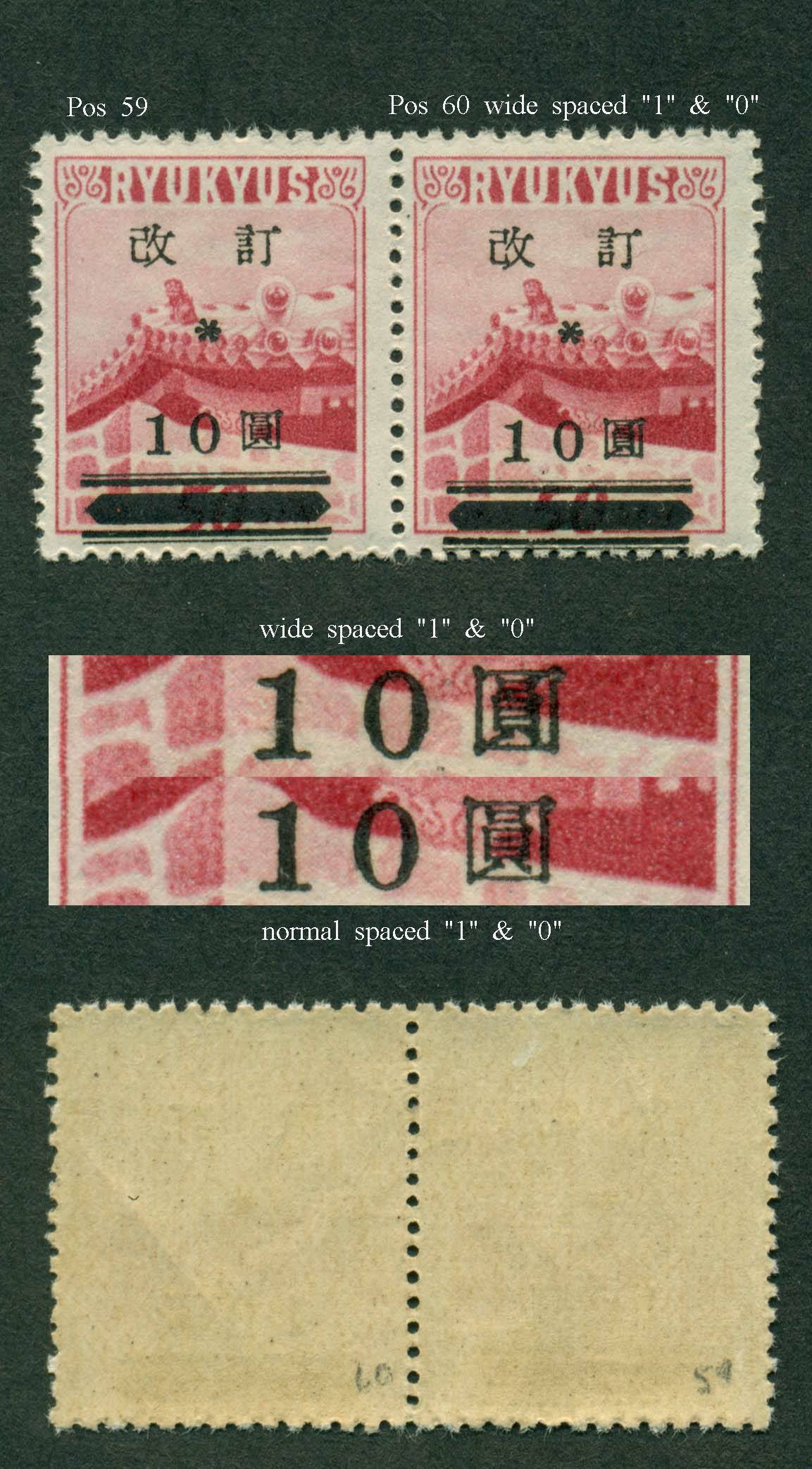
60 "1 0" spaced wider than the normal. Normal is 1.6mm
from the shank of the "1" to the left of the "0".
This variety measures 2mm.
Another in block of 4, pic here
60 "1 0" spaced wider than the normal. Normal is 1.6mm
from the shank of the "1" to the left of the "0".
This variety measures 2mm.
 Positions 59-60, pic here
62 Foot of the "1" is concave rather than flat. The top
thin bar is broken in several spots. The middle
left projection of the asterisk is missing.
Positions 59-60, pic here
62 Foot of the "1" is concave rather than flat. The top
thin bar is broken in several spots. The middle
left projection of the asterisk is missing.
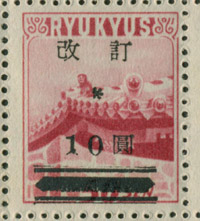 64 Right end of heavy bar rounded rather than pointed (not constant)
 d
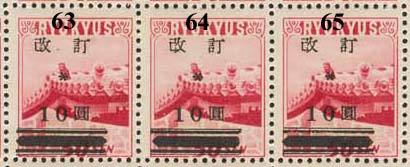
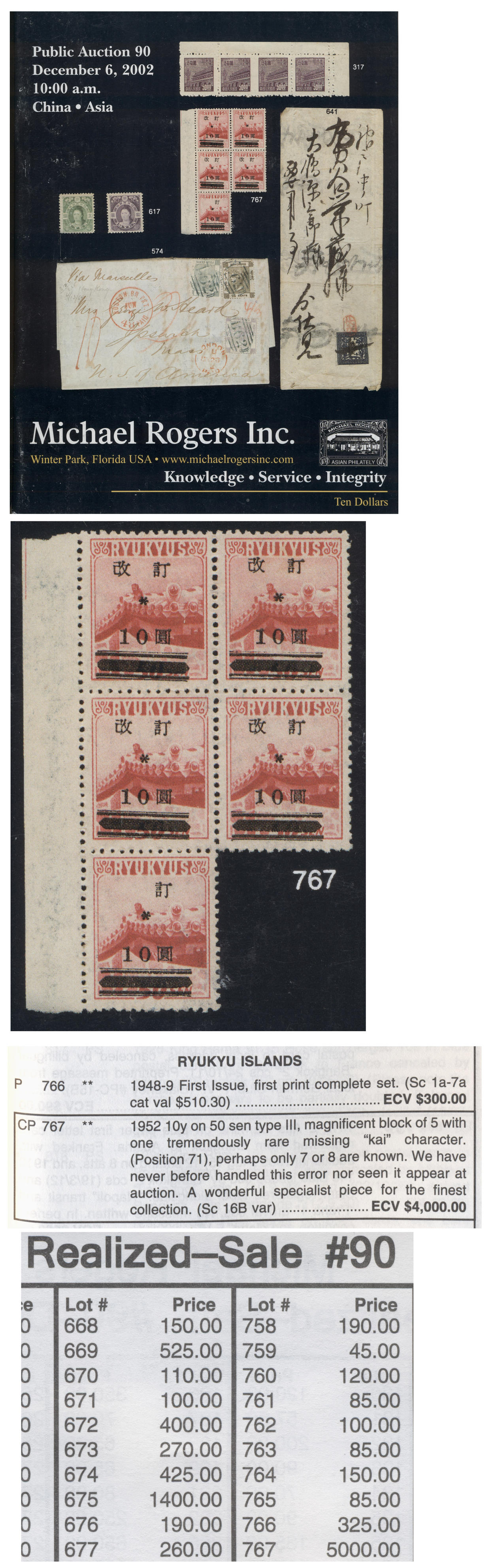
71 "Kai" omitted - Major Error - Scott 16Be & JSCA 16Cva.
A MNH block/5 with positons 51-52, 61-62 & 71 sold
in Michael Rogers Public Auction #90, lot 767,
December 6, 2002, realizing $5,000.00 + a 15% commission against
an estimated value of $4,000. Few copies (8-11 copies) are known.
See 54 above for another major error.
d
71 "Kai" omitted - Major Error - Scott 16Be & JSCA 16Cva.
A MNH block/5 with positons 51-52, 61-62 & 71 sold
in Michael Rogers Public Auction #90, lot 767,
December 6, 2002, realizing $5,000.00 + a 15% commission against
an estimated value of $4,000. Few copies (8-11 copies) are known.
See 54 above for another major error.
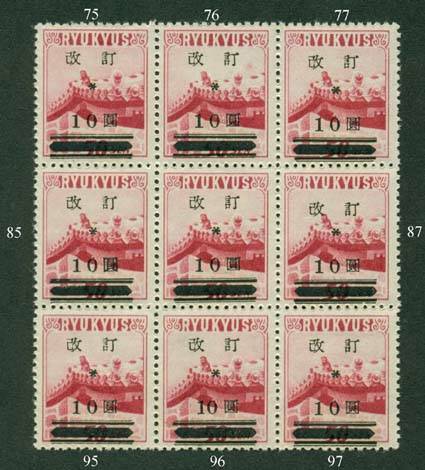
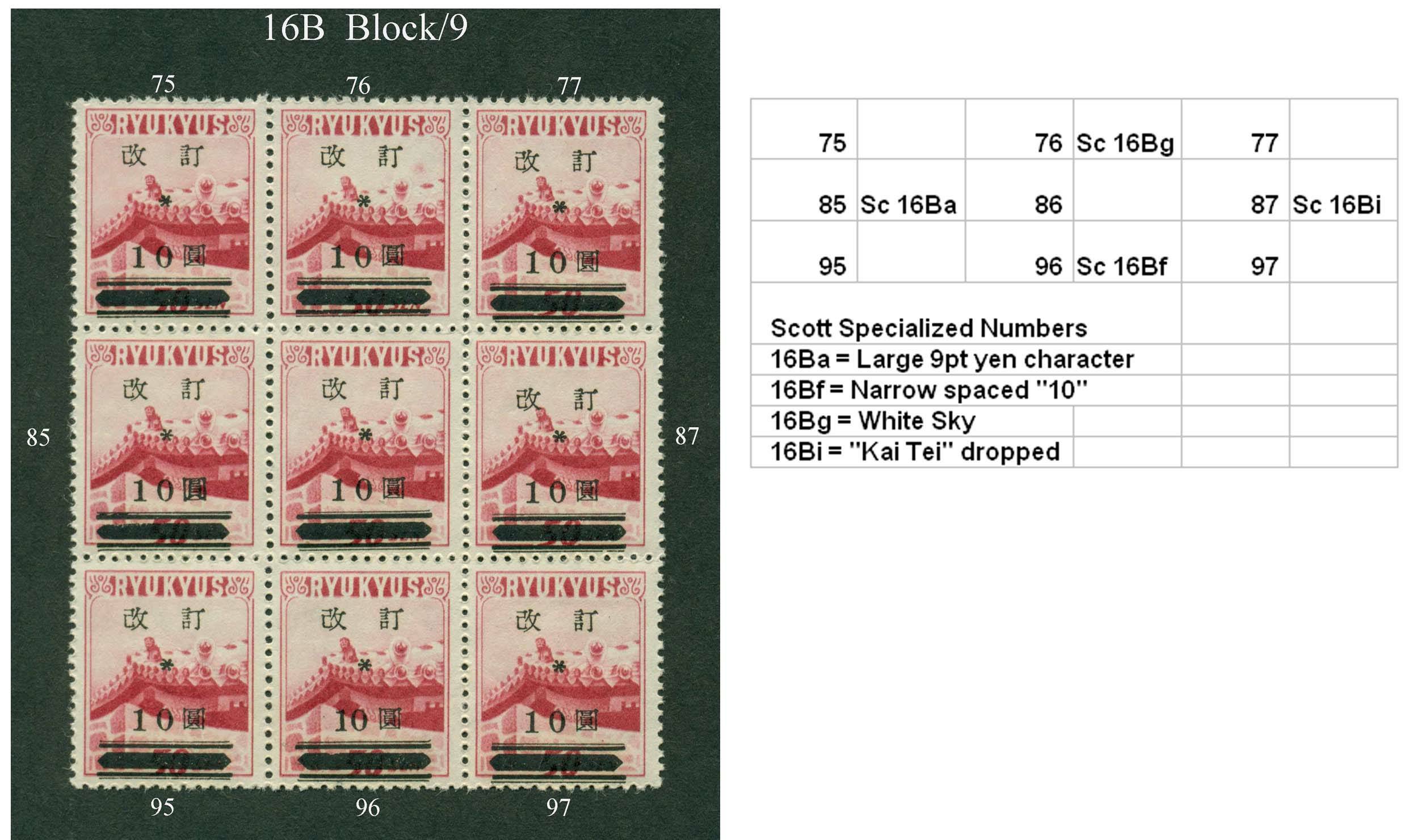
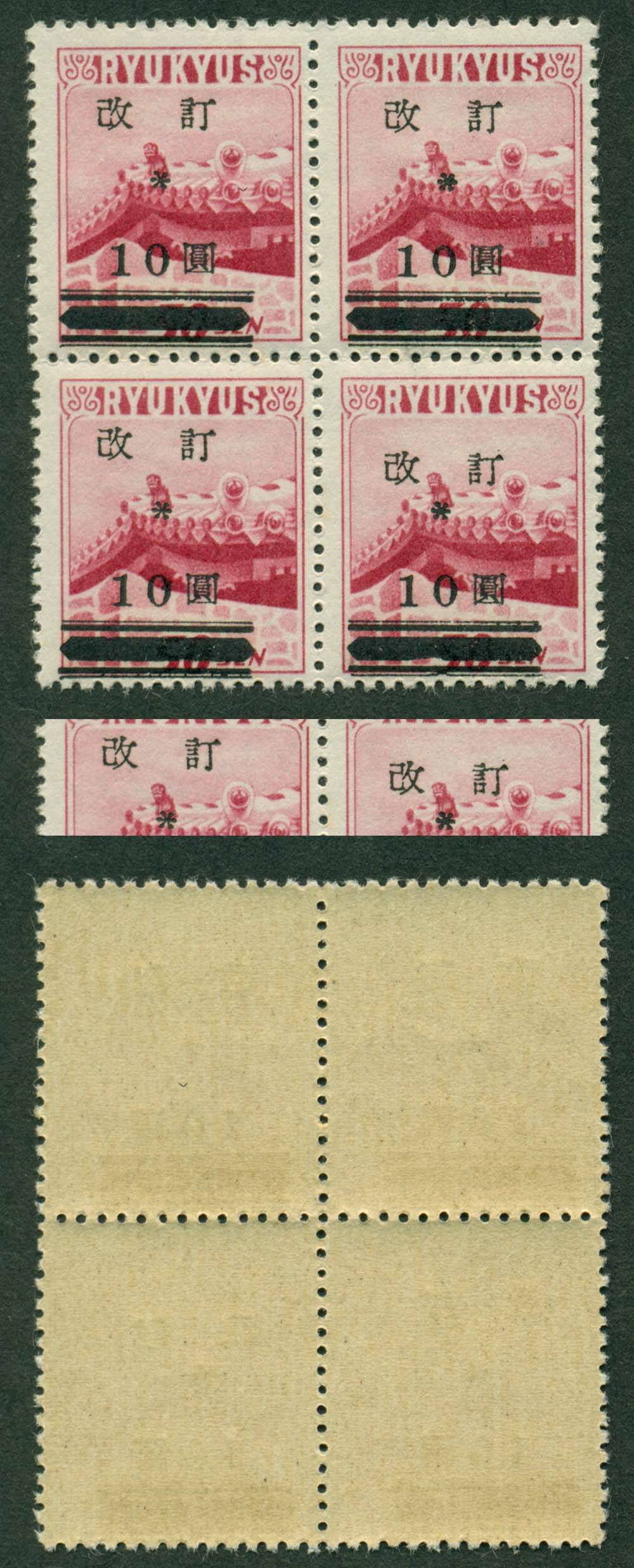
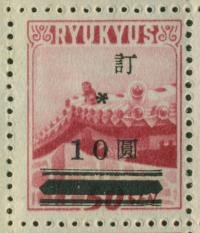 76,85,87,96 block White sky (76), large "Yen (85)," dropped "Kai Tei" (87) and
narrow "10" (96) in a block of 9 (Key Multiple in Sheet)
76,85,87,96 block White sky (76), large "Yen (85)," dropped "Kai Tei" (87) and
narrow "10" (96) in a block of 9 (Key Multiple in Sheet)
 76 White sky variety in basic stamp
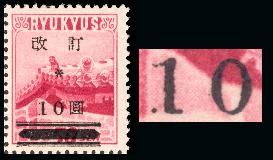
 84 "1" deformed, top serif partially missing, bottom horizontal
line to left of vertical downstroke broken or missing
84 "1" deformed, top serif partially missing, bottom horizontal
line to left of vertical downstroke broken or missing
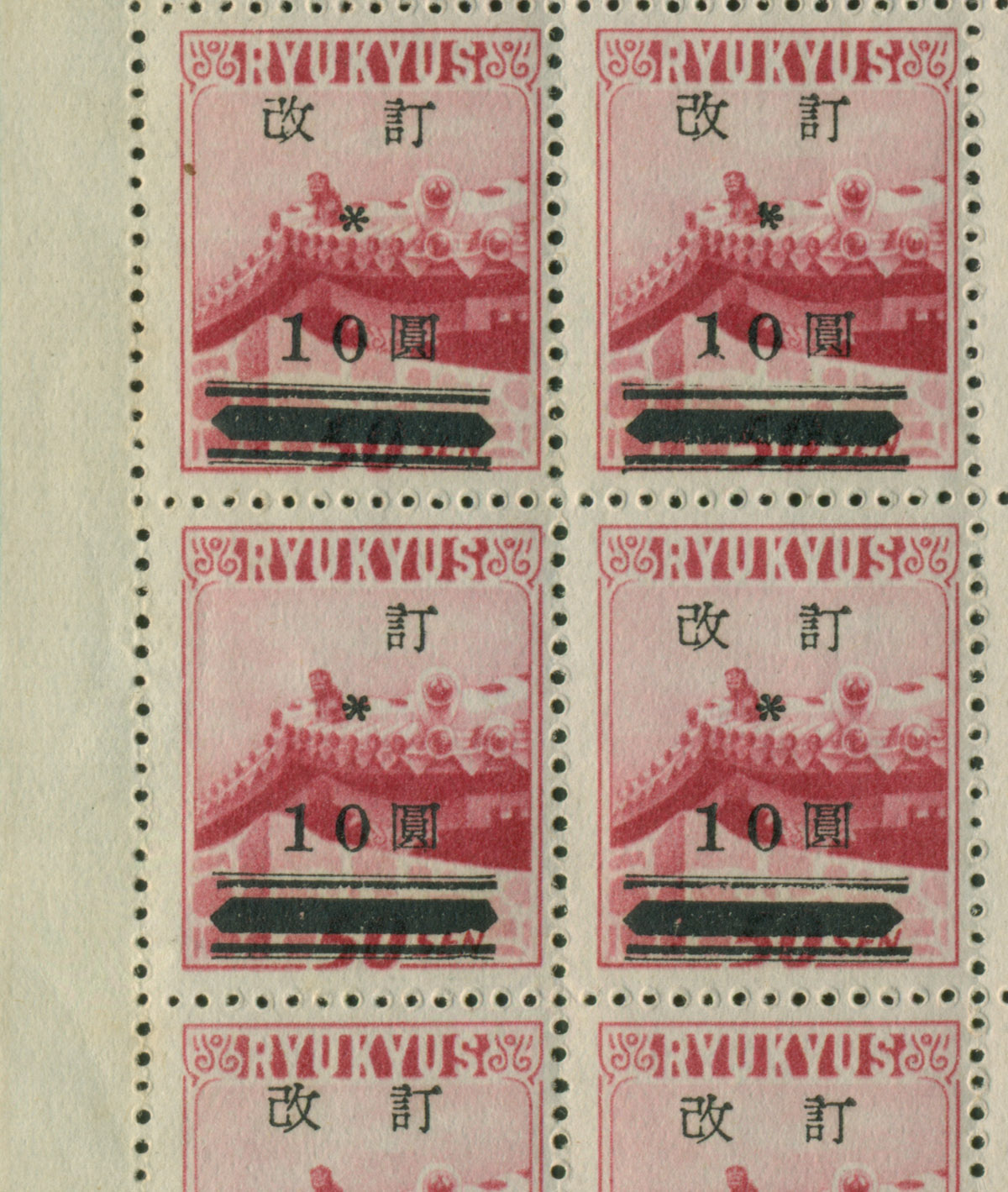
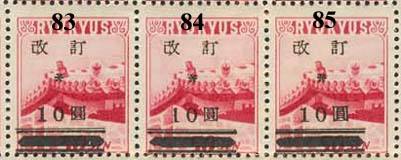 In lower right corner block, click here
85 also 25, 35 Wrong large font "Yen" - similar to 9p font
In lower right corner block, click here
85 also 25, 35 Wrong large font "Yen" - similar to 9p font
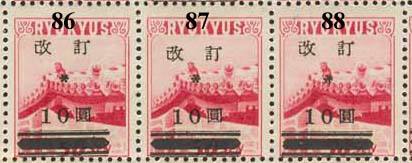
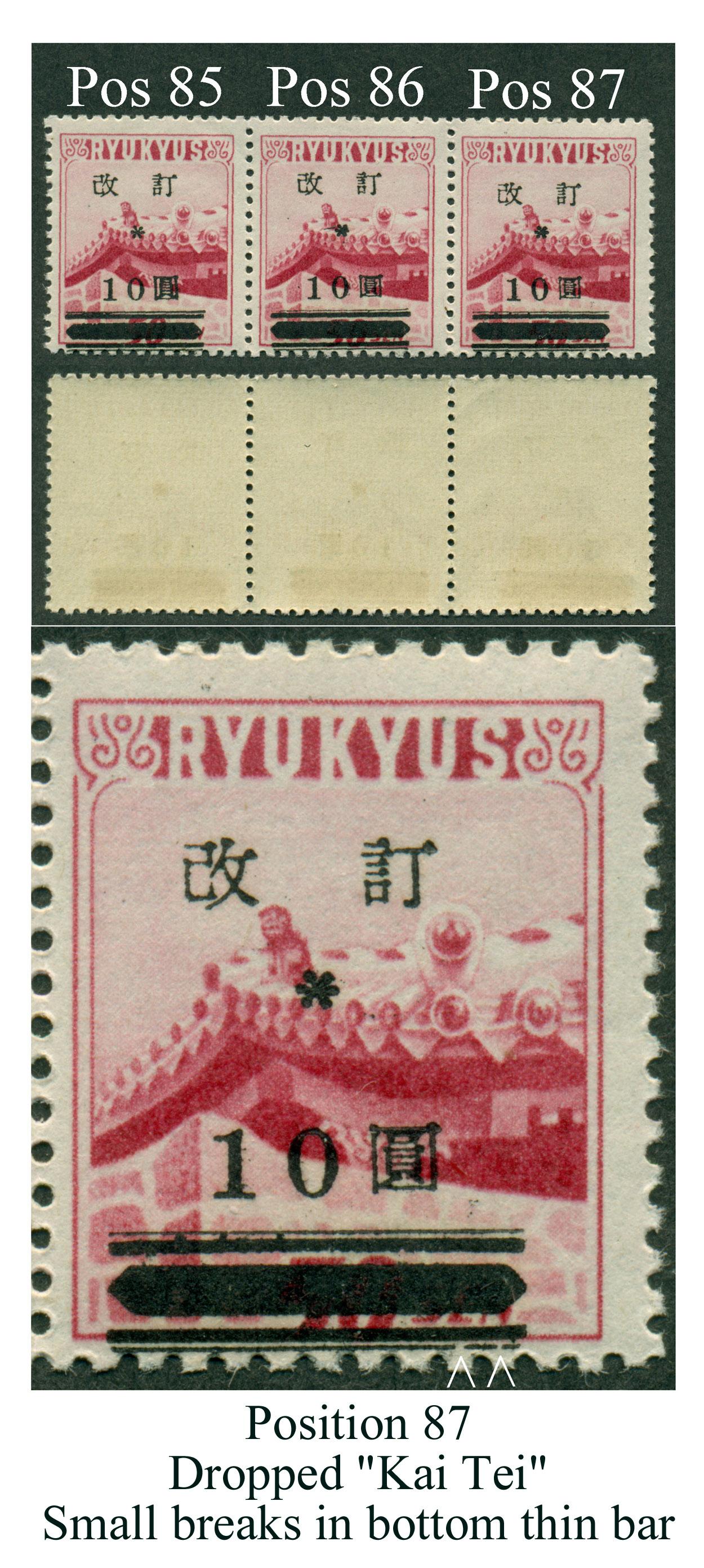
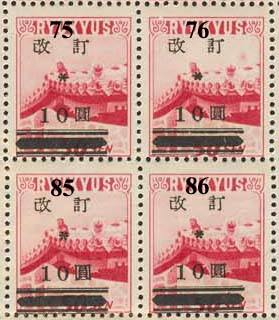 87 "Kai Tei" dropped 2mm (normal is 3mm between "*"
and "Kai Tei"), JSCA listed, Scott 16Bi. Short breaks at
right in the bottom thin bar. Vertical dimension from top
of the "Kai Tei" to outside of bottom bar measures 18.1mm vrs
the normal 19.1mm.
87 "Kai Tei" dropped 2mm (normal is 3mm between "*"
and "Kai Tei"), JSCA listed, Scott 16Bi. Short breaks at
right in the bottom thin bar. Vertical dimension from top
of the "Kai Tei" to outside of bottom bar measures 18.1mm vrs
the normal 19.1mm.
 For close-up of short breaks in bottom thin bar, click here
96 also 10 Narrow spaced "10" appears similar to 16 (2nd printing),
distance between "1" and "0" is less than 1mm versus the
norm of 1.5+ mm
For close-up of short breaks in bottom thin bar, click here
96 also 10 Narrow spaced "10" appears similar to 16 (2nd printing),
distance between "1" and "0" is less than 1mm versus the
norm of 1.5+ mm
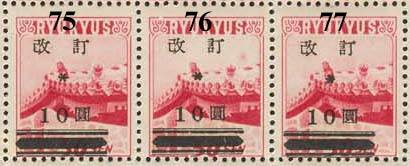
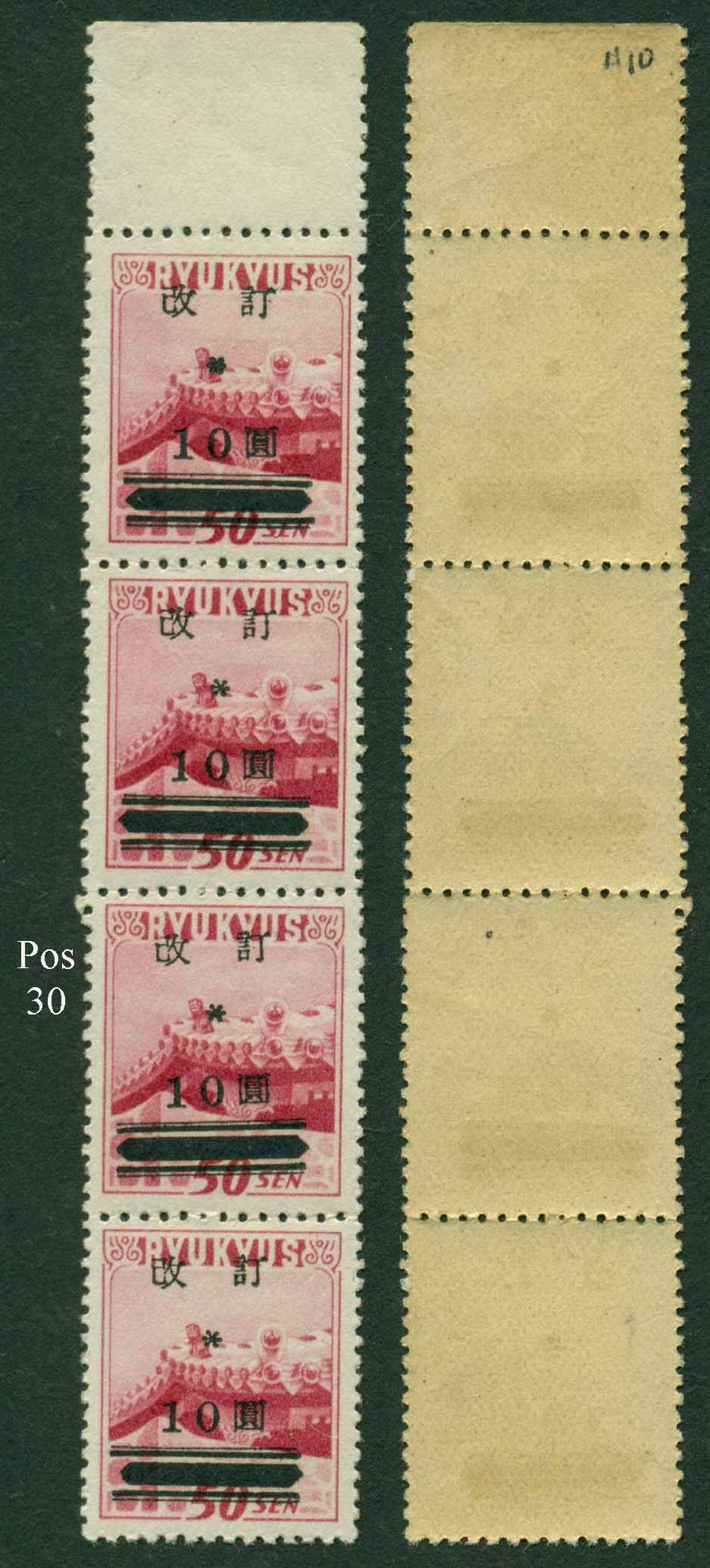
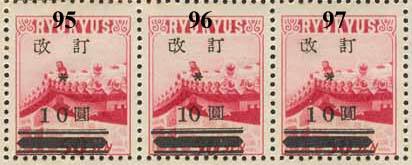 (Scott 16Bf strip of three)
Miscellaneous/Unlisted - Varieties (not in Scott or JSCA, prehaps not constant)
84 & Deformed "1"
(Scott 16Bf strip of three)
Miscellaneous/Unlisted - Varieties (not in Scott or JSCA, prehaps not constant)
84 & Deformed "1"
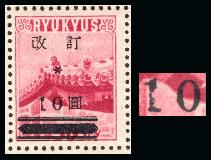 In lower right corner block, click here
94 Deformed "1"
In lower right corner block, click here
94 Deformed "1"
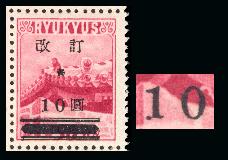 In lower right corner block, click here
In block/4, click here
"J" does not touch next character
Base of "1" broken & deformed (pos unknown)
In lower right corner block, click here
In block/4, click here
"J" does not touch next character
Base of "1" broken & deformed (pos unknown)
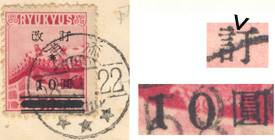 Slanting Bars Noted in numerous positions - 1, 2, 11, 12, 51, 52, 61, 62
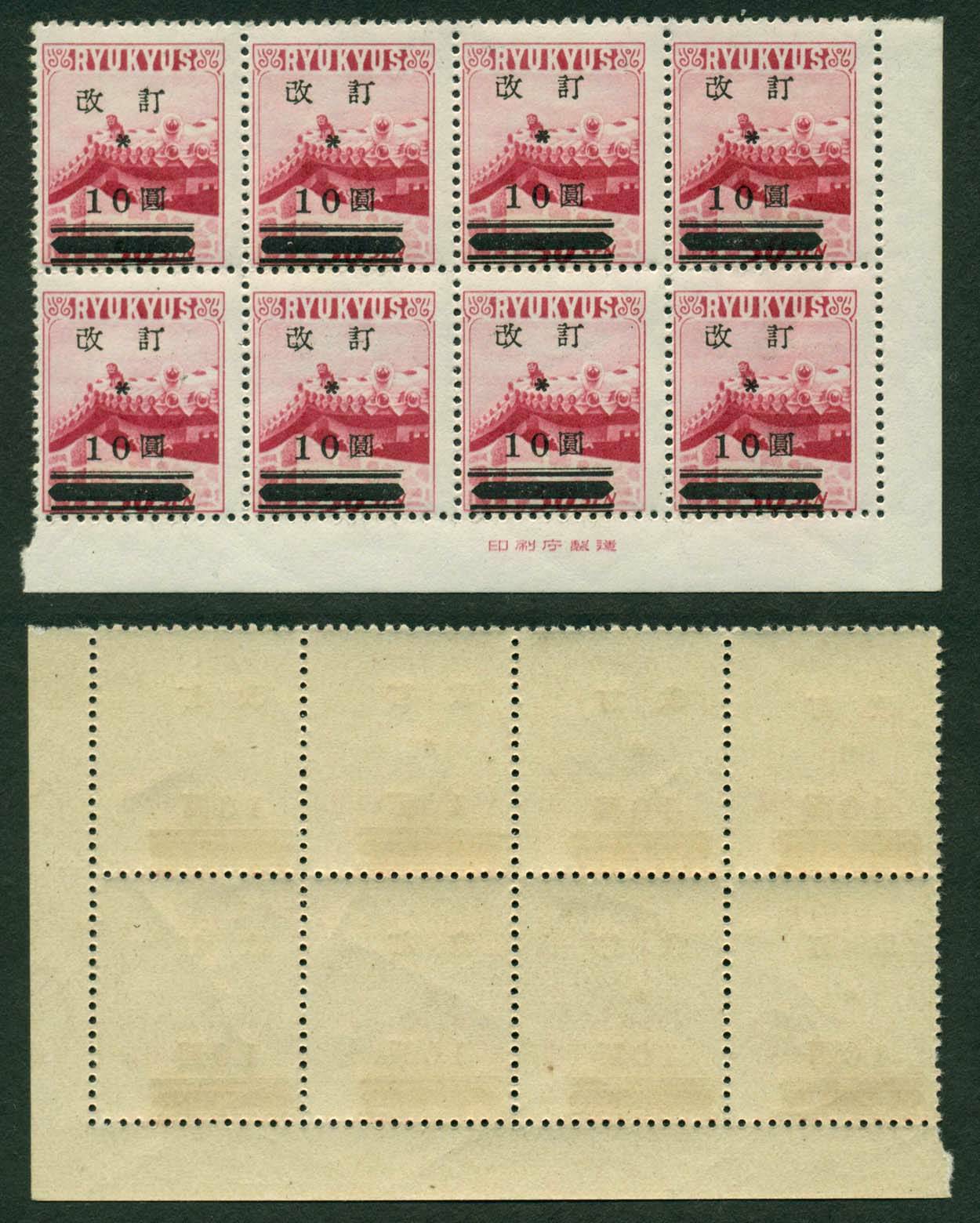
Inscription Block 6 Lower right block of six with inscription
Slanting Bars Noted in numerous positions - 1, 2, 11, 12, 51, 52, 61, 62
Inscription Block 6 Lower right block of six with inscription
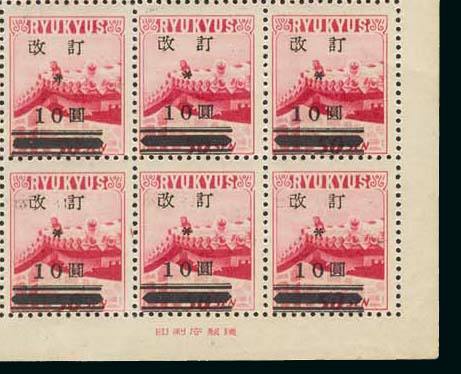 Higa Block (no) Only 2nd printing confirmed with Higa seal in upper rith selvage.
Quantity Printed:
   16       200,000
   16A      200,000
   16B       40,000
            440,000     Total
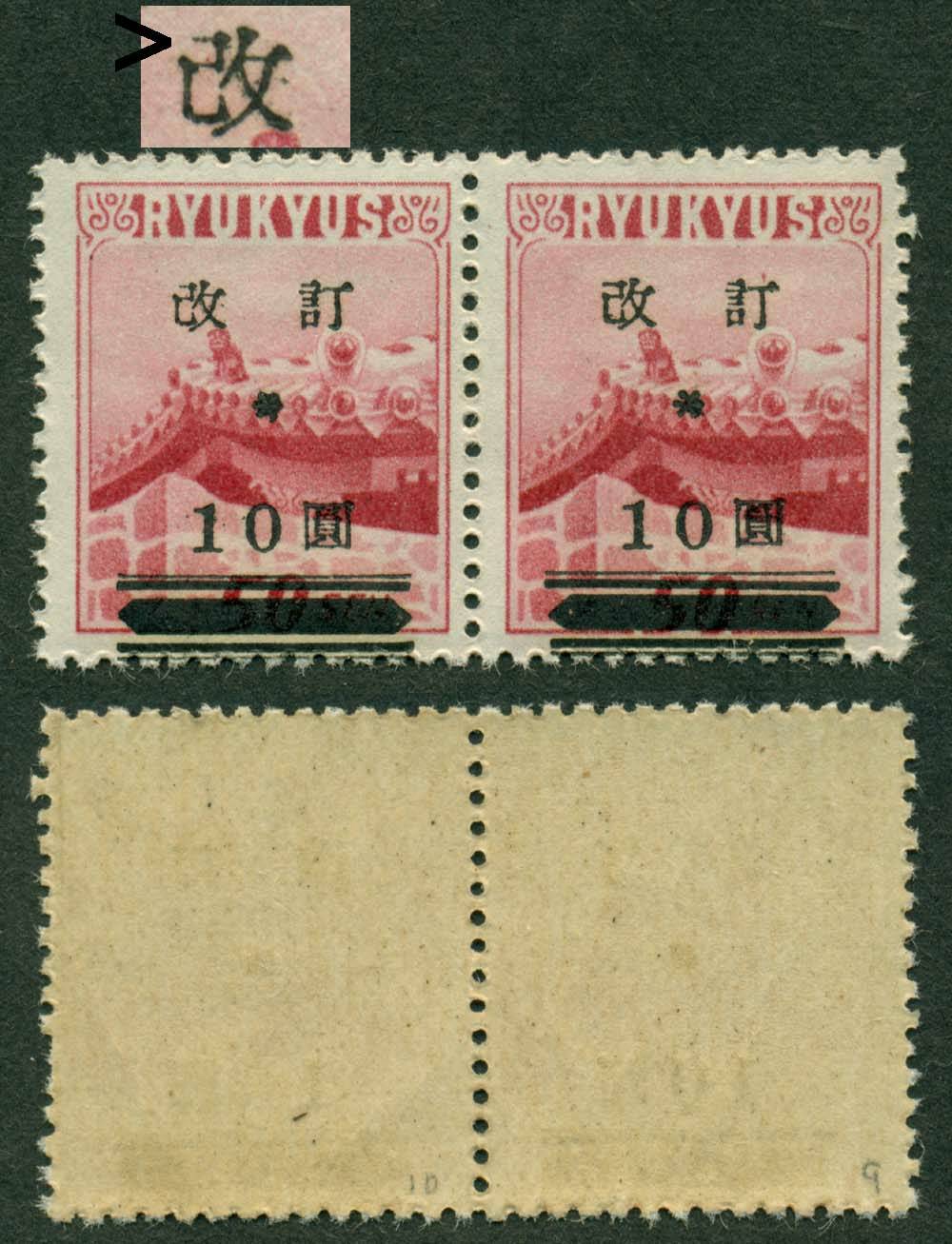
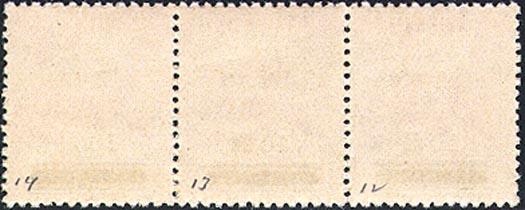
Gum on 16 Series Stamps. Don't expect to find 16 series stamps with nice clean shinny gum. While they certainly can be found in that condition, it is not the norm. The norm for this series is a dry flat appearing gum. In some cases the gum has browned slightly. Pencil Plate Position Annotations on the gum side of 16 series stamps. A common practice of dealers who broke up sheets of the 16 series was to make light pencil annotations of the sheet positions on the stamps. In my opinion, this adds to the value of the item rather than detracts. It ensures that you can quickly and accurately plate the stamp(s). Below is an illustration of the back of a 16 series stamp which shows the dry flat gum and dealer's pencil annotation of position.
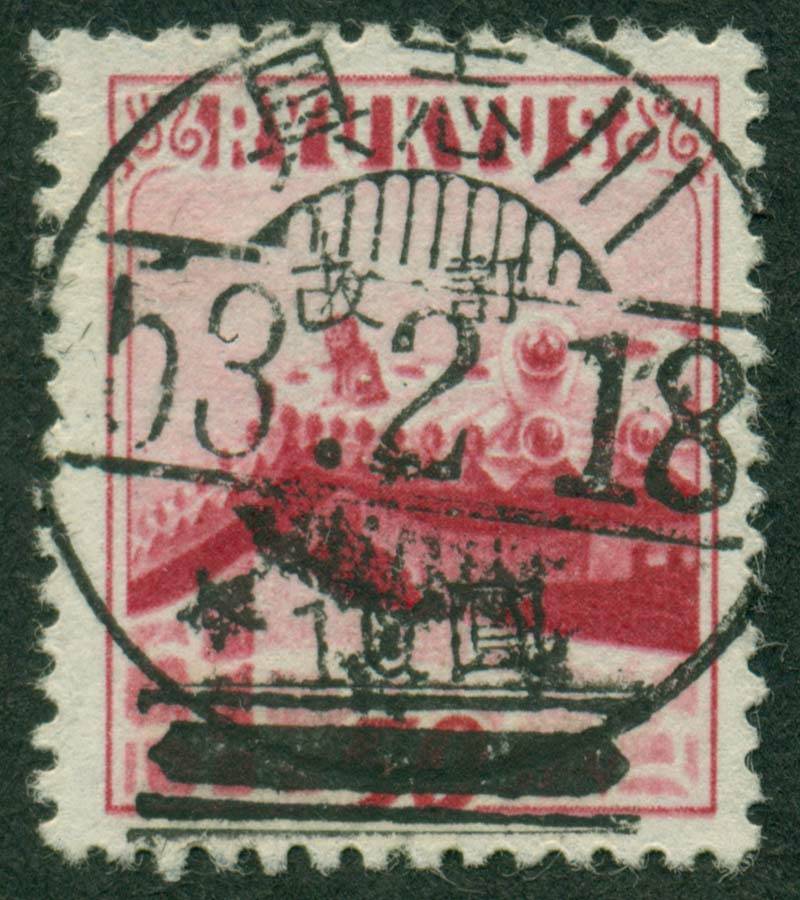
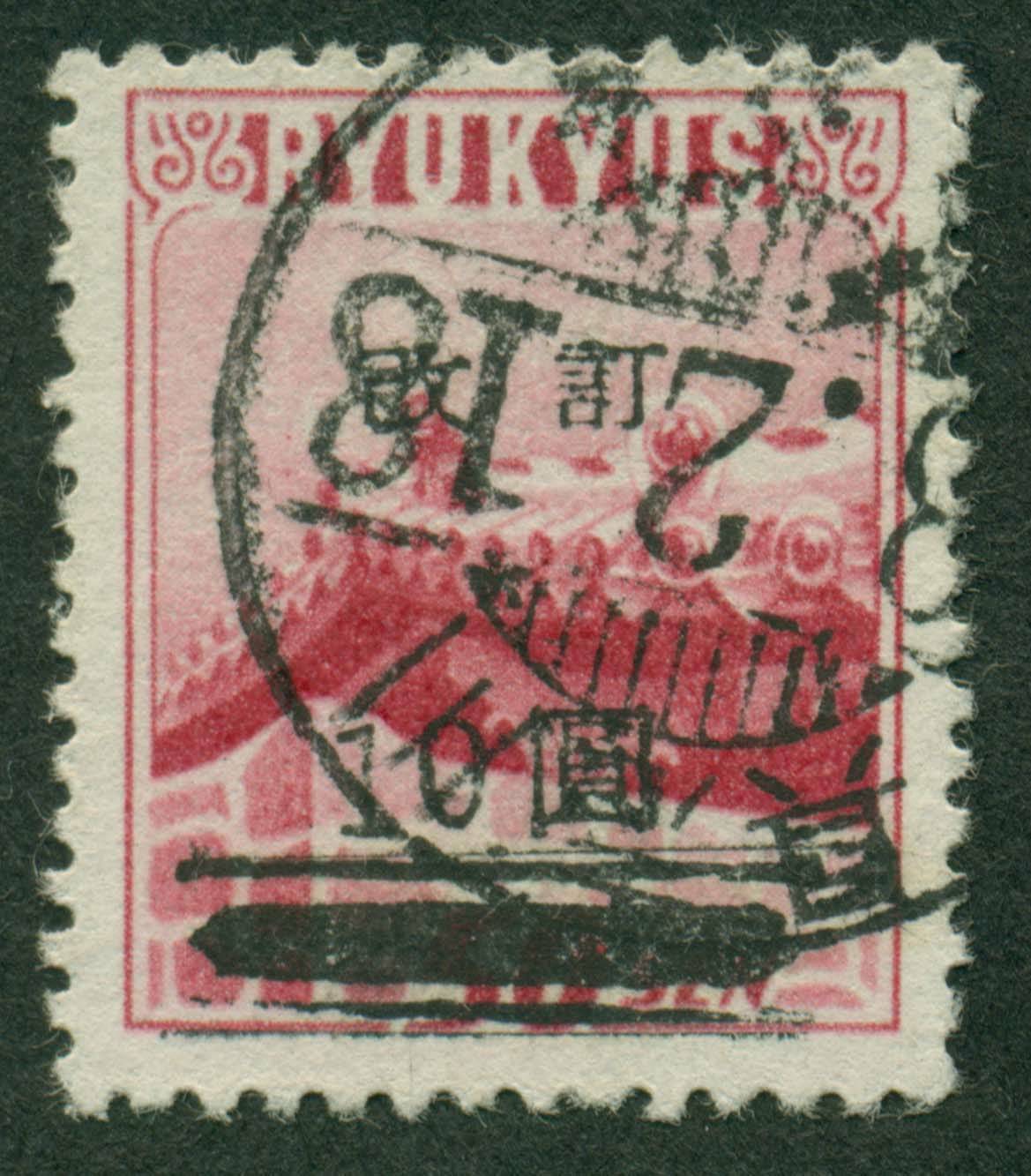
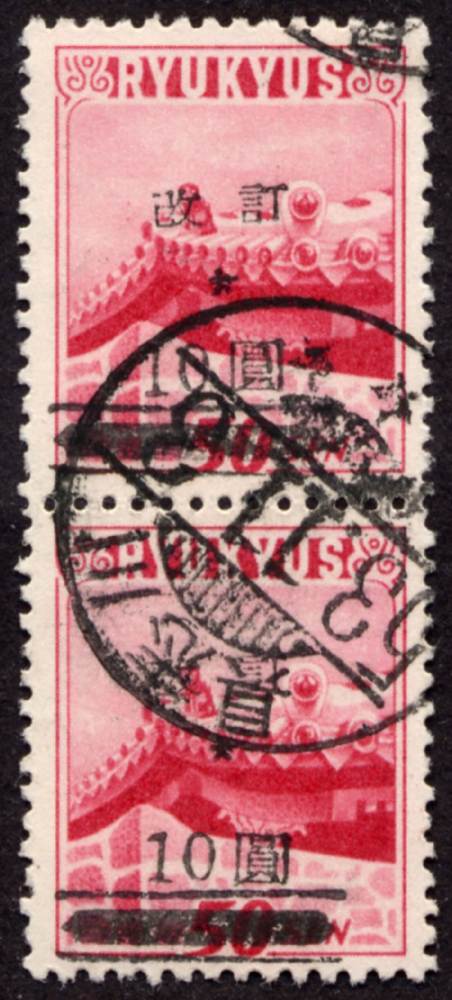
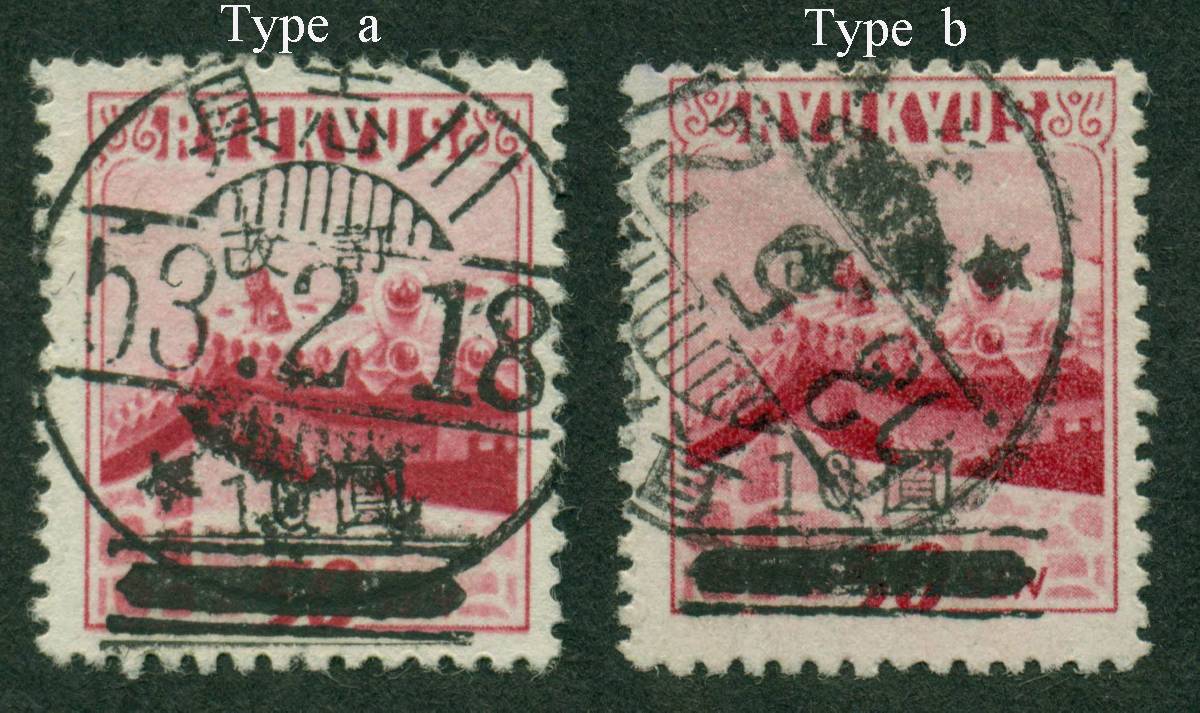
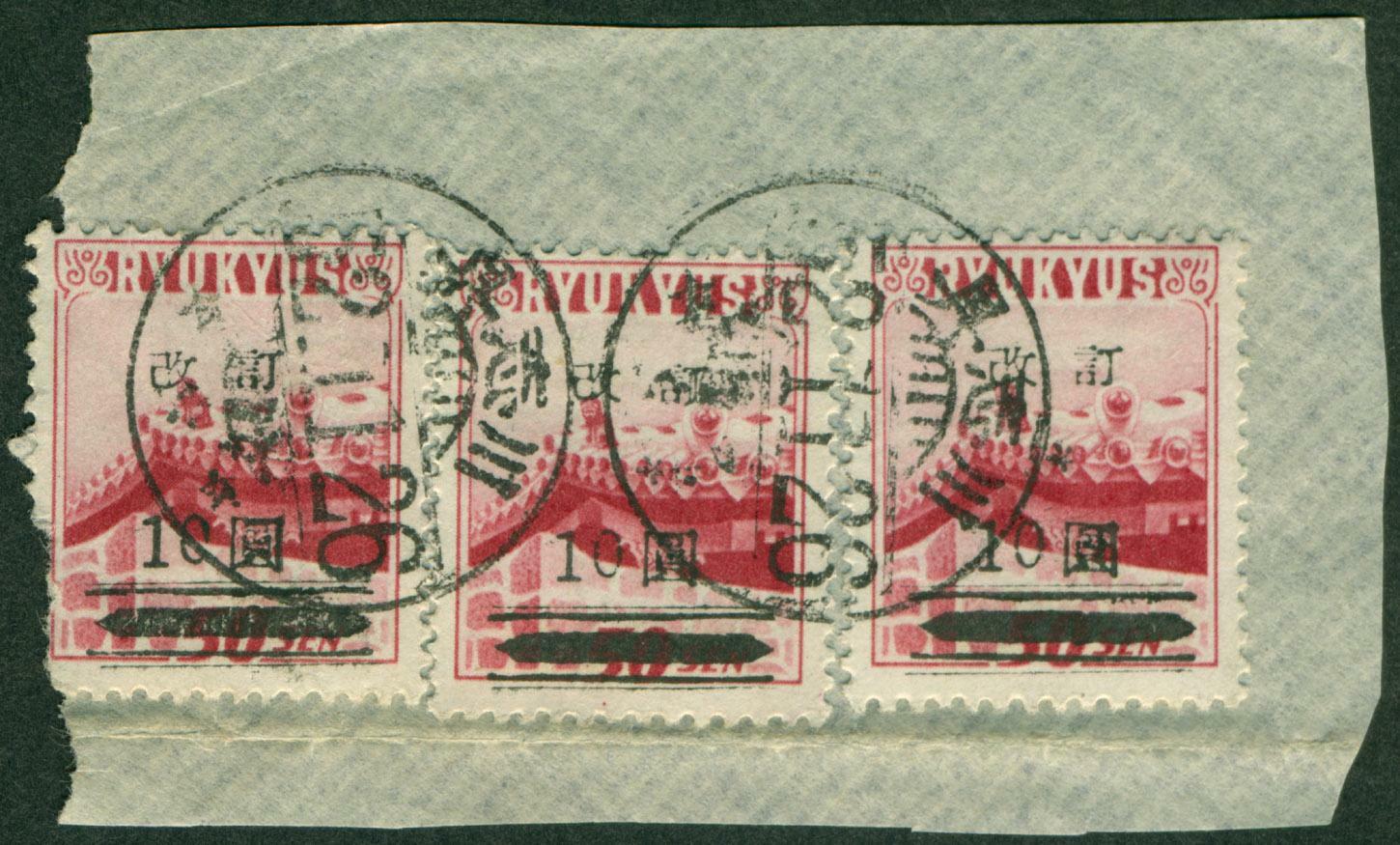
Forgeries. By the term forgery, I am referring to a stamp that was made with the intent to defraud the postal service of revenue. They are manufactured and used without paying the postal service. There are well documented forgeries of the 10 yen Kai Tei overprint. Two such forgeries are called the Gushikawa forgeries. These are discussed in From the Dragon's Den, Volume 15:2, (Whole No. 49) April, 1983. The overprints appear different than the genuine 16, 16A, 16b and they can easily be confirmed as forgeries if they have part of Gushikawa cancel (1953) as show below. Forgeries are in demand. Most collectors do not have them. Consider yourself fortunate if you have a 16 series forgery in your collection. Two types of the Gushikawa forgery have been recorded (See FTDD 15:2).
Type a. The first type has the large middle bar (pointed on both ends) with a pair of bars (thick and thin) above and below the center bar. In this respect the stamp is similar to the genuine 16s with a total of 5 bars at the bottom of the overprint. The balance of the overprint appears to have been applied separately and at times the "10" rests on the upper thin bar. The "0" in "10" is usually shorter than the "1". Dates of Use. Below are the earliest and latest date uses I have personally confirmed of both types of forged stamps.
Type a. Earliest: 52.11.26 - Latest: 53.2.18 The forgeries (to defraud the Postal Agency) are listed and valued in a footnote in the Scott Specialized Catalogue of United States Stamps & Covers at the conclusion of the listing of stamps in the 16 series. The footnote advises of the two types of forgeries. Perhaps because it is so obvious, the type b forgery is the one that I see the most.
| ||||||
Covers. Any of the 16 series stamps on cover is an excellent item. I have a steady demand for this series on cover. If you have them to sell, please contact me. |
||||||


George C. Baxley, PO Box 807, Alamogordo, NM 88311
|
|
|
|
|