We are Buying! We are interested in purchasing the type of material you see listed on this web page. If you have books to sell, please contact us.
We are Selling! Many of the items listed on this page are available for purchase. If an item is in stock, you will find a clickable link just below the heading and it will take you to the item on our Book Price List.
The period from the late 1700s through the mid-1800 was the era of great Exploring Expeditions by the major world powers. These expeditions had several purposes. They were intended to document, survey, map and generally record the places they visited. Perhaps foremost was the political purpose. The major world powers were seeking to expand their influence and bring these new areas under their influence. There were several major US Exploring Expeditions undertaken in 1830-55 period. These included:
- Charles Wilkes, Expedition to the Pacific, 1838-42.
- William Lewis Herndon, Expedition to the Dead Sea, 1847.
- James Melville Gilliss, Astronomical Expedition to Chili, 1849-1852
- William Lewis Herndon, Exploration of the Valley of the Amazon, 1851-2.
- Commodore Cadwallader Ringgold and later Captain John Rodgers, North Pacific Exploring Expedition, 1853-1856.
The Perry Expedition to Japan (1852-4) may well represent the pinnacle of these epic Naval Exploring Expeditions. Japan had long been closed to the outside world. American ships were plying the seas around Japan in increasing numbers and it was becoming imperative to open Japan to our sea commerce and trade. It was in this context that Commodore Perry embarked on his great exploring expedition.
The public was very interested in this expedition (and others also). It was closely followed in the press and printed media. In addition, the US Government recognized a responsibility to document the expedition. This was accomplished primarily through a published narrative of the expedition. The Perry Expedition included artists and a photographer. The work of these members was woven into the narrative report of the expedition to provide a comprehensive view of what was done and seen.
The Perry Expedition may well be one of the best documented of all these great Exploring Expeditions. This was passed down in the official Narrative published by order of Congress and numerous unofficial accounts published over the years. The numerous books and publications pertaining to the expedition are outlined below.
1856-1858 Narrative, Three Volume Set
Original Narrative of the Expedition
Perry, Commodore M. C.,
Hawks, Francis L., compiler:
Narrative of the Expedition of an American Squadron to the China Seas and Japan, Performed in the Years 1852, 1853, and 1854, under the Command of Commodore M.C. Perry, United States Navy.
Printed by Order of the Government of the United States. Compiled by Francis L. Hawks. First Edition, two different printers (Nicholson & Tucker), Washington, 1856-8, 3 Volumes. One authorized by the US Senate (Senate Printer - Beverley Tucker) and the other by the US House or Representatives (House Printer - A. O. P. Nicholson). In addition, a full and unabbreviated version of the Narrative was printed privately by D. Appleton. This privately printed version is identical to the two government authorized versions and is not to be confused with abridged versions printed by Appleton.
The narrative is illustrated with numerous black and white, tinted and hand-colored lithographs, folded maps, 352 wood-engraved charts of the night skies, drawings in the text, and a fourteen page facsimile of the treaty with Japan in Japanese calligraphy. The book measures approximately 24cm x 29.25~.75cm (9.5 x 11.75+ inches) [4to - quarto].
The Narrative was actually written under Perry's supervision by Reverend Francis L. Hawks and Dr. Robert Tomes. Hawks was the rector of Calvary Church, New York City and Tomes was a physician who was just beginning a career as an author. Perry was an Episcopalian and this influence, combined with Hawks background, explains the Protestant-moralist ethical tone of the Narrative. Some scholars believe that Heine (the expedition artist) also contributed in writing the Narrative.
Printers:
Beverley Tucker, Senate Printer, 1856-1858, Washington
A. O. P. Nicholson, House Printer, 1856-1858, Washington
D. Appleton & Company, private printing, 1857, New York (only Vol 1 confirmed)
Summary of Lithographs - Prints - Maps etc
Volume 1, Original Narrative (1 of 3 Parts)
Available - Volume 1, Rebound, Beverley Tucker, Senate Printer - Purchase Here
Available - Individual Lithographs from Vol 1 - Purchase Here
Volume 1, Original Narrative, 1856 (Tucker and Nicholson) & 1857 (Appleton). The first volume (Tucker, Nicholson & Appleton) (537 pages) is a chronological account or narrative of the expedition. It contains the following art and illustrations:
- 89 or 90* lithograph plates, all but one color (tinted lithographs and chromo-lithographs)(the image area is generally 15½-16 x 22½-23cm and sheet size is generally 22.25~23 cm x 28.5~29 cm).
- 3 "facsimiles" of Japanese woodblock prints - 2 folding (included in the total count of 89/90 lithographs above).
- 6 maps & charts - 2 folding.
- Numerous (78 listed) woodcut engravings in the text.
The unabbreviated Appleton printing of Volume 1 is not widely know. However, the book is listed in the Library of Congress catalogue (LC Control Number: 03022255). I have found no evidence that Appleton published unabbreviated versions of Volumes 2 and 3 and doubt that the company did.
Volume 2, Original Narrative (2 of 3 Parts), 1858
Volume 2, Original Narrative, 1858. This volume (414 pages) is made up of a series of reports, most by expedition members on the topography, geology, botany, agriculture, and resources of the countries visited. It also contains military orders and correspondence of Commander Perry. Unlike Volume I, which has a total of 89 (90) lithographic plates - most tinted, this volume has a wide variety of plate types. There are uncolored engraved plates (4), hand colored engraved plates (13), tinted lithographs (4) and hand colored lithographs (6). This comes to a total of 27 diverse type full page plates. For detailed information on this volume, click here.
The following art and illustrations are in this volume:
- 4 tinted lithographs of Chinese scenes;
- 2 uncolored engraved plates of animals (natural history);
- 6 hand-colored lithographs of birds;
- 10 hand-colored steel-engravings of fish;
- 5 engraved plates of shells - 2 hand-colored;
- 16 diagram plates of winds & currents;
- 14 page facsimile of Japanese language version of
the US-Japan treaty;
- 17 folding maps/charts (2 merged with text and 15 (14 map sheets with 15 maps) at the end of the volume);
- 10 woodcuts in the text.
The bird section of Volume 2 was prepared by the noted ornithologist, John Cassin, and is well illustrated with six hand-colored lithographic plates. These are the only hand-colored lithographs in the Narrative set. They are quite attractive with strong vivid colors.
While I have not personally examined the item, I have been advised that the Government prepared and distributed the 15 maps (14 map sheets), found in the back of Volume 2, as a separate volume. The covers of the map folio being identical to the bindings used on the other three volumes. The set reported with the extra volume for the maps was a Nicholson printing in blue embossed binding. Information/confirmation of this "4 Volume" Government bound set would be appreciated. Privately binding the maps into a separate volume is not uncommon. A Government prepared binding of these maps using the original boards/spine is scarce or perhaps rare.
Volume 3, Original Narrative (3 of 3 Parts), 1857
Available (Vol 3, Nicholson, Original Binding) - Purchase Here
Available (Vol 3, Nicholson, Rebound) - Purchase Here
Volume 3, Original Narrative, 1857. United States Japan Expedition. Observations on the Zodiacal Light, from April 2, 1853, to April 22, 1855, made chiefly on board the United States Steam-Frigate Mississippi, during her late cruise in eastern seas, and her voyage homeward: with conclusions from the data thus obtained; by Rev. George Jones, A.M. [Observations on the Zodiacal Light], xliii, 705 pp., [large 4to+ - quarto], 352 full-page plates. This volume has woodcut white on black star charts throughout. This volume was originally intended to be an extensive illustrated account of the botanical aspects of the expedition. Unfortunately, a very serious dispute developed between the Department of State botanist (Dr. Morrow) who accompanied the expedition and Commodore Perry and the plan for a botanical volume was abandoned in favor of the highly technical and much less appealing Zodiacal Light (star chart) volume. For more information on this controversy, click here.
Covers. For a description (with pictures) of the book covers, as issued, visit the covers page. The original covers have embossed images. The cover size (original binding) for the Tucker and Nicholson books is 30 x 24 cm - 12 x 9 1/2 in. The books are frequently found rebound, particularly Volume 1. Rebound books often have smaller covers and the pages have been trimmed in an effort to present a cleaner and more uniform appearance. Normally the original covers/spine are a green cloth however, they are also found in a blue-gray cloth. The boards have embossed illustrations (blind, no gilt) front and back and the spine has gilt stamped letters. The green cloth cover seems to predominate. I have confirmed a Volume 2, Tucker printing, and a Volume 3, Nicholson printing, with the original covers (embossed cover and stamped letters on the spine) in the blue-gray cloth. The covers of the 1857 Appleton unabridged volume 1 are brown blind stamped gilt tooled full morocco. The spine has five ridges (gold gilt) and the title "Perry's Expedition to Japan" in gold gilt and all three exposed edges are gold gilt. The covers of the Appleton volume 1 measure the same as the Tucker and Nicholson editions (30 x 24 cm).
General Comments.
This work is the detailed and profusely illustrated account of Perry's expedition to open Japan to the West.
Retail (Three Volume Set): $1,600-$5,000. This set is scarce. Retail prices vary much depending on condition and printer. The books are normally found in Fair or Good condition with significant problems (see comments regarding condition below) and often have been rebound or repaired. I would estimate that of an aggregate set value (3 volumes) the percentages are:
78% for Volume 1,
16% for Volume 2 and
6% for Volume 3.
It appears that the Senate printing by Beverley Tucker is the scarcer of the two Government printings. Except for the lithographic plates and maps, you seldom see the individual components of an individual volume offered.
Condition (Three Volume Set). It is my experience that most books offered from the three volume set are in "Good" condition. It is common to find them described as having "intermittent/scattered/occasional/some foxing" - "occasional water staining" - "light/medium/heavy staining" - "browning" - "few pages with ragged edges" - "some loosening of plates" - "some plates loose (completely free of binding)" - "maps with tears at the folds" - "occasional offsetting from images/text" - "staining along the fore-edges" - "covers worn/rubbed/chipped/bumped scraped" - "insect holes on covers" - "somewhat worn but generally ____" (fill in the blank, generally too high a grade for the book) - "almost/near good" - "bullet holes and bloodstains"(just kidding!) and on and on. I have found that a "Good" or "Good+" is the norm for this book. To see an example of a "well worn" book from this set, click here. A genuine Very Good set with little or no staining, foxing, browning etc is, in my opinion, a very scarce item. I find that Volume 3 is generally the cleanest of the three as it was probably opened the least.
Condition of Individual Lithographs and Book Grading. Because a major portion of the value of Volumes 1 & 2 lies in the lithographic plates, I have established my own system to grade these plates. My system is discussed here. I rank them on a scale from 5 (Best or Above Average) to 3 (Average) to 1 (Poor or Below Standard). Missing or duplicate plates are ranked as 0. When I offer these books I assign a value to each lithographic plate and outline that plate by plate. The numbers are then totaled and divided by the number of plates for an overall average. Using this system, the buyer has a better idea of the contents of a given book.
Dates of Publication. Volume 1 was published in 1856 (1857 for Appleton). It was followed by Volume 3 in 1857. Volume 2 was published in 1858.
Illustrations in Volume 1 and 2.
The three volume set (particularly Volumes 1 and 2) is a fascinating study in the state of art of book illustration in the United States during the mid-1850s. The books were commercially produced at government expense and that removed a common limitation/impediment, financial constraints. Deep pockets were available to finance the art work/illustrations to be incorporated into the Narrative and the finished product is a testimony to that fact.
At this time, book illustrations were hand-created and executed by the craftsmen. The mechanical processes (photogravure, collotype and trichromatic half-tone) would not be widely employed until the 1870-80s. The tedious/labor intensive lithographic process was the premiere method (since the 1830s) for creating book illustrations and it was heavily employed in the Narrative. Various other forms of engraving (woodcut and steel) were also employed to create illustrations. The fine color plates brought to life by craftsmen certainly distinguish the Narrative as an excellent example of the highly sought American color books of the 19th century. The massive quantities of color illustrations produced by Government sponsored projects like this Narrative and the 13 volume Pacific Railroad Survey series were important factors in the growth of the lithographic industry in the mid-1800s. It has been estimated that the Pacific Railroad Survey books required the production of a total of twenty-one million plates (color and black and white) during the period of 1855-1860. While the Perry Narrative was on a much smaller scale, it also added a significant amount of color plate production to the printing industry.
Not only does the Narrative report the account of this critical historical mission, it documents the people, places and things encountered during the expedition lavishly with illustrations. An accomplish artist, Wilhelm Heine, and a noted daguerreotypist (early photographic process), Eliphalet M. Brown, Jr. were selected to accompany and document the expedition. Their paintings and daguerreotypes (and the work of others also) were then converted to lithographs and engravings for the printed work.
In Volume 1 there are 89/90 handcrafted lithographs, each a work of art to itself. Of these lithographs, three are chromolithographs (multi-color), one is a black and white lithograph and the balance are tinted lithographs. The lithographs are not assigned page numbers. There are 537 numbered text pages in Volume 1. This is a ratio of approximately one (1) full plate/page lithographic illustration for every six (6) pages of text. In addition, the text pages are extensively illustrated with woodcut engravings, some approaching 1/2 to 3/4 page in size. Volumes 1 and 2 are supplemented with 20 maps ranging from single sheet size to large multi-fold format.
To better understand the lithographs from the Narrative, there are several detailed pages on this site that will be of assistance. These page are:
Printing Numbers. I have not found exact printing figures on the Narrative published by the US Government. An 1856 article in Putnam's Monthly Magazine (Volume VIII, Issue 44, page 218) asserted that 18,000 sets were produced at a cost of $20.00 each. The article also alleged that each Congressman was allocated 50 copies and most of them were sold to booksellers. Obviously, the lavish Narrative was not free of criticism. It can be confirmed that the House of Representatives passed a resolution ordering 10,000 copies be produced with and additional 500 for presentation to Commodore Perry (House Resolution). I believe 18,000 sets is a reasonable estimate of the number of complete sets produced for the Government. William Elliot Griffis in his book, Matthew Calbraith Perry, placed the quantity of sets printed to be 18,000 (see page 385). In the book Okinawa, the History of an Island People, George H. Kerr concluded that 10,000 sets were produced at a total cost of $360,000 and of this total Perry received 1,000 sets. If the figure of 18,000 sets is correct, then at $20 each set, the amount would be the same total cost ($360,000) as Kerr states. It appears to me that Kerr may be in error on the quantity but not the total cost to the Government. An article by William Elliott Griffis published in 1885 cites a total production of 18,000 sets in these terms:
The printing of the work illustrates the methods of our Government publishing house. The work cost $360,000, and 18,000 copies were printed, an extra set of 200, with special illustrations, being sent to the governments of the world. 15,000 copies were ordered by Congress for members, each receiving 50 sets of the work, 3,000 copies were allowed to the officers of the squadron, of which Perry received 1,000. He presented 500 copies to Dr. Hawks, chiefly for putting his name to the work and writing the preface; so that all the extra pay, bounty, reward, or pension the commodore received from a grateful country for his triumph was 500 copies of his own book. (The Magazine of American History with Notes and Queries, Historical Publication Co., New York, Volume XIII, No.5, January-June, 1885, William Elliot Griffis article at pages 433-4)
The reference to the 200 special presentation sets by Griffis is the first and only time I have seen that mentioned and I have not confirmed the existence of such sets. I have found no information regarding the Appleton private printing of the unabridged edition of volume 1. I believe the printing number is very low. They are rarely seen on the market.
1856 - Public Bath at Simoda (Banned Lithograph)
Available - 1856, Public Bath at Simoda - Purchase Here
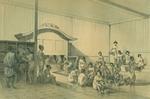 The "Banned" Lithograph. A very limited number of Volume 1 were published with a "nude bathing" (Public Bath at Simoda) lithograph. This lithograph was quickly deleted from Government published volumes due to public indignation at the nude figures in the scene. The scene was the inside of a public bath house in Japan where males, females and children have bathed together in the nude for centuries without concern. The lithograph is sometimes found unbound/extracted. When found in a bound volume 1, the print is generally found facing page 408. Either bound or unbound, this lithograph is scarce.
1856 to 1859 - Abridged/One Volume Books
Several one volume abbreviated versions of the three volume set have been printed. These book are sometimes referred to as the "One Volume," "Abridged" or "Trade" version of the Narrative.
1. The 1856 & 1857 Appleton Abridged Books.
Perry, Commodore M. C.,
Hawks, Francis L., compiler:
Narrative of the Expedition of an American Squadron to the China Seas and Japan, Performed in the Years of 1852, 1852, and 1854, Under the Command of Commodore M. C. Perry, United States Navy, compiled by Francis L. Hawks, published by D. Appleton, New York, 1856 and 1857, 624 pp. Red cloth gold embossed covers and spine. Cover size - 18.5 x 26 cm -- 6 3/4 x 10 1/4 in, 8vo. This edition is often referred to as the "First Trade Edition." The book has 9 full page steel engraving plates, 68 full page plates (woodcut), 11 maps and 44 text illustrations. The steel engraved plates and woodcut plates (77 pages) are not numbered and not included in the 624 page count. For detailed information about this book, to include a listing of all chapters and illustrations and pictures of the cover and spine, click here. To compare the engravings in this book with lithographs in the original three volume narrative, click here.
Plates, maps and illustrations in the 1856 & 1857 Abridged Books:
Note: The maps and 8 of the 9 steel engravings are not in the subsequent 1857 and 1859 editions.
2. The 1857, 1859 & 1860, Appleton, Americans in Japan, Abridged Books
Perry, Commodore M. C.,
Hawks, Francis L., compiler,
Tomes, Robert, editor:
The Americans in Japan: An Abridgment of the Government Narrative of the U.S. Expedition to Japan, Under Commodore Perry. This book has 415 pages versus the 624 pages of the 1856 edition. There are an additional 8 page of advertisement for various Appleton books. The cover size is 19 x 14 cm -- 5 1/2 x 7 3/4 in, 12mo (large). The covers are found in green and blue. The front and back boards have a blind embossed ornamental framework that may have once surrounded stamped (not embossed or impressed) images. The spine has gold gilt lettering and an illustration at the foot. The book has a total of 69 wood engravings. One engraving is a full page frontispiece. The other 68 are merged in the text and range from full page (2) to 1/4 page in size. The plates and the front cover are detailed here.
While this book is an abridged version of the original Narrative of the expedition, it is not merely a version that has had sections deleted. The editor, Tomes, clearly presents the information in a different light from the Narrative.
When viewing book listings it is often difficult to determine if they are referring to the original three volume printing of 1856 (Tucker or Nicholson) or the abridged Appleton printings of 1856, 1857, 1859 or 1860. The key is to look for "624" pages or "415 pages" and the size 8vo or terms such as "Trade" version, "first octavo edition" or "one volume" edition.
Available - 1857, Americans in Japan - Purchase Here
4. Later Editions (Not Appleton)
Printed in 1952 - abridged by Sidney Wallach, Coward-McCann, Inc., 1952, 276 pages + Forward, 10 black and white illustrations, 6 x 9 inch format [8vo - octavo], (pages 23 x 14.7 cm).
Printed in 1954 - abridged by Sidney Wallach, MacDonald London., 1954, 305 pages + Forward [8vo - octavo].
Printed in 1973 abridged by Robert Tomes, Scholarly Resources, Wilmington, Del., ISBN: 0842014063 (415 pages with illustrations - 23 cm) (A reprint of Americans in Japan).
Library of Congress Control Numbers:
01013866 - New York, London, D. Appleton & Co., 415 pages, 1857.
52011706 - New York, Coward-McCann, 305 pages, 1952.
72082113 - Wilmington, Del., Scholarly Resources, 415 pages, 1973
1940 - 4 Volume Set - AMS Press
Seeking more information. Four volume reprint (June 1940), AMS Press, ISBN: 0404050603.
1967 - Reprint by AMS Press / Arno Press / Vol 1-3
Available - Purchase Here
1967 - Reprint by AMS Press / Arno Press / Vol 1-2
Available - Purchase Here
1967 - Reprint by AMS Press / Arno Press / Vol 1
Available - Purchase Here
This three volume set was reprinted in 1967 by AMS Press - Arno Press. This three volume set was reprinted in 1967 by AMS Press - Arno Press. It is a facsimile edition in three volume set lacking only the charts that were printed at the end of Volume II in the original Narrative. Size is 4to with a black cloth cover. Vol. I: xvii + 537 pp., Vol. II: 414 pp. + facsimile of treaty + index, Vol. II: xliii + 705 pp. Some sets have a separate slipcase which contains 15 (2 are published in the text of Vol 2) maps/charts reproduced from those at the end of Vol. II. The Bath House plate is reproduced in this reprint edition. To see the covers, click here.
The reprint is of the Beverley Tucker, Senate Printer book of 1856. The page size is 21 x 27.8 cm (8 1/4 x 10 9/10 in). The page size format size for the 1856 editions is larger, 23 x 29 cm. Page thickness is 5.5 mm. The prints have an obvious fine screen of small dots which clearly distinguish them from lithography. The differences are so great that the prints from this book are easily distinguished from those in the original editions.
As noted above, Volume 2 of this reprint edition does not contain the map folio found at the back of the original volume 2. AMS Press published 15 of 17 maps in loose sheet format and 2 of the 17 are inserted at the correct page in the reprint volume 2. The loose sheets are housed in a black cardboard slip case with a tipped on inventory. To see the slip case, click here. This map folio is very desirable as the maps are much easier to use and fold in the loose sheet format. It is seldom seen on the market.
1968 - Smithsonian - Personal Journal of the Expedition
Available - Purchase Here
Perry, Commodore M. C.,
Morison, Samuel Eliot, introduction
Pineau, Roger, editor:
The Japan Expedition 1852-1854. The Personal Journal of Commodore Matthew C. Perry. This one volume work was published by Smithsonian Institution Press, Washington, DC, in 1968. The book contains 30 black & white illustrations and 49 color plates. It measures 8 1/2 x 11 1/4 inches (21½cm x 28½cm) and is 241 pages long. Perry's journal was incorporated into the official Narrative of the expedition. However, certain personal matters were omitted and numerous drawings were not made a part of the official Narrative. These are contained in this book. The book also has an appendix with President Filmore's letter to the Emperor of Japan (Appendix A) and the reply to the letter. You also find a list of the ships of the expedition (Appendix B) and the Officers and Chief Petty Officers (Appendix C). For more information on the book click here.
Library of Congress Control Number: 68009578. ISBN: 0405189400
1998 - Japanese Reprint
??:
U.S. Japan Expedition in 1854, Japanese title: Peri~Nippon Enseiki Zufu [Illustrations from Perry's Japan Expedition] Japan, Art Digest, Shimoda Museum, 255 pp, 18mo (4.25 x 5.75 in - 10.5 x 15 cm), soft cover with dust jacket. This book is almost all in Japanese except for captions to the print reproductions. It looks like it is a translation of parts of Volume 1 and 2 of the Narrative. The interesting and predominant feature of this book is that it reproduces, in color, all the lithographs and engravings from Volume 1 and Volume 2 except those that do not relate to Japan or Lew Chew (Okinawa). The treaty is also reproduced. Most of the horizontal format lithographs and engravings span 2 pages. The nature lithographs and engravings of animals, fish, birds, and shells are present. In total there are 91 items reproduced. Each plate has the English caption from the narrative. For more information, click here.
ISBN: 4-7636-1586-6 C0171
2000 - Reprint of Volume 1 - Dover
Available - Purchase Here
Perry, Commodore M. C.
Hawks, Francis L., compiler:
In 2000, Volume 1 of the original narrative of Commodore Perry's expedition was re-published by Dover Publications, Inc., New York (537 pages with illustrations - 20 1/2 x 27.8cm). This soft cover book is titled Commodore M. C. Perry, Narrative of the Expedition to China Seas and Japan, 1852-4. This book is an inexpensive way to see the lithographs of the expedition and read the accounts that pertain to them. Available from BaxleyStamps - Order On-line.
Library of Congress No. 00022784
ISBN: 0-486-41133-8 (pbk)
ca 2001 - Reprint of Appleton
Abridged Narrative - Elibron
Available - Purchase Here
Perry, Commodore M. C.
Hawks, Francis L., compiler:
This is a reprint/"Replica" of the abbreviated Narrative of the Perry Expedition that was published by Appleton in 1856. Part 1 contains from the title page through page 358. Part 2 continues from page 359 to page 624. The reprint is large 12mo (5 1/2 x 8 in) and is soft cover. This book should not to be confused with the 2000 Dover reprint (see above) of Volume 1 of the original Narrative.
Books/Pamphlets/Prints Relating to the Perry Expedition -to Japan (in whole or in part).
1849 - Palmer Letter Urging Japan Expedition
Palmer, Aaron Haight:
Letter to the Hon. John M. Clayton, Secretary of State, Enclosing A Paper, Geographical, Political, and Commercial, on the Independent Oriental Nations; and Submitting a Plan for Opening, Extending, and Protecting American Commerce in the East, &c: Respectfully Submitted to the President and Cabinet, By Aaron Haight Palmer, Counsellor of the Supreme Court of the U.S. -- Published by Direction of the Department of State in the National Intelligencer of the 6th September, 1849. Revised, and Now Republished with an Appendix, Washington, Gideon & Co., Printers, 1849, large 12mo (5 1/2 x 8 1/2 in), 63 pp.
This is a letter dated April 14, 1849 from Palmer to the Secretary of State. An appendix with supplemental information has been added, apparently by the Department of State. In his letter, Palmer urges that the United States initiate broad ranging initiatives to facilitate trade with the "Independent Maritime Commercial Nations of the East." The countries include "Japan and it's colonial dependencies" among many others. For more information of this document, click here.
1857, Aaron Haight Palmer, Documents and Facts Illustrating the Origin of the Mission to Japan, Authorized by the United States Government, May 10, 1851...., Washington, DC, Henry Polkinhorn, Printer, 1857, 8vo, 22 pp. This paper can be found online here.
1852 - The President's Message to Congress, Pre-Japan Expedition
Fillmore, Millard
Webster, Daniel:
Message of the President of the United States, Communicating Certain Official Documents Relative to the Empire of Japan, US Government Document 59, Washington, DC, 1852, 8vo, 87 pp.
1852 - Pre-Expedition Article in the American Whig Review
Unstated:
The Japan Expedition, published in American Whig Review, New Series, Volume IX, Whole Number XV, June 1852, New York, Champion Bissell, 8vo, card wraps pamphlet, double columns, pages 475-566. The Japan Expedition article is 9 pages long. This article was written as Commodore Perry was assembling his expeditionary squadron and before he actually departed the United States. It outlines the reasons for and scope of the expedition.
1852 & 1853 - Gleason's Articles on the Expedition
Author Unstated:
Gleason’s Pictorial Drawing-Room Companion, Boston, February 12, 1853, Volume IV, No. 7, Whole No. 85, pages 97-112. The St Valentine's Day edition of the paper. Includes a two page (center page -- 15.75 x 22.75 in - 40 x 58 cm) engraving (woodcut I presume) of the Perry Expedition Squadron. The engraving is titled, "A Superb View of the United States Japanese Squadron, Under the Command of Commodore Perry, Bound for the East." The engraving was by J.W. Orr from a drawing by Wade, both of New York. The engraving shows the ships assembled and with full sail showing. Commodore Perry is seen standing in a long boat headed to board his flag ship, the Mississippi. The drawing was not based on an actual scene but represented the artist's concept of what the assembled squadron would have looked like. The engraving lists 12 ships of Perry's "United States Japanese Squadron." The ships are the Mississippi (Perry's Flag Ship), Vermont, Saratoga, St. Marys, Macedonian, Plymouth, Vandalia, Susquehanna, Princeton, Alleghany, Powhatan and Supply. In addition to the engraving there is a short article (60% of a 1/3 page) on the "Japan Expedition" which presents statistics about the ships of the squadron. This is may well be one of the earliest widely circulated illustrated article on the expedition. The print often has faults (folds, staining, foxing, paper thinned or broken at folds) which are typical of its age. It is sometimes found with hand coloring added. For general information on the article and to see the engraving, click here.
For General Information on Gleason’s Pictorial Drawing- Room Companion, click here.
Earlier Similar Illustration
- 1852, May 15, Volume II, No. 20, page 305 (Illustration of Squadron). To see this illustration, click here.
1853 - The Earliest Detailed Accounts of the Perry Expedition
Unstated author:
Ka-Ji-Kan-Chin, Hong Kong, August 1853 – April 1854, monthly periodical (British or American), English language, varying in length from eleven to fifteen Chinese-style double leaves per edition, includes eight maps. Over 9 monthly editions this publication published the first detailed information regarding the progress of the Expedition. Information on the Perry expedition is found in three of the nine issues. The September, 1853 issue carries a report on the arrival of Commodore Perry's squadron in Japan (July, 1853). This may well be the first printed English language account of the event to reach the outside Western world. This is followed by comments on the fleet's departure in the January issue. The April issue contains two reports of the Japanese consent to open their nation to foreign commerce with the United States.
1853 - Bayard Taylor's Letters Regarding the Expedition
Taylor, Bayard:
Whalemen's Shipping List And Merchants' Transcript, New Bedford, 1853-4. Taylor's letter regarding the expedition were reprinted in various issues of this publication. Many of the letters also appeared in the New York Tribune during the same time period.
1853 - Thomas Allen Speech on the Expedition
Allen, Thomas:
Japan, and the Expedition Thereto, of the United States, a Discourse Delivered Before the Missouri Historical Society in the Hall of the House of Representatives, Jefferson City on December 22, 1852, St Louis, Printed at the Missouri Republican Office, 1853, small 8vo (5 1/2 x 8 1/2 in - 14 x 21.5 cm), 34 pp. I have not confirmed the as issued state of this publication. However, it appears to have been as a pamphlet with no soft or hard cover. Thomas Allen was a publisher and printer in Washington, DC from 1837-42. At the time he gave this speech he was a state senator in Missouri. Allen was a entrepreneur and supporter of the transcontinental railroad. To see the title page, click here.
1853 - Naval and Mail Steamers of the United States
Stuart, Charles B.:
Naval and Mail Steamers of the United States, New York, Charles B. Norton, 1853, First edition, 4to (33.5 x 26.5 cm), 21 pp. Illustrated with 9 full page lithographs (one in color) of Commodore Matthew C. Perry's "Black Ships" and other warships. In addition, there are numerous full page diagrams of the internal mechanisms and weaponry of these ships. Original binding is pictorial stamped morocco.
Later Edition:
- 1853, New York, Second Edition, 36 engraved plates, 1 color lithograph (US Naval Steamer Powhatan), 4to, 22 pages of publisher's ads, 216 pp.
1853-4 - Perry Expedition, The Japanese Perspective
Hino Kazuaki:
Some Casual Remarks About Japanese Defenses, 2 volume set, 1853-4, Japanese language, written by a subordinate to the Chief Japanese Commissioner, Hayashi. A contemporaneous account of the Perry Expedition from the Japanese perspective. On display at a Japan Expedition exhibit in the Smithsonian Institution in 1968.
1854 - Japan Expedition Press
U.S. Navy:
Japan Expedition Press, a newspaper type publication printed during the expedition. Single sheet (broadside) measuring approximately 9 3/4 x 15 in. On the only issue I have seen depicted, the masthead included "Japan Expedition Press" an illustration of an eagle with wings outstreatched and a ribbon in it's beak and "U.S. Steam-Frigate 'Powhatan,' Simoda, Japan, May 1st, 1854." This issue contained the President's letter to the Emperor of Japan and a translation of the Japanese response. S.E. Morision discusses the "Japan Expedition Press" in an article which outlined below. (see 1967, below)
In an auction in August of 2009 three Japan Expedition Press publications were sold. The mastheads read:
- Japan Expedition Press, U.S.Steam Frigate Mississippi, at Sea, July 17, 1854, Compact Between [the United States and the] Kingdom of Lew Chew.
- Japan Expedition Press, U.S.Steam Frigate Mississippi, at Sea, July 21, 1854, Additional Regulations.
- Japan Expedition Press, U.S.Steam Frigate Mississippi, Hong Kong, Sept. 4, 1854, Sailing Directions for Yedo, By Lieut. Wm. L. Maury, U.S. Navy.
Other issues Reported:
- Japan Expedition Press, at Sea, 1854, Sailing Directions for Hakodadi.
- Japan Expedition Press, at Sea near Simoda, 1854, Regulations Respecting Pilots, and the Supplying of American Vessels Entering the Port of Simoda.
1854 - Ethiopian Concert Aboard the Powhatan
U.S. Navy:
Ethiopian concert. United States steam frigate Powhatan, Hakodadi, Island of Yesso, Empire of Japan, May 29th [1854]. An Ethiopian entertainment will be given by the Japanese Olio Minstrels, on board this ship, this evening, weather favorable, to which the Officers invite your attendance,, 1854, Japan Expedition Press, program and invitation letter press printed on washi paper with decorative flower pattern in white, 19 x 26 cm opened flat. Only two copies believed to exist.
1854 - Illustrated Japanese View of the Perry Expedition
Not Stated:
Ikoku Ochiba-kago (Fallen Leaves from a Foreign Country), Tokyo, Bigakudo, 1854, 4 1/2 x 7 in - 11.5 x 17.5 cm, brown wraps, 20 double folded leaves, 17 color wood block illustrations, 2 double page maps. A very rare contemporary view of the Perry Expedition. This book is recorded in the 1966-9 Dawson Book Shop Catalogues, Catalogue 354, Lot 154 ("Rare Perry Book"). For more information, click here.
1854 - Gleason's Article on the Biddle and Glynn Missions to Japan
Kennedy (Secretary of the Navy):
Gleason’s Pictorial Drawing-Room Companion, Boston, June 10, 1854, Volume VI, No. 23, Whole No. 153, page 364. The entire issue runs from page 353 through page 368. The article which is titled "First Japan Expedition" is on page 364. The article quotes a speech by Secretary Kennedy (Secretary of the Navy) where he discussed the failed mission to Japan of Captain Biddle (1846) and the successful mission of Commodore Glynn(1849). For more information on the article, click, here. Other articles in this issue include Governor John Winthrop, the Roman Soprano or Captain of the Swiss Guard, Monument to Colonel Johnson (Richard M.), Charles W. Morgan, Late of the U.S. Navy, full page illustration of statute honoring Andrew Jackson, Rudolph the Burgess - Legend of Noyais, Salisbury, Conn. (5 illustrations on 2 full pages), Mosque and Cannon Foundry at Constantinople, Russia and the Russians, and Tecumseh (article on the occasion of his death). To see the article on Japan, click here.
1854 - Gleason's Article on Commodore Perry
Unstated:
Gleason’s Pictorial Drawing-Room Companion, Boston, August 5, 1854, Volume VII, No. 5, Whole No. 161, page 68. The entire issue runs from page 65 through page 80. The article which is titled "Commodore Perry" is on page 68. It contains a portrait (woodcut engraving) of Commodore Perry and one column (5 3/4 in) of text discussing his military career. For more information on the article, click, here
1854 - Newspaper Article Quoting Heine (Expedition Artist)
Heine, Wilhelm (unstated however):
A Dinner Party in High Life, an article published in the Vermont Watchman and State Journal, Vermont, March 31, 1854, Volume XLVIII, No. 18, Whole No. 2476. The article spans approximately 3/4 of a column on the front page of the paper (2 1/4 x 13 in). This article contains a quoted account of a dinner given by the Regent of Loo Choo for officers of Perry's Expedition to Japan. The name of the person quoted is not stated, only that he is "A German who accompanied...." the expedition. The would be Wilhelm Heine who was the official artist for the expedition. Heine was an artist and writer and subsequently published a book in Germany about the expedition. At this time, Perry had prohibited reports such as this. For more information on this article, click here.
1854 - Okinawa, Letter by Dr. Williams
Williams, S. Wells:
Sketch of Lew Chew, published in The Missionary Herald, Volume L, No. 6, June 1854, Boston, American Board of Commissioners for Foreign Missions, 8vo, paper wraps, string tied, 1854. A letter by Dr. Williams, who accompanied the Expedition as Commodore Perry's interpreter, regarding Okinawa. Such correspondence was officially banned by Commodore Perry. Dr. Williams describes Okinawa including comments on the geography, people, housing, dress, language religion, social customs, government and foreign policies.
c1854 - Hatch & Severyn Lithograph, Perry's First Landing in Japan
Hatch & Severyn (lithographers):
The American Expedition, Under Commodore Perry, Landing in Japan. July 14, 1853, c1855, New York, Hatch & Severyn Lithographers and Printers, George S. Appleton, publisher, 15 1/2 in x 21 1/4 inch hand colored lithograph depicting Perry's first landing in Japan. The image depicts the first landing at Uraga, Japan. The American forces are in the foreground and the Japanese forces and meeting hall are in the background. Commodore Perry follows the pennant bearer detail and two sailors (small boys actually) carrying the letter from the President. Three ships of the squadron are seen in the distant foreground at the left. The Japanese figures and the building have more Chinese than Japanese characteristics.
A similar view is depicted in an 1855 lithograph by published by Eliphalet M. Brown, Jr. and drawn by Wilhelm Heine (First Landing of the Americans in Japan, click here). However, the view in this lithograph by Hatch & Severyn is less of a panoramic view and a more of a detailed depiction of the landing party as they approach the meeting hall.
1855 - Illustrations of the Japan Expedition, Eliphalet Brown & Wilhelm Heine
Available - "Passing the Rubicon" - Purchase Here
Brown, Eliphalet M. Jr. (Art and Publisher)
Heine, Wilhelm (Art):
Illustrations of the Japan Expedition, 1855. A folio of six (6) large ("Elephant" folio) high quality hand colored lithographic prints (36 1/2 x 26 in - 92.5 x 65.5 cm) accompanied by an illustrated descriptive cover sheet was produced and published by Brown in 1855 and printed by the lithographic printer of Sarony & Co, New York. The prints included art by Wilhelm Heine and Eliphalet Brown. For more information on this folio, click here. Copies of these lithographs are rare and often found in museum collections.
More information.
- "Passing the Rubicon," click here.
- "First Landing of the Americans in Japan," click here.
This folio of lithographs should not be confused with the book and folio of ten (10) lithographs published by Wilhelm Heine in 1856. For more information on that material, click here.
1855 - The President's Message to Congress, Post-Expedition
Available - Fair Condition - Purchase Here
Franklin, Pierce
Dobbin, J. C.
Perry, Matthew C:
Message of the President of the United States, Transmitting a Report of the Secretary of the Navy, in Compliance with a Resolution of the Senate of December 6, 1854, Calling for Correspondence &c., Relative to the Naval Expedition to Japan (U.S. 33d Congress, 2d Session, Senate Executive Document 34), 1855, Washington, DC, Government Printing Office, 8vo (6 x 9 1/4 in - 15 x 24 cm), 195 pp, blind embossed brown or burgundy or purple cloth, title on spine reads "Japan" - "Perry." To see the cover and title page, click here. This is the first official US Government report on the expedition. As required by Senate Resolution of December, 1854, President Pierce, transmitted the Secretary of the Navy's report on the expedition to the Senate. This report on the expedition is unique in that it is primarily composed of a chronological compilation of letters (mostly Commodore Perry to/from the Secretary of the Navy) dealing with the day to day diplomatic, political and military matters that were in progress. The Message also includes such matters as sailing directions for various ports by Silas Bent and supplemental agreements entered into by Perry and the Government of Japan. This document preceded the publication of the three volume narrative of the expedition and is an invaluable supplementary resource regarding the Expedition.
1855 - J.W. Spalding Account of the Expedition
Available - First Edition - Rebound (1855) - Purchase Here
Spalding, J. W.:
The Japan Expedition. Japan and Around the World. An Account of Three Visits to the Japanese Empire with Sketches of Madeira, St. Helena, Cape of Good Hope, Mauritius, Ceylon, Singapore, China, and Loo-Choo, Redfield, New York, 1855, blue cloth with gilt on spine, 12mo (5 x 7 1/2 in - 13 x 19 cm), frontispiece and 7 tinted illustrations, 377 pp. Contemporary eye-witness account by an observer who was on board the U.S. Steam Frigate Mississippi, Commodore Perry's flag ship during most of the expedition to Japan. For more information on the book and a listing of the 8 tinted illustrations, click here.
Another Early Printing:
- 1855, Phillips (Sampson and Co), Boston, Derby, 576 pp, 8vo, earliest printed edition?
Later Printings:
- 1856, London, Sampson Low, 12mo, 377 pp
- 1859, Redfield, New York, 12mo, 377 pp.
- 1902, Phillips (Sampson and Company), Boston, (limited edition 500 printed, 612 pp
- 1902, Sanshosha, Tokyo, reprint of an 1861 printing (limited edition 500 printed)
- 1906, Chicago, C. McClurg, (xxxii), 401 pp
1855 - Bayard Taylor's Account of the Perry Expedition
Available - 1855 Edition, Blue Covers - Purchase Here
Available - 1855 Edition, Brown Covers - Purchase Here
Taylor, Bayard:
A Visit to India, China and Japan In The Year 1853, New York, G.P. Putnam & Co., London - Sampson Low, Son & Co., 1855, 539 pp. with a black and white frontispiece (steel engraving), black and white illustrated (steel engraving) short title page, embossed green, brown, black or blue cloth covers with gilt decorated spine, 8vo (5 x 7 3/4 in). The frontispiece is an Okinawan scene, the "The Valley of Ulnna in Lew Chew." Two minor variations in the frontispiece in the first edition have been recorded. The book is a narrative of Taylor's two and 1/3 year world travels of over 50,000 miles. The journey spanned most of the European countries, the Nile to Central Africa, Palestine, Asia Minor, India, China (twice), Okinawa and Japan. Taylor tied up with the Perry Expedition to Japan in Shanghai by actually joining the Navy as an "officer of very moderate rank" (p 361). During the expedition, Taylor traveled onboard the Susquehanna as the personal clerk to Captain Buchanan. Taylor, probably America's most popular literary journalist of that period, accompanied the expedition and recorded the military and diplomatic maneuvers by which Perry gained access to Japanese officials. He was not on the entire expedition but was on the expedition to Japan during 1853 which included the visit to Okinawa, the delivery of the President's letter and the return to Hong Kong and Macau. The Perry Expedition portion of the book spans approximately one-fourth of the book (ca. 140 pages). For more information on the book, click here.
Subsequent Related Books:
- 1855, London, Sampson Low, American title-page retained before the English one, 539 pp.
- 1859, London, James Blackwood, edited by George Frederick Pardon (Visit to India, China and Japan), frontispiece is Canton engraving.
- 1860, G.P. Putnam & Sons, Japan, one volume in the "Bayard Taylor's Travels" series (see 1870s below also).
- 1864, G.P. Putnam & Sons, Visit to India, China and Japan, 539 pp.
- 1870, G.P. Putnam & Sons, Visit to India, China and Japan, 539 pp.
- 1872, New York, first volume of the series title "Library of Travel, Exploration & Adventures," Japan in Our Day "Compiled And Arranged By Bayard Taylor," Charles Scribner And Company, 12mo, 280 pp plus ads.
- 1872-1893 at least 16 editions printed, Japan in Our Day.
- 1880, London, James Blackwood, edited by George Frederick Pardon, Visit to India, China and Japan, 294 pp.
- 1870s-1889, New York, G.P. Putnam's Sons, "Bayard Taylor's Travels," India, China and Japan, one volume in "Bayard Taylor's Travels - Household" edition, a 10 volume compilation of Bayard Taylor's works. For more information on the 10 volume set, click here.
- 1885, New York, G.P. Putnam's Sons, A Visit to India, China and Japan in the Year 1853, 12mo, 539 pp.
- 1892, New York, G.P. Putnam's Sons, "Bayard Taylor's Works," Visit to India, China and Japan, one volume in a 11 volume compilation of Bayard Taylor's works. For more information on the 11 volume set, click here.
1855 - Ballou's Article on Rhode Island's Gift to Perry
Available - Purchase Here
No Author Stated:
Ballou’s Pictorial Drawing-Room Companion, Boston, October 6, 1855, Volume IX, No. 14, Whole No. 222. The entire weekly issue runs from page 209 through page 224. The article which is titled "Testimonial to Commodore Perry" is on page 220. This is an account of a ceremony held on June 14, 1855 at the Statehouse in Rhode Island where Commodore Perry's role in the "Japan Expedition" was honored. During the course of the ceremony, Commodore Perry was presented an engraved silver tray which is illustrated in a woodcut engraving accompanying the article. Other articles and large engravings in this issue are An Inland Fishing Party, Falcone: The Mysteries of Mexico, East Room of Independence Hall, Philadelphia (1/2 page engraving), Voyage of an American Clipper (2 full pages with six 1/4 page illustrations of clipper ships), Honorable Charles H. Peaslee and Endicott and the English Ensign (full page engraving). To see the article on Commodore Perry, click here.
1855 - Newspaper Article, Lew Chew Compact
Pierce, Franklin:
Intercourse with the Lew Chew Islands, an article published in the New-York Daily Tribune, New York, March 17, 1855, Volume XIV, Whole No. 4,340. The article spans 8 inches of 2 1/2 inch wide column (6 columns across page) and is on page 5 of the 8 page paper. The article is a reprint of President Franklin Pierce's Proclamation issued on March 9, 1855 which officially published the Compact with Lew Chew executed by Commodore Perry in Naha on July 11, 1854. For more information on the Proclamation, click here.
1855 - Speiden's Unpublished Journal
Speiden, William, Jr.:
Journal of a Cruise in the U.S. Steam Frigate Mississippi (9 March 1852 - 16 February 1855), unpublished manuscript, in the files of the Naval Historical Foundation, Navy Yard, Washington, DC.
1855 - Aaron Haight Palmer and the Japan Expedition
Available - Extracted Copy - Purchase Here
Palmer, Aaron Haight:
Memorial of Aaron Haight Palmer Praying Compensation for services, in collecting valuable information and statistics in relation to the geography, productive resources, trade commerce &c., of the independent oriental nations, January 18, 1855, ordered to be printed Feb 1, 1855. Senate, Mis. Doc. No. 10, 33d Congress, 2d Session, large 12mo (5 3/4 x 9 in), pages 1-23, 23 pp. This is Aaron Haight Palmer's formal petition to the Senate for compensation for his efforts in expanding US trade and commerce in the "oriental nations" between 1846 and the Perry Expedition. In this request for compensation, Palmer references the many occasions he proposed plans for the opening of Japan or conducted activities towards that goal. For more information on item, click here. For a similar document, see 1859, below.
1856 - Perry Paper/Address
Perry, Matthew C.:
A Paper by Commodore M.C. Perry Read before the American Geographical and Statistical Society, March 6, 1856, New York, D. Appleton & Company, 1856. For more information, click here.
1856 - Howitzers and the Perry Expedition
Dahlgren, John A.:
Boat Armament of the U.S. Navy, Philadelphia, King & Baird, 1856, 12 illustrations, 212 pp. The book contains a hand colored double page plate ("Demarkation in Japan of Boat Howitzers") showing howitzers being unloaded ashore for use in escorting Commodore Perry on his landing in Japan.
Other Edition
- 1856, 2nd ed, Philadelphia, King & Baird, 12 illustrations, 212 pp.
1856 - Harper's Articles
Available - Purchase Here
Harper's New Monthly Magazine:
Commodore Perry's Expedition to Japan, Harper's, New York, 1856, Volume XII, 441-466 pp (March, 1856, No LXX) and 733-756 pp (May, 1856, No LXXII), 8vo - 16.5 x 25 cm (6 3/4 x 9 3/4 in), double column, 37 woodcut illustrations. The woodcut illustrations are of scenes of Loo Choo & Japan. The two Perry Expedition articles are contained in Volume XII which is a bound edition of Harper's New Monthly Magazine that covers the period from December, 1855 through May, 1856. These articles probably represent the first widespread distribution of information about the expedition and accounts of the visits to Lew Chew (Okinawa) and Japan. For more information, click here.
You will find pages:
- 441-66 (Volume XII, Issue 70, March 1856) on-line (no illustrations) here.
- 733-56 (Volume XII, Issue 72, May 1856) on-line (no illustrations) here.
1856 - Characteristics of Japan, Illustrated London News
Available - Purchase Here
Unstated:
Illustrated London News, London, December 13, 1856, Volume XXIX, No. 834, pages 583-606. Pages 590 and 591 contain an article titled "Characteristics of Japan -- The United States' Expedition." The article discusses the recently published US Government narrative of the Japan expedition and the privately published abbreviated version of the narrative. It draws from the narrative to present "Characteristics of Japan." The two facing page article contains three wood-cut reproductions of lithographs from the Government narrative. Two are approximately 1/3 page each and the third is about 80% of the page. To see the article, click, here.
1856 - Heine Prints and Book
William Heine, the official artist on the expedition. His art formed the basis for most of the lithographs in the official narrative of the expedition. Additionally, he produced a series of ten (10) lithographs that were marketed in book and folio form. His work also was used by E. Brown in the production of a series of six (6) large, high quality, lithographs.
Heine's Graphic Scenes Lithographs, Tinted & Color - High Quality
Plate #3 - Wampoa (Whampoa) Pagoda, Available - Purchase Here
Plate #10 - Graveyard at Simoda Dio Zenge, Available - Purchase Here
Plates #2~10, Individual Plates - Available - Purchase Here
Heine, William:
Graphic Scenes of the Japan Expedition, 1856. This work consists of a regular title page, an illustrated title page, ten large folio lithographic prints (including two colored and eight color tinted) and ten accompanying text pages. The lithographs were produced by Sarony & Company of New York and the book was published by G. P. Putnam & Company. The book has an introduction by Francis L. Hawks. For more information visit the Heine Book page on this web site. The same lithographs were also produced in a folio format. The book or the complete print folio are very scarce and very seldom appear on the market.
A facsimile of the book (24 pages) is currently available on a print on demand order basis.
These lithographs should not be confused with the very large lithographs published by E. Brown, in 1855. For more information on that material, click here.
1856-76 - Wilhelm Heine Books & Related Works
(German, Dutch, French, English & Swedish)
Heine, William (Wilheim):
Reise um die Erde nach Japan an Bord der Expeditions-Escadre unter Commodore M. C. Perry in den Jahren 1853, 1854, und 1855, Unternommen im Auftrage der Regierung der Vereinigten Staaten, Leipzig and New York, H. Costenoble and C. Gunther, 2 volumes (volume 1, 322 pp -- volume 2, 374 pp). Heine's memoir of the trip was published in German in 1856. It was in two volumes in this book set. The books contain a total of 11 (sometimes offered with 10 - probably not counting the frontispiece plate) lightly tinted plates (tinted engravings?) (one is a frontispiece for volume 1) which are interleaved with rice paper. Also numerous woodcut engravings. Volume 1 has a frontispiece, pictorial title and 3 other plates. The plates depict the island of Liu Kiu, local Japanese, Commodore Perry in negotiation with Japanese officials as well as views of the other countries visited during this journey. Included is the infamous plate depicting the public bath at Shimoda. The plates are by Heine and the woodcut illustrations in the books are by Eduard Kretschmar. Sometimes offered in paper wraps. Also often found with both volumes bound into one. The size is a large 8vo.
Subsequent / Related Editions:
Dutch Language:
1856, Two Volumes. Reis Om De Wereld Naar Japan, Aan Boord van het Expeditieeskader Onder Commodore Perry, in de Jaren 1853, 1854, en 1855, Ondernomen op Last op Last van Regering der Vereenigde Staten, Rotterdam, Nijgh, red decorated cloth, Dutch text, lithograph title page, 10 black and white lithograph plates (at least 2 relate to Okinawa/Lew Chew), text illustrations, 486 pp.
German Language:
1860, One Volume (Related). Japan Und Seine Bewohner. Geschichtliche Ruckblicke und Ethnographische Schilderungen von Land und Lenten, Leipzig, 8vo, 383 pp. A history of Japan and the Dutch and at Nagasaki from the 17th century through the Perry Expedition.
Swedish Language:
1860, Carl Wingstedt, Japan och Dess Innebyggare, Stockholm, Huldbergs Bokhandel, 6 tinted lithographs, frontispiece and 17 black and white plates, 1 foldout lithographic map, 8vo, purple cloth with gilt lettering, 182 pp. The plates are 24 x 16 cm and image sizes generally 15.5 x 10 cm. The plates in this book were obviously drawn from images found in the original US Government narrative. This book is reported to be a translation from a German work titled Das Kaiserreich Japan, nach den besten vorhandenen Quellen geschildert von einem Vereine Gelehrter.
1871, Anton Baeckström, Ett besök i Japan och Kina jemte bilder från vägen dit öfver Goda-Hoppsudden, Bourbon, Nya Kaledonien, Manilla och Kokinkina. Anteckningar och minnen från en treårig tjenstgöring i franska flottan, Stockholm, Albert Bonniers, 8vo, brown blindstamped cloth with gilt decoration and lettering, 24 plates including (8 tinted lithographs & 16 full page woodcut plates), 39 text illustrations, 391 pp. Many of the illustrations are based on W. Heine's work.
French Language:
1859, One Volume Edition. Le Japon. Expédition du Commodore Perry Pendant les Annèes 1853, 1854 et 1855, Faite D'Après les Ordres du Gouvernement des États-Unis, Traduit de L'Allemand. Par A. Rolland, Bruxelles, H. Dumont, Libraire-Editeur, 1859, 8vo, two volumes bound into one, 10 tinted engraved plates + tinted engraved (on China paper) frontispiece, 304 and 315 pp.
1859-60, Two Volume Edition. Le Japon. Voyage Autour Du Monde. Expédition du Commodore Perry, pendant les années 1853, 1854 et 1855. Faite d'après les ordres du gouvernement des États-Unis, Bruxelles, H. Dumont, 1859-60, 8vo, two volumes, 10 tinted engraved plates on China pager + tinted engraved (on China paper) frontispiece, 304 and 316 pp.
1863, One Volume Edition. Le Japon. Expédition du Commodore Perry Pendant les Annèes 1853, 1854 et 1855, Faite D'Après les Ordres du Gouvernement des États-Unis, Traduit de L'Allemand. Par A. Rolland, Bruxelles - Lacroix, Verboeckoven et Cie, 1863, 8vo, two volumes bound into one, 10 tinted engraved plates + tinted engraved (on China paper) frontispiece, 304 and 315 pp.
1863, Two Volume Edition (2nd edition). Le Japon. Voyage Autour Du Monde. Expédition du Commodore Perry, pendant les années 1853, 1854 et 1855. Faite d'après les ordres du gouvernement des États-Unis, Brussels, two volumes, 304 and 315 pp, 10 full page tinted engravings on china paper + similar frontispiece. This is a translation from German into French by A. Rolland. Volume 1 covers the expedition from the departure to the first visit to Japan to deliver the President's letter to the Emperor. Volume 2 covers the return to Japan for the answer and then the return to the United States via the Hawaii. The set contains 11 full page tinted engravings (from Heine's paintings) on China paper with the following general subjects: Frontispiece, 1 Canton, 4 Liou-Kou (Okinawa), 3 Japan, 1 Hawaii and 1 Straits of Magellen).
1863, One Volume Edition (2nd Edition combined into one volume). Le Japon. Voyage Autour Du Monde. Expédition du Commodore Perry, pendant les années 1853, 1854 et 1855. Faite d'après les ordres du gouvernement des États-Unis, Bruxelles, large 8vo ( 3/4 x 10 in), frontispiece (tinted engraving on China paper) + 304 pp + 5 full page tinted engravings on China paper and 315 pp + 5 full page tinted engravings on China paper. For more information and pictures of the engravings, click here.
Other Books by Wilhelm Heine:
Heine Memoir
Available - Purchase Here
Heine, William
Frederic Trautmann (Translator, Introduction and Annotations):
1990, Translated from German to English. Portions of the original memoir were republished in With Perry to Japan, A Memoir by William Heine, Translated, with an Introduction and Annotations by Frederic Trautmann, University of Hawaii Press, 3/1/1990, 235 pp, 6 1/4 x 9 1/2 format (8vo large), 16 pp of black and white illustrations - primarily of Heine's works. Trautmann provides a 5 page preface, 22 page introduction, 8 page chronology, 30 pages of notes, a 10 page bibliography and an 11 page index that supplement the Heine memoir. In total, Trautmann provides 86 pages of invaluable supplemental information which helps the reader understand the Heine memoir and place the expedition to Japan in historical perspective. The Heine memoir is not the choppy journal entry type style you often find in such literature. Instead, it is a rich and flowing narrative style chronicle of events by a key member of the expedition. ISBN 0-824-1258-1.
Ringgold/Rogers North Pacific Expedition (3 Volume Heine Set)
Available - Volumes 1 & 2 - Purchase Here
Heine, Wilhelm:
1858-9, Die Expedition in die Seen von Japan, China und Ochotsk unter Commando von Commodore Calw. Ringgold und Commodore John Rodgers, im Auftrage der Regierung der Vereinigten Staaten unternommen in den Jahren 1853 bis 1856, unter Zuziehung der officiellen Autoritäten und Quellen, Leipzig, Otto Burfurtt, 1858-59, German language. Three volumes. Vol 1 - 330 pp, Vol 2 - 391 pp & Vol 3 - 424 pp, plus twenty-five lithographic and engraved plates (sixteen tinted), and six maps (five folding). Heine also published this book on the North Pacific Expedition under Commander Cadwalader Ringgold. This expedition, which was primarily a surveying and exploring voyage, set sail in June of 1853 for the Orient via the Cape of Good Hope and Batavia. The full page illustrations in this book depict Japanese and Chinese people and scenes and are all variants of illustrations (generally based on Heine's drawings) found in Volume 1 of the Narrative of the Perry Expedition to Japan. The set includes a large folding map (in two parts) of the coast of China and Japan and maps of the north Pacific (showing Alaska) and other Pacific charts. For more information on this three volume set, click here.
1860-2, German Expedition to Japan under Graf F. zu Eulenburg. Heine also accompanied the German Expedition which was the equivalent of the Perry Expedition. He apparently was not the primary artist for this expedition. The expedition is narrated in Die Preussische Expedition nach Ost-Asien, nach amtlichen Quellen which is discussed below.
1864, Eine Weltreise um die nordliche Hemisphere...Ostasiatischen Expedition in 1860-1861, 2 Volumes, Lepzig, Brockhaus.
1873 & 1880, Japan, Beitrage zur Kenntnis des Landes und Seiner Bewohner, Dresden, Selbstverlag des Verfassers, a large folio book published in three parts. Each part with 5 photographs and 5 sheets of text. In 1880 the book was published in 8vo format in 5 parts each containing 10 plates and 10 sheets of text. Forty of the plates illustrate the history, religion and natural history of Japan and the other 10 are views.
ca 1876, Yeddo. Nach Original-Skizzen, Dresden, George Glibers, small 12mo, not dated but ca 1876, two expeditions (US and Prussian) discussed in a 40 text page book with a panorama of Tokyo from a painting by Heine. The five plate are tipped in albumen photographs. This is believed to be the last book that Heine wrote. For more information on the book, click here.
The following set has illustrations by Heine.
1861, Die westliche Welt: Reise, by Alexander Mackay, 2 volumes, Leipzig, Kollmann.
1857 - Japan Expdition Origin, Aaron Haight Palmer
Palmer, Aaron Haight:
Documents and Facts Illustrating the Origin of the Mission to Japan, Authorized by Government of the United States, May 10th 1851; and Which Finally Resulted in the Treaty Concluded by Commodore M.C. Perry, U.S. Navy, With the Japanese Commissioners at Kanagawa, Bay of Yedo, on the 31st March, 1854. To which is appended a list of the Memoirs, &c., prepared and submitted to the Hon. John P. Kennedy, Late Secretary of the Navy, by his order, on 26th February, 1853, for the use of the projected U.S. Exploring Expdition to Behring's Strait, &c., under the command of Commander Cadwallader Ringgold, U.S. Navy, Washington, Henry Polkinhorn Printer, 1857, 22 pp. On-line here.
ca 1857 - Steam-Frigate Mississippi in a Typhoon, Lithograph
Brown, E.
Heine, William:
The US Steam-Frigate Mississippi in a Typhoon on October 7th 1854 on her passage from Shimoda, Japan to Sandwich Islands, Britton & Rey, San Francisco, ca 1857, drawn by William Heine and E. Brown, Jr. Large format lithograph (16 x 21 in) showing the Mississippi in very rough seas. Also produced with tint by Currier & Ives. The Currier & Ives lithograph states: "Entered according to act of Congress in the Year 1857, by E. Brown, Junr., in the Clerks Office of the District Court, of the Northern Dist. of N.Y."..."The U.S. Steam Frigate 'Mississippi' in a Typhoon On her passage from Simoda Japan to the Sandwich Islands Oct. 7th, 1854 Lat. 35. 59' N. Long. 153. 47' E...." The Currier & Ives version of the lithograph omits credit to Heine as found in the Britton & Rey version. To see a facsimile (reproduced in color hafltone) of the lithograph, click here. This facsimile was contained in Early Steamships (see below).
- 1933, Felix Riesenberg, Currier and Ives Prints, Early Steamships, No. 4, New York & London, The Studio Publications, 8 color halftone facsimiles, tipped to plate, of Currier & Ives lithographs of steamships. Number 4 in a series reproducing noted Currier & Ives prints of ships. The first plate in this volume is the Mississippi in a Typhoon.
1858 - Japan Opened
The Religious Tract Society
Anonymous (author):
Japan Opened, Compiled Chiefly From the Narrative of the American Expedition to Japan in the Years 1852-3-4, London, The Religious Tract Society, Reed and Pardon, printer, 1858, 10 woodcut black and white plates, 1 text illustration, 18mo (4 1/4 x 6 1/4 in), 299 pp. The stated purpose of the book is to make the government Narrative available to the public "in a cheap form." The first chapter (pages 1-45) of the book is background and not a summary of the Narrative. This chapter traces western contacts with Japan from Marco Polo at the close of the 13th century to the American contacts in the 1830s-40s leading up to the Perry Expedition. The balance of the book is an abridgement of the Narrative. For more information on this book, click here.
Subsequent editions:
- 1859, 2nd edition, London, The Religious Tract Society, frontispiece + 11 other engraved plates, 1 fold-out map, 18mo, 309 pp.
- 1861, London, The Religious Tract Society, 322 pp.
1859 - Interview with M.C. Perry
Heine, William:
Origins and Aims of the Expedition to Japan. Public Interview With Commodore Perry. Establishment of a Commercial Treaty With Japan. Concluding Labors of Perry in Japan and Lew Chew, Philadelphia, Evans, 1859, extracted, 41+ pages (356-406). Based upon an interview with Perry and his personal notes.
1859 - Aaron Palmer Asserts Credit for the Perry Expedition and Opening Japan
Palmer, Aaron Haigh:
Origin of the Mission to Japan. This pamphlet is reported in by Inazo Nitobe in The Intercourse Between the United States and Japan at page 144. For more information on that book, click here. It is probably very similar to his early request for compensation to the Senate in 1855 as well the 1857 pamphlet with the same title (see above).
1860 - Heine German Book
Heine, William:
Japan Und Seine Bewohner. Geschichtliche Ruckblicke und Ethnographische Schilderungen von Land und Lenten, Leipzig, Burfurst, 381 pp. A German language work that recounts the history of Japan, the Dutch, Nagasaki from the 17th century through the Perry Expedition.
1860 - George Davis - Origin of the Expedition
Davis, George Lynn-Lachlan:
A Paper Upon the Origin of the Japan Expedition: Read the 7th of May, 1857, Before the Maryland Historical Society, Baltimore, printed by John Murphy & Co., 1860, a 14 page pamphlet. Davis states. "Will it be believed that the Expedition was actually projected eighteen months before the sailing of Commodore Perry; that a proposal was submitted to the Government, by Commodore John H. Aulick, as early as the 9th of May, 1851..." (at page 7). This paper can be found online here.
1861 - German Book On Perry Expedition
Steger, Friedrich
Wagner, Hermann:
Die Nippon-Fahrer oder das wiedererschlossene Japan. In Schilderungen der bekanntesten älteren und neueren Reisen insbesondere der amerikanischen Expedition unter Führung des Commodore M. C. Perry in den Jahren 1852 bis 1854, Leipzig, Spamer, 1861, 7 tinted engravings and numerous (ca. 140) woodcut engravings in text, 1 map, 352 pp,. There is a chapter on Okinawa and it contains 6 woodcut engravings. See 1861, below, for another book by Friedrich Steger which incudes sections on the American and British expeditions to Japan.
c1895 - Walke Family History
Walke, Henry (Rear Admiral):
Private Record of The Walke Family in the United States, privately published, c1895, small 4to (12 x 9 in - 30.2 x 23.4 cm), text in double columns, faux alligator skin front and back stiff wraps, staple bound with black tape spine covering, 22 pp. Title on the first page of text reads "Brief Records and Recollections of The Walke Family and Relations in the United States." The pamphlet is undated but contains references to newspaper articles as late as 1893. Admiral Walke died in early 1896. Admiral Walke records, with extensive footnotes (16), the genealogy of his family. It starts with Thomas Walke's emigration from England to Barbados and subsequently to the United States in 1648. The paternal and maternal family histories are recorded. Additionally there is much information on Southeastern Virginia, particularly the Richmond and Norfolk areas. Major heading (used by the author) are: "Relations and Family Connections; Issue of Colonel Anthony Walke by His First Marriage; Historical and Descriptive Sketches of Norfolk and Vicinity; Children of William and Mary Thoroughgood Walke; Death of Mr. William Walke; Children of Anthony and Susan H. (Carmichael) Walke; Children of George and Elizabeth Mason (Walke) McIntosh; Children of Drayton M. and Mary Calvert (Walke) Curtis; Children of William and Elizabeth (Nash) Walke and Children of Thomas and Anne McCauley (Walke) Williamson." Admiral Walke discusses himself at pages 12-13. To see the front cover and section on Admiral Walke, click here. Two lithographs in the Narrative of the Perry Expedition to Japan are attributed to Henry Walke. However, there is no indication in this pamphlet, or any other source I have examined, that he actually accompanied the expedition.
1900 - John Kell Account
Kell, John McIntosh:
Recollections of a Naval Life Including the Cruises of the Confederate States Steamers "Sumter" and "Alabama", the Neale Company, Washington, 1900, 307 pp, portrait frontispiece and 4 pp of ads, pictorial cloth. About half of the book is devoted to Kell's Civil War experience. Kell also recounts his experiences with the China Sea Fleet and the Expedition to Japan.
Subsequent editions:
- Available as "Print on Demand."
- Available on-line.
1901 - Son of Satsuma - With Perry In Japan
Munroe, Kirk:
A Son of Satsuma - Or With Perry In Japan, Scribners, NY, 1901, 1st edition, black & white illustrations (Frontispiece + 7) by R.F. Zogbaum, frontispiece has tissue guard, no dust jacket, green cloth with red, white and black illustrated front and spine, 12mo (5 1/8 x 7 1/2 in - 13 x 19 cm), 308 pp. A fictional account of an American stranded in Sumatra when his ship, the "Friendship," is taken by local pirates. The US Navy Frigate "Potomac" is dispatched by President Jackson to rescue the crew and avenge the taking of a US merchant ship. The main character "Bob Whiting" and a shipwrecked Japanese sailor (Katto) are rescued and taken to Canton and deposited there to await the arrival of the next American ship. Bob and Katto sneak into Japan where he came under the protection of the Daimio of Satsuma who treated him as a son. Bob and Katto were there to watch Perry's first entrance into Yedo Bay. The fictional account traces the events of the Perry expedition through the eyes of Bob and from the Japanese perspective (as written by an American). Bob departs Japan aboard the Saratoga after the second (final) visit of Perry to Japan. He even arranged to have his trusty sidekick, Katto, sent by the Japanese government to attend the US Naval Academy. For more information on this book, click here.
Subsequent edition:
- 1904, Scribners, NY, pictorial front cover and spine, green cloth, 306 pp.
1902 - Unveiling Perry Monument in Kurihama
Long, John D. et al:
Unveiling Monument to Commodore Perry in Japan, Letter from the Secretary of the Navy, Washington, DC, February 10, 1902, 26 pp., Senate Document 174, 57th Congress, 1st Session, designated "SD-57-1-Vol 16-4", found in bound Volume 21 (January-March, 1902) of Senate Documents, 57th Congress, small 8vo (5 3/4 x 9 in - 14.5 x 23 cm). This letter placed in the Congressional record various documents / writings relating to the establishment and unveiling of the monument to Commodore Perry in Kurihama, Japan on July 14, 1901. For more information on this article, click here.
1904 - Harper's Article on Commodore Nicholson
Harper's New Monthly Magazine:
World's Trade by Commodore Nicholson who was Navigating Officer of Commodore Perry's Flag-ship at the Time of the Expedition, Harper's, New York, 1904, 3 page article with 2 black and white photos.
ca 1904 - Leaflet No. 151, Old South Leaflets, Chapter 13 of Government Narrative
Available - Purchase Here
Old South Leaflets:
Old South Leaflets., No. 151. Commodore Perry's landing in Japan. From the "Narrative of the expedition of an American squadron to the China seas and Japan, performed in the years 1852, 1853, and 1854, under the command of Commodore M. C. Perry," published, by order of Congress in 1856, Boston, Directors of the Old South Work, ca 1904, self-wraps, leaflet, staple bound, small 8vo, 28pp. The leaflet is a verbatim reprint of the text portion of Chapter 13 of Volume 1 of the Government published narrative of the Perry Expedition to Japan. It covers the section of the narrative dealing with the Perry's first landing in Japan (July, 1853) and the subsequent presentation of the President's letter. The narrative from the text is followed by 1 1/4 page of commentary. This leaflet was also included in bound Volume VII, issues 151-175, which was published ca 1900. To see the front page of the leaflet, click here.
1905 - Logbook of the Captain's Clerk
Available - Purchase Here
Sewall, John S.:
The Logbook of the Captain's Clerk: Adventures in the China Seas, Bangor, Maine, Charles H. Glass, 1905, 1st edition, 278 pp, small 8vo (14 x 20 cm, 5 1/2 x 8 in). Only illustration is the frontispiece (with tissue guard) picture of the USS Saratoga. White lettering and decoration on the front cover. Issued without a dust jacket. This is a memoir written by John S. Sewall who was serving as a Yeoman, Captain's Clerk, on the Saratoga during the period of Perry's expedition to Japan. The book was written more than 50 years after the events and is more of a memoir or account and not actually a day by day log. The Saratoga was already in the China Sea as part of the East India Squadron and protecting US shipping and interests when Perry arrived with the Mississippi in April of 1853. The Saratoga was diverted from its return to the US to participate in the Expedition to Japan. The first 1/3 of the logbook deals with events before the expedition.
Others Accounts and a Reprint:
Available - 1995 Reprint - Purchase Here
- 1890, John S. Sewall, New Englander and Yale Review, Volume 53, "The Invincible Armada in Japan," a two part article, pages 201-211 (September 1890 - No CCXLVI) and pages 331-339 (October 1890 - No CCXLVII). Sewall's account of the Perry Expedition to Japan.
- 1905, John S. Sewall,, Century Magazine, "With Perry In Japan, Personal Recollections of the Expedition of 1853-4," 3 illustrations, 12 pp.
- 1995, John S. Sewall, Dudden, Arthur Power (Editor), Chicago, R.R. Donnelley, December, 1995, hard cover, issued with no dust jacket, brown cloth, 16mo (11.3 x 17.5 cm, 4 1/2 x 7 in), 291 pp, 38 b/w and color illustrations, 12 maps. A majority of the illustrations are reproductions of lithographs in the original Narrative of the Perry Expedition to Japan. This is one in a series of the Lakeside Classics. Contains a Publisher's Preface, List of Illustrations and Historical Introduction (i-cv - 42 pp). The book is well executed and illustrations give you a good flavor of the illustrations found in the original Narrative.
- 1995, Gift Edition, 283 pp, given by publisher (Donnelley) as Christmas Gift to customers.
1905 - Japanese Account
Satow, Ernst M. (Translator):
Kaikoku Shidan (Japanese Title) - Japan 1853-1864 Genji Yume Onogatari, Tokyo, 1905, 242 pp. This book traces the circumstances in Japan after the Perry Expedition. By 1864 great internal social and civil turmoil developed in opposition to the opening of Japan.
1908 - McClure's Magazine - Perry Prints
Japanese Prints of Perry, New York, 1908, McClure's Magazine, bound volume XXXII, December issue, 2 pp (pages 223-4). This very brief article presents five pictures from a Japanese scroll in the Library of the Imperial University, Tokyo.
1909 - Lord Ii Naosuke and New Japan
Available - Purchase Here
Akimoto Shunkichi
Nakamura Katsumaro (translator):
Lord Ii Naosuke and New Japan, Translated and Adapted by Shunkichi Akimoto from Il Tairo To Kaiko by Katsumaro Nakamura, Tokyo, Bungakushi, printed by the Japan Times, 1909, 12mo (4 3/4 x 7 1/2 in - 12 x 18.8 cm), black cloth with gilt lettering on front board and spine, four black and white frontis-plates (2 collotype with tissue guards and 2 halftone), preface dated June 25, 1909 (i-iiii), 187 pp. Ii Naosuke was born into nobility in one of the most important fiefs in Japan and rose to positions of great power under the Shogun Tokugawa Iesada. Naosuke was a key figure in the turbulent period between 1853 and 1858 as Japan struggled to deal with the mounting American and foreign pressure to open its ports to foreign trade. Naosuke pursued a moderate position urging a peaceful resolution and a limited opening of Japan to foreign trade. These were turbulent times and his position was not popular within the Shogun's government or the general population. Despite strong opposition, Naosuke's views prevailed and a series of treaties were executed with America and other European powers which opened Japan, on a limited basis, to foreign trade. Naosuke was assassinated at the age of 44 in 1860 by opponents to his position on the opening of Japan. This book recounts Nasokue's life from his birth to death. It reviews the Japanese policy of seclusion prior to the arrival of Commodore Perry and the American squadron in 1853. The political power structure in Japan that dealt with the American initiate to open the country is outlined and Naosuke's key role in that structure is detailed. His activities supporting the opening of Japan and the subsequent treaties are covered. This book is a translation of a book titled Ii Naosuke to Kaiko (or "Ii Naosuke and the opening of the ports") by Akimoto Shunkichi which was published the same year. For more information on this book, click here.
Related Book:
- 1896, Agitated Japan: the Life of Baron Ii Kamon-No-Kami Naosuke, see 1896 above.
- 2008, Aristophanes Press & Kessinger Publishing, facsimile edition.
1909 - Commodore Perry and the Founding of Yokohama, 2 Picture Postcards
Available - Purchase Here
Commodore Perry and the Jubilie of the Founding of the Port of Yokohama. In 1909 the Yokohama Chamber of Commerce issued a two postcard set commemorating the founding of the Port of Yokohama. One of the postcards in this set featured images of Commodore Perry and Lord Tairo Li Naosuke. For more information on the postcard set click here.
1910 - Williams Journal Published in TASJ
Williams, Samuel Wells (Journal)
Williams, Frederick Wells (Preface & Editor):
A Journal of the Perry Expedition to Japan (1853-4), Yokohama, 1910, Transactions of the Asiatic Society of Japan (TASJ), Volume XXXVII, Part II, published by Kelly & Walsh, Ltd, printed by the Fukuin Printing Co., 8vo, black and white tissue guard protected collotype frontispiece (portrait of Perry), color chromolithograph plate depicting Dr. S. Wells Williams as drawn by a Japanese artist, 2 other black and white collotype plates of drawings/paintings ("Perry Landing at Kurihama, 14 July, 1853" and "View of Yokohama Harbor when Perry Was First Sighted"), 9 page "Prefatory Note (i-ix), 263 pp. Williams was the official translator for the Commodore Perry during the Expedition to Japan. In this very critical position, he observed all the major events that occurred as the Japan expedition progressed. This is his personal journal recorded on a day by day basis. The journal covers 1853-54. It was made available to the Asiatic Society of Japan by his son, F. W. Williams. Considered by many to be the most important contemporary journal published by a member of the expedition. More than one third of the journal relates to activities on Okinawa. For more information on this book, click here.
The Well's journal is said to have also been published in the Journal of the Royal Asiatic Society of Great Britain and Ireland, London, 1910, 8vo, color frontispiece, illustrations, 263 pp. I have not confirmed this however.
Stand-alone Version and Reprint/Facsimile Edition
- 1859, Shanghai, "Lecture on Japan" in Journal North China Branch Royal Asiatic Society, First Series, No. 11, 8vo, pages 180 and following. May contain information from the Williams journal.
- 1973, Wilmington, Scholarly Resources, facsimile edition, 8vo, 259 pp. ISBN-10: 0842014101 - ISBN-13: 978-0842014106
1914 - National Alumni Article On Perry Expedition
National Alumni:
The Opening of Japan (1854), 1914, National Alumni, 1914, 20 pp.
1921, February - Perry's Expedition to Japan
US Naval Institute Proceedings Article
Krout, Mary H.
Perry's Expedition to Japan, United States Naval Institute Proceedings, Annapolis, Vol 47, No. 216, February, 1921, pages 215-229 (15 pp). This article is a summary of Perry's Expedition to Japan and is drawn primarily from J.W. Spalding's account of the expedition. For more information on this article/publication, click here. The article is contained in the paper wraps issue for February, 1921.
1922 - Literary Digest - Special Japan Issue
Unstated:
The Literary Digest, New York, Funk & Wagnalls Company, January 7, 1922, Volume 72, No. 1, Whole No. 165, paper wraps, magazine, 4to (9 3/4 x 12 in), 80 pp. This "Special Japan Number" issue has a portrait of Commodore Matthew C. Perry on the front cover and a section (pages 28-72) devoted to Japan. In addition, it has two articles outside the special Japan section relating to Japan. The special section deals with the "Seventy Dazzling Years" since the treaty negotiated by Commodore Perry. For more information on the magazine, click here.
1926 - Japanese Diary of the Expedition
Yasuteru, Koda:
Peruri Tekan Ryukyu Homonki: Diary of a Visit of Commodore Perry to the Ryukyu Islands [Tokyo 1926, Koda] - Japanese language. The book has 2 fold-out maps, line drawings, 21 loose b.w. plates of Lew Che-wans and 46 leaves of plates, 246 pp. It documents the Lew Chewan portion of Perry's Expedition to Japan. It covers, in great detail, Okinawan costume, merchants, the court interpreter Shui Lew Chew, the reception of Perry at Shui Castle, Perry's dinner with the Regents, Nagagusko the interior, ancient castle at Na Ga Gus Ko, peasants, Perry's dinner to the Regents aboard the Susquehanna, Tumai Temple, Tshan Di Coo Sha, tombs, Kung-Kwa near On-Na, view of Na-Ga-Gus-Ko. The maps are: Island of Great Lew Chew and Great Lew Chew and it's Dependencies. Library of Congress Control Number: 86215043.
1931 - Japanese Diary of Perry's Second Landing, TASJ Off-print
Available - Purchase Here
Bakufu Official:
Diary of an Official of the Bakufu, reprinted from The Transactions of the Asiatic Society of Japan, Second Series, Vol. VII, 1931, Tokyo, 8vo, card wraps, staple bound pamphlet, pages 98-119. This is a translation into English of a diary contained in the Gaiko Komon Sho, published by the Historigraphic Section of the Tokyo Imperial University. The author of the diary is not stated. The diary begins on 19th day of the "first month, seventy year of the Kayei Era" (February, 1854). It records the behind the scenes activities from the Japanese perspective regarding Commodore Perry's second landing and the execution of the treaty. The diary runs through the departure of Perry's squadron on May 13, 1854. To see the front cover, click here.
1940 - Sproston Diary
Available - 1st Edition - Purchase Here
Sproston, John Glendy (Journal Writer)
Kraus, S.J. (Introductory Note)
Sakanishi Shio (Editor):
A Private Journal of John Glendy Sproston, U.S.N., Tokyo, Sophia University, printed by Kyodo Insatsu Kabushiki Kaisha, 1940, large 8vo (19 x 26 cm - 7 1/2 x 10 1/4 in), red cloth, front cover blind stamped border, title in gilt on front board and spine, 19 black and white halftone plates (designated "Figures") on glossy paper, xii, 122 pp. The book begins with "A brief note on our Early American-Japanese Relations Series" (pages i-iii) written by Dr. J.B. Kraus. The illustrations are sketches (some with manuscript annotations) by Sproston. A personal narrative of the Perry Expedition as recorded by a Midshipman on the Macedonian. Sproston recorded his journeys ashore and interactions of the Americans and Japanese. The journal starts in February 1854 in Yedo Bay (Perry's return to Japan to conclude the treaty - 2nd visit). It continues on to the mission to survey trip to Hakodade (via Shimoda) (May, 1854) and then the return to Shimoda (June, 1854). Next the journal recounts the visit to Formosa (July, 1854) then on to Manila (August, 1854). The book is an excellent means of viewing this portion of the expedition from the perspective of a junior Naval officer. For more information on the book, click here.
Reprint:
Available - Purchase Here
1968, Sophia University in Cooperation with Charles E. Tuttle Company, edited by Shio Sakanishi, foreword by George Alexaneder Lensen, Sophia University in Cooperation with Charles E. Tuttle Company, 128 pp, 1 foldout plate in color and 19 black and white plates, 17.7 x 26.4 cm (6 3/4 10 1/2 in (8vo), blue decorative design boards (hardboard-cardboard type) and off-white cloth spine with title printed in gold, issued with dust jacket. For more information on the book, click here.
1940 Captain Porter Proposes Japan Expedition, 1815
Porter, David
Cole, Allen B. (editor):
Captain David Porter's Proposed Expedition to the Pacific and Japan, 1815, published in The Pacific Historical Review, Volume IX, No. 1, March 1940 at pages 61-65. Perhaps the earliest public discussion proposing an American expedition to Japan.
1940 - Wilson Book
Wilson, Glen A.
The Perry Expedition to Japan - Contemporary Attitude, 1940, South Pasadena, Ca, 126 pp, printed on one side only. Original gold stamped 4to cloth.
1941 - John Manjiro - The Castaway
Ibuse, M.
Kaneko, H. (Translator):
John Manjiro the Castaway. His Life and Adventures, Hokuseido Press. The story of John Manjiro, a shipwrecked Japanese fisherman, who was educated in the US and returned to Japan. Manjiro served the Japanese government in the negotiations with Commodore Perry.
1942 - McCauley Diary
Available - Purchase Here
McCauley, Edward Yorke (diary writer)
Cole, Allan B. (editor):
With Perry in Japan: The Diary of Edward Yorke McCauley, 1942, Princeton, NJ, Princeton University Press, 8vo, brown cloth, with dust jacket, illustrated title page, 12 text illustrations, 126 pp. While Commodore Perry prohibited the keeping of diaries such as this, McCauley knowingly disregarded the prohibition. The first 34 pages are the editor's comments regarding McCauley and the Perry Expedition. This is followed by 102 pages (pages 35~126) of the McCauley diary. McCauley served as a Acting-Master aboard the Powhatan during the Expedition to Japan. His diary spans the period from February 13, 1853 through June 10, 1854 and provides first hand accounts of many key events during the expedition.
1942 - Unpublished Record of the Japan Expedition
Available - Purchase Here
Mattice, Harold A.:
Perry and Japan, An Account of the Empire and an Unpublished Record of the Perry Expedition, published in the Bulletin of the New York Public Library, New York, Bulletin #46, February 1942, New York Public Library, at pages 167-84. Also published by the Library in 1942 as a separate pamphlet (paper wraps - staple bound) of 20 pages with two unnumbered pages of black and white illustrations and one unnumbered page describing the illustrations. The illustrations are of a thirteen foot long Japanese scroll, in the possession of the New York Public Library, which was a contemporary record of the expedition. The first half of the publication traces the history of foreign involvement in Japan and brings it up to the Perry Expedition. The second half recounts key events of the expedition and goes through Perry's return to the United States and his death. The title is somewhat misleading. This is not an unpublished account of the expedition by a person who actually participated in it. Rather, it is a historical presentation of the circumstances leading up to the expedition and the expedition itself. It also contains a Japanese picture scroll depicting the expedition and I presume this is the basis for the title noting an "unpublished record." To see the cover and illustrations, click here.
1943 - Three Letters Regarding the Expedition
MacLeod, Julia H.:
Three Letters Relating to the Perry Expedition, published in the Huntington Library Quarterly, San Marino, California, February 1943, Volume VI, Number 2, pages 119-251, "Notes and Documents" section, 8vo, paper wraps, at pages 228-37. This article presents three letters in the Rhees manuscript collection of the Huntington Library. The first letter is a brief letter from Commodore Perry to the President dated September 5, 1853 which conveys articles obtained in Japan on the first visit. The second letter was written aboard the Macedonian in Yedo Bay and is dated April 3, 1854. It is from George Henry Preble (then a lieutenant aboard the Macedonian) to Alexander Dallas Bache. The letter discusses the treaty with Japan that was just completed and matters concerning surveying activities in Yedo Bay and elsewhere during the expedition. Preble concluded "The golden commerce expected to flow from Japan will, I think, be a disappointment." The third letter was from J.R. Goldsborough (then a lieutenant aboard the Saratoga) and to Bache. It was written aboard the Saratoga on May 15, 1854 in Honolulu. This letter discuss the treaty in general and matters relating to surveys. Goldsborough was not as pessimistic as Preble regarding trade with Japan. In the letter he concluded that the possibilities of future commerce "... are to be unfolded by time alone, and must be predicted by those who are more versed in matters of statesmanship and commercial affairs than myself."
1944 - Bonin Islands' Story by Ross H. Gast
Gast, Ross H.:
Bonin Islands' Story with Maps, Old and New, additional title on the cover reads: United States vs. Japan in the Pacific a Hundred Years Ago, California, Monrovia News-Post, 1944, 12mo (5 1/2 x 7 1/2 in - 13.7 x 19 cm), staple bound pamphlet, printed in sepia ink, one halftone reproductions a woodcut, 4 maps, 30 pp. Gast discusses the unique relation the United States had with the Bonin Islands starting with settlement by New England whalermen in the early 1800s, to the visits made by Commodore Perry's Expedition to Japan and to its annexation by Japan (1874). Gast's work contains an excellent summary of the various European powers interacting in the political struggle to control these islands. The pamphlet contains (pages 25-30) Bayard Taylor's report on the exploration of Peel Island which was published in volume 2 of the government narrative of the Perry Expedition to Japan. This is the first of two similar pamphlets published by Gast. The other (see 1945 below) dealt with the Ryukyu Islands. For a picture of the covers of this pamphlet, click here.
1945 - Lew Chew by Ross H. Gast
Available - Purchase Here
Gast, Ross H.:
Lew Chew or the Ryukyu Islands with Commodore Perry in 1853, additional title on the cover reads: Base of the United States Fleet for the First "Invasion" of Japan, Hollywood, CA, Murray & Gee, 1945, 12mo (5 1/2 x 7 1/2 in - 13.7 x 19 cm), staple bound pamphlet, printed in sepia ink, numerous halftone reproductions of pictures and drawings, 3 maps, 26 pp. This pamphlet was written before the actual US invasion of Okinawa (April 1, 1945) as the author references the invasion of the Kerama islands which occurred in the last week in March of 1945. Gast discusses the Perry Expedition to Japan and the importance of Okinawa to that undertaking. Pages 19-26 contains the report that Dr. James Morrow made regarding the Agriculture of Lew Chew. This report was published in Volume II of the official government narrative of the Perry Expedition to Japan. Most of the images found in the book are derived from lithographs and woodcut published in the official Government narrative. Two of the three maps are from the narrative. This is the second of two similar pamphlets published by Gast. The other (see 1944 above) dealt with the Bonin Islands. For a picture of the covers of this pamphlet, click here.
1946 - Black Ships Off Japan
Walworth, Arthur:
Black Ships Off Japan: The Story of Commodore Perry's Expedition, New York, Knopf, 1946, orange pictorial cloth, 278 pp, 2 maps, 12 appendices (A-L), frontispiece (portrait of Perry) + 7 black and white plates, bibliography, sources of quotations and index, small 8vo (5 7/8 x 8 1/2 in - 15 x 22 cm), pictorial dust jacket. A well researched book recounting the Japan expedition and how it impacted on the Japanese as well as the Americans. The book is introduced by the noted Japanese authority, George Sansom. For more information on this book, click here.
Reprint.
- 1966, Hamden, Connecticut, Archon Books, portrait of Perry and ten other illustrations, two maps, 277 pp.
1946, January - The American Historical Review,
Diary of a British Missionary
Bettelheim, Bernard John (personal diary)
Schwartz, William Leonard (editor):
Commodore Perry at Okinawa, From an Unpublished Diary of a British Missionary, Richmond, MacMillan Co, an article published in The American Historical Review, Vol 51, No 2, January, 1946, pages 262-76 (15 pp). This article contains an unpublished diary of Bernard John Bettelheim, a British missionary [Loochoo Naval Mission] on Okinawa at the time of Perry's visit. The author of the Review article provides comments to the "extant fragments" of the Bettelheim diary. Reverend Bettelheim served as a consultant to the American squadron, particularly in matters pertaining to obtaining provisions. Commodore Perry visited in the Bettelheim residence at least once and Reverend Bettelheim was aboard the squadron vessels on several occasions. The bell that Commodore Perry was presented was from the Buddhist temple (now Shinto shrine) in Nami-no-ue where Bettelheim and his family resided. Reverend Bettelheim departed Okinawa with the American Squadron in July of 1854. He sent his family home several months earlier. The short article is an interesting account of how the Americans interacted with their hosts through Bettelheim. Apparently the Lew Chewan authorities were very pleased that the Reverend departed with Perry and it is interesting that the Reverend did not give his version of that story in his short but informative diary. For more information on Bettelheim, click here. The bound volume (51, October 1945-July 1946) also contains an article (No 1, October 1945, pages 1-34) titled From Jimmu Tenno to Perry: Sea Power in Early Japanese History. This article discusses Japanese sea power through 1905 with a brief mention of the impact of Commodore Perry's squadron. To see the cover of the softcover, single issue (Vol 51, No. 2, Jan 1946), click here. The entire annual volume (Volume XL, October 1945 - July 1946 contains four quarterly journals and 832 pages which include a index for the entire year.
1947 - Scientist with Perry in Japan
Available - Purchase Here
Morrow, James (MD) (journal writer):
Cole, Alan B. (editor),
A Scientist with Perry in Japan, The Journal of Dr. James Morrow, Richmond, The University of North Carolina Press - Chapel Hill (William Byrd Press, Inc.), 1947, 307 pp, 15 x 23 cm (6 x 9 in), 8vo, portrait of Dr. Morrow as frontispiece and 8 black and white photographic plates (4 pages with photographs front and back), beige cloth, issued with dust jacket. The dust jacket is illustrated with a reproduction of a lithograph from the official Narrative of the Perry Expedition to Japan which is titled "Torigasaki, Yedo Bay." This is the day by day scientific journal of the Expedition's agriculturalist who studied plant specimens and agriculture in Singapore, China, Java, Okinawa & Japan during the expedition. For more information on this book, click here.
1947 - Perry and American Imperialism
Swisher, Earl:
Commodore Perry's Imperialism in Relation to America's Present Day Position in the Pacific, published in the Pacific Historical Review, No. 16, 1947, at pages 30-40.
1947, June - Perry's Call in Okinawa
US Naval Institute Proceedings Article
Bullard, B. Saunders
Great Lew Chew Island, United States Naval Institute Proceedings, Annapolis, Vol 73, No. 6, June, 1947, pages 705-711.
1950 - A Fictional Account of the Perry Expedition
Hungerford, Edward Buell:
Forbidden Island, Chicago, Wilcox & Follette Co, 1950, numerous text illustrations by Robert Frankenberg, charts on front and back end pages, 256 pp. This book is part of Hungerford's "junior novels - Heros of the Sea" series. It is the fictional account of a sailor (Barry Sturgess) on the Expedition to Japan who was searching for his twin brother (Barney Sturgess) who had been shipwrecked from an American whaler, the Noddy Tern out of Marblehead, off Okinawa in November of 1851. In order to find his brother, Barry sailed with Perry on the Expedition to Japan. While a fictional account, it is clear the author had excellent knowledge of the expedition. The story is written around the key events of the expedition which are very accurately woven into the plot. The key people, places and events of the expedition are present and viewed through Barry's perspective as he searches for his brother. The book is much more a chronological account of the expedition as seen by a sailor than a fictional drama. The story has a happy but totally fictional ending.
1950-51 - Personal Accounts / Bluejackets with Perry
Available - One Volume Reprint, VG -Purchase Here
Available - One Volume Reprint, VG(-) - Purchase Here
Bluejackets with Perry in Japan, A day-by-day account kept by Master's Mate John R.C. Lewis and Cabin Boy William B. Allen, edited and introduced by Henry F. Graff. From the Bulletin of the New York Public Library, Astor, Lenox and Tilden Foundations, Volumes 54, Nos. 8-10 and Volumes 55, Nos. 1-7. This is a 10 part series published consecutively in the bulletin from August of 1950 through July of 1951. There are a total of 179 pages. The issued format was 8vo, soft cover. The 10 parts are found bound in book form with blue cloth boards and gilt lettering on the spine. The bound book carries 1952 on the title page and a frontispiece sketch by John R.C. Lewis and has 181 pp. In the first three parts, Graff sets the historical and political background leading up to the Expedition to Japan by Perry. This is an comprehensive and well documented discussion and provides detailed notes, with references, for those interested in further research. Graff also introduces the two individuals (John R.C. Lewis and William B. Allen) that kept the logs, journals and memorandum that form the basis for the remaining 7 parts. Graff then merges the accounts from these two men in chronological order. Further, through notes he amplifies and explores matters raised by the accounts. The accounts of Lewis and Allen provide a perspective into the expedition you will not find in the official narrative. While the accounts are more restrained that other unofficial accounts, they do provide the perspective of the expedition from the sailor's point of view where there is no political agenda being pursued. For more information, click here.
1951 - Great Britain & Opening of Japan
Beasley, W.G.:
Great Britain and the Opening of Japan, 1834-1858, London, 1951, Luzac, 227 pp, index, appendix, bibliography, 2 maps, buff covers. Encompasses the period before, during and after the Perry Expedition from the British perspective.
Subsequent Edition.
- 1995, Japan Library, 227 pp, paper wrappers.
1951 - Zabriskie Monograph - Perry's Expedition
Available - Purchase Here
Zabriskie, George:
Perry's Expedition to Japan 1853-4, The Doldrums, Ormond Beach, FL, 1951, 26 pages, 14 b.w. illustrations, 5 1/2 x 8 in. There is a page where the author can address the monograph to a person by name. This page also provides a pre printed message and signature block. The monograph is often found with this page executed by the author. The back page states "Of this book 750 copies have been printed by the George Grady Press, New York, December 1951." This is a small, 26 page, monograph concerning Commodore Perry and his Expedition to Japan. Contains a detailed listing of the vessels in the expedition. The listing includes name, class, complement, tonnage and number of guns. The book provides a thumbnail sketch of the Expedition and includes 14 black and white full page to quarter page illustrations. The monograph is a reprint of an article in the Quarterly of the New-York Historical Society.
1952 - Harvard Library Bulletin - Japan Expedition Press
Lovett, Robert W.:
Harvard Library Bulletin, Volume XII, No. 3, Autumn 1958, 8vo, soft covers, pages 242-52, the Japan Expdition Press.
1953 - The Commodore Perry Centennial
Issue, Okinawa, Volume II
Available - Vol 1 and II Set, VG - Purchase Here
Yamada, Shinzan:
The Commodore Perry Centennial Issue, Okinawa, Volume II, 1853-4, Commemorating 100 Years of Ryukyuan American Friendship, by Shinzan Yamada, Shuri, Okinawa, University of the Ryukyus Foundation, 1953, 30 numbered pages (60 if you count front and back). Yellow cloth with a gold embossed front cover. Cover size - 26 x 35 cm -- 10 1/4 x 13 3/4 in. This book is in the format of an album with stiff covered boards. There is no cover on the spine except for two inch strips at the top and bottom of the spine. The contents of the book are tied to the front and back cover with ribbon. The book was issued without a dust jacket. In this book the artist recreates people, places and religious/cultural beliefs as they were at the time of Commodore Perry's visit in 1853. There are 30 (14 in color) tipped in halftone illustrations reproducing Yamada's paintings. For more information, click here.
This is the second book by Mr. Yamada, for more information on his first book (Okinawa, Her Beauties and Traditions, No. 1), click here.
1953 - Centennial of the Opening Of Japan
Dulles, John Foster (Introduction):
Centennial Celebration of the Opening of Japan, 1853-1953, Washington, DC, US Government Printing Office, 1953 paper wraps, 8vo, 27 pp. This Government pamphlet commemorating the Centennial of Commodore Perry's opening of Japan to commercial and cultural relations with the Western world. Black and white illustrations of 19th century art work.
1953 - National Geography Article on the Perry Expedition
Kuhn, Ferdinand:
The Yankee Sailor Who Opened Japan, Commodore Perry and His Black Ships Changed the Course of History by Ending Japan's Seclusion a Century Ago This Month, National Geographic, Vol. 104, No. 1, July, 1953, pages 85-102.
1953 - Centennial of the Perry Expedition
US Navy:
1853-1953, Centennial - Opening of Japan by Commodore Matthew C. Perry, United States Navy, (NAVEXOS P-1167), Washington, DC, Department of the Navy.
1953 - Japanese Account of Perry's Visit to Hakodate
Available - Purchase Here
Kojima, Matajiro
Commodore Perry's Expedition to Hakodate, May 1854, A Private Account with Illustrations, Hakodate, Japan, Hakodate Kyodo Bunkakai (Hakodate Cultural Association), 1953, 2 volumes, large 12mo (5 7/8 x 8 1/4 in - 15 x 21 cm), purple stiff paper wraps, bound Japanese style with string ties, double fold pages printed on both sides, paste on titles in English and Japanese, accompanying string tie folding case. The volumes are not numbered but contain 276 pages on 138 double folded pages. One volume consists of a 174 page facsimile manuscript of Kojima's original journal/record of the Perry call at Hakodate in March of 1854. Illustrations (50) are incorporated into the manuscript. Many are hand colored. There is also a map which spans two pages and folds out an additional page. The other volume consists of an English translation of the Kojima journal and a Japanese language typeset version. This volume has 102 pages. Both volumes have numbers inscribed in the colophon. The number of sets actually issued is not specified however. I have reviewed a copy bearing number 557. The author of this account, Matajiro Kojima, was a lower level Government official present during the visit of Perry's ships to Hakodate which was designated as one of the open ports in the treaty just completed. The account gives the Japanese reactions to Perry's visit as well as a description of the behavior of the Americans. While Kojima's reaction to the American visitors was not totally negative, he did report some unpleasant aspects. For more information on this set, click here.
1953 - Perry Centenary Commemorative Pamphlet
Asato, Genshu
Commodore Perry's Visit to the Ryukyus, Except from Narrative of the Expedition of an American Squadron to the China Seas and Japan, Compiled in Commemoration of Perry Centennial, Okinawa, Ryukyu Kokusai Shinbun - Okae Fujihara, 1953, paper wraps, 12mo (5 x 7 1/2 in), 45 pp (39 numbered pages and portrait of Perry and 5 pages reproducing lithographs for the Narrative). The contents are verbatim extracts from the original Narrative of the Expedition found in Chapters VIII and IX. This covers the time period from Perry's arrival on Okinawa on May 26, 1853 through the visit with the Regent of Lew Chew at Shuri Castle on June 6, 1853. The back cover has a paste down label stating "Approved by USCAR on May 25, 1953." For more information on this book, click here.
1953 - Perry, National Geographic Article
Kuhn, Ferdinand:
The Yankee Sailor Who Opened Japan, 1953, National Geographic Magazine, Volume 104, No 1 (July) pages 85-102.
1954 - Chicago History - Perry Commemorative Issue
Angle, Paul M. (editor):
Perry Opens Japan to the World, Chicago, published in the Chicago History, Volume III, Winter 1953-4, Number 10, published by the Chicago Historical Society, large 18mo (4 x 7 1/2 in), illustrated paper wraps, 5 black and white halftone illustrations, pages 289-303 of an issue that runs from pages 289-320. The Perry article commemorates the 100th anniversary of the Japan expedition. Most of the article is an excerpt from the original narrative. The article has an image of an oil painting in the Museum's collection by John Evans which is titled "Perry's squadron on it's way to Japan." This painting shows what appears to be the US Steam Frigate Susquehanna and a sails ship in rough seas. The front cover features the photograph of Commodore Perry published by E. Anthony, using a photograph negative from "Brady's National Portrait Gallery." To see the cover, click here.
1955 - US/Japan Foreign Policy 1853-1868
Beasley, W.G:
Select Documents on Japanese Foreign Policy, 1853-1868, London, Oxford University Press red cloth, 359 pp. Seventy-seven documents dealing with Japanese foreign policy in the period between the arrival of Commodore Perry in 1853 and the Meiji Restoration of 1868. Key documents reflecting US/Japan foreign relations beginning with the Perry Expedition to Japan, the subsequent treaty, the opening of the treaty ports and through to the restoration of the Meiji Emperor.
1955 - Russia's 1852-5 Expedition to Japan
Available - Purchase Here
Lensen, George Alexander:
Russia's Japan Expedition of 1852 to 1855, Florida, University of Florida Press Book (Rose Printing Company), 1955, 8vo, black cloth, 4 pages of black and white illustrations, frontispiece portrait of Admiral Putiatin, illustrated end papers, extensive footnotes and bibliography, issued with dust jacket, 208 pp. Chronicles the Russian expedition to Japan by Admiral Putiatin during the same time as Perry's expedition to Japan.
Reprint:
- 1982, Greenwood Press, Westport, 208 pp.
1956 - John Manjiro
Warinner, Emily V.:
Voyager to Destiny, Bobbs Merrill, Indianapolis, 1956, 16 illustrations, 267 pp. The story of John Manjiro, a shipwrecked Japanese fisherman, who was educated in the US and returned to Japan. Manjiro served the Japanese government in the negotiations with Commodore Perry.
1958 - Letters from an Expedition Surgeon
Wheelwright, Charles H (Writer of Letters)
Forbes, Hildegarde B. (Editor):
Correspondence of Dr. Charles H. Wheelwright, Surgeon of the United States Navy, 1813-1862, Boston, Thomas Todd Co. (privately printed), 1958, 8vo, blue cloth with gilt lettering, 8 black and white plates, 3 fold-out charts at rear (genealogy tables), 350 pp. Dr. Wheelwright was the Assistant Surgeon of the Powhatan during the Expedition to Japan. The book is primarily a series of his letters, primarily to family members, from his service as a Naval Surgeon from October 1839 through January 1862. The Expedition to Japan is covered in chapter 8 and is 23 pages long (pages 173-215). The writer presents a rather uncomplimentary view of the expedition. For example Dr. Wheelwright observed - "The Comdre. is as close as an oyster. I don't think he has much more sense." - regarding Commodore Perry (at page 183). The editor weaves historical background between the letters to place them in perspective.
1958 - American Heritage Magazine, Perry Expedition Article
Catton, Bruce (editor):
American Heritage, April 1958, Vol. 9, Number 3, New York, American Heritage Publishing Co., Inc., 4to, pictorial hardcover. Article on the Perry Expedition to Japan.
1962 - The Opening of Japan
Available - Purchase Here
Preble, George Henry, Rear Admiral, USN,
Szczesniak, Boleslaw (editor):
The Opening of Japan, A Diary of Discovery in the Far East, 1853-1856, printed by University of Oklahoma Press, Norman, Oklahoma, 1962, xxvi, 453 pages, 12 black and white plates, 6 1/4 x 9 1/4 (8vo - medium octavo), issued with dust jacket. The black and white plates are published back to back. Five of them are reproductions of lithographs from the original narrative. George Henry Preble was a Lieutenant serving aboard the U.S.S. Macedonia, one of the ships on Perry's expedition to Japan. He recorded his journey in a day by day diary (under the guise of letters to his wife). This book is a reprint of that manuscript diary. Since Commodore Perry had banned the exchange of information about the expedition by members and declared that any private notes or journals belonged to the government, Preble's account actually violated the order. Preble's diary offers views of events that are not in harmony with the official Narrative.
1962 - Perry's Visit to Okinawa - Translated
Available - Revised Edition - Purchase Here
Hokama, Seisho (Translator):
Commodore Perry's Visit to Okinawa, English-Japanese Translation, 442 pages, green cloth with gold Japanese and English printing, 14 x 18.75 cm (12mo - large), 1 color frontispiece photo plate, 42 full page black and white photo plates (primarily images of lithographs and illustrations from the official narrative), 1 partial page illustration (Commodore Perry) and one map, cardboard sleeve with image of Commodore Perry and a map in the background (no dust jacket). The book consists of major portions of the Lew Chew sections of the official narrative translated from English into Japanese. The sections are amplified by English/Japanese footnotes. Most of the photo plates are from Volume 1 of the Narrative.
- 1975, Commodore Perry's Visit to Okinawa, Revised Edition, 1974, Seisho Hokama, Tokyo, 14 x 18.5 cm (12mo -large), red cloth with gilt lettering on front board and spine, fold out map, numerous illustrations as in first edition, no dust jacket or slip case, 442 pp. Title page reads "Commodore Perry's Visit to Okinawa, Selections from Narrative of the Expeditions of an American Squadron to the China Seas and Japan." To see the covers, title page and colophon, click here.
1963 - The Black Ship Scroll
Available - Purchase Here
Statler, Oliver,
Lane, Richard, Ph.D. (translations):
The Black Ship Scroll, Weathermark (John Weatherhill), Tokyo, 1963, hard cover, first edition, 5 1/4 x 10 1/4 in, issued in a limited first edition of 1,500 copies for private distribution to members and friends of the Japan Societies of San Francisco and New York and not for public sale. White textured paper over boards with black cloth back strip lettered in white.
An account of the Perry Expedition at Shimoda in 1854 and the lively beginnings of people to people relations between Japan and America, based on contemporary records, with translations by Richard Lane, Ph.D. This book consists of a 30 page introductory essay regarding the Perry Expedition to Japan and 40 internal pages of the actual scrolls that were painted documenting his visit to Shimoda in 1854. Color scroll paintings are also on the inside of the front and back cover extending across to the adjoining page. Each painting has been translated and comments based on contemporary records provided. In the comments it is noted that these paintings fall in the category of folk art and typical of this art, the foreigners were depicted as they were "supposed" to look rather than the way they really were.
For more information on the book, to include distinguishing the limited edition from the public printings, click here.
Other Editions:
- 1963 ?? - Tuttle, Rutland, 1963, 1st ed (limited edition), color plates
- 1964 ?? - Tuttle, Rutland, 1964, 2nd ed, 40 color plates
- 1964 Weathermark, (John Weatherhill, Tokyo), 2nd Edition, 1964 - for sale June 1964, public edition, 40 color plates, 85 pp + end paper maps.
- 1965 Weathermark, (John Weatherhill, Tokyo), 2nd Edition, second printing, 1965 - for sale January, 1965 public edition.
- 1969 Random House, New York, 1969, actually a different book same title, same author, 626 pp.
1963 - Commodore Perry in Japan
Reynolds, Robert L.:
Commodore Perry in Japan, New York, American Heritage Publishing Co., 153 pages.
1963 - Perry in Japan - American Heritage Series
Reynolds, Robert L.
Commodore Perry in Japan, American Heritage Publishing Co., New York, 1963, 4to (7 1/4 x 10 in), 153 pp, 40 color photographs, 70 black and white photographs and 2 maps, decorated color endpapers of Perry landing in Japan. This is a glossy decorated/illustrated cover hardback and was not issued with dust jacket. A well illustrated account of the expedition to Japan. This is a volume in the American Heritage Junior Library and is geared toward the "younger reader." However, the illustrations make it a significant resource for readers of any age.
1966-9 - Dawson Book Shop Catalogues
Available - Purchase Here
Dawson's Book Shop:
Foreigners in Early Japan: Paintings, Prints, Books; Including a Remarkable Perry Scroll and Scroll of Russians in Japan, 1853-1855, Dawson's Book Shop, Los Angeles 1966-1969, 5 1/4 x 8 1/4 in, 3 different soft cover catalogues (#354, 363-Part II and #386-Part III) bound into one hardback book (green cloth), 136 pp., 300+ black and white photos, primarily of scrolls. This book is an wonderful reference for numerous prints, paintings and books related to foreigners in early Japan. It resents an amazing array of material and is a valuable reference for Japanese prints, paintings, painted scrolls and books relating to this period in Japan and the foreign visitors to Japan of this period.
1967 - The Japan Expedition Press
Available - Purchase Here
Morison, S.E.:
Commodore Perry's Japan Expedition Press and Shipboard Theatre, published in The Proceedings of the American Antiquarian Society, Volume 77, Part I, at the semi-annual meeting held in Boston on April 19, 1967, Worcester, Massachusetts, American Antiquarian Society, 1967, 8vo, gray paper wraps, no illustrations, 9 pages (pages 35-43) of a 190 page publication. Morison discusses the Japan Expedition Press which was used to publish information for the expedition crew, disseminate sailing instructions and other information regarding harbors and coasts to other ships (even outside the expedition) and publish playbills for onboard theatrical productions. It appears that these theatrical productions were almost entirely black minstrel type shows produced by junior members of the crew. Morison documents 12 items produced by the "Japan Expedition Press." One such item was a 2 page "Japan Expedition Press" document published on May 1, 1854 which included the President's letter to the Emperor of Japan and a translation of the Japanese reply to that letter. Another was a "Japan Expedition Press" publication dated July 15, 1854 with the Compact with the Kingdom of Lew Chew. In total, Morison documents 3 playbills (often titled "Ethiopian Concert") and 9 other "Japan Expedition Press" publications.
In an auction in August of 2009 three Japan Expedition Press publications were sold. The mastheads read:
- Japan Expedition Press, U.S.Steam Frigate Mississippi, at Sea, July 17, 1854, Compact Between [the United States and the] Kingdom of Lew Chew.
- Japan Expedition Press, U.S.Steam Frigate Mississippi, at Sea, July 21, 1854, Additional Regulations.
- Japan Expedition Press, U.S.Steam Frigate Mississippi, Hong Kong, Sept. 4, 1854, Sailing Directions for Yedo, By Lieut. Wm. L. Maury, U.S. Navy.
1968 - Smithsonian Exhibition on the Perry Expedition
Smithsonian Institution:
The Japan Expedition 1852-1855 of Commodore Matthew Calbraith Perry, 1968, Smithsonian Institution, Washington, DC, staple bound, paper wraps, 8vo (7 x 9 5/8 in. - 18 x 24.5 cm), 32 pp. This pamphlet was issued in conjunction with an exhibit of the same name held at the Smithsonian Institution in Washington, DC from October 11 through December 11, 1968. The pamphlet discusses the origins of the Japan Expedition and summarizes the major events of expedition. A chronology of the expedition is provided at pages 29-32. The pamphlet catalogues 209 items that were on exhibit. These included Individual Journals (1-8), American Paintings, Lithographs and Sketches (9-52), Kakemono (hanging pictures) (53-4), Byobu (screens) (455-56), Ship and Boat Models (57-61), Maps & Charts (62-69), Makimono (scrolls) (70-81), Letters (82-88), Japanese Paintings and Prints (89-112), Books (113-120), American Gifts (121-127), Japanese Gifts (128-158), Documents (159-167) and Other Artifacts (168-209). A few of the numbered items contained multiple items. The front cover features the Heine watercolor "Landing at Yokohama, 8 March 1854." Four other Heine watercolors from the expedition were also shown. At the time, a lithograph was displayed of the "Exercise of Troops in the Temple Grounds, Shimoda, 8 June 1854." The location of the original Heine watercolor was unknown at the time. It was later discovered and displayed in Tokyo (see c1970, below). In addition to the color illustration on the front cover, the book has 10 small text type illustrations. To see the front cover, click here.
1969 - Thesis on Dr. Bettelheim
Teruya, Yoshihiko
Bernard J. Bettelheim and Okinawa: A Study of the First Protestant Missionary to the Island Kingdom, 1846-1854, Colorado, University of Colorado, 1969 - ©1970, 407 pp (typed - not printed/typeset). This is doctoral thesis on Bernard John Bettelheim, a missionary on Okinawa during the period of the Perry Expedition. The author brings into focus numerous published and unpublished sources to paint a comprehensive picture of life on Okinawa for the Bettelheims. The sources include well known published books and periodicals and, more importantly, less known or unpublished Ryukyuan, American, British, Chinese and French documents/records as well as letters from and to Dr. Bettelheim. A extraordinary study and balanced picture of Dr. Bettelheim's life on Okinawa. The portion of the thesis regarding the time period of the Perry Expedition is 40+ pages. However, the entire thesis deals with the period leading up to the American expedition and puts the Okinawa aspect of the Expedition in historical context. This thesis was publish in Japanese in 2004 titled Ei senkyo i betteruhaimu - ryukyu dendo no kyu nen-kan.
1970 - Perry Expedition Depicted by Japanese Artists
Tamarin, Alfred
Japan and the United States, Early Encounters, 1791-1860, New York, Macmillan Company, 1970, 8vo, blue cloth with silver lettering, 260 pp. A comprehensive review of US/Japan relations during the period from 1791-1860. Well illustrated with black and white images and maps by Japanese and American artists who recorded the events that were unfolding during this important period as Japan was emerging from self-imposed national seclusion. Almost one half of the book relates directly to the Perry Expedition to Japan. The title page is illustrated with a section of the E. Brown lithograph based on a W. Heine painting titled Passing the Rubicon.
1970 - "White Flag" Controversy
Available - Purchase Here
Center for East Asian Cultural Studies:
Meiji Japan Through Contemporary Sources, 1844-1882, Volume Two, Tokyo, 1970, The Toyo Bunko/Center for East Asian Cultural Studies, text in English, 8vo, red cloth with gilt lettering on spine, dust jacket, 235 pp. The book is a compilation of 41 letters and documents ranging from an 1844 letter from the King of Holland urging the opening of Japan to an 1882 prospectus regarding the establishment of the Liberal Party which became Japan's first political party. The book contains a letter (Item II-C) dated July 14,1853 alleged to be from Commodore Perry which is the source of the "White Flag" controversy. In this letter Perry refers to a white flag already presented to the Japanese and demands that they raise it to show "reconciliation" and thereby stop him from using force to open the country. This letter is sourced to a 1910 document and the original document. A letter by Tokugawa Nariaki dated August 7, 1853 (Item II-D) presents in detail the anti-opening views that existed in Japan as Perry's initiatives to open that country were in progress. This letter is sourced to the same 1910 publication.
This book is part of a three part series.
- Volume 1, 1969, Meiji Japan Through Contemporary Sources, Basic Documents, 1854-1889, Volume One, Tokyo, Toyo Bunko, 221 pp.
- Volume 2, 1970, Meiji Japan Through Contemporary Sources, 1844-1882, Volume Two, Tokyo Toyo Bunko, 235 pp.
- Volume 3, 1972, Meiji Japan Through Contemporary Sources, Basic Documents, 1869-1894, Volume Three, Tokyo, Toyo Bunko, 273 pp.
c1970 - William Heine, Watercolors, Japan Expedition, Tokyo Exhibition
Available - Purchase Here
Pineau, Roger:
The Heine Watercolors, The Japan Expedition 1852-1855 of Commodore Matthew C. Perry, As Exhibited in the Residence, American Embassy, Tokyo, 1970, Smithsonia Institution Press, c1970, horizontal 8vo (8 x 12 in - 20.5 x 31 cm, dark green thick card covers with gilt lettering and decoration, staple bound, text in English and Japanese, 6 full page color illustrations and 1 full page black and white illustration, 16 pp. The first text page is the title page, the next page is a discussion of the six color Watercolors prepared by Willliam Heine from the Japan Expedition. These six illustration were the basis for the six elephant folio lithographs published for public sale (see here). The size of each watercolor is give. Inside the back cover, the name of the owner(s) of each item is given. As a general rule they are 17-18 x 32-33 inch. The black and white full page illustration is of the lithograph cover sheet for the Illustrations of the Japan Expedition. The six full page color illustrations are of Heine watercolors titled:
- Return of Commodore Perry, Officers and Men of the Squadron from an Official Visit to the Prince Regent at Suri, Capitol of Lew Chew, June 6th 1853.
- Passing the Rubicon, Lieut. S. Bent in Mississippi's First Cutter Forcing His Way Through a Fleet of Japanese Boats While Surveying the Bay of Yedo, Japan, July 11th 1853.
- First Landing of Americans in Japan, Under Commodore M. C. Perry, July 14th 1853.
- Landing of Commodore Perry, Officers and Men of the Squadron, to Meet the Imperial Commissioners at Yoku-Hama, Japan, March 8th 1854.
- Landing of Commodore Perry, Officers and Men of the Squadron to Meet the Imperial Commissioners at Simoda, Japan, June 8th 1854.
- Exercise of the Troops in Temple Grounds, Simoda, Japan. In presence of the Imperial Commissioners, June 8th, 1954.
To see the cover and title page, click here.
1973 - Scholarly Resources, Reprints of Japan Related Books (22)
Available - Purchase Here
Various Authors:
SR, Scholarly Resources Inc, Wilmington, Deleware, twenty-two, 1973 reprints of key Japan related books, all books 8vo, unformily bound in black cloth with the title and author in red on the spine, some books have decoration in red (the rising sun) on the front board. Each book starts with the reprint title page, this is followed by publication information to include the name of the publisher and the publication date of first published edition of the book. For more information on this set, click here.
The twenty-two repints are:
Books relating to the Perry Expedition to Japan (Reprints).
- The Americans In Japan: An Abridgement of the Government Narrative of the U.S. Expedition to Japan, Under Commodore Perry by Robert Tomes, 415 pp. First published in 1857
- Documents and Facts Illustrating the Origin of The Mission To Japan, Authorized by Government of the United States, May 10th, 1851 and which finally resulted in the Treaty Concluded by Commodore M.C. Perry, U.S. Navy by Aaron Haight Palmer, 22 pp. First published in 1857.
- A Journal of the Perry Expedition to Japan (1853-1854); Transactions of The Asiatic Society of Japan. Vol XXXVII, Part II by S Wells Williams edited by his son, F.W. Williams, 259 pp. First published in 1910.
All other books (Reprints).
- Japan: As it Was and Is, Hildreth, 1855.
- Japan and Her People, Steinmetz, 1859.
- Nine Years In Nipon: Sketches of Japanese Life and Manners, Faulds, 1885.
- The Intercourse Between The United States and Japan; An Historical Sketch, Inazo Nitobe, 1891.
- Glimpses of the Orient; The Manners, Customs, Life and History of the People of China, Japan and Corea, White, 1897.
- Under the Dragon Flag, Allan, 1898.
- Kinse Shiriaku. A History of Japan, From the First Visit of Commodore Perry in 1853 to the Capture of Hakodate by the Mikado's Forces in 1869, Translated by Satow, 1906.
- The Japanese Letters of Lafcadio Hearn, Bisland, 1910.
- The Story of Old Japan, Longford, 1910.
- The Japanese Nation; Its Land, Its People and Its Life, Nitobe, 1912.
- The Far East Unveiled; An Inner History of Events in Japan and China in the Year 1916, Coleman, 1916.
- Japan at First Hand; Her Islands, Their People, The Picturesque, The Real, Clarke, 1918.
- The Making of Modern Japan, An Account of the Progress of Japan From Pre-Feudal Days to Constitutional Government & the Position of a Great Power, Gubbins, 1922.
- Japan and the California Problem by T. Iyenaga and Kenoske Sato, 249 pp. First published in 1921.
- Japan in Crisis; An Englishman's Impressions by H. Vere Redman, 223 pp. First published in 1935.
- The First Japanese Mission to America (1860); Being a Diary Kept By a Member of the Embassy, translated into English by Fukuyama & Jackson, 1937.
- Aliens in the East; A New History of Japan's Foreign Intercourse, Wildes, 1937.
- Japan and the United States 1790 - 1853, Sakamki, 1939.
- London To Tokyo, Sir Tilley, 1942.
1975 - Voyage of the Sea Serpent, 1854-1855
Available - Purchase Here
Gregory, Hugh McCulloch (journal writer)
Burgess, Robert H. (editor):
The Sea Serpent Journal, Hugh McCulloch Gregory's Voyage Around the World in a Clipper Ship, 1854-55, New Port News, VA, University Press of Virginia, Mariners Museum, 1975, 8vo, blue cloth, illustrated dust jacket, chart endpapers, 24 black and white illustrations, 1 fold-out plate showing the 32 different sails on the clipper ship Sea Serpent, 142 pp. This is the log of a sailor aboard the "extreme clipper" Sea Serpent. It covers the ship's voyage around the world starting February 24, 1854 and ending on February 16, 1855. The voyage started with the New York to San Francisco route. It then proceeded across the Pacific, via Hawaii, to Hong Kong and Shanghai. The return route took her around the Cape of Good Hope and across the Indian and Atlantic Oceans back to New York. An excellent day by day account of life aboard a great clipper ship as she plied the New York, San Francisco and China trade. The journal is even more interesting because the voyage intersects in the China Seas and Hong Kong with the Perry Expedition squadron which had just successfully completed the Japan Expedition. The Sea Serpent arrived at Hong Kong on August 21, 1854. Gregory noted that nine American naval ships were in the Hong Kong Harbor at that time (Mississippi, Susquehanna, Powhatan, Macedonian, Vincennes, Supply, John Hancock, Porpoise and J. Fenimore Cooper). To see the dust jacket, click here. ISBN 0-8139-0589-3.
1976 - Okinawa Naval Mission
Rubenstein, I.H.:
Okinawa Naval Mission, Chicago, Waldain Press, 1976, large 12mo (5 3/4 x 8 3/4 in), light blue cloth covers, dust jacket - white with blue lettering), 73 pp. This book is actually a play. It is based upon the thesis (stated on the dust jacket) that Commodore Perry favored the annexation of Okinawa. It tracks this theory through the key roles of Commodore Perry, the Bettelheims (husband and wife), various Naval Officers of the Squadron, the Regent of Okinawa, and the Mayor of Naha. While the play does not have the obligatory "bath house" scene often found in books about this period, a couple of "Okinawan geishas" are added to the mix. Rubenstein, who served as the Director of the Legal Department in the US Military Government in Okinawa in 1947, sheds much light on the Bettelheim presence in Okinawa and the strong (hinted at but mostly undeveloped in the Official Narrative) possibility that the United States might use Okinawa as a base of military operations against mainland Japan or actually annex the island. The play follows through and touches on Bettelheim's return to the US through 1865. This book is a very interesting supplement to the rather dry and formal official and unofficial narratives of the expedition.
1977 - Pacific Overtures
Available - 1st Edition - Purchase Here
Sondheim, Stephen
Weidman, John
Wheller, Hugh:
Pacific Overtures, New York, Dodd, Mead & Company, 1977, red cloth, black titles, 23 black and white production photographs, frontispiece drawing by Al Hirshfield, color photo-illustrated dust wrapper, 8vo, 128 pp. The play was first presented by Harold Prince and Ruth Mitchell at the Winter Garden Theatre, New York City on January 11, 1976. This was a Kabuki-styled musical concerning the Perry Expedition to Japan and the subsequent impact that it had on Japan. Perry is depicted as a lion like figure (complete with a flowing white mane) in the play. John Manjiro has a prominent role in the play. Act I is Perry's first visit to Japan and delivery of the President's letter. Act II is the second visit by Perry and conclusion of the treaty and the British, Russian, Dutch and French demands for similar treaties. This act also traces the impact of the Western influences on Japan zooming forward 120 years in a few short scenes (1973). To see the front cover of the dust jacket, click here. ISBN 0-396-07414-6.
Subsequent Editions (book club type).
- 1977, New York, Dodd, Mead & Company, hardcover.
- 1986, New York, New York Theatre Communications Group, hardcover.
- 1991, New York, New York Theatre Communications Group, paperback.
1982 - Perry Expedition Exhibition
Yokohama Archives of History
Available - Purchase Here
Yokohama Archives of History
Tohyama Shigeki (preface):
The Japan Expedition of Commodore M.C. Perry, 1982, Yokohama, stiff wraps, 8vo (7 x 10 1/8 in. - 18 x 25.5 cm), Japanese and English text, 57 pp. This book was issued in conjunction with an exhibit of the same name held at the Yokohama Archives of History from June 2 through August 30, 1982. The catalogue was published on March 31, 1982 (Showa 57). The book catalogues 81 items that were on exhibit. Most of the items are pictured. These were grouped under the following categories: American Contact with Japan Before Perry's Arrival (1-11, books and manuscripts), Books on Japan (12-25), Commodore Matthew Perry (26-32, his portrait, sword, pistol and other personal possessions), The Japan Expedition 1852-5 (33-42, books, lithographs, ship model, expedition's US flag, etc), American Gifts (43-45, telegraph set, planetarium, globe, sextant & microscope), Japanese Picture Scroll (46, depicts the train given to the Japanese), Japanese As Seen by Perry and His Men (49-52, books and personal journals of C. Blue, W.F. Speiden, and J. Globe), Perry's Private Letters (53-58), Perry' Official Correspondence (59-67), High Appraisal of Perry's Expedition in America (68-75, medals given to members of the expedition, daguerreotype of Perry used to make the medal, books and periodical accounts of the expedition), T.C. Dudley, Assistant Purser of USS Powhatan (76-81, photograph, sketches, fans, clogs brought back as souvenirs). The book concludes with a two page timeline, completely in Japanese except for the dates, which focuses on the Japan Expedition from March 23, 1852 through 1854. The timeline chronology actually begins in 1796. To see the front cover, click here..
1985 - Perry in the Land of the Shogun
Available - Purchase Here
Blumberg, Rhoda:
Commodore Perry in the Land of the Shogun, Lothrop Lee & Shepard, New York, 1985, 144 pp., 11" x 8 3/4". Provides a look at the negotiations surrounding the Treaty of Kanagawa and Commodore Perry's role in opening Japan's closed society to world trade in the 1850's. 1986 Newbery Honor Book (silver seal attached to the dust jacket). There were at least three printings. Sometimes classified under juvenile literature. ISBN 0-688-03723-3.
1988 - The Black Ships / Opening of Japan
Okubo, T., N. Matsudaira, N & Iwakabe, Y (Compilers):
Kurofume Rahkoh Fu: Kaikoh E No Jokyoku: Prelude, Coming of the Opening of Ports to Black Ships, Tokyo, Mainichi, 1988, Japanese text, blue cloth (w/slipcase), 139 color and 48 black and white illustrations, 199 pp. This book is a compilation of graphical records chronicling the opening of Japan and arrival of foreigners starting in the 1850s.
1993 - Auction of Perry's Collection of Prints
Christie's of New York:
Important American Furniture, Silver, Prints, Folk Art and Decorative Arts, Christie, Manson & Woods International, Inc., catalogue for an auction held Friday and Saturday, January 22 and 23, 1993 in New York City. Lot 317 contained "The Property of Descendants of Commodore Matthew C. Perry" and consisted of the six framed lithographs (20 1/4 x 32 1/8 in - 514 x 815 mm) and the lithographic title sheet published by E. Brown. The description notes the title sheet was printed by G.W. Lewis and further states that four of the lithographs were printed by Sarony & Co. and the other two by Boell & Lewis and Boell & Michelin. The description also notes that the lithographs were printed 1855-1856 on wove paper and all but the title sheet and the "Return of Commodore Perry" were laid down on linen. The elaborately illustrated title sheet reads "Illustrations of the Japan Expedition." All the prints were described as in "generally good condition" with minor defects. I believe that Christie's was using a term of art when describing the prints as in good condition and that term signifies an item with rather significant blemishes or faults. The "Exercise of the Troops..." print has numerous large dark spots along the top edge of the image area and extending down along the right side. The title sheet and six lithographs are all pictured in the catalogue. The prints were framed and in all likelihood displayed and thereby exposed to the environment in a non-archival type stetting. This lot sold for $30,800, including the buyer's premium, against a pre-sale estimate of $15,000-$20,000. For more information on this folio of prints, click here.
1995 - Smithsonian Exhibition in Japan, 1994
Available - Purchase Here
Graham, Otis L.(Editor)
Lubar, Steven (Perry Article):
In the Footsteps of Perry: The Smithsonian Goes to Japan, published in The Public Historian: A Journal of Public History, Volume 17, No. 3, Summer 1995, 8vo, stiff wraps, 144 pp. The 35 page article on the Smithsonian exhibition in Japan is at pages 25-59. This article discusses the seven week Smithsonian's Japan exhibition (The Smithsonian's America) held July - August, 1994 as a part of American Festival Japan '94 near Tokyo. The exhibition was a general presentation of American history, culture and music. The gifts given by the US Government through Commodore Perry were an important aspect of the exhibition. The author delves into how the American's viewed the gifts as well as how they were regarded by the Japanese recipients. The American views were drawn from the numerous published accounts of the expedition (Perry, Heine, Morison, Preble, Sporston). The American gifts to the Japanese represented the pinnacle of American technology and were intended to convince the Japanese that acceptance of trade and commerce with such a power as the United States was in Japan's best interests. The author discussed the various gifts that were exchanged between the parties as well as artifacts that were gathered by both parties on a formal and informal basis. The bulk of the article discusses the Smithsonian's exhibit and the Perry portion was just one section of the exhibit.
1995 - Artifacts of Diplomacy from the Japan Expedition
Available - Type I Covers - Purchase Here
Available - Type II Covers - Purchase Here
Houchins, Chang-su:
Artifacts of Diplomacy: Smithsonian Collections From Commodore Matthew Perry's Japan Expedition (1853-1854), Smithsonian Contributions to Anthropology, Number 37, Washington, DC, Smithsonian Institution Press, 1995, 4to, soft cover, 130 items illustrated and discussed, 155 pp. The origin of the Smithsonian's "Perry collection" is traced through historical documents and accounts of the expedition. The specific items in the collection are listed by category (lacquerware, textiles, ceramics, fans, umbrellas, tobacco pipes, graphics, bamboo, wood and straw products, metalware, swords and arms, tools and miscellany) and described (many with accompanying black and white pictures) in detail. The book contains nine appendixes of which eight are the original lists of the various articles as they were obtained. The author also traces gifts given by the Americans to the Japanese. The seventh appendix contains a list of the American presents for the Japanese that were brought ashore in Japan on March 13, 1854. The eighth appendix lists American gifts in 1853 and 1854 to high officials in Okinawa, Edo Bay and Shimoda. The author presents a detailed study of the accounts of the expedition as they relate the acceptance or presentation of items between the Americans and Japanese. This book is found with two different covers. One is illustrated with the front and back of Japanese fans and contains no reference to the series (#37) on the spine. I call this type I covers. To see the covers of the type I book, click here. The second type of covers, has a drawing of flowers on the front and the series number on the spine. I call this type II covers. To see the covers of the type II book, click here. ISBN: 1-56098-538-0.
1995 - Smithsonian Exhibition in Japan, 1994
Available - Purchase Here
Graham, Otis L.(Editor)
Lubar, Steven (Perry Article):
In the Footsteps of Perry: The Smithsonian Goes to Japan, published in The Public Historian: A Journal of Public History, Volume 17, No. 3, Summer 1995, Santa Barbara, University of California Press, 8vo, stiff wraps, 144 pp. The 35 page article on the Smithsonian exhibition in Japan is at pages 25-59. This article discusses the seven week Smithsonian's Japan exhibition (The Smithsonian's America) held July - August, 1994 as a part of American Festival Japan '94 near Tokyo. The exhibition was a general presentation of American history, culture and music. The gifts given by the US Government through Commodore Perry were an important aspect of the exhibition. The author delves into how the American's viewed the gifts as well as how they were regarded by the Japanese recipients. The American views were drawn from the numerous published accounts of the expedition (Perry, Heine, Morison, Preble, Sporston). The American gifts to the Japanese represented the pinnacle of American technology and were intended to convince the Japanese that acceptance of trade and commerce with such a power as the United States was in Japan's best interests. The author discusses the various gifts that were exchanged between the parties as well as artifacts that were gathered by both parties on a formal and informal basis. The bulk of the article discusses the Smithsonian's exhibit and the Perry portion was just one section of the exhibit.
1999 - Japanese Book on the Expedition
Available - Purchase Here
Shimoda, Histo Zushu:
U.S. Japan Expedition, Vol. 86, Kyoto, Kyoto Shoin, 1999, 256 pp. ISBN: 4763615866.
2000 - Lew Chew (Ryukyu Islands) in Western Art
Available - 4th Printing (Small Format) - Purchase Here
Oechsle, Rob
Uehara, Masatoshi:
Great Lew Chew Discovered: 19th Century Ryukyu in Western Art and Illustration or Aoime Ga Mita Dai Ryukyu (Japanese Title - "Great Ryukyu (as) Seen by Blue Eyes"), Shimonoseki, Japan by Shunposha Shashin Insatsu (Printer), Nirai Sha (Publisher - Naha-shi, Okinawa, Japan), 2000 (4th printing), ©1987, white boards, square format (8 x 8 1/2 in - 21 x 20.7 cm), 240 pp. [Western art and illustrations depicting Okinawa from 1796 to 1908]. The book is predominately in Japanese but titles are in English. The English introduction and titles are sufficient to make this book a valuable resource to the non-Japanese language reader. This book presents a wonderful representation of 19th Century Western art and illustration pertaining to Lew Chew (Ryukyu Islands). There are 383 different illustrations. Color art is presented in color. Each illustration is individually numbered for easy reference. The reader will recognize art from the well know early illustrated books dealing with Okinawa. You find art from books by authors such as: Broughton, Basil Hall, Heine, Taylor, Habersham, Perry/Hawks (Government Narrative), Smith, Basil Chamberlin Hall, and Schwartz - to name a few). The art from the official Government Narrative of the Perry Expedition is well represented. In addition to the better know art, other Western art - which is much less accessible or documented otherwise - is presented. Painting and drawings in private hands are also presented. This book is a comprehensive presentation of this seldom seen art depicting Okinawa of the 1800s. Those familiar only with the occasional illustrations showing Okinawan scenery and people, will find those represented extensively along with a wonderful array of early illustrations of plants, flowers, birds, fish, shells, tattoos, hair-do, implements, pictorial book vignettes, architecture, geology, and even astronomical wood-cuts of the starry skies over Okinawa 150 years ago. A must for anyone interested in early Okinawa as it was seen and documented by the Westerners (those with "blue eyes") that called there in the 19th century. This edition was completed in May 2000 with a total of 2,500 copies printed. ISBN 4-931314-42-2 - 4th Printing.
Earlier Printings:
- 1987-1999, three earlier printings, same book but larger format (10 x 10 1/2 in - 25 x 26.3 cm). 1st printing (Aug 1, 1987) - 3,000 copies, 2nd printing (Nov 1, 1987) - 3,000 copies, 3rd printing (April 1, 1988) - 2,000 copies.
2002 - Facsimiles of Books Relating to Perry Expedition
Beasley, W.G. (editor/compiler)
Various Authors:
The Perry Mission to Japan, 1853-1854, United Kingdom, Routledge, July 2002, ISBN 1903350131. A reprint of key book relating to the Perry Expedition to Japan. Includes:
2003 - Perry Expedition, Arts of Asia
Available - Purchase Here
Sperling, Harvey B.:
The Opening of Japan and the Perry Expedition, published in Arts of Asia, Volume 33, Number 4, July-August 2003, Hong Kong, 2003, 4to, softcover with illustrated wraps, 29 text illustrations in color where the original was in color, pages 46-55, 11 pp. An excellent over view of the Perry Expedition accompanied and illustrated by many rarely seen maps, woodblocks and prints relating to the expedition. Illustrations include images from Japanese, European and American sources which span the period before the expedition through a few years after completion. Depicted is a very seldom seen image of a lithograph titled "The Steam-Frigate Mississippi in a Typhoon on October 7th, 1854 on her passage from Shimoda, Japan to the Sandwich Islands." The original work was executed by Wilhelm Heine and E. Brown, Jr. and subsequently printed by Britton & Ray in 1854. A rendition of the lithograph is found as a text illustration in the official narrative but the entire original work is unique and this is the only instance where I have seen it referenced or reproduced.
2004 - Perry and the Westernization of Japan
Johnson, Hiroko:
Commodore Perry and the Westernization of Japan, the 150th Anniversary of the Relationship between the Unites States and Japan, San Diego, Central Library, San Diego Public Library, 4to, illustrated paper wraps, 36 black and white illustrations, 5 page introduction, 33 pages of catalogue. This is the exhibition catalogue for an exhibition of the same title that was held July 10 through August 28, 2004 at the San Diego Central library. The exhibit contains illustrations from various media to include lithographs, drawings and paintings, albumen photographs and printed newspapers relevant to the opening and Westernization of Japan during the period from 1853 through approximately 1875. E. Brown's large lithograph depicting the first landing at Kurihama is the cover picture. Most of the exhibition items were provided by the Yokohama Archives of History. Exhibits depicted in the catalogue include a portrait of Perry (from W. Heine's Graphic Scenes of the Japan Expedition), articles from the London Illustrated News and Charles Wirgman's Japan Punch, E. Brown's large lithograph of the second landing of Perry in 1854. The focus of the exhibits are on Yokohama and the events and the industries that stand-out in the historical record of mid to late 19th century as Japan came under increasing Western influences.
2005 - Bettelheim Journal and Correspondence (1845-1851, Part I) edited by A.P. Jenkins
Available - Purchase Here
Jenkins, A.P. (Editor):
The Journal and Official Correspondence of Bernard Jean Bettelheim, 1845-1854, Part I (1845-51), Okinawa, Japan, published by the Okinawa Prefectural Board of Education, a part of the Okinawa Prefectural History Series, Shiryo-hen 21, Kinsei 2 (edited documents series no.21), 2005, printed by Ozato Insatsu Yogengaisha, 8vo, green cloth with gilt lettering on spine in English and Japanese, ribbon page marker, cardboard slip case, issued without dust jacket, black and white frontispiece, introduction in English (v-xxii) and Japanese (xiv-xxvi), text in English, index, one page errata & addenda sheet inserted loose, xxx, 640 pp. The frontispiece is a sample page from Bettelheim's diary. Through records at Birmingham University and the University of Ryukyus, the editor has assembled an almost complete record of Dr. Bettelheim's journals and official correspondence during the from late 1845 through July 1854. This part deals with this material from December 27, 1845 through December 31, 1851. A subsequent volume is anticipated to bring the record up to 1854. Heretofore only small and selected portions of Bettelheim's journals and writings were published by the Ryukyu (Loochoo) Naval Mission (here) and in the American Historical Review (here). Without a doubt this book represents the most comprehensive publication of Dr. Bettelheim's writings (journals and letters) todate. Professor Jenkins provides extensive footnotes which are an invaluable supplement to understanding writings. This volume covers the period prior to arrival of the Perry Expedition to Japan in Okinawa in 1853. To see the covers, spine of the slip case and title page click here.
2012 - Bettelheim Journal and Correspondence (1852-1854, Part II) edited by A.P. Jenkins
Available - Purchase Here
Jenkins, A.P. (Editor):
The Journal and Official Correspondence of Bernard Jean Bettelheim, 1845-1854, Part II (1852-4), Okinawa, Japan, published by the Okinawa Prefectural Board of Education, a part of the Okinawa Prefectural History Series, Shiryo-hen 22, Kinsei 3 (edited documents series no.22), printed by Ikemiya Shouten, 2012, 8vo, green cloth with gilt lettering on spine in English and Japanese, ribbon page marker, cardboard slip case, issued without dust jacket, black and white frontispiece map behind the title page, introduction in Japanese (i-ii), preliminary information (iii-x) text in Japanese and English, journal, correspondence and balance of the book in English, comprehensive index (pages 709-732), 732 pp. The editor has assembled Dr. Bettelheim's diary and correspondence during the period from January 1, 1852 through July 16, 1854. Dr. Bettelheim's interaction with the American Expedition to Japan starts on May 26, 1853 (page 397) and carries through to the last entry of July 16, 1854 (ending on page 678). In his May 26 entry Dr. Bettelheim reports "Ships in sight" and immediately rows out to meet the American ships of the Japan expedition. The last entry of July 16, 1854 has him aboard the Powhattan and Mississippi as he prepares to depart from Okinawa. Dr. Bettelheim's interaction with the Americans and the Loochooan officials is presented in candid and wonderful detail through his first hand records. To see the covers, spine of the slip case, title page and colophon, click here. ISBN: 978-4-87180-024-2
2006 - Perry & The Opening of Japan
Available - Purchase Here
Feifer, George:
Breaking Open Japan, Commmodore Perry, Lord Abe and American Imperialism in 1853, Smithsonian Books and New York, Collins and imprint of Harper Collins Publishers, 2006, 8vo, illustrated dust jacket, frontis maps of Japan from 1853-4, each of the 19 chapters starts with vignette illustration, 389 pp. The author surveys the situation in Japan leading up to the Perry Expedition. This is followed by a detailed chronological discussion of the key events in the Expedition. The final 60+ pages of text deal with events after the expedition. The book is extensively documented with footnotes and the associated chapter by chapter endnotes (pages 335-363). The endnotes are followed by a bibliography (pages 365-373) and index (375-389). An important resource on the Japan expedition. ISBN-10:0-06-088432-0 and ISBN-13:978-0-06-088432-1
Bibliographical Books/Literature/Art Relating to
Commodore M.C. Perry and the Perry Family
1848 - Naval Scenes from the Mexican-American War, 8 Large Lithographs, Henry Walke
Available - Lithograph, Plate No. 1 - Purchase Here
Available - Lithograph, Plate No. 3 - Purchase Here
Available - Lithograph, Plate No. 4 - Purchase Here
Available - Lithograph, Plate No. 7 - Purchase Here
Walke, Henry:
Naval Scenes in the Mexican War by H. Walke, Lieut. U.S. Navy, Nos. 1~8.
Henry Walke's Classic Naval Lithograph Portfolio is perhaps the rarest American Naval print series. It is a series of eight plates depicting Naval actions in the Mexican War in the Spring and Summer of 1847. At this time Commodore M.C. Perry was in command of the Gulf Squadron conducting operations in the Mexican War. The first lithograph in the series shows the The U.S. Steam Frigate Mississippi which Perry would later employ as the centerpiece in his Japan Expedition squadron. Walke served in the war as the second in command of the U.S.S. Vesuvius, a bomb brig of the Gulf Squadron. During the war the Vesuvis participated in the blockade Laguna and supported landings at Tuxpan and Tabasco. Walke returned to the United States in October 1847 and immediately began work on his Naval lithograph portfolio. The lithographic prints were produced by the firm of Sarony and Major, New York, and distributed through Nathaniel Currier in 1848. All of the lithographs were after original art by Walke and he personally rendered five of them onto the lithograph stones. For more information on this portfolio, click here.
1887 - Perry Biography by Griffis
Griffis, William Elliot.:
Matthew Calbraith Perry, A Typical American Naval Officer, Boston, Cupples and Hurd, 1887, blue cloth, gilt lettering on front cover and spine, bust of Perry on front cover, large 12mo (5 1/2 x 8 in), top edge gilt, frontispiece (woodcut of MC Perry standing) protected by tissue guard and 8 other black and white text illustrations, 459 pp,. The earliest comprehensive biography of Commodore Matthew C. Perry published. The Expedition to Japan is covered in 100 pages (ca 1/5 of the book). For more information on the book, click here.
1913 - The Perry Family History
Perry, Rev. Calbraith Bourn:
The Perrys of Rhode Island and Tales of Silver Creek; The Bosworth-Bourn-Perry Homestead: Revised and Enlarged from a Lecture before the Ondawa Chapter of the D.A.R. and their Guests of the S.A.R.,at the Public Library, Cambridge, N.Y., April 13, 1909, New York, Tobias A. Wright, 1913, red cloth with gilt lettering on the spine, 8vo (6 3/4 x 9 3/4 in - 17 x 24.6 cm), text printed on high quality watermarked laid paper, outside edges of text pages untrimmed, top edge gilt, tissue guard protected frontispiece with portrait of O.H. Perry, numerous plates, 115 pages of text. A history of the Perry family to include Matthew Calbraith Perry and Oliver Hazard Perry. There are 125 illustration on 67 single side pages. The images are reproduced in halftone on thick stock glossy paper. The plates are unnumbered. This makes the book a total of 182 pages (115 pp + 67 plates) when the plates are counted. To see the covers and frontispiece, click here.
1935 - The Great Commodore
Barrows, Edward M:
The Great Commodore, the Exploits of Matthew Calbraith Perry, New York, Bobbs-Merrill, 1935, 16 black and white plates, end page maps, 398 pp.
1945 - M.C. & O.H. Perry Biography
Long, Laura:
Square Sails and Spice Islands, New York, Longmans, Green and Company, 1945, 8vo, cloth, decorated front board and spine, maps on endpapers, 249 pp. The biographies Matthew C. and Oliver H. Perry.
1961 - The Slidell Family (Perry's Wife's Family)
Delmar, Vina:
The Big Family, New York, Harcourt, Brace and Company, 8vo, 375 pages. A romantic and "fundamentally true" saga of John and Jane Slidell and their descendants. The Slidells' oldest daughter married Commodore Perry. More of a fictional account based on historical facts. The Perry Expedition to Japan is covered in the book. Issued as a book of the month club publication also.
1967 - Morison Biography of Commodore M. C. Perry
Morison, Samuel Eliot:
"Old Bruin" Commodore Matthew C. Perry, 1794-1858, The American Naval Officer Who Helped Found Liberia, Untied Pirates in the West Indies, Practised Diplomacy with the Sultan of Turkey And the King of Two Sicilies; Commanded the Gulf Squadron in the Mexican War, Promoted the Steam navy and Shell Gun, And Conducted the Naval Expedition Which Opened Japan, Boston, Little Brown and Company, 1967, 8vo, dark blue / light blue cloth with gilt littering on front and spine, dust jacket, 60+ black and white illustrations, 482 pp. A excellent biography of Commodore M.C. Perry and a must have resource for anyone interested in Commodore Perry and the Naval expedition to open Japan that he commanded. The Japan expedition is a major portion of the book (approximately 1/3) and is covered in chapters XX~XXVII (pages 270~410).
2001 - M.C. Perry, Antebellum Sailor and Diplomat
Available - Purchase Here
Schroeder, John H.:
Matthew Calbraith Perry: Antebellum Sailor and Diplomat, Annapolis, Naval Institute Press, February 2001, 8vo, quarter cloth, 17 black and white illustrations, extensive footnotes, bibliography, index, 326 pp. From the Library of Naval Biography series. The Expedition to Japan is covered in detail from pages 154 to 248 (Chapters 7, 8 & 9) and spans well over one-fourth of the book. This book provides a scholarly discussion of Commodore Perry's life and the Expedition to Japan. Regarding the Japan Expedition, it is an easy to follow chronology of the key events. ISBN: 1-55750-812-7.
Books Relating to Okinawa / Japan / China
But Not the Perry Expedition - Western Contacts
Covering the 250 or so Years Before and
60 Years After the Expedition
1615 - Second Japanese Embassy to Europe
Amati, Scipione:
Historia del regno di Voxu del Giapone, dell’antichita, nobilta, e valore del suo re Idate Masamune...E dell’ambasciate c’ha inviata alla S.ta di N.S. Papa Paolo V,e delli suoi successi, con altre varie cose di edificatione, e gusto spirituale dei lettori..., Rome, Giacomo Mascardi, 1615. The second Japanese embassy to Europe was based upon urging by the Franciscans (Franciscan missionary Luis Sotelo) in Japan. The first embassy, encouraged by the Jesuits in Japan, was sent in 1585. This account of this embassy to Rome is discussed in an article titled "A Sketch of the Life of Date Masamune and an Account of his Embassy to Rome" published in Transactions of the Asiatic Society of Japan, 1st Series, XXI (1893-94), pages 1-105.
- 1617, German translation.
1628 - Christians in Japan
Rodrigues Girão, João:
Histoire de ce qui s’est passé au Royaume du Japon l’annee 1624. Traducit d’Italien en François, par un Pere de la Cogmpagnie de Iesus, Paris, Sebastien Chappelet, 8vo, 1628, French edition, 390 pp. Written outside Japan, this is Rodrigues Girão's account of the situation in Japan in 1624 and the plight of Christians there as government hostility to the religion grew and the policy of national seclusion began to form. A first edition was published in Rome in 1628.
Related Book:
- 2001, João Rodrigues's Account of Sixteenth-Century Japan, London, Hakluyt Society, Michael Cooper, editor, Hakluyt Series No. III, Volume 7, ISBN 0-904180-73-5, 8vo, blue cloth with dust jacket, 428 pp.
1653 - English Translation of Mendez Pinto's Voyages
Pinto, Fernand Mendez
Cogan, Henry
Gent, H.C. (translation into English)
Voyages and Adventures of Fernand Mendez Pinto, a Portugal: during his travels for the space of one and twenty years in the Kingdoms of Ethiopia, China, Tartaria, Cauchinchina, Calaminham, Siam, Pegu, Japan, and a great part of the East-Indiaes. With a relation and description of most of the places thereof; their religion, laws, riches, customs, and government in time of peace and war. Where he five times suffered shipwreck, was sixteen times sold, and thirteen times made a slave. Written originally by himself in the Portugal tongue, and dedicated to the Majesty of Philip King of Spain. Done into English by H.C. Gent, London, first English edition, printed for J. Macock, Henry Cripps and Lodowich Lloyd, 1653, large 8vo (28 x 19 cm), 326 pp. Pinto asserts that he entered Japan in 1542, introduced the firearms into the country in 1543 and founded the first Christian church in Japan. Pinto's claims have been soundly rejected over the years.
1669 - Illustrated Dutch Account of Japan
Montanus, Arnoldus:
Gedenkwaerdige Gesantschappen der Oost-Indische Maetschappy in 't Vereenigde Nederland, aen de Kaisaren van Japan: Vervaetende Wonderlijke voorvallen op de Togt der Nederlandsche Gesanten: Beschryving Van de Dorpen, Sterkten, Steden, Landschappen, Tempels, Gods-diensten, Dragten, Gebouwen, Dieren, Gewasschen, Bergen, Fonteinen, vereeuwde en nieu..., Amsterdam, Jacob van Meurs, 1669, folio (33 x 22 cm), 1st edition (Dutch) of this work, engraved frontispiece, title-page printed in red and black, 1 folding map with travel routes in Japan, 24 double-page engraved plates, 4 of which folding, 71 half-page engravings in the text, 456 pp. First edition of Montanus's work on Japan, containing first known picture of the Island of Deshima. From 1642 the Dutch East India Company sent an annual delegation from Deshima to the Shogun in Yedo to renew the trade license. Montanus's work on Japan is based on the accounts of these journeys, which must have come from the Dutch East India Company archives. He also discusses Japanese religion, history, and biology.
Other or Related Editions.
- 1670, London, Arnoldus Montanus & John Ogilby [translator], Thomas Johnson, Atlas Japannensis,Being Remarkable Addresses by way of Embassy from the East-India Company of the United Provinces, to the Emperor of Japan. Containing a Description of Their Several Territories, Cities, Temples, and Fortresses; Their Religions, Laws, and Customs; Their Prodigious Wealth, and Gorgeous Habits; The Nature of their Soil, Plants, Beasts, Hills, Rivers, and Fountains. With The Character of the Ancient and Modern Japanners. Collected out of their several Writings and Journals .. English'd and Adorn'd with above a hundred several Sculptures ..., London, first English Edition, engraved frontispiece title, letter press title in red and black, folding engraved map, 24 double page or folding engrave plates, 70 engraved text illustrations.
- 1670, Amsterdam, Jacob van Meurs, German Edition. Denkwurdige Gesandtschafften Der Ost-Indischen Gesellschaft in den Vereinigten Niederlandernan Unterschiedliche Keyser von Japan Darinnen zu Finden Nicht Allein die Wunderlichen Begabnusse auf der Reyse der Niederlandischen Gesanten Sondern auch eine Beschreibung der Dorffer Festungen Stadte Landtschafften Gotzengebeue Gotzendienste Kleider-Trachten Heuser Thiere Gewachse Berge Brunnen als Auch der Alten und Itzigen Kriegstaten der Japaner, small folio, engraved pictorial title, 24 engraved double-page or folding plates, 70 engraved illustrations in text.
- 1680, Amsterdam, Jacob van Meurs, French Edition. Ambassades mémorables de la Compagnie des Indes Orientales des Provinces Unies, vers les Empereurs du Japon. Contenant plusieurs choses remarquables arrivées pendant le voyage des Ambassadeurs; et deplus, la description des villes, bourgs, châteaux, forteresses, temples & autres bâtimens: des animaux, des plantes, montagnes, riviéres, fonteines; des m urs, coutumes, religions & habillemens des Japonois: comme aussi leurs exploits de guerre, & les révolutions tant anciennes que modernes que ces peuples on essuyées. Le tout enriche de figures dessinées sur les lieux, & tiré des mémoires des Ambassadeurs de la compagnie, folio, 1 engraved frontispiece, 1 engraved double page folding map, 25 engraved plates (4 folding double page and 21 double page) and 71 engraved text illustrations.
1696 - Missions in Japan and Hokkaido
Thevenot, Melchisedec:
Relations de divers Voyages Curieux... Nouvelle Edition, Augmentée de plusieurs Relations curieuses, Paris, Thomas Moette, 1696. Various travel narratives. Includes François Caron’s account of the missions in Japan and the "discovery" of Esdo (Hokkaido), with a map.
1711 - Christianity in Japan
Bilberg, Gustaf Otto:
Almanach til ahret efter Christi fodelse 1711, Strangnas, B. Widman, 1711, Swedish text, 16mo, printed in black and red, 12 woodcut vignettes. Christianity in Japan from its introduction through abolition.
1715 - Christianity in Japan by Charlevoix
Available - Tome 2, 1715 - Purchase Here
Charlevoix, Pierre Francois Xavier De:
Histoire de L'Etablissement, des Progres, et de la Decadence du Christianisme dans l'Empire du Japon. Ou l'on voit les differentes revolutions qui ont agite cette Monarchie pendant plus d'un fiecle, 3 Volume (Tome) set, 1715, Pairs, A. Rouen, Chez Pierre le Boucher, 18mo (4 x 6 1/2 in), text in French, calf with gilt spine, 337 pp (Tome 1), 398 pp (Tome II) and ??? pp (Tome III). A Roman Catholic history of Japan. In addition to the establishment and progress of the Catholic Church in Japan, this work includes comments on the manners, customs, and dress of the Japanese as well as the topography, natural history and political situation of the country. Later editions were highly illustrated.
Other Editions and Charlevoix Books Regarding Japan:
- 1736, Paris, Chez Pierre-François Giffart, Histoire et description generale du Japon; ou l'on trouvera tout ce qu'on a pu apprendre de la nature & des productions du pays ... des habitans, du gouvernement & du commerce, des re volutions arrive es dans l'empire & dans la religion; & l'examen de tous les auteurs, qui ont e crit sur le me me sujet. Avec les fastes chronologiques de la decouverte du Nouveau Monde, 2 volume set, 4to, 667 pp and 746 pp, twenty five copper engraved plates (thirteen folding) and eight folding, engraved maps and plans. A rewritten edition.
- 1737, Paris, 9 volume set.
- 1739, Paris, A. de Mame, 9 volume set (Juvenile Adaptation).
- 1754, Paris, Chez Giffart, 6 volumes, 10 x 17 cm, 417 pp and 14 folding plates (Tome 1), 429 pp (Tome 2), 558 pp and 1 folding plate (Tome 3), 534 pp (Tome 4), 479 pp (Tome 5) and 386 pp with 41 folding plates (Tome 6). A total of 56 engraved illustrations/maps. Sometimes referred as the Second Edition and the finest and most complete version of this work.
- 1828, Paris, De Rusand, Nouvelle Edition, 2 volumes, 469 pp & 467 pp.
- 1828-29, Belgium, Louvain, Vanlinthout et Vandenzande, Histoire de l'établissement, des progrès et de la décadence du christianisme dans l'empire du Japon, où l'on voit les différentes révolutions qui ont agité cette monarchie pendant plus d'un siècle., 2 volumes, 8vo, 410 pp & 540 pp. A part of published in the series, "Bibliothèque Catholique de la Belgique."
- 1839, Paris, A. de Mame et Cie, De Histoire et Description du Japon d'après P. de Charlevoix, 2 volumes, 308 pp and 288 pp.
- 1853, Lille, Lefort, Le Christianisme au Japon 1542-1660 d'apres le R.P. de Charlevoix.
- ca 1830, Paris, Bureau de la Bibliothèque Catholique, 2 volumes, 12mo, 362 pp & 476 pp.
- 1855, Liege, H. Dessain Imprimeur Libraire, 2 volumes, 8vo, 336 pp & 334 pp.
- 1858, Barcelona, Libreria Religiosa, text in Spanish, Historia Del Cristianismo en el Japon, 392 pp.
- Several other editions not listed above.
1715 - History of Japon by Crasset
Crasset, Jean:
Histoire de l'église du Japon, Paris, F. Montalant, 1715, 2nd edition, 8 copper engraved plates (1 folding), 4to (7 x 9 1/2 in), 2 volumes - 659 pp and 678 pp. A history of the Jesuit mission in Japan from the beginnings (1549) to the middle of the 17th century. First published in 1689.
Related Books:
- 1689, first edition.
- 1738, Außführliche Geschichte der in dem äussersten Welt-Theil gelegenen japonischen Kirch, worinn die glückliche Vertilgung der Abgötterey, Einführung, Fortpflanzung, Verfolgung, und letztens gäntzliche Verbannung des Heiligen Römisch Catholischen Glaubens, in disem grossen Reich anjetzo aber auf viler Verlangen in die teutsche Sprach übersetzt worden, Augsburg, Frantz Anton Ilger, 1738, red and black title pages, folio, 2 volumes, German text, double column pages, 9 engraved plates, 534 pp and 559 pp. Often found bound into one book.
1752 - Description of Japan, Vol 40, Didot Library of Voyages
Available - Purchase Here
No Author Stated:
Historie Generale des Voyages, ou Nouvelle Collection de Toutes les Relations de Voyages par Mer et Par Terre Qui ont ete Publiees Jusqu a Present...., Volume XL (Tome Quarantie'me), Paris, Chez Didot, de l'Imprimerie de la Veuve de Claude Simon, 1852 (M. DCC. LII), 18mo (4 1/4 x 6 1/2 in - 10.6 x 16.7 cm), brown full leather, five raised bands, gilt lettering decoration on spine, all edges dyed red, marbled endpapers, text in French, title page printed in red and black, 6 (7?) copper engraved plates (1 folds out), two page listing of plates (for Volumes 37-40), five page catalogue of pulisher's books, 425 numbered pages. The first page reads "Depuis le commencement du XV Sicle. Seconde Partie. Livre Second." The entire volume is devoted to Japan. For more information on this book click here.
1754 - Histoire Moderne des Japonnois (Tome II - Japan)
Marsy, Francqois-Marie de
Richer, Adrien:
Histoire Moderne des Chinois, des Japonnois, des Indiens, des Persans, des Turcs, des Russiens, &c: Pour Servir de Suite a` l'Histoire Ancienne de m. Rollin, Tome/Volume II (Japan), Paris, Chez Desaint & Saillan, "De L'Imprimerie d' Aug. Martin Lottin," 1754, 18mo (4 x 6 3/4 in - 10.3 x 17.2 cm), brown full leather, five raised bands, gilt lettering decoration on spine, all edges dyed red, ribbon page marker, marbled endpapers, text in French, 504 pp. To see the covers, title page and table of contents, click here.
Other Editions.
- Several later editions, starting in 1756, as parts of world history sets.
1770 - 18th Century Japan and Okianwa
Dorville, André-Guillaume Contant:
Histoire des Differens Peuples du Monde ..., Paris, Herissant, 1770, Volume 1, illustrated with vignetes, 12mo (5 x 8 in - 12.5 x 20 cm), 535 pp. A work in French language dealing with Asia, its habits and manners. One volume of a six volume set. This volume (Volume 1) deals with China, Kingdom of Lieou-Kieuo (Ryukyu Islands), Korea, Formosa, Japan, Kingdom of Tonkin, Kingdom of Pegu, Kingdom of Arrakan and Kingdom of Siam. For more information on this book click here.
1777/79 - 17th Century Japan
Available - 1729, 2 Volume, French Edition - Purchase Here
Available - 1971 AMS - Vols 1-3 Reprint (of 1906 Set) - Purchase Here
Available - 1971 AMS - Vol 1 Reprint (of 1906 Set) - Purchase Here
Kämpfer (Kaempfer), Engelbert:
Lippischen Leibmedikus Geschichte und Beschreibung von Japan, Lemgo, Germany, Im Verlage der Meyerschen Buchhandlung, 1777 [vol 1], 1779 [vol 2]. Two quarto volumes; Volume 1 - 310 pp with 18 leaves of folded plates; volume 2 - 478 pp with 27 leaves of folded plates. A German physician and traveller, Engelbert Kaempfer spent ten years, 1683-1693, traveling through Persia and Southeast Asia, including two years in Japan, 1690-92. Residing in Nagasaki, he made two three-month trips to Edo (Tokyo) and had audiences with Shogun Tokugawa Tsunayoshi. His illustrated accounts of his travels and observations are the most detailed Western descriptions of 17th century Japan, and his trips within Japan were the basis of the most accurate Western maps of the interior for the next 150 years. He wrote this monumental work in his native German, but it was first published in an English translation from the author's manuscript in Sir Hans Sloane's collection (The History of Japan, London, 1728).
Facsimile Sets of the German Edition:
- 1980, Geschichte und Beschreibung von Japan, New York, Springer-Verlag, 4 volume set, leatherette folding case, limited edition.
- 1982, Geschichte Und Beschreibung von Japan. Aus den Original handschriften des Verfassers herausgegeben von Christian Wilhelm Dohm, Stuttgart, Brockhaus, 2 volumes. Volume 1 folding map, 310 pp. Volume 2: 1 folding map, 1 folding plan, 1 folding plate, 8 black and white full page plates, 478 pp.
Earlier English & French Editions & Related Books:
- 1712, Amoenitatum Exoticarum Politico-Physico-Medicarum Fasciculi V, Quibus Continentur Variae Relationes, ..., Lemgoviae, a botanical account relating to Japan, frontispiece, folding map, 15 folding engravings, 60 full-page engravings, 9 text illustrations. Published almost 20 years after Kaempfer's return from Japan, this books deals with his extensive travels, including Japan. Rare.
- 1727, History of Japan, Giving an Account of the Ancient and Present State and Government of that Empire; of Its Temples, Palaces, Castles and other Buildings; of Its Metals, Minerals, Trees, Plants, Animals, Birds and Fishes; of the Chronology and Succession of the Emperors, Ecclesiastical and Secular; of the Original Descent, Religions, Customs, and Manufactures of the Natives, and of Their Trade and Commerce with the Dutch and Chinese. Together with a Description of the Kingdom of Siam. Written in High-Dutch by Engelbertus Kiempfer ... and Translated from His Original Manuscript Never Before Printed, by J. G. Scheuchzer ... with the Life of the Author, and an Introduction...., London (for Hans Sloane), two volumes, folio, with an engraved additional title page in Latin in Volume 1 (dated 1727) and 45 engraved plates and maps/plans (many double page or folding), Volume 1 - pages 1~392, Volume 2 - pages 393-612, 75 pp appendix, translated from the German language for Hans Sloane by J.G. Scheuchzer. Printed on uncut rag paper for Thomas Woodward and Charles Davis.
- 1728, Being Part of an Authentick Journal of a Voyage to Japan, made by the English in the year 1673?, appendix to the 1727 translation by J.G. Scheuchzer.
- 1729, Histoire Naturelle, Civile, et Ecclésiastique de l'Empire du Japon, The Hague, La Haye P. Gosse & J. Neaulme, 1829, 2 volumes, first French Edition, folio, engraved title vignettes, engraved headpiece on first page of dedication, sometimes extra engraved title to volume 1 and 45 engraved plates and maps, mostly folding. For more information on this set, click, here.
- 1732, 1st French edition, Histoire Naturelle, Civile, et Ecclesiastique de l’Empire du Japon, Amsterdam, Herman Uytwerf, 3 volumes (312 pp, 416 pp, 379 pp), frontispiece engraving, 13 folding copper-engraved maps and plans, 12mo (10.5 x 16.5 cm).
- 1733, 2nd Dutch edition, De Beschryving van Japan, behelsende een verhaal van den ouden en tegenwoordigen staat en regeering van dat ryk, van deszelfs tempels, paleysen, kasteelen en andere gebouwen;van deszelfs metalen, mineralen, boomen, planten, dieren, vogelen en visschen...benevens eene beschryving van het Koningryk Siam, Amsterdam, Jan Roman de Jonge, 1 volumes, folio, 48 engraved plates, 500 pp.
- 1747-9, Engelbrecht Kämpfer's Beschreibung des Japonischen Reiches, (Engelbrecht Kämpfer's Description of the Japanese Empire) Rostock, Germany, by Johann Christian Koppe, part of Volume 4 of a four volume set, 552 pages in Volume 4. Kämpfer's map of Japan and plan of Nagasaki are in the work. The balance of the set Ausführliche Beschreibung des Chinesischen Reichs und der grossen Tartarey (1747-9) relates to China. For more information on the complete set, click here. This is a translation back to German of the 1727 English language book. Scarce.
- 1758, 2nd French edition, Histoire Naturelle, Civile et Ecclésiastique de L'Empire du Japon: Compofée en Allemand par Engelbert Kaempfer, Docteur en Medecine a Lemgow, & traduite en François fur la Version Angloise de Jean-Gaspar Scheuchzer, Membre de la Société Roiale, & du Collège des Médecins, à Londres, La Haye, Gosse & Neaulme and Amsterdam, Uytwerf, 3 volumes (312 pp, 416 pp, 379 pp), 12mo (105 x 170 mm), 13 folding copper engravings and maps (3, 2, & 8, pocket size, abbreviated second French edition.
- 1853, An Account of Japan by Engelbert Koempfer, M.D., Physician to the Dutch Embassy at the Emperor's Court, London, Ingram, Cooke, and Co., "abridged and arranged from the translation by J.G. Scheuchzer," Port of Nagasaki and ships plate as frontispiece, illustrated title page ("Japanese Family"), double column text, 105 pp. A part of "The Universal Library" and bound with "Memoirs of the Life of Colonel Hutchison" (139 pages).
- 1906, The History of Japan. Together with a Description of the Kingdom of Siam 1690-1692 by Engelbert Kaempfer, M. D. Physician ot the Dutch Embassy to the Emperor's Court and translated by J. G. Scheuchzer, F. R. S., Glasgow, James MacLehose and Sons, 3 volumes, 8vo (23 x 15 cm), limited edition (1000 ccy), 337 pp, 397 pp and 386 pp, with numerous illustrations and maps (162 - some folding). For more information on this book set, click here.
- 1929, The History of Japan, Kyoto, Koseikaku, 2 volumes bound in one, a part of the Historia Imperii Japonica series, a reprint of the 1727 London edition. This reprint was limited to 150 numbered copies.
- 1971, History of Japan, New York, AMS Press, a facsimile set, of the 1906 set published by James MacLehose and Sons, Glasgow, no dust jacket, 8vo, gray cloth with gilt decoration on front board and gilt decoration and lettering on spine. Sold as a set of three volumes. Set (ISBN 0-404-03630-9), Volume 1 only (ISBN 0-404-03631-7) or Volume 2 only (ISBN: 0-404-03632-5) and Volume 3 only (0-404-03633-3).
- 2000, De Beschrijving van Japan, a reprint, Franeker, Dutch language, 500 pp. A facsimile of the Dutch language version.
1784 - Botany of Japan by Thunberg
Thunberg, Carl Peter:
Flora Japonica Sistens Plantas Insularum Japonicarum Secundum Systema Sexuale Emendatum Redactas ad XX Clases, Ordines, Genera et Species CVM Differentiis Specificis, Concinnis et XXXIX Iconibus Adiectis, Lipsiae, Mulleriano, 1784, 39 folded copper engraved plates, 418 pp.
Reprint:
1792 - Flora of Japan, Hand Colored Plates
Buchoz, (Pierre-Joseph):
Herbier Colorié du Japon faisant suite `a l´Herbier colorié des Plantes de la Chine, gravé d´apr`es des Dessins colori`es au Japon et dirigé par les soins de J.P. Buchoz, auteur de l´Histoire générale et oeconomique des 3 Regnes, Paris, Chez Auter, 1792, folion 39 hand colored engravings, no text. Japanese flora. A rare book.
1796 - Account of Japan (1775-6)
by Surgeon for the Dutch
Thunberg, Charles Peter
Travels in Europe, Africa, and Asia, Performed Between the Years 1770 and 1779, in Four Volumes, Vol III. Containing A Voyage to Japan and Travels in Different Parts of that Empire in the years 1775 and 1776, London, F. & C. Rivington, 1796, 8vo, 2nd English Edition, 4 volume set. Volumes 3 and 4 deal with Dezima, Nagasaki, Jedo, Odowara and other places in Japan, 331 pp (Volume 3). The author, Charles (Karl) Peter Thunberg, M.D. (1743-1828), was Professor of Botany at Uppsala, student of the famous Swedish botanist, Linnæus (Carl von Linne) and surgeon to the Dutch East India Company. The first volume deals mainly with South Africa, the second with the East Indies, the third Japan and the fourth Japan and the East Indies. This set is referred to as the 2nd English edition. There is an earlier English edition published by Richardson. There was a subsequent 3rd edition the same year (1796) printed for F. & C. Rivington and sold by W. Richardson. The English editions are translations from a Swedish 1st edition. Hard to find the set with all volumes having the same imprint. Thunberg's writings were first published by the Royal Society of London in it's Philosophical Transactions, No. 70 (1780) at pages 143-56; Appendix, i-vii. Thunberg's accounts, particularly volume 3, probably provided the best accounts of Japan at the time they were published. For more information on Volume III, 3rd English Edition, here.
Similar Books:
- 1788-93, Resa uti Europa, Africa, Asia, forrattad Aren 1770-1779 [Travels in Europe, Africa and Asia between the years 1770 and 1779, Sweden, Uppsala, Joh. Edman, 1788, first edition of this set, text in Swedish language, 12mo (18 x 12 cm), 4 volumes (irregular pagination), 11 plates.
- 1793-95, London, Richardson, 1st English edition, 8vo, 11 plates (one folding). A 4 volume set, volume 3 (285 pp) and volume 4 (293). The Japan portion of the book is found on pages 137-180 of volume 3. 1st English Edition.
- 1794, Voyage en Afrique et en Asie, Principalement au Japon Pendant les Années 1770-1779. Servant de Suite au Voyage de D. Sparrman. Traduit du Suedois, avec des Notes du Traducteur, Paris, Chez Fuchs, 1794, 8vo, 532 pp. Extensive description of Nagasaki.
- 1796, Paris, Benoit Dandre, Garnery, Obre, French edition Voyages de C(arl) P(eter) Thunberg, au Japon, Par le Cap de Bonne-Esperance, Les Iles de la Sonde, &c. Traduits, Rediges et Augmentes de Notes Considerables sur la Religion, le Gouvernment, le Commerce, l'Industrie et des Langues de ces Differentes Contrees, Particulierement sur le Javan et le Malai; par L. Langles, Conservateur des Manuscrits Orientaux de la Bibliothèque Nationale, et Professeur de Persan, de Tatar-Mantchou, &c. a la meme Bibliotheque; et Revus, Quant a la Partie d'Histoire Naturelle, par J. B. Lamarck, Professeur d'Entomologie et d'Helmentologie au Museum National d'Histoire Naturelle. Avec des Planches, large 12mo (5 1/2 x 8 - 13 x 20.5 cm), 4 volumes, engraved frontis portrait and twenty eight plates, five of which are folding, 417, 430, 445 & 462 pp + index. Volumes 1 & 2 are a travelogue to the Netherlands and from the Netherlands via the Cape of Good Hope to Japan. Volumes 3 & 4 deal with China and Japan and Nagasaki and Deshima. For more information on Volume 4, click here.
- 1796, as above set but with slightly different title, Voyages au Japon, par le cap de Bonne-Espérance, les Iles de la Sonde, &c Traduits, rédigés et augmentés de notes considérables sur la Religion, le Gouvernement, le Commerce, l'Industrie et les Langues de ces différentes contrées, particulièrement sur le Javan et le Malai, par M. Langlès et revus, quant à la partie d'Histoire naturelle, par J. B. Lamarck.
- 1796, London, Rivington, 1796, 8vo, 2nd English edition (see above).
- 1796, London, Rivington, 1796, large 12mo, 3nd English edition, (volume 3, 285 pp + 13 pp Index, + 31 pp Vocabulary) as 2nd English edition.
- 1801, Travels in Japan and Other Countries, Philadelphia, Joseph & James, 15 cm , 107 pp.
1804 - Broughton's Voyage of Discovery,
Japan, Korea, Okinawa
Broughton, William Robert:
A Voyage of Discovery to the North Pacific Ocean in which the Coast of Asia, from the Lat. of 35' North to the Lat. of 52' North, the Island Insu, the North, the South and East Coasts of Japan, the Lieuchieux and the Adjacent Isles, as well as the Coast of Corea, have been Examined and Surveyed. Performed in his Majesty's Sloop Providence and Her Tender in the Years 1795, 1796, 1797 and 1798, London, John Murray & Co., 1804, 8vo (8 x 10 1/4 in), 9 maps & plates, 393 pp. This is the narrative of the voyage performed in his Majesty's Sloop Providence. Broughton sailed from England to Rio de Janeiro, from there to Australia, Tahiti and the Hawaiian Islands. Then he sailed up the North-West coast of America, to Nootka Sound on Vancouver Island. He then sailed back down the California coast and across the Pacific to Japan and spent almost four years charting the northeast coasts of Asia and of the Japanese islands. The book contains panoramic sketches of Okinawa which may well be the first published Western illustrations of Okinawa. Plates and charts relating to Okinawa are 1) Chart from the South Point of Formoso to Great Lieuchieux, including the Islands of Madjicosemah, 2) Sketch of Napachan Roads, Island of Lieuchieux, 3) Panoramic Sketch of the Bay, Town and Entrance of the Harbour of Napachan on the Island of Likeo or Loochoo. The visit to the Okinawa is covered in 26 pages and spans the period from June 27, 1797 to July 15, 1797. [Note: I have seen this book described as printed by T. Cadell and W. Davies and 4to format].
Subsequent Edition/Reprint:
- 1807, Voyage de Découvertes dans la Partie Septentrionale de l'Océan Pacifique, fait par le Capitaine, Commandant la corvette de S.M.B. la Providence et sa conserve, pendant les années 1795, 1796, 1797 et 1798; Dans lequel il a parcouru et visité la côte d'Asie, depuis le 35 degré nord, jusqu'au 52; l'île d'Insu, ordinairement appelée Jesso; les côtes Nord, Est et Sud du Japon; les îles de Likeujo et autres îles voisines, ainsi que la côte de Corée. Traduit par ordre de S.E. le Ministre de la Marine et des Colonies, par J.B.B. E(yriès), Paris, Dentu, French language, 2 volumes, 243 pp and 341 pages, with 7 maps and plates (6 of which are fold-out). Contains a large folding engraved map of the North-East coast of Asia and Japan and the Japanese islands, folding engraved map of the islands Likeujo (Okinawa) and Madjicosemah (Miyako), plans of the harbors of Chosan in Corea, of Napachan on Likeujo (Okinawa) and Endermo on Jesso on large folding engraved plate, views of coastlines and harbors of Okinawa on 3 folding plates, and full-page engraved plate showing the costume of Volcano Bay. For more information on this set, click here. Scarce.
- 1967, N. Israel / Da Capo Press , Amsterdam and New York, 394 pages. A facsimile edition, part 13 of the Bibliotheca Australiana series.
1812 - Japanese Gingko Tree
Gouan, Prof. Antoine:
Description du Gingko Biloba, dit Noyer du Japon, A. Montpelier, Delmas, 1812, 8vo, phamplet, one folding plate, 12 pp.
1813 - Russian Contact with Japan
von Krusenstern, Captain Adam J:
Hoppner, Richard Belgrave (Translator):
Voyage Round the World in the Years 1803, 1804, 1805 and 1806, by Order of His Imperial Majesty Alexander the First, On Board the Ships Nadesha and Neva, London, John Murray, 1813. The book was first printed in German. It was translated and printed in English by John Murray in 1813. It also appeared in a Dutch and Swedish version and probably other languages. The expedition escorted the first Russian embassy of Nikolai Rezanov to Japan. While his efforts to establish relations with Japan were unsuccessful, the account of this undertaking greatly expanded knowledge of Japan in the Western world. Krusenstern sailed from England to Brazil, around Cape Horn and on to the Sandwich Islands and Japan, and conducted exploration of the Japan Sea, the Sakhalin Peninsula, and China, finally returning to Denmark. In addition to the unsuccessful mission of opening Japan to Russian trade, other missions of the voyage included establishing relations with the Sandwich Islands, improving trade with South America, examining California for a possible colony and conducting a study of the Northwest coast. The original German and English printings are rare.
Subsequent Editions:
- 1968, Amsterdam & New York, N. Israel & DaCapo Press, facsimile edition of the 1813 Murray edition, 3 volumes, 314 pp, 404 pp and atlas portfolio with maps/plates (104 plates and maps), 4to.
- 1974, Amsterdam & New York, N. Israel & DaCapo Press, as above.
1813 - English (Saris) Voyage & Travels in Japan, 1613
Available - Purchase Here
Saris, John
Kerr, Robert (editor):
A General History and Collection of Voyages and Travels, Forming a Complete History of the Origin and Progress of Navigation, History, and Commerce, by Sea and Land, from the Earliest Ages to the Present Time, Volume IX (1611-1701), Edinburgh, printed by James Ballantyne for William Blackwood, 1813, 8vo, 562 pp. The book starts with the voyage of Captain John Saris in the Clove on a mission for the London (English) East India Company to establish commerce with Japan. This section is titled "the Eighth voyage of the English East India Company in 1611 (incorrectly listed in the heading as 1611 - should have been 1613) by Captain John Saris." Saris arrived off Firando, Japan on June 11, 1613. Will Adams joined Saris from Yedo on July 29 and negotiations were conducted which resulted in the Emperor of Japan granting the London East India Company the right to engage in commerce in Japan. Captain Saris departed Japan on Dec 5, leaving the Richard Cocks, "captain and Cape merchant" of the English factory which he was to establish. Eight other Englishmen were also left behind and Will Adams was hired. In addition to the journal of the visit there are 7 letter from Richard Cocks between 1614 and 1620 pertaining to the British factory. The voyage to Japan and attached letters cover pages 1-91 in the book.
Other voyages in the book are the Ninth voyage of the East India Company in 1612 by Commander Thomas Best; the Eleventh Voyage of the English East India Company in 1612 in the "Salomon;" the Twelfth voyage of the East India Company in 1613 by Captain Newport; numerous voyages to India between 1613-1616 and "Observations during a Residence in the Island of Chusan (off China), in 1701 by Dr James Cunningham; with some early Notices respecting China" (pages 549-562).
1816 - Rescue of Golovnin by Rikord
Rikord, Captain Petr Ivanovich:
Zapiski Flota Kapitana Rikorda o Plavanii Ego K Yaponskim Beregam b 1812 i 1813 Godakh, St. Petersburg, Morskaya, 1816, 4to (23.5 x 28 cm), engraved frontispiece and 4 engraved folding plates, text in Russian. Rikord's account of the rescue of Vasilii Mikhailovich Golovnin.
- 1817, German version, Leipzig, Bey Paul Gotthelf Kummer, Erzahlung des Russischen Flott-Capitains Rikord von Seiner Fahrt nach den Japanischen Kusten in den Jahren 1812 und 1813 und von Seinen Unterhandlungen mit den Japanern: Gedruckt auf Allerhochten Befehl St. Petersburg 1816.
1817 - Henry Ellis's Account of the Amherst Embassy to China
Available - 1851 Edition - Purchase Here
Ellis, Henry (Third Commissioner of the Embassy):
Journal of the Proceedings of the Late Embassy to China, Comprising a Correct Narrative of the Public Transactions of the Embassy, of the Voyage to and From China, and of the Journey From the Mouth of the Pei-Ho to the Return to Canton. Interspersed with Observations Upon the Face of the Country, the Policy, Moral Character, and Manners of the Chinese Nation. The Whole Illustrated by Maps and Drawings., London, Printed for John Murray by "T. Davison, Lombard-street, Whitefriars, London," 1817, 4to, black and white tissue guard protected stipple engraved frontispiece with portrait of Lord Amherst, 7 hand colored tissue guard protected aquatint plates engraved by J. Clark from drawings by Charles Abbott, 3 copper engraved maps (one being a large folding map - 42 x 53 cm), 13 appendices, iv, 526 pp. For more information on this book, click here.
Subsequent Editions:
- 1818, London, John Murray, two volumes, 8vo. Volume I, portrait and 1 folding map, 442 pp. Volume II, 1 folding map, 359 pp. For more information on Volume II, click here.
- 1818, Philadelphia, A. Small, large folding map (Donnai River), 5 plates, 8vo, 382 pp, first US edition.
- 1851, London, William Tegg and Co., title reads Journal of the Proceedings of the Late Embassy to China; Comprising a Correct Narrative of the Public Transactions of the Embassy, of the Voyage to and from China, and of the Journey from the Mouth of the Pei-Ho to the Return to Canton, A New Edition, frontispiece map, 128 pp. Contains a note dated July 1840 noting "...now given to the public in a cheap form...." Issued as paperback and often found bound with other books. Often found bound with other books. For information on this book in a consolidated publication, click here.
- Elibron Classics reprint, paperback.
1817 - McLeod's Account of the Amherst Embassy
Available, 1818 Second Edition, Good++ - Purchase Here
Available, 1818 Second Edition, Good - Purchase Here
McLeod (Mac Leod), John:
Narrative of a Voyage, in His Majesty's Late Ship Alceste, to the Yellow Sea, Along the Coast of Corea and Through its Numerous Hitherto Undiscovered Islands, to the Island of Lewchew; with an Account of Her Shipwreck in the Straits of Gaspar, London, John Murray, 1817, 1st Edition, frontispiece, 4 color color aquatint plates, 4 pages of advertisements, 8vo, 288 pp. The book contains 5 appendices. The first pertains to the court-martial pertaining to the loss of the loss/sinking of the Alceste. The other four relate to Okinawa (Lew Chew). This book is the Narrative of the expedition (February 1816 - August 1817) of the British Naval ships the Alceste and the Lyra to transport the Lord Amherst's Embassy to China and explore the relatively little known East China Sea and the Yellow Sea. The book includes extensive sections on visits to China, Korea, Okinawa and St Helena. For more information on this book, click here.
McLeod traveled aboard the Alceste. Another account of the voyage was published the next year by Basil Hall who sailed aboard the Lyra.
Other Editions:
Book Review:
Available - Edinburgh Literary Review, Volume XXX - Purchase Here
- 1818, Edinburgh Review, Volume XXX, No 60, September 1818, Article V, pages 388-406 (19 pp), "Shipwrecks of the Alceste and the Medusa." The shipwreck of the Alceste on the return voyage to England is covered in McLeod's book. This article compares that shipwreck and the actions of the crew to a similar shipwreck of the French frigate Meduse.
Reprints:
Available - Purchase Here
McLeod, John,
McCune, Shannon (Introduction):
The Voyage of the Alcesta to the Ryukyus and Southeast Asia, 1816-1817. This is a facsimile edition of the above book which was printed in 1963 by C.E. Tuttle Co, Rutland, Vt. It has 288 pages and contains a fold out map and 5 plates including Lewchew Chief and Garden of the Temple (at Lew Chew). Printed in photo-offset. Measures 5 1/2 x 8 1/2 in (14 x 22 cm). Issued with dust jacket.
Library of Congress Control Number: 63-22228.
1818 - Clarke Abel's Account of the Amherst Embassy to China
Abel, Clarke:
Narrative of a Journey in the Interior of China, and of a Voyage to and From That Country in the Years 1816 and 1817; containing an Account of the Most interesting Transactions of Lord Amherst's Embassy to the Court of Peking and Observations on the Countries which it Visited, London, Printed for Longman, Hurst, Rees, Orme and Brown, 4to, 1818, 19 aquatint plates (8 are hand colored), 4 engraved maps (3 are folding), table of contents, tables, appendices, numerous text illustrations, errata, xvi, 420 pp. An account the Amherst Embassy to China written by the expeditions chief medical officer and naturalist. The plates are engraved by T. Fielding after art by W. Havell and others.
Subsequent Edition:
- 1819, London, printed for Longman, Hurst, Rees, Orme, and Brown, second edition, 4to, as above.
1818 - Basil Hall's Account of the Amherst Embassy to China
Available - 1820 Second Edition, London - Purchase Here
Available - 1820 Milano - Purchase Here
Available - 1840 Edition - Purchase Here
Available - 1865 Edition - Purchase Here
Available - 1865 Edition (different version)- Purchase Here
Available - 1865 Edition (different version)- Purchase Here
Hall, Basil:
Account of a Voyage of Discovery to the West Coast of Corea and the Great Loo-choo Island; with an Appendix Containing Charts, and Various Hydrographical and Scientific Notices. By Captain Basil Hall, Royal Navy, F.R.S. Lond. & Edin. Member of the Asiatic Society of Calcutta, of the Literary Society of Bombay, and of the Society of Arts and Sciences of Batavia. And a Vocabulary of the Loo-Choo Language, by H. J. Clifford, Esq., Lieutenant, Royal Navy, London, John Murray, Albermarle Street, 1818, squarish 4to (27 x 22 cm), gilt titles and decoration on front cover, appendix, glossary, 9 plates (8 hand colored engraved plates & 1 black and white engraved plate), 5 engraved charts/maps (including 2 folding maps), 222 pp plus 72 appendix,. The appendix contains charts, and geological/ hydrographical/ scientific data, an abstract of the Lyra's voyage and a vocabulary of the Loo-Choo language by H.J. Clifford. The tissue guarded plates were drawn by William Havell, one of the best early painters in water-color, and engraved by Robert Havell based on sketches by the author and C. W. Browne. The plates include views of 1) Sulphur Island, 2) Corean Chief with his secretary, 3) Napakiang, 4) Loo Choo Chief with two Sons, 5) Priest and Gentleman of Loo Choo, 6) Prince of Loo Choo, 7) Scene after the Prince's Feast, 8) Gentleman of Loo Choo in Cloak, 9) Items of Daily Use by Loo Chooans and Bridge at Napakiang (b/w). The maps/charts include 1) chart of the Gulf of Pe-chee-lee, 2) map of coast of Corea with the track of HMS Alceste and Lyra, 3) chart of the Great Loo Choo Island, 4) folding map of the Napakiang roads on S.W. side of the Great Loo Choo Island. 5) map of the N.W. side of the Great Loo Choo Island. A Wollastone's Dip Sector chart is also present and sometimes accounted for as a map/chart. This expedition formed part of Lord Amherst's embassy and explored the relatively little known East China Sea and the Yellow Sea. Visits were made to Korea and the Ryukyu Archipelago. Korea had been little explored by Europeans and it was not until the Alceste and Lyra expedition that detailed information was obtained about the Ryukyus (Loo Choo). Click here for more information on the book.
Hall traveled aboard the Lyra. Another account of the voyage was published the year before by John McLeod (Mac Leod) who sailed aboard the Alceste.
Numerous Other Editions:
- 1818, Philadelphia, Abraham Small, Account of a Voyage of Discovery to the West Coast of Corea, and the Great Loo-choo Island: With an Appendix Containing Charts, and Various Hydrographical and Scientific Notices, 8vo (14 x 22 cm), light blue paper covered boards, gray paper covered spine, titles on paper spine labels, two full page frontis maps/charts, 2 ads, no plates as in the 1818 London edition, appendix abbreviated, first American edition, 201 pp.
- 1818, Dutch Version, Verhaal Eener Ontdekkingsreis Langs de Westkust van Corea en het Groot Loo Choo Eiland in de Japansche Zee / Basil Hall; uit het Engelsch, Rotterdam, Arbon & Krap, Dutch edition, 286 pp.
- 1820, London, Murray, 339 pp, one colored engraved frontispiece, two maps and 9 engraved plates (5 hand colored), 8vo (214 x 128 mm), stated as third edition.
- 1820, Voyage to Corea and the Island of loo-Choo, London, John Murray, 18mo, one colored engraved frontispiece, one folding map and 3 engraved plates, 259 pp. "The present edition is confined to the narrative alone, to the exclusion of all technical and other details not calculated to interest the general reader." For more information on this book, click here.
- 1820, Milan, Giambattista Sonzogno, Italian version, translated by F. Contarini, Relazione d'un Viaggio di Scoperte Alla Costa Occidentale Della Corea Eo Alla Grand'Isola Lu-Tsciu, volume XXVI in the Raccolta de Viaggi set, 18mo (4 x 6 3/4 in - 10.2 x 17 cm), 285 pp. Frontispiece engraved portrait of Captain Hall, foldout map of the southwest coast of Okinawa, 5 hand colored plates. For more information on this book, click here.
- 1826, Edinburgh, Volume I, 322 pp, 32mo (3 3/4 x 5 3/4 in - 9.5 x15.5 cm), only illustration is an engraved vignette on the consolidated title page. The Loo-Choo account is in Volume I of this three volume set. Volume II and III pertain to Chili, Peru and Mexico. Often referred to as the 5th edition. For more information on this three volume set, click here.
- 1827, New York, G. & C. Carvill, Voyage to the Eastern Seas in the Year 1816 Including an Account of Captain Maxwell's Attack on the Batteries at Canton and Notes of an Interview with Bonaparte at St. Helena in August 1817, Sleight & George, printers, Jamaica, L.I., paper label on spine reads "Hall's voyage to the Eastern Seas," 331 pp.
- 1831, London, Murray, 7 colour plates + 2 b/w engraved plates + 5 chart (2 folding), paper covered boards, 222 pp.
- 1840, London, Moxon, Narrative of a Voyage to Java, China, and the Great Loo-Choo Island: With Accounts of Sir Murray Maxwel's Attack on the Chinese Batteries & of An Interview With Napoleon Buonaparte, at St. Helena, ribbed brown cloth, gilt title on front board, 81 pages printed in double columns, 2 maps. While the title page carries the date of 1840, some are found with a roman numeral date of 1841 (2nd edition?)
- 1840, London, Moxon, Narrative of a Voyage to Java, China, and the Great Loo-Choo Island: With Accounts of Sir Murray Maxwel's Attack on the Chinese Batteries & of An Interview With Napoleon Buonaparte, at St. Helena, and three other voyages and travels books, cloth, gilt title on spine, 482+ numbered pages printed in double columns, 2 maps. Click here for more information on the book.
- 1865, London, William Tegg & Co., title same as 1840 edition above, 2 maps, 81 pp. Considered to be a paperback. Contains none of the plates found in the earlier editions. Does not contain the appendix. Generally found bound with other travel narratives to form a consolidated book. These books are 8vo and printed in double column format. They provide a convenient, easy to read and inexpensive edition of relatively expensive books. For information on a typical book in a consolidated publication, click here.
- 1969, Milano, A. Martello Editore, 12mo, 313 pp. Reprint of the 1820 Italian verison.
Book Reviews:
Available - Edinburgh Literary Review, Extracted Article - Purchase Here
Available - Quarterly Review, Extracted Article - Purchase Here
- 1818, Edinburgh Review, Volume XXIX, No 58, February 1818, pages 475-498 (22 pp), review of the book. For more information, click here.
- 1818, Quarterly Review, London, John Murray, Volume 18, Number 36 (January, 1818), Article II, pages 308-24.
1818 - Golownin - Russian Voyage and Captivity in Japan
Available 1852 Edition, Vol I - Purchase Here
Golownin, Captain R.N. (Golovnin, Vasilii Mikhailovich)
Rikord, P. (Volume II):
Narrative of My Captivity in Japan, During the years 1811, 1812 & 1813: With Observations on the Country and the People, by Captain Golownin, R.N., To Which is Added An Account of Voyages to the Coasts of Japan and of Negotiations with the Japanese, for the Release of the Author and His Companions, London, Colburn, 1818, two volumes 302 pp & 348 pp, large 12mo (5 3/4 - 8 1/2 in). This is an English language translation of a Russian book. The set is an account of the voyage of the Russian ship Diana to Japan and the capture of it's Captain and part of the crew by the Japanese. The author and the part of the ship's crew were held captive by the Japanese for two+ years. This is a narrative of that voyage, the captivity and eventual release of the Russians. The account by Captain Rikord is in the second volume. There are no illustrations in the set. These two volumes are sometimes offered with the 1819 book (see below) as a three volume set. For information on the two volume set, click here.
Other Editions/Related Books & Articles:
- 1817, Begebenheiten des Capitains von der Russisch-Kaiserlichen Marine Golownin, in der Gefangenschaft bei den Japanern in den Jahren 1811, 1812 und 1813, nebst seinen Bermerkungen über das das japanische Reich und Volk und einem Anhange des Capitains Rikord, Leipzig, G. Fleischer, 2 volumes, 1st edition, German language, 8vo, volume 1 - 480 pp, volume 2 - 268 pp.
- 1818, Voyage de capitaine de vaisseau de la marine impériale de Russie, contenant le récit de sa captivité chez les Japonois, pendant les années 1811, 1812 et 1813, et ses observations sur l''empire du Japon; suivi de la relation du voyage de M. Ricord, capitaine de vaisseau de la marine impériale de Russie, aux côtes du Japon en 1812 et 1813, etc.; traduit sur la version Allemande; par J.-B.-B. Eyriès, Paris, Gide Fils, 2 volumes, French language, engraved frontispiece portrait and engraved map of the Kurile Archipelago by G. Lemaitre, 396 pp and 452 pp.
- 1819, London, Henry Colburn, Recollections of Japan,see below. Often bound with the 1818 volumes 1 and 2.
- 1824, London, Henry Colburn and Co., Memoirs of a Captivity in Japan During the Years 1811, 1812 and 1813: with Observations on the Country and the People, Second Edition, three volumes, purple cloth, 8vo (23.5 x 14.6 cm), Vol 1 - 315 pp, Vol 2 - 356 pp and Vol 3 - 302 pp.
- 1852, London, 2 volumes, Japan and the Japanese, Comprising the Narrative of a Captivity in Japan and an Account of British Commercial Intercourse with that Country, New and Revised Edition, added Editor's Preface by "S.R.", 12mo (5 x 7 3/4 in), Volume 1 - 334 pp.
- 1853, London, Henry Colburn, 2 volumes, 8vo, 334 pp & 286 pp.
- 1973, London/Hong Kong, Oxford University Press, three volumes, Vol 1 - 316 pp, Vol 2 - 358 pp and Vol 3 - 302 pp. A facsimile of the 1824 London reprint.
- 1819, Edinburgh Review, Volume XXII, No. XILLL pages 107-129, 22 pp, review of the Narrative. For more information, click here.
1818 - Edinburgh Review, Bound Volume 29
Various Authors:
The Edinburgh Review, or Critical Journal for Nov. 1817...Feb. 1818, Volume 29, Edinburgh & London, Archibald Constable and Company and Longman Hurst, Rees, Orme and Brown, printed by David Willisom, 1818, 8vo, 526 pp. The Edinburgh Review, first published in 1802, is an acclaimed literary and cultural review publishing a wide range of original and topical material. It publishes essays on culture, politics and ideas; short stories and excerpts from novels; poetry; drama; and book review articles as well as shorter reviews. This bound volume contains two quarterly editions (LVII and LVIII). Two articles are of particular interest from the perspective of this page. The first is the Article titled: Account of a Voyage of Discovery to the West Coast of Corea, and the Great Loo-Choo Island. This a review of Basil Hall's book of the same year. Another article of interest is Journal of the Proceedings of the late Embassy to China. By Henry Ellis, Third Commissioner to the Embassy which reviews Ellis' book regarding the British (Amherst) diplomatic mission to China which was published in 1817. For more information on this book, click here.
1818 - Manners, Costumes and Views of Japan
Breton, M. (Breton de la Martiniere):
Le Japon, ou, Moeurs, Usages et Costumes des Habitans de cet Empire: D'après Les Relations Récentes de Krusenstern, Langsdorf, Titzing, etc.,et ce que les Voyageurs Precedens Offrent de Plus Avere; Suivi de la Relation du Voyage et de la Captivite du Caitaine Russe Golownin, Paris, A. Nepveu, 1818, 24mo (5 1/4 x 3 1/2 in - 13.1 x 8.75 cm), Volume I: 187 pp, Volume II: 231 pp, Volume III: 226 pp, Volume IV: 272 pp. Title page states 51 illustrations.
1818 - Japan & China
De Beaumot, F.M.M.:
Beautes De L'Historie De La China, Du Japon et Des Tartares ou Tableau Des Principaux Evenemens de L'Historie de Ces Peuples, Belles Actions et Maximes de Leurs Grands Hommes et de Leurs Sages; Traits Singuliers de Vertu et de Piete Filiale, les Usages, les Sciences, les Arts etle Commerce de ces Pays. Ouvrage Consacre a l'Instruction de la Jeunesse, Paris, Librairie d'Education (d'Alexis Eymery), 1818, 12 black and white copper etchings plates, 2 Volumes - 435 pp and 480 pp. Early history of China and Japan.
1818~23 - Charter-House, Loo-Choo Article
Various Authors:
Charter-House, London, Charter-House, 1818~1823, 6 yearly issues bound into one volume ,12mo (5 1/4 x 7 3/4 in - 13.2 x 20 cm), blue textured cloth with gilt lettering on the spine, edges in gilt. Six yearly issues from 1818 through 1823 bound into one volume. Includes a list of Governors, Masters, Monitors and Pupils and prize essays and poems for 1818~1823. The six issues are dated: April 2, 1818 (40 pp), April 22, 1819 (32 pp), April 13, 1820 (31 pp), April 30, 1821 (43 pp), May 21, 1822 (27 pp) and May 7, 1823 (31 pp). The April 13, 1820 issue contains an article in Latin by William Jago titled "Loo-Choo." To see the covers of this book, click here.
1819 - Golownin - Recollections of Japan
Available, Bound with 1818, Vol I, II - Purchase Here
Golownin, Captain R.N.:
Recollections of Japan, Comprising a Particular Account of the Religion, Language, Government, Laws and Manners of the People, with Observations on the Geography, Climate, Population and Productions of the Country. By Captain Golownin, R.N., Author of "Narrative of a Three-Years' Captivity in Japan." To Which Are Prefixed Chronological Details of the Rise, Decline, and Renewal of British Commercial Intercourse with That Country, London, Henry Colburn, 1819, 302 pp with an additional 89 pages of Introduction concerning "English commerce with Japan" - not by Golownin, large 12mo, (5 1/2 x 8 1/2 in - 13.2 x 21.8 cm). This book is a follow-up to the two volume set published in 1818 concerning Golownin's capture, imprisonment and release by the Japanese in the years 1811, 1812 & 1813 (see below). This work relates Captain Golownin's observations, gained while he was held captive, on a wide range of subjects covering Japanese culture, history, politics, geography, etc. He notes that his observations, in the large part, were based upon accounts given him by guards and interpreters. While Golownin clearly recognized the weakness in such sources, he tried to improve reliability by reporting accounts that were "...confirmed by the concurrent testimony of several Japanese." The the tried and proven - "hear it one time - it's a rumor, twice it's its a fact" - school of journalism I guess. There are no illustrations in this book. This book is sometimes offered with the 1818 two volume set (see above) as a three volume set. For more information on this book, click here.
Subsequent Edition:
- 1819, often found bound with Narrative of My Captivity in Japan, 1818, volumes I & II.
- 1824
1819 - Hall's Visit to Okinawa
Eddis, W.:
A Short Visit to Loo-Choo in November, 1818 and Chinese Account of Loo-Choo, published in the Indo-Chinese Gleaner, Malacca, No. 7, January, 1819, pages 1-4 and pages 4-11. This issue is available on-line in a PDF file here (click link for No. 7).
1820 - Japan and the Dutch, Titsingh
Titsingh, M. Isaac:
Memoires et Anecdotes sur la Dynastie Regnante des Djogouns, Souverains du Japon, Paris, Chez A. Nepveu, 1820, Nepveu, 6 large fold-out copper etched plates, folding chronology table, 301 pp.
1821 - Neuestes Gemalde von Japan und den Japanern
Shoberl, Frederic:
Gemalde Neuestes - von Japan und den Japanern. Nach den neuesten Reisen eines Krusenstern, Langsdorf und golownin, mit steter Vergleichung der ältern Berichte von Kämpfer, Thunberg und andern. Nebst einem Abriß der zweyjährigen Gefangenschaft Golownins und seiner Gefährten in diesem Lande, Pesth, Hartlebens Verlag, 1821, 2 volumes, 12mo, folding engraved frontispiece in volume 1 depicting Japanese women, 7 engraved plates in the each volume, 264 pp and 234 pp. First edition of a work on Japan and the Japanese from the series Miniaturgemälde aus der Länder- und Völkerkunde.
1822 - Japan Illustrated (Dutch Work)
Titsingh, M. Isaac
Shoberl, Frederic (Translator):
Illustrations of Japan Consisting of Private Memoirs and Anecdotes of the Reigning Dynasty of the Djogouns, or Sovereigns of Japan, A Description of the Feasts and Ceremonies Observed Throughout the Year at Their Court and of the Ceremonies Customary at Marriages and Funerals: To Which are Subjoined, Observations of the Legal Suicide of the Japanese, Remarks on their Poetry, an Explanation of Their Mode of Reckoning Time, Particulars Respecting the Dosia Powder, The Preface of a Work By Confoutzee [Confucius] on Filial Piety &c &c, Translated from the French, by Frederic Shoberl, London, Ackermann, 1822, red cloth, 4to (9 3/4 x 12.5 in), 25 aquatint illustrations on 13 hand colored copper etched plates, one plate is a fold out (Japanese Court - a color foldout plate 98 cm. long), 325 pp. Titsingh was the head of the Dutch East India Company activity in Nagasaki (Decima/Deshima) and spent 10+ (ca 1778~1788) years in Japan. The book presents a view of Japan which was at that time closed to other outside powers. Titsingh was born in 1740 and spent most of his life in the East. He died in 1812 and this first English version of his manuscripts and notes was printed a few years after a French version. Contains a handcolored plan of the Dutch factory at Deshima.
Other Editions/Related Editions:
- 1819, Cérémonies Usitées en Japon Pour les Mariages et les Funérailles, Paris, French publication of Titsingh's notes and manuscripts regarding Japan.
- 1820, Mémoires et Anecdotes de la Dynastie Regnante des Djogouns, Paris, A. Nepveu, folding plate as frontis, two folding plans and one folding chart. Another French publication of Titsingh's notes and manuscripts regarding Japan.
- 1822, Cérémonies Usitées au Japon Pour les Mariages, les Funérailles et les Principales Fêtes de l'année; Suivies d'anecdotes sur la Dynastie Régnante des Souverains de cet Empire, Ouvrage traduit du Japonais par M. feu Titsingh, Ambassadeur de Hollande en Chine. Orne de 24 Gravures, Faites d'apres des Peintures Japonaises, Paris, Nepveu, 12mo, 3 volumes.
- 1824-5, Bijzonderheden over Japan, behelzende een verslag van de huwelijkse plegtigheden, begrafenissen en feesten der Japanezen. De Gedenkschriften der laatste Japansche keizers en andere merkwaardigheden nopens dat Rijk. Uit het Engels, s-Gravenhage, J. Allart, 2 volumes, 8vo, 2 handcolored engraved title pages and 4 colored aquatint illustrations (including a plan of the Dutch factory at Decima, 250 pp & 264 pp. This is a Dutch translation of the English book.
1822 - Ricord's Rescue of Golownin
Available - Vol 2 - Purchase Here
Breton, M. (Jean Baptiste Joseph)
Ricord, Paul:
Le Japon ou Voyage de Paul Ricord, aux Iles du Japon, en 1811, 1812 et 1813 Sur la Corvette Russe la Diane, Pour la Délivrance du Capitaine Golownin, Traduit de L'Allemand Par M. Breton, Accompagne de planches inedites, d'apres les dessins du cabinet de feu M. Titzingh, ambassadeur hollandaise en Chine, et resident au Japon, Pairs, Nepveu, Librarie, Passage des Panoramas, 1822, 32mo (3 1/2 x 5 1/4 in - 9 x 13 cm), 2 volumes, Volume 1 - 272 pp, Volume 2 - 214 pp. Volume 1 has 4 plates (3 are folding). Volume 2 has 3 plates (2 are folding). In volume 2 (perhaps 1 also), behind the half-title page is found "De L'Imprimerie de D'Hautel." This a French edition with the account of the journey made by the Russian Captain Paul Ricord to rescue Captain Golownin who was held captive in Japan for 3 years. Volume 1 (Chapters I-VIII) concerns the rescue of Golownin. Volume 2 (Chapters IX-XVIII) Japanese culture, life, commerce and industry. Ricord (Rikord) spent two years sailing the Japanese coasts in a successful effort to rescue Captain Golownin. In this set, Ricord recounts his experiences in the rescue effort and also relies on notes prepared by Golownin. This set appears to be a "trade edition" of the set. A deluxe type edition is noted below. For more information on volume 2 of this set, click here.
- 1822, Paris, Nepveu, 12mo, 2 volumes, 10 plates [4 (3 handcolored) in volume 1 and 6 (4 handcolored) in volume 2], decorated paper wraps, 272 pp, 214 pp.
1823 - American Voyage to the China Sea
White, John:
History of A Voyage to The China Sea, Boston, Wells and Lilly, 1823, 8vo (5 3/4 x 9 1/2 in), folding map as frontis (Don-Nai, from Cape St. James to Saigon), 6 black and white plates, 372 pp. Captain White (Lieutenant, US Navy) sailed from Salem to the Far East (Cochin China specifically) in 1819 as part of a joint venture with the Brig Franklin and the Ship Marmion. This was among the first American vessels to ascend the Dong Nai River to Saigon and a considerable amount of time was spent in Saigon. The account includes a great deal of information on Vietnam and the Vietnamese and on Batavia and the Philippines. I have seen this book offered bound with the first US printing of the 1818 Henry Ellis account of the Lord Amherst's Embassy to China (Journal of the Proceedings of the Late Embassy to China; Comprising a Correct Narrative of the Public Transactions of the Embassy, of the Voyage to and from China, and of the Journey from the Mouth of the Pei-Ho, Return to Canton).
1824-5 - Dutch Account of Japan by Titsingh
Titsingh, Issac:
Bijzonderheden Over Japan Behelzende een Verslag van De Huwelijks Plegtigheden, Begrafenissen en Feesten der Japanezen, De Gedenschriften der laatste Japansche Keizers en andere merkwaardigheden nepens dat Rik. , Gravenhage, 1824 & 1825 (MDCCCXXIV & V), Dutch language, illustrations, large 12mo (5 1/2 x 8 3/4 in), 2 volumes, Volume 1 - 250 pp, Volume 2 - 269 pp. Both volumes with a color frontispiece, color illustrated title page and two fold out color illustrations.
1824 - Loo Choo Islands - National Gazette Article
Not Stated:
National Gazette and Literary Register, Philadelphia, Vol. IV, No. 455, January 27, 1824 issue. This article is approximately one and 1/3 columns long. It is titled "The Loo Choo Islands" and reprinted from the New York Daily Advertiser. The article describes the islands, the people and gives a brief history of the islands. The article was written based upon accounts of the Voyages of the Alceste and Lyra (see McLeod and Hall books above). The article also references the "Indo Chinese Gleaner" as a source of information on Okinawa. Page size measures 12 1/2 x 21 in.
c1825 - Illustrated (Color) Book on Japan
Shoberl, Frederic.:
The World in Miniature Edited by Frederic Shoberl. Japan, Containing Illustrations of the Character, Manners, Customs, Religion, Dress, Amusements, Commerce, Agriculture & of the People of That Empire with Twenty Coloured Engravings, a volume from The World in Miniature series, c1825, Printed for R. Ackermann, Repository of Arts, Strand, 20 hand colored engravings (19 showing dress/costumes, 1 showing writing implements), 32mo (3 1/2 x 5 3/4 in - 9 x 14 cm), 286 pp. Perhaps one of the earliest book about Japan with colored illustrations. This is one volume in a 42 volume set of English colored books published from 1821-27 about various countries.
1828 - Loo Choo - The Albion, Beechey Letter
Beechey, Frederick, et al:
The Albion, British Colonial, and Foreign Weekly Gazette, New York, Vol. 6, No. 39, March 8, 1828 issue of 8 pages. This article is approximately 1/3+ of a column long in a newspaper printed in a three column format. The article spans pages 307-8. It is titled "Loo Choo" and reprinted from the London Literary Gazette of January 5, 1828. The article is a copy of a July 5, 1827 letter from Captain Frederick Beechey in which he gives an account of his visit to Okinawa. Beechey was not as favorably impressed with Okinawa as Basil Hall had been on his visit a few years earlier. There is an editorial comment on page 310 noting the differences of opinion between Beechey and Hall and declaring "... from the composition and internal evidence of the statements offered by the two officers, we should most unhesitatingly declare ourselves in favour of Capt. Hall." This article/information predated the published narrative of the Beechey expedition which was not published until 1831/2 (see below). Page size measures 10 1/2 x 14 3/4 in.
1828 - Island of Lewchew - Youth's Instructor
Available - Korea Article, Sep 1828 - Purchase Here
Not Stated:
The Island of Lewchew from The Youth's Instructor and Guardian, October 1828 (Vol. XII, No 141, pages 325-30) and November 1828 (Vol XII, No 142, pages 360-5), London, J. Mason, 10.6 x 18 cm (18mo). These two articles are extracts from the book by John McLeod that was first published in 1817 (Voyage of His Majesty's Ship Alceste, Along the Coast of Corea, to The Island of Lewchew with an Account of Her Subsequent Shipwreck). The articles have the two Okinawa related illustrations that are found in the book. The basic publication is an early Methodist monthly magazine. To see the illustrations click here. The September 1828 issue (Vol. XII, No. 141, pages 287-324) contains an article (1 illustration - "Corean Chief and Attendants" - pages 289-94) on the visit of the Alceste to Korea.
1830 - Dutch Book Regarding Japan
Meijan, C.F.:
Japan, Amsterdam, M. Westerman & Zoom, 1830, 23 cm, 190 pp.
1831 - Beechey Expedition Narrative
Available - 1968 Reprint - Purchase Here
Beechey, F.W.:
Narrative of a Voyage to the Pacific and Berring's Strait, to Cooperate with the Polar Expeditions: Performed in His Majesty's Ship Blossom, under the Command of Captain F.W. Beechey, F.W., ..... in the Years 1825, 26, 27, 28, London, Henry Colburn and Richard Bentley, 1831, two volumes, 4to, Volume I: 392 pages, 14 plates (engraved), 3 maps (2 folding), 1 fold-out copper engraved map. Volume II: 359 pages, 10 (engraved) plates (6 of which are fold-out), 1 fold-out copper engraved map. Sometimes found bound in one volume. The pages run 1-392 and 393-742. Beechey was attempting to discover a North-West passage. After explorations in Arctic and Alaskan regions, he sailed to the Pacific and discovered several Pacific Islands, visited Tahiti and the Pitcairn Islands and cruised along the Chinese coast. The narrative contains an extensive account of the expedition's visit to Okinawa. This is in Chapter V and it spans pages approximately 90 pages. The expedition remained in Okinawa, "Loo Choo," from May 11 to May 25, 1827. The stay on Okinawa provides interesting commentary on the people and how they lived. For more information on this book, click here.
Subsequent Editions:
- 1832, Carey and Lea, Philadelphia, 493 pages, 8vo?, 1 volume, 493 pp.
- Book Club of California edition, 1941, Grabhorn Press (Account of Visit to California portion only), 84 pp, 350 copies printed, 12.25 x 9.25 in.
- Reprint: 1968, N. Israel, Amsterdam - Da Capo Press, New York, two volumes (6 x 8.5 in - 8vo - small.
- Reprint: 1973, Hakluyt Society at the University Press, Subtitle: The Journal of Lieutenant George Peard of H.M.S. Blossom, 1825-1828, 259 pp, Editor : Barry M. Gough.
1832 - Okinawa, Corea and Hokkaido
Rinsifee of Sendai
Klaproth, Julius von (translator):
San Kokf Tsou Ran to Sets, ou Apercu General des Trois Royaumes, Contenant une Description de la Corée, une Notice des Iles Lieou Khieou Appelées en Japonais Riou Kiou, une Description du Pays des Yeso, printed for the Oriental Translation Fund of Great Britain and Ireland and sold by John Murray and Parbury, Allen & Co, 1832, 8vo, French language, 5 folding leaves of plates, 5 maps in accompanying atlas (4to), 288 pp. Contains a vocabulary of the Aino language.
1832/3 - Dutch in Japan, Fisscher Book
van Overmeer Fisscher, Johan Frederick:
Bijdrage tot de Kennis van het Japansche Rijk ("Contributions toward the Understanding of the Japanese Empire"), Amsterdam, J. Müller, 1832/3, 4to, Dutch text, printed wraps, 15 hand colored plates (often described as lithographs), 320 pp. Fisscher came to Japan in 1820 as clerk to the Dutch factory at Decima in Nagasaki. He remained in Japan for a total of nine years. Fisscher describes how Portuguese and Spanish traders were supplanted in Japan by the Dutch and the subsequent installation of the Dutch merchants on the island of Deshima. Chapters on the geography of the country, sciences, archeology, painting and the drawing, religion, art of war, arms and armaments, flora and fauna, domestic life and costume, trades, buildings, and boats. There is a description of the strategic island of Decima. The fifteen illustrations are hand colored and accented with gold and silver. They are based on designs by the artist Kawahara Keiga, regarded as one of the pioneers of western style painting in Japan. The subjects of the illustrations are: 1) The first Japanese couple, Foeke and Senno, under the protection of the gods of the wind and the thunder - 2) Plan of Japan, with the famous Fuji mount in the distance - 3) Japanese alphabet Katakane. - 4) The god of old age, Tostokt-Samma, with wise Zjirozjien. - 5) Japanese woman seated at a table with instruments of drawing - 6) Interior of a Japanese Budsda temple. - 7) Minamoto No Jusits, a Japanese warrior. - 8) Japanese man and his wife in formal dress being served by two young women - 9) Travelling acrobats and musicians - 10) The god of agriculture and the foxes, Juari Daij Miosin. - 11) Five year old boy in formal dress - 12) Two Japanese woodcut artists. - 13) A country outing. - 14) Japanese man in ceremonial Asa Kamisimo costume. - 15) Japanese woman in ordinary clothes.
- 1833, Amsterdam, J. Müller, 1833, 4to, decorated paper covered boards, 15 uncolored plates, 320 pp.
- 1977, facsimile edition.
1832-1851 - The Chinese Repository
Bridgman, Elijah Coleman (editor, 1832-1847)
Bridgman, James Granger (editor, 1847-1849)
Williams, Samuel Wells (editor, 1849-1852):
The Chinese Repository, 1832-1851, published in China (Canton, Hong Kong), a monthly publication with information on China and the entire Southeast Asia Area (Malacca, Penang, Singapore, Siam Batavia Java, Rangoon, Lew Chew, Japan etc), 8vo (20 x 23 cm). Individul issues carry the month of publication, volume number, and consecutive number within the volume. For example, the July 1834 issue is "Vol. III, July, 1834, No. 3 The publication was estabished by Elijah Coleman Bridgman who served as a missionary in China from 1830-1847. Samuel Wells Willimas, also a missionary, was deeply involved in efforts to open Japan and severed as the official interpreter for Commodore M.C. Perry on the Expedition to Japan (1853-4). Articles relating to Okinawa are found scattered throughout the publication. The monthly issues are generally consolidated into bound volumes. The following is the typical bound volume composition:
Volume I, May 1832 - April 1833
Volume II, May 1833 - April 1834
Volume III, May 1834 - April 1835
Volume IV, May 1835 - April 1836
Volume V, May 1836 - April 1837
Volume VI, May 1837 - April 1838
Volume VII, May 1838 - April 1939
Volume VIII, May 1839 - April 1840
Volume IX, May 1840 - December 1940
Volume X-XX, January - December of the Years 1841-1851
Facsimile Editions:
- 1943, Tokyo, facsimile, Maruzen.
- 2002~4, Boston, facsimile, Adamant Media, Elibron Classics
- Print on demand versions currently available
1832-1852 - Siebold Series
Siebold, Philipp Franz von:
Nippon. Archiv zur Beschreibung von Japan und dessen Neben-und Schutzländern: jezo mit den südlichen Kurilen, Krafto, Koorai und den Liukiu-Inseln, nach japanischen und europäischen Schriften und eigenen Beobachtungen bearbeitet, Leiden, bei dem Verfasser, 7 parts, usually bound in 5 or 6 volumes, folio. Approximatley 1350 pages of text. The plates are apparently in two volumes (15 1/2 x 23 in) dated 1852, lithographed frontispiece and 382 different images. The work was privately published by Von Siebold and only ca. 100 copies were subscribed. It is one of the rarest and most desirable works on Japan and complete copies are of the greatest rarity. The work was never completed. Seven parts were published dealing with the following subjects: Mathematical and physical geography of Japan, hydrographical and geological maps, views and tables; People and state, a description of the inhabitants of Japan, their manners and administration; Contributions to the history of Japan, mythology, history, archaeology, numismatics; arts and sciences, in particular the Japanese language and literature; Religion, description of the deities, deified rulers, temples and monasteries, priests, monks and nuns, religious monuments, utensils and dress in Shintoism and Buddhism; Agriculture, industry and commerce with descriptions of related natural products and illustrations of commercial crops, animals, machines and implements; Neighboring countries of Japan, Ezo with the Southern Kurile Islands, Korea and the Ryukyu Islands. Von Siebold was the most important European scientist who almost single handily put Japanese studies on the European academic map. In 1823 he was posted to Japan as a surgeon to the Dutch factory on Deshima. He played a significant role in introducing Japan to the West and in his introduction of Western science to Japan. For the illustrations of the present work use was made of Siebold's large ethnographical collection, which was opened to the public in 1831 and bought by the Dutch government in 1837.
Later Editions/Printings:
- 1838-40, Voyage au Japon, execute pendant les aannees 1823 a 1830, ou Description physique, geographique et historizue de L'Empire japanese, de Iezo, des i^les Kuriles me´ridionales, de Krafto, de la Core´e, des i^les Liu-Kiu, etc., etc, Par M. Ph Fr De Siebold, Edition Francaise Par M.M. Montry et E. Fraissinet, a 5 volume set, Paris, A Bertrand, 1838-40, 4to. Volume one is said to have 72 plates.
- 1897, Nippon, Archiv zur Beschreibung von Japan, Wurzburg and Leipzig, 2 volumes generally found bound into one book. Apparently the illustrations (perhaps the entire book) were reprinted. Illustrations measure 54 x 36 cm with an image area of approximately 33 x 18 cm.
1833 - Siebold's Birds of Japan
Siebold, Philipp Franz von:
Fauna Japonica, Aves Japonicae, Volume IV, edited by C. J. Temninck et H. Schlegel.
1934, facsimile edition, Tokyo, Tanaka, Folio (38 x 28 cm), 120 color plates, 141 pp.
1833 - Ship Lord Amherst - Visit to Lew Chew
Lindsay, Hugh Hamilton.
Gutzlaff, Charles:
Report Of Proceedings On A Voyage To The Northern Ports Of China, in the Ship Lord Amherst: Extracted from Papers, Printed by Order of the House Of Commons, Relating to the Trade with China, London, Fellowes, 1833, large 8vo, 296 pp. Contains reports of Hugh Hamilton Lindsay (pages 1-268) on Fokien, Amoy, Ning-Po, an Extract from Peking Gazette, Transaction at Shanghae, in Keang-soo, Transactions in Chaou-seen, or Corea (Korea), and Transactions in Lew-kew, or Loo-choo. Also contains reports by Karl Freidrich August "Charles" Gutzlaff (pages 269-96), a German Lutheran missionary, linguist and writer. Gutzlaff's reports deal with the Provinces of Canton Fuh-keen Che Keang, Keang-Soo and Shang-tung, also Korea and great Loo Choo (Okinawa).
- 1834, London, Fellowes, 2nd edition, 296 pp.
1833 - Dutch in Japan
Doeff, Hendrik:
Herinneringen uit Japan, (Recollections of Japan), Haarlem, De erven François Bohn, 1833. 8vo, 268 pp. Doeff served as the Warehouse Master and Superintendent (Opperhoofd) of the Dutch trading concession on Deshima at various times during the period of 1799-1817. This his record of his time in Japan.
- 1836, Souvenirs du Japon, published in Nouvelles Annales de Voyages des Sciences and Geographques..., Septembre 1836, "XVIII Annee de la Collection," Librairie De Gide Fils, Paris, 1836, thin paper wraps, large 12mo (5 1/2 x 8 1/2 in), untrimmed, pages 257-300. A French translation of Doeff's work. This volume also contains "Journal d'un Voyage sur Le Massarouni en 1831" by William Hilhouse (pages 301-332), "Un Tour en Sicile" (pages 333-342) and "Voyage en Norvege fait dans lete de 1832" by M.F.W. Otte (pages 343-351). This book contains pages 257-399 in this series of publications. To see the covers, click here.
1834 - Journal Article, Loo-Chooans
Available - Extracted Article - Purchase Here
Chambers, William (Editor):
The Loo-Chooans, an article published in the Chambers' Edinburgh Journal, Edinburgh, November 8, 1834, Whole No. 145, 4to (9 x 13 in - 23 x 33 cm), 3 columns, pages 327-8. This article is actually based on the narratives of Hall and Mac Leod, published some 16 years earlier. It conveys a extremely favorable view of Okinawa based on the narratives. For more information on this article, click here.
1834 - Journal of Three Voyages
Gutzlaff, Charles (Karl Friedrich August Gützlaff):
Journal of Three Voyages along the Coast of China in 1831, 1832 & 1833 with Notices of Siam, Corea and the Loo-Choo Islands, To Which is Prefixed, an Introductory Essay on the Policy, Religion, etc. of China, by the Rev W. Ellis, London, Frederick Westley and A. H. Davis, 1834, 1st London edition (US edition in 1833 however), engraved frontispiece (Gutzlaff's residence at Canton), one folding map, 8vo (20 x 13 cm), 450 pp. The author, Karl Friedrich August Gutzlaff (Guetzlaff), recounts his visit to Okinawa in 1832. One narration reads: "After dinner we took a long walk among the hills and groves of this delightful island. We saw several women working very hard in the fields; and the peasantry appear to be poorly clad and in poor condition; yet, they were as polite as the most accomplished mandarins. Sweet potatoes occupied the greater part of the ground, and seem to constitute the principal food of the inhabitants."
Other Editions/On-Line Edition
- 1833, The Journal of Two Voyages Along the Coast of China in 1831-1832; the First in a Chinese Junk, the Second in the British Ship Lord Amherst; with Notices of Siam, Corea, and the Loo-Choo Islands, New York, John P. Haven, 12mo, blue/purple cloth with gilt lettering on spine, 332 pp.
- 1834, A Sketch of Chinese History, Ancient and Modern Comprising a Retrospect of the Foreign Intercourse and Trade with China. Illustrated by a New and Corrected Map of the Empire, London, Smith, Elder & Co, 2 volumes, large folding map, 11 appendices (10 are folding statistical tables), 435 pp and 463 pp.
- 1834, London, Frederick Westley and A. H. Davis, 1834, 2nd edition, 8vo, frontispiece, folding map, tan cloth with gilt lettering on spine, 347 pp.
- 1835, Dutch Edition, Reizen Langs de Kusien van China, en bezoek op Corea, en de Loo-choo-eilanden, in de Jaren 1832 en 1833, door K. Gutzlaff, Benevens een Overzigl van China en Siam en van de Verrigtingen der Protestantsche Zendelingen, in Deze en Aangrenzende Laden, door W. Ellis, en twee Andere Historische Bijlagen, Rotterdam, M. Wijt & Zonen, 1835, Dutch edition of the book first published in 1834, 8vo, 354 pp.
- 1835, German edition, Missionars der Evangelischen Kirche, Dreijähriger Aufenthalt im Königreich Siam : Nebst einer Kurzen Beschreibung Seiner drei Reisen in den Seeprovinzen Chinas in den Jahren 1831-1833, Basel.
- 1836, Swedish edition (translated from the 1835 German edition), Nyaste Underrattelser om Ostra Indien Och China, Eller Missionaren C. Gutzlaffs Treariga Vistelse I Konungariket Siam, Jamte Hans Trenne Resor I China, Aren 1831, 1832 Och 1833, Stockholm, B.M. Bredberg, 1836, 8vo, one folding map, abridged version, translated by J. Ekelund, 96 pp.
- 1840, London, Thomas Ward and Co., 1840, 3rd edition, 8vo, frontispiece, folding map, tan cloth with gilt lettering on spine, 312 pp.
- 1847, another German edition.
- 1968, Ch'Eng-Wen Publishing Co, Taipei, reprint, 451 pp.
- Elibron Classics reprint, paperback, 558 pp.
- This book is on-line at the National University of Singapore Library. You need the Adobe Acrobat Reader to read the book and that can be downloaded free. The section on Loo Choo is at Chapter VII (pages 289-296) and spans a visit of approximately 5 days (August 22-27, 1832).
1834 - Residence in China - Japan and Loo Choo Chapters
Abeel, David:
Journal of a Residence in China, and the Neighboring Countries, from 1829 to 1833, New York, Leavitt, Lord & Co. and Boston, Crocker & Brewster, 1834, pebbled and blind stamped green cloth with gilt title lettering on the spine, 12mo (13 x 20 cm), 398 pp. The book is derived from the author's journal account of his stay in Canton with visits to Macao, Java, Batavua, Malayasia, Siam (Thailand) and Singapore. Abeel also includes commentary on Borneo, the Celebes, the Philippines, Loo Choo islands and Japan which he apparently did not visit. Abeel was a missionary and traveled extensively. For more information on this book, click here.
Subsequent Editions:
- 1835, Revised (British) Edition, London, James Nisbet, 12mo, title: Journal of a Residence in China and the Neighbouring Countries from 1830 to 1833. Revised and Reprinted from the American Edition, With an Introductory Essay, color folding frotispiece map by R. Palmer, 366 pp.
- 1836, Second Edition, New York, J. Abeel Williamson, 12mo, 378 pp.
1834 - Japanese Emperors, Translation
Titsingh, M. Isaac (Translator)
Klaproth (Translator):
Nipon O Dai Itsi Ran, Ou Annales Des Empereurs Du Japon, Traduites Par M. Issac Titsingh, avec l'aide de plusieurs interpretes attaches au Comptoir hollandais de Nagasaki; Ouvrage revu, complete et corrige sur l'Original japonais-chinois, accompagne de notes, et precede d'un Apercu de l'Histoire mythologique du Japon, par M. J. Klaproth, Paris & London, Oriental Translation Fund of Great Britain and Ireland, sold by Parbury Allen and Company, London, 1834, 4to, 460 pp. All text in French, with occasional Japanese characters. This book is a translation of the Nippon O-dai Ichiran (Chronology of Japanese Rulers) by Hayashi Shunsai, which was originally published in 1663. It was based primarily on oral translations provided to Titsingh, a member of the Dutch community at Deshima. The chronology is updated through 1834. Sometimes carries an additional engraved leaf.
Other Editions:
- 1834, Paris, 4to, text in French, 460 pp.
1834/5 - Liou-Tcheou (Ryukyu) - French Book
Available - Five Ryukyu Related Plates - Purchase Here
D'urville, M. Dumont:
Voyage Pittoresque Autour Du Monde, Resumé Général des Voyages de Découvertes de Magellan, Tasman, Dampier, Anson, Byron, Wallis, Carteret, Bougainville, Cook, Laperouse, G. Bligh, Vancouver, D'Entrecasteau, Wilson, Baudin, Flinders, etc., Paris, Henri Dupuy/Chez L. Tenre, 1834/5, two volumes, Vol 1 - frontispiece and 137 plates, 576 pp; Vol 2 - frontispiece and 134 plates, 584 pp, 4to, 6 folding engraved maps and 13 woodcut text illustrations, text in French printed in double column format. This is a two volume compilation of voyages of discovery edited by Dumont d'Urville, one of the great French explorers of the mid-nineteenth century. Volume 1 covers travels to Rio de Janeiro, South Africa, Indonesia, China, Japan, Liou-Tcheou, Hawaii, Tahiti, Tonga, etc. Volume 2 deals with Australia and Tasmania. Most of the great explorers are represented in this work, including Cook, Laperouse, Vancouver, Bougainville, Anson, Byron, Dillon, Dampier, McLeod/Hall and others. The plates reproduce, in small scale, the illustrations from Choris, Cook and most of the other published narratives. A compilation of existing accounts. Okinawa (Liou-Tcheou) related plates (each with two images per plate) include: (1) top - Komi, the chief of Okinawa, and his wife, bottom - the head priest, (2) top - a large junk in the harbor, bottom, the garden of the priest of Liou-Tcheou, (3) top - view of the Naha, bottom - a tomb, (4) top - Chief and Servants, bottom - the Chief, with attendants (Korean) and (5) top - Chief and Sons, bottom - Kwan-Yin, Goddess of Mercy. Includes folding maps of Hawaii, Tahiti, Tonga, New Zealand, the world and a "Carte Generale de l'Ocean Pacifique." To see the Okinawa related plates, click here.
Subsequent Edition:
- 1839, Paris. 2 volumes,
- 1842, Paris, Furne et Cie, 2 volumes, Vol. 1 has 288 engravings, Vol. 2 has 280 engravings, each volume has a frontispiece of 4 portraits and there are 6 folding maps, 4to.
1837 - Commodore Perry's Vision of the Navy
Slidell, Alexander - A.S. (after 1838 aka Mackenzie)
Perry, M.C. (not listed as author):
Thoughts on the Navy, published in The Naval Magazine, January, 1837, Volume II, Number 1, published by The United States Naval Lyceum, New York, 1837, 55 pp. This article was written by M.C Perry and his brother-in-law Alexander Slidell. It was written after they returned from US Naval service in the Mediterranean. The authors detailed their experiences and recommendations regarding the Navy's approach to that area. Perry is not listed as a co-author but Samuel Elliot Morison concludes that he was in "Old Bruin" Commodore Matthew Calbraith Perry (see page 124). The article does not relate to Japan but it is informative in that it presents Perry's and Sidell's vision of the future Navy. Slidell was the brother of Commodore Perry's wife, Jane Slidell. In honor of his maternal uncle, the state legislature authorized him to add Mackenzie to his name in 1838.
1837 - Voyage of the Morrison to Japan
Williams, S. Wells:
Narrative of a Voyage of the Ship Morrison, Captain D. Ingesoll, to Lew Chew and Japan in the Months of July and August, 1837, published in The Chinese Repository, Canton, 1837 (September - December issues). Later published in book form in 1839 (see below).
1838 - Parker Journal - Loo Choo & Japan
Parker, Peter (Samuel) (journal writer)
Reed, Andrew (editor/reviser):
Journal of an Expedition from Sincapore (sic) to Japan with a Visit to Loochoo, London, Smith, Elder and Co., 1838, 18 cm, 75 pp. The book is the journal of an American medical missionary. It covers visits to Singapore, Okinawa (Loo Choo) and Japan on the voyage of the ship Morrison.
Reprint:
- 1948, Tokyo reprint, 75 pp.
- 1972, hardcover. ISBN 0-84201-4004
1838 - Letters to Okinawa
Ching, Lilliam
Thurston, Stephen (editor):
Letters of Lilliam Ching, A Native of the Island of Loo Choo, To His Brethren Upon That Island, While a Resident in the United States; in Which is Shown, the Inconsistency of All Wars and Fightings with the Principles and Spirit of the Christian Religion....,
Portland, Maine, Arthur Shirley, 1838, 8vo, 32 page pamphlet, plain paper wrappers.
1839 - Morrison Voyage to Japan
Williams, S. Wells:
A Narrative of a Voyage of the Ship Morrison, Captain D Ingesoll, to Lewchew and Japan in the Months of July and August, 1837, Mission Press, 1839, extracted from the Chinese Repository, 1837-38 (issues 5, 8 & 9), 66 pp. The journal/account by Williams of the mission of the Morrison to Japan. For a later book on the voyage of the Morrison, click here here.
1839 - Morrison Voyage to Japan, Another Account
King, Charles William
Lay, G.T.:
The Claims of Japan and Malaysia upon Christendom, Exhibited in Notes of Voyages made in 1837, from Canton, in the ships Morrison and Brig Himmaleh, Under Direction of the Owners, Volume 1, E. French, New York, 1939 5 x 7 3/4 in, a 2 volume set. Volume 1, 219 pp, blind stamped green cloth, covers the Voyage of the Morrision. Chapters in volume 1 include: Voyage to and stay at Napakiang, Voyage to and transactions in the Bay of Yeddo, Voyage to and transactions in the Bay of Kagosima, Return to China, Interferences from the Voyage, Conclusion, Nautical Memoranda and Tables. The book has a fold-out map ("Japan, the Islands of Loochoo & Formosa and the Maritime Provinces of China") at the front measuring approximately 17 x 10 1/2 in. The voyage by the Morrison to Japan was one of the early American (private, non-government) efforts to open relations with Japan. Volume 2 covers the voyage of the Brig Himmaleh in the Malayan archipelago (see below).
Companion Book.
- 1839, George Tradescant Lay, E. French (Scatcherd and Adams Printers), New York, 5 x 7 3/4 in, same main title as Volume 1 (above), second title: Notes Made During the Voyage of the Himmaleh in the Malayan Archipelago (Volume 2), see below.
1839 - Voyage of the Himmaleh to the Malayan Archipelago & Borneo
Lay, George Tradescant:
Notes Made During the Voyage of the Himmaleh in the Malayan Archipelago (Volume 2), behind the main title page The Claims of Japan and Malaysia upon Christendom, Exhibited in Notes of Voyages made in 1837, from Canton, in the Ship Morrison and Brig Himmaleh, Under Direction of the Owners, the second volume a two volume set, New York, E. French, 1839, 12mo (5 x 7 3/4 in - 12.8 x 19.8 cm), black cloth blindstamped boards, large foldout lithographed map, 295 pp, The title page states "by G. Tradescant Lay, Naturalist in Beechey's Expedition, and Now Agent of the British and Foreign Bible Society, for Eastern Asia." The fold out map is at the front of the volume. It was printed by "Buford's Lith NY" and is titled "Eastern Islands or Malay Archipelago" and is 4 folds out and 2 folds up measuring 41.5 x 35.1 cm. The map has significant detail with extensive legends and lettering. This is a key 19th century map of this area. The book is sometimes described as having a plate. The only illustration (at page 222) is a full page drawing of a musical instrument which is printed on the back of a text page. The Brig Himmaleh, flying the American flag, and under the command of A.V. Fraser was directed by Olyphant & Co, Canton to conduct exploratory voyages starting from Singapore and venturing into the Malaya Archipelago, the Philippine Islands, Celebes and finally Borneo (Burni). The purpose of these visits was to establish contact in order to "...propose the opening of commercial intercourse...and let it be seen that you...wish to gain a footing for medical and Christian residents." (Preface) The Dutch and Spanish settlements in the areas to be visited were to "be avoided." Hostile acts toward the mission were anticipated they were instructed to fire in self-defense. The Himmaleh departed Hong Kong in December of 1837. She stayed in Singapore from December 15 through January 29, 1838. Traveling with calls in the Celebes and Philippines (Mindanao, Zamboanga, April) en route, she arrived in Borneo in late April and remained through May. The voyage was completed when she arrived in Hong Kong in July of 1838. The narrative has much detail on the flora, fauna and cultures from the many stops on the voyage. The primary thrust of the narrative is how best to establish Christian outposts and commercial relations. The book contains separate chapters at the back on meteorology, music (with a full page illustration), natural history (descriptions of animals, birds, sea life and plants). This is an early and well documented voyage of discovery that seems to have received much less attention than other such voyages during this period. To see the covers, title pages, illustration and map, click here. A higher resolution image of the map is here. The book is sometimes reported with a second and smaller folding map at the front.
Companion Book.
- 1839, The Claims of Japan and Malaysia upon Christendom, Exhibited in Notes of Voyages made in 1837, from Canton, in the ships Morrison and Brig Himmaleh, Under Direction of the Owners, Volume 1, see above.
1839 - Very Early Japanese/English Vocabulary Book
Medhurst, Walter Henry:
An English and Japanese and Japanese and English Vocabulary Compilated from Native Works by W. H. Medhurst, Batavia (Jakarta), 8vo, lithograph printing, 344 pp.
1841 - Loo Choo Visit
Jocelyn, Lord Robert:
Six Months with The Chinese Expedition: or Leaves from a Soldiers Notebook, London, John Murray, 1841 (3rd edition or 4th edition), 12mo (4 1/2 x 7 in), red cloth, blind stamped and decorated in gilt on the rear board, two fold-out map, 2 folding plates (1. the Gulf of Pechelee, with the Great Wall and the town of Shjaw-Hai-Wei and 2. sketch of Chusan Harbour), 4 pp of publisher's ads, 155 pp. An account of the Nemesis Expedition of 1840. Contains notes on a call at Loo-Choo.
1841 - Wreck of the Indian Oak on Okinawa
Bowman, J.J.B.:
Account of the Wreck of the Indian Oak, published in The Nautical Magazine and Naval Chronicle for 1841, A Journal of Papers on Subjects Connected with Maritime Affairs, London, Simpkin, Marshall, and Co., 1841, article covers 20 pages - pp 299-308 and 385-94, 895 pp. On Aug. 14, 1840 the Indian Oak, a British ship owned by the East India Company, was shipwrecked off Chatan in a typhoon. The survivors were treated kindly by the Okinawans. They were subsequently rescued by British warships but not before the Okinawans had constructed a ship for use by the Indian Oak survivors.
1841 - Japanese Customs and Manners
Busk, William:
Manners and Customs of the Japanese in the Nineteenth Century, London, John Murray, 12mo, 432 pp.
1842 - Dutch / Von Siebold Account of Japan
von Siebold, Philipp and other Dutch Writers:
Manners and Customs of the Japanese, in the Nineteenth Century: From the Accounts of Recent Dutch Residents of Japan, and from the German Work of Dr. Ph. Fr. Von Siebold, New York, Harper and Brothers, 1842 (©1841) (2nd US edition), 18mo (4 1/4 x 6 1/4 in - 10.5 x 15.7 cm), illustrated title page, 298 pp. Perhaps the first comprehensive record of Japan in the 19th century written by an outsider. The work is primarily a translation of Von Siebold's writings on Japan. Philipp Von Siebold, a Dutch (German/Bavarian by birth) physician, was the company physician for Dutch trading settlement in Deshima from August of 1823 until October of 1829. For more information on this book, click here.
Other Editions:
- 1841, London, John Murray, First Edition, 8vo, paperback and hardback (perhaps bound later), 5 x 7 in, 423 pp.
- 1841, New York, Harper and Brothers, "Harper's Family Library, CXXXII," paper wraps, 298 pp.
- 1842, New York, Harper and Brothers, "School District Library - No. 149" and "Japan Manners and Customs" on spine, 1/4 leather, gilt stamped spine and cloth boards, 298 pp.
- 1845, New York, Harper and Brothers, 25 chapters, 298 pp.
- 1852, London, John Murray, Japan and the Japanese, in the Nineteenth Century: From Recent Dutch Travels, Especially the Narrative of Von Siebold. Manners & Customs of the Japanese, 423 pp.
- 1855, New York, Harper and Brothers, Manners and Customs of the Japanese, in the Nineteenth Century: From Recent Dutch Travels, Especially the Narrative of Von Siebold, 298 pp.
- 1855, New York, Harper and Brothers, "Family Library," 298 pp.
- 1867, New York, Harper and Brothers, "Family Library," 298 pp
1843 - Another Account of the Wreck
of the Indian Oak on Okinawa
Not Known:
Loss of the Transport Indian Oak (Captain Grainger) on Lew Chew, published in Chinese Repository, volume 12 (1843), no. 2, Art IV, pages 81-2. On Aug. 14, 1840 the Indian Oak, a British ship owned by the East India Company, was shipwrecked off Chatan in a typhoon. The survivors were treated kindly by the Okinawans. They were subsequently rescued by British warships but not before the Okinawans had constructed a ship for use by the Indian Oak survivors.
1846 - Captain Mercator Cooper's Visit to Japan
Winslow, L.F.:
Some Account of Capt. Mercator Cooper's Visit to Japan in the Whale Ship Manhattan of Sag Harbor, published in The Chinese Repository, Canton, 1846 (April issue).
1846 - Catholic Mission in Okinawa
Available - Purchase Here
Forcade, Theodore A., et. al.:
Annales de le Propagation de le Foi, Recueil Periodique, Des Lettres Des Eveques et des Missionnaires, des Missions des Deux Mondes, et de Tous Les Documents Relatifs Aux Missions et a L'Oeuvre de la Propagation de la Foi, Collection Faisant Suite Aux Lettres Edifiantes, Tome Dix-Huitieme (Volume 18), A. Lyon, Chez L'Editeur des Annales, 1846, small 8vo (5 1/2 x 8 1/2 in - 13.8 x 20.6 cm), blue paper boards, title and volume number on paper labels on spine, text in French, 576 pp. This is a yearly report on the various Catholic missions throughout the world. It is primarily a compilation of letters and reports submitted by the missions in the field. Most of these are dated during the period of 1844-1845. The report covers the entire world with reports from missions in China, Korea (Coree), Lieou-Kiou (Lew Chew - Loo Choo - Okinawa), Tong-King Occidental, Thailand (Siam), Inde, Syrie, Constantinople, Madagascar, United States, Canada, Australia, Iles Marquises, Wallis, Tonga, New Zealand, New Caledonia and Melanesie. There is a statistical section covering the year of 1845 which outlines the amounts spent on the various foreign missions. The report from the mission on Okinawa (Lieou-Kiou) is of particular interest. The letter of October 12, 1845 by Father Forcade (pages 363-383) included in this volume probably represents the earliest published account of Okinawa written by a Westerner actually residing there and not just briefly stopping in the course of a voyage. At the time the letter was written, Father Frocade had been on Okinawa for over 16 months. For more information on this book, click here.
1847 - Visit to Chinese Treaty Port Cities, George Smith, 2nd Ed
Available - 1847, London 2nd Ed, Fair Condition - Purchase Here
Available - 1847, London 2nd Ed, Extracted Plates - Purchase Here
Smith, George:
A Narrative of an Exploratory Visit to Each of the Consular Cities of China, and to the Islands of Hong Kong and Chusan, in Behalf of the Church Missionary Society in the Years 1844, 1845, 1846, London, Seeley, Burnside & Seeley, Hatchard & Son and J. Nisbet and Co., 1847 (stated to be Second Edition), printed by W. Watts, London, 12 tinted full page plates (7 lithograph and 5 engraved), 1 double page map of China, 8vo, brown blind-stamped cloth with gilt vignettes on front and back cover, 532 pp. Several of the plates (lithograph and engraved are marked "Kidd Lith" at the bottom left corner. The map was published by John Arrowsmith and outlines the route of the author's trip in yellow. Bishop Smith was sent on a mission to visit the five newly opened Chinese treaty ports of Canton, Shanghai, Ningopo, Foo-Choo and Amoy. The trip also included visits to Hong Kong and Chusan. As stated in the forward, the purpose of this visit was to "...prepare the way for other Missionaries of the Church by collecting statistical facts, recording general observations and by furnishing detailed data for rightly estimating the moral, social and political condition of that particular nation." The book offers detailed views of life in the five Chinese Treaty Ports in the mid-1840s with a constant focus on the existing and future role of Christian missionaries. Smith's work must have been highly regarded by the Church of England as in 1850 the Church sent him to Hong Kong and gave him responsibility for missionary activities in China and Japan. For more information on this book, click here.
For other George Smith books, see below.
Other editions:
- 1847, London, Seeley, Burnside & Seeley, as above but first edition, 13.2 x 21.4 cm, 12 plates (lithographs/engravings?), 1 map, 532 pp.
- 1847, New York, Harper, red blind stamped cloth, large 12mo, 12 full page plates and a folding map of China - illustrations are all black and white engravings, 467 pp.
1848 - British Ship Samarang - Luchu Visit
Adams, Arthur
Belcher, Sir Edward:
Narrative of the Voyage of the H.M.S. Samarang, During the Years 1843-1846; Employed Surveying the Islands of the Eastern Archipelago; Accompanied by a Brief Vocabulary of the Principal Languages. Published under the Authority of the Lords’ Commissioners of the Admiralty by Captain Sir Edward Belcher, Commander of the Expedition. With Notes on the Natural History of the Islands by Arthur Adams, Assistant-Surgeon, 2 volumes, Reeve, Benham and Reeve, London, 1848, 24.5 x 15 cm., 8vo (tall), Volume 1 - 358 pp / Volume 2 - 574 pp + appendix, a total of 30 plates with 21 lithographs (referred to as etchings), 9 tinted lithographs and 5 maps/charts (three folding). Both volumes have frontispiece (included in the total of 30 plates). This is the account of a British surveying voyage around the southern tip of Africa to the Indian Ocean and off Southern Asia. The account details the events of voyage and includes cultural, linguistic (with a brief vocabulary of the principal languages) and zoological details. Originally sent to survey the coast of China, the voyage was expanded to include the coasts of the Philippine Islands, Borneo and Formosa. The Samarang survey also included land surveys of Miyako and Yaeyama Islands during the voyage. The natural history section by Arthur Adams spans pages 223-532 in Volume 2.
Earlier Books by Sir Belcher:
Narrative of a Voyage Round the World Performed in Her Majesty's Ship Sulphur, During the Years 1836-1842. Including Details of the Naval Operations in China from Dec. 1840, to Nov. 1841, London, Henry Colburn, 1843, 2 volumes, 8vo. Volume 1 -387 pp, three folding maps and 8 hand colored plates, 8 pp adverts. Volume 2 - 474 pp, 11 hand colored plates. The 19 hand colored plates include views of Port of Honolulu, Panama, Mount St. Elias, New Archangel, Port Anna Maria at Marquesas, Fort George at Astoria, maritime scenes and Chinese military.
The Botany... [and] The Zoology of the Voyage of H.M.S. Sulphur..., London, Smith, Elder, 1843 & 1846. Two volumes containing a total of 124 lithographic plates by Hullmandel. there are 60 lithographs in the Botanical atlas and the Zoological atlas contains 64 lithographs of mammals, birds and ichthyology.
1848 - British Ship Samarang - Another Account
Marryat, Frank S.:
Borneo and the Indian Archipelago. With Drawings of Costume and Scenery, London, Longman & Brown and Green, 1848, 4to, 21 tinted lithographic plates with tissue guards and additional lithographic title-page, 37 black and white woodcut illustrations, 232 pp. Another account of the surveying cruise of the H.M.S. Samarang. Marryat, a midshipman on board the vessel, made/recorded numerous drawings and written accounts of the people and scenery of Borneo, Brunei, Hong Kong, Manila, Mauritius, Singapore, Sarawak the Island of Poo-Too and other ports. In particular there are a number of illustrations and anthropological observations about the Dyaks, the aboriginal inhabitants of Borneo.
1849 - Loochooan & Japanese Grammar, Bernard Jean Bettelheim
Bettelheim, B.J.:
Elements or Contributions Towards a Loochooan and Japanese Grammar, 1849. 4to, folded pages, 52 pp.
Another Bettelheim book on same subject:
- 1867, English-Loochooan Dictionary, with Many Phrases in Higher Style of Literati and a Glossary of Deriviatiions from the Chinese Language, 1867, 4to, folded pages, 679 pp.
1850 - Japan of the 16th & 17th Century
William Adams and the East India Company in Japan
Rundall, Thomas (editor):
Memorials of the Empire of Japon: In the XVI and XVII Centuries, London, Hakluyt Society, 1850, 8vo, frontispiece folding map of Japan, 5 facsimiles of letters/documents (2 are foldout), 187 pp. This book publishes six 17th century (1611-1617) letters written by William Adams, an Englishman living in Japan at the time, who was employed by the Shogun. An account from an agent of the East India Company is also published. The letters generally relate to foreign trade with Japan. The last four letters are from Adams and specifically concern trade with Japan by the British (East India Company). William Adams was instrumental in obtaining trading concessions from the Shogun for the British East India Company. The book has extensive notes which describe Japan in the 16th and 17th century. For more information on this book, click here.
Reprint:
1970, New York, Burt Franklin, 187 pp.
1850 - Bettelheim's Mission in Okinawa
Bettelheim, B.J.:
Letter from B.J. Bettelheim, M.D. Giving an Account of His Residence and Missionary Labours in Lewchew During the Last Three Years published in the Chinese Repository, Volume 19, Nos. 1 & 2, Jan & Feb, 1850, pages 17-49 and pages 57-90 (actually 2 letters). A third letter was published in Volume XXI, No. 1, Jan, 1852 pages 8-42.
1850 - British Voyage (HMS Reyard) to Okinawa
Report of a Visit to Lewchew by H.M.M. Screw Sloop Reyard Carrying the Bishop of Victoria published in the Chinese Repository, Volume 19, 1850, page 623. Captain Cracroft in command of the Reyard was dispatched to Okinawa with Bishop Smith to demonstrate official British support for, and secure better treatment of, the British missionary, Bernard Bettelheim. This is an account of that mission.
1850 - Another Account of British Voyage
(HMS Reyard) to Okinawa
Visit of the Reyard to Ryukyu in October, 1850 published in the China Mail, Shanghai, issue number 303, November 28, 1850. Another account of the Cracroft mission to Okinawa.
1850 - Claims of Loochoo on British Liberality
Clifford, Herbert John
Loochoo Naval Mission (LNM):
The Claims of Loochoo on British Liberality, London, 1850, 5th edition, irregular pagination.. This pamphlet was basically an appeal for the establishment of the Loochoo Mission Society by Herbert John Clifford. Clifford, then a British Navy Lieutenant, visited Okinawa during the 40 day stay of the Alceste and Lyra in Okinawa during September and October of 1816. In this appeal, he outlined the friendly acts by the people of the Loochoo islands towards British. These included the rescue of seamen from HMS Providence (off-Miyako) in 1797 and shelter and assistance, which included building a ship for departure for China, provided shipwrecked seamen from the Indian Oak in 1840. Clifford believed that the British owed the Loochoo people a debt which could best be repaid by sending the Gospel to them through a British missionary effort. The pamphlet addresses the selection of Dr. Bernard Jean Bettelheim to serve as the first missionary for the Loochoo Naval Mission who actually arrived in Okinawa in April of 1846. For more information on Dr. Bettelheim, click here.
1850 - Glynn's Rescue of Imprisoned American Seamen
Graham, Will A. (Secretary of the Navy):
Imprisoned American Seamen. Letter From the Secretary of the Navy, Transmitting Correspondence Relative to the Visit of the "Preble" to the Port of Nagasaki, for the Purpose of Demanding Imprisoned American Seamen, Washington, DC, 1850, House of Representatives Executive Document No. 84, 31st Congress, 1st Session, 8vo, 44 pp. This document transmits the Secretary of the Navy's report on the Commodore James Glynn's (the Preble) rescue of seamen from the American whaler Lagoda who were imprisoned in Nagasaki.
1851 - London Illustrated News - Okinawa Article
Unstated Author:
Sketches in Loo Choo published in The Illustrated London News, Volume 18, March 8, 1851, London, folio/newspaper, 1/2+ page, at page 187. This article discusses the visit of HM Sloop Reynard to Okinawa in October of 1850. The purpose of the visit was to show British support for Dr. Bettelheim's missionary efforts on Okinawa and ameliorate the harsh conditions imposed upon him by the local authorities. Bishop George Smith (Bishop of Victoria/Hong Kong) and Captain Cracroft where the principals in this visit. This article brings Bettelheim's mission on Okinawa and the adversities he faced to the public attention in England. It also provides comment on life and culture on Okinawa. The article contains four woodcut engravings relating to Okinawa (1. Dr. Bettelheim's Residence, Loo Choo, 2. Dr. Bettelheim' Residence, from Napa Roads, 3. Mode of Travelling in Loo Choo and 4. Shuidi, the Capital of Loo Choo). In the article Dr. Bettelheim is described as a person who, while "...overflowing with missionary zeal, is somewhat peculiar in his views and conduct." To see the entire article, click here. For more information on Dr. Bettelheim and his missionary activities on Okinawa, click here.
1851~2 - USS Preble Cruise to Okinawa/Japan
US Government:
Cruise of the U.S. Sloop-of-War Preble, Commander James Glynn, to Napa and Nagasaki, U.S. Senate Documents: 32nd Congress, 1st Session (1851-2), Volume IX, Executive Documents, No 59, Series 620, starting at page 44. Voyage of the Preble to Nagaski to pick up shipwrecked American sailors. Contains an account of a three day stop in Naha in April of 1849 where Ryukyuan authorities unsuccessfully petitioned Commander Glynn to remove the Bettelheims from Okinawa.
1852 - Japan Up to the Perry Expedition
MacFarlane, Charles:
Japan: An Account, Geographical and Historical, From the Earliest Period at Which the Islands Composing This Empire Were Known to Europeans, Down to the Present Time, and the Expedition Fitted Out in the United States, New York, George P. Putnam & Co., 1852, 8vo (19 x 12 cm), frontispiece, 28 steel engravings, black or green cloth, decorative front cover and gilt on front and spine, 365 pp. The focus of the book is Japan, as it was then known from the American's perspective, before the Perry expedition which embarked the same year the book was first published. The book discusses Japan from the perspective of foreign commerce, geography, resources, flora and fauna, history, etc.
Subsequent Editions:
- 1852, London, George Routledge & Co., 435 pp, small 4to (1st edition, London).
- 1854, George P. Putnam & Co., 365 pp.
- 1856, Hartford, Silar Andrus & Son, 365, 8vo.
1852 - American Book Regarding Japan
Watts, Talbot:
Japan and the Japanese, From the Most Reliable and Authentic Sources, With Illustrations of Their Manners, Costumes, Religious Ceremonies, &c., New York, J.P. Neagle, 1852, 8vo, 184 pp. A second edition was published the same year.
1852 - British Voyage (HMS Sphinx) to Okinawa
Visit of the Sphinx to Ryukyu in Feb. 1852 published in the Chinese Repository, number 368, March 4, 1852. Another British mission to demonstrate official British support for, and secure better treatment of, the British missionary, Bernard Bettelheim. This is an account of that mission.
1853 - Medicine in Okinawa
Farre, Frederic J.:
Medicine in Lewchew, published in The Medical Times and Gazette, London, 1853, Volume VIII (July 2 - Dec 31, 1853) at pages 168-9.
1853 - The Dutch in Japan
Kaempfer, Engelbert
Scheuchzer, J.G. (translator):
An Account of Japan, London, Ingram, Cooke & Co., 1853, 8vo, illustrated title page, 105 pp. Frontispiece with image of the Port of Nagasaki.
1853 - Emperor of Japan in Jeddo
Available - Purchase Here
Unstated:
Gleason’s Pictorial Drawing-Room Companion, Boston, April 23, 1853, Volume IV, No. 17, whole number 95, front page (page 258). The front page of this edition has a 1/2+ page (7 1/2 x 9 1/2 in - 16.5 x 23.7 cm) woodcut engraving of the Emperor of Japan giving an audience. The engraving is titled, "Representation of the Throne of the Emperor of Japan, at Jeddo." There is a short article above the engraving describing the Emperor giving audience to his "assistant rules" while setting under a roof "...covered with gold plates." For more information on the article, click, here.
1853 - Bishop George Smith's Visit to Okinawa
Smith, George:
Lewchew and the Lewchewans; Being a Narrative of a Visit to Lewchew or Loo Choo, in October, 1850, London, Hatchard, 1853 (1856), 12mo (4 1/2 x 7 in - 11.6 x 17.7 cm), black and white engraved frontispiece showing the "Residence of Dr. Bettelheim, Loo Choo," 95 pp. George Smith, D.D. was the Lord Bishop of Victoria (Hong Kong). Probably the most comprehensive English language account relating to Okinawa published prior to the narrative of American Expedition to Japan headed by Commodore Perry which arrived in Okinawa more than two years after Smith's visit. This book is Bishop Smith's account of his efforts, supported by the British Government, to obtain better treatment of Dr. Bernard Bettelheim. Bettelheim, a medical missionary, had been sent to Okinawa in 1846 by the British Loochoo Missionary Society. His presence on Okinawa was unwelcome by the authorities and his activities were constantly limited and hindered. Both Bettelheim and the Okinawan authorities complained about his situation but an impasse had developed. Neither side appeared to be willing to give in. Bishop Smith's visit was intended to show the Okinawans that the full authority and power of the English government supported Bettelheim's continued and unrestricted presence on Okinawa. Bishop Smith's account of his visit, which spanned the period from Oct 3 - Oct 10, 1850, provides exceptional insight into the conditions under which Bettelheim conducted his medical mission. It is an important account of Okinawa as it stood positioned at the leading edge of the relentless push by the Western powers to force Japan to open to outside trade and contacts. In addition to describing Dr. Bettelheim's mission, Bishop Smith provides insight into the geography, culture and political structure he found. The standalone version of this book has dark blue blindstamped cloth covers with the title "Lewchew" in gilt on the front cover. Additionally, the standalone copy I have examined has 36 pages of publisher's advertisements at the rear which are dated November,1856. This book is often found bound with the Seventh Report of the Loochoo Mission Society which was published the same year (1853). The consolidated book I have examined has the same dark blue blindstamped cloth covers with the title "Loo Choo Mission" in gilt on the front board. For more information on the standalone book,click here and for more information on the consolidated book, click here.
Related Book/Articles by Bishop George Smith:
- 1847, Chusan, in Behalf of the Church Missionary Society, in the Years 1844, 1845, 1846, London, Seeley, Burnside & Seeley, 1847, 8vo, frontispiece, plates, folding map, 532 pp.
frontispiece, plates, folding map. Appears to be the same book as the three listed below.
- 1847, Smith, George. A Narrative of an Exploratory Visit to Each of the Consular Cities of China, and to the Islands of Hong Kong and Chusan, in Behalf of the Church Missionary Society in the Years 1844, 1845, 1846, London, Seeley, 1847 (1st ed), 12 tinted plates (7 lithograph and 5 engraved), 1 folding map, 8vo, brown blind-stamped cloth with gilt vignettes on front and back cover, 532 pp. See above.
- 1847, Smith, George. A Narrative of an Exploratory Visit to Each of the Consular Cities of China, and to the Islands of Hong Kong and Chusan, in Behalf of the Church Missionary Society in the Years 1844, 1845, 1846, London, Seeley, 1847 (2nd ed), 7 tinted lithographic plates (includes 2 of Hong Kong - "View of Victoria, Hong Kong, from the Opposite Mainland" and "View of Hong Kong Harbour from East Point" - and 1 of Macao) and 5 tinted engraved plates, 1 folding map, 8vo, 532 pp.
- 1847, Smith, George. Title as above, New York, Harper, 1847, 12 black and white woodcut engravings, 1 folding map, 467 pp.
- 1851, Smith, George (Introduction). The Jews at K'ae-Fung-Foo: Being a Narrative of a Mission of Inquiry to the Jewish Synagogue at K'ae-Fung-Foo, on Behalf of the London Society for Promoting Christianity among the Jews with an Introduction by the Right Revd. George Smith, Shanghae, Missionary Society's Press, 1851, 8vo, folding map, 82 pp. An online facsimile is of 10 pages of this paper from the Princeton Review (April, 1852) is here.
- 1854, Smith, George. China, Her Future and Her Past; Being a Charge Delivered to the Anglican Clergy in Trinity Church, Shanghae on October 20, 1853, London, Thomas Hatchard, 1854, 12mo, 50 pp. (See separate listing below, under 1854).
- 1861, Smith, George. Ten Weeks in Japan (See separate listing, below, under 1861).
1853 - Seventh Report of the Loochoo Mission Society
Loochoo Mission Society
Bettelheim, Bernard Jean:
The Seventh Report of the Loochoo Mission Society for 1851-2, London, published by the Society, 1853, 12mo (4 1/2 x 7 in - 11.6 x 17.7 cm), 32 pp plus an appendix of 61 pp in very small print. The appendix is preceded by a black and white frontispiece engraving titled "Loochooan Priest and Gentleman" and carries a separate title page which reads: Loochoo Mission: Extracts from the Journal of the Society's Missionary, Dr. Bettelheim, 1850-1852. The Society report examines the state of the society and appeals for continued support of the ongoing mission and work of Dr. Bettelheim in Okinawa. The appendix contains exhaustive, and sometimes exhausting, extracts from Bettelheim's journal for the period from 1850-1852. Bettelheim's journal is a remarkable account of his day to day work on Okinawa and his daily struggles with the authorities to carry on his religious and medical missions. While the journal is, as one would expect, certainly biased to his version of the situation, he also documents the points and objections made by the Okinawan authorities in there opposition to his continued and clearly unwanted presence on the Island. This report, with the appendix, is often found bound with Bishop Smith's narrative of his visit to Okinawa in 1850 in support of Dr. Bettelheim (see above). The consolidated book I have examined has dark blue blind stamped cloth covers with the title "Loo Choo Mission." in gilt on the front board. An Eighth Report was published by the Society covering the years 1853-4 but details are unconfirmed. For more information on the Seventh Report and Bishop Smith's narrative, click here.
1853 - Golovnin's 1817 Books Republished
Golovnin, Vasilii Mikhailovich:
Japan and the Japanese: Comprising the Narrative of a Captivity in Japan, and an Account of British Commercial Intercourse with that Country, London, Colburn, 1853, two volumes, green blind-stamped cloth, 8vo. A republication of Golovnin's 1817 two book set.
1854 - China's Future & Past, Bishop George Smith
Smith, George, DD, Bishop of Victoria:
China, Her Future and Her Past; Being a Charge Delivered to the Anglican Clergy in Trinity Church, Shanghae on October 20, 1853, London, Thomas Hatchard, 1854, 12mo, 50 pp. In this Charge to his clergy, Bishop Smith, traces the course of Christianity in China from 1834 when a "Native preacher," Leang Afa, distributed Christian literature with extracts from the bible to the current day Protestant missions in China. References are made to Dr. Morrison, the "first Protestant missionary in China" and Karl Gutzlaff. At this time the Taiping Rebellion and movement was in progress in China. It was founded and lead by Hung Hsiu-ch'uan, who was influenced by Liang Afa and other Protestant missionaries. Regarding this movement, Smith cautioned his clergy "...neither expect too much of matured Christianity on the one hand nor identifying Protestant Missions with it to indiscriminately on the other." Smith observed that the leaders of this rebellion require an "external" submission to Christianity but cautioned that while some may be motivated by sincere religious conviction, others may merely be "political adventurers." Smith addresses Okinawa/"Loochoo" as a "provincial city" as if it were a part of China. He notes that a new protestant missionary will soon be dispatched to Loochoo through the efforts of the Loochoo Missionary Society in London. Smith is referring to Rev. G. H. Moreton who arrived on Okinawa in February of 1854 replacing Dr. Bettelheim who departed Okinawa in the wake of the Perry Expedition to Japan. Smith describes religion in China and traces the impact of religions introduced by foreigners on it. To see the title page, click here. While this Charge was delivered during the time that the Commodore Perry and the American squadron were using Hong Kong as a staging point for the expedition to Japan, there is no mention of that.
1854 - Gleason's Pictorial Drawing-Room Companion, Japan Articles
Available - Complete Year - Purchase Here
Gleason, F.:
Gleason's Pictorial Drawing-Room Companion, 1854, Volumes VI & VII, Boston, F. Gleason, folio, a weekly illustrated journal/newspaper, numerous woodcut illustration, 52 consecutive issues, complete for the year 1854, 416 pp & 414 pp. The publications for 1854 run from Whole No. 131 (Jan 7, 1854, Vol VI - No. 1) through Whole No. 182 (Dec 30, 1854 - Vol VII, No 26). The issues are packed with illustrated news and current events, national and international, of the day. The Perry Expedition to Japan was in progress during this period and the issues contain the following Japan related material: a 1/8 woodcut portrait of Commodore M. C. Perry; "Mount of Pleasures and Japanese Harbor" (front page illustration with article); "Jeddo, Capital of Japan" (article with 6 illustrations; four well illustrated articles on "Japanese Scenes" and a 10 part series of articles (not illustrated) by Rev. Luther Farnham on "Japan and the Japanese." The year of 1854 was the last year that weekly was published under this name. Starting in 1855, it took on the name of it's new owner and was called "Ballou's Pictorial Drawing-Room Companion." For more information on this publication click here.
1854 - Justo Ucundono, Prince of Japan
Blox, John B.:
Justo Ucundono, Prince of Japan. By Philalethes, London & Baltimore, John Murray & Co., 1854, 12mo (4.5 x 8 in), 343 pp. Early US fictional book on Japan. I have seen this book described as "Usual mix of complete nonsense with a tiny dash of truth." and "historical nonsense."
1854 - Maury's Sailing Instructions
Maury, Lieutenant M.F.:
Explanations and Sailing Directions to Accompany the Wind and Current Charts, Approved by Commodore Charles Morris, Chief of the Bureau of Ordnance and Hydrography; and Published by Authority of Hon. J. .C. Dobbin, Secretary of the Navy, Philadelphia, E. C. and J. Biddle, 1854, 6th edition, hard cover, paper wraps, 4to, 766 pages + 17 plates. Includes sailing instructions for Japan (Directions for Yedo, Simoda, Napha, Hakodadi, etc.), to include Japanese Port regulations. Also contains sailing instructions relating to the Antarctic and Arctic, Australia, South America and the coast of Africa. Includes more than 20 pages of text of letters written to Maury from whalers ("Letters from Whalemen" - pages 363-388), noting where they have found whales. Contains sections on the "Routes between California & Australia" and "Routes from Europe & the US to Australia." These sections do not appear in the earlier editions of the "Sailing Directions" and are aimed specifically at the voyages to Australia where gold had been discovered in 1852. Maury contributed to maps in the Narrative of the Perry Expedition to Japan.
- 1855, Philadelphia, E. C. and J. Biddle, soft cover.
- 1858, Washington, William A. Harris, 8th edition, "Approved by Captain D. N. Ingraham, Chief of the Bureau of Ordnance and Hydrography and Published by Authority of Hon. Isaac Toucey, Secretary of the Navy," improved and enlarged (2 volumes).
1854 - Ports & Sailing Instructions - Japan by Silas Bent
Blox, John B.:
Ports and Harbors of Japan: Sailing Directions for Napha Island and, Great Lewchew, From Surveys of Japan Expedition, by Order of Commodore M.C. Perry, extracted from The Monthly Nautical Magazine and Quarterly Review, Volume 1, Number 1 - October 1854 to March, 1855.
1855 - Sailing Instructions, Includes Okinawa & Japan, 1st Ed
British Hydrographic Office:
The China Pilot. The Coasts of China, Korea, and Tartary: the Sea of Japan, Gulfs of Tartary and Amur, and Sea of Okhotsk; and the Babuyan, Bashi, Formosa, Meiaco-Sima, Lu-Chu, Ladrones, Bonin, Japan Saghalin, and Kuril Islands. See 1861, below, for 3rd edition.
1855 - Japan As it Was and Is
Available - 1902 Facsimile, Tokyo - Purchase Here
Hildreth, Richard:
Japan as It Was and Is, Phillips, Sampson & Company, Boston, and J.C. Derby, New York, 1855, (1st Edition) 8vo, 576 pp, one large foldout map of Japan (with Nagasaki insert map). Book has brown blind-stamped cloth with gilt spine lettering and engraved title-page in red and black. Traces European contact with Japan from the 13th century through to the 1850s and includes descriptions of various aspects of life in Japan during the mid-19th century. The book is a useful history of Japan from the earliest European contact through Perry. This book contains one of the earliest (perhaps earliest) historical accounts of the Perry Expedition to Japan. It was published prior to publication of the official and unofficial narratives of the Perry Expedition. First editions relate the specific book to the number printed by thousands 1000. For example "First Thousand," "Second Thousand," and "Third Thousand" etc.
Facsimile Edition. Phillips, Sampson & Co., Boston, and Sanshusha & Kandan, Tokyo, 1902, 8vo (6 1/4 x 9 in - 15.5 x 22.7 cm; Tokyo edition), 611 pp, green cloth with a gilt title on spine and ship on front, fold-out map of Japan as frontispiece. Edited with supplementary notes by K. Murakawa. It appears the Tokyo edition may be scarcer and was issued in a quantity of only 500. For more information on the Tokyo printing of this facsimile edition, click here.
Subsequent Edition:
Hildreth, Richard
Japan and the Japanese, Bradley & Dayton, Boston, 1860 & 1861, 588 pp (no illustrations). This edition has been revised to the date of printing.
Hildreth, Richard
Clement, Ernest W. (Supplementary Notes),
Elliot, William (Introduction):
The Empire of the East. A Simple Account of Japan as It Was, Is, and Will Be, 2 volumes, 12mo (19 x 13 cm), A. C. McClurg & Company, Chicago, 1906, frontispieces, 73 plates and 2 folding maps, Vol 1 - 401 pp, Vol 2 - 387pp.
Hildreth, Richard:
The Empire of the East. A Simple Account of Japan as it was, is, and will be, Chicago: A.C.
McClurg, 1909, hardcover, 8vo, 19 illustrations, including one in color, 307 pp.
1855 - Report of Loo-choo Mission Society
Unstated:
Report of the Loo-choo Mission Society, Eighth Report for 1853-54, London, 1855, 12mo.
1857 North Pacific Exploring Expedition
Available - 1878 Edition (Type I Cover) - Purchase Here
Habersham, A. W.:
The North Pacific Surveying And Exploring Expedition; Or, My Last Cruise. Where We Went And What We Saw; Being An Account Of Visits To The Malay And Loo-Choo Islands, The Coasts Of China, Formosa, Japan, Kamtschatka, Siberia, And The Mouth Of The Amoor River, J. B. Lippincott & Co. Philadelphia, 1857, 8vo-tall, 507 pp., frontispiece, engraved title page, 28 black and white plates (engravings and woodcuts). The plate of the Japan bath house scene is often referred to as one of the key plates in the book. This Narrative recounts the journey of the United States Exploring Expedition to the North Pacific and China Seas, 1853-1856, under Cadwallader Ringwald. It includes sections on the visits to Malay, the Loo-Choo Islands, the Coasts of China and Formosa, Japan, Kamtschatka, Siberia, and the mouth of the Amoor River. Habersham was a Lieutenant in the surveying party. The expedition, under the command of Commander Cadwalader Ringgold, sailed in June of 1853 for the Orient via the Cape of Good Hope and Batavia. The Vincennes served as flag-ship to four other vessels. The ships returned from Japan via San Francisco and Cape Horn arriving at the New York Navy Yard in the summer of 1856.
Subsequent Editions:
- 1858, J. B. Lippincott & Co. Philadelphia, 507 pp. The title page shows a date of 1858 while the copyright is 1857.
- 1871, 1873 & 1878, J. B. Lippincott & Co. Philadelphia, 507 pp. (Slight variation in title: My Last Cruise. Where we Went and What we Saw: Being an Account of Visits to the Malay and Loo-Choo Islands, the Coasts of China, Formosa, Japan, Kamtschatka, Siberia, and the Mouth of the Amoor River).
- For more information on the 1878 edition, click here.
- The 1878 edition has at least two different cover types.
1856 - Journal of a British Visit to Loochoo & Japan
Halloran, Alfred Laurence:
Woe Yang Jin: Eight Months' Journal Kept on Board H.M. Sloops of War During Visits to Loochoo, Japan and Pootoo, London, 1856. This book contains an account of the rescue of shipwrecked British sailors. The Elizabeth and Henry was ship wrecked off Kume-jima on February 10, 1849. The British officials in China dispatched the HMS Mariner to retrieve the sailors and it arrived in Okinawa on March 2. The book recounts the unsuccessful efforts by Okinawan authorities to have Dr. Bettelheim taken from Okinawa with the sailors.
1856 - Dutch Account of Early Japan, van Assendelft de Coningh
van Assendelft de Coningh, Cornelis Theodoor
Mijn Verblijf in Japan, Amsterdam, Gebroeders Kraay, 1856, 8vo, illustrated title page, 180 pp. As the Captain of the Dutch ship Joan, van Assendelft spent three months in Japan, arriving in August of 1851. This book documents this stay.
1856 - Characteristics of Japan
Available - Purchase Here
Unstated:
Illustrated London News, London, December 13, 1856, Volume XXIX, No. 834, pages 583-606. Pages 590 and 591 contain an article titled "Characteristics of Japan -- The United States' Expedition." The article discusses the recently published US Government narrative of the Japan expedition and the privately published abbreviated version of the narrative. It draws from the narrative to present "Characteristics of Japan." The two facing page article contains three wood-cut reproductions of lithographs from the Government narrative. Two are approximately 1/3 page each and the third is about 80% of the page. To see the article, click, here.
1858 - American Explorers, Including Perry
Smucker, Samuel M.:
The Life of Dr. Elisha Kent Kane, And of Other Distinguished American Explorers: Containing Narratives of Their Researches and Adventures in Remote and Interesting Portions of the Globe, Philadelphia, John E. Potter and Company, 1858, brown blind stamped cloth, decorative gilt stamped spine and front cover, frontispiece, large 12mo (5 x 7 1/2 in), 406 pp and 8 pp of advertisements. The lives and explorations of Elisha Kent Kane (explored the Arctic in the mid-nineteenth century), John Charles Fremont (explored the American West), John Ledyard (explored with Captain Cook), Charles Wilkes (expedition of 1840 discovered Antarctica) and Matthew C. Perry (Japan expedition of 1852-5). The Perry portion of the book is 35 pages long.
Subsequent editions.
- 1859, Philadelphia, G. G. Evans, blue cloth frontispiece, 406 pp, 12mo.
- 1860, Philadelphia, G. G. Evans, blue cloth frontispiece, 406 pp, 12mo.
1859 - British Treaty with Japan
Available - 1859, 1st Edition, Volume II - Purchase Here
Available - 1859, 1st Edition, Volume II - Extracted Plates (13) & Maps (3) - Purchase Here
Available - 1860 Harper (US) Edition - Purchase Here
Available - 1969 A. Kelley Reprint, Volumes 1 & 2 - Purchase Here
Available - 1970 Oxford Facsimile, Volume 1 - Purchase Here
Oliphant, Laurence:
Narrative of the Earl of Elgin's mission to China and Japan in the years 1857, 1858, 1859, Edinburgh, William Blackwood and Sons, 1859, 2 volumes, blue pictorial/gilt cloth, 8vo. Illustrated with 5 folding maps, 20 colored lithographic plates (4 based upon Japanese woodcuts) and 50 wood-engravings. Volume 1 - 492 pp, Volume 2 - 496 pp. Laurence Oliphant was a private secretary to Lord Elgin and accompanied him to Calcutta, Hong Kong, Canton, Tientsin and Yedo. The main purpose of the mission was the signing of treaties opening both China and Japan to British trade. The first part provides a survey of the Yangtze river and the opening of China to Western commerce. The second part provides a description of the political and social conditions in Japan. For more information on this set, click here.
Subsequent Editions/Reprints:
- 1860, Edinburgh, William Blackwood and Sons, two volumes, stated second edition, with 20 colored or tinted lithographic plates, 5 folding maps, numerous in text illustrations, 8vo (6 x 9 in), red or blue pictorial cloth with gold gilt, 492 pp + 16 pp ads - 496 pp.
- 1860, Edinburgh, William Blackwood and Sons, two volumes - same as first but without the colored or tinted plates, 4 folding maps, numerous in text illustrations, 6 x 9 in, red pictorial cloth with gold gilt.
- 1860, Amsterdam, De zending van Graaf van Elgin naar China en Japan in 1857, 1858, 1859, Nolet & Zoon, 1st Dutch Edition, translated into Dutch from the 2nd English by J. van der Leeuw, two volumes, 5 color lithograph plates, 3 maps (2 of which are folding), 382 pp & 361 pp.
- 1860, New York, Harper & Brothers, (first US edition), 1 volume, 645 pages, color frontispiece (hand colored chromolithograph?), 60 black and white woodcut illustrations, green pictorial gilt cloth. To see the cover and sample illustrations, click here.
- 1860, Paris, Michel Levy Freres, Libraires-Editeurs, La Chine et Le Japon, Mission du Comete D'Elgin Pendant Les Annees 1857, 1858 et 1859, translated into French by M. Guizot, 2 volumes, 493 pp & 459 pp.
- 1868, Milano, La Cina et il Giappone, Missione di Lord Elgin Negli Anni 1857-9, Corona e Caimi, 2 volumes, 307 pp and 441 pp.
- 1875, Paris, Michel Levy Freres, Libraires-Editeurs, Le Japon Raconté par Laurence Oliphant Traduction Publiée par M. Guizot, Nouvelle édition, translated into French by M. Guizot, 16 plates, 379 pp.
- 1969, New York, Augustus Kelley, red cloth, two volumes.
- 1970, New York, Praeger Scholarly Reprints, one volume, 645 pp. Maps not reproduced.
- 1970, London & New York, Elgin's Mission to China and Japan, introduction by J.J. Gerson, Oxford University Press, "Oxford in Asia Historical Reprints," facsimile edition, maroon boards, two volumes.
1859 - Two Journeys to Japan
Includes a Visit to Lew Chew
Cornwallis, Kinahan:
Two Journeys to Japan, 1856-7, London, Thomas Cautley Newby, 1859, 8vo, 2 volumes, two hand colored frontispieces, one hand colored plate and five tinted lithographs, 340 pp and 300 pp. An account of a visit to Okinawa in August of 1857 is covered in Volume 1 at pages 203-233. For more information on this set, click here.
Reprint:
- Elibron Classics reprint, 2 volumes, 666 pp.
1859 - Another Account of the British Visit to Japan
Osborn, Sherard:
A Cruise in Japanese Waters, Edinburgh, Scotland, William Blackwood and Sons, 1859, green cloth with gilt lettering, 18mo, (4 1/2 x 7 1/2 in -- 11 x 19 cm), 16 pages of advertisements at the rear, no illustrations, 210 pp. Originally published in Blackwood's Magazine. Osborn, the captain of the paddle-wheel frigate Furious, went from China to Japan with Lord Elgin after the signing of the treaty of Tientsin. Lord Elgin then concluded a British treaty which virtually opened Japan to Western intercourse. Contains descriptions of Deshima and Nagasaki. An account of the people, culture and international commerce of Japan in the period immediately after the Perry Expedition. Also deals with the foreign powers present (Dutch in Deishima and American Counsel - Townsend Harris and Russian traders).
Other Editions:
- 1859, Edinburgh, 2nd edition - same year as the 1st, green cloth, 210 pp, plus 16 pages of publisher's ads at rear.
- 1860, Edinburgh, 210 pp.
- 1865, Edinburgh, small 8vo, 535 pp.
- Originally published in Blackwood's Edinburgh Magazine, Vol LXXXIV, Jul-Dec, 1858 (Part 1), Vol LXXXV, Jan-June, 1859 (Parts 2-4).
1859 - Voyage of the HMS Barracouta to Japan
Tronson, J.M.:
Personal Narrative of a Voyage to Japan, Kamtschatka, Siberia, Tartary, and Various Parts of Coast of China; in H.M.S. Barracouta, London, Smith, Elder & Co., 8vo, 1859, blind stamped brown cloth, gilt lettering on spine, tinted lithograph frontispiece (Japanese Garden), 5 charts/maps all but one folding (Track of the Voyage - 50 x 53 cm), Nagasaki harbor (not folding), River Amour, Barracouta Harbor & Costal Line of Tartary (32 x 40 cm), Port Seymor (32 x 34 cm), 7 lithograph (3 being tinted) plates (Costal Lines of Castries Bay, View of Castries Bay, View of Port Seymour, View of Table Hil, Coastal Lines of Guerin Gulf, View of Port May, Costal Lines of Port Louis) - a total of 13 leaves of plates when the frontispiece is counted (5 charts/maps, 8 lithographs), 2 text illustrations (Langle Island and a Japanese coin), 24 pages of publisher's advertisements, 414 pp. An account of a voyage to the Far East along the coasts of Russia, Japan and China in 1854-56.
- Elibron Classics reprint.
1859 - Early British Account of Japan
Steinmetz, Andrew:
Japan and Her People, London, Routledge, Warnes, and Routledge, 1859, dark blue pebbled cloth with gilt decoration (diety Quanwon) and lettering on front and spine, 12mo (12 x 19 cm), frontispiece woodcut engraving of the Palace at Jeddo, 30+ woodcut illustrations which include 6 tissue guard protected plates, 447 pp plus a 32 page book list at the end.
Subsequent Edition.
- 1860, London, Routledge, Warnes, and Routledge, 8vo, blue blind stamped boards with gilt decoration on front and gilt decoration and title on spine, 6 tissue guarded plates and 29 text illustrations, 447 pp.
1859 - US Navy Surgeon in Japan
Wood, William Maxwell:
Fankwei; or, The San Jacinto in the Seas of India, China and Japan, New York, Harper & Brothers, 1859, 8vo, red or black cloth, 545 pp. Account written by a US Navy surgeon. Includes observations and descriptions regarding Japan.
1859 - An English Boy in Japan
Dalton, William:
The English Boy in Japan; The Perils and Adventures of Mark Raffles Among Princes, Priests, and People, of That Singular Empire, London, T. Nelson and Sons, 1859, 308 pp. A fictional account of an English boy who lived with the Dutch at Deshima prior to the Perry expedition and opening of Japan.
1860 - Cruise to Japan and China by Johnston
Available - Lithographs - Purchase Here
Johnston, James D.:
China and Japan: Being a Narrative of the Cruise of the U.S. Steam Frigate Powhatan, Philadelphia, 1860, Charles Desilver, large 12mo (5 1/2 x 8 in - 14 x 20.5 cm), red (green also) blindstamped and pebbled cloth with gilt decoration on the front front board, illustrated with frontispiece (hand colored lithograph) and 7 other hand colored lithographs by Thomas Wagner, 2 maps - Nagasaki Harbor & City, and map of the Pei Ho River, illustrated title page, 448 pp, . The lithographs and maps are shown here. James D. Johnston, lieutenant, U.S. Navy, executive officer of the Steam-Frigate Powhatan, wrote an account of the trip of the Powhatan to open diplomatic relations with China and to transport the first Japanese ambassadors to the United States less than seven years after Commodore Matthew C. Perry Expedition to Japan.
Other Edition/Online Edition:
- 1861, Philadelphia, Charles Desilver, dark blue blindstamped and pebbled cloth with gilt decoration on the front board and and gilt lettering and decoration on the spine, 448 pp.
- The book can be found on-line here.
1860 - Cruise to Japan and China by Gragg
Gragg, William F:
A Cruise in the U.S. Steam Frigate Mississippi, Wm. C. Nicholson, Captain: to China and Japan From July, 1857 to February, 1860, Boston, 1860, Damrell & Moore, Printers, 76 pp.
Facsimile Edition/On-Line Edition:
- 2007, Kessinger Publishing, LLC.
- The book can be found on-line here.
1860 - The Japanese Empire
Kemish, S. B.:
The Japanese Empire. It's Physical, Political, And Social Condition And History: With Details Of The Late American And British Expeditions, London, Partridge And Co., 1860, Red cloth & gilt title, 303 pp.
1860 - Alcock Article, Journal of the Royal Society
Alcock, Rutherford:
Narrative of a Journey in the Interior of Japan, Ascent of Fusiyama, and Visit to the Hot Sulphur-Baths of Atami in 1860, 1861, Journal of the Royal Society,
London, John Murray, Vol XXXI, article at pages 321-56.
1860 - French Embassy to Japan and China
Moges, Marquis de:
Recollections of Baron Gros's Embassy to China and Japan in 1857 and 1858, Attache to the Mission [Authorized Translation] with Coloured Illustrations, London, R. Griffin, translated from the French (see below), 1860, 4 tinted lithographs, 368 pp. For more information on this book, click here
Other Edition & Facsimiles:
- 1860, Souvenirs d'une Ambassade en Chine et au Japon, en 1857 et 1858, Paris, Hachette, 12mo, 350 pp. Published with paper wraps and hardbound. For more information on this book, click here.
- 1861, Recollections of Baron Gros's Embassy to China and Japan in 1857-1858 by Marquis De Moges, Attache to the Mission [Authorized Translation], 2nd edition, London, Griffin, Bohn & Co., 4 tinted lithographs, maroon blind stamped cloth with gilt emblem (same as first London edition), 12mo, 368 pp.
- 1972, Recollections of Baron Gros's Embassy to China and Japan in 1857-1858 by Marquis De Moges, (facsimile) Ireland, Irish University Press - Harper & Row, 8vo, 368 pp.
- 1972, Recollections of Baron Gros's Embassy to China and Japan in 1857-1858 by Marquis De Moges, (facsimile) Wilmington, DE, Scholarly Resources, 8vo, 368 pp.
1860 - Tour of the World, Japan Visit
Charton, M. Edouard (Editor):
Le Tour Du Monde; Nouveau Journal des Voyage, 1860, Part 1, Paris, Librairie Hachette Et Cie, 1869, Volume I, 4to (9 x 12 in - 23 x 31 cm), French language in double column text format, 434 pp. This is the first book (Volume I - 1860, Part 1 - Deuxieme Semestre) in a long series. The book is lavishly illustrated with wood engravings in text (250+ illustrations, many full page). This French travel journal includes articles and reprints of articles on current explorations, voyages, travels, current in the world at that time. Articles include: "Queques Jours au Maroc",- Morrocco; "Sir John Franklin et ses Compagnons" - arctic exploration; "De La Fregate Autrichienne la Novara" - Ceylon, Philippines; Voyage en Albanie et au Montenegro"; "Le Fleuve Amour" - Korea?; "...Littoral de la mer Caspienne" - Caspian Sea; "Fragment D'un Voyage a la Nouvelle" - Orleans, Mississippi River, USA, "Voyage en Chine et au Japan" - China and Japan; "...a la Grande Viti, Fiji" and "Voyages en Palestine, Jerusalem" - Israel.
1860 - Japanese Embassy to US, E. Anthony Stereoviews
Anthony, Edward:
In 1860, Edward Anthony offered a series of 24 different stereoviews of a reception held for the Japanese Embassy in New York City. Anthony also produced stereoviews of Japan at this time and it is believed that the negatives were provided by F. Beato. In 1862 E. and H.T. Anthony produced a stereoview series titled "Views in China and Japan" from negatives provided by M. Miller.
c1860 - Life in Japan
Holmes, Captain Henry:
My Adventures in Japan (Before the Treaty Came into force, February, 1859). A Personal Narrative by Captain Henry Holmes (author of "Life and Adventures on the Ocean"), London, R.E. King & Co, c1860, 8vo, 4 illustrations (including 1 color and one folding), 70 pp.
1860~66 - 20 Chromolithographs of Japan
Lijnden, Graaf van:
Souvenirs du Japon, vues d'apres Nature, La haye, 1860~1866, folio, twenty chromolithographic plates with 15 pages of text, published in 10 parts.
1861 - Japanese Grammar by Alcock
Alcock, Rutherford:
Elements of Japanese Grammar: For the Use of Beginners, Shanghai, 8vo, 2 folding plates, 67 pp.
1861 - British Consul in Nagasaki and Hakodate
Hodgson, Christopher Pemberton
Hooker, W.J. (botanical catalogue):
A Residence at Nagasaki and Hakodate in 1859-1860 With an Account of Japan Generally With a Series of Letters on Japan by His Wife, London, Richard Bentley, printed by Spottiswoode and Co, 1861, 12mo (5 1/4 x 7 3/4 in - 12.7 x 19.6 cm), blue blind stamped cloth with gilt illustration on front cover and gilt decoration and lettering on spine, tissue guard protected chromolithograph (with hand coloring) frontispiece, 2 black and white woodcut plates showing Japanese coins, 5 black and white woodcut text illustrations, 350 pp plus 2 pp of advertisements. An early account of Japan by H.B.M. Consul at ports of Nagasaki and later Hakodate. The book covers the author's tour as the British counsel in the two newly opened treaty port cities and a full range of topics to include four trips away from the treaty ports into the interior of Japan, priests and religion, the temporal government of Japan, Japanese governors, the city government of Hakodate, the relation of Hakodate and the Russians, the Aino, Japanese homes, Japanese coins and her natural history and resources. Two letters from the author's wife to her mother are also included. Pages 327-350 contain a catalogue of plants, ferns, fungi, musci and algae (1600+) of Japan. This listing was prepared primarily by Mr. J.B. Black, curator of the Herbarium at Kew, and submitted to the author by Sir W. J. Hooker. The list includes newly recorded finds of moss in the Loo Choo Islands. A important record of Japan during this very dangerous transitional period. Hodgson was a keen observer of Japanese society, culture, and history and was in a position to observe it from the perspective of important British diplomatic posts. This book is one of the early and key Western language books spawned by the opening of Japan. For more information on this book, click here.
1861 - Ten Weeks in Japan, George Smith, Color Plates
Available - 4 Extracted Plates - Purchase Here
Smith, George:
Ten Weeks in Japan, London, Longman, Green, Longman & Roberts, 1861, 8vo (6 3/8 x 9 in - 16 x 23 cm), light blue blindstamped cloth with gilt illustration ("Japanese Official Gentleman" with two swords) on front board and gilt lettering on the spine, publisher's advertisements on front and rear pastedowns, 8 plates full page tinted/colored woodcut engraved plates, one large lithographed folding map (13 1/2 x 15 in) with coasts outlined in blue, 459 pp. The book is primarily about George Smith's journey to Japan during the period of April 9, 1860 to June 17, 1860. The focus of the book is on the thriving foreign communities that were emerging after the opening of Japan just 6 years earlier. Smith visited Nagasaki, Yokohama and Tokyo (Yeddo) and made brief stops at several other cities in Japan. The book gives a flavor of the inter-action of Japanese and the foreign guests and provides basic information on politics, international relations and commerce, religion, social customs and practices and the everyday way of life of the Japanese at that time. Although somewhat out of place, the book also contains a chapter on Loo Choo which Smith visited 10 years earlier. Often found missing the fourth illustration ("Japanese Ladies"). For more information on this book (including pictures of the plates), click here.
For earlier books by George Smith, D.D., click here.
1861 - Another Account - French Mission (Baron Gros) to Japan
Chassiron, Baron Charles (Gustave Martin) de:
Notes Sur Le Japon, La Chine, L'Inde 1858, 1859, 1860, Paris, Dentu & Ch. Reinwald, 1861, 8vo, text in French, 17 plates including two woodcut maps (Japan/Korea & Nord China), two large folding woodcut plans (Tokyo and Nagasaki), thirteen woodcut plates (three are folding), 356 pp. An account of the French diplomatic mission of Baron Gros to Japan in 1858. All plates are hand colored except for the two maps. Also contains a section on China and the Catholic missions in Korea. For more information on this book, click here
1861 - The Dutch in Japan
Steger, Friedrich:
De Nippon-Vaarders of het wedergeopende Japan: In schetsen uit de bekendste oudere en nieuwere reizen, Leyden, A.W. Sythoff (also reported Rotterdam, Bolle), 1861, 387 pp. Dutch language, 24 wood-cut plates, 7 of which are tinted, numerous text illustrations. An account of Dutch and Japanese relations to include the American and British expeditions to Japan.
1861 - Sailing Instructions, Includes Okinawa & Japan, 3rd Ed
King, John W.
British Hydrographic Office:
The China Pilot. The Coasts of China, Korea, and Tartary: the Sea of Japan, Gulfs of Tartary and Amur, and Sea of Okhotsk; and the Babuyan, Bashi, Formosa, Meiaco-Sima, Lu-Chu, Ladrones, Bonin, Japan Saghalin, and Kuril Islands, London, Blackie & Son Limited, J.D. Potter (sold by), Hydrographic Office, British Admiralty (printed for), 1861, 8vo, lemon yellow cloth, third edition, 459 pp. Primarily published to alert pilots of potential shipping threats. Acknowledges and incorporates surveys by Belcher, Hall, Beechey, Richards and others. Reflected the best information then know to guide ship pilots in the far east. The first edition was published in 1855. Only a recorded through the fourth edition. Includes information on vicinity of the Miyako Islands (Meiaco-sima) and other Ryukyu Islands (Lu-Chu).
1861 - Japanese/English Commercial Phrases
Reed, Eugene M.:
A Handbook of Commercial Phrases in English and Japanese, Kanagawa, 12mo, 90 pp.
1861 - Russian Voyage to Japan
Tilley, Henry Arthur:
Japan, the Amoor, and the Pacific; With Notices of Other Places Comprised in A Voyage of Circumnavigation in the Imperial Russian Corvette "Rynda," in 1858-1860, London, Smith, Elder, 1861, 8 full page tinted lithographs, 405 pp + 1 page of advertising. Includes the voyage to Japan (the Cape Colony, Batavia, Singapore, Manila, Shanghai and Hong Kong) extensive coverage of Japan (6 chapters) and the return voyage (the Russian colonies of the Amoor, San Francisco, Hawaii and finally Monte Video and Buenes Aires.
1861 - Will Adams by William Dalton
Available - ca 1868 2nd Edition - Purchase Here
Available - ca 1875 Blackwood Edition - Purchase Here
Dalton, William:
Will Adams, the First Englishman in Japan, London/New York, Cassell, Petter and Galpin, 1861, 12mo (5 x 7 in), 20 woodcut illustrations in the text, 298 pp. This book, which was first published in 1861, is a fictional account of Will Adams life with the focus on his life in Japan. The book is written in the first person using the construct of a fellow shipwrecked sailor named Melichor von Santvoort (an actual member of the Dutch fleet) who was also a member of the ill-fated Dutch fleet that brought Adams to Japan in early 1600. This is an early Western account of Japanese polictics, Japanese royalty, the Christian faith in Japan, Western contact with Japan, and life in general Japan in the 17th century (1600-1650).
- 1861, London, first edition (per Wenckstern), 20 plates.
- 1866, London, George Routledge & Sons, 2 plates, 19 cm, 434 pp.
- 1868, 2nd edition (per Wenckstern).
- 1870, London, Blackwood, 26 woodcut illustrations, 289 pp (reported).
- 1871, London, A.W. Bennett:Routledge, 343 pp (per Rogola).
- 1875, London, Blackwood (per Rogala).
- ca 1875, London, Blackwood, 19 woodcut illustrations, 298 pp. For more information on this edition, click here.
- 1875, New Edition (per Wenckstern).
1861 - Celebrated Travelers
Howe, Henry:
The Travels and Adventures of Celebrated Travelers in the Principal Countries of the World, Cincinnati, Henry Howe, 1861, cloth, 832 pages, 6 x 9 in. Illustrated with steel plates, hand colored engravings, woodcuts, etc. Contents include, among others, sections on the Perry Expedition to Japan, Golovnin's Captivity in Japan and Wilkes's Exploring Expedition to the Pacific Ocean. There was a previous (1858) and subsequent edition (1870) of this book.
1861 - Japanese Fragments
Available - Purchase Here
Osborn, Captain Sherard:
Japanese Fragments. With Facsimiles of Illustrations By Artists of Yedo, London, Bradbury & Evans, 1861, large 12mo (5 3/4 x 7 1/2 in - 14.5 x 18.8 cm), purple blindstamped cloth boards with gilt vignette (boys feeding storks) on front board and gilt lettering and decoration on spine, gilt edges, 6 color woodblock plates, 11 black and white woodblock engravings and 6 woodblock text illustrations, 139 pp. Japanese history with focus on foreign contacts with Japan. Said to be one of the earliest appearances of Hokusai and Hiroshige color prints in any Western publication. For more information on this book, click here.
1861 - Tilley's Visit to Japan
Tilley, Henry Arthur:
Japan, The Amoor, and the Pacific; with Notices of other Places Comprised in a Voyage of Circumnavigation in the Imperial Russian Corvette "Rynda", in 1858-1860, London, Smith Elder & Co, 1861, 8vo, green cloth with gilt, 8 sepia lithograph plates, 405 pp.
Chapters 5-10 and the plates relate to a call in Japan.
1861 - Nagasaki English Language Newspaper
Hansard, Albert William:
Nagasaki Shipping List and Advertiser, 1861, Nagasaki, English language newspaper, published by Albert W. Hansard, twice a week (Wednesdays and Saturdays), 28 issues published between June 22, 1861 and October 1, 1861. The newspaper was devoted shipping information. The annual cost was $20. Referred to as the first English language newspaper published in Japan. Hansard relocated to Yokohama in November, 1861 and renamed the paper the The Japan Herald.
1861 - The Japan Express, Yokohama English Language Newspaper
Schoyer (Schover), Raphael (editor)
The Japan Express, Yokohama, Raphel Schoyer publisher, English language, lithograph printed in columns (3), folio (ca 21 x 14 in), approximatley 12 pages per issue. The only issue I have seen recorded was ca August 1862. It is believed that publication began in 1861. Asserted to be the first foreign language periodical published in Yokohama. Not recorded in Wenckstern.
1861 - Japan Herald, Yokohama English Language Newspaper
Hansard, Albert William
Black, John Reddie:
The Japan Herald, 1861, Yokohama, a bi-weekly English language newspaper, first issue - November 23, 1861. Also published a daily advertising paper called The Daily Japan Herald. John Reddie Black joined the enterprise in November, 1864 and by April, 1865 he was a partner. A.W. Hansard died in Japan in the summer of 1865 and J.R. Black took over the operation. The early issues were single sheet papers measuring 14 x 19 in 5 column format.
1861 - Alcock Article on Nagasaki & Yeddo, Royal Geographical Society
Alcock, Rutherford:
Extracts from Narrative of a Journey though the Interior of Japan and Nagasaki to Yeddo in 1861, 1861, published in the Proceedings of the Royal Geographical Society of London, London, Vol VII, includes a map.
1861 - Alcock Article on the Ascent of Mt Fuji, etc, Royal Geographical Society
Alcock, Rutherford:
Narrative of a Journey in the Interior of Japan, Ascent of Fusiyama, and Visit to the Hot Sulphur-Baths of Atami, in 1860, 1861, published in the Proceedings of the Royal Geographical Society of London, London, John Murray.
1861 - J.G. Gower, Views of Japan
Gower, J.G.:
Views of Japan, London, Negretti and Zambra, 1861. This publication is reported in A Timely Encounter, Nineteenth-Century Photographs of Japan, published by the Peabody Museum Press for the Wellesley College Museum (see 1988, below). It is characterized as "...the first commercially produced photographs of Japan...." in the museum exhibition catalogue.
1861 - Negretti & Zambra, Stereoviews of Japan
Negretti & Zambra
Rossier, Pierre:
Japan Series, London, 1861, stereoviews, photographs possibly by the Swiss photographer Pierre Rossier or the British photographer, W.B. Woodbury, or the British amateur photographer, Abel J. Gower. A very early stereoview series on Japan. Old Japan Company has catalogued 19 views ranging from number 55 through number 79 and believes the series may have 25 views. George Smith, in Ten Weeks in Japan, sources the images in five of the eight color woodcut plates in his book to Negretti & Zambra.
ca 1861 - G.A.B., Stereoviews of Japan
G.A.B.
Very little is known about this French publisher who issued stereoviews of Japan in the 1860s. The two G.A.B. Japan stereoviews I have seen both had printed paste on labels on the back reading "Japan" with an English language description of the image and "Registered No. xxxx" and the initials "G.A.B.". The same number as the registered number is etched into one image on the front. Otherwise, there are not titles or lettering, in the image or on the mount, on the front.
ca 1861 - C. & G.H. Drew, Stereoviews of Japan
Drew, C. & G.H.:
Stereoviews of Japan in yellow mounts with handwritten captions. Exact date has not been established but believed to be from the mid-1860s. View recorded is "757" with the handwritten title "View of Temple Osaka, Japan" The stereoview bore the handstamp "Photo by C. & G.H. Drew, 22 Tremont Street Under Boston Museum."
1862 - Early Photographic Images of Japan
Westfield, T.C. (Thomas Clark):
The Japanese, Their Manners and Customs with an Account of the General Characteristics of the Country, its Manufactures and Natural Productions: Originally Delivered as a Lecture, at the Marylebone Literary and Scientific Institution, London, Photographic News Office, 1862, 4to. One of the earliest books to contain actual photographs of Japan. These were in the form of six tipped in stereograph photographs. The photographs are attributed variously to A.A.J. Gower (a British consular official), or professional photographers Rossier (French) or W. B. Woodbury (British).
1862 - Yokohama Guide/Directory
Not Stated:
Tales of Yokohama - Yokohama-Hanashi, published by Kineya of Yokohama, Autumn of Bunkyu II (1862), 6 x 9 in. An illustrated guide to the City in English. Includes a listing of foreign residents in Yokohama (100) and their addresses.
1862 - Another Yokohama Guide/Directory
Not Stated:
Strange Stories of Yokohama - Yokohama Kidan, published by Kinkodo of Yokohama, ca late 1862, 4 1/2 x 7 in. Another early English language Yokohama guide and directory of foreign residents. The date is not stated but was guesstimated by comparing the list of residents to the list in the previous guide.
1862 - Japan and China
de Fonblanque, Edward Barrington:
Niphon and Pe-Che-Li; or, Two Years in Japan and Northern China, London, Saunders Otley and Co, 1862, 8vo, 286 pp. De Fonblanque served as a British consular official in Japan for one year.
Subsequent Edition:
- 1863, Saunders Otley and Co., 8vo, blind stamped blue or red cloth, gilt lettering, 6 color plates, 1 tinted plate, 2 black & white foldout plates, a tinted foldout map, and 6 text illustrations, 286 pp.
1862 - President's Message
Lincoln, Abraham:
Message of the President (Abraham Lincoln) to the Two Houses of Congress at the Commencement of the Third
Session of the Thirty Seventh Congress - Vol. I, Papers Relating to Foreign Affairs, Washington DC, Government Printing Office, 1862, 8vo, 910 pp. The President's message contains numerous foreign affairs reports. The section on Japan deals with the attack on the British legation in Yedo, measures taken for the arrest and punishment of the murderers of Mr. Heusken, US Legation interpreter in Yedo, opening of certain ports for trade, audience with the Tycoon and the letter from President Lincoln to the Tycoon of Japan.
1862~1887 - The Japan Punch
Available - 1865~6, Thirteen Issues, Bound - Purchase Here
Available - 1869 Issue, Fair - Purchase Here
Available - 1874 Issue, Good - Purchase Here
Available - 1876 (April) Issue, Fair - Purchase Here
Available - 1876 (October) Issue, VG - Purchase Here
Available - 1886 (June) Issue, VG - Purchase Here
Wirgman, Charles:
The Japan Punch, Yokohama, May 1862~1887, large 4to, an illustrated satirical periodical, often described as the first English language Japanese magazine. The first issue was published in May of 1862. The last issue was published in March, 1887. Information on the following issues is here:
- 1865-1866, 13 Issues
- 1869
- 1871
- 1873
- 1874
- 1876, April
- 1876, August
- 1876, October
- 1886, June
Related Reference Books:
- 1990, Cha-ruzu Wa-guman: Botsugo 100-nen Kinen: Rondon Hatsu, Yokohama-yuki, aru Igirisujin Gaka no Bakumatsu Meiji (Japanese Title), title in English is Charles Wirgman, Yokohama, 1990, 8vo, 237 pp. Commemorative exhibition catalogue. See detailed description below (1990).
- 1990, "Charles Wirgman (1832-1891), recent discoveries and re-evaluations" a paper by John Clark. Published in British Library Occasional Papers II, Japanese Studies. A well reseached paper on Wirgmans life both in Japan and before Japan. Spans pages 260-76 in the book. For more information on the book, click here.
- 2004, The Genius of Mr. Punch: Life in Yokohama's Foreign Settlement, Charles Wirgman and the Japan Punch, 1862-1887, compiled and annotated by Jozef Rogala, translations by Yamashita Hitomi, compiled and annotated by Jozef Rogala, translations by Yamashita Hitomi, Yokohama, Yurindo, illustrated stiff wraps, 290 illustrations, 230 pp. ISBN 4-89660-187-4. More information on this book is here.
1862 - Japan and China
Fonblanque, Edward Barrington de:
Niphon and Pe-Che-Li; or, Two Years in Japan and Northern China, London, Saunders Otley and Co,, 1862, 8vo, 286 pp. De Fonblanque served as a British consular official in Japan from January 1860 through October 1860. This an account of that residence in Japan. The book also includes an account of his stay in China from November 1860 through December 1861.
Subsequent Edition:
- 1863, Saunders, Otley and Co., 2nd Edition, 8vo, blindstamped blue or red cloth, gilt decoration on front cover and gilt decoration and lettering on spine, 8 color plates, 1 tinted plate (fold out map), 3 black & white (2 fold out) plates and 6 text illustrations, 287 pp. There appear to be different versions of the 2nd Edition which vary in the number and types of plates. For more information on this book, click here.
1862 - The 26 Martyrs of Japan
Nenclares, Eusebio María de.:
Vidas de los martires del Japon: San Pedro Bautista, San Martin de la Ascension San Francisco Blanco y San Francisco de San Miguel, todos de la Orden de San Francisco, naturales de Espana,... biograficade los 22 restantes no espanoles, y la de San Miguel de los Santos... de la Orden de Trinitarios..., Madrid, Perez Dubrull, 1862, 4to, 6 tinted lithographs (one folding), 264 pp. An account of the of the 26 catholics martyred in Nagasaki on February 5, 1597. These martyrs were canonized in June of 1862.
1863 - Capital of the Tycoon
Alcock, Sir Rutherford:
The Capital of the Tycoon: A Narrative of a Three Years' Residence in Japan, London, Longman, Green, Longman, Roberts & Green, 1863 (1st ed), 2 volumes, 8vo, green blindstamped cloth with gilt illustrations and lettering on front covers and spine, 16 tissue guard protected chromo-lithographs (2 frontispieces and 14 in the text), 128 black and white woodcut engravings, 2 folding colored maps, 469 pp / 539 pp. An account Japanese life, culture and geography by the British Special Envoy to Japan. The book is an excellent first hand description of major upheaval during this period as the foreign powers maneuvered to establish most favored relations with Japan and intense internal civil strife erupted between forces in favor of modernization and those championing Japanese isolation. Alcock was a keen observer and the book is his account across the entire spectrum of life in Japan during this period to include, politics and government, social and political turmoil, customs and social practices, pastimes, language, geography, international and domestic commerce and the economy (including monetary system), the legal system and flora and fauna. The book is a window into Japanese life of the 1859-61 period. In addition, Alcock provides historical background to place events in perspective. Drawings by Charles Wirgman form the basis of lithographs (three in volume 1 & nine in volume 2) in this set. For more information on this book, including pictures of the lithographs, click here.
Subsequent editions.
- 1863, New York, Harper & Brothers (1st US edition) 2 volumes: 407 pp / 436 pp, 2 folding maps, 2 frontispieces and approximately 100 other black and white illustrations (wood engravings - text & plates), small 8vo.
- 1868, New York, Bradley, 2 volumes: 407 pp / 436 pp, 2 folding maps and 100+ black and white woodcut illustrations, small 8vo.
- 1877, New York, Harper & Brothers?
1863 - Journey to Japan & China
Fortune, Robert:
Yedo and Peking: A Narrative of a Journey to the Capitals of Japan and China, With Notices of the Natural Productions, Agriculture, Horticulture, and Trade of Those Countries, and Other Things Met With by the Way, London, J. Murray, 1863, 8vo (14 x 21 cm), red and orange patterned cloth, gilt title on spine, gilt-stamped vignette to upper board, brown coated end papers, folding wood engraved panorama frontispiece of Yokohama, 8 wood engraved plates including two maps/plants (street plan of Yedo, folding map of Japan and part of China), other engraved text illustrations, 395 pp. Account of visit in several areas of Japan to include Nagasaki, Yedo, Fuji, Kamakura, Yokohama, and the Inland Sea. Also contains accounts of trips in China.
Other Books by Robert Fortune:
- 1852, A Journey to The Tea Countries Of China including Sung-Lo And The Bohea Hills With A Short Notice Of The East India Company's Tea Plantations In The Himalayan Mountains, London, John Murray, 8vo, green cloth, gilt lettering and decoration, frontispiece (tinted lithograph), one lithographed map, 2 plates (one tinted lithograph and one wood-engraving), numerous engravings in the text, 398 pp. Fortune was a botanist traveling in China to collect plants for the Horticultural Society in London. He traveled throughout China in search of plants wearing Chinese clothes and presenting himself as Chinese.
- 1863, while not the author, Fortune contributed specimens that were used in The Pines and Firs of Japan by Andrew Murray, see below.
1863 - Pines & Firs of Japan
Available - Purchase Here
Murray, Andrew Dickson:
The Pines and Firs of Japan. Illustrated by Upwards of Two Hundred Woodcuts. Reprinted (With Additions and Corrections) from the Proceedings of the Royal Horticultural Society, London, 1863, printed by Bradbury & Evans, 8vo (6 1/4 x 9 in - 15.5 x 23 cm), green cloth with title in gilt on front board, 224 numbered black and white woodcut text illustrations, index, 124 pp. At the time this work was prepared Andrew Murray was an Assistant Secretary to the Royal Horticultural Society. The work was based upon specimens provided by two British botanists who had recently returned from Japan, Robert Fortune and John G. Veitch. The author also drew information from works published by Kaempfer, Thunberg, Seibold and Zuccarini. For more information on this book click here.
1863 - English Woman's Japan Visit
D'Almeida, Anna:
A Lady's Visit to Manilla and Japan, London, Hurst and Blacket, 8vo, red cloth, colored lithographic frontispiece (Nagasaki), vignette on title-page, 297 pp. The D'Almeida family toured the Far East during March-July of 1862. Calls included Hong Kong, Manilla, Macao, Shanghai, Nagasaki, Yokohama, Amoy and Canton. This book presents Anna D'Almeida's observations on the women and domestic life in these places. The Manila commentary is one of the few English accounts from this period. The commentary on Japan presents a very early view of that country which was just opened to the West in the 1854~9 period.
1863 - Portuguese Mission to Japan in 1860
Pereira, Feliciano Antonio Marques:
Viagem da Corveta Dom Joao I: A Capital do Japao no Anno de 1860 por F.A.M. Pereira, Capitao de Fregata e Commandante de Mesma Corveta, Lisbon, Imprensa Nacional, 1863, multi-foldout map, Portuguese text, 8vo, blue cloth with gilt lettering, 221 pp. The Portuguese Navy corvette "Dom Joao I" called in Edo in 1860 with a diplomatic mission to negotiate a commercial trade treaty. The book is a Portuguese naval captain's (Captain of the Dom Joao I) description of Japan and the Portuguese effort to obtain a commercial trade treaty with Japan. Commentaries on Kanagawa, Yokohama, commercial industries & Japanese products. Contains a copy of the trade documents of September 22, 1862.
1863 - Destruction of Kagoshima & British Trade with Japan
Richard, Henry (MP):
The Destruction of Kagosima, and Our Intercourse with Japan, London, Jackson, Walford and Hodder, 1863, small 8vo, 24 pp.
Later Edition:
- 1863, Second Edition, London, Jackson, Walford, and Hodder, small 8vo, 24 pp.
1863 - Formosa with Plates After Charles Wirgman Drawings
Swinhoe, Robert
Wirgman, Charles (illustrations):
Notes on the Island of Formosa (Read Before the British Association at Newcastle, Aug. 1863, and Before the Geographical Society), London, Frederick Bell, 1863, small 8vo, handcolored full page map of Formosa, double page color lithograph plate (16.5 x 24 cm) of a "Group of the Kwei-Ying Clan" and a full page color lithograph plate of the "Chiefs of Kwei-Ying Clan," 145 pp. Both lithographs were based upon Charles Wirgman drawings made for Swinhoe's sketches.
1863~5 - The Chinese & Japanese Repository
Available - Volume I - Purchase Here
Summers, Rev. James (editor)
Rost, Dr. Reinhold (editor):
The Chinese and Japanese Repository of Facts and Events in Science, History and Art, Relating to Eastern Asia, London, W.H. Allen and Company, 8vo, July 1863-December 1865, Nos. 1-29, published monthly in paper wraps, later bound into three volumes. For more info on bound Volume I, click here. For information on the May and June 1864 issues (Vol I, Nos. 11 & 12), click here.
Volume I, ca 1864, Nos. 1-12, July 1863 - June 1864, 524 pp.
Volume II, ca 1865, Nos. 13-17, August 1864 - December 1864, 230 pp.
Volume III, ca 1866, Nos. 18-29, January 1865 - December 1865, 592 pp.
- 1967, facsimile edition printed in Tokyo for Kraus of Nendeln, Liechtenstein, 3 vol.
- 2001, facsimile edition, Elbron Classics, paperback.
- 200?, facsimile edition, Tokyo, three volumes, Yushodo Press, ISBN: 978-4-8419-3004-7.
1863~1884 - British Consul Commercial Reports
British Consuls in Japan:
Commercial Reports by Her Majesty's Consuls in Japan, London, printed by Harrison and Sons, 1865-1885 (covering the years 1863-1884), 8vo, blue paper wraps. Annual reports regarding commerce and trade in Japan filed by various British Consuls and submitted to Parliament in a consolidated report form. The British Consuls reporting included those at Hakodate, Hiogo and Osaka, Kanagawa (Yokohama), Nagasaki and, for a time, Niigata. In addition, the British Consul General would often provide an annual summary of trade for the year. The reports provide a wealth of information, in narrative and table format, on many aspects of Japanese trade with Great Britain. Among the many matters the reports detail are shipping and tonnage, imports and exports by commodity, duties collected, exchange rates and currency, railways and other internal transportation systems, foreign residents and firms, public works, demographics and population. Often reports would deal with current events relevant to commerce. The earliest British Consul Trade Report I have seen reported was for the year 1863-4. It was printed and presented to Parliament in 1865. It is quite possible earlier reports exist. These publications were consolidated reports combining one or more consul reports into a single publication for submission to Parliament. I believe that starting for the year 1885, individual reports were issued by the various consuls but not combined into printed consolidated reports. For detailed information on the reports (17 publications total) for the 11 years between 1874 and 1884, click here.
1864 - Prussian Expedition to Japan and East Asia, Photographs
Wolff, Fr.:
Album von Ost-Asien, Düsseldorf und Mönchen-Gladbach, Ad. Spaarmann, 1864, large 4to, 30 hand color photographic plates, 60 pp. Plates include images of Japan, China, British India, Siam and Luzon. The plates were made after originals by the photo studio Risse & Blind.
1864~73 - German Expedition to Japan
Eulenburg (Graf Friedrich zu)
Berg, Albert (Editor):
Die Preussische Expedition nach Ost-Asien, nach amtlichen Quellen, Berlin, R. V. Decker [Verlag der Koniglichen Geheimen Ober-Hofbuchdruckerei], 1864/73, 1600+ pp (352 pp, 375 pp, 426 pp, & 448 pp), 4to, 48 lithographs and 4 lithographed maps of the Far-East, red cloth, German text. A four volume set generally found bound into two volumes. Following England (1854), Russia, France, Holland (1855) and Portugal (1860), Prussia dispatched a fleet of four warships carrying 844 men in order to establish Germany as a world-power with trading interests. This is the narrative of this 1860-2 German exploring/trade expedition that was equivalent to the Perry Expedition. The commander was Graf F. zu Eulenburg. The German expedition visited Singapore, Japan, China and Siam. Contributors to the book include Albert Berg, M. von Brandt, Wilhelm Heine and Freiherr von Richthofen. The first two volumes deal with Japan and the last two volumes with China, Indochine, Thailand, etc. The plates are from paintings by German painter Albert Berg. Two additional parts were issued. One was "Zoologischer Theil" (Berlin, 1867) with 22 plates, 447 pp. The other was "Botanischer Theil" (Berlin, 1867) with 8 plates, 152 pp. A large folio plate volume of "Views of Japan, China and Siam" (Ansichten aus Japan, China and Siam) (Berlin, 1865~73) with 60 plates (20 in color). In addition, a separate atlas with 48 plate was issued 1864/73 (generally not present with the set).
1865 - Shelling of the Dutch Ship de Medusa
Casembroot, François De:
De Medusa in de Wateren van Japan, in 1863 en 1864, s'Gravenhage (The Hague), de Gebroeders van Cleef, 1865, 8vo, half red calf, 5 lithographed folding maps (2 are large), 150 pp. One map is a large folding map of the "Simonoseki straat." The account of the shelling of the Medusa by Japanese shore batteries as it passed through the Straits of Shimonoseki on July 11, 1863. Four crew members were killed and five wounded in the shelling giving rise to an international incident. Also the measures taken in retaliation by naval forces of Great Britain, France, Netherlands and the United States. Lieutenant Casembroot was the commander of the Dutch corvette Medusa.
Other Edition:
- 1865, 2nd edition, The Hague, Gebroeders Van Cleef, small 8vo, lithographed wraps, frontispiece (the Medusa in the Straits of Simonoseki on 11 July 1863) and 2 lithograph sketch maps of battle postions, all lithographed by S. Lankhout, 136 pp.
1866 - Japanese Odes Translated
Dickins, F. V.:
Hyak Nin Is'shiu, or Stanzas by a Century of Poets Being Japanese Lyrical Odes, London, Smith, Elder and Co., 1866, gilt edges. Edges and top rubbed and worn. Considered to be one of the earliest translations of Japanese poetry into English. Text in original Japanese characters, and also as pronounced in Roman characters. Comprehensive index and tables.
1866 - Japanese Poetry
Dickins, Frederick V.:
Hyak Nin Is'Shiu, or Stanzas by a Century of Poets, Being Japanese Lyrical Odes, Translated Into English, with Explanatory Notes, the Text in Japanese and Roman Characters, and a Full Index, London, Smith, Elder, & Co, 1866, 8vo, brown cloth with gilt lettering and decoration, all edges gilt, 52 pp. A very early English language translation of Japanese poetry.
1866 - Geological Research in Japan & China, December 1862-5
Available - Purchase Here
Pumpelly, Raphael:
Geological Researches in China, Mongolia, and Japan, During the Years 1862-1865, (Smithsonian Contributions to Knowledge 202) Washington City (DC), Smithsonian Institution, August 1866, 4to (9 3/8 x 12 in - 23.8 x 30.6 cm), printed by Collins, Printer, Philadelphia, 18 text illustrations (figures), Appendices 1-3 (pages 119-128), index (pages 129-143), 9 plates at the rear, 161 pp. Each plate is preceding by a one page description. Plate 1 is a fold out with cross section of land in China. Plates 2 and 6 are color lithograph maps. Plate 8 is the only one relating to Japan and it is a black and white map of Southern Yesso. The author spent the years 1862-1864 conducting geologic research in Japan, China and Mongolia. The majority of the book relates to the geology of China and Mongolia. Chapter IX , "Geological Itineraries of Journeys on the Island of Yesso in Northern Japan," is the section on Japan. It covers pages 79-108. Half of the text illustrations are in the Japan section.
For more information on this book, click here.
1866 - Journal of the North-China Branch of the Royal Asiatic Society, December 1865
Various Authors:
Journal of the North-China Branch of the Royal Asiatic Society, New Series, No. II. December 1865, Shanghai, Printed at the Presbyterian Mission Press, 1866, 8vo, 4 plates, 187 pp. All four plates are printed on thin, high quality, laid paper. The "Annals of The Western Ocean" is the translation of a Japanese manuscript which recounts the arrest of a Roman Catholic priest (Jean Bapitista Shirotte) on the island of "Yaka-shirma" in 1708 and his removal and questioning in Nagasaki and finally trial, imprisonment and death in Yeddo in 1715. Swinhoe's article on the birds and animals of Formosa contains the name of the bird/animal in Chinese (written and tranliterated), English and in some case the Latin name. The Notes of the Geology of the Great Plain contains 19 figures/text illustrations. Most are woodcut drawings of shells. Two of the figures are cross-section diagrams. For more information on this book, click here.
1866 - Political Relations Between China and Lewchew
Williams, S. Wells:
Political Intercourse between China and Lewchew, published in the Journal of the North China Branch of the Royal Asiatic Society, Shanghai, 1866, New Series No III, pages 81-93.
1866-69 - Le Japon - Aime Humbert's Account
Charton, M. Edouard (Editor)
Humbert, Aime (Author of Article):
Le Tour Du Monde; Nouveau Journal des Voyage, Le Japon...1863-4, Paris, Librairie Hachette Et Cie, 1866~1869, 4to, 6 volumes. M. Aime Humbert was the Switz Ministre Plenipotentiaire to Japan. He first arrived in Japan in 1863. His accounts of Japanese life and customs were first published in this serial form over a 4 year period and included 350+ steel engravings and one map, 23 parts, 2600 pages total. They spanned issues nos. 340-344, 359-361, 384-386, 415-417, 448-450, 492-495, 508-9 appearing in Volumes XIV at pages 16-80 and 305-352, XV at pages 289-336, XVI at pages 369-416, XVIII at pages 65-112, XIX at pages 353-416 and XX at pages 193-224. This series was later published in book form in French as Le Japon Illustre (1870, below) and in English as Japan and the Japanese Illustrated (1874). Some of the individual volumes are discussed below.
1867 - Tour of the World - Japan Visit
Charton, M. Edouard (Editor):
Le Tour Du Monde; Nouveau Journal des Voyage, 1867, Part 1, Paris, Librairie Hachette Et Cie, 1867, Volume XV, 4to (9 x 12 in - 23 x 31 cm), French language in double column text format. This is Volume XV (1867, Part 1) in a series. The book is lavishly illustrated with wood engravings in text (250+ illustrations, many full page). This French travel journal includes articles and reprints of articles on current explorations, voyages, travels, current in the world at that time. Articles include: "Voyage a L'Albert N'Yanza ou lac Albert" (Kenya, Nile, Lake Albert), "Le Volga" (Russia) "Voyage de L'Ocean Pacifique a L'Ocean Atlantique" (Brazil, Amazon), "Le Creusot et les Mines de Saone-et-Loire" (mining images), "La Semaine Sainte A Rome" (Italy) "Voyage dans le Pays de Galles" (Ireland?), "Le Japon" (Japan), "Plombieres et ses Environs", "Voyage en Abyssinie." The article on Japan runs from pages 289-336 (47 pages). It is by M. Aime Humbert, Ministre Plenipotentiaire De La Confederation Suisse and covers a stay in Japan from 1863-4. The Japan article contains 15 full plate engravings and 30 partial page (1/2 to 1/3) engravings.
1867 - Letter & Report of Yokohama Chamber of Commerce, Opening of Hiogo & Osaka
Chamber of Commerce, Yokohama
Gay, A.O.:
A one page manuscript letter and an eight page printed report transmitted by the letter.
- One Page Manuscript Letter. A one page manuscript letter dated December 6, 1867 from A.O. Gay (Yokohama Chamber of Commerce) to the President of the Chamber of Commerce, New York. The letter transmits a report by the Special Committee of the Yokohama General Chamber of Commerce regarding the opening to areas in Hiogo and Osaka to foreign interests. The letter measures 8 1/4 x 10 1/2+ in (21 x 26.5 cm).
- Eight Page Printed Report Dated December 1867. In this report the Chamber of Commerce is expressing frustration that its' representatives have not been given access to the soon to be opened foreign concessions at the Port of Hiogo (later called Kobe) and the City of Osaka and that it has been provided very little information on the matter. This report is dated December of 1867 and the two concessions were scheduled to be opened in January of 1868. Without this information the members of the Chamber of Commerce in Yokohama were unable to make plans for engaging in business in the newly opened areas. This report is a strong expression of the Chamber's frustration at the lack of information it was receiving from official government sources regarding the soon to be opened areas. The report contains 4 appendices. Appendix A is "Osaka Convention" which provided for establishing foreign areas/concessions in at Hiogo and Osaka. Appendix B is a February 7, 1867 letter from the Chamber of Commerce to representatives of Great Britain, France, Holland and the United States requesting that representatives of the Yokohama Chamber of Commerce be allowed to go to Hiogo and Osaka and be given information on the soon to be opened areas. Appendix C contains the British and Dutch replies dated February 1867 and April 1867 which summarily rejected the request to allow a delegation of the Chamber of Commerce to visit the areas. Appendix C. is a letter dated October 27 from a Japanese representative which gives little information and leads to the conclusion that even as of that late date plans for the two areas are not completed. The appendices are followed by an undated "Minute" which is from the same Japanese representative and does provides some detail as to the Japanese plans for the soon to be opened areas. This letter reproduced in the minute was pronounced inaccurate by the Kanagawa governor. The report is on high quality blue paper ("E. Towgood, 1866" watermark) and measures 8+ x 11 1/2+ in (20.6 x 29.6 cm). The report is composed of a front cover with title and inside blank, 5 pages of text and a blank back cover (8 pages total). At the foot of the last page of text is "Yokohama--Printed at the 'Japan Times' Office."
To see the letter and cover page for the report, click here.
This same letter and report is recorded in the Annual Report of the U.S. Chamber of commerce in these terms:
From The Chamber of Commerce of Yokohama, Japan. A communication was read from Mr. A. O. Gay, Chairman of the General Chamber of Commerce of Yokohama, Japan, dated December 6, 1867, and enclosing a copy of a report made by a Special Committee upon the opening of the ports of Hiogo and Osaca, which was ordered on file. (New York, John W. Amerman Printer, 1868, Tenth Annual Report of the Chamber of Commerce of the State of New York, For the Year 1867-'68, Part I, at page 34, to see click here).
1867 - Sketches of Japanese Life
Silver, Jacob Mortimer Wier:
Sketches of Japanese Manners and Customs. Illustrated By Native Drawings, Reproduced in Fac-Similes By Means of Chromo-Lithograph, London, Day & Son, 1867, 4to (11 x 8 1/8 in - 18.3 x 20.3 cm), pictorial title page, reddish brown cloth with gilt decoration on front, beveled edges, chromolithograph title page and 27 chromolithograph plates (tissue guard protected) by Day & Son, blue cloth box, errata slip, text illustrations, 52 pages of text. An early example of the intense interest in the arts of Japan following the opening up of trade with the west during the Meiji period after the Perry expedition. Silver served in Japan during 1864-5 as a Lieutenant of Royal Marines, Light Infantry. This is his account of Japanese customs, rituals and general social life supplemented with chromo-lithograph reproductions of paintings by Japanese artists.
1867 - Guide - Treaty Ports of China & Japan
Mayers, William Frederick
Dennys, N. B. (Nicholas Belfield)
King, Charles:
The Treaty Ports of China and Japan, A Complete Guide to the Open Ports of those Countries, Together with Peking, Yedo, Hongkong and Macao. Forming a Guide Book & Vade Mecum for Travellers, Merchants, and Residents in General...Compiled and Edited by N.B. Dennys, London, Trubner and Company, Hong Kong, A Shortrede and Co, 1867, 8vo, frontispiece map of "China Proper," with a total of 29 maps/plans/plates (most are folding), three appendices, 668 pp. Plates include a frontispiece mapy of "China Proper," a folding numismatic plate, a folding map of Hong Kong, a plan of Victoria, a street map of Canton, a map of the harbor and town of Macao and maps of Shanghai, Peiking and Tokyo. Three appendices: appendix "A" deals with transportation routes, rates and dates of service between American/Europe and China and Japan; appendix "B" is mileage tables and apppendix "C" is a "Catalogue of Books on China." Printer's entry indicates printed in Hong Kong.
1867~8 - Dutch Account of Early Japan, Pompe van Meerdervoort
Pompe van Meerdervoort, J.L.C.
Vijf Jaren in Japan 1857-1863. Bijdrage tot de Kennis van het Japansche Keizerreijk en Zijne Bevolking (Five Years in Japan), Leiden, Van den Heuven & Van Santen, 1867-1868. 2 volumes, pictorial wraps, each volume with a lithographic frontispiece (view of Nagasaki Bay and View of Nagasaki hospital), 12 lithographic plates of which are 10 colored, tinted lithographic folding map, Volume 1 - 336 pp, Volume 2 - 357 pp. The internal plates are of Japanese dress. Pompe van Meerdervoort, a medical doctor with the Dutch in Deshima, provides his observations on Japan and his medical work in the country. The author, a Dutch surgeon, spent five years in Japan at the request of the Japanese government. He established a western style hospital and medical school which was the genesis of the Medical School of Nagasaki University. Pompe also introduced photography in Japan during his stay and Ueno Hikoma and Uchida Kyuichi studied under him. In 1862 he opened a photographic studio in Nagasaki.
1868 - Beato, Two Volume Set
Albumen Photos (ca 200)
Beato, Felice A.:
Native Types and Views of Japan, Photographic Views of Japan with Historical and Descriptive Notes, Compiled from Authentic Sources, and Personal Observations During a Residence of Several Years (with letterpress by James W. Murray) and Native Types, Yokohama, 1868. A two volume set. Each volume contains approximately 100 tipped in albumen photographs. Opposite each photograph is a printed descriptive caption. The Views volume is entirely black and white while the Types volume contains hand colored albumen photographs. Beato's use of artists to hand color photographs was a pioneering effort which would rapidly expand over the next 30 years. Charles Wirgman, the noted artist and satirist, is said to have colorized many of the photographs for these books. James W. Murray, who provided the descriptive text for the photographs, was a noted author of travel guides for Japan. The albums were very expensive and cost the equivalent of $200 at the time. Many of the images have vignetted edges which was typical of Beato's work. In 1877 Beato sold his studio to Baron Stillfried. You often see Beato's photographs with English titles added to the negative by Stillfried.
1868 - Beato, Early Photographic Images of Japan
Beato, Felice A.:
Photographic Images and Customs of Japan, 1868, 4to. A photographic type album of mounted hand tinted albumen prints that have the information relating to the image attached verso. One photograph is titled "Sentence" and shows a condemned man affixed to a cross.
1868 - Japanese Cloisonnes and Western Art
Burty, Philippe
Regamy, Felix (illustrations):
Les Emaus Cloisonnes. Anciens et modernes, Pairs, Chez Martz Joaillier, 1868, 12mo, paper wraps, 70 pp. A study of Japanese cloisonne enamels and the impact they, and Japanese art in general, were having on European art. While the table of contents indicates chromolithographs, none were issued. Felix Regamy drew the Japanese style vignettes used in the book. Burty is credited with coining the term "Japonisme" in 1872 in several articles he wrote on Japanese art.
c1868 - Atrocities Against Foreigners in Japan, Albumen Photographs (7)
Beato, Felice
Sutton, Frederik William:
A grouping of 7 black and white albumen photographs documenting atrocities committed against foreigners in Japan during the period for October 1863 through march of 1868. Each photograph is mounted on parchment type paper (ca 11 x 17 in). Attribution of the photographs and the accompanying manuscript text is uncertain.
The following images are present.
1. Corpse of Lieutenant Camus (French) killed on the outskirts of Yokohama in October 18, 1863 (believed to a Beato photograph). On the back of the plate there are manuscript accounts detailing the assassination.
2. Collaborator Ichikawa Shaburo before execution (believed to by Sutton). Manuscript notation reads: "Ichi-kawa sha bro, La ung usa shi ngu no, a priest taken prisoner at the attack of Sir Henry Parkes, 23 March 1868."
3. The severed head of the head of Parke's assassin, Hidashida (unknown photographer). Manuscript notation reads "Head of Hi-hashi-da, a medical student (one of the Kioto assassins) who attacked Sir Henry Parkes when going to visit the Mikado, 23rd March '68 & was killed on the spot by Yakai & Goto sho jiro, officers of the Mikado's court."
4-7 (details not known)
1868~1877 - Dajokan Gazette
Available 32 Issues, 1868/71 - Purchase Here
Dajokan (Great Council):
Dajokan Nisshi (Gazette/Journal of the Great Council/Council of State), Kyoto (1868) and Tokyo (late 1868 forward), Murakami Kanbee - printer in Kyoto and Suwaraya Mohee - printer in Edo (Tokyo), Keio 4 (1868) through Meiji 10 (1877), 8vo (6 1/8 x 8 7/8 in - 15.5 x 22.5 cm), paper wraps, text entirely in Japanese, string tied, folded pages, high quality laid paper, woodblock printed, issued periodically, generally several issues per month. The first issue was published February 23, 1868 (Keio 4) and the last issue January 23, 1877 (Meiji 10). The front cover of each issue states the issue number and the year and month of issuance. This periodical represents the first official effort to publish government ordinances by the Dajokan. It was first issued by the newly established Dajokan (Great Council/Privy Council) under the Keio era emperor and continued until 1877 through the early years of the Meiji era emperor. For more information on this publication, click here.
c1868 - Will Adams in Japan
Available - Purchase Here
Dalton, William:
Will Adams, The First Englishman in Japan, A Romantic Biography, London & New York, Cassell, Petter and Galpin, not dated but ca 1868, second edition, 18mo (6 1/2 x 4 1/2 in - 16.8 x 11.6 cm), illustrated title page, woodcut frontispiece, 16 woodcut illustrations in text, 298 pp. For images from this book, click here.
Other editions.
- ca 1861, London, A.W. Bennett.
- ca 1870, London, Blackwood, 289 pp.
- ca 1875, London, Blackwood.
1869 - Tour of the World, Japan Visit
Charton, M. Edouard (Editor):
Le Tour Du Monde; Nouveau Journal des Voyage, 1869, Part 2, Paris, Librairie Hachette Et Cie, 1869, Volume XX, 4to (9 x 12 in - 23 x 31 cm), French language in double column text format, 434 pp. This is Volume XX (1869, Part 2 - Deuxieme Semestre) in a series. The book is lavishly illustrated with wood engravings in text (250+ illustrations, many full page). This French travel journal includes articles and reprints of articles on current explorations, voyages, travels, current in the world at that time. Articles include: Les Naufrages des Auckland" (with map) - New Zealand; "Voyages Dans les Provinces Meridionales de L'Inde" (map of Ceylon) - Ceylon, India; "Les Captifs de Theodoros" - (map of Abyssinie) Ethiopia; "Le Japon" (pages 193-224) - Japan; "Voyage et Aventures Dans La Colombie Anglaise, L'ile Vancouver et L'Alaska" - (with map) Alaska; "Voyage en Espagne" - Spain; "Tempetes et Naufrages" - ships/shipwreck; and "Rome." The article on Japan runs from pages 193-224 (32 pages). It is by M. Aime Humbert, Ministre Plenipotentiaire De La Confederation Suisse and covers a stay in Japan from 1863-4. The Japan article contains 6 full plate engravings and 28 partial page (1/2 to 1/4 page) engravings.
1869 - Our Life in Japan
Jephson, Richard Mounteney
Elmhirst, Edward Pennell:
Our Life in Japan by R. Mounteney Jephson and Edward Pennell Elmhirst, 9th Regiment. With Illustrations from Photographs by Lord Walter Kerr, Signor Beato, and Native Japanese Drawings, London, Chapman and Hall, 1869, printed by Virtue and Co., 8vo, dark blue cloth with gilt decoration on front board and gilt lettering and decoration on the spine, title page, dedication page, table of contents, list of illustrations, introduction, "Dramatis Personae," i-xvii, frontispiece and 20 additional plates, three of which are hand colored, 428 numbered text pages, 22 numbered and illustrated pages of publisher's advertisements at the rear. The authors spent the months of May through July 1866 in Japan. This is their survey of the country during that period. While the focus on the Japan and the Japanese, they also give accounts of the life of Westerners living in the newly opened treaty ports in the country. This is a very early and detailed account from this turbulent period. For more information on this book, click here.
1869 - Travels in the East Indian Archipelago
Bickmore, Albert S.:
Travels in the East Indian Archipelago, New York, D. Appleton and Co., 1st US Edition, 1869, engraved frontispiece with tissue guard, two folding maps, and 35 woodcut engraving on 31 plates, 6 pages of publisher's advertisements at the rear, 8vo, green/blue pebbled cloth with pictorial gold gilt, 553 pp and ads. This is Bickmore's narrative (drawn from his journal) of his voyage primarily to the Malay Archipelago and Dutch East Indies that began in January of 1865. It provides accounts of the Ainu of Northern Japan, parts of China, the Strait of Sunda and Batavia, Samarang, Surabaya, the Islands of Java, Celebes, Timor, Ceram, Sumatra, Singapore and minor islands en route. It also includes visits to Celebes, Timur, Amboina, Banda, Buru, Ternate & Tidore, Gilolo, the Minahassa, and Padang. Topics include cannibals, natural history, agricultural products, geography and history of Dutch colonies in the East Indies.
Other Editions:
- 1868, London?, Murray?, 32 plates, 2 folding maps.
- 1869, London, Murray, 542 pp.
1869 - Japanese Art by Jarves
Jarves, James Jackson:
Art Thoughts. the Experiences and Observations of an American Amateur in Europe,
New York, Hurd and Houghton, 1869, green cloth, 8vo, 379 pp. This book is said to contain the first American discussion of Japanese art.
Subsequent Editions:
- 1870, New York, Hurd and Houghton.
- 1871, New York, Hurd and Houghton.
- 1879, Boston, Houghton, Osgood and Co.
- 1976, Garland Publications.
1869 - World Voyage of the Beauvoir
Beauvoir, Ludovic, Marquis de:
Voyage Autour du Monde par Le Comte de Beauvoir, Pekin, Yeddo, San Francisco, Paris, Henri Plon, 1869, second edition, frontispiece, 15 full page plates illustrations with tissue guards, 4 maps, French language, 359 pp. World voyage of Le Comte de Beauvoir. This is the third in a 3 volume set (Vol 1: Australie, Vol 2: Java, Siam, Canton). Includes a visit to Yeddo with a color map of the area around Yeddo (Tokyo) and Yokohama. Inserts include detailed plans of the cities of Tokyo and Yokohama (dimensions - 20 x 16 cm).
Other Editions:
- 1868~1874, numerous editions (at least 9).
1869 Japanese History, Dickson
Dickson, W.:
Japan, Being a Sketch of the History, Government and Officers of the Empire, Edinburgh, Wm. Blackwood, 1869, 8vo, red cloth, color frontispiece, 489 pp.
ca 1869 - Japan Stereoviews, T. Houseworth
Houseworth, Thomas:
Approximately 1869, Thomas Houseworth & Company offered a series of stereoviews titled "Oriental Scenery" (No 61 - No 153) with Japan and China views.
1869-70 - Chinese Mission to Lewchew, 1801
Williams, S. Wells:
Journal of a Mission to Lewchew in 1801, published in the Journal of the North China Branch of the Royal Asiatic Society, Shanghai, 1869-70, 23 pp.
ca 1869~74 - Japanese Shells, 37 Chromo-Lithographs
Lischke, C.E. (Carl Emil):
Japanische Meeres-Conchylien, ein Beitrag zur Kentniss der Mollusken Japan's, mit Besonderer Rucksicht auf die Geographische Verbreitung Derselben , Germany, Cassel & T. Fischer, 1869-74, 4to, 3 volumes, text in German, 37 chromo-lithograph plates, 192pp, 184pp & 123 pp.
1869~1932 - The Graphic, Illustrated Newspaper
Available - 1894, Volume 2 - Bigot Sketches - Purchase Here
Bigot, Georges, et al:
The Graphic, An Illustrated Weekly Newspaper, London, Graphic Office, Folio, Volumes 1-135 (semi-annual bound volumes) spanning whole numbers 1-3254. There was a keen interest in Japan in Great Britain and that is reflected in the pages of this weekly paper. It is reported that during the period from the papers founding in 1869 through 1910 Japan related articles/illustrations can be found on more than 1,000 separate pages of the publication. Georges Bigot, the French artist residing in Japan from 1882-1899, was a contributing artist. Illustrations were predominately black and white halftone or wood engravings. However, an occasional color plate was included. Information regarding the 1,000 Japan related plates was obtained from Old Japan, Catalogue 29, February 1999, item 126. For information on the bound volume for the second half of 1894, click here. This volume contains Bigot's sketches titled "A Run Ashore in Japan" which are a satirical view of the adventures (misadventures) of a British marine in Tokyo. The sketches are presented in two full page color plates.
1870 - Illustrated Japan Book Set (French)
Humbert, Aime:
Japon Illustre, Ouvrage Contenant 476 Vues, Scenes, Types, Monuments et Paysages. Une Carte et Cinq Plans, Paris, Librairie De L. Hachette et Cie, 1870, 10 1/2 x 13 1/2 in, 432 illustrations, Volume 1 -- 424 pp, Volume 2 -- 432 pp. Illustrations (steel engravings) were drawn by E. Bayard, H. Catenaci, E. Ciceri, L. Crepon, Hubert, Clerget, A. de Neuville, M. Rapine, E. Therond and others. Humbert was Minister Plenipotentiary of the Swiss Republic in Japan and he lived in Japan for two years. Volume 1 has 248 illustrations (many full-page plates) plus four maps: Kioto, Osaka, Yedo (Tokyo), and Japan. The Yedo map is an a large fold-out map (24" X 17 1/2").
Other Editions (English Language)/Related:
- 1873, Japan and the Japanese Illustrated, (First English Edition) London, translated by Mrs. Cashel Hoey and edited by H. W. Bates, 207 illustrations, 400 pp.
- 1874, Manners and Customs of the Japanese (Cover), Japan and the Japanese Illustrated (Title Page), (First US Edition) New York, Appleton, folio (10 x 12 in), translated by Mrs. Cashel Hoey and edited by H. W. Bates, folio, red cloth pictorial front and spine with gilt lettering and decoration, 198 woodcut engravings, 378 pp.
- 1874, Japan and the Japanese Illustrated, London, Richard Bentley, decorated red cloth, 4to, 378 pp.
- 1876, Japan and the Japanese, (Second Edition - English) translated by Mrs. Cashel Hoey and edited by H. W. Bates.
- 1880, Japan och Japanerna. Oefversättning af C. Swahn, the Swedish translation of 2 articles about Japan originally published in Le Tour du Monde, Paris, 30 x 23 cm, 48 pp + 40 pp with 31 plates and 30 text illustrations.
1870 - Will Adams Biography
Dalton, William:
Will Adams: The First Englishman in Japan. A Romantic Biography, London, Blackwood, ca. 1870, 26 woodcut illustrations, 289 pp.
1870 - A Marine Visits Japan and the Far East
Lawrence, James B.:
China and Japan, and a Voyage Thither, An Account of a Cruise in the Waters of the East Indies, China and Japan, Hartford, Press of Case, Lockwood & Brainard, 1870, large 12mo (6 x 7 1/2 in), blind stamped green cloth boards, gilt titles on spine, 9 black and white illustrations - including frontispiece portrait of the author and plates depicting Shanghai harbor, Macao, Whampoa Beach, Hong Kong and opium smoking, appendix, 444 pages. The author was a US Marine aboard the U.S.S. Wachusett and the book is his narrative, in letter form, of places visited. Calls include, Yokohama, Osaka, Nagasaki, Java, Manila, Hong Kong, Macao, Canton, Shangai, Yangste Kiang, Chefoo, Ningpo and Singapore.
1870 - Sinking of US Navy Steamer Oneida in Yokohama Bay
Robeson, Geo. M. (Secretary of the Navy):
Loss of the United States Steamer Oneida, Letter From the Secretary of the Navy, Washington, DC, House of Representatives, April 4, 1870 (Part 1) & May 11, 1870 (Part 2). House of Representatives Executive Document No. 236 and 236 Part 2, 41st Congress, 2nd Session, 8vo, 1 fold out map, 126 pp. This document transmits the Secretary of the Navy's report on the sinking of the United States steamer Oneida on January 24, 1870 in Yokohama Bay. The report contains two letters from the Secretary of the Navy. One dated March 30, 1870 (86 pp) and the other dated May 2, 1870 (30 pages + fold out map). Together these letters transmit the Navy's view of the circumstances surrounding the loss of the Oneida. These letters to Congress contain a vast amount of eyewitness testimony and graphic statements from survivors, as well as letters and correspondence between officials and politicians. The Oneida collided with the much larger British mail steamer Bombay in Yokohama Bay. The Bombay struck the Oneida almost midship and then steamed off ignoring the disaster. The Oneida sank in 15 minutes. Twenty officers and 95 enlisted men were lost or missing. All of their names and ranks are listed. Only 61 crew members survived the sinking. There was no finding by the Secretary of the Navy Court of Inquiry that the Oneida or the Bombay were at fault for the collision. However, the action of the Captain of the Bombay (Captain Eyre) in ignoring the collision the subject of critical comment.
1870 - Naturalist in Japan and Manchuria
Adams, Arthur:
Travels of a Naturalist in Japan and Manchuria, London, Hurst & Blackett, 8vo, green cloth with tilt lettering, tissue guard protected woodcut frontispiece portrait, 334 pp plus publishers catalogue at rear.
ca 1870 - "B.K." - Paris, Stereoviews of Japan
Block, Adolphe (B.K.):
Stereoviews of Japan in red mounts with handwritten captions. Exact date has not been established but believed to be the early-1870s. Left hand side reads "Chine & Japon" and the right reads "B.K. - Paris." The title is written in hand on the back. View confirmed is "Repas Japonaise - Yokohama."
1870~3 - The Phoenix
Available - No. 29 - Purchase Here
Available - Nos. 31-6 (6 issues) - Purchase Here
Available - No. 35 w/ Notes on Loochoo - Purchase Here
Summers, Rev. James (editor):
The Phoenix, London, 8vo (7 1/2 x 10 in - 19 x 25.5 cm), July 1870 through June 1873, Nos. 1-36, published monthly, generally found bound into three annual volumes. Ernest M. Satow contributed articles for the publication.
Subtitles:
Volume I, A Monthly Magazine for China, Japan and Eastern Asia
Volumes II & III, A Monthly Magazine for India, Burma, Siam, China, Japan and Eastern Asia
More information:
Volume III, No. 28, October 1872, click here.
Volume III, No. 29, November 1872, click here.
Volume III, Nos. 31-36, January - June 1873, click here.
Volume III, No. 35, May 1873, click here. Contains "Notes on Loochoo" by Satow.
1870~1878 - The Far East
Black, John Reddie
Moser, Michael (Photographs)
von Stillfried, Baron (Photographs):
The Far East, an Illustrated Fortnightly Newspaper (1870-1873), Yokohama, 4to, and then titled The Far East, A Monthly Illustrated Journal (1873-76), Yokohama and Tokyo, 4to, and then titled The Far East, a Monthly Journal, Illustrated with Photographs (1876-78), published simultaneously in Tokyo, Shanghai and Hong Kong, 4to. All volumes illustrated with tipped in albumen photographs.
- 1st Series, Volumes I-VIII (May 1870 - October 1875).
- 2nd Series (New Series), Volumes I-V (July 1876 - November 1878)
It is reported that a set from July 1876 ~ December 1877 contained a total of 116 tipped in albumen photographs.
For information on the series and to see the first two volumes of the 2nd series, click here.
ca 1870 - Lives of the Dominican Missionaries in Japan
Available - Purchase Here
Wilberforce, Bertrand A.
Edward, Henry (preface):
A Sketch of the Lives of the Dominican Missionaries in Japan; Including Those of the Martyrs Beatified by Pius IX. By Fr. Bertrand A. Wilberforce, of the Order of the Friar-Preachers. With a Preface by His Grace the Archbishop of Westminster., London, John Philp, printed by Plackett and Moody, London, undated but ca 1870, green or green with gilt lettering and decoration on the spine and blindstamped rules and decoration on the front cover, 16mo (4 1/2 x 6 1/4 in - 11.5 x 15.7 cm), publisher's ads (pages i-vii) at the rear, 234 pp. For more information on this book, click here.
c1870 - c1890 - German Language Periodical Published in Yokohama
Various:
Echo du Japon, Yokohama, c1870-c1890, folio, illustrated with woodcuts. Per Wenckstern (1895) - "published for nearly 20 years in Yokohama. - Stopped 4-5 years ago."
1871 - The President's Message to Congress, US Consular Courts in Japan
Available - Purchase Here
Grant, U.S.
Fish, Hamilton (Secretary of State)
DeLong, C.E. (US Minister to Japan):
Message of the President of the United States, Communicating a Copy of the Regulations for the Consular Courts of the United States in Japan, Decreed and Issued by the Minister of the United States in that Country, Washington, DC, 41st Congress, 3rd Session, Senate, Ex. Doc. 25, January 27, 1871, 8vo, 50 pp. This document transmits to Congress the regulations for the US Consular Courts operating in Japan. The bulk of the regulations relate to civil actions (pages 1-30) and only three pages relate to criminal proceedings. In addition to the regulations (pages 1-32), the document contains transmittal letters and a seven page index. United States citizens in Japan were exempt from Japanese law (civil and criminal) at this time. The US Consular courts exercised extraterritorial jurisdiction in these matters. To see the first page of the document, click here.
1871 - Letter to the President, Domestic Relations with Japan
Walsh, Thomas:
A Letter, Addressed to the President of the United States on the Existing Diplomatic Relations with Japan, New York, John W. Amerman Printer, 8vo, self-wraps, internal pages string tied, 10 pp. This letter, dated November 7, 1871, was presented to the New York Chamber of Commerce by Thomas Walsh on December 7th, 1871 and was ordered published by the Chamber. In this letter Walsh outlined the American efforts in opening diplomatic and trade relations with Japan. Walsh believed that the British were gaining prominence in Japan and doing so on the back of American initiatives. He also lamented the fact that the Japanese are employing Europeans, not Americans, for technical assistance in modernizing the country. He urged the President to increase the American mission in Japan to equal rank with the missions of the European powers. He also urged recruiting a corps of student assistants to be sent to Japan to work in the American legation and consulates. Walsh believed the current American efforts in Japan were inadequate and she was falling behind the European powers in standing and prestige. To see the front cover/title page, click here.
1871 - Silk Trade in Japan, Maps & Color Plates
Adams, F.O. (Francis Ottiwell):
Third Report By Mr Adams on Silk Culture in Japan, Dated August 10, 1870, London, HMSO, 1871, folio, 2 folding maps, 1 folding plate, 6 other full page plates (2 in color), 16 pp. A British Parliamentary Paper, Japan No 1 (1871) (C 243). Mr. Adams was Secretary to the British Legation. This important trade report covered tours from Yedo to Niigata, Furumaya, etc.
Related Silk Reports by F.O. Adams:
- 1869, Yokohama, Report on a Visit to the Silk Districts of Japan, 8vo, with plate, 20 pp.
- 1869, Lyon, Rapport sur une Tournee dans les Districts Serigenes du Japon, 8vo, with plate, 20 pp.
- 1870, Lyon, Deuxime Rapport sur la Sericiculture au Japon, with illustrations. Published in Revue Universelle de Sericiculture, volume III, pp 294-310;316-319), 8vo, with illustrations.
- c1870, London, Report on the Silk Districts of Japan, with map. Published in the Journal of the Royal Geographic Society, Vol 40, pages 339 and following, 8vo.
- 1870, Yokohama, Third Report..., as above, with 8 plates, 22 pp.
- 1870, London, Third Report...., as above, folio, 2 maps and 17 plates 16 pp.
- 1871, London, Report on the Central Silk Districts of Japan, folding map, 5 pp. Published in the Journal of the Royal Geographical Society.
- 1871, London, Despatches from Mr. Adams, H.M. Secretary of Legation at Yedo Respecting the Deterioration of Silk in Japan, 13 pp, folio.
- 1871, Lyon, Troisieme Rapport sur la Sericiculture au Japon. Published in Moniteur des Soies, Vol X, pp 474-6.
1871 - Tales of Old Japan
Mitford, Algernon B. F.:
Tales of Old Japan, London, Macmillan, 1871, 2 volumes, 8vo, green cloth with black and gilt decoration, 277 pp and 272 pp. Translations of traditional Japanese fables/fairy tales. Illustrations drawn and cut on wood by Japanese artists. Volume 1 has twenty-five full-page woodcut illustrations and Volume 2 has six. The author is also know as Baron Rasedale and was Second Secretary to the British Legation in Japan. Often found with both volumes bound into one. The Western interest in Japanese fables spawned by this book was reflected in the illustrated Kobunsha/Hasegawa crepe paper books that would follow.
Subsequent editions (all one volume) :
- 1874, London, Macmillan, front cover with black decoration, spine with title in gilt and decoration in gilt and black, 326 pp, 2nd ed
- 1876, London, Macmillan, stated 3rd edition, frontispiece, 29 black and white woodcut plates, 8vo, front cover with black decoration, spine with title in gilt and decoration in gilt and black, 383 pp. Tales are: (1) The Forty-Seven Ronins, (2) The Loves of Gompachi and Komurasaki, (3) Kazuma's Revenge, (4) A Story of the Otokodate of Yedo, (5) The Wonderful Adventures of Funakoshi Jiuyemon, (6) The Eta Maiden and the Hatamoto, (7) Fairy Tales - 9 different, (8) The Ghost of Sakura, (9) How Tajima Shume was Tormented by a Devil of his Own Creation, (10) Concerning Certain Superstitions, (11) Japanese Sermons.
- 1879, London, Macmillan, 383 pp, stated 3rd edition?
- 1883, London, Macmillan, 383 pp, "New Edition"
- 1890, London, Macmillan
- 1893, London, Macmillan, 383 pp
- 1894, London, Macmillan, 383 pp
- 1901, London, Macmillan
- 1903, London, Macmillan, 383 pp
1871 - Chinese Mission to Lewchew in 1801
Williams, S. Wells:
Journal of a Mission to Lewchew in 1801, published in the Journal of the North China Branch of the Royal Asiatic Society, Shanghai, 1871, New Series No VI, pp pages 149 and following.
1871 - French Naval Expedition Including Japan
Available - Purchase Here
Baeckstrom, Anton:
Ett Besok i Japan Och Kina jemte bilder fran vagen dit ofver Goda-Hoppsudden, Bourbon, Nya Kaledonien, Manilla och Kokinkina, Anteckningar och minnen fran en trearig tjenstgoring i franska flottan af Anton Baeckstrom. Mit 63 illustrationer i stentryck och trasnitt, Stockholm, Alb. Bonniers Boktryckeri, 1871, Swedish text, 8vo (6 x 9 - 15 x 22.7 cm), half title page and full title page, dark blue or red blindstamped cloth with gilt decoration and lettering on the front cover and spine, a black and white engraved frontispiece plus 62 illustrations which include 8 tinted lithograph plates, 15 black and white wood engraved plates, 39 black and white wood engraved text illustrations, 391 pp. The book is an account of the French Far East Expedition (1867-70) which the author accompanied. The expedition called in New Caledonia, Manila, Cochinchina (Indo-china/Vietnam), Japan, China and Singapore. The Japanese portion of the narrative accounts for more than one half of the book (pages 177-384). There is a discussion of the US Expedition to Japan under Commodore Perry and the events that followed (pages 322-40). The illustrations in this section (Perry Expedition) are drawn for the work of Wilhelm Heine, an artist accompanying the US expedition of 1853-4. One text illustration which depicts the Shurei-mon (Gate of Courtesy), in Shuri, Okinawa, is a reproduction of a lithograph in the narrative of the American Expedition. For more information on this book, click here.
1871 - Paper Manufacturing in Japan
Parkes, H. S.:
Reports on the Manufacture of Paper in Japan, Presented to Both the Houses of Parliament by Command of Her Majesty, London, folio, with 8 (7) color plates (some folding), 24 pp. Scarce.
ca 1871 - Japan Views by Wilhelm Burger
Burger, Wilhelm:
Bilder Aus Japan, Wein, ca 1871, 56 views of Japan from photographs taken primarily, but not exclusively, by Burger.
1871 - Trade with Japan
Walsh, Thomas:
A Letter Addressed to the President ofthe United States on the Existing Diplomatic Relations with Japan, New York, John W. Amerman, 8vo, paper wraps, 10 pp. Walsh, a member of the Chamber of Commerce of New York, notes the commercial advantages of doing business with Japan and warns of other nations taking advantage of the market recently opened.
1872 - Japanese Art, Audsley
Audsley, George Ashdown:
Notes on Japanese Art. Paper Read before the Architectural Association, London, 1872. Illustrated by Specimens of Japanese Art, From the Collection of James L. Bowes, Esq., Liverpool, Liverpool, 1872, large 8vo (8 1/2 x 11 1/4 in), 2 tipped in plates with tissue guard, 35 other tipped in plates, 163 pp. A series of papers read before the Architectural Association, London, 1872. Illustrated by specimens of Japanese art from the Collection of James L. Bowes. Contains information on Japanese and Chinese cloisonne and enamel in addition to Japanese ceramics and lacquer, ivory carvings and metalwork.
- 1872, Notes on Japanese Art, printed for private circulation, 4to (28 x 21.5 cm), all edges gilt, 15 black and white plates, 31 pp.
1872 - Hokkaido of 1869
Blakiston, Captain T.:
A Journey in Yezo, contained in the Journal of the Royal Geographical Society, Volume 42, London, J. Murray, 1872, pages 77-142 (66 pp) with one color foldout map. Geographical observations and color map recording the author's travels in Hokkaido in 1869. Captain Blakiston spent from September 10, 1869 - November 29, 1869 traveling around Hokkaido in a "...journey of 900 miles, almost entirely over ground hitherto untrodden by any foreigner." This is the account of this journey he delivered to the Royal Geographical Society at it's meeting of February 12, 1872 and subsequently recorded in the Society's journal that same year. For more information on this article, click here.
1872 - Hepburn's Japanese Dictionary
Hepburn, J.C. (James Curtis), MD, LLD:
Japanese-English and English-Japanese Dictionary, Second Edition, Shanghai, 1872, American Presbyterian Mission Press, 8vo, 622 & 201 pp.
The first edition was published in 1867.
1872 - The Japanese Embassy to America
Lanman, Charles (editor):
The Japanese in America, New York, University Publishing Company, 1872, 8vo, 3 black and white collotype plates, red cloth, with gilt decoration, 352 pp. The focus of the book is the Japanese Embassy which visited the US in 1872. The Embassy included over 100 individuals and many were key figures in the Meiji Restoration. The book also contains essays by Japanese students in America and Jugoi Arinori Mori's "Life and Resources in America." The frontispiece is a group photograph with Jussammi Tossimitsi Okubo, Jushie Hirobumie Ito, Vice ambassadors. Sionii Tomomi Iwakura, Ambassador Extraordinary. Jushie Massouka Yamagutsi, Jussammi Takayossi Kido, Vice Ambassadors. The other two plates are "Japanese Girls" and a portrait of Mori.
1872 - Trip to Hakone
Sandwith, John Henry:
A Trip into the Interior of Japan from the 20th of August to the 20th of September with Photographs, Yokohama, 1872. Contains tipped in albumen photographs. Sandwith was a Royal Marine and amateur photographer.
1872 - Portraits of Western and Oriental People
Takashige, Jono:
Wayo Kijin Den, [Unusual Western and Oriental People], 12mo, Japanese language, 37 full plate portraits with a Japanese portrait on one page and across from it a Westerner's portrait. Portraits are accompanied by short biographies of the person. The last plate is a single portrait of a Japanese. Westerners include Commodore Perry and President Lincoln
1872 - Tour Through Japan
Troup, J.:
Journal Of A Tour Through Parts Of The Provinces Of Echigo, Echiu, Kaga, And Noto, Japan, published in the Proceedings of the Royal Geographical Society of London, 1872, 1 map, 7 pp.
1872~1896 - Transactions of the Asiatic Society of Japan
Available - Bound Volume I (1874), TASJ - Purchase Here
Available - Vol III, Part I (1875 - 1883 Reprint), TASJ - Purchase Here
Available - Vol VII, Parts I - IV - Purchase Here
Available - Vol VII, Part IV (1879 - 1889 Reprint), TASJ - Purchase Here
Available - Vol XXIV (1896), TASJ - Purchase Here
Various authors including:
Aston, W.G.
Batchelor, John
Chamberlain, Basil Hall
Lloyd, Arthur
Satow, Ernest:
Transactions of the Asiatic Society of Japan, Volume I~XXIV, Yokohama, printed at the "Japan Mail" office/K. Meiklejohn. For a listing of the volumes from I~XXIV (1872~1896), click here. Publication of the Journal extends far past 1896 but that is an arbitrary cut-off I use for the purpose of web page.
1873~c1953 - German Journal on Japan
Available - Parts 1-6, May 1873 ~ Dec 1874, Bound Volume - Purchase Here
Available - Part 6, December 1874, 1890 Reprint - Purchase Here
Available - Part 12, 1877, Supplemental Issue - Purchase Here
Available - Part 13, November 1877 - Purchase Here
Various Authors:
Mittheilungen der Deutschen Gesellschaft fur Natur- Und Volkerkunde Ostasiens (Journal of the German Society for Natural and Cultural Science of East Asia), Yokohama, printed by the Japan Mail, Yokohama, Echo du Japan, Yokohama and Von R. Meiklejohn & Co. Yokohama & von Asher & Company, Berlin, 1873~c1953, German text and printed in columns, 4to and later 8vo, paper wraps (individual issues/parts) and bound volumes.
General comments regarding Mittheilungen der Deutschen Gesellschaft fur Natur- Und Volkerkunde Ostasiens. This periodical is a well illustrated scholarly journal covering all facets of life and culture in Meiji era Japan. The primary contributors to the publication were German scientists, scholars and academicians living in Japan at the time. You often find their works published in a similar scholarly journal, Transactions of the Asiatic Society of Japan, which began publication in 1872 in Japan. The publication was issued individually and in bound volumes. Volumes 1-6 (1873-1897) contain parts 1-60 and were issued in the 4to format. Beginning with volume 7 the format was changed to 8vo. It appears that while publication was suspended from 1916-21 and from 1946-52 the periodical was published until 1953 and perhaps later. Wenckstern contains a very detailed listing (article by article) of the contents through Volume 10 (1906). Reprints of the earlier issues were made. The issues contain numerous text illustrations, tables, maps, plans, musical scores, and plates (some fold out and in color). Part 23 (March 1881) has a well illustrated article on "Die Liu-Kiu-Insel Amami Oshima" by Dr. L. Boederlein.
Variations in titles. The publication generally carries the title Mittheilungen der Deutschen Gesellschaft fur Natur-Und Volkerkunde Ostasiens. Herausgegeben von dem Vorstande on the front cover. Sometimes "Ostasines" has an apostrophe ("Ostasien's"). From the periodicals I have examined, the "Ostasien's" variation began with Part 3, September 1873. A reprint of Part 1 dated 1890 carries the title Mittheilungen der Deutschen Gesellschaft fur Natur-Und Volkerkunde Ostasiens in Tokio."
Printers. The first part ("Erstes Heft." - Mai 1873) does not state a printer only "Yokohama." The second part (2tes Heft. - July 1873 and third part (3tes - September 1873) were printed by the Japan Mail, Yokohama ("Yokohama/Druckerei der 'Japan Mail."). Starting with part four (4tes Heft. - Januar 1874) the printer is Echo du Japon, Yokohama ("Yokohama/Druckerei der 'Echo du Japon"). At least through part 24 (1881) and probably later, Echo du Japon remained the printer. A reprint of part one in 1890 was printed by R. Meiklejohn & Co, Yokohama ("Buchdruckerei Von R. Meiklejohn & Co.").
Albumen photograph tipped in illustrations. I have confirmed two parts with tipped to page albumen photographs. These are:
- Part 2, July 1873, at page 10, four tipped in albumen photographs (6.6 x 12.5 cm, each photograph). The page is titled "Ein Japanischer Globus." and the photographs show sections of a map/globe.
- Part 4, January 1874, at page 3, one tipped in albumen photograph (17.3 x 12 cm). The photograph follows an article titled "Sitzung in Yokohama am 10ten Januar 1874." The image is very faded but appears to be a view looking at a bluff.
More information on early issues:
- Parts 1-6, May 1873 through December 1874, click here.
- Part 6, December 1874, 1890 reprint, click here.
- Part 12, 1877, Separate (Supplemental) Issue, click here.
- Part 13, November 1877, click here.
- Part 24, 1881, Separate (Supplemental) Issue, Liu-Kiu-Insel - Amami Oshima article, click here.
1873 - Japan and the Universal Exposition, Vienne, 1873
La Commission Imperiale Japonaise:
Notice sur l'Empire du Japon et sur sa Participation a l'Exposition Universelle de Vienne, 1873, Publiee Par La Commission Imperiale Japonaise, Yokohama, C. Levy, 1873, French text, 8vo (6 1/4 x 9 1/2 - 15.7 x 24.5 cm), paper wraps, 85 pp. For more information on this book, click here. The book was accompanied by an album of photographs ("Accompagnee d'un Album Photographique"). The photograph album is quite scarce.
1873 - Conversational Japanese
Matsumoto Kosuke:
The Modern Conversations in English & Japanese: for those who learn the English language, Tokie (Tokyo), Printed by "Matsmoto" the sixth year of Meidei 2533 (1873), 8vo, 153 pp.
Related books:
- 1886, Tokyo, 12mo Easy Conversations in English and Japanese for Those Who Learn the English Language, Shinkodo, 225 pp.
- 1887, Osaka, 12mo, 2nd Edition, Easy Conversations in English and Japanese for Those Who Learn the English Language, Osaka.
1873 - Japan After Perry
Mossman, Samuel:
New Japan, The Land of the Rising Sun, Its Annals During the Past Twenty years, Recording the Remarkable Progress of the Japanese in Western Civilization, London: John Murray, 1873, 8vo, red cloth, decorated in black and gilt, vii + 484 pp. + large foldout map + advertisements. Covers the 20 years of Japanese history from the Perry Expedition forward.
1873 - Japanese History 1853 to 1869
Available - 1876, 2nd Ed. - Purchase Here
Available - 1906, Revised Ed. - Purchase Here
Yamaguchi, Ken (Shozan Yashi)
Satow, Ernest (translator):
Kinse Shiriaku, A History of Japan from the First Visit of Commodore Perry in 1853 to The Capture of Hakodate by the Mikado's Forces in 1869, Translated from Japanese by Sir Ernest Mason Satow, printed at the "Japan Mail" Office, 1873, 1st edition, 148 pp, printed wrappers.
- 1876, Yokohama, Kinse Shiriaku. A History of Japan, from the First Visit of Commodore Perry in 1853 to the Capture of Hakodate by the Mikado's Forces in 1869. Translated From the Japanese by Sir E. M. Satow, Japanese Secretary to H.B.M. Legation, Republished from the 'Japan Weekly Mail,' 2nd Edition, Yokohama, F.R. Wetmore & Co., large 12mo (5 3/4 x 8 3/4 in - 14.4 x 22.4 cm), printed paper wraps, 1876, 148 pp. For more information on this book, click here.
- 1906, Tokyo, Kinse Shiriaku. A History of Japan, from the First Visit of Commodore Perry in 1853 to the Capture of Hakodate by the Mikado's Forces in 1869. Translated From the Japanese by Sir Ernest Mason Satow, Ex-British Envoy Extraordinary and Minister Prenipotentiary at Tokyo. Revised Edition, with Supplementary Notes by Shuziro Watanabe, The Naigwai Shuppan Kyokwai, 12mo, (5 x 7 1/2 in - 12.8 x 18.7 cm) printed paper wraps, 178 pp. For more information on this book, click here.
1873 - Japan and the Japanese
Humbert, Aime:
Hoey, Cashel (translator)
Bates, W.H. (editor):
Japan and the Japanese Illustrated, London, Richard Bentley, 1873, 4to, 207 illustrations, 400 pp. Japan of 1863-4 as documented by a Swiss diplomat.
Other Editions:
- 1873, New York, Appleton, 198 woodcut engravings, 378 pp.
- 1874, London, Richard Bently, 4to, red cloth decorated in black & gilt, 198 illustrations, 378 pp. .
- 1876, London, Richard Bentley.
1873 - New Japan by Mossman
Mossman, Samuel:
New Japan, The Land of the Rising Sun; its Annals During the Past Twenty Years, Recording the Remarkable Progress of the Japanese in Western Civilization, London, John Murray, 1873, 8vo, red cloth, decorated in black and gilt, map, 16 pp ads, 484 pp.
Reprint:
- 2001, New York, Elibron Classics.
1873 - Tea Production in Japan, UK Consular Report
??:
Consular-Reports on the Production of Tea in Japan, London, 1873, 9 large color plates, 22 pp.
1873 - Yedo Colloquial, Satow
Satow, E. M.:
Kuaiwa Hen, Twenty-Five Exercises in the Yedo Colloquial, for the Use of Students. Part I, Yokohama, 1873, 153 pp.
Other Editions:
- 1877, as above.
- c1910, Kuaiwa Hen. Texte Japonais, reprint in two volumes, yellow paper wraps, string tied, Part I has exercises 1-14 and Part II has exercises 15-25.
1873 - Japanese Language Paper Published in London
Summers, Rev. James:
Taisei Shinbun, London, newspaper format, type set with in Japanese kana and kanji, illustrations from copperplate engravings, only one issue published. A copy of the paper was later (1929) reprinted in Japan. A Japanese language publication published in London apparently intended to provide Japanese there information on world events. Summers was also the editor of The Chinese and Japanese Repository of Facts and Events (1863-5) and The Phoenix (1870-73) both also published in London. These periodicals were in English and contained articles on Japan. Summers eventually went to Japan. He arrived there in October of 1873 and remained there until his death in 1891.
1873 - Kyoto Guide Book
Yamamoto, K.:
The Guide to the Celebrated Places in Kiyoto & the Surrounding Places for the Foreign Visitors, Kiyoto, Niwa, 1873, small 8vo, black and white text illustrations, folding map.
Facsimile Edition:
- 1987, Kyoto, fascimilie edition, Dai Nippon Screen Mfg. Co, Ltd.
1873-4 - China, 96 Collotype Plates with 200+ Images
Thomson, John:
Illustrations of China and its People, London, Sampson, Low, Marston, Low and Searle, 1873-4, 4 volumes, folio (36 x 49 cm), 96 plates with a total of 218 collotype images of China, plates protected by leaves with letterpress descriptive text.
- 1874, 2nd edition.
- 1977, Hong Kong, J. Warner Publications, China: the Land and Its People: Early Photographs by John Thomson, reprint, 160 pp.
- 1982, New York, Dover Publications, China and its People in Early Photographs, unabridged reprint, 272 pp.
1874 - Notes on Loochoo - TASJ
Available - Volume I, TASJ - Purchase Here
Satow, Ernest:
Notes on Loochoo, published in Transactions of the Asiatic Society of Japan, Volume I, Yokohama, printed at the "Japan Mail" office, published 1874, 8vo, 359 pp. Published in two parts bound into one to form the first volume in this series. The first part covers the period of October 30, 1872 - October 9, 1873. It has 110 numbered pages and contains 5 foldout black and white woodcut plates (related to Okinawa), 2 foldout tables and what appears to be a two page albumen photograph reproduction of chart of hurricane tracts. The second part covers the period of October 22, 1873 - July 15, 1874. It has 249 numbered pages and contains 2 foldout tables. A total of 359 numbered pages, 5 folding illustrations, 4 foldout tables and 1 double page chart. For more information on this complete volume (Volume I) and the Loochoo article by Satow, click here.
1874 - History of Japan
Adams, Francis O.:
The History of Japan: From the Earliest Period to the Present Time, London, Henry S. King, 1874, 8vo, 2 volume set, volume 1 - 506 pp, volume 2 - 356 pp, 5 foldout maps or charts.
1874 - Coal Deposits in Hokkaido
Munroe, Henry Smith:
Geological Survey of Hokkaido: Yesso Coals, Tokei, Kaitakushi, 1874, 8vo, 3 folding plates, 39 pp.
1874 - Sketches of Yedo
Purcell, Theobald A. (T.A.P.):
"Our Neighbourhood" or Sketches in the Suburbs of Yedo. By T.A.P., Yokohama, 1874, 12mo (5 1/4 x 7 3/4 in - 13 x 19.5 cm), frontispiece, and 23 additional plates (all black and white woodcuts), 124 pp. Per the preface, "These little sketches, originally published in the 'Japan Weekly Mail' and here collected together, have been in a measure revised and, indeed, in some instances rewritten." Surgeon-Major Purcell was British medical officer with duty in Japan. This is one of the earlier accounts actually published in Japan describing the culture and customs from the perspective of a Westerner living in Tokyo (Yedo). Topics include the sake shop, the barber, the sparrow catcher, the doctor and the graveyard. Most topics are illustrated by a representative plates. For more information on this book, click here.
Later (Modified) Edition:
- 1889, A Suburb of Yedo, London, 1889, 23 plates, 212 pp. Slightly altered reprint of the 1874 book above.
1874 - Watson Article on Yezo, Royal Geographical Society
Available - Extracted Copy - Purchase Here
Watson, R. G.:
Notes of a Journey in the Island of Yezo in 1873; and on the Progress of Geography in Japan, 1874, Proceedings of the Royal Geographical Society of London, 1874, London, pages 132-145, 14 pp. Notes on Watson's visit to Yezo in the summer of 1873. Contains extensive comments on the Aino. Also contains comments on the efforts by the Japanese government to accurately survey all of the "Mikado's domains."
1874 - Watson Article on the Japanese Education System
Watson, R.G.:
Japan. Report By Mr. Watson, Her Majesty's Secretary of Legation, on the Present Education System of Japan, London, Harrison and Sons, 1874, comprising a part of Commercial Report No. 16 (1874) - Reports of Her Majesty's Secretaries of Embassy and Legation on the Manufactures, Commerce, &c., of the Countries in Which They Reside, Part I, 8vo, pages 25-126, 101 pages in total. This British Parliamentary paper reports on the current reforms in Japanese education which were introducing features of western educational systems. The report deals with the Japanese educational system from grade school through college and includes military schools. This comprehensive study deals with such areas as the structure of the school system and various types of schools, courses of instruction, recent Japanese laws regarding education, training teachers, schedules, examinations and westerners currently employed in the Japanese educational system. The report includes an inclosure (pages 106-126) which contains an extract of an article on education in Japan from the Japan Mail. A comprehensive review of the Japanese educational system as the country was emerging from decades of self-imposed isolationism and rapidly assimilating western ideas and technology under the Meiji Emperor.
1874 - D.R. Clark Stereoviews of Japan
Clark, D.R.:
Asiatic and Tropical Views series, Indianapolis, Indiana, D.R. Clark, 1874, stereoviews on yellow/cream mounts, square image areas, #51-56 are Japan views (51 Terraced Hills, Japan, 52 Temple in Japan, 53 View in Temple in Japan, 54 Temple and Burial Ground, 55 Nagasaki and 56 Mirror View). Views #57-9 are views of China and #60-78 are views of Ceylon. Left reads "Published by D.R. Clark. Indianapolis, Indiana." Right reads "North Pennsylvania Street." Bottom reads " Copyright by D.R. Clark, No.___ (number in manuscript)." The title/subject is not included on the face of the stereoview. To see views #52, #54 and #55, click here.
1874 - The Silk Trade in Japan
Bavier, Ernest de (Ernst von Bavier):
La Sériculture , Le commerce des soies et des graines et l'industrie de la soie au Japon. Avec une carte du Japon et sept planches,
Lyon, H. Georg Milan, 1874, large 8vo, text in French, 7 folding plates, one large folding map, 157 pp. The author was the representative for Bavier & Co. in Yokokoma and engaged in the silk trade. An important account of the silk industry in Japan as it was transforming into a major international trade item.
1874-5 - History of Japan
Adams, F. O. (Francis Ottiwell):
The History of Japan from the Earliest Period to the Present Time, with Maps, 2 volumes, Henry S. King, London, 1874-5, 8vo, frontispiece maps, 6 folding maps/plans, black linen lettered in red and gold, 476 pp & 356 pp. Volume 1 (1853-64) contains two large fold-outs. One is a plan titled "The Emperor's Palace at Kioto - The Nine Gates." The second is a map of Kioto. Volume 2 (1856-71).
1875 - Chiushingura
Available - 1880, "New Edition" - Purchase Here
Takeda Izumo (1691-1756) (Original author)
Dickins, F.V. (Translator):
Chiushingura, or the Loyal League: a Japanese Romance Translated By Frederick V. Dickens with an introduction by Hoffmann Atkinson, with Notes and an Appendix Containing a Metrical Version of the "Ballad of Takasago," and a Specimen of the Original Text in the Japanese, Yokohama, Japan Gazette, 1875, 8vo, 250 pp. Contains 29 full page aizuri-e illustrations (woodblocks printed predominately in white, black, blue and gray) drawn and execcuted by Japanese artists. A leaf of Japanese characters at the front, and 5 leaves at the end, reprinting the original author’s preface.
Other Editions:
- 1876, New York, G. P. Putnam's Sons, first "American" edition, 1876, 8vo (16 x 22.5 cm), frontispiece, 29 woodcuts and 5 leaves of text in facsimile, 214 pp. 1880, Yokohama & London, Allen & Co., "New Edition," 8vo, 29 aizuri-e woodblock plates, 1 plate with Japanese characters, 202 numbered pages + 2 unnumbered pages (204 pp). For more information on this edition, click here.
- 1886, French translation.
- 1892, Tokyo, Maruya, 3rd edition.
- 1912, London, 4th Edition, Gowans & Gray london, purple cloth, top edge gilt, 204 pp.
1875 - Voyage of HMS Dwarf in the Eastern Seas
Bax, Captain Bonham W.:
The Eastern Seas: Being a Narrative of the Voyage of HMS "Dwarf" in China, Japan and Formosa, With a Description of the Coast of Russian Tartary and Eastern Siberia, from the Corea to the River Amur, London, John Murray, 1875, Bradbury, Agnew & Co., printers, Whitefriars, large 12mo (5 1/2 x 8 1/4 in), blue cloth, paneled in black on front and back covers, gilt decoration on front cover, lettered in gilt on the spine, one lithographed folding map of Formosa with color outline, 13 black and white woodcut illustrations (counting the frontispiece) which include 4 full page plates and 9 text illustrations, i-x, 287 pp with an additional 32 pages of publisher's advertisements. Bonham Ward Bax (1837-1877) was the Captain of the British gunboat HMS Dwarf. In this capacity he spent over three years (May 1871- November 1874) in Asiatic waters representing British interests in the region. This book is a chronological account of his experiences during this period. The narrative presents an important contemporary and first hand account of the situation in China, Japan, Formosa, the Loo-Choo Islands (Okinawa), Hong Kong and the Russian Possessions in Tartary and Eastern Siberia. A significant portion of the book is devoted to Japan. The HMS Dwarf made numerous calls in Yokohama and Nagasaki and Bax recounts his travels (including a trip to Mt Fuji) in Japan during those visits. The ship spent over four months in Nagasaki. On one call she protected foreign residents during the Sega Rebellion. The Dwarf was in Nagasaki in May of 1874 when the Japanese launched a punitive expedition against the Bootan tribesmen in Formosa out of that port and those events are discussed. She subsequently sailed to Formosa in June and Bax met with the Japanese commanders of the expedition. The book contains an account of a visit in the Loo-Choo Islands where the Dwarf made a 2 day call (10-12 Sept 1871) in Naha, Okinawa. At this time, written Western accounts of Okinawa were seldom seen. For more information on this book, click here.
1875 - Economic Development of Hokkaido
Capron, Horace:
Reports and official letters to the Kaitakushi by Horace Capron, Commissioner and Adviser, and His Foreign Assistants, Tokei (Tokyo), The Kaitakushi, 1875, 8vo, 6 plates, 748 pp. On line here.
1875 - Anti-Christianity Writing
Chiuhei Yasui:
'Bemmo' or, An Exposition of Error: Being a Treatise Directed Against Christianity, Yohohama, Printed at the 'Japan Mail' Office, 1875, 8vo, 30 pp.
1875 - Japan's Minerals
Munroe, Henry Smith:
The Mineral Wealth of Japan, Philadelphia, Sherman, 1875, 8vo, large folding map, 67 pp.
1875 - Gold Fields in Hokkaido
Munroe, Henry Smith:
Geological Survey of Hokkaido: the Gold Fields of Yesso, Tokei (Tokyo), Kaitakushi, 1875, 8vo, 80 pp.
1875 - Japan (French Version) by Oliphant
Oliphant, Laurence
Michel, Levy, Freres (Editors)
Guizot, M. (Translator):
Le Japon, Paris, Libraire Nouvelle, 1875, 8vo (7 x 10 in) , French text, full page plates and text illustrations (engravings), illustrations of Japan and China. 380 pp.
1875 - Self-Taught English by F. Brinkley
Brinkley, Frank:
Gogakuhitori Annai (Self-Taught English), Tokyo, Nisshu-sha, 3 volumes, printed wraps 353 pp, 271 pp & 349 pp.
1875 - Japanese Expedition to Formosa in 1874
House, Edward Howard:
The Japanese Expedition to Formosa: Cheng Tai Chi Shih, Tokio, 1875, large 8vo, 231 pp. The Japanese Military expedition to Formosa in 1874. On line here.
1875 - Lost Tribes of Israel in Japan
Available - 1877, Illustrations to Epitome - Purchase Here
Available - 1879, Epitome of Ancient History of Japan, Appended Edition - Purchase Here
McLeod, N (Nicholas):
Epitome of the Ancient History of Japan, Including a Guide Book, Nagasaki, printed for the author at the "Rising Sun" office, 1875, 12mo, no illustrations, 165 pp. McLeod was a Scottish independent missionary and businessman who arrived in Japan in 1867. As many others did in various lands during the 19th century, he sought to find the descendants of the Ten Lost Tribes of Israel (5th century B.C.) and did so, in his opinion, in the Japanese people. He wrote his first book on this subject in 1875. In it he outlined what he believed to be proofs that the Japanese people descended from the Ten Lost Tribes of Israel. This first book was not illustrated. Over the next five years, McLeod produced a number of similar books (some with limited illustrations), and companion volumes of illustrations on the same general topic (see below). It is my experience that the books of 1875~1877 are quite scarce and are rarely seen on the market. The books from 1878 and 1879 are also scarce but do appear on the market from time to time. For more information on the 1st edition of the illustrations book (1877), click here.
Other Related Publications by N. McLeod:
- 1875, Nagasaki, Epitome of the Ancient History of Japan and the Ten Lost Tribes of Israel, Illustrated with the Likeness of the Tycoon's Heads and of Each Dynasty and Narratives of the Lives, It Also Contains all the Proofs of the Japanese Descent from Obsee, the Last King of Israel, the Golden Unicorn of the Brest of the House of Ephraim, Being in the Center of the Mikado's Crown
- 1877, Kyoto, Illustrations to the Epitome of the Ancient History of Japan, Including Illustrations to the Guide Book, Collected and Arranged by N. McLeod, copper engraved plates, cloth boards, cord tied, large oblong 8vo (6 3/4 x 11 in), 51 leaves containing 77 pages with copper engraved illustrations showing 160+ images. For more information on this book, click here.
- 1878, Nagasaki, Appended Edition. Epitome of the Ancient History of Japan by N. McLeod with Illustrations of the Principal Historical Personages, taken from Ancient Pictures, Dedicated to the Rve. William Mackenzie (Late of North Leith Free Church, Scotland), Printed for the Author at the Rising Sun Office, Nagasaki, and Engraved at Osaka, Japan (from the title page), Japan and the Lost Tribes of Israel by N. McLeod (title on front board), printed at the "Rising Sun" office, 24mo (4 1/2 x 5 1/2 in) gilt lettered green cloth covers, 15 copper engraved plates, 153 pp, also reported with 165 pp.
- 1878, Kyoto, Illustrations to the Epitome of the Ancient History of Japan, Including Illustrations to the Guide Book, Collected and Arranged by N. McLeod, Second Edition (for the illustrations), title page, preface, two page summary of the Shinto Faith, and a list of the Emperors and guide to their graves, 80 pages of engravings, most double sided, and with multiple images, and a two contents pages.
- 1879, Yokohama, Korea and the Ten Lost Tribes of Israel with Korean, Japanese and Israelitish, Illustrations Dedicated to Great Britain, America, Germany, France and other Teutonic Nations of Europe..., C. Levy and Seishi Bunsha Co, large oblong 8vo (7 x 11 in), green cloth, duplicates some portions of the text from the 2nd edition (above), 28 engraved plates. Identified to McLeod only by the initials "N.M."
- 1879, Nagasaki, Rising Sun Office, Appended Edition, Epitome of the Ancient History of Japan, With Illustrations of the Principal Historical Personages, taken from Ancient Pictures, 15 copper engraved plates, small 18mo, flexible covers, 155 pp. Information here.
- 1879, Tokio, Illustrations to the Epitome of the Ancient History of Japan, Including Guidebook-views, Specimens of the Ethnology of the Different Races in Japan, and Their Special Belongings, Shinto and Buddhist Pictures, Legends and Illustrated Proofs of the Descent of Part of the Japanese Race from Lost Israel, 3rd edition, 8vo, (7 x 11+ in) with 80 plates, 8 pp. Includes a list of Japanese emperors and two pages of text by McLeod on the Shinto religion. Eighty copper etchings of individuals, buildings, mythology and other subjects.
1875 - Fu-So Mimi Bukuro, Pfoundes
Available - Hardbound- Purchase Here
Available - Stiff Wraps- Purchase Here
Pfoundes, C.:
Fu-So Mimi Bukuro. A Budget of Japanese Notes, Reprinted from the 'Japan Mail', Yokohama, Yokohama, Printed and Published at the "Japan Mail" Office, 1875, 12mo (5 3/8~5 1/2 x 7 1/2 in - 14 x 19.2 cm), brown cloth with leather spine and leather tipped corners, 184 pp. Reprints of 30+ articles previously published in the Japan Weekly Mail. Topics cover a wide range of subjects including superstitions, music, theatre, dress, swords and hara kiri. Found in hardbound and stiff wrap versions. For more information on this book, click here.
1875 - Kasira Gaki Zou Vo Kin Mon
Available - Purchase Here
Serrurier, Lindor:
Kasira Gaki Zou vo Kin Mou Dzu wi Tai Sei. Encyclopédie Japonaise. Le chapitre des quadrupèdes avec la première partie de celui des oiseaux. Traduction française sur le texte original avec fac-simile, 2 Volumes, text volume and illustrations volume, Leiden, E. J. Brill, 8vo, paper wraps, 60 pages of text, 42 pages of black and white lithographed illustrations. To see the covers and an illustration, click here.
1875 - Shimonoseki Affair
Available - 72 Footnote Version + CDV - Purchase Here
House, Edward Howard:
The Shimonoseki Affair, a Chapter of Japanese History, Tokio, April, 1875, 8vo (5 7/8 x 9 1/8 in - 23.3 x 19 cm), publisher not stated, no wraps, in the nature of an off-print pamphlet, string ties, 72 footnotes, 35 pp. This is a contemporary account of "Shimonoseki Indemnity" that resulted from a naval engagement by forces of the Tycoon against an American merchant steamer, the Pembroke in the Strait of Shimonoseki on June 25, 1864. On July 16 the U..S. S. Wyoming arrived in the strait with the mission of seizing or destroying the two Japanese vessels that attacked the Pembroke. A naval battle ensued in which one Japanese vessel was sunk and another disabled. Five American sailors were killed and 6 injured in the battle. House discusses the history of the battle and the resulting political and legal consequences.
To see the front and back pages and the last 2 text page, click here.
Edward H. House was American journalist, war correspondent of the New York Tribune during the Civil War, Professor of English in the Japanese College at Tokyo (1871) and editor of the English-language Tokyo Times (1875-77). He authored several works on Japan and the Far East. Sometimes found bound with the article noted below.
There is a 33 page version of this pamphlet. The title of that pamphlet is The Simonoseki Affair, a Chapter in Japanese History. The "h" has been dropped and that spelling is used consistently throughout. That version is also dated April 1875, It is essentially the same as the above version, except it has 74 footnotes and a small amount of supplemental text on the last 2 pages. That version has been published on-line here.
Related Articles by House:
- 1875, The Japanese or Simonoseki Indemnity, 33 pp.
- ca 1875, The Kagoshima Affair, a Chapter of Japanese History, Tokyo, ca 1875, 8vo, 36 pp.
>
1875~7 - Keramic Art of Japan
Audsley, George Ashdown
Bowes, James Lord:
Keramic Art of Japan, Liverpool & London, Henry Sotheran & Co, 1875~7, folio (20 x 41 cm). Two volumes. Decorative red half-leather depicting bamboo, a flying crane and Mount Fuji in gilt, five banded spine. Volume 1 is the text volume with 61 pages of text and 12 plates. Volume 2 contains most of the illustrations with 51 plates of Japanese keramic art and four pages of plate marks. In Volume 2 the plates have facing descriptive texts. The set discusses and depicts the styles and manufacture of porcelain and pottery in Japan. Between the two volumes there is a total of 67 plates (63 plates of ceramic art and 4 plates of marks), most of which are in color. Originally published in 7 parts. For more information on this set, click here.
Subsequent edition.
- 1881, London, Henry Sotheran & Co., one volume, 4to (7 x 10 in), 32 plates (22 color and 10 halftone), other illustrations in text, include a 25 page glossary of marks and monograms, 304 pp.
1876 - Japan and England Treaty, T. Baba
Available - Facsimiles - Purchase Here
Baba Tatui:
The Treaty Between Japan and England, 1876, London, Trubner and Company, 28 pp.
- 1888, The Political Condition of Japan, Showing the Despotism and Incompetency of the Cabinet and the Aim of the Popular Parties 22 pp.
- 1956, facsimile of above, Tokyo, 22 pp + 4 pp + 3 pp with halftone photographs at the front.
1876 - Shipwrecked and Stranded Japanese
Brooks, Charles Wolcott:
Japanese Wrecks, Stranded and Picked Up Adrift in the North Pacific Ocean, Ethnologically Considered, as Furnishing Evidence of a Constant Infusion of Japanese Blood Among the Coast Tribes of Northwestern Indians, San Francisco, California Academy of Science, 1876, 8vo, printed wrappers, folding frontispiece map, an offprint from the Proceedings of the California Academy of Sciences. This is a broad-ranging effort to chart the possible influence of the Japanese in North America. Describes sixty known examples of Japanese craft recorded on the Californian and Alaskan coasts, in Hawaii, or adrift in mid-Pacific. -- The first in 1617 with the most notably that of Manjiro, rescued by Captain Whitfield of Fairhaven in 1841, who later returned to Japan and was involved with the Perry Expedition. Includes information on Pacific Ocean winds and currents, much supplied by George Davidson.
Reprint:
- 1964, Fairfield (UK), Ye Galleon Press, 400 copies printed, 8vo, 23 pp., wraps.
1876 - Visit to Okinawa Shima, TASJ
Brunton, Robert H.
Notes Taken During a Visit to Okinawa Shima, Loochoo Islands, December, 1876, Transactions of the Asiatic Society of Japan, Volume IV, pages 66-77.
1876 - Ogi Paper Mill, Tokyo
Anderson, William:
Description of the Ogi Paper Mill, Japan, published in Institution of Mechanical Engineers, Proceedings, 3 May, 1876, Birmingham, England, Issue 1876, No. 2, large 12mo (5 1/2 x 8 1/2 in), paper wraps, article illustrated with 14 plates (plates 11-24) containing a total of 35 figures, pages 127-162 of the issue. This is a detailed technical description of the Ogi Paper Mill in Tokyo (Yeddo). The mill was erected by the author's firm in 1874. The illustrations are line drawing and show all aspects of the plant for it's layout to the equipment and how it operates. This issue contains a total of 177 pages with 27 plates (all line drawings). Other articles in the issue are "On the Lancashire Boiler, its Construction, Equipment, and Setting" by Lavinton E. Fletcher and "On the Yield of Wells Sunk in Chalk in the Central Portion of the London Basin" by Edward Easton.
1876 - The Mikado's Empire by Griffis
Available - Purchase Here
Griffis, William Elliot:
The Mikado's Empire: Book I. History of Japan, From 660 B.C. to 1872 A. D. -- Book II. Personal Experiences, Observations, and Studies in Japan, 1870-1874 (two books in one volume), New York, Harper & Brothers, 1876, 625 pp + 12 pp ads., illustrated with 108 plates, many full page with tissue guards, 8vo, map of Dai Nippon, brick red cloth, beveled edges, gilt titles. In Book I the author traces Japan's history from 660 BC to 1872 AD, with chapters such as Aborigines, Japanese Mythology, Sujin the civilizer, Yamato-Dake, Life in Ancient Japan, Ancient Religion, The Throne and Noble Families, Yoritomo and the Minamoto Family, Glory and Fall of the Hojo Family, Buddhism in Japan, Invasion of the Mongol Tartars, War of the Chrysanthemums, Ashigkaga Period, Middle Ages, Feudalism, Nobunaga the Persecutor of the Buddhists, Hideyoshi's Enterprises, The Invasion of Corea [Korea], Perfection of Duarchy and Feudalism. Book II includes his personal experiences, observations, and studies in Japan from 1870 to 1875. Not only a history of Japan, but much on the culture, people and life in the 1870's in that country, with chapters on Tokio, temples, his students, children's' games and sports, household customs and superstitions, mythical, zoology, folklore, proverbs, the role of woman, along with notes on business, government, the military, postal system, art and poetry, agriculture, mining, and other subjects.
Subsequent Editions:
- 1877, New York, Harper & Brothers, 1877, 2nd edition, ©1876, map of Dai Nippon, 108 woodcut illustrations which include 14 full page plates with tissue guards, small 8vo (6 x 8 3/4 in - 15.3 x 22 cm), 645 pp + 12 pp of advertisements, green cloth with gilt lettering on front and spine.
- 1878-1913, at least 13 editions, perhaps more.
1876 - Japanese Exhibits at the U. S. Centennial International Exhibition in Philadelphia, 1876
Imperial Japanese Commission
International Exhibition, 1876, Official Catalogue of the Japanese Section and Descriptive Notes on the Industry and Agriculture of Japan, Philadelphia, published by The Japanese Commission, printed by W.P. Kildare, 1876, 8vo, paper wraps, 4 plates, 130 pp. The exhibition contained 7 exhibits from the Ryukyu Islands. These included lacquer ware, cloth and paper. The Japanese exhibits probably were the first introduction of Okinawan bingata fabric to the United States. Pages 114-115 discuss Japanese gardening/horticulture and references "dwarf trees." An early discussion of the art of bonsai gardening as practiced in Japan. For more information on this book, click here.
1876 - The Mikado's Empire - Harper's Article/Review
Alfred H. Guernsey
Harper's New Monthly Magazine:
The Mikado's Empire, Harper's, New York, 1876, individual issue 205 dated June 1876 which is found in the semi-annual bound volume XXXV (35) - June 1867 to December 1867, pages 496-514 (19 pp), 8vo - 16.5 x 25 cm (6 3/4 x 9 3/4 in), double column, numerous (22) woodcut illustrations. This is an illustrated review of William Elliot Griffis' two volume work, The Mikado's Empire. To see some key illustrations, click here.
You will find the article (with illustrations) on-line at:
1876 - Art of Japan by Jarves
Jarves, James Jackson
A Glimpse at the Art of Japan, New York, Hurd and Houghton, 1876, 30 full page black and white illustrations (photo-lithographs) of Japanese Art, black/dark blue cloth with gilt lettering and decoration, 8vo, 216 pp. Divided into five sections which include, the historical origin of Japanese art, religious art of Japan, literature and poetry, working conditions for the Japanese artist and Japanese decorative and ornamental art.
- 1970, Philadelphia, Albert Saifer.
- 1984, Rutland, Charles E. Tuttle Co., paperback.
1876 - Cruise of Triton - Okinawa/Japan Calls (French)
Kingston, W.H.G. (journal writer)
Belin de Launey, J. (editor:
Une Croisière Autour du Monde, Paris, Louis Hachette, 1876, 44 engravings by Riou, French language, Large 8vo (10 x 6 1/2 inches), 279 pp. Journal of a round the world cruise of the ship Triton (route -- Falkland Islands, Cape Horn, Chile, Chinchas Islands, Mexico, San Francisco, Hawaiian Islands, Tahiti, Fiji Islands, Lieou-Kieou (Okinawa), Japan, Madagascar and back in England). The visit to Okinawa is found on pages 245-51 (no illustrations).
Subsequent Editions:
- 1877, Paris, Louis Hachette, 44 engravings, 279 pp.
- 1882, Paris, Louis Hachette, 44 engravings, 279 pp.
1876 - Foreign Relations (Japan & Okinawa) and President's Message
U.S. Government:
Papers Relating to the Foreign Relations of the United States, Transmitted to Congress with the Annual Message of the President, December 4, 1876, Washington, DC, Government Printing Office, 8vo, 648 pp. This volume covers many matters relating to Japan to include the expected declaration of war with Korea and Japan/Korean relations, action by the Consular Court in Nagasaki, issuance of paper money, mine statistics, opening of a girls school by the Empress and copyright law in Japan. There is also a discussion of the Lew Chew situation.
1876~8 - Japanese Art, Chromolithographs
Noritane, Ninagawa:
Kwan-Ko-Dzu-Setsu - Notice Historique et Descriptive sur les Arts et Industries Japonais, Tokyo, 5 volumes, 1877-8, large horizontal 4to (10 3/4 x 15 1/4 in), illustrated wraps, bound Japanese style, introductory text in Japanese, each volume with 18 chromolithograph plates, each volume accompanied by a pamphlet in French. Issued with folding portfolio case.
1877 - Grammar of Japanese Written Language, 2nd Ed, W.G. Aston
Available - Purchase Here
Aston, William George:
A Grammar of the Japanese Written Language, Second Edition, London, Trubner & Co., Yokohama, Lane, Crawford & Co., 8vo, printed by R. Meiklejohn and Co., Printers, Yokohama, dedication, preface (dated May, 1877), table of contents, introductory remarks (i-xii), text (pages 1-212), appendix I (pages i-iv), appendix II (pages i-lxx), index (i-vii), "Errata et Addenda" (1 page at very back). The title page gives Astons title as "Secretary, H.B.M.s Legation, Yedo, Japan." Appendix I is a "List of Japanese treatises on Grammar." Appendix II contains nine different "Specimens of Japanese." This includes to passages from "Kojiki." To see the title page, table of contents for the text and table of contents for appendix I, click here.
Other Editions:
- 1872, London, A Grammar of the Japanese Spoken Language: With a Short Chrestomathy, 8vo, "Printed for the Author at the Office of the Phoenix, 3 George Yard, Lombard Street, 1872," 115 pp,
- 1904, London & Yokohama, Third Edition, Revised and Corrected, Lutz (London) and Lane, Crawford & Co. (Yokohama), 198 pp + lxvii (68 pp), a part of "Luzac's Oriental Grammer Series."
- 1997, Genesha Publishing, facsimile of the 1904, Third Edition.
1877 - Japan, Historical and Descriptive
Eden, Charles H.:
Japan, Historical and Descriptive. Revised and Enlarged from 'Les Voyages Celebres', London, Marcus Ward & Co., large 18mo (4 3/4 x 6 3/4 in), brown or red pictorial cloth with gilt lettering on spine and cover, tinted frontispiece (Japanese barbers), 20 plates, 1 map, numerous text illustrations, 32 pages of publisher's advertisements (dated February 1878) at the rear, 328pp.
1877 - Geology of Hokkaido, the Kaitakushi
Lyman, Benjamin Smith :
Geological Survey of Hokkaido, A General Report on the Geology of Yesso,, Tokei, "Published by the Kaitakushi" (Hokkaido Colonization Department), 1877, paper wraps, large 12 mo (5 5/8 x 8 3/4 in - 14.4 x 22.3 cm), 2 maps in map pocket at the back, 116 pp. A report by Lyman to His Excellency K. Kuroda on the geology of Yesso. The report is composed of the following sections: the lay of the land, the geology (new alluvium, old alluvium, new volcanic rocks, toshibets group, old volcanic rocks, coal bearing groups, Kamokotan group), useful mineral (coal, iron, gold, sulphur, limestone & other buildings materials), water, oil, lignite, peat and other minerals, working minerals, maps, and results of the survey. Lyman's work was one facet of an undertaking of the Meiji government to develop the Hokkaido area. He was one of a number (approximately fifty) Americans employed between 1871 to 1882 by the Kaitakushi to assess and advise regarding the social and economic development of the Hokkaido region. This is an important geological survey in this undertaking and was concluded in 1876 and published the next year. The report itself lists numerous maps but does not contain a list of the maps that were actually published with it. The map pocket at the back is small and could not hold a large number of maps or large maps. The report is sometimes reported with two maps but most often the maps are not reported as present.
1877~ca1907 - Japanese Satirical Publication
Nomura Fumio:
Dandan Chinbun, Tokyo, 8vo (17 x 24 cm), March 1877 - ca 1907, paper wraps, published weekly (on Saturday). A satirical pamphlet. Primarily in Japanese but some illustrations included English titles. Westerners were often the subject of the illustrations.
ca 1877 - Missionary's Letters from Japan
Pryn, Mary:
Grandmamma's Letters from Japan, Boston, James H. Earle, 1877, frontispiece, illustrations, 16mo, red-brown cloth, 219 pp. A series of letter home from Japan written between 1871 and 1875.
ca 1877 - Stillfried & Anderson Photograph Book
Stillfried-Ratenicz, Baron Raimund von,
Andersen, H.:
Views and Costumes of Japan, photographic book said to contain 96 albumen photographs taken by Stillfried and Beato. The book is oblong folio (19.5 x 24.4 cm). The majority of the photographs are hand colored and some have the number or titles in the image and some with have titles written in pencil below the image. Mounted on pages front and back. There is a albumen frontispiece titled "Views & Costumes of Japan by Stillfried & Andersen, Yokohama." I have also seen this book described with 45 albumen photographs (23 colored, 22 black and white). While not dated the approximate date of the book can be determined from know facts. The Stillfried and Andersen association ran from 1876 through 1879. That firm took over Beato's stock of photographs in 1877 and they were used extensively in this book. While the publication date is approximated as 1877, the photographs are generally from mid-1860s through the early 1870s when Beato was most active as a photographer.
ca 1877 - A Summer in Japan - 26 Stereoviews of Japan
Available - Individual Stereoviews - Purchase Here
Bennett, H.H. (publisher)
Metcalf, William H. (photographer):
A Summer in Japan, Kilbourn City, Wisconson, Stereoviews published for sale by H.H. Bennett, made from photographs by William H. Metcalf, ca 1877, 26 different stereoviews on printed orange/yellow mounts , 8 x 7.4 cm - each image, 8.9 x 17.8 cm - mount, monochrome/sepia. At the left of the image it reads: "Published for Sale by H.H. Bennett, Kilbourn City, Wisconsin." To the right of the image it reads: "A Summer in Japan, Negatives by W.H.M." Below the images are captions reading "View No." and the title. For more information on this series of stereoviews, click here.
1878 - Art and Art Industries in Japan
Alcock, Sir Rutherford:
Art and Art Industries in Japan, London, Virtue & Co, 1878, 2 color title pages, color woodblcok frontispiece, 105 black and white woodcut illustrations, 8vo, green cloth with gilt to spine with gilt embossed decoration to front and blind embossed decoration to back, 202 pp. A lavishly illustrated account of Japanese art and art industries by the British Special Envoy to Japan. For more information click here.
1878 - Visit to Japan in 1860
Blanchard, Henry P. (WHB):
A Visit to Japan in 1860: In the U.S. Frigate Hartford, and a Return From China by the U.S.S. Frigate Niagra, to Aden & Thence via the Red Sea & Europe to the United States,
San Francisco 1878, Women's Cooperative, blue cloth, 59 pp. Letter's from the author to home describing his visit in Japan which began in October, 1860. Includes accounts of Nagasaki, Jeddo, Kanagawa and Osaca. Early American account of Japan.
1878 - A Missionary's View of Japan
Clark, E. Warren:
Life and Adventure in Japan, New York, American Tract Society, 1878, engraved frontispiece,illustrated title page, map of Japan, 30 black and white illustrations ("From Original Photographs"), brown or dark blue decorative cloth with gilt lettering/designs, 18mo (4 3/4 x 6 3/4 in) 247 pages. The book discusses the author's journey through Japan during his stay from 1871-1875. The book is written for the young reader. Full chapter discussion of the role of the Christian missionary in Japan. For more information on this book, click here.
1878 - Japanese Language
Brown, Samuel R.:
Prendergast's Mastery System, Adapted to the Study of Japanese or English, Yokohama, Kelly Company, 1878, 213 pp. Brown was a founder of the Asiatic Society of Japan and taught English in Japan. A book published before the firm became Kelly & Walsh which appears to have happened the same year this book was published.
1878 - Commercial Affairs, Japan & China
??:
A Retrospect of Political and Commercial Affairs in China & Japan During the Five Years 1873 to 1877, Yokohama and Shanghai, Kelly & Walsh Co.
1878 - William Adams
Adams, W.:
The Original Letters of the English Pilot William Adams Written from Japan between A.D. 1611 and 1617, Reprinted from the Papers of the Hakluyt Society, Yokohama, 1878, 73 pp.
1878 - French View of Japan
Metchnikoff, Leon:
L'Empire Japonais, Le Pays, Le Peuple, L'Historie et Actualities, Geneve, Mueller, 1878, 4to, French text, 5 maps, 14 color plates, 2 black and white plates, 6 black and white photographs, 692 pp.
Other Edition:
- 1881, Genève, F. Turrettini, 4to, paper wraps, 5 maps in color, 19 plates (including 12 chromolithographs), 692 pp
1878 Albumen Photographs of the Tokaido
Wada, Tarumatsu (editor & publisher):
Tokaido Gojusan Tsugi, Japan, Tarumatsu Wada, 1878, photographic (albumen) views of the 53 stages of the Tokaido as depicted in Hiroshige prints, 10 x 6 cm. The views are shown in 28 pages of albumen photographs. Wooden boards with title in ink on front and back.
1878 - Four Week Walk from Kyoto to Tokyo in 1877
Goff, Lieutenant Colonel:
A walk through Japan, 1877, London, William Clowes and Sons, 1878, 4to, gray printed wraps, lothograph frontispiece and map, 14 pp.
1878 & 1883 - Japanese and Chinese Products by Geerts
Geerts, A.J.C. (Antonius Johannes Corneilius):
Les produits de la nature japonaise et chinoise: comprenant la de´nomination, l'histoire et les applications aux arts, a l'industrie, a l'economie, a la medecine, etc. des substances qui derivent des trois regnes de la nature et qui sont employees par les Japonais et les Chinois Partie inorganique et mineralogique, contenant la description des mineraux et des substances qui derivent du regne mineral, 2 Parts, Yokohama, L. Levy & S. Salabelle, first part (fasciculus) not numered, published 1878, plates 1-17 and a map, pages 1-296, second part (fasciculus), published 1883, plates 18,19, 23, 27-9 and 30, pages 297-662, 8vo.
1878-9 - Coronation of King of Loochoo
None Stated:
Coronation of the King of Loochoo, 1878-9, China Review, Volume VII, Hong Kong, pages 283.
1879 - Japanese Archaeology with Albumen Photograph Plates, H. Siebold
von Siebold, Heinrich Philipp (Henry):
Notes on Japanese Archaeology with Especial Reference to the Stone Age by Henry von Siebold, with 12 Photographic Plates, Typography of C. Levy, Yokohama, typography (text) by C. Levy, 1879, 4to (9 1/2 x 13 3/4 in - 24.5 x 36 cm), printed paper covered boards with green cloth spine, preface (I-III), 12 albumen photograph plates, 22 pages of text. The last four pages of the text (pages 19-22) contain tables titled "Explanation of Photographic Table" These tables provide the details regarding of the 285 items pictured and numbered in the plates. The plates are composed of original sepia tone albumen photographs tipped to card stock. The individual photographs can be characterized as large size photographs, approximately 7 1/2 x 9 1/2 inches (or slightly larger) each. Above each photograph is a tipped on heading indicating the "Table" (Plate) number. Each object shown in the photograph is identified by a small manuscript number etched in white adjacent to it. These numbers correspond to the detailed information found in the four pages of "Explanation of Photographic Table" found in the text portion of the book. For more information on this book, click here.
1879 - Weekly Photographic Publication
Various:
Sashin Shimbun, Zenshin-sha, 1879, contained tipped in albumen photographs. The publication had a short life span of only approximately 10 issues.
1879 - Early Japan Guide Book
Mc Leod (MacLeod), N:
Album and Guide Book of Japan from Satsuporo in the North to Kagoshima in the South, with Historical and Statistical Notes, Yokohama, 1879, stiff paper wraps, large 8vo (6 3/4 x11 1/4 in - 17.5 x 28.5 cm), 13 pages of copper etchings (43 views), 21 pp. On of the earliest Western (written by an American) illustrated travel guides of Japan.
1879 - The Satsuma Rebellion of 1877
Available - Purchase Here
Mounsey, Augustus H.:
The Satsuma Rebellion. An Episode of Modern Japanese History, with Maps, London, John Murray, printed by William Clowes and Sons, 1879, 8vo (5 1/2 x 7 3/4 in - 14 x 19.6 cm), green blindstamped cloth with gilt stamped decoration on front and back covers, gilt lettering on the spine, top edge untrimmed, frontispiece map of "Kiusiu," foldout tinted map of Japan (31 x 27.4 cm) following the last page of text, 294 pages of text with an additional 32 pages of publisher's advertisements ("Mr. Murray's General List of Works") at rear dated January, 1878. For more information on this book, click here.
- 1979, Greenwood Publishing Group, 294 pp, facsimile edition.
1879 - Foreign Adventures by the Japanese, TASJ
Saito, Masakane.
A Short Narrative of Foreign Travel of Modern Japanese Adventures, 1879, Transactions of the Asiatic Society of Japan, Volume ??, pages 191-204. The first English translation of Saito's history of foreign travels by Japanese. Includes Korea, the colonization of Loo Choo and military actions in Formosa and Siam.
- 1879, Yokohama, Lane, published (extracted) as a separate book.
1879 - The Sunrise Kingdom, Japan
Available - Purchase Here
Carrothers, Julia D.:
The Sunrise Kingdom or, Life and Scenes in Japan, and Woman's Work for Woman There, Philadelphia, Westcott & Thompson for the Presbyterian Board of Publication, 1879, green cloth boards (blue cloth boards) and spine with embossed and gilt and black decorations (Mt. Fuji, a crane, the setting sun in gold), large 12mo (5 1/2 x 7 1/2 in - 14 x 19 cm), 408 pp. This book covers the period from August of 1869 through February of 1877 from the perspective of a female Presbyterian missionary in Japan. It is primarily a narrative of the stay in Tokyo and the focus is on religion, women and children and every day life of the Japanese. An interesting extended record (7+ years) of Japanese culture by an American who arrived less than 16 years after Perry opened Japan to Americans. The book is illustrated with 17 full page (15 in book with blue boards) woodcut engraving plates. For more information on this book, click here.
1879 - Okinawa Article, TASJ
Saito, M.
James, J.M. (Translator):
Kai-Gai-I-Den (History of Foreign Exploits, originally published in 1850, Translated), Yokohama, 1879, Transactions of the Asiatic Society of Japan, pages 191-204. Includes section dealing with the colonizing of Loo Choo by Minamoto no Tametomo.
1879 - Lewchew Islands, China Review Article
Allen, H.G.:
The Lewchew Islands, an article published in the China Review, Hong Kong, Volume VIII at pages 140-3.
1879 - Loochooan and Aino Languages, Aston
Aston, W.G.:
On the Loochooan and Aino Languages, published in the Church Missionary Intelligencer, August 1879 and summarized in the Proceedings of the Royal Geographical Society and Monthly Record of Geography, 1879 at page 598. To see the summary, click here.
1879 - Japan Directory (Foreigners)
Unstated:
The Japan Directory for the Year 1879, Yokohama, published by Japan Gazette (70 Main Street), January 1879, 8vo (9 1/2 x 6 1/2 in - 24 x 16.5 cm), 246 pp. At the back of the directory are 47 pages of advertising. Includes a white page listing of foreigners in Japan. A wealth of information on foreigners and foreign businesses and institutions in Japan. Also extensive information of use to foreigners in Japan such as laws, commercial practices, customs, passports, transportation and financial matters.
1879 - Child Life in Japan
Ayrton, Chaplin:
Child-Life in Japan and Japanese Child-Stories, London, Griffith and Farran, 1879, large 8vo, pictorial cloth with gilt lettering on spine, 7 full page black and white illustrations by Japanese artists, text illustrations, 125 pp + 16 pp of advertisements.
- ca 1888, London, Griffith, Farran, Okeden & Welsh, not dated, large 8vo, 7 plates, pictorial cloth, 125 pp.
- 1901, D.C., D. C. Heath and Co, 70 pp.
1879 - Omori Shell Mounds, E.S. Morse
Morse, Edward S. (Professor of Zoology):
Shell Mounds of Omori, published in Memoirs of the Science Department, University of Tokio, Japan, Volume 1, Part 1, University of Tokio, Nisshusha Printing Office, 2539 (1879), 8vo, paper wraps, frontispiece, 18 foldout plates, 36 pp. Each plate has several figures and these are discussed in a page of notes for each plate. Morse discovered the Omori shell mounds (between Tokyo and Yokohama) and this paper documents the results of the archaeological excavation of the site that he lead. The text portions of the book can be found here.
1879 - Yokohama Dialect
Atkinson, H:
Revised and Enlarged Edition of Exercises in the Yokohama Dialect, Revised and Corrected at the Special Request of the Author by the Bishop of Homocho, Yokohama, Lane Crawford Co, Yokohama, Shanghai and Hong Kong, 1879, printed at the Japan Gazette Office, No. 29, Main Street, small 8vo, orange printed wraps, 31 pp. Copy examined stated "Twenty Second Thousandth."
1879-80 - The "Ryukyu Question"
Not Stated:
During this period numerous articles appeared in the Japanese press concerning
the "Ryukyu Question." Articles appearing in the English language press are found in Japan Gazette, Japan Daily Herald, Tokio Times, Japan Weekly Mail. The Ryukyu Question - (Ryukyu Shobun -- disposition of Ryukyu" revolved around the abolishment of the Ryukyu Kingdom by Japan, the annexation of Kingdom as Okinawa-ken, a Japanese prefecture, and the political impact of this with China.
1880 - Japanese Chronological Tables
Bramsen, William:
Japanese Chronological Tables: showing the date, according to the Julian or Gregorian calendar, of the first day of each Japanese month, from Tai-kwa 1st year to Mei-ji 6th year (645 A.D. to 1873 A.D.): with an introductory essay on Japanese chronology and calendars, Tokyo, Printed at the "Seishi Bunsha" Office, 1880, small 4to, 84 leaves (3 folding), 49 pp.
1880 - British Cruise in Japanese Waters
St. John, Capt. H.C., Royal Navy:
Notes and Sketches from the Wild Coasts of Nipon: With Chapters on Cruising After Pirates in Chinese Waters, Edinburgh, David Douglas, 1880, 16mo, red decorated cloth, eagle in gilt on front cover, 5 maps, 10 tinted lithographs, 41 text illustrations, 392 pp. Frontispiece is "Action at Kagoshima" and other lithographs include "Two Volcaneos at Yesso," "The Goto Isles from Mira Sima," "The Last Shot," "A Trap" and "Entrance to Nagasaki Harbour, from the Hills." The result of 7 years spent surveying/cruising the waters in and around Japan.
1880 - Visit to Japan by British Naval Architect
Reed, Sir Edward J.:
Japan: Its History, Traditions, and Religions, With the Narrative of a Visit in 1879,
London, John Murray, 1880, 8vo, brown pictorial cloth with gilt, 2 volumes, one folding map, 16 full page engraved plates (8 plates were engraved in Japan by native engravers after the works of Hokusai), volume 1 - 366 pp, volume 2 - 356 pp. The author, a distinguished British naval architect, visited Japan at the invitation of the Imperial Government. This book is drawn from the diary he kept of his visit.
- 1880, London, John Murray, Second Edition, 2 volumes, 2 frontispiece engravings, colored map, numerous engravings in text, 365pp & 366pp.
1880 - Japanese Coins - Copper, Lead & Iron
Bramsen, William:
The Coins of Japan, Part I: the Copper, Lead and Iron Coins Issued by the Central-Government, Yokohama, "Yokohama Typ. 'Echo du Japon,'" Kelly & Co., Yokohama, Trubner & Co., London, Baker, Pratt & Co., NY, 1880, 4to, 8 plates with 74 figures (each figure being a coin, obverse & reverse), 10 text pages. Reprinted, with modifications, from the Mittheilungen der Deutschen Gesellschaft fur Natur-Und Volkerkunde Ostasiens part 21, 1880. This article is available on line here.
- 1880, article (in English) titled Notes on Japanese Coins published in Mittheilungen der Deutschen Gesellschaft fur Natur-Und Volkerkunde Ostasiens, Volume III, part 21, pages 21-8, 4to, Yokohama. Same as above publication.
- 1880, (in French) titled Les Monnaies du Japon, Yokohama. Same as above publication but translated into French.
1880 - Isabella Bird's Travels Through Japan
Bishop (Bird), Isabella Lucy:
Unbeaten Tracks in Japan; An Account of Travels on Horseback in the Interior including Visits to the Aborigines of Yezo and the Shrines of Nikko and Ise, London, John Murray, 1880, small 8vo, 2 volumes, frontispiece in each volume, one color folding map, 40 text illustrations, 32 pages of advertisements, volume 1 - 398 pp, volume 2 - 383 pp. A narrative by one of the most famous women travelers (Isabel Bishop) of the time as she traveled alone on horseback through Japan in 1878 on a journey covering 1400 miles. The book is a narrative compiled from some 44 letters that she wrote to her sister regarding the travels in Japan. The author spent considerable time in the mountains of the interior of Japan as well as Tokyo, Kyoto, Osaka and Nagasaki. Account also records travels in the interior of Japan, including visits to the Aborigines of Yezo and the Shrines of Nikko and Ise.
Subsequent editions:
- 1880, New York, G.P. Putman, 2 volumes, volume 1 - 398 pp, volume 2 - 383 pp.
- 1880, New York, G.P. Putnam, 2 volumes in one, brown cloth with gilt design and Japanese characters on cover, gilt title on spine.
- c1881, New York, G.P. Putnam, "Popular Edition," two volumes bound in one. Not dated but c1881, brown cloth with gilt lettering on spine, "Popular Edition" stated at top of spine but not on title pages. Volume 1, 407 pp, Volume 2, 392 pp. Confirmed with inscription dated 1883. To see the covers, click here.
- 1885, London, George Murray, 1 volume.
- 1900, London, George Newnes, "New Edition," 1 volume, folding map and 56 illustrations.
- 1911, London, stated Second Edition.
- 1884~Present, numerous printings and facsimile editions.
1880 - Mt Fuji - Phototype Plates
Petit, Ch. jun:
Excursion au Fujiyama with Phototyped Plates, Paris, phototype (collotype) plates, 1880, 8vo, 36 pp.
1880 - Drawings by Japanese Artists
Dillon, Fr.:
Drawings by Japanese Artists, Reproduced and Coloured in Facsimile by the Autotype Process with Letter-press Descriptions by F. Dillon, London, J. Hogarth & Sons, 1880, folio, decorated tan and red cloth covered boards, stamped in gilt, cloth ties, 15 color plates on thick card stock, 17 page introduction, each plate has a one page description, 48 pp.
1880 - Chiushingura Translated
Available - 1880, New Edition - Purchase Here
Dickins, Frederick V. (translator):
Chiushingura or the Loyal League, A Japanese Romance, London, Allan & Co., 1880 (New Edition), Allen & Company, 8vo, yellow cloth, gold stamped, 29 Aizuri ban (blue and black) woodblock plates with English captions, 1 calligraphic woodcut, mica flecked paper, 202 pp. For more information on this book, click here.
- 1876, 1st edition, P. Putnam's Sons, oblong 8vo (16 x 22.5 cm), 30 woodblock plates, 211 pp.
- 1876, French edition.
- c1892, Japan edition (sometimes called 3rd edition) revised, Chiushingura or The Loyal League. A Japanese Romance....with Notes and an Appendix Containing a Metrical Version of the Ballad of Takasago, Tokyo, Z.P. Maruya and Kelly & Walsh, not dated, ca 1885), small 8vo, red cloth with gilt and black decoration, 10 color woodblock plates 227 pp. Also designated, "Japanese Library No. 1."
- 1910, 3rd edition, L., Glasgow, Gowans and Gray, 8vo, 8 illustrations, 115 pp.
- 1912, 4th edition.
1880 - Hokusai's Views of Fuji
Dickins, Frederick V.:
Fugaku Hiyaku-Kei, or a Hundred Views of Fuji by Hokusai, London, Batsford, 1880, folio, 150 pages (75 double folded). Illustrations of Mount Fuji on 144 of the pages. English translations and commentaries.
1880 - Classic Japanese Poetry, B.H. Chamberlain
Chamberlain, Basil Hall:
The Classical Poetry of the Japanese, London, Trubner & Co., 1880, 8vo, orange cloth with gilt lettering on spine and gilt embossed emblem on front board, 227 pages plus 9 pages of publisher's ads at the front and 79 pages at the rear.
Related Book:
- 1910, Japanese Poetry, London, John Murray and Yokohama, Kelly & Walsh, Limited, 8vo, 260 pages. For this book and other editions of it, click here.
Reprints:
- 1880, Boston, Osgood, 227 pp.
- 1891, London, Kegan Paul, Trubner & Co., Ltd, 8vo, 227 pp. A part of "Trubner's Oriental Series."
- 2000-1, London, Taylor & Francis (Routledge), reprint, 244 pp.
- 2005, Adamant Media Corp, reprint, 262 pp.
1880 - Japan Herald Hong List & Directory
Japan Daily Herald:
The Japan Herald Annual Directory for Yokohama, Tokio, Kobe, Osaka, Hadodate, Nagasaki & Niigata for the Year 1880, title on front board reads The Japan Herald Hong List and Directory, Yokohama, printed at the Office of the Japan Daily Herald, 8vo, 131 pp and 30 pp of advertisements. Publication started as early as a directory for the year 1875.
1880 - Archeology - Prehistoric Japan, 5 Albumen Plates
Milne, John:
Prehistoric Remains, Notes on Stone Implements from Otaru and Hakodate, with a Few General Remarks on the Prehistoric Remains of Japan, Yokohama, an article in the Transactions of the Asiatic Society of Japan, Volume VIII, 8vo (6 x 9 in), 5 tipped in sepia tone albumen photographs, one engraved drawing and one folding map, pages 61-87. The image areas of the photographs average 3 3/4 x 5 3/4 in. The 5 albumen photographs contain a total of 81 different artifacts - arrow heads, spear points, knives, scrapers, awls, axes, grinding stones, magatma, etc - excavated from sites in Otaru and Hokodate. For more information on this article, click here.
1880 - Japan by Samuel Mossman
Mossman, Samuel:
Japan, London, Sampson, Low, Marston, Searle, & Rivington, 16mo, green cloth with decoration and lettering in black, folding color maps and numerous illustrations, 247 pp. A book in a series with the additional title "Foreign Countries and British Colonies." Contains a significant section on the Japanese military.
ca 1880 - Baron von Stillfried Photograph Album
von Stillfried, Baron Raimund:
Views and Costumes of China and Japan, Yokohama, not dated (ca 1880), album with 70 handcolored albumen photographs. The front cover is a montage. Photographs generally measure 7 1/2 x 9 1/2 in and are mounted on heavy card stock and protected by tissue guards. Images fall into the following general areas: Enshima (1), Nagasaki (11), Papenberg (4), Sofkudji (1), Fukuya (1), Tenodji (1), Megane-Bashi (1), Kiyomidzo (2), Choin (1), Honwandji (2), Ketang (2), Karasaki (1), Ishiyama (2), Nari (5), Kanasawa (1), Daibutz (2), Hasse (1), Tomioka (1), Tokaido (1), Mandarin Bluff (1), Kiga (1), Goten (2), Fusiyama (2), Nikko (8) Saruhashi (1), Yumoto (4), Asayama (2) Shua (2), Fukiage (1), Asakuja (1), Odji (1) and Uyendo (2). Baron von Stillfried lived in Japan 1867-1883. While he was an accomplished photographer, he also purchased the stock of Felice Beato in 1877 and the merger of the Beato stock with his work/stock complicates identification of his works.
ca 1880 - American View of the Japanese
L.R.L.:
A Queer People, Boston, D. Lorthrop & Company, 18mo (4 1/4 x 6 1/2in), not dated but c1880, mustard yellow cloth, numerous illustrations, 74 pp. Chapters cover clothing, children, education, religion and funerary customs.
ca 1880 - Kyoto Views, Album of 24 Albumen Photographs
Photographer Undetermined
Japan Kiyotomeisho Ph[o]tographer, Kuwada Seisendo, Kioto. This is an album of 24 sepia tone (untinted/uncolored) cloth covered album with albumen photographs of temples, shrines and scenic places in the Kyoto area. In addition there is an albumen photograph inside the front cover which contains text in English and Japanese. The binding is front to back (not accordion) and is very flimsy. Each photo is mounted on a heavy (paper) board. The album measures 6 1/2 x 5 1/4 in (16.8 x 13.5 cm). The individual photographs measure 5 1/2 x 4 1/4 in (13.8 x 10.8 cm) Each image has a rectangular box with a descriptive caption in English and Japanese. There are no numbers in the captions. There are no labels on the covers. The book is accompanied by a cloth covered slipcase with a albumen photograph paste down label. The label reads "Japan Kiyotomeish/ Photographer / Kuwada Seisindo. Kioto/ Matsuwara Janaginobaba No Higasi." The case that accompanies the book is closed except at the ends. The album slides into the case. For more information on this album, click here.
1880-1 - Yokohama, 1858-1879
Black, John R.:
Young Japan, Yokohama and Yedo, A Narrative of the Settlement and the City, from the Signing of the Treaties in 1858 to the Close of the Year 1879, With A Glance at the Progress of Japan During Period of Twenty-One Years, Yokohama, author's private press (Japan Gazette), 1880-1, 2 volumes, 8vo, yellow or brown cloth with gilt lettering on the spine, 15 mounted albumen photographs, vii - 418 pp and xiv - 522 pp. One of the 15 photographs is a folding map of Japan. An account of both foreign and Japanese activities in Yokohama from its early opening to foreign activities in 1858 through 1879. John Reddie Black was the former editor of the "Japan Herald," the "Japan Gazette," "Far East," and the "Nisshin Shinjishi" among several other publications. Includes observations on such critical events as the arrival of Lord Elgin and Mr. Alcock, Japanese experiences with foreigners, murder of Russians and assassinations of foreigners, the murder of Henry Heusken, rebellion of Satsuma forces, the Ohara Mission, account of Choshu Forts cannon attacks upon foreign vessels, Sir Harry Parks, the foreign community and foreign commerce in Yokohama, and the establishment of the "Japan Times." Excellent view of life in Japan for the Westerner just a few years after the opening of Japan. A landmark book chronicling the opening of Japan, arrival of the Westerners and restoration of the Meiji emperor.
Other Editions/Reprints:
- 1882, London, Thurber & Co, Yokohama, Kelly & Co, black cloth with gilt lettering, two volumes, 8vo, 418 pp & 522 pp. Title pages bear original publication dates of 1880 (Vol I) and 1881 (Vol II).
- 1883, New York, Baker & Pratt, 8vo, black cloth, two volumes, 418 pp & 552 pp.
- 1940, Japan, green cloth with gilt lettering, two volumes, large 12mo (5 1/2 x 7 1/2 in - 13.8 x 19 cm), 418 pp & 522 pp. Title pages bear original publication dates of 1880 (Vol I) and 1881 (Vol II). A Japanese language paste on plate on back end page indicates printing and publication in Showa 15 (1940) and a price of 8y 50s for the set. To see the covers and paste on plate, click here.
- 1968, Tokyo, Oxford University Press, facsimile edition, two volumes hardcover with dust jackets.
1881 - Japanese Episodes by House
House, Edward Howard:
Japanese Episodes, Boston, J.R. Osgood, 1881, decorated brown cloth, 247 pp.
1881 - Liu-Kiu-Insel, Amami Oshima, by Dr. Doederlein
Available - Purchase Here
Döderlein (Doederlein), Ludwig Heinrich Philipp:
Die Liu-Kiu-Insel, Amami Oshima. Separat-Abdruck aus den Mittheilungen der Deutschen Gesellschaft für Natur-und Völkerkunde Ostasiens (24tes Heft), Tokio, 1881, small 4to (8 1/2 x 12 1/4 in - 22 x 31 cm), paper wraps, German text, letter press printing by "Echo Du Japon" - Yokohama, 3 plates (map of Ryukyu Islands with insert of Amami Oshima, sketch of dwellings on Amami, tattooed hand), 31 pp. All three plates are lithograph printed. There is a small insert tipped in before the map. The plate of the tattooed hand is in printed in blue. Doederlein was a noted German zoologist and paleontology who resided in Tokyo between 1879-1881. This report on Amami Island is one of the early Western language discussions of this island in the Northern portion of the Ryukyu Islands. The plate on the Ryukyuan custom of tattooing hands is an early Western account of this practice. The "Echo Du Japon" was an important German language periodical published in Yokohama for almost 20 years (c1870-c1890). I do not know if this article was originally published in that periodical or if only the letter press printing services of that company were used to produce this publication. To see the front cover and the three plates, click here.
1881 - Tobacco Growing in Japan
Awoye, Hide:
Satsu-Gu Ensoroku (Tobacco Culture at Osumi and Satsuma), Tokyo, 1881, 8vo, illustrated with over 150 figures and plates (some in color), 594 pp. Text in Japanese but with an introduction in English and English captions on the illustrations.
1881 - Travel Guides - Later Murray's Guide
Satow, Ernest Mason
Hawes, A.G.S.:
A Handbook for Travellers in Central & Northern Japan: Being a Guide to Tokio, Kioto, Ozaka, Hakodate, Nagasaki, and Other Cities; the Most Interesting Parts of the Main Island; Ascents of the Principal Mountains; Descriptions of Temples; and Historical Notes and Legends, London, Murray, 12mo, 1884, 2nd ed (1st ed, 1881), cloth boards, maps and plans, 72 pp of ads, 586 pp. I believe this was the first travel guide for Japan published by Murray. It would be followed by many more. All the editions seem to have a free standing pullout map, either in the front or back. Generally, these maps were held by a pocket created between the cover and the front/rear end paper.
Other editions
1881 - Japanese Ceramics by Audsley/Bowes
With Chromolithographs/Autotypes
Audsley, George Ashdown
Bowers J. L.
et al:
La Ceramique Japonaise, par G. A. Audsley et J. L. Bowes de Liverpool, Edition Francaise, Publiee sous la direction de M. A. Racinet Traduction de M. P. Louisy, Paris, Librairie de Firmin-Didot Et Cie, Imprimeursde L'Institut, 1881, French Edition, 8vo (8 x 11 in), 32 full page plates (16 chromolithographs, 7 autotypes and 9 unspecified process, 27+ text illustrations, 320 pp. The book covers all the main types of ceramics in Japan (Satsuma, Bizen, Kaga etc). For more information on this book here.
Other Editions:
- 1877, Paris, Firmin-Didot, French Edition in 2 Volumes.
- 1881, London, Keramic Art of Japan, London Henry Sotheran & Co, decorated red cloth with gilt lettering, 4to, 32 chromolithograph plates, 304 pp.
1881 - Sketches of Japanese Life
House, Edward Howard:
Japanese Episodes, Boston, James R. Osgood & Co., 1881, 16mo (4 1/2 x 6 in), brown decorated and gilt (front and spine) cloth, 247 pp. Four sketches of Japanese life; 1) Little Fountain of Sakanoshita, 2) To Fuziyama and Back, A Japanese Statesman and Hero, and 4) A Day in a Japanese Theatre.
1881 - Bairei, Color Woodblocks of Birds
Available (1884 Edition, Volume 3 only) - Purchase Here
Bairei Kono:
Bairei Hyakucho Gafu (Bairei's Album of One Hundred Birds), Tokyo, Kineido and Kyoto, Okura Magobei, Meiji 14 (1881), printed paper covers with title label, string tied with strings what wrap around the spin at four points, Japanese text, 3 volumes, 8vo (6 1/2 x 9 3/4 in - 16.6 x 24.8 cm), handmade paper in folded leaves, 65+ folded leaves with 100 fine woodblock prints of birds in their natural habitat. The woodblocks often include birds among flowers and plants. The woodblock plates include single page plates as well as plates that span two adjoining pages. Each bird is identified in Japanese and each plate has the artist's seal/hanko. For more information on the first two volumes of this set, click here.
Other Bairei Kono Woodblock Book Sets:
- 1884, Bairei Hyakucho Gafu, Zoku Hen (Bairei's Album of One Hundred Birds, Supplemental Series), Meiji 17 (1884), Tokyo, Okura Magobei, Supplemental or Second Series (Zoku-hen), 3 volumes
- 1883, Kogyo Zukushi (Sketches for Artisans), Meiji 16 (1883), five volumes, 12 x 18 cm.
- 1883, Bairei Kacho Gafu (Bairei's Album of Flower and Bird Pictures), Meiji 16 (1883), Tokyo, Okura, 25 x 36 cm, 2 volumes, each with 25 color woodblocks.
- 1889-91, Chigusa no Hana (A Thousand Flowers), Meiji 32-4 (1889-91), Tokyo, Unsodo, 4 volumes, 200 color woodblocks.
- 1899, Bairei Kacho Gafu (Bairei's Album of Flower and Bird Pictures), Meiji 32 (1899), Tokyo, Okura, 25 x 37 cm, 4 volumes, each with 25 color woodblocks.
- 1901, Soka Hyakushu (One Hundred Flowers), Meiji 34, Tokyo, Unsodo, 2 volumes.
- 1905, Birds and Insects, Meiji 38 (1905), 3 volumes, Kacho (Birds) "Ten" (Sky) - Kacho (Birds) "Chi" (earth/ground) and Mushi (Insects) "Hito." Each book with ca 25 folded pages with woodblock prints.
1881 - Tokyo Weather in 1880
Mendenhall, Thomas C. (Thomas Corwin):
Report on the Meteorology of Tokio for the Year 2540 (1880), Tokio, Tokio Daigaku, Memoirs of the Science Department, Tokio Daigaku (University of Tokio) No. 7, 1881, 8vo, 52 plates (1 folding), 81 pp.
1881 - French Book on Japan with Maps/Plates
Metchnikoff, Leon:
L' Empire Japonais,
Geneve, 1881, 4to, cloth boards, French text, 692 pp. A wide ranging work dealing with many facets of Japan. Illustrated with 5 color foldout maps, and approximately 20 plates (ca 14 color plates (lithographs) and 6 black and white photographs). Published descriptions of the plates vary but 19 or 20 seems to be accurate. Includes discussion of the Ainu.
1881 - British Naval Officer's Japan Visit
Shore, Henry Noel:
The Flight of the Lapwing, A Naval Officer´s Jottings in China, Formosa and Japan, London, Longmans, Green & Co, 1881, 8vo, blue cloth with gilt decoration, woodcut frontispiece, 1 color folding map, 1 color map of Formosa, 1 woodcut plate, 24 pages of advertisements, 549 pp. An account of the HMS Lapwing's cruise in Asiatic waters from 1875~1878. Includes accounts of a visit to Siam for observation of a total solar eclipse as well as calls in Hong Kong, Shanghai, Ninghai, Nagasaki and Taiwan. Contains an 11 section appendix which includes extract of newspaper articles, including one on religious toleration in Japan.
c1881 - K. Tamamura Photo Album
Tamamura, Kazaburo
Views and Costumes of Japan by Tamamura, Yokohama, c1881, an album of 50 hand colored/tinted mounted albumen photographs. The title is on a label on the inside cover the label also includes the address "No 2, Bentendori-itchome, Yokohama." Most of the photographs are identified in English or Japanese on the image. K. Tamamura relocated his business from Tokyo to Yokohama in 1881.
1881-3 - The Chrysanthemum
Available - Volumes I & II - Purchase Here
Various Contributors:
The Chrysanthemum, A Monthly Magazine for Japan and the Far East, Volume I and II, 1881-2, Yokohama, small 8vo (5 1/2 x 8 1/2 in - 14 x 21.5 cm), green blindstamped coth with gilt decoration (a chrysanthemum) on front cover and gilt lettering on spine, a monthly publication, text in English and occasional Japanese characters shown for translation purposes. This periodical presents significant information on Meiji era Japan seen through the eyes of Westerners. Many of the articles have a religious orientation and several of the contributors were important missionaries and medical missionaries in Japan. Each volume contains the 12 monthly issues for that year. The issues are bound in without the soft covers. At the front of each volume there is a consolidated index of the articles.
Volume I, January to December, 1881, twelve monthly issues, Yokohama, published by Kelly & Co., No. 28 Main Street, printed by First Branch Office of Kokubunsha, No. 12, Takekawacho, (near Shinbashi) Tokio, 507 pp.
Volume II, January to December, 1882, twelve monthly issues, Yokohama, published and printed by Meiklejohn and Co. Printers, No. 16 Water Street, 576 pp.
Volume III, January to June, 1883, six monthly issues, Yokohama, published by Kelly & Co., 302 pp.
For more information on the Volume 1, No 4, April, 1881 issue, click here. For information on bound Volumes I and II, click here.
Ryukyu Related Articles:
- Vol I (1881). Spelling of Riu-Kiu (Vol I, No 4, April, 1881, pages 132-4. (Article here).
- Vol I (1881). Notes Regarding the Principality of Loochoo -- A lecture given before the Foreign and Colonial Section of the Society of Arts on the 31st of July 1881, by Gubbins, J.A., Vol I, pages 301-2. (Article here).
- Vol I (1881). Miyako-Shima, an Island in the Liu-Kiu, Vol I, pages 471-2. (Article here).
- Vol III (1883). The story of the Riukiu [Loochoo] complication by F. Brinkley, Vol III, pages 122-153. The article was previously published in various numbers of the Japan Weekly Mail.
1882~5 - Ornamental Arts of Japan, Audsley
Audsley, George Ashdown:
The Ornamental Arts of Japan, London, Sampson Low, Marston, Searle, & Rivington, 1882-5, generally bound into two (2) volumes, folio, 30 x 41 cm. Eight sections: 1) Drawings, 41 pp, 16 color plates, 4 b/w plates, 2) Embroidery, 12 pp, 9 color plates, 3) Textiles, 25 pp, 11 color plates, 2 plates in "heliogravure," 4) Lacquer, 44 pp, 10 color plates, 3 plates in "heliogravure," 5) Incrusted work, 8 pp, 6 color plates, 3 plates in "heliogravure," 6) Metal Work, 30 pp, 4 color plates, 13 plates in "heliogravure," 7) Cloisonne enamel, 32 pp, 10 color plates, 3 plates in "heliogravure," 8) Modelling and carving, 29 pp, 6 color plates, 2 plates in "heliogravure," 9) Heraldry, 27 pp, 2 plates containing 48 flags in color. Also has a preface and introduction (V+V) and 10 page index. Of the 100+ plates, 70+ color plates are primarily chromolithographs printed by Lemercier & Cie., Paris. For examples of the chromolithographic plates in this book, click here
- 1882, London, Sampson Low, Marston, Searle, & Rivington, Artist's Proof Copies, limited to 50 copies and issued to English subscribers, 2 volumes, 70 chromolithograph plates and 31 black and white plates.
- ca 1883, New York, Charles Scribner's Sons, limited to 500 copies, 2 volumes.
- ca 1883 & 1884, New York, Charles Scribner’s Sons, "Special Artist’s Proof Copies" limited to 60 copies, limitation statement signed by Audsley, Vol 1 (1883), Vol 2 (1884).
1882 - Labor & Pottery and Porcelain Industries of Japan
Available (Dept of State - Labor in Japan) - Purchase Here
Van Buren, Thomas B.:
Labor in Japan - together with - Pottery and Porcelain Industries of Japan, Yokohama, Japan, Printed at the Japan Gazette Office, 1882, 8vo (6 1/4 x 9 in - 15.7 x 23.3 cm), 59 pp + 10 pp. Contains eleven (11) hand colored albumen photographs of 1) His Imperial Majesty, Mutsu Hito, Emperor [Meiji], 2) Her Imperial Majesty, Empress Haruko, 3) Ainos, 4) Samurai Warrior, 5) Coolie, 6) Geisha, 7) Vegetable Peddler, 8) Girl in Winter Dress, 9) Coolie in Winter dress, 10) Satsuma Vase, and 11) Kutani Plate. Prepared by Thomas B. Van Buren, the U.S. Consul-General in Japan. This book contains two reports which were originally printed in the Reports of the Consuls of the United States, No. 2, November, 1880, published by the Department of State. The reports as published by the US Government have been slightly modified (corrected) and supplemented with eleven (11) albumen photographs interspersed in the text. The photographs of the Meiji Emperor and Empress in this book are scarce early images. For more information on this book, click here. Van Buren held office from June 1874 until June 1885.
Related Material:
- ca 1881, Labor in Japan, Report By Consul-General Van Buren of The Topography, Soil, Climate, Laws, Religion, Government, Education. The Prices Of Labor, Living, &c., of Japan, reprinted from Reports from the Consuls of The United States. No 2, November 1980, Published by the Department of State, 8vo.
- ca 1881, Labor in Japan, Report By Consul-General Van Buren of The Topography, Soil, Climate, Laws, Religion, Government, Education. The Prices Of Labor, Living, &c., of Japan, reprinted from Reports from the Consuls of The United States. No 2, November 1980, published by the Department of State, as above but supplemented with hand colored albumen photographs, maps and charts, 8vo. Contains 8 full page tipped in color albumen photographs each with a typed description pasted beneath the image, 17 smaller tipped in color albumen pictures showing aspects of Japanese life, 4 hand drawn colored maps regarding tea, silk and rice production and population, statistical tables (some colored). This appears to be a very limited edition of the report.
- 1881, Commercial Relations of the United States, Reports (Nos. 1, 2 and 3, 1880 and 1881,) from the Consuls of the United States on the Commerce, Manufactures, Etc., of Their Consular Districts, Department of State, Washington, Government Printing Office, 1881, 600 pp. The report on "Labor in Japan" by Counsul-General Van Buren is contained at pages 192-217.
1882 - Translation of the Ko-Ji-Ki
Chamberlain, Basil Hall (Translator):
Ko-Ji-Ki or Records of Ancient Matters, translation and introduction by Basil Hall Chamberlain, Yokohama, The Asiatic Society, 1882. (Supplement to Volume X of the Transactions of the Asiatic Society of Japan), original binding - half leather, 1 map, folded at frontispiece, 369 pages. An English language translation of the Ko-ji-ki (Records of Ancient Matters completed in 712 AD).
Includes: I. Authenticity and nature of the Text, together with bibliographical notes. II. Details concerning the Method of Translation. III. The Nihon-Gi or Chronicles of Japan. IV. Manners and customs of the Early Japanese. V. Religious and political ideas of the Early Japanese. Beginnings of the Japanese Nation, and Credibility of the National Traditions. According to Chamberlain, the Ko-Ji-Ki is the most important monument of Japanese literature, in that preserved more faithfully than any other book, the mythology, manners, language and traditional history of ancient Japan.
Reprint:
- 1932, Kobe, J.L. Thompson & Co.
1882 - Four Years Residence in Japan
Dixon, William Gray:
The Land of the Morning: An Account of Japan and Its People, Based on a Four Years Residence in that Country Including Travels into the Remotest Parts of the Interior by William Gray Dixon, M.A., Edinburgh, James Gemmell, 1889, 8vo, 21 woodcut engravings, map, 689 pp. llustrations drawn on wood by J. Bayne and the map by Dixon.
1882 - Tour of the World with Okinawa Visit
Charton, M. Edouard (Editor):
Le Tour du Monde, Nouveau Journal des Voyages, publié sous la direction de M. Charton et illustré par nos plus célèbres artistes, Deuxieme Semestre, Paris, Librairie Hachette et cie, 1882, Volume XLIV, large 8vo (9 x 12 in - 23 x 31 cm), red blind embossed covers, gold gilt title, French language, 435 pp. The book is lavishly illustrated with wood engravings in text (416 illustrations, many full page) and 5 in text maps - generally 1/2 page size). In China alone there are 128 illustrations. The book recounts an 1877 visit to Okinawa (Iles Lou-Tchou) by M.J. Revertegat. This section is from page 250 through 256 and has 6 illustrations, one of which is a full page. Other areas covered in this volume are China (extensive), Belgium, Haut Niger, Nouvelle-Guinee (Oceanie). For more information on this book, click here.
1882 - Japanese Architecture & Art
Dresser, Christopher:
Japan Its Architecture, Art, and Art Manufactures, London by Longmans and New York by Scribner and Welford, 1882, large 8vo, buff linen decorated covers and spine, 202 black and white illustrations - several full page, 467 pp. Dresser visited Japan in 1876. This is an important work by one of the first Western professional industrial designers to visit Japan. He discusses many aspects of the Japanese national style of architecture and ornamental art. An important book for its description of life, religion and architecture in early Meiji Japan and its detailed account of Japanese art, including lacquer, pottery, metal and fabric.
1882 - Japan, Swedish Book
Bousquet, Georges:
Japan I Vara Dagar, Stockholm, Fritzes, red cloth with gilt decoration and lettering, Swedish text, numerous engraved black and white plates and text illustrations, 28 pages of advertisements, 620 pp.
1882 - Sutton's Readings and Slides on Japan
Sutton, Frederick W.:
Reading for Lantern Exhibitions of Travels in the Eastern Island World, China, Loo-Choo, and Japan, Readings 1-8, London, W.F. Stanley, 8vo. As a British Naval officer, Sutton traveled extensively in Japan, Okinawa and China in the mid-1867. He was an amateur photographer and later converted his photographs to magic lantern glass slides. These readings where eight lectures he presented in conjunction with his glass slides. The first lecture was devoted to Loo-Choo and was accompanied by 19 glass slides.
1882 - Corea (Korea) by W.E. Griffis
Available - 1st Edition - Purchase Here
Griffis, William Elliot:
Corea, the Hermit Nation, New York, Charles Scribner's Sons, 1882, 1st edition, 8vo, blue cloth with gilt emblem on front cover and gilt lettering on spine, beveled edges on covers, engraved frontispiece with tissue guard, one color map (multi-fold) at the rear, 20 text illustrations (woodcut engraving), 26 map or plan text illustrations (some full page), 462 pp followed by 2 pages of advertisements. The book is divided into three parts. Part I covers "Ancient and Medieval History" and includes the first invasion of Korea by the Japanese in May of 1592 and the second invasion in September of 1597. Part II covers "Political and Social Corea." Part III covers "Modern and Recent History" and includes the French Expedition of 1866 and American relations with Korea. There is an extensive seven page bibliography at the front of the book and three appendix on the Korean language, measures and calculations and cartography. This book is a key early Western work on Korean history and culture. To see the covers, click here.
Other Editions:
- 1885, 2nd Edition, New York, Charles Scribner's Sons, folding map, 462 pp
- 1889, 3rd Edition, New York, Charles Scribner's Sons, folding map, 474 pp
- 1894, 4th Edition, New York, Charles Scribner's Sons, folding map, 474 pp
- 1904, 7th Edition (Revised & Enlarged), Charles Scribner's Sons, folding map, 502 pp
- 1905, 7th Edition, London, Harper & Brothers, folding map, 502 pp
- 1911, 9th Edition (Revised & Enlarged), New York, Charles Scribner's Sons, folding map, 526 pp
- 1971, Facsimile Edition of 9th Edition, New York, AMS, 526 pp
1883 ~ ca 1912, Sketches by Georges Bigot
Available - Croquis japonais (31 Etchings) - Purchase Here
vailable - Croquis japonais (Individual Etchings) - Purchase Here
Available - Croquis du Bal Travesti - Purchase Here
Bigot, Georges:
Ohayo Album/Une Chasse, Tokyo, 1883, large 8vo (8 3/4 x 12 in - 22.2 x 30.2 cm), paper wraps, string tied, 32 leaves of etchings (including the front cover and title page) and 10 leaves of lithographic prints ("kage-e"). The etchings and lithographs are in black and white and printed on Japanese paper. The 32 etchings depict Japanese in all social ranks and professions engaged in everyday activities. The 10 lithographic plates contain 19 different images of a Japanese goose hunt. These images are presented in silhouette style (kage-e). The Une Chasse (Going Hunting) section is sometimes found with an 11th plate which is a title page. This work appears to be one of the earliest books published by Georges Bigot in Japan. It contains no colophon or indication of the date, place of publication or printer. Bigot, a French painter and sketch artist, resided in Japan from 1881-1899. Georges Bigot and Charles Wirgman (See The Japan Punch) are both noted for their satirical sketch art in Japan. For more information on this book, click here.
Other G. Bigot Books/Publications:
Books include:
- 1882/3, L'Eclaireur, Yokohama, 35 cm, 1 volume.
- 1883, Asa Album/Diner Japonais, 31 leaves, of which one is the title page, printed in lithograph on Japanese paper, 22 x 30 cm. Plus 11 leaves printed in woodcut on Japanese paper, of which one is the title page
- 1883, Ma-ta,a color woodcut title, 21 etching including title page, 21.5 x 29 cm.
- 1886, Croquis japonais, 31 black and white etchings (includes front and back covers with paste-on etchings), small folio (12 1/2 x 18 in - 31.6 x 46 cm). More information on this book is here and here (larger pics of the plates). Several editions were published and I have seen the book reported with various numbers of etchings ranging from 29 to 50.
- ca 1886, Croquis de Siberie, Yokohama, 1 volume.
- ca 1886, Album of Etchings of Japanese Life, 3 volumes.
- ca 1886, Le Jours De L'An Au Japon, 10 black and white plates (lithographs?) with images in silhouette style.
- 1887, Yakko Shissa-Matssou with Bigot illustrations.
- ca 1887, Airs Japonais Por Piano by Lerbux with Bigot illustrations.
- 1889, Le Japon, Album D'Eaux-Fortes par Georges Bigot, Yokohama, Club Hotel No. B., Kelly and Walsh, 12 x 17 cm.
- 1889, Tobae Sport, Courses d'Automne, October, 1889, Yokohama, 19 x 25 cm.
- 1889, Airs Japonais et Chinois by C.H. Leroux.
- 1890, Le Japon, Album D'eaux-Fortes, Yokoham.
- 1890, La Journee d'un Depute. More information here.
- 1890, Le Jour de L'An. Album Humouristique, Tokio, 26 cm, 1 volume.
- ca 1890, Le Depart du Colonel,35 cm, 1 volume.
- ca 1891, La Journee d'une Guesha a Tokio (title page) and Albums Humouristiques de la Vie Japonaise. Dessins de G. Bigot (front cover), 19 x 26 cm, illustrated front cover and back covers and 26 pages of illustrations. The front and back covers are illustrated in black, red and white all other illustrations are black and white. All illustrations appear to be lithographs, not etchings. Some illustrations are in silhouette style as in Une Chasse.
- ca 1891, Le Journee d'un Policeman a Tokyo, 27 x 19.5 cm, 33 lithographs (28 single color, others in two colors) (see 1899 also).
- 1892, Yokohama Ballads, 32 etchings.
- ca 1892, Great Japan.
- ca 1894, Villegiatures Royals.
- ca 1895, Old England in the Far East, 15 plates.
- 1896, Traite de Commerce entre la France et le Japon, Tokio, 35 cm.
- ca 1896, Croquis de Siberie.
- 1897, Croquis du Bal Travesti, Ilustraciones por G. Bigot, Par le Pompier de Service, 15 lithograph plates. More information here.
- 1897, Le Japon in 1897, Tokio, 25 cm, 2 volumes.
- 1897, Dai-Nippon Great Japan, Tokio, 4to, 21 plates.
- 1897, Greece and Turkey Album, Tokio, 25 cm, 1 volume.
- 1897, Les Evenements de L'Annee 1897, Tokio, 25 cm.
- 1897, The Diamond Jubilee in Japan, Album. 25 cm, June 1897, title page and 20 plates.
- 1897, Le 14 a Yokohama, Tokio, 25 cm.
- 1897, Les Aventures du Capitaine Goudzou 20 lithographed plates. More information here.
- 1897, Faits Divers, ou Le Japon en 1897 Illustres, Tokyo, 4to, 19 leaves.
- ca 1897, The Far East in Album: May & June.
- ca 1897, Album Humoristique de la vie Japonaise.
- ca 1897, Tobaye.
- ca 1897, Shocking au Japon. Fernand Ganesco, More information here.
- ca 1897, Un Duel a Yoko, 26 cm, 1 volume.
- 1898, In the Far East, Album, Yokohama, 25 cm, 3 volumes, January, Februray and May, 1898.
- 1898, Old England in China, April, 1898, 25 cm, 1 volume.
- 1898, En China.
- 1898, In the Far East, Album, different from the book with same title published in 1897.
- 1898, Erreur Judiciaire a Coculand Laponie.
- 1899, Albums Humouristiques de la Vie Japonaise.
- 1899, Yokohama Ballads, Tokio & Yokohama, 35 cm.
- 1899, Mai 1899, Album (published after departure from Japan and banned in Japan).
- 1899, Un Jour dans la Vie d'une Geisha (published after departure from Japan and banned in Japan).
- 1899, Un Jour dans la Vie d'une Servante (published after departure from Japan and banned in Japan).
BooksPeriodicals (published or contributed to while in Japan)
Believed to be more than 100 periodicals, including:
- ca 1887, Tobaye, Feb 1884-1889.
- ca 1887, Tobae, Journal Satirique, Feb 1887-1890.
- ca 1887, Courses d'Automne. Dessins de Georges Bigot, Yokohama, 21 lithographs.
- ca 1890, Potins de Yoko.
- 1890, 1898, La Vie Japononaise.
- 1890~1891, Japan Echo.
- 1892, The Great Earthquake in Japan, October 28th, 1891. Being a Full Description of the Disasters Resulting From the Recent Terrible Catastrophe, Taken From the Accounts in the "Hyogo News" By Its Special Correspondent, and From Other Sources, (Second edition) by H. Tennant with etchings (4) by G. Bigot, 8vo, 64 pp. Published by the Hyogo News, Kobe. (see 1892 below for more details). More information here.
- 1892, Hiogo (Hyogo) News (provided etchings).
- ca 1893, Le Potin.
- ca 1893, The Graphic (see 1869 above). Bigot contributed sketch art. For information on a bound volume with his art covering the second half of 1894, click here.
- ca 1895, Illustrated London News
Books/Periodicals (contributed to while in France - before 1883 and after 1899):
- L'Art Japonais a book by Louis Gonse (before 1882)
- La Vie Moderne a journal (before 1882)
- Nana, 1882, Paris, C. Marpon, large 8vo, 356 pp. Illustrated by Andre Gill, Bertall, G. Bellenger, Georges Bigot (17 illustrations), Clairin and others.
- Masako by Paul Valern
- Le Rire
- Le Petit Parisien
- Les Illustrations
- 1902-1910 Journal des Voyages et des Aventures de Terre et de Mer, for examples of Bigot art (1902-1910), click here. Information on the 1904 bound volume with Bigot art is here. Information on the 1906 bound volume with his art is here.
- 1904 Historie de la Guerre Russo-Japonaise, by Gaston Donnet, Paris, Delagrave, large 8vo, 402 pp. Also a 255 page version.
- c1904 Dans L'Oreille de Bouddha, large 8vo, 127 pp with 19 test illustrations by Georges Bigot . More information here.
- 1906-1916 Imagerie Pellerin cartoon/caricature type prints ("Epinal Prints") usually on Japanese subjects. This phase of Bigot's life is discussed in Daruma, Issue 33, Winter 2002, discussed below.
- ca 1912, Japan As I Saw it by A.H. Exner, London, Jarrold, green cloth with gilt on spine, 49 black and white plates, includes 16 illustrations by Bigot, 259 pp.
Books and Articles about Bigot:
- Georges Bigot: Il y a cent ans, un artiste Francais au Japon, Tokyo, Reunion des Musees Japonais and Journal Yomiuri, 1987, square 8vo (9 x 9 1/2 in - 23 x 24 cm), text in Japanese and French, soft wraps, front cover illustrated with Bigot painting of a young lady carrying a child, 773 numbered illustrations of Bigot's work, 198 pp. An exhibition catalogue. This exhibition toured Japan and Paris from March through October of 1987. The catalogue is divided into two parts - works in color (386 numbered illustrations) and works in black and white (387 numbered illustrations).Often a numbered illustration contains sub-parts so there are far more than the 773 numbered illustrations. At the back are two sections with notes on each numbered illustration. The color illustrations show Bigot's works in Japan in water color, oil on canvas and pen & ink. The black and white illustrations show Bigot's sketch work as depicted in actual drawings or contained in various published formats (etchings, reproduced in lithograph and photo-mechanically reproduced). While Bigot's work before and after Japan are shown in this part, the vast majority are from the period when he lived in Japan. The black and white section also reproduces 6 photographs (#339) which appear to be his wife and son. A important and richly illustrated listing of Georges Bigot work in Japan. To see the front cover, click here.
- Images de L'ere -- Le Monde de Georges Bigot, un Artiste Francqis au Japon, ("Images of the Meiji Era - The World of Georges Bigot, a French Artist in Japan"), 2002, Kawasaki, Japan, Yamakawa Company, 4to, soft cover with illustrated dust jacket, 192 pp. Extensively illustrated in color and black and white. Covers Bigot's works in France before and after 20 years in Japan as well as his books, drawings, sketches and paintings while in Japan. Also provides biographical information on Bigot. In Japanese except for some captions to images which also include the English translation. A comprehensive review of Bigots work including his paintings, drawings (many published in The Graphic, La Vie Moderne and Journal des Voyages), satirical art and books. To see the dust jacket, click here. ISBN 4-634-60590-2.
- Daruma, Issue 33, Winter 2002, "Georges Bigot's Secret Life as Epinal Print Artist" discussed below.
- Daruma, Issue 35, Winter 2002, "Georges Bigot's Passion for Japan" discussed below.
Except for books described in detail, the number of etchings/sketches in the books
as shown above have not been confirmed. These are figures shown by Wenckstern or
dealer book lists.
1883 - Etchings by Buhot
Buhot, Felix Hilaire:
Japonisme. Dix eaux-fortes, Paris, Edmond Sagot, folio, title page (etching) and 9 other etchings by the French artist, Felix Buhot, Holland paper, limited edition of 100 copies, loose in cream illustrated wrappers or bound. Etchings include the title page, Masque en Bois, Pharmacie Ivoire, Génie Bronze, Boite à Thé Porcelaine, Vase Étain Laqué, Cavalier Bronze, Crapaud Bronze, Barque de Dai-Ko-Ku - Bois, Ex Libris - Papillon et Libellule and Pharmacie Ivoire.
- 1883, same title, Paris, Edmond Sagot, folio of 10 etchings in cream illustrated wrappers, 35.8 x 54.4 cm including wide margins.
1883 - Japanese Art by Gonse
Gonse, Louis
Guerard, Henri Charles (illustrator):
L'art Japonais, Paris, A. Quantin, 2 volume set, folio, white silk over boards, 64 full page plates many tinted or in color, numerous text illustrations (ca 700), 310 pp and 369 pp. Limited a edition of 1400 copies with each volume numbered. Plates include 13 etchings (eaux-fortes), 21 heliogravures, 2 typographic graveures in black and gold, 10 chromolithographs and 18 watercolors reproduced in chromotypography. Issued with dustjackets. One hundred of the total of 1400 copies were issued in a deluxe edition printed on Japan paper. The etchings, and many of the text illustrations, are by Henri Charles Guerard. Many of the plates were printed by Charles Gillot.
1883 - British Factory in Japan, 1615-1622
Available - Vols I & II, First Edition - Purchase Here
Available - Vol I, Franklin Facsimile - Purchase Here
Cocks, Richard (diary writer)
Thompson, Edward Maunde (editor):
Diary of Richard Cocks, Cape-Merchant in the English Factory in Japan 1615-1622, With Correspondence. Edited by Edward Maunde Thompson, 2 volumes, London, Hakluyt Society, printed by T. Richards, London (Vol. 1) and Whiting and Company, London (Vol. 2), 1883, 8vo, blue blindstamped cloth, gilt vignettes on front covers and gilt spine lettering, half title page and full title page, 349 & 368 pp. This is dairy of a "cape-merchant/clothworker" in the English factory in Japan during the period of 1615-1622. Volume I covers the period from 1615-1617. Volume II covers the period from 1618-22. The books are volumes 66 and 67 of the First Series of Hakluyt Society publications and that is stated on the half title pages. To see the covers and title pages, click here.
- 1899, 2 volumes, "Japanese Edition," Tokyo, the Sankosha, 8vo, gray cloth blindstamped with gilt, with notes by N. Murakami, 439 pp and 455 pp. Text in English and Japanese. For more information on volume II of this set, click here.
- New York, Burt Franklin, facsimile edition of 1883 set, not dated but ca 1970, 349 & 368 pp.
- Elibron Classics, paperback.
- 1900, related book by Murakami, see 1900, below.
1883 - French Illustrated Book on the Far East
Bonnetain, Paul:
L'Extrême-Orient, Paris, Maison Quantin, 200+ engravings, 3 maps, 4to, 613 pp. Above the title reads, Le Monde Pittoresque et Monumental. Below the title reads, Ouvrage Illustré de Nombreux Dessins D'Après Nature et Accompagné de Trois Cartes Cressées D'Après les Documents les Plus Récents. This is a well illustrated French language travel and exploration book divided into into 3 sections: (1) Burma, Malacca peninsula, Siam, Cambodia, Laos, Cochinchine, Saigon, Annam & Tonkin (2) Chinese Empire - China, Peking, Canton, Hong Kong, Macau, Formosa and (3) Japan.
Subsequent Printing:
- 1887, Paris, May & Motteroz, 518 pp.
- 1892, Paris, Librairies-Imprimeriries Réunies.
1883 - Riukiu "Complication" - Chrysanthemum
Brinkley, F.
The Story of the Riukiu [Loochoo] Complication, Yokohama, 1883, Chrysanthemum and Phoenix, Volume III, pages 122-53.
1883 - A British Engineer in Early Meiji Japan
Available - Purchase Here
Holtham, E.G.:
Eight Years in Japan, 1873-1881, Work, Travel, and Recreation, 1883, London, Kegan Paul, Trench & Company, large 12mo (5 x 8 in. - 14.5 x 20.5 cm), red cloth with black and gold decoration and gilt lettering on the spine, 3 foldout lithographed maps at the rear, 361 pages with an additional 47 pages of publisher's advertisements at the rear. With the Meiji restoration in 1868, Japan turned toward the West and began adapting western institutions and practices. The railway system was at the vanguard of the emerging "Victorian Japan." The Railway Bureau under the Ministry of Public works was charged with this effort. Edmund Gerald Holtham was a British civil engineer hired by the Railway Bureau to work on this project. He arrived in Japan in November 1873 and this his account of the eight years he spent in Japan. The book is a chronological blend of his work experiences and his personal travel and everyday living. The railroad line between Tokyo and Yokohama had been completed when Holtham arrived. He provides detailed accounts of the expansion of system to include Kobe to Osaka (by early 1874) and onto Kyoto (by 1876). Holtham also recounts a Westerner's view of the Great Rebellion of 1877. The book is not technically oriented. To the contrary, Holtham's focus is on the social and political aspects of his work as a civil engineer working for the Meiji government far more than the nuts an bolts of building and maintaining a railway system. He was a keen observer of Japanese life and the book records his day to day experiences and his extensive personal travels throughout Japan. For more information on this book, click here.
1883 - Okadaira Shell Mound at Hitachi, Lithograph Plates
Available - Purchase Here
Iijima, I
Sasaki, C:
Okadaira Shell Mound at Hitachi, Being an Appendix to Memoir Vol. I., Part I. of the Science Department, Tokio Daigaku (University of Tokio) by I. Iijima and C. Sasaki, Students of Biology, Tokio, Published by Tokio Daigaku, 1883 (2543), large 8vo (7 3/4 x 11 1/8 in - 18 x 28.3 cm), gray card wraps, all text in English, preface dated September 1, 1882 (1 page), text (8 numbered pages), 11 black and white lithographed foldout plates, each plate preceded by a facing text page with an "Explanation of Plate." The 11 fold-out plates measure 14 1/4 x 11 1/8 in (36.2 x 28.1 cm). The plates are printed on the same thin paper as the rest of the book. For more information on this book, click here.
1883 - Regamey, Japonais Illustre
Regamey, Felix:
Okoma Roman Japonais Illustre par...d' "Apres Le Texted de Takizava-Bakin et les Dessins de Chiguenoi, Paris, E. Plon et Cie, 1883, 4to (24 x 32 cm), publishers quarter cloth, pictorial boards, orange and yellow with illustrations in black and lettering in red, 13 full page color plates, 1 ull page black and white plate, numerous color text illustrations, 83 pp. Text by Takizava-Bakin and lithographic illustrations in color and black and white by Chiguenoi.
1883 - Japanese Art, Artifacts & Trinkets
Sichel, Philippe:
Notes D'Un Bebeloteur au Japon. Avec Une Preface de M. Edmond de Goncourt, Paris, E. Dentu, 1883, 12mo, printed wraps, 86 pp. The total printed was 340 copies and of these 245 were printed on special paper.
- 1885, Parigi, facsimile edition.
- 1950, facsimile edition, St-Gall Tschudy.
1884 - Japan Travels & Research
Rein, J. J. (Johann Justus):
Japan: Travels and Researches Undertaken at the Cost of the Prussian Government, Translated from the German, New York, A. C. Armstrong and Son, 1884, first US edition, large 8vo (7 1/2 x 10 in - 19 x 25.5 cm), leather ribbed spine, leather corner tips, gilt lettering on spine, edges with marble pattern, marbled endpapers, 20 black and white illustrations, 2 large color lithograph multi-foldout maps at the rear, 543 pp. Of the 20 illustrations, 4 are text illustrations and 16 are full page plates (one side only - thick paper). Plates include 5 tissue guarded plates with tipped in "phototypes" (collotypes), 3 lithographed map/plans and 8 engraved plates (including the frontispiece). Chapters include geology, geography, hydrography, climate, flora, fauna, people, civilization, social condition, ethnography, topography, and history of Japan up to the time of publication. Based upon the author's residence for nearly two years in Japan. For more information on this book, click here.
Other Editions.
German editions:
- 1881, Leipzig, Wilhelm Engelmann, Japan nach Reisen und Studiem im Aftrage der Königlich. Preussichen Regierund Dargestellt two bands
Band (Volume) I, 1881, Natur und Volkkunde des Mikadoreiches, 630 pp. Plates and 2 maps.
Band (Volume) II, 1886, Land und Forstwissenschaft, Industrie und Handel, 678 pp.
UK and US editions:
- 1883, London, Hodder and Stoughton, 1st UK edition, large 8vo, 543 pp. Same illustrations as US edition, 20 illustrations, 2 folding maps.
- 1884, London, 2nd UK edition, large 8vo, 543 pp. Same illustrations as US edition.
- 1888, New York, 2nd US edition, A. C. Armstrong and Son, reissue of the 1884 1st US edition.
- 1888, London, 3rd UK edition, Hodder and Stoughton, reissue of 1883 1st UK edition (also seen reported as 1889).
Related Book. The Industries of Japan. Together with an Account of its Agriculture, Forestry, Arts and Commerce. From Travels and Researches Undertaken at the Cost of the Prussia Government. The industries book is sometimes called the second volume, the above volume being the first in the set. For information, click here.
1884 - Sketch Book of Japan, Charles Wirgman
Wirgman, Charles:
A Sketch Book of Japan, C. Wirgman, Yokohama (26 Water Street), R. Meiklejohn & Co., not dated but ca 1884, horizontal 8vo (7 7/8 x 10 1/2 in - 20 x 26.7 cm), hard boards, decorated cloth, edges beveled, 39 tinted lithographs (including the title page) reproducing sketches by Charles Wirgman, each lithograph protected by a tissue guard, no text. Wirgman's sketches are reproduced by the lithographic printing process in black against a light tan background (tint). For more information on this book, click here.
1884 - Russian Expedition to Japan
Goncharov, Ivan A.
Wilson, N. W. (translator):
Nihon Tokoki (Account of the Voyage to Japan), excerpted from Polnoe Sobranie (collected works), Volume II, Frigate Pallada, St Petersburg, 1884. Goncharov, a noted Russian writer, was aboard the Frigate Pallada as the Russian Naval Expedition to Japan under Admiral E. V. Putyatin followed (shadowed) Perry's expedition to open Japan. This volume is an account of the voyage of the expedition from St. Petersburg, Cape of Good Hope, Singapore, Hong Kong, Manila, Okinawa, Japan, Yakutsk, to Irkutsk. The account includes a stop in Okinawa and a visit with the British missionary, Dr. Bettelheim. Translated into Japanese by Inoue Mitsuru.
- 1965, The Voyage of the Frigate Pallada, London, The Folio Society, light green decorated cloth, 8vo, with slipcase, endpaper map, 4 maps plus maps on front and back endpapers, frontispiece and 7 other illustrations, 266 pp. The 1st English edition, translated by N. W. Wilson from the "1957 Soviet Muraveisky" edition. Many portions are summarized rather than directly translated.
- 1987, The Voyage of the Frigate Pallada, New York, St. Martin's Press, 8vo, 649 pp.
1884 - Ancient Japanese Stone Instruments, Lithographs
Available - Purchase Here
Kanda Takahira
Kanda N. (translator):
Notes on Ancient Stone Implements, &c., of Japan by T. Kanda, Ex-Governor of Hiogo, Member of Genroin (Senate), Member of Gakushikwaiin. Translated by N. Kanda, B.A. With 24 Lithographic Plates, and a Map of Japan, Tokyo, printed by Kokubunsha, 1884, large 8vo (7 1/4 x 10 3/4 in - 18.5 x 27.3 cm), card wraps, all text in English, preface, list of contents, 8 pages of discussion, 24 fold-out lithographic plates and a fold-out map at the front. The 24 fold-out plates measure 14 x 10 3/4 in (34 x 27.3 cm). The map is titled "Map of Japan Indicating the places mentioned in this work" and it measures 13 1/4 x 10 3/4 in (30.7 x 27.3 cm). The map and 24 plates are printed on the same thin paper as the rest of the book. Each plate is preceded by a one or two page discussion. The objects illustrated on the plates are numbered and the discussion describes, by the number, the items depicted. The preface by T. Kanda is dated December 1, 1884. For more information on this book, click here.
1884 - The Eastern Wonderland
Angus, D.C.:
The Eastern Wonderland, London, Cassell, Petter, Galpin & Co., 1884, 5 x 7 3/4 in, green decorated cloth with floral design stamped in green and gilt stamped lettering and decorative devices, 138 black and white illustrations and drawings, 215 pp. Japanese life and character, both past and present, written in a first person narrative style.
Subsequent Edition:
1905, London, Cassell, Petter, Galpin & Co., 210 pp.
1884 - The Ainu of Northern Japan
Greey, Edward
The Bear Worshippers of Yezo and the Island of Karafuto; Or, The Adventures of the Jewett Family and Their Friend Oto Nambo, Boston, Lee & Shepard and Charles Dillingham, New York, 1884, 8vo, 180 illustrations by Rinzo and by Ichiske Hamada, pictorial brown cloth, 304 pp. Greey's experiences and life among the Ainu of Northern Japan. The book is devoted to the manners and customs of the bear-worshippers of Yezo and of the five tribes inhabiting Karafuto (Saghalin). This island was originally part of Japan when the author first visited but was later ceded to Russia. The book provides an insight to the aboriginal Ainu and their customs, habits, life style, way of hunting, and beliefs.
1884 - Japanese Life by House
House, E.H.:
Japanese Episodes, Boston, James R. Osgood and Company, 1881, small 16mo, brown illustrated cloth, gilt stamped title, gilt decoration on spine, decorated endpapers, 247 pp. Covers Japanese domestic relations, pleasures, etc. with chapters on the Little Fountain of Sakanoshita, to Fujiyama and Back, a Japanese Statesman at Home, a Day in the Japanese Theater.
1884 - Earthquakes in Japan by Milne
Milne, John:
Recherches sur les Tremblements de Terre au Japon, Yokohama, Printed by "l'Echo du Japon," 8vo, 2 folded leaves, 22 pp.
1885 - Nine Years in Japan
Faulds, Henry:
Nine Years in Nipon. Sketches of Japanese Life and Manners, London, Alexander Gardner, 1885, 8vo, pictorial cloth with gilt lettering, 42 woodcuts, 3 maps, 304 pp.
Other Editions:
- 1887, 2nd edition, London, Alexander Gardner, 8vo, yellow pictorial cloth, 304 pp.
- 1888, American edition, Boston, Cupples, 42 illustrations after Japanese woodcuts, 8vo, yellow (mustard) pictorial cloth, 3 maps, 304 pp.
1885 - Labor in Japan
van Buren, Thomas B.:
Labor in Japan, A Report by U.S. Consulate Generals in Asia, Washington, DC, 1885, published in Executive Documents of the House of Representatives, 2nd. session, 48 Congress, pages 317-348. Also includes reports on China (Consul Goldsborough - Labor in Amoy, China and Consul Seymour - Labor in Southern China). The report on Japan includes information on topography, geography, holding of land, education, religion, transportation and industries. A wide ranging review of Japanese life in the mid 1850s.
1885 - Japanese Homes
Morse, Edward S.
Japanese Homes and Their Surroundings, New York, Harper and Brothers, 1885, 8vo, 1st edition, blue decorated cloth with gilt on spine, top edge gilt, 307 black and white text illustrations, 372 pp. This work covers in great detail city and village dwellings, construction, frame work, carpenter's tools, store houses, interiors, mats, screens, tea-rooms, the Tokunoma, and other kinds of houses.
- 1886, Boston, Ticknor and Company, 2nd edition, 372 pp
- 1886, London, Sampson Low, 1st (British) edition, 372 pp
- 1888, London, 2nd (British) edition, 372 pp
- 1889, New York, Harper, 4th edition, 372 pp
- 1895, New York, Harper, 372 pp
- 1904, New York, Harper, 372 pp
- 1965, Dover reprint
- 1972,3,4,8, 1982, 1997, Tuttle reprints
1885 - Nine Years Residence in Japan
Faulds, Henry:
Nine Years in Nipon: Sketches of Japanese Life and Manners, London, Gardner, black/white illustrations (42 woodcuts, 3 maps), 8vo, 1885, 304 pp. By a surgeon at Tsukiji Hospital in Tokyo. Description of Japan and the Japanese, their cities, daily activities, life at work and a guide to the sights, the land and climate. Scarce.
Other Editions:
- 1887, London, Gardner, pictorial yellow cloth, (no illustrations?), 304 pp.
- 1888, Boston (illustrations).
1885 - Brinkley Art Sale Catalogue
Brinkley, F.(Frank):
Description of "The Brinkley Collection" of Antique Japanese, Chinese, and Korean Porcelain, Pottery and Faience: Revised by Captain F. Brinkley of Yokohama, Japan...With a Brief Account of Each Ware, From His Forthcoming "History of Japanese Keramics" New York, Art Gallery of Edward Greey, 1885, limited edition sales catalogue, 8vo, frontispiece drawings, gold cloth, cord tied, 148 pp.
1885 - The First Lines of English Grammar, Osaka Printing
Brown, Goold
Kiddle, Henry:
Brown's Small Grammar Improved. The First Lines of English Grammar; Being a Brief Abstract of the Author's Larger Work, The "Institutes of English Grammar," Designed for Young Learners, A New and Revised Edition Arranged to Form a Series of Language Lessons with Exercises in Analysis and Parsing and Construction by Henry Kiddle, A. M., Osaka, Osaka Bookselling Company, Meiji 18 (1885), 12mo (5 1/8 x 7 1/2 in - 13 x 19.2 cm), entirely in English except for a Japanese language colophon and three pages following the colophon, white printed paper covered cardboard boards, leather spine covering, text printed using metal type, no illustrations, 156 pp. The title page of the book states the year 1885 and the colophon states the same date (Meiji 18). A copyright date of 1882 by William Wood & Company, New York, is stated on the page behind the title page. Numerous printings of this book were made starting in 1823. They were generally published in New York by William Wood. A later (1887) Osaka printing by Daitokuan has been reported. This book is an example of how Japan was eagerly embracing Western language, culture and technology in the years during the Meiji restoration. For more information on this book, click here.
1885 - Railroad Bridges for Japan
Waddell, J.A.L. (John Alexander Low):
A System of Iron Railroad Bridges for Japan, 2 volumes, Tokio, Tokio Daigaku, Memoirs of the Tokio Daigaku, no. 11, 8vo, volume 1 - text, 258 pp illustrated with tables and diagrams, volume 2 - an atlas with 66 folding leaves and xxiv tabs.
1885~1940s - Kobunsha's Japanese Fairy Tales
Other Hasegawa Publications - Crepe Paper / Color Woodblock Illustrations
Available - Many Not Listed Below - Visit T. Hasegawa Page
Available - "Hanasaki Jiji" Fairy Tale #4 (1885, 1st Edition)
Available - "Kachi-Kachi Yama" Fairy Tale #5 (1885, 1st Edition)
Available - "Kohana San" (1892, 22 pp Version)
Available - "Sword & Blossom Poems (I vol of 3)" (1907)
Available - "Sword & Blossom Poems (II vol of 3)" (1910)
Chamberlin, B.H. (translator)
James, H.T. (translator)
Hepburn, J.C. (translator)
Thomson, David (translator):
A series of twenty (20) crepe paper, color illustrated, translations of Japanese children's books. Printing started in 1885 in Yedo by Hasegawa. These are commonly referred to as Kobunsha's Japanese Fairy Tales. More than one edition of each book was printed. German editions (Japanische Maerchen) were also published. For a complete listing of the series, click here. To see one of these books, The Tongue Cut Sparrow, click here. . Similar books are sometimes seen listed but not printed on crepe paper. Also similar crepe paper books in a larger format are sometimes seen listed. It also appears that some books were of the series were printed on crepe paper in London, generally by Griffith Farran & Co., London and Sydney, N.S.W. Similar books were printed in French and German.
For more information on the above and other Hasegawa books, click here.
1886 - Cruise of the Marchesa
Available - 1886, Volume 1 & 2, 1st Ed - Purchase Here
Guillemard, F. H. H.:
Cruise of the Marchesa to Kamschatka and New Guinea with Notices of Formosa, Liu-Kiu & Various Islands of the Malay Archipelago, 2 Volumes, London, John Murray, 1886, (1st Edition), 2 hand-colored lithographed frontispieces (birds), 14 maps (most are colored - some are folding), 28 full page black and white plates and 85 woodcut text illustrations (majority in volume 2), 8vo, Volume 1 - xix, 284 pp, Volume 2 - xvii, 399 pp, 8vo (6 3/4 x 9 in), beveled edges, gilt spine lettering, covers with gilt cursive lettering and a circular vignette with a ship in the middle surrounded by leafy branches. The account of a British natural history expedition (focus on birds - ornithology) aboard a 420 ton auxiliary screw schooner yacht Marchesa from January 1882 through April 1884. The Marchesa visited Formosa, Ryukyu Islands, Japan, Kamchatka, Bering Islands, Sulu Islands, British North Borneo, Lubuan and Brunei, Batavia, Celebes, the Moluccas, New Guinea and Amoboina, Banda and the Aru Islands. Includes a comprehensive section on "Liu-Kiu" (Ryukyu Islands - Okinawa) in volume 1. For more information on this set, click here.
Subsequent editions:
- 1888 & 1889, NY, Scribner & Welford, 6.75 x 9.25 in., ca 139 woodcut text illustrations, 14 tinted/colored maps, 455 pp.
- 1889, London, John Murray, 28 black and white full page plates and 111 text illustrations and 14 maps, 455 pp, blue cloth, 8vo. For more information on this book, click here.
1886 - Pictorial Arts of Japan by Anderson
Available - Individual Plates - Purchase Here
Anderson, William:
The Pictorial Arts of Japan. With A Brief Historical Sketch of The Associated Arts, and Some Remarks Upon The Pictorial Art Of the Chinese and Koreans, Sampson Low, Marston, Searle & Rivington, (also Boston & New York, Houghton, Mifflin & Company), printed in London by Gilbert and Rivington, 1886, folio (29 x 41 cm), all edges gilt, 4 sections/volumes, blue/green gilt decorative cloth, eighty plates (with tissue guards with descriptive text) including 16 chromolithograph plates and 64 black and white plates (wood engravings and photogravures) as well as 146 black and white text illustrations, 276 pages of text. Each plate has a guard which is printed with a subdued line illustration on one side and descriptive text and illustrations on the reverse. The photogravures are on thick card stock paper with the image area recessed. Wood engravings are on thin card stock paper. The chromolithographs are on thick card stock paper and sometimes bear the inscription "Imp. Lemercier & Cie, Paris" or "Wilhelm Greve" of Berlin.
The set is divided into four parts and an index with continuous pagination throughout. Each part is separated by a section title which is not included in the pagination.
- Part I - General History (pages 1-68)
- Part II - General History Concluded & Applications of Pictorial Art (pages 69-139)
- Part III - Applications Concluded, Technique & Characteristics (pages 140-205)
- Part IV - Characteristics Concluded, Chinese Art & Korean Art (pages 206 - 270)
- Index (pages 271-276).
Generally found bound in one volume. The rich variety of illustration media - chromolithographs (16 plates), photogravures and wood engravings - makes this a very attractive book. Unfortunately, frequently found with the 16 chromolithographs removed.
The four parts were also issued in an unbound loose (folio) format in folding cases (30 x 42 cm). The folding are green with decoration in black and red with lettering gilt on the front cover and gilt lettering on the spine. To see the folding case, click here. In this format the text pages are double fold. The section dividers are single sheet and the single sheet plates and plate guards are loose at the back. Also included in each part is a single sheet the table of contents. To see the table of contents pages for parts II-IV, click here.
- 1886, Boston and New York, Houghton, Mifflin and Company, The Cambridge Press, Cambridge, 1st US edition. I have confirmed the US edition was issued unbound in loose folio format (see above).
1886 - German Book, Art, Chromolithographs
Dolmetsch, H. (Henry):
Japanische Vorbilder, Stuttgart, Julius Hoffmann, 1886(7), small folio (10 x 13 1/2 in -- 25 x 34 cm), pictorial cloth with gilt design on front cover and spine, illustrated title page, 50 plates (30+ of which are tinted or chromolithographs), 2 page introduction and 4 pages of text (explanation of the plates) at the rear. Text is in German. All the plates are protected by tissue guard. For more information, click here.
1886 - The Japanese Language by B.H. Chamberlain
Available - Purchase Here
Chamberlain, Basil Hall:
A Simplified Grammar of the Japanese Language (Modern Written Style) by Basil Hall Chamberlain Author of "The Classical Poetry of the Japanese," Etc., London, Trubner & Co.; Yokohama, Kelly and Walsh, 1886, 12mo (5 1/4 x 7 1/2 in - 13.3 x 18.8 cm), light tan cloth with black lettering and borders, yellow endpapers, series title page, main title page, preface (v-vii), errata (vii), text (pages 1-100), index (pages 101-105), Japanese language colophon, "List of Kegan, Paul, Trench, Trubner & Co.'s ("Limited) Publications" (89 numbered pages), illustrated advertisement for "Shakspere's Works" (4 pages). The Japanese language colophon at the end of the text pages lists a printing date of November 1885 (Meiji 18) and a publication date of March 1886 (Meiji 19). The text section was "Printed at the 'Japan Gazette' Office, No. 70, Main Street" (stated opposite the title page and at the foot of page 99) and the advertisements at the rear were "Printed by William Clowes and Sons, Limited, London and Beccles" (stated on page after advertisements). This book is number XV in the Trubner's Collection of Simplified Grammars of the Principal Asiatic and European Languages. Edited by Reinhold Rost, L.L.D., Ph. D. and this is stated on the series title page which precedes the main title page. For more information on this book, click here.
Reprints:
- 2000, Tokyo, Ganesha Publishing, Collected Works of Basil Hall Chamberlain: Major Works, Volume 1. Reprinted together with A Romanized Japanese Reader.
1886 - Romanized Japanese Reader by B.H. Chamberlain
Available - Purchase Here
Chamberlain, Basil Hall:
A Romanized Japanese Reader, Consisting of Japanese Anecdotes, Maxims, etc., in Easy Written Style, with an English Translation and Notes, Yokohama, Kelly & Walsh, London, Trubner & Co., printed at the Office of the "Japan Mail" in Yokohama, 1886, three parts bound into one book, 16mo (4 3/4 x 6 1/2 in - 12 x 16.5 cm), blue cloth with gilt lettering and ruling on the spine, title at the head of the spine and "Paul, Trench, Trubner & C." at the foot, preface (pages iii-iv) dated May 1886, Part I, Japanese Text - 106 pp, Part II, English Translation - 135 pp, Part III, Notes - 103 pp, List of "Difficult Idioms in Common Written Use" (pages i-xiii), Japanese language colophon followed by two unnumbered pages of "Abbreviations." All three parts start with a full title page. Parts I & II have a table of contents next. Part III begins with an "Introductory Note" after the title page. Intended to be a companion to Simplified Grammar of the Japanese Language by Chamberlain and published the same year. For more information on this book, click here.
Reprints:
- 1942, New York - Baker & Taylor, London - Cambridge University Press and Shanghai - The Commercial Press, 8vo, introduction by Richard Bowring added.
- 2000, Tokyo, Ganesha Publishing, Collected Works of Basil Hall Chamberlain: Major Works, Volume 1. Reprinted together with Simplified Grammar of the Japanese Language.
1886 - Pilgrim's Progress in Japanese
Bunyan, John
White, Rev. W. J. (translator):
The Pilgrim’s Progress, Yokohama, American Baptist Press, Meiji 19 (1886), 12mo, 12 copper etching plates, 332 pp. A Christian missionary work for distribution in Japan. Plates reproduce scenes in Japanese (Ukiyo-e) style.
- 1889, Yokohama, 2nd edition.
1886 - Letters from Meiji Japan
Maclay, Arthur Collins:
A Budget of Letters from Japan - Reminiscences of Work and Travel in Japan, New York, A.C. Armstrong, 1886. 8vo, gilt decorated black cloth, frontispiece, 24 black and white plates, 391 pp. The author taught English in Japan at a high school in Hiroshi and an institute in Yokohama from 1873 to 1878. The book is a series of letters which provide insight into Japanese life in the early Meiji period as well as life in Yokohama.
1886 - Six Month Visit to Japan
Mason, Clara Arthur:
Etchings from Two Lands, Boston, D. Lothrop & Co, 1886, 8vo, gilt decorated front cover, 1 plate, 179 pp. An account of a trip to Japan starting in October, 1873 and ending in May 1874
1886 - Ooi's Modern English and Japanese Conversations, 2nd Edition
Available - Good+ - Purchase Here
Available - Good - Purchase Here
Ooi, K. (Kamakichi):
English - Japanese Conversations for Those Who Learn the English Language, Second Edition, the title on the front cover reads: Modern English and Japanese Conversations by K. Ooi, Second Edition, Tokyo, published by Toorindo, Kimura, & Co., 1886, 18mo (4 x 5 1/4 in - 9.7 x 13.5 cm), green cloth with gilt lettering on front cover, 357 pp. First published in 1885 (Meiji 18) approximately annual editions of this book were published, this being the second. The book contains two volumes. Volume 1 has paged numbered from 1-172. Volume 2 has pages numbered from page 173-357. Each volume has a title page and table of contents (volume 1 - pages i-viii, volume 2 - pages i-iv. The book is composed of Vocabulary (Tan go), Part 1, pages 1-66; Familiar Phrases (Tan wa), Part II, pages 67-126, Dialogues (Kuwaiwa), Parts III-IV, pages 127-330 and Forms of Letters (Tegami no Kakikata), Part V, pages 331-357. Text is printed in columns of two. The left hand column is the word, phrase or dialogue in English and the right is the Japanese equivalent transliterated into English. For example "You are welcome, Sir" (left column) is transliterated as "Anata yoku irasshai mashita" (right column). For a picture of the covers, title pages and colophon, click here. See 1891, below, for the 6th edition.
1886 - Tchou-Chin-Goura, French Translation
Available - Purchase Here
Takeda Izumo (1691-1756) (Original author)
Dickins, Frederick V. (Japanese to English translation)
Dousdebès, Albert (English to French translation):
Tchou-Chin-Goura, Ou Une Vengeance Japonaise. Roman Japonaise Traduit en Anglaise Avec Notes et Appendice par Frederick V. Dickens. Traduction Française de Albert Dousdebès. Nombreuses Gravures sur Bois, Paris, Paul Ollendorff, Editure, 1886, 8vo (6 3/8 x 9 3/8 in - 16 x 23.7 cm), beige paper slip cover type outer wrap with black lettering, Japanese flag in red and three Japanese characters in red, French text, black and white frontispiece of Japanese written characters, black and white plate with Japanese written characters at the front between the "Note" and the Preface, 29 woodblock plates in black, blue and gray, 4 black and white woodblock plates with Japanese Hirakan writing ("Specimens de text original") at the back, 224 pp. All plates (6 black and white and 29 color) are on paper with flakes of silver. This is a French language translation by Dousdebès of the 1875 translation by Dickins which was titled Chiushingura, The Loyal League, the tale of 47 Ronins. To see the covers, frontispiece/title page and representative plates, click here.
1886 - A Japanese Romance Story
Greey, Edward:
A Captive of Love: Founded upon Bakin's Japanese Romance Kumono Tayema Ama Yo No Tsuk, Boston, Lee and Shepard, 1886, 8vo, gold or red cloth with gilt and black decoation, frontispiece, 23 plates, 5 pages of publisher's ads, 280 pp. Based upon Bakin's romance titled The Moon Shining Through a cloud Rift on a Rainy Night.
1886 - English Language History Book Published in Japan
Parley, Peter:
Peter Parley's Universal History, on the Basis of Geography. A New Edition, Brought Down to the Prsent Day. Illustrated by 20 Maps and 125 Engravings, Tokio & Osaka, Daitokuwan & Co., 1886, 8vo, 718 pp. Japanese language colophon shows a printing date of Meiji 18 (1885) and publication date of Meiji 19 (1886).
1886-7 - Lithographs of "Japanese Types"
Watanabe, Yuko:
Japanese Types (Types Japonis), Quarante Planches Dessinees et Lithographs. Dai Nippon Teikoku Kokon Fuuzoku: Imperial Japan's Ancient and Modern Manners and Customs, illustrated by Mrs. Yuko Watanabe, Tokyo, 1886-7, 22.4 x 30 cm, 2 volumes. Volume 1 (1886) with 40 tissue guard protected lithographic plates (French titles & captions) and Volume 2 (1887) with 25 lithographic plates (English captions). Black line sketches (on buff background) of Japanese in daily life activities.
1887 - Chamberlain on the Ainu
Batchelor, John
Chamberlain, Basil Hall:
Memoirs of the Literature College, Imperial University of Japan. No. I. The Language, Mythology and Geographical Nomenclature of Japan Viewed in the Light of Ainu Studies. With an Aino Grammar, Tokyo, Imperial University, printed at the "Japan Mail" Office, large 8vo (19 x 28 cm), originally issued in printed wraps, 174 pp. Includes "An Ainu Grammar" by John Batchelor and "A Catalogue of Books Relating to Yezo and the Ainos." The catalogue/bibliography lists 465 publications pertaining to the the Aino and Yezo.
1887 - Kyosai's Book on Painting
Kyosai, Kawanabe
Masakazu, Uriu (English titles/text)
Kyosai Gaden: Gyosai's Account of Painting: Various Styles by Gyosai, Tokyo, Iwamoto, 4 volumes, Japanese text but with some English sub-titles and explanations, richly illustrated. The paintings and print subjects of Kawanabe Kyosai (1831-1889) range from traditional to comic, pornographic, bizarre and fantastic. His drawing style was unique and at the same time he was capable of painting in the finest traditional style. Kyosai formed a close association with Josiah Conder who later published a book regarding his works, Paintings and Studies by Kawanabe Kyosai. For more information on that book, click here.
1887 - One Hundred Eminent Japanese, Color Woodblocks
Teichi Miki
Takahashi Kyushundo (translation):
Pictures of a Hundred Eminent Japanese with Their Biographies in Japanese and Chinese, Tokyo, Kyushundo, 1887 (Meiji 20), 8vo (10 x 6 3/4 in - 25.5 x 17 cm), paper wraps, 10 double page color woodblocks, 84 pp. The 10 woodblocks depict the following famous individuals: Saigo Takamori, Kato Kiyomasa, Kusunoki Masashige, Hojo Tokimune, Taira no Shigemori, Minamoto no Yoshiie, Wage no Kiyomaro, Takenouchi no Sukune, Jingu Kogu and Yamatotake no Mikoto. For more information on this book, click here. Scarce.
Related Book:
- 1890 Short Biographies of Emineni (sic - Eminent) Japanese in Ancient and Modern Times. Each With a Characteristic Illustration., same author/translator and printer, c1890, paste-on title label on font board, 10 double page color woodblocks, text in English and Japanese, 8vo (10 x 6 3/4 in - 25 x 17.5 cm), string ties, 2 different volumes reported, 44 pp. See 1890, below.
1887 - Famous Places in Japan, Color Woodblocks
Teiichi, Miki
Takahashi, G (translation):
Pictorial Descriptions of the Famous Places in Tokyo, Tokyo, Kyushundo, 1887 (Meiji 20), 12mo (7 1/4 x 5 in - 18.5 x 12.5 cm), paper wraps, 2 double page color woodblocks as well as numerous black and white woodcut images, 132 pp. The 2 color woodblocks depict the Cherry-Trees on Ueno and Aspects of Mukojima. Each place has an English (and Chinese) description of about 1/2 to 1 page. For more information on this book, click here.
Similar Book:
- 1895 Pictorial Descriptions of Famous Places of Japan in Japanese and Chinese. Accompanied by an English Translation made by G. Takahashi, Vol 1, 10 plates.
1887 - Sketches of Life in Japan
Knollys, Henry:
Sketches of Life in Japan, London, Chapman, 1887, 8vo, 7 black and white collotype plates, 40 pp of ads at rear, 327 pp.
1887 - Art Carvings of Japan, Audsley
Audsley, George Ashdown
Tomkinson, M.:
The Art Carvings of Japan, Ivory and Wood, London, 1887, folio, 50 heliogravure plates.
1887 - The Forty Seven Ronin, Color Woodcuts
Umesaburo Takana:
The Portraits of the "Forty-Seven Ronins" With the Biographical Sketch of Each "Ronin", Yokohama, edited and published by Tanaka Umesaburo, No. 84, Sumiyoshiche Hokuchome, Yokohama, Japan, distributed by Z.P. Maruya & Co., Booksellers, No. 68 Bentendori Shichome, Yokohama, Japan, 1887 (Meiji 20), 8vo, brocade cloth-covered covers, text and captions in English, 50 color woodcuts with the characters of the story and a large folding plate of the battle. When issued priced at one dollar. A similar book, on creped paper, was published by Umesaburo in 1893 (see the T. Hasegawa web page, this site).
1887 - Photography in Japan
Burton, W.K.:
Photography in Japan, London, published in Volume 34, August 19, 1887, British Journal of Photography.
1887 - Hepburn Pocket Dictionary
Available - Purchase Here
Hepburn, James Curtis:
Japanese - English and English - Japanese Dictionary, Second Edition, Revised and Enlarged, Tokyo, Z.P. Maruya & Co. Ltd, Yokohama, Kelly & Walsh, London, Trubner & Co., R. Meiklejohn & Co., Stereotypers and printed at "Seishi Bunsha," Tokyo, 1887, small 16mo (4 3/4 x 6 in - 12 x 15 cm), red blindstamped cloth with black decoration on front board and gilt lettering on front board and spine, two parts (Parts First & Second) numbered continuously, text in parallel columns on the page, 1033 pp. In the preface to this book Hepburn states the "... abridgement consists only in the omission of the Chinese characters, the Japanese Kana, all the archaic and obsolete words...." Part First (pages 1 to 759) contains the "Japanese and English Dictionary ." In this part you find the transliteration of the Japanese word followed by the English definition. Part Second (pages 761 to 1033) contains the "English and Japanese Dictionary Containing the Most Important English Words with Numerous Examples" In this part the English word is presented along with the transliteration of the Japanese version. The second part has a separate title page. The first part is not preceded by a separate title page but the book contains a complete title page (for both parts) at the front. The last line of text reads: "R. Meiklejohn & Co., Printers and Sterotypers, 26 Water Street, Yokohama." There is a Japanese colophon at the back. This is a pocket size edition (pocket dictionary) of the Hepburn dictionary with characters in English only. Wenckstern described this as a "Pocket dictionary .. in Roman characters only." For more information on this book, click here.
Other Editions, Related Editions and Reprints:
- 1867, A Japanese and English Dictionary with an English and Japanese Index, Shanghai, American Presbyterian Mission Press and London, Trubner, 2 parts (560 pp & 132 pp), small 4to.
- 1870, A Pocket Edition of Japanese Equivalents for the Most Common English Words, Tokyo, Matsmoto.
- 1872, A Japanese and English Dictionary with an English and Japanese Index, Second Edition, Shanghai, 2 parts, 632 pp and 210 pp, small 4to.
- 1873, A Japanese - English and English - Japanese Dictionary, Abridged by the Author, 8vo, Shanghai, 330 pp & 206 pp. ("pocket dictionary" in English only).
- 1873, A Japanese - English and English - Japanese Dictionary, Abridged by the Author, New York, A.D.F. Randolph & Company, 2 parts 330 pp & 206 pp, 16mo. ("pocket dictionary" in English only).
- 1876, A Japanese - English and English - Japanese Dictionary, Tokyo, Z.P. Maruya & Co.
- 1886, A Japanese - English and English - Japanese Dictionary, Third Edition, Tokyo, Z.P. Maruya & Co., large 8vo, 962 pp.
- 1887, A Japanese - English and English - Japanese Dictionary, Abridged by the Author, Second Edition, Revised and Enlarged, small 16mo, 2 parts numbered consecutively, 1033 pp.
- 1886 & 1887, A Japanese - English and English - Japanese Dictionary with an English and Japanese Index, Osaka, Nitsuse-Kuwan.
- 1888, A Japanese - English and English - Japanese Dictionary, Fourth Edition, Improved and Enlarged, Tokyo, large 8vo, 962 pp.
- 1894, A Japanese - English and English - Japanese Dictionary, Fifth Edition, Tokyo, Z.P. Maruya & Co and London, Trubner & Co. 8vo, 962 pp.
- 1897, A Japanese - English and English - Japanese Dictionary, Tokyo, Z.P. Maruya & Co.
- 1900, A Japanese - English and English - Japanese Dictionary, Sixth Edition, Tokyo, Z. P. Maruya & Co.
- 1903, A Japanese - English and English - Japanese Dictionary, Seventh Edition, Tokyo, Z. P. Maruya & Co. and London, Trubner & Co., 8vo, 962 pp.
- 1905, A Japanese - English and English - Japanese Dictionary, Second Edition, Abridged by the Author, Tokyo, Z. P. Maruya & Co.
- 1907, A Japanese - English and English - Japanese Dictionary, Third Edition, Revised and Enlarged, Tokyo, Z.P. Maruya & Co, 8vo, 962 pp.
- 1907, A Japanese - English and English - Japanese Dictionary, Fifteenth Edition, Revised and Enlarge, Tokyo, Z.P. Maruya & Co, 12mo, 1033 pp.
- 1970, A Japanese - English and English - Japanese Dictionary, Tokyo, Toyo Bunko, reprint of 2nd edition of 1872 edition, 8vo, 632 pp and 201 pp.
- 1970, 1983 & 1985, A Japanese - English and English - Japanese Dictionary, Vermont, Charles E. Tuttle Co. reprint.
1887 - Muramasa Swordsmith
Wertheimber, Louis:
A Muramasa Blade, A Story of Feudalism in Old Japan Boston, 1887, green pictorial cloth, 5 copper etchings by Nakamura Munehiro of Tokyo and 70+ black and white illustrations, 188 pp.
1887 - Second Reader (Harper's School and Family Readers), Osaka Printing
Available - Purchase Here
Willson, Marcius:
The Second Reader of the School and Family Series, Osaka, K. Harada, Meiji 20 (1887), 16mo (4 3/4 x 7 1/4 in - 12.1 x 18.3 cm), entirely in English except for a Japanese language colophon, printed paper covered cardboard boards, original red linen tape type spine covering, text printed using metal type, numerous black and white woodcut illustrations, 154 pp. This is a reprint of the book published by Harper & Brothers ca 1860. It is the third book of the "Harper's Series, School & Family Readers" and that is so stated on the front cover. The title page and front cover both state "K. Harada - Osaka" whereas "Harper Brothers" is found on the books published in the United States. Other than this, the Japanese language colophon and a different back cover, the book is a facsimile of the ca 1860 book published by Harper Brothers in New York. For more information on this book, click here.
1887 - Webster's Elementary Spelling Book, Tokio/Osaka Printing
Available - Purchase Here
Webster, Noah:
The Elementary Spelling-Book, Being an Improvement on the American Spelling-Book, The Latest Revised Edition, Tokio & Osaka, Rikugokuwan, Meiji 20 (1887), large 18mo (4 1/2 x 6 3/4 in - 11.2 x 17 cm), entirely in English except for a Japanese language colophon and a page following the colophon, blue printed paper covered cardboard boards, original red linen tape type spine covering, 10 black and white woodcut illustrations, 174 pp. The front cover states "Sold by all principal Booksellers throughout all parts of the world." The front cover and title page bear only the imprint of Rikugokuwan, Tokio and Osaka. The title page boasts "The Cheapest The Best And the Most Extensively Used Spelling Book Ever Published." This book was originally published in the United States and I have seen with several different imprints which include the American Book Company, New York, and D. Appleton & Co, New York. Numerous editions of the Webster's "Speller" were published starting in 1786. The "Elementary Spelling" book first appeared in the United States in the late 1820 and came to be know popularly as the "Blue-Backed Speller." The revised edition was first sold in the late 1850s. This book contains a preface remark dated in 1880. This book is an example of how Japan was eagerly embracing Western language, culture and technology in the years during the Meiji restoration. For more information on this book, click here.
1887 - Webster's New Elementary Spelling Book, Osaka Printing
Available - Purchase Here
Webster, Noah:
The Elementary New Spelling Book, Being an Improvement on the The Latest Revised Edition, Osaka, Sekizenkwan, Meiji 20 (1887), 12mo (5 1/4 x 7 1/2 in - 13 x 19 cm), entirely in English except for a Japanese language colophon, white printed paper covered cardboard boards, red linen tape type spine covering, no illustrations, 114 pp. Normally the cover and title page to these books reads "The Elementary Spelling-Book, Being an Improvement on the American Spelling-Book, the Latest Revised Edition" but in this printing the word "New" has been added after "Elementary" and the words "American Spelling-Book" have been omitted.. The front cover and title page both carry "Book-Seller, Sekizenkwan, Osaka, Japan" and the year 1887. Pages 21-28 are not present and appear to have been omitted in error. These books normally have a total of 152 lessons spanning 174 pages. This book stops at page 114 which is the end of lesson 101. Further, eight numbered pages are missing. The missing pages (pages 21-28) cover parts of lessons 21 and 28 and all of lessons 22-27. The back cover of the book lists "Approved School Books" and approximately half appear to be Japanese text books written in English. This type of spelling book was originally published in the United States and I have seen with several different imprints which include the American Book Company, New York, and D. Appleton & Co, New York. Numerous editions of the Webster's "Speller" were published starting in 1786. The "Elementary Spelling" book first appeared in the United States in the late 1820 and came to be know popularly as the "Blue-Backed Speller." The revised edition was first sold in the United States in the late 1850s. This book contains a preface remark dated in 1880. This book is an example of how Japan was eagerly embracing Western language, culture and technology in the years during the Meiji restoration. For more information on this book, click here.
1887-8 - Japan in Days or Yore, Four Part Set, Walter Dening
Available - Complete Set of 4 Parts, Japan in Days of Yore and
Complete Set of 5 Parts, The Life of Toyotomi Hideyoshi - Purchase Here
Available - Complete Set of 4 Parts - Purchase Here
Available - Part IV, Trade Edition (No Plates) - Purchase Here
Dening, Rev. Walter:
Japan in Days of Yore, a 4 volume set, Tokyo, The Hakubunsha and London & NSW, Griffith, Farran & Co, 1887-7, 12mo (5 x 7 1/4 in - 12.7 x 18.3 cm), illustrated string bound wraps, folded plain paper pages, text in English, color prints (5-6 per part) which span two pages.
Volume I. Human Nature in a Variety of Aspects.
Volume II. Wounded Pride and How it Was Healed.
Volume III. & IV. The Life of Miyamoto Mushi.
Volume V. The Triumph of Virtue Over Vice (not confirmed to have been published).
Volume VI. The Life of Okubo Hikozaemon (not confirmed to have been published).
For more information on this set, click here.
Each volume with color woodblock illustrations by "well-known artists." The object of the work is "to portray the life and manners of Japan." In 1889 each volume sold for 50 cents. Reverend Dening (1846-1913) was a frequent contributing writer to the Chrysanthemum as well as the author of other books.
Other Editions:
- 1890, Tokio, deluxe 5 volume set.
- 1904~8, Tokyo, Kyobunkwan, 2nd Edition, color plates.
- 1906, Tokyo, Methodist Publishing House, olive cloth gilt stamped, 13 x 19.5 cm., complete, with 10 tales, 620 pp.
- 1976, London, Fine Books Limited, a facsimile edition of all four volumes (I~IV, above), covers with the Griffith Farrar, imprint, no title pages or colophons reproduced however, 329+ pp.
1887-8 - Birds of Loo-choo Islands
Seebohm, H.
Notes on the Birds of the Loo-choo Islands with Colored Plates, London, 1887-8, Ibis 5th Ser, Vol V (no 18) pages 173-82 and Vol VI (no 22), pages 232-6, 8vo.
1887/90 - Biographies of Eminent Japanese, 2 Volumes, Color Woodblocks
Available -Volume 1 - Purchase Here
Teicki (Teiichi) Miki:
Short Biographies of Eminent Japanese in Ancient and Modern Times, each with a characteristic illustration. The Japanese and Chinese by Miki Teicki, the English by Takahashi Kyushundo, 2 volumes, Tokyo, 8vo (7 x 10 in - 17.5 x 25,2 cm), volume 1 - Meiji 20 (1887), volume 2 - Meiji 22 (1890), stiff wraps, paste on titles in English (front) and Japanese (back), folded pages (text), string tied Kangxi Binding, each volume with 10 biographies and 10 associated color woodblock plates. The biographies are in English, Japanese and Chinese. The biographies in volume 1 are: Saigo Takamori, Kato Kiyomasa, Kusunoki Masashige, Hojo Tokimume, Taira no Shigemori, Minamoto no Yoshiie, Wage no Kiyomaro, Takenouchi no Sukune, Jingu Kogu and Yamatotake no Mikoto. A partial listing of the the biographies in volume 2 includes Iwakura Tomomi, Murasaki Shikibu, Sugawara no Michizane and Prince Shotuko. For more information on Volume 1, click here.
1888 - Christian Missionary Work in Japan
Carrothers, Julia D.:
Kesa and Saijiro: Or, Lights and Shades of Life in Japan, New York, American Tract Society, red decorated cloth, 12mo, 18 black and white illustrations, 442 pp.
1888 - Aino Folk-Tales, Basil Hall Chamberlain
Available - Purchase Here
Chamberlain, Basil Hall
Tylor, Edward B. (introduction)::
Aino Folk-Tales (Folk-Lore Society, XXII), London, privately printed for the Folk-Lore Society, 1888, prefatory remarks dated July 20, 1887, 8vo, paper wraps, vii, 57 pp. This is a compilation of 54 different Aino folk tales gathered by Chamberlain primarily during a stay in Hokkaido among the Aino in Summer of 1886 and during two earlier visits. While I have seen this publication described with cloth covered boards, I believe that it was bound privately or a modern reprent. I believe that the publication was originally issued by the Folk-Lore Society as a stand-alone soft-cover book. More information on this book is here.
This work was prepared at the same time that Chamberlain's Aino Fairy Tales No. 1 and No. 2 were being prepared for publication by The Kobunsha/T. Hasegawa. Variants of the three of the folk tales in Chamberlain's 1888 book are found in the T. Hasegawa color woodblock illustrated books. Information on Basil Hall Chamberlain's Aino-Fairy Tales published by Takejiro Hasegawa is here.
- 1967, Nendeln/Liechstein, Kraus Reprint Limited, reprinted with the permission of the Folk-Lore Society, 8vo, hardbound with title tipped on front board, 57 pp.
- Numerous print on demand suppliers now available.
1888 - A Japanese Tale & Japanese Grammar
Dickins, F. Victor:
The Old Bamboo-Hewer's Story (Taketori no Okina no Monogatari), London, Trubner & Co, 1888, gilt and brown decorated brown moire silk, 8vo (22.5 x 14.5 cm), three foldout chromolithographs taken from Makimono, 118 pp. A translation of a 10th century Japanese tale. Approximately 1/2 the books is a "Sketch of Japanese Grammar" based upon this tale.
1888 - Book of Psalms, Transliterated by J.C. Hepburn
Available - Purchase Here
Hepburn, J(ames) C(urtis):
The book of Psalms, English and Japanese, Transliterated by J.C. Hepburn, M.D L.L.D., Japanese title transliterated as Ei-Wa Taiyaku Shihen,Yokohama, 1888, printed by Sheihi Bunsha, blindstamped cloth (green/brown) with title in gilt on front board and spine, 18mo (4 1/4 x 6 in - 10.6 x 15.1 cm), full title page in English followed by short title page transliterated into Japanese, 263 pp. The book is printed in a two column format. The English text is on the left and the transliteration into Japanese is to the right. J.C. Hepburn arrived in Japan in 1859 as Protestant medical missionary. He founded the Hepburn school which developed into Meiji Gakuin University. To see the covers and an example of a page, click here.
1888 - Edward House's Yone Santo
House, Edward Howard:
Yone Santo, A Child of Japan, Chicago, Belford Clarke, 1888, 12mo.
1888 - Dragonflies of the Ryukyu Islands
Available - Purchase Here
Pryer, M.:
Odonates Recueillis aux Iles Loo-Choo par feu M. Pryer. par M. de Selys-Longchamps. Extrait des Comptes rendus de la Societye Entomologique de Belgique, Seance du 7 Juillet 1888, 1888, self-wraps, 8vo, offprint from Annales de la Société Entomologique de Belgique, Volume 32, 8 pp. This is study of the odonates ("toothed ones" - dragonflies and damselflies) of the Ryukyu Islands. To see the first and last page, click here.
1888 - Whitney's Index of Chinese Characters<
Available - Purchase Here
Whitney, W. Norton:
Index of Chinese Characters in Hepburn's Dictionary, Arranged According to Their Radicals, Tokyo, Z.P. Maruya, 8vo, 122 pp. To see the covers, title page, first text page and colophon, click here.
ca 1888 - Gillot's Collection of Japanese Art
Gillot, Charles:
Documents Decoratifs Japonais, Tires de la Collection C. Gillot, 8 volumes, Paris, Librairie de l'Art, c1888, 8vo, sewn pictorial wraps, each volume contains approximately 16 color plates.
- 1900, Paris, Librairie de l'Arts, black and white plates.
ca 1888 - Christian Missions in Okinawa
Unstated:
Chinese Recorder and Missionary Journal, Shanghai, American Presbyterian Mission, ca 1888, 8vo, Volume XVIII contains the following article, Dr. Bettelheim in Loochoo Islands at page 469 and Persecution in Loochoo Islands at page 470.
ca 1888 - Weekly Box of Curios
Various:
Box of Curios, Yokohama, Box of Curios Printing & Publishing, ca 1888, a weekly illustrated English language paper. Wenckstern reported the paper in his 1895 bibliograpy noting it had been published for the "last 4 or 5 years." It appears that a monthy edition was also published. In 1907 the editor was listed as C.H. & E.V. Thorn and the title included "A Journal of Fun, Facts and Fancies." The Box of Curios Printing Office published several Western language books over the years.
1888~1890 - Life of Toyotomi Hideyoshi
Available - Complete Set of 5 Parts, The Life of Toyotomi Hideyoshi and
Complete Set of 4 Parts, Japan in Days of Yore - Purchase Here
Available - Parts II & III - Purchase Here
Dening, Rev. Walter:
The Life of Toyotomi Hideyoshi, a 5 part set, Tokyo, The Hakubunsha, 1888-90 (Meiji 21-23), stiff wrap covers illustrated in color, 12mo (5 x 7 1/4 in - 12.7 x 18.3 cm), string ties, text in English and on folded pages, Japanese language colophon at the rear, approximately 5-6 double page color woodblock prints per part, each part with approximately 80 text pages, pages numbered consecutively, 417 pp. Publisher's advertisements at the end of at least Parts II and III.
Part I, pages 1-78, Meiji 21 (1888)
Part II, pages 79-154, Meiji 22 (1889)
Part III, Pages 155-244, Meiji 22 (1889)
Part IV, Pages 245-324, Meiji 23 (1890)
Part V, Pages 325-417, Meiji 23 (1890)
For more information on Parts I, II & III, click here.
Later editions issued in one volume:
- 1890, Tokyo, Hakubunsha, published in a single volume.
- 1904, Tokyo, published by the Methodist Publishing House, printed by Kyobun Kwan, A New Life of Toyotomi Hideyoshi, red/gray cloth, color foldout frontispiece, 2 foldout maps, 3 black and white plates, 3 color woodblock plates, 405 pp.
- 1906, Tokyo, Yarakusha, 2nd edition, 417 pp.
- 1930, London & Kobe, Kegan Paul, Trench, Trubner & Co. (London) and J.L. Thompson (Kobe), stated 3rd Edition, 5 chromo-lithograph plates including 3 folding, 2 folding maps, 1030 copies of which 30 were printed on Japanese paper, 323 pp.
- 1955, Tokyo, Hokuseido Press, stated 4th Edition, 360 pp
- 1971, NY, AMS reprint of 1930 edition.
1888~1891 - Artistic Japan, S. Bing
Bing, Siegfried:
Artistic Japan, Illustrations and Essays, Collected by S. Bing, with the Assistance of Mr. Wm. B. Anderson (et al) ...; The English Edition is under the Editorship of Mr. Marcus B. Huish, Sampson Low, Marston, Searle, & Rivington, London, folio (26 x 34 cm), a monthly publication, each issue has 8-12 full-page plates, most in color, some folding, and numerous illustrations in the text, with color covers for each issue, pages unnumbered. When bound into volumes, the covers are usually bound in at the end of each volume. Bound volumes are generally composed of 6 issues per volume (Bound Volumes 1~6 containing 36 issues for the three year period). Sometimes found bound into three volumes. The complete set contains 337 plates (148 color, 189 duotone, 14 folding) and 532 black and white illustrations (primarily in the text). periodical devoted to Japanese art with the intention of promoting Japanese art products and design among Western art manufacturers, artists, designers and consumers. New York editions also exist.
1889 - Tours of Okinawa, TASJ
Higa, Gasei:
Tours of Okinawa, Yokohama, 1889, Transactions of the Asiatic Society of Japan.
1889 - HMS Phaeton at Nagasaki in 1808, TASJ
Available - Vol VII, Part IV - Purchase Here
Available - Vol VII, Parts I - IV - Purchase Here
Aston, W.G.:
H.M.S. "Phaeton" at Nagasaki in 1808, Transactions of the Asiatic Society of Japan, Volume VII, Part IV, 1879 but reprinted 1889, Tokyo, The Hakubunsha, 8vo, pages 267-464, (article is at pages 329-44). In September of 1808 the British ship H.M.S Phaeton deliberately probed the Japanese exclusionary policy at Nagasaki. While an important event in series of challenges to the exclusionary policy that would ultimately lead to the opening of Japan, the incident has received very little scholarly attention. In this article Aston translates the official diary kept by the Japanese government in Nagasaki regarding the incident. This translation is probably the most detailed and accurate account of the Phaeton incident. Other articles in this issue include, A Discourse on Infinite Vision (J.M. James), Wasobyoe, the Japanese Gulliver (B.H. Chamberlain), Analyses of Surface Waters in Tokiyo (R.W. Atkinson), A History of Japanese Art (W. Anderson), Notes on Osaka (J. Summers) and Ancient Japanese Rituals - Part II (Ernest Satow). Additional matters include Reports on general meetings and the annual meeting, report of the council and a listing of members.
1889 - Gleanings From Japan
Dickson, W.G.:
Gleanings from Japan, London, Blackwood, 1889, 27 black and white illustrations, 400 pp. Relates the author's travels and experiences in Japan in 1883-4. Contains notes on a visit to Okinawa (Liukiu Islands).
1889 - Japanese Industries
Rein, J.J.:
The Industries of Japan. Together with an Account of its Agriculture, Forestry, Arts and Commerce. From Travels and Researches Undertaken at the Cost of the Prussia Government, London, Hodder and Stoughton, 1889, 3 folding maps, 24 illustrations, 3 maps, and 20 woodcuts in the text, 8vo, 570 pp. An early work in English focusing on the Japanese art industry, including lacquerware and painting. Also includes Japanese agriculture, cattle, gardening, forestry, mining, textile, silk, paper, metal, ceramic, and enamel industries, as well as general trade and commerce.
Subsequent Editions:
- 1889, New York, A.C. Armstrong and Sons, gilt lettering and illustrations on front and spine, 579 pp. First US edition, 3 maps, collotypes, actual photographs tipped in, gilded leather paper sample, hand colored lithographs, actual color lacquer samples, woodcuts, other plates. The lacquer samples were created using the "powdered gold" process. .
- Related Book. Japan: Travels and Researches Undertaken at the Cost of the Prussian Government. For information, click here.
1889 - Japanese Art
Huish, Marcus B.:
Japan And Its Art, London, Fine Art Society, 1889, small 8vo, illustrated publisher's cloth with bevelled edges and patterned endpapers, frontispiece, 19 full page illustrations, 121 in text illustrations, 254 pp + 5 pp publisher's advertisements. Contains information on xylography, sculpture in wood and ivory, porcelain & lacquer. Also includes chapters on Japanese history, society, and customs.
Subsequent Editions:
- 1892, 2nd Edition, London, Fine Art Society, 155 in text illustrations, 288 pp.
- 1912, 3rd Edition, London, B. T. Botsford, revised and enlarged, 6 color plates and 225 in text illustrations, 373 pp.
1889 - Life and Letters of Samuel Wells Williams
Williams, Frederick Wells (son of S. Wells Williams):
The Life and Letters of Samuel Wells Williams, Missionary, Diplomatist, Sinologue, New York and London, G.P. Putnam's Sons, The Knickerbocker Press, 1889, copyrighted 1888, 8vo (6 1/2 x 9 in - 16.5 x 23 cm), dark blue cloth with gilt lettering on front board and spine, printed on heavy laid paper, tissue guard protected finely engraved frontispiece portrait of S. Wells Williams, top edge gilt, outside edge edge untrimmed, index, i-vi, 490 pp. Samuel Wells Williams (1812-1884) was a noted missionary to China, diplomat and Sinologist who wrote extensively on China. This book was written by his son Frederick Wells Williams. The book starts with his birth in the US in 1812 in Utica New York. Williams moved to China in 1833. He spent the years from 1833-1876 in China as a missionary, printer and in diplomatic roles. The major events in China, with emphasis on the Western Powers, are chronicled through his journals and letters through his departure in 1876. The last chapter of the book deals with his live after returning to the United States. In China, Williams was deeply involved in the Western efforts to open Japan. His participation in the voyage of the ship Morrison to Okinawa and on to Japan in 1837 is covered is covered as well as his important role in the Perry Expedition to Japan and the immediate aftermath (Chapters V-VI, pages 183-233). The book is composed primarily of journal entries and letters by or to S. Wells Williams. They are merged into historical context by the author. For more information on this book, click here.
1889 - Theory of Japanese Flower Arrangement, TASJ
Available - Purchase Here
Conder Josiah.:
The Theory of Japanese Flower Arrangement, Transactions of the Asiatic Society of Japan, 1889 (Volume XVII), Tokyo, The Hakubunsha, No. 1, Shichome, Tokyo, 8vo, 112 pp. This book contains the Conder article on flower arrangement (pages 1-96, 69 black and white plates - four of which fold out) and articles on a gravestone for a Japanese Christian of the XVII century found in Batavia (pages 97-101) and the Japanese legal seal (pages 102-112, 2 plates in red, black and white). These articles are followed by 24 pages of society related matters (iii-xxv). To see the covers, contents page and representative plates, click here. The Conder article is also reported as published by Meiklejohn & Co., Yokohama. Also see 1891 book and 1893 two volume set below.
1889 - Dictionary of Chinese-Japanese Words
Gubbins, John Harington:
A Dictionary of Chinese-Japanese Words in the Japanese Language, London - Trubner & Co., Tokyo - The Hakubunsha Ginza, Yokohama, Shanghai, Hongkong, Singapore - Kelly & Walsh, three volumes, 8vo, continuous numbers in across the three volumes. Volume 1 covers A-J, 325 pp. Volume 2 covers K-R, 327 pp. Volume 3 covers S-Z.
1889 - A British Missionary in Japan
McLean, M. Miss.:
Echoes from Japan, Second Edition, London, Passmore & Alabaster, 1889, 8vo, 315 pp. On line here.
1889 - Forty Seven Ronins, Mitford
Mitford, A.B.:
The Tale of Forty Seven Ronins with Illustrations, Tokyo, Jiujiya & Company, 1889. See 1891, below. The colophon in the Second Edition, Revised shows the following publication dates:
- First Edition: Meiji 22(1889).2.27, printed - Meiji 22(1889).3.2, published.
- Second Edition Revised: Meiji 24(1891).5.30, printed - 24(1891).6.1 published.
1889 - Japanese Roads, Towns and Villages & Appendix
Available - Appendix- Purchase Here
Whitney, Willis Norton:
A Concise Dictionary of the Principal Roads, Chief Towns and Villages of Japan with Populations, Post Offices, etc., Together with Lists of Kens, Kuni, Kori and Railways, Tokyo, Z.P. Maruya & Co., Ltd, Yokohama, Kelly & Walsh, London, Trubner & Co., 1889, small 8vo or large 12mo, double columns, large folding map of Japan, 248 pp. Also reported as a two volume set with 248 pp and 288 pp.
Appendix to Concise Dictionary of the Principal Roads, Towns and Villages of Japan Containing the Constitution of Japan [Dai-Nikon-Teikoku-kempo], and Laws Relating Thereto, the Law for the Organization of Cities, Towns and Villages, Together with Statistical Information Respecting Territory, Population, Agriculture and Industry, Domestic and Foreign Commerce Transport and Navigation, Banking, Insurance, Public Instruction, Religion, Public Hygiene, Public Charities, Police, Prisons, Justice, Army and Navy Finance and Political Administration. Compiled from Official Documents by W.N. Whitney, M.D., Interpreter of the U.S. Legation, Tokyo, Tokyo, Z.P. Maruya & Co., Ltd, Yokohama, Shanghai Hong Kong and Singapore, Kelly & Walsh, Limited, London, Trubner & Co., 1889, printed at the Tsukiji Kwappan Seizosho "Insatsubu," one foldout table, numerous tables in text, large 12mo (5 1/4 x 7 1/2 - 13.2 x 18.7 cm, 167 pp. The copy I have examined had thin paper wraps.
The Dictionary and Appendix are often found bound together.
1889~1916 - Fuzoku Gaho
Available - Single Issues Nos. 6, 7, 9 & 10 (1889), As a Unit - Purchase Here
Available - Nos. 18-34 (1890-1891) - Purchase Here
Available - Single Issues (12) 1889~1896, Individually Priced - Purchase Here
Various Authors and Artists:
Fuzoku Gaho, Tokyo, Toyodo, 1889-1916, 8vo (7 3/8 x 10 in - 18.6 x 25.7 cm - unbound), illustrated monthly journal. Japanese text but in later years the illustrations sometimes carried English titling and descriptive captions. Many famous artists worked as illustrators for the journal to include Yamamoto Shoun. The June 1896 issue contains a translation of Takanoya's "An Account of Okinawan Culture." An important and finely illustrated graphic/pictorial journal depicting life in Meiji and Taisho era Japan.
For more information on 17 consecutive issues between 1890 and 1891, click here. It appears that color plates were not placed in the publication until 1890.
For images of several unbound issues of 1889 follow these links: No. 6 - Meiji 22 (1889).7.10; No. 7 - Meiji 22 (1889).8.10; No. 9 - Meiji 22 (1889).10.10; No. 10 - Meiji 22 (1889).11.10; No. 12 - Meiji 23 (1890).1.10; No. 19 - Meiji 23 (1890).8.10; No. 23 - Meiji 23 (1890).12.10; No. 28 - Meiji 24 (1891).5.10; No. 29 - Meiji 24 (1891).6.10; No. 41 - Meiji 25 (1892).5.10; No. 43 - Meiji 25 (1892).7.10; No. 45 - Meiji 25 (1892).9.10; No. 48 - Meiji 25 (1892).12.10; No. 49 - Meiji 26 (1893).1.10; No. 56 - Meiji 26 (1893).7.10 and No. 129 - Meiji 29 (1893).12.1.
Modern Reproductions Exist. A word of caution regarding this publication is in order. Modern facsimiles of the publication are on the market. They are very easy to distinguish from the originals. The front and back covers are printed in half-tone rather than lithographed. The paper is whiter in color than the original editions and the plates are on bright white paper. They are bound with glue whereas the original issues are string tied and then glued and string leaves and imprint on the front and back covers. If an issue looks too clean and bright to be old, it probably is a modern reproduction.
1889~ca1991 Kokka, Monthly Illustrated Journal
Ogawa, K (Collotypes):
Kokka, An Illustrated Monthly Journal of Fine and Applied Arts, Tokyo, October 1889~ca1991. Some volumes have English text. Most issues contain excellent color and black and white plates (collotype, woodblocks etc) reproducing treasures of Oriental art in various collections throughout Japan. Kazumasa Ogawa was involved in the publication of the early issues of the publication. For more information on this journal, click here.
ca 1889 - S. Wells Williams, Miscellaneous Papers
Williams, S. Wells:
S. Wells Williams, Miscellaneous Papers, privately assembled, ca 1889, 8vo (6 x 9 in - 15.5 x 22.5 cm), quarter binding, leather spine with corner tips, marbled boards, spine with six compartments formed by five raised bands, title in gilt lettering on spine, marbled endpapers, typewritten contents list, 528+ pp. This book is a compilation of 28 articles/papers/speeches represented by offprints and extracts from a wide variety of original publications. While there is no positive indication in the book, I understand that this book was prepared by the Williams family. On a free page there is an ink signature of "Walworth Williams." S. Wells Williams married Sarah Walworth in November of 1845 and this probably is the signature of his wife who died in 1881. Most, if not all, of the items in the book were written by S. Wells Williams. They span the period from 1848 to 1889. Williams lived in China from 1833 until 1877 when he returned to the US and became a Professor of East Asian Languages and Literature and the first to hold Yale's prestigious Chair of Chinese Language and Literature. He died on February 16, 1884. A few of the 28 items contain the title page of the source publication but most do not. The source of a few of the items is not identified. This is an important original source compilation of S. Wells Williams material. The book opens with Williams' autobiography which was prepared in 1878 and published in 1889. Most of the articles deal with China but articles on Okinawa (Lew Chew, Liu Kiu), Japan, Afghanistan and Korea are also present. For more information on this book, click here.
1890 - Story of Neesima
McKeen, Phebe Fuller
McKeen, Philena (introduction):
"Upright against God" - A Sketch of the Early Life of Joseph Hardy Neesima, Boston, D. Lorthrop Company, 16mo (5 x 6 1/2 in - 12.5 x 16.3 cm), 1890, red cloth spine extending onto 1/2 of the covers, balance of the covers in decorative pattern, gilt lettering on front cover, tissue guard protected frontispiece photograph of Handy Neesima and his family, 5 other full page plates from photographs, 1 plate reproducing Neesima's han/seal, 52 pp. The introduction (pages 1-20) is dated 1890 but the remainder of the book (pages 21-52) is dated 1867. All plates are black and white and printed in halftone. This book was published after Neesima's death the same year it was published. While the illustrations deal with his life after returning to Japan, the bulk of the book relates to his life in America. The Mckeen sisters were close acquaintances of Neesima at Andover and Phebe Fuller McKeen was the teacher of a Sabbath School he attended. For more information on the book, click here.
1890 - Joseph H. Neesima by Rev. Davis
Available - 1894, 2nd Edition, VG(-) - Purchase Here
Available - 1905, 3rd Edition, VG Purchase Here
Davis, Reverend J.D. (Jerome Dean):
Sketch of the Life of Joseph Hardy Neesima LL.D, President of Doshisha University, Kyoto, at the head of the title page reads, A Maker of New Japan, Kyoto, printed by Maruzen Company (Tokyo), 12mo, 1890, 16 black and white plates including a frontispiece portrait of Neesima, 174 pp. Joseph Hardy Neesima, a Japanese educated and ordained a Christian minister in America, bridged the gap between the Christian faith in the United States and the newly opened Meiji era Japan. He is probably best known as the founder of Doshisha University in Kyoto. The biography starts with birth in 1843 in Tokyo. In June of 1864 he began his one year voyage to Boston on the American schooner the Wild Rover. The owner of the ship, Alpheus Hardy, took him under his care and provided for his education at Phillips Academy in Andover, Mass and Amherst College where he graduated in 1874. He was ordained an "evangelist" and appointed to the Japan Mission of the American Board. He returned to Japan in December of 1874 after raising funds to found a Christian college in his native country. The Christian school he first established was the genesis of the Doshisha University in Kyoto. The biography traces his life to his death in 1890. The biography was written by a close associate of Neesima and first published in the year of his death. It provides a remarkably detailed and well informed account of the man, his commitment to the Christian faith and his accomplishments, goals and ideals. For a later, 2 volume account of Neesima's life see 1895, below.
Later Editions/Related Material:
- 1894, Rev. Joseph Hardy Neesima LL.D, President of Doshisha University, Kyoto, at the head of the title page reads, A Maker of New Japan, New York, Fleming H. Revell, 2nd edition, preface dated 1894 added, 12mo, 4 pages of publisher's ads at the rear (Missionary Biography Series & Travel and Exploration), 156 pp. Issued with stiff wraps or red cloth boards. Tissue guard protected frontispiece and 15 other full plates (black and white halftones or engraved). One plate is a photograph of the first class to graduate from Doshisha taken 15 years after graduation. To see the covers, sample plates and the list of illustrations, click here.
- 1905, Joseph Hardy Neesima LL.D, President of Doshisha University, Kyoto, New York, Fleming H. Revell, 3rd edition, preface dated 1905 added, 12mo, issued with brown or gray cloth boards, tissue guard protected frontispiece and 15 other full plates (black and white halftones or engraved), 156 pp. Same plates found in 2nd edition. To see the covers and sample plates, click here.
- 1909, Sketch of the Life of J.H. Neesima, LL.D., Founder of Doshisha, Kyoto, Doshisha College, 18mo, paper wrap pamphlet, two black and white halftone illustrations (portrait of Neesima with his dog and panorama of Doshisha College), 15 pp. This appears to be a promotional type pamphlet for Doshisha College. The first 12 pages are concerned with Joseph Neesima's life. The balance of the pamphlet deals with Doshisha College. The place and publisher is not stated but it is presumed to be Kyoto and by the College because the book is in the nature of a promotional pamphlet for Doshisha College. To see the cover and two illustrations, click here.
- 1915 (Taisho 4), Japan, 12mo, green cloth with gilt decoration and lettering on spine, 163 pp (5 page appendix "The Later Development of Doshisha" dated May, 1915, added), printed on ribbed paper, only illustration is collotype frontispiece of Neesima. For more information on this edition, click here
1890 - A Pocket-Book of Japanese Words and Phrases by A. Farsari, Sixth Edition
Available - Purchase Here
Farsari, A.:
A Pocket-Book of Japanese Words and Phrases by A. Farsari, Sixth Edition Revised and Enlarged, the title on the front cover reads: Japanese Words & Phrases for the Use of Strangers, Sixth Edition, Yokohama, A. Farsari and Kelly & Walsh, Limited, not dated but ca 1890, 32mo (3 3/4 x 5 1/2 in - 9.8 x 13.8 cm), green cloth with paste on title label, preface (from 4th edition) iii-vi, 49 pp + 10 pp. Text is arranged in two columns. The English and the Japanese equivalent transliterated into English are side by side. For example the first entry in the left column is "Abdomen, hara." The first part is English and Japanese words and phrases (page 1-39) followed by numbers (pages 40-43) and then "Months - Days of the Month - Hours - Beverages, Eatables - Features of a Country - Words Used by Foreigners, But Which Are Not Japanese ('Piggi-Sure Go Away') - Local English, and Phrases Often Used by Natives" (pages 44-49). After these 49 numbered pages is a 10 page section titled "Japanese and English" where Japanese words are followed by the English (ie 'Baka, fool'). Blank work pages are interspersed between the text pages. Inside the back cover is an advertisement for "Keelings Guide to Japan," Second Issue, 1890. For a picture of the front cover and title page, click here.
1890 - Things Japanese by Chamberlain
Chamberlain, Basil Hall:
Things Japanese Being Notes on Various Subjects Connected with Japan for the Use of Travelers and Others, London, Kegan Paul, Trench, Trubner & Co., Ltd., 1890, 8vo, dark brown cloth, pictorial burnt orange decorative design and gilt lettering, top edge of text block in red, coated green endpapers, tissue guard protected frontispiece, 20 x 18 1/2 in fold-out colored map of Japan, 503 pp. Numerous later editions and facsimile reprints.
1890 - Don Juan's Grandson by Murdoch
Murdoch, James (anonymous):
Don Juan's Grandson in Japan. With Notes for the Globe-Trotter's Benefit. Edited by A. Miall., Tokyo, printed and sold at the Hakubunsha, Ginza, Tokio, 8vo, 86 pp.
1890 - Pit-Dwellers & Anio of Yezo
Available -
Bound Report Complete - Purchase Here
Available -
Extracted Report #5, Yezo Pit-Dwellers - Purchase Here
Available -
Extracted Report #6, Ainos of Yezzo - Purchase Here
Hitchcock, Romyn, et al:
Annual Report of the Board of Regents of the Smithsonian Institution Showing the Operating Expenditures and Condition of the Institution for the Year Ending June 30, 1890 and the Report of the U.S. National Museum Under the Direction of The Smithsonian Institution, for the Year Ending June 30, 1890, Washington, DC, Government Printing Office, 8vo, brown cloth, 811 pp.
This annual report contains the following two reports relating to Japan.
- The Ancient Pit-Dwellers of Yezo found in Section III and numbered as Report 5, 8 black and white halftone plates from photographs, halftone drawings as text illustrations, pages 417-427, 11 pp. One plate is of artifacts. The other seven are of then existing (1888) people and structures in Yezo. The illustrations for the Pit-Dwellers report are listed here.
- The Ainos of Yezo, Japan found in Section III and numbered as Report 6, 37 black and white halftone plates from photographs and paintings, numerous statistical tables, halftone drawings, maps and photographs as text illustrations, pages 429-502, 73 pp. A comprehensive illustrated study of Anio culture and life in the 1880s. The illustrations for the Aino report are listed here.
1890 - Japanese History, Illustrated, 2 Volumes
Asso, T.H.
Arnold, Edwin (Revisions):
Pictures of Ancient Japanese History, Part First & Part Second, Tokyo, Z. P. Maruya & Co., 1890 (Meiji 23), 4to (9 1/4 x 11 3/4 in - 23.5 x 29.8 cm ), Japanese and English language text, bound Japanese style with two four hole silk stab ties, color woodblock illustrated covers (front and back) of thick card stock, spine uncovered, reads Japanese style from back to front, 48 black and white illustrations in the text, 98 pages of text (Part I, 50 pages and Part II, 48 pages). Each book contains 24 numbered sections on famous people, historical topics and important events. On the right side page the text is in Japanese and there is a one quarter page illustration at the top. On the left side page the text is in English.
Complete titles.
- Part I. Pictures of Ancient Japanese History, From the coronation of the Emperor Jimmu to the rebellion of Masakado and Sumitomo, Part the First, by T.H. Asso, Chief Inspector of Machinery, H.I.J.M.N., Revised by Sir Edwin Arnold, K.G.I.E., C.S.I., chapters I-XXIV.
- Part II. Pictures of Ancient Japanese History, From the evil doings of Fujiwara to the battle of Dan-no-ura, Part the Second, by T.H. Asso, Chief Inspector of Machinery, H.I.J.M.N., Revised by Sir Edwin Arnold, K.G.I.E., C.S.I., chapters XXIV-XLVIII.
For more information on the set, click here.
1890 - Keeling's Guide to Japan
Farsari, A:
Keeling's Guide to Japan, Yokohama, Tokio, Hakone, Fujiyama ... Together with Useful Hints, History, Customs, Festivals, Roads, etc., Yokohama, A. Farsari, 1890, Fourth Edition, Second Issue, 18mo, revised and enlarged, 10 double page maps, red soft cloth, 164 pages plus 15 pages of advertisements in the rear and 5 pages of advertisements in the front. Third edition, 12mo, Yokohama, 1887. Fourth edition, first issue, 164 pp, 1889. For more information on the 1890, 4th Edition, second issue, click here.
1890 - Overthrow of Christians in Japan
Kitchin, William C.:
Paoli: The Last of the Missionaries. A Picture of the Overthrow of the Christians in Japan in the Seventeenth Century, New York, Robert Bonner's Sons, 1890, 12mo, maroon cloth with gold lettering, frontispiece and text illustrations, 468 pp + advertisements. Illustrations by G.A. Traver and Henry Bouche.
1890 - Japanese Fairy Tales, Griffis
Griffis, William Elliot:
Japanese Fairy World: Stories from the Wonder-Lore of Japan, New York, James H. Barhyte, 12mo, brown cloth with blindstamped decoration, gilt lettering on spine, 11 black and white reproductions of drawings protected by tissue guards, 304 pp. Thirty two short stories of Japanese fairy tales.
1890 - Japanese Colloquial Texts, Rev A. Lloyd
Lloyd, Rev. A.:
Japanese Colloquial Texts with Translations and Notes, Yokohama, 1890, 95 pp.
1890 - Saigo War, George J. Penney
Penney, George J.:
Popular Japanese Stories, Together with Misuyae, A Story of the Saigo War, Kobe, Hyogo News, 8vo, 110 pp.
ca 1890 - The Meiji Constitution & Associated Laws, London Printing
Ito, M.:
Imperial Oath at the Sanctuary of the Imperial Palace, The Constitution of the Empire of Japan, etc., London, Smith, Kay & Co., Printers, 42, Rathbone Place, London, 12mo (5 1/8 x 7 1/2 in - 15 x 19 cm), quarter cloth, marbled boards, c1889, 93 pp. The printer's name is found at the foot of the last page. The book has no title page and the name of the translator is not stated. The contains a series of translations of official documents (listed below) relating to the establishment of the Constitution of the Empire of Japan which was promulgated in 1889. The translations are identical to those found in Commentaries on the Constitution of the Empire of Japan, 1889, translations by M. Ito. The documents translated into English are: Imperial Oath at the Sanctuary of the Imperial Palace, Imperial Speech on the Promulgation of the Constitution, The Constitution of the Empire of Japan, Law of the Houses, Law of Election for Members of the House of Representatives, The Law of Finance, and the Imperial Ordinance Concerning the House of Peers. For more information on this book, click here.
ca 1890 - The Meiji Constitution & Associated Laws, Brentano's Printing
Not Stated:
The Constitution of Japan, "Brentano's Print," c1890, 8vo (5 7/8 x 9 3/8 in - 15 x 23.7 cm), green cloth with gilt lettering on the spine, all text translated from the Japanese into English, 107+ pages. This book is a compilation of the Meiji constitution enacted in 1889 and the associated laws and ordinance implementing the new Constitution. The book starts with the Emperor's speech regarding the Constitution. The following seven documents, translated into English, are included in this book: #1. Imperial Speech on Promulgation of the Constitution, 1 pp. #2. Imperial Ordinance Concerning the House of Peers, 4 pp. #3. The Constitution of the Empire of Japan, 14 pp. #4. The Law of Finance (Translation), 12 pp. #5. Law of the Houses, 22 pp. #6. Law of Election for Members of the House of Representatives, 28 pp. #7. Appendix of the Law of Election for Members of the House of Representatives, 26 pp. The Constitution and associated laws (#2-7) are each preceded by an unnumbered one or two page translation of an affirmation of allegiance dated the 11th day of the second month of the 22nd year of Meiji (1889). The signatories to this affirmation include "His Imperial Majesty" and various ministers and officials. This book has no title page or colophon. The imprint "Brentano's Print" appears numerous places throughout the book on the back of blank pages. For more information on this book, click here.
ca 1890 - A Yoshiwara Episode by Murdoch
A.M. (Murdoch, James):
A Yoshiwara Episode, London, A.H. Wheeler/Walter Scott Press, cream paper wraps illustrated in green, 8vo, number 22 in the Indian Railway Library series, ca 1890, 101 pp. Stories set in Japan and Australia. One in a series of "1 Shilling" books with stories relating to Japan.
1890~1 - Japan Echo
Murdoch, James (editor)
Salabelle, L. (publisher):
Japan Echo, weekly publication that apparently lasted six weekly issues. Primarily written by James Murdoch. Contained drawings by G. Bigot.
1891 - Kobe Guide, George J. Penney
Penney, George J.:
The Tourist's Guide to Kobe and Its Surroundings, and a Trip to Aso San, in Kiushiu, Edited and Compiled by George J. Penney, Editor of the Kobe Herald, and Author of 'Japanese Popular Stories,' a Story of the Saigo War, Etc., Etc., Yokohama, R. Meiklejohn & Co. Printers, paper wraps, fold-out map.
1891 - United States and Japanese Commerce
Nitobe, Inazo (Ota):
The Intercourse Between the United States and Japan: An Historical Sketch, Baltimore, Johns Hopkins Press, John Murphy & Co., Printers, 1891 (copyrighted 1890), green cloth, 8vo (6 x 9.5 in - 15.5 x 24 cm), gilt lettering on the spine, 198 pp, 4 pages of advertisements for other books in this series. The title on the spine reads "The United States and Japan." This is "Extra Volume VIII" of Johns Hopkins University Studies in Historical and Political Science. The other volumes in the series are listed in the 4 pages of ads at the end of the book. The focus of the book is the foreign commerce between Japan and the United States. It deals extensively with the Perry Expedition and it's influence on US/Japan commerce. The book contains a section on Americans in Japan to include the "Dark Side of Foreign Influences" as well as a section on Japanese in America which includes the "Japanese in California." For more information on the book, click here.
1891 - Useful Japanese Plants, 1000+ Color Woodblocks
Available - Vol 2 - Purchase Here
Tanaka, Yoshio
Shokkaku, Ono:
Yuyo Shokubutsu Zusetsu (Illustrated Catalogue of Useful Plants), Tokyo, Imperial Institute of Natural History, Meiji 24 (1891), 8vo (8 3/4 x 6 in), 7 volumes (3 volumes of plates, 3 text volumes and 1 index volume), 8vo, folded leaves, string tied, illustrated with 1015 woodblock print illustrations in color. There are generally 4 prints of plants to a plate. Japanese text with the Japanese name translated into English and Latin names. Woodblock volumes: Vol 1, illustrations 1-322, 84 pages; Vol 2, illustrations 323-658 (Chapters XV~XXII), 86 pages; Vol 3, illustrations 659-1015, 90 pages. The index volume has 156 pages. Sometimes offered with the 3 volumes of plates and one 1 index volume. To see the covers and representative illustrations from volume 2, click here.
Other editions:
- 1895, Tokyo, 2 volumes, text in English and over 1000 color woodcut prints.
1891 - Japonica by E. Arnold
Arnold, Edwin:
Japonica, New York, Schribner's, 1891, tissue guarded frontispiece, 53 black and white illustrations Robert Blum, 4to (7 1/2 x 10 in), brown pictorial cloth with gilt on front cover and spine, top edge gilt, other edges uncut/rough, 128 pp. Edwin Arnold (1832-1904) was a British poet, scholar and journalist who spent several years in Japan. This is his first hand account of Japanese life. It is broken down it three areas -- 1) Japan, the Country, 2) Japanese People, and 3) Japanese Ways and Thoughts. The book is based upon articles first appearing in Scribner's Magazine. The illustrator, Robert Blum (1857-1903), was a noted American artist who also had lived in Japan.
Other editions:
- 1891, London, Osgood, 128 pp.
- 1892, New York, Schribner's, 128 pp.
1891 - Joseph H. Neesima
Available - 1st Edition, 1891 - Purchase Here
Hardy, Arthur Sherburne:
Life and Letters of Joseph Hardy Neesima, Boston & New York, Houghton, Mifflin & Company, imprint of the Riverside Press, Cambridge, Mass. on the back of the title page, 1891, large 12mo (5 1/2 x 8 in), green cloth with gilt lettering on spine, top edge gilt, frontispiece portrait of Joseph Neesima, portrait of A. Hardy, plate with facsimile from Neesima's journal (line drawings and manuscript notes), 350 pp. The two portraits are steel engraved plates protected by tissue guards. The plate with a facsimile is a woodcut engraving. Joseph Hardy Neesima stowed away on a ship to the United States in the 1860s. He studied at Amherst College and subsequently returned to Japan and founded Doshisha University in Kyoto. To see the cover and two portrait plates, click here.
Several later editions/impressions:
- 1892, Boston & New York, Houghton, Mifflin & Co, 5th Edition, 350 pp.
- 1892, Boston & New York, Houghton, Mifflin & Co, 6th Edition, 350 pp.
- 1900, Boston & New York, Houghton, Mifflin & Co, 10th Edition.
1891 - Flowers and Flower Arranging in Japan
Conder, Josiah:
The Flowers of Japan and the Art of Floral Arrangement, Tokio, Hakubunsha, Ginza, 1891, Folio, 14 full page tissue guarded color plates (woodblock prints?), 40 full page outline woodcuts and 26 in text figures, 136 pp. A printing in 1892 is also noted. A revised edition was published in 1899 (see below).
1891 - Sakura, Color Woodblocks
Matsuoka, Gentatsu (Joan):
Ohin Igansai
(Flowering Cherry Blossoms), Kyoto, Bunkyudo, 1891, 2nd edition, 2 volumes, small-8vo, 100 & 88 double folded leaves, with 59 mostly full page color printed woodblock plates. This work describe 69 varieties of sakura, flowering cherry. The author, Matsuoka Joan, was a botanist and Dutch scholar.
1891 - Famous Sites in Tokyo
Watanabe, T.:
Tokyo Meisho Ehon (Picture Book of Famous Sites in Tokyo), 1891 (Meiji 24), 16mo (7 x 4.75 in - 18 x 12 cm), straw covers, paste on title (in Japanese), bound accordion style, 12 double page color prints so each print is 9.5 x 7 inches. Plates are of Aoyama Palace, View of Shokonsha, Home Department, View of Susaki Yukaku, Asakusa Kanon, Ferry of Makurabashi, Kiobashi, Kabukiza, Nihonbashi, Scene of Tsukuda Oki, Parliament and Jojoji. Plates have English titles.
1891 - "Real Japan" by Norman
Norman, Henry:
The Real Japan: Studies of Contemporary Japanese Manners, Morals, Administration, and Politics, London, T. Fisher Unwin, 1891, 8vo, 364 pp.
Special Edition/Other Editions:
- 1892, London, T. Fisher Unwin, Special Edition, 100 copies were printed on Japan vellum.
- 1892, 2nd Edition, London, T. Fisher Unwin, 34 black and white plates (halftone or woodcut) and collotype frontispiece, numerous text illustrations, 364 pp.
- 1892, 2nd Edition (1st US Edition), Charles Scribner's Sons, 8vo, 364 pp.
- 1893, 4th Edition, London, T. Fisher Unwin, 8vo, 354 pp (new and revised "cheaper" edition with only about 40 illustrations - per Wenckstern).
- 1908, 5th Edition, London, T. Fisher Unwin, 8vo, 364 pp.
- 1909, 5th Edition (US Edition), Charles Scribner's Sons, 8vo, 364 pp.
1891 - Ancient Pit-Dwellers & Ainos of Yezo
Hitchcock, Romyn:
The Ancient Pit-Dwellers of Yezo & The Ainos of Yezo, published in Annual Report of the Board of Regents of the Smithsonian Institution, Washington, DC, Government Printing Office, 1891, 8vo, pages 417-27 (pit-dwellers) with 8 photographs and pages 429-502 (Ainos) with 20 photographs. The entire annual report for 1890 is 811 pp.
1892 - Forty Seven Ronins, Mitford, Second Edition, Revised
Mitford, A.B.:
The Tale of Forty Seven Ronins with Illustrations, Second Edition Revised, Tokyo, Jiujiya & Company, with Branch Stores in Yokohama and Kobe, 1891 , 8vo, illustrated paper over cardboard boards, black and white frontispiece and 13 black and white plates, text in English, 31 pp. The colophon shows:
- First Edition: Meiji 22(1889).2.27, printed - Meiji 22(1889).3.2, published.
- Second Edition Revised: Meiji 24(1891).5.30, printed - 24(1891).6.1 published.
1891 - Ooi's Modern English and Japanese Conversations, 6th Edition
Ooi, K. (Kamakichi)
Inouye, T (Tsutomu):
K. Ooi's English - Japanese Conversations for Those Who Learn the English Language, Revised, the title on the front cover reads: Modern English and Japanese Conversations by K. Ooi, Sixth Edition, Tokyo, Yokohama and Kobe, Jujiya & Company, Kelly & Walsh, Limited and Maruya & Co, 1891, 18mo (4 x 5 1/4 in - 9.7 x 13.5 cm), green cloth with gilt lettering on front cover, 330 pp. First published in 1885 (Meiji 18) approximately annual editions of this book were published, this being the sixth. The book is composed of Vocabulary (Tan go), Part 1, pages 1-66; Familiar Phrases (Tan wa), Part II, pages 67-126 and Dialogues (Kuwaiwa), Parts III-IV, pages 127-330. Text is printed in columns of two. The left hand column is the word, phrase or dialogue in English and the right is the Japanese equivalent translated into English. For example "I know it by heart" is translated as "Shinkara shitte ori masu." The next edition to be published (Seventh, 1895) would be in a different format with three columns (English, Japanese & transliteration). Editions 1-6 of this book are seldom seen (1891 and earlier). For a picture of the covers, title page and colophon, click here. See 1888, above, for the second edition.
1891 - Kyoto Guide Book, Color Woodblocks
Available- 1st printing - Purchase Here
Available- 2nd printing - Purchase Here
Yoshii, T (Tsunetaro)
Ludlow, J.P.:
Illustrated Guide to Kyoto and Its Suburbs with Map, an Entirely New Work by T. Yoshii, Revised by J.P. Ludlow, Osaka, 1891 (1st printing) and 1894 (2nd printing), T. Nakashima & Co., printed by Osaka Maeno-Kappansho, 32mo (3 1/2 x 5 in - 8.8 x 12.3 cm), decorated card cover, silk ties, 1/2 inch of the top and bottom of spine covered with blue silk cloth, text in English, text on folded pages, color fold-out frontispiece map, 17 color woodblock prints on single sheets, 8 (4 folded pages) unnumbered pages at front, 56 (28 folded pages) numbered pages. The title page indicates a price of "30 sen only." The book carries the date of 1891 on the title page. However, the colophon gives printing and publication dates in Meiji 23 (1890) and reprint date of Meiji 25 (1894). For more information on this book, click here.
1892~1918 - Books/Collotypes by K. Ogawa
Available - 1892, Forty -Seven Ronin - Purchase Here
Available - ca 1892, Costumes & Customs - Purchase Here
Available - ca 1892, Japanese Life - Purchase Here
Available - ca 1892, Nikko & Vicinity - Purchase Here
Available - The Nikko District (48 Plates) - Purchase Here
Available - 1893, History of Empire of Japan (Original Binding, VG+) - Purchase Here
Available - 1893, History of Empire of Japan (Original Binding, G+) - Purchase Here
Available - 1893, History of Empire of Japan (Rebound) - Purchase Here
Available - 1895, Costumes & Customs, Vols I & II - Purchase Here
Available - 1895, Japanese Costume Before the Restoration & Military Costume in Old Japan, VG+ - Purchase Here
Available - 1895, Military Costume in Old Japan (15 Extracted Plates Only), VG - Purchase Here
Available - 1895, Japanese Costume Before the Restoration, VG - Purchase Here
Available - 1895, Japanese Costume Before the Restoration, Fair - Purchase Here
Available - 1896, Illustrations of Japanese Life, Deluxe Edition, 100 Color Plates, Plain Paper - Purchase Here
Available - 1896, Illustrations of Japanese Life, Vol I & II, 98 B&W Plates, Crepe Paper - Purchase Here
Available - 1896, Dobutsu Shashin Sho - Purchase Here
Available - 1897, Temples of Nikko - Purchase Here
Available - 1898-9, Japanese Art Folio - Purchase Here
Available - 1897-1898, Misc. Ogawa Flower Collotypes - Purchase Here
Available - 1898, Photographs of Japanese Customs and Manners - Purchase Here
Available - 1898, 4 Ogawa Flower Collotypes - Purchase Here
Available - 1899, Selected Relics of Japanese Art, Vols I-XX - Purchase Here
Available - 1910, Illustrations of Japanese Life - Women & Children - Purchase Here
Available - 1910, Illustrations of Japanese Life - Customs & Ceremonies- Purchase Here
Available - 1911, Illustrations of Japanese Life - Customs & Ceremonies- Purchase Here
Available - 1911, Scenes in the Eastern Capital of Japan, 1st Ed - Purchase Here
Available - 1918, Illustrations of Japanese Life (3 Different Books) - Purchase Here
Ogawa, K. (Kazumasa):
Illustrations of Japanese Life, Tokyo, K. Ogawa, descriptions by S. Takashima, 1896, printed on crepe paper and bound Japanese style, tied with purple twisted silk threads, 8vo (10 1/4 x 7 1/2 in - 26 cm x 19 cm). Four books with different images have been recorded. Each book has 18 pages in total. This includes the covers (4 pages), the title and introduction pages (2 pages) and 12 pages of images. All pages are double folded so the actual page count is 9 double folded pages. Each book features 12 hand colored collotypes of 19th century life and customs of Japan which show people in daily occupations and activities. The images in these books focus on people rather than scenery or sights. Each image has a caption and most have an informative narrative paragraph below the image. Descriptions/captions were provided by S. Takashima, Professor in the Higher Commercial College. In addition to K. Ogawa, images are attributed to T. Tamamura and Professor Burton. However, individual images are not attributed to a particular photographer. Three of the books are in horizontal format and one is in vertical format.
For information on Kazumasa Ogawa, click here.
Subsequent Editions/ 4 Different books:
- 1896~1918, Illustrations of Japanese Life, Tokyo, Ogawa, editions 1-6 and 11-12 have been reported (don't know what happened to 7-10).
- Four Different Books. To see versions of four books, click here.
During the period from 1892~1918, Kazumasa Ogawa published or contributed collotype plates for numerous books. For a listing and more information on these books, click here.
1892 - Great Earthquake in Japan in 1891, 2nd Edition, with Four G. Bigot Etchings
Hyogo News
Tennant, H. (Forwards)
Bigot, Georges (Etchings):
The Great Earthquake in Japan, October 28th, 1891., Being a full description of the disasters resulting from the recent terrible catastrophe, taken from the accounts in the "Hyogo News" by its Special Correspondent, and from other Sources., 2nd Edition, Kobe, 1892, "Printed and Published at the Office of the "Hyogo News," horizontal 8vo (9 1/2 x 6 7/8 in - 24.2 x 17.4 cm), thick cardboard illustrated boards, spine and 1/2 in (1.3 cm) onto boards covered with black tape, 4 etching by Georges Bigot, 12 woodcut plates, 2 sketch maps of Japan, 64 text pages.
For more information, click here.
- 1891, 1st Edition, Kobe, Office of the "Hyogo News," same title, vertical format, 4 sketch maps, pages designated as i-xviii, numbered pages 1-47 and an errata page, no woodcuts or etchings.
1892 - Ayame-san, A Japanese Romance
Available - ca 1892, Ayame-San, Sampson Low Imprint - Purchase Here
Murdoch, James
Burton, W. K. (Photographs)
Ogawa, K (produced illustrations):
Ayame-san, Japanese Romance of the 23rd Year of Meiji (1890)
, Yokohama, Kelly & Walsh, ca 1892, paper pictorial boards and silk spine and cords, 8vo (6 x 9 in), illustrated by photographs taken W. K. Burton and produced by K. Ogawa, 77 text illustrations (photographs reproduced by K. Ogawa), 3 of the 77 are full page, 310 pp + 2 pp errata. Originally sold in wooden box. For more information on this book click here.
1892 - Australia to Japan, Murdoch
A.M. (Murdoch, James):
From Australia and Japan, London, Walter Scott Ltd, 10+ illustrations, 8vo (5.5 x 7.5 in), gilt embossed decorative cloth, gilt top edge, 1892, 220 pp. Seven chapters (or stories): Felix Holt Secundus, The Wooing of Webster, A Yoshiwara Episode, The Bear Hunt on Fuji-san, A Tosa Monogatari of Modern Times, Faustus Junior, PhD. and Fred Wilson's Fate.
1892 - The Bimetallic (Gold & Silver) Monetary System in Japan
Boissonade, G. (Gustave Émile):
The Reconciliation of Gold with Silver, Medium Bimetallism in the New Japan Civil Code, a Lecture delivered in Tokyo by Mr. G. Boissonade, Honorary Professor of the College of Law of Paris, Legal adviser of the Japanese Government., Tokyo, No 1, Shichome. Ginza, Printed by the Hakubunsha, paper wraps, 8vo, 29 pp. Gustave Emile Boissonade was a well known law professor in Paris when, in 1871, he was hired by the Japanese Ministry of Justice to move to Japan and advise on the drafting the legal codes of the new Meiji era Japan. He lived in Japan until 1897 when he returned to Japan. This is a speech he gave regarding the gold and silver monetary standard established in the new Meiji era codes. The monetary system of Japan established in Meiji 4 (1871) was based upon a gold standard. A 20 yen gold coin was minted containing 514.4 grains of 90% fine gold. This came to 25.72 gains of 90% fine gold per 1 yen. In 1878 a silver yen coin of 416 grains of 90% fine silver was placed into circulation as legal tender. Thus as of 1878 Japan had a bimetallic monetary system. The ratio of gold to silver was established by law at a ratio of 1 to 16.13. In the years after 1871 the value of silver declined relative to gold. Under the fixed rate system the debtor had the legal right to pay in gold or silver. Since silver was the depreciated currency, payment was - as a general rule - made in silver. The fact that silver was trumping gold caused great concern at the political level. Basically it was interfering with international commerce, particular with countries on a gold standard. As early as 1891 this problem was a major political and economic topic. This pamphlet contains the Boissonade's proposed system to deal with the bimetallic monetary system in Japan and take into account the depreciating value of silver. The author proposed that, absent contractual agreement to the contrary, the debtor would be required to pay 1/2 in gold and 1/2 in silver. He also discussed other bimetallic systems which gave the parties the right to specify the type of payment, or in the absence, any loss in value of one metal against another was allocated between the parties. All these proposals were rather complex and his "medium" bimetallic standard was not adopted. Instead, Japan went on the gold standard in 1897 through the enactment of the Coinage Law. While the new law did monetize silver and copper, they were legal tender only for small amounts (silver, 10 yen and copper, 1 yen). Essentially the currency law enacted in 1897 placed Japan on the gold standard. To see the covers, click here.
1892 - Pocket Anglo-Japanese Dictionary, Eastlake & Tanahashi
Available - Purchase Here
Eastlake, F. Warrington
Tanahashi, Ichiro.:
A Pocket Anglo-Japanese Dictionary, Sanseido, Tokyo, stated sixth edition (but actully a ninth edition), 1892 (Meiji 25), 64mo (2 3/4 x 3 3/4 in - 6.5 x 9.5 cm), red embossed cloth with black decoration and gilt lettering, illustrations in text, 871 numbered pages. The book is 1 1/4 inch (3 cm) thick. To see the covers, title pages and examples of the pages, click here. The English title page is dated 1890 and is a stated sixth edition. The colophon information indicates a ninth edition published in Meiji 25 (1892) and this book is dated by that entry.
Other Editions:
- 1890, Tokyo, Sanseido, first edition published in Meiji 23 (1890) with many editions (perhaps as many as 32) that followed.
1892 - Japanese Stencil-Cutter Art
Tuer, Andrew W.:
The Book of Delightful and Strange Designs Being 100 Facsimile Illustrations of the Art of the Japanese Stencil-Cutter, London, oblong 4to, 1892, 56 plates, frontispiece is real Japanese stencil plate, 77 pp.
Other editions:
- 1892, 2nd edition, London, identical to first except without the stencil plate frontispiece.
- 1893, French edition, Paris, Le Livre des Desseins Charmans et Etranges Contenant 100 Specimens Facsimile de l'art du Graveur-sur-papier Japonais.
- 1967, Dover Publications, New York, reprint.
1892 - US Trial of Navy Lieutentant in Japan
Hetherington, James H.:
The trial of Lieutenant Hetherington, U.S.N., for shooting George Gower Robinson, Esq.: containing all the testimony verbatim from the minutes of the court stenographer, the speeches of counsel in full and the letters put in evidence, together with the motions, pleading, and judgment, on the trial...in the Court of the U.S. Consulate-General, at Yokohama, Japan, March-April, 1892, from the stenographic report., Yokohama, "Box of Curios" Print Office, 1892.
1892 - Great Earthquake of Japan 1891 by Milne & Burton
Milne, John
Burton, W. K.
Ogawa, K (plates):
The Great Earthquake in Japan, 1891, Yokohama, Lane, Crawford & Co., printed at the Tokyo Tsukiji Type Foundry, green cloth with gilt lettering, large horizontal 4to (29 x 41 cm), green cloth with gilt lettering, 29 (30) black and white plates by K. Ogawa and a lithograph map, tissue guards with descriptive titles protect the plates.. For more information on the second edition of this book, click here.
1892 - Rambles Through Japan
Tracy, Albert (Leffingwell, Albert Tracy):
Rambles Through Japan Without a Guide, London, Sampson Low, Marston, & Co., 1892, 12mo, pictorial black cloth with gild illustration on front and red lettering, numerous woodcut illustrations, 287 pp. The author's experiences on a three month journey through Japan.
- 1894, New York, The Baker and Taylor Co., black decorated cloth, 15 full plate steel engravings, 287 pp.
1892 - Ainu of Japan
Bachelor, Rev. John:
The Ainu of Japan, The Religion, Superstitions, and General History of the Hairy Aborigines of Japan, London, Religious Tract Society & New York, Fleming H. Revell, not dated but 1892, 8vo, blue/green cloth with gilt title and design, frontispiece and 79 black and white illustrations, 336 pp. Includes a chapter on Reverend Bachelor's missionary work with the Ainu.
- c2000, New York, Martino Publishing, facsimile edition, numbered limited edition of 150 copies.
1892 - The Japanese Postal Service
Department of Communications:
A Short Sketch of the Progress of the Postal Service in Japan, Tokyo, Department of Communications, 1892, 8vo, paper wraps, 42 pp.
1892 - The Tokaido by Otis A. Poole
Poole, Otis A.:
"The Tokaido," An Illustrated Lecture on Japan New York, The Lotus Press, 1892, illustrated on each page, 10 x 17 cm, pamphlet, white paper wraps, printed in brown ink. Otis Poole apparently continued to deliver this lecture as late as January 30, 1897.
1892 - Guide Book with Color Woodblocks
Shizuki, Takahisa:
An Illustrated Guide Book to the Famous Places of Japan, Volume I, Tokio, publisher S. Nakagawa and Meikosha, printed by Seishi-Bunsha, Engraver T. Goto, picture printer T. Tamura, sole dealers H. Motegi, Tokio & T. Yoshi, Yokohama, horizontal folio, string tied. Contains 40 color woodblock prints, some foldout. Japanese and English text and captions. Also contains a map of Japan with towns, districts, railroads, etc and a map of Tokio, and Uyeno Park. Advertisements in the back.
1892 - Japan Society, London
Available - Vol XXII (1924-5) - Purchase Here
Various:
Transactions and Proceedings of the Japan Society, London, London, published by the Society, 8vo. The Japan Society, London was founded in 1891 with it's inaugural meeting held in April, 1892. The first published volume was dated 1893 and covered activities of the Society for 1st Session, 1892. The Society is still publishing this journal.
- Volume XXII (1924-5), trade agent Kegan Paul, Trench, Trubner and Co., 8vo, 16 halftone plates and a one foldout collotype plate with a plan of Kioto with a map of the ancient Capital of Heian superimposed, 249 pp. To see the covers and plan, click here.
ca 1892 - Volcanoes of Japan w/ Ogawa Collotypes
Milne, John
Burton, W. K.
Ogawa, K. (Kazumasa) (collotype plates):
The Volcanoes of Japan, Part 1, Fujisan, Yokohama, Kelly & Walsh, Yokohama, Shanghai, Hongkong and Singapore, printed at the Tokyo Tsukiji Type Foundry, collotypes by K. Ogawa, horizontal large 4to (11 1/4 x 15 1/2 in - 28.8 x 39.5 cm), undated but ca 1892, no colophon, pale green card covers, staple bound with spine uncovered, 10 tissue guard protected black and white collotype plates, 32 pp. For more information on this book, click here.
ca 1892~ca 1895 - Box of Curios
Various:
Box of Curios, Yokohama, weekly English language illustrated comical/satirical paper, ca 1892~ ca 1895. In 1895 Wenckstern notes "...published for the last 4 or 5 years in Yokohama. -- Still in Progress." There is no mention of the paper in the 1907 Wenckstern. The most recent edition I have seen reported is Vol. 4, No. 35, 28 Dec. 1895.
1893 - History of the Empire of Japan, K. Ogawa Collotypes
Available (Original Binding - Very Good+) - Purchase Here
Available (Original Binding - Good+) - Purchase Here
Available (Rebound) - Purchase Here
Takatsu Kuwasaburo et. al.
Brinkley, F. (translator):
History of the Empire of Japan, Compiled and Translated for the Imperial Japanese Commission of the World's Columbian Exposition, Chicago, U.S.A., 1893, Tokyo, published by the Dai Nippon Tosho Kabushiki Kwaisha, by order of the Department of Education, Tokyo, printed at the "Japan Mail" Office, Yokohama, 1893, 8vo (6 1/2 x 9 1/2 in - 16.6 x 24 cm), plain gray silk covered boards, front board with title in black in Japanese and English and gilt decoration (clouds), back board has blindstamped illustration, spine covered in silk with decorative design of birds and stars, cover edges beveled, decorative endpapers, decorative (not actually a part of the books binding) four hole string ties top and bottom on front and back boards, 1 color foldout map, 2 plans, 5 black and white collotype double page plates by K. Ogawa, 5 color double page woodblock plates, 18 black and white double page woodblock plates, 11 black and white single page woodblock plates, table of contents (I-VI), preface (I-VI), 428 pp. An important 19th century history of Japan produced under the authority of an Imperial commission. This book was "...intended for the use of visitors to the Japanese Section of the World's Columbian Exposition in Chicago, U.S.A, 1893." For more information on this book, click here.
1893 - Bronze Falcons, World's Columbian Expo
Available - 12 Falcon Plates Only - Purchase Here
Hayashi Tadamasa:
Twelve Bronze Falcons Exhibited at the World's Columbian Exposition Chicago 1893. Artist: Chokichi Suzuki, Exhibitor and Designer: Tadamasa Hayashi, Tokyo, printed by Seishi-Bunsha, 1893, large 8vo (8 x 11 in), an unbound folio with 14 black and white "Arto-Type" (autotype - collotype) with plates letter-press titles and lettering, 16 leaves total (title page, remarks, 14 plates) plus a 9 page accompanying booklet. For more information on this folio, click here.
This entire folio consists of:
1). Soft cover folio case with a cover with the title and color woodblock image of a falconer on horseback with falcon in hand.
2). Title Page.
3). Remarks - 2 pages.
4). Two unnumbered black and white "Arto-Type" (Collotype) plates.
a. The first unnumbered plate shows "A Falconer, Artist, Chokiti Suzuki and Designer, Tadamasa Hayashi."
b. The second unnumbered plate is a wide angle view titled "Twelve Bronze Falcons." This plates shows all twelve falcon statutes on display shelves on a stage with a Japanese and United States flag in the foreground. The lettering indicates this image was from an "Exhibition at the Imperial Hotel, Tokyo."
5). Twelve black and white "Arto-Type" (Collotype) plates showing each of the 12 bronze falcon statutes.
6). Cover Sheet titled "Remarks of Daily Papers of Japan in Reference to The Twelve Bronze Falcons." (Translations).
7). Nine pages (i-ix) of Japanese newspaper articles commenting on the bronze falcon exhibition (6 & 7 are a separate pamphlet).
The folio, minus the 12 falcon plates, can be viewed on-line here.
1893 - Customs of the Loochooans, TASJ, Vol XXI
Available - Purchase Here
Chamberlain, Basil Hall:
On the Manners and Customs of the Loochooans, November 1893, Transactions of the Asiatic Society of Japan, Volume XXI, Yokohama, Kelly & Walsh, Ltd., printed by R. Meiklejon & Co., 8vo, at pages 271-289, 289 pp. Basil Hall Chamberlain spent one month in Okinawa (Loochoo) and this is his effort to bring before the Society some of the "...most noteworthy characteristics of the land and people...." The paper discusses tombs and funeral/burial practices, marriage and the practice of using "marriage brokers," physical characteristics, wear of hairpins (rank/class being distinguished by gold, sliver, pewter or wood), snakes which he calls "the greatest curse of Loochoo," lack of religious influence, the Loochooan language, national character ("docility, courtesy and mildness") and the role of women. Other items in this volume are: Life of Date Masamune (C. Meriwether), Esoteric Shinto - Part 1, 2 & 3 (Percival Lowell), Touching Burmese, Japanese, Chinese and Korean [languages] (E.H. Parker), Ainu Economic Plants (J. Batchelor and K. Miyabe). This issue also contains the standard sections of Society Minutes, Report of Council, List of Members and Constitution and By-Laws. For more information on this publication, click here.
1893 - Ainu of Japan, Landor
Landor, A. Henry Savage:
Alone with the Hairy Ainu or 3,800 Miles on a Pack Saddle in Yezo and a Cruise to the Kurile Islands, London, 1893, Murray, 8vo, green pictorial cloth, colored map of Hokkaido with an inset of the Kuriles, 93 black and white illustrations, listing of artifacts found, 325 pp. Probably the most comprehensive early Western account of the Ainu of Japan.
1893 - History of the Japanese Merchant Marine
Mercantile Marine Bureau:
A History of the Mercantile Marine in Japan (Translation), Tokyo, Mercantile Marine Bureau, Department of Communications, 1893, 12mo, paper wraps, 2 large fold out plates, Japanese colophon at the back, 61 pp. Six chapters include summary of history (evolution of ship construction in Japan), yearly returns of vessels and officers, Tokio Mercantile Marine College, navigation companies in Japan, Tokio Marine Insurance Company and a history of progress made in facilitating navigation on the coasts of Japan. Pages 42-61 contain tables (21 in total) of merchant marine data from 1872-1891. Table XVIII is a very large table (1 fold up, 1 fold down and 5 folds out) of light houses, "staff lights" and light ships on the Japanese coasts. Table XIX is a large foldout table of buoys and beacons on the Japanese coasts. To see the front cover, click here.
1893 - Commerce and Industry in Japan
Available - Purchase Here
No Author Stated:
General View of Commerce & Industry in the Empire of Japan, Tokyo, M. Onuki, printed for The Bureau of Commerce and Industry, Department of Agriculture and Commerce, Japan, 12mo (5 x 7 in), maroon silk cloth boards with gilt lettering on front cover and spine, nine maps/plans, which include two foldout maps (one is foldout map of the Japaese Empire as frontismap the other Tokyo (p32) and 7 double page maps/plans of Yokohama (p10), Kobe (p16), Nagasaki (p22), Hakodate (p26), Niigata (p28), Kyoto (p34), and Osaka (p36). 492 pp.
Other Editions.
- 1897, Tokyo, Yamaguchi, black cloth, seven double page maps and two larger folding maps, 315 pp.
- 1900, Paris, M. de Brunoff, 1900, 9 maps and plans, 455 pp. Prepared for the Paris International Exposition of 1900.
1893 - Landscape Gardening in Japan
Conder with Ogawa Collotypes in Volume II
Available - Volume 1 - Purchase Here
Conder, Josiah
Ogawa, Kazumasa (Collotype Illustrations - Supplemental Volume):
Landscape Gardening in Japan, 2 volumes, Tokio, printed by Hakubunsha, published and sold by Kelly & Walsh, 1893, large 4to (11 x 14.5 in - 28 x 36.7 cm), green cloth with extensive gilt decoration on front cover, back cover is blind stamped, beveled edges, decorated endpapers. Volume I contains 37 full page tissue guard protected plates (12 of which are tinted lithographs) and 161 numbered pages of text. Within the text there are 55 woodcut text illustrations. Volume II (Supplement) contains 40 black and white tissue guard protected collotypes with 60 different images by renowned photographer and printer Kazumasa (K.) Ogawa. Each collotype is preceded by a descriptive text page. This work is a very early, comprehensive and well illustrated Western language discussion of Japanese landscape gardening. It presents the history, rules, and theories from ancient times, drawn from both a study of Japanese authorities and the personal observations of the author. There is extensive coverage of pagodas, tea gardens, bamboo fences and gates, rock groupings, individual stones, lanterns, water basins, garden enclosures, rustic wells, decorative bridges, arbors, ornamental water, garden vegetation, and composition. Laid out in great detail are the principles behind the combining of these elements in the construction of specialist garden forms such as the hill garden, water garden, tea garden, passage garden, and flat garden. The supplemental volume of K. Ogawa collotypes includes views of the famous Kinkakuji, Ginkakuji and Imperial gardens, as well as several privately owned gardens. For more information on this 2 volume set, click here.
Other Editions:
- 1912, Tokio, Shuyeisha, 2 volumes.
- 1990, New York, Dover, 4to, paperback facsimile of 1912 edition, 251 pp. ISBN: 0486265595.
- 2001, New York, Kodansha America, Inc., 4to, paperback and hardcover facsimile editions of 1912 edition, 208 pp. ISBN: 4770028520.
- 2002, London, Kegan Paul Japan Library, hardcover, 161 pp. ISBN: 0710307527.
1893 - Doctrines of Nichiren
Kobayashi Nitto, Abbot:
The Doctrines of Nichiren With a Sketch of His Life, Tokyo, Kelly & Walsh, 1893, 12mo, one black and white drawing of Nichiren, Japanese style binding, 29 pp.
1893 - Japanese Art, Books with Color Plates
Department of Science and Art of the Committee of Council on Education:
Japanese Art, I. Japanese Books and Albums of Prints in Colour in the National Art Library South Kensington, London, printed for Her Majesty's Stationery Office by Eyre and Spottiswoode, 1893, 94 pp. A digital copy is archived here.
ca 1893 - Kyoto Exhibitors Book, Columbian Exposition, 16 Color Woodblock Plates
Kyoto Exhibitor's Association:
Kyoto, Compliments of Kyoto Exhibitors' Association, Japan, ca 1893, 8vo (6 1/2 x 9 5/16 - 16.8 x 23.8 cm), paper wraps illustrated with color woodblock prints, spine not covered, text in English, 16 double page color woodblock plates, 1 map, unpaginated but 44 pages of text. For information on this book click here.
1893~1925 - The Japan Evangelist
Various:
The Japan Evangelist, 1893~1925, Yokohama, Seishi Bunsha, roughly bi-monthly publication, 8vo, Vol 1:1 (Oct 1893) thorough Vol 32:10 (Oct 1925). The individual issues are often found privately bound into a single volume covering a full year. They were also marketed from Japan in bound volumes, at least Volume 1. The first bound volume (Vol 1, No 1 (Oct 1893) to Vol 1, No 6 (Aug 1894)) spanned the years of 1893-4. A typical single issue is 60 page long with two full page plates. In the 19th century the plates were high quality collotype reproductions of pictures or paintings. A wide range of topics were covered from current events to historical material. Often extensive essays were presented in serial form. For information on Volume 1 (1893-4) click here.
1893(5?) - Sketches of Tokyo Life
Inouye, Jukichi:
Sketches of Tokyo Life , Yokohama, Toronto, nd but 1893 (Meiji 26), 8vo, pictorial color paper wrappers with 2 yarn ties, 6 color woodblock plates and 39 black and white plates, vertical format, double leaves (ie folded), 103 pp. Of the six color plates, one is a triple page plate (inside front cover), four are double page plates and one is single page (inside rear cover). I have only seen the 1895 edition of this book offered. However, Wenckstern lists the first edition as Meiji 23 - 1893). Generally the book is listed as not dated "nd" and when a date is attributed it is ca 1895.
- 1895, Yokohama, Toronto, as above.
- 1897, American edition, Chicago
1894 - Nikko Guide Book, French Language
Available - Purchase Here
Dautremer, Joseph:
Nikko Passé et Présent Guide Historique par Joseph Dautremer, 1st Secretaire-Interprete a La Legation De La Republic Francaise au Japon, Tokio, Tokyo Tsukiji Type Foundry, 1894, 8vo, paper wraps, French language, frontispiece line drawing illustration, frontis map ("Plan D'Ensemble du Massir De Nikko") with route in red, plus 13 additional plates, 109 pp. Six of the plates reproduce Japanese inscriptions found at various locations in Nikko. The other seven plates are woodcut engravings depicting scenes or objects. Four of these plates foldout. To see the cover and map of Nikko, click here.
1894 - Genji Monogatari
Shikibu, Murasaki
Suematsu, K. (Translator):
Genji Monogatari, Tokyo, 2nd edition, Maruzen Co, 12mo, 297 pp. An English translation of this famous romance novel written 1000 years ago by a Lady in the court of Empress Akiko.
- 1974, Tokyo, Charles E. Tuttle Co, paperback 227 pp.
1894 - Fans of Japan, Chromolithographs
Available - Purchase Here
Salwey (nee Birch), Charlotte M (1871-1973).
Anderson, William (Introduction):
Fans of Japan, With Introduction by William Anderson, F.R.C.S. Late of H.M's. Legation, Japan, London, Kegan Paul, Trench, Trubner & Co. Ltd, printed by Ballantyne, Hanson & Co, Edinburgh & London, 1894, 4to (9 3/4 x 12 1/2 in - 25.5 x 31.5 cm), mustard cloth with large fan motif in blue, red, green and gilt and gilt-lettered pictorial spine, beveled cover edges, 10 full page color (chromolithographs) tissue guard protected plates and 39 black and white text illustrations, xix, 149 pp. There is an errata strip insert before page 1. Pages 141-149 are composed of "Notes" and an index. The early history, manufacture, construction, marketing, uses, legends and applied arts of the fans in Japan. To see the covers, click here.
1894 - W.K. Burton Article Regarding K. Ogawa
Burton, W.K.:
The Practical Photographer, June 1, 1894 issue contains an article by W.K. Burton on the famous Japanese photographer, Kazumasa Ogawa. This is the only contemporary English language article on K. Ogawa of which I am aware.
1894 - W.K. Burton Photograph of Matsushima
Burton, W.K.:
Panorama of Matsushima, Yokohama, 1894, large albumen photograph, folded and sold in bookform.
1894 - Folktales in French with Woodblock Prints
La Fontaine
Barboutau P.:
Fables Choisies de La Fontaine. Illustrées par un Groupe des Meileurs Artistes de Tokio. Sous la Direction de P. Barboutau, 2 volumes, 1894, Tokyo, Tsoukidji (S. Mageta), French language, 8vo (15.4 x 20 cm), printed on honsho creped paper, bound with ribbon ties, each volume with 14 folded page prints. Japanese stories and folktales illustrated by important Tokyo artists of the time to include Kano Tomonobu, Kajita Hanko, Eda Sadashiko, and Okakura Shiou-Soui. While some volumes state a limitation of 350 numbered copies, unnumbered copies, apparently in excess of 350, have been reported.
ca 1894 - Map of Japan w/ K. Ogawa Ad
Kelly & Walsh, Limited
Ogawa, K (advertisement):
Map of Japan, Yokohama, Kelly & Walsh, c1894, 32mo (3 3/4 x 5 1/8 in), cardboard covers with multi-fold map affixed to front and back covers. An advertisement for "Ogawa's Celebrated Collotype Albums of Scenery and Types of Japan" is printed on the back cover. Multi-fold color lithographed map of Japan. When opened the map is three folds out and 6 folds down with a total image area of 17 1/2 x 22 1/2 in - 45 x 57 cm. A typical pocket/tourist type map from the late 19th century. The date is arrived at by the listing of Kazumasa Ogawa collotype books. The latest one shown was published in 1894 and the listing refers to one as showing snow scenes "...during the recent Winter." For more information on this folding map, click here.
1894 - Letters Published in the Japan Times
Palmer, Henry Spencer:
Letters from the Land of the Rising Sun: Being a Selection from Correspondence Contributed to "The Times" Between the Years 1886 and 1892, Yokohama, Japan Mail Office, 1894, 4to, 76 illustrations, cream boards with gilt title and decoration, 313 pp.
Reprints:
- 2005, Tokyo, Ganesha Publishing, Ltd, Volume 38 in Ganesha series "Japan in English: Key Nineteenth-Century Sources on Japan," 328 pp.
- 2005, University of Chicago Press, as above, 328 pp.
1895 - Joseph Heco Narrative (a 2 Volume Set)
Available - Volume I & II, 1895 First Edition - Purchase Here
Available - Volume II, 1895 First Edition - Purchase Here
Available - Vols I & II, 1950 Reprint VG+- Purchase Here
Available - Vols I & II, 1950 Reprint VG - Purchase Here
Available - Vols I & II, 1950 Reprint VG - Purchase Here
Available - Vols II Only, 1950 Reprint - Purchase Here
Heco, Joseph (Narrative Writer)
Murdoch, James (Editor):
The Narrative of a Japanese: What he has seen and the people he has met in the course of the last forty years., Yokohama, printed by the Japan Gazette Newspaper Company, Yokohama and sold by Maruzen Ltd., Tokyo, 1895, 8vo, 2 volumes, 14 plates, 1 map, 17 text illustrations, 346 pp and 254 pp. This is narrative of Joseph Heco (1837-1897), a fisherman from the province of Sanyodo (Japan), who went to sea in 1850. He was shipwrecked and rescued by an American ship which took him to California. He did not return to Japan until 1859. Heco became the first Japanese national to be naturalized as an American citizen. This narrative offers a very unique perspective on the opening of Japan and the Western push to open the country. Though the eyes of a native Japanese familiar with both cultures, one views the opening of Japan from Perry's ground breaking expedition to the establishment of diplomatic and trade relations through the domestic and international turmoil that ensued as Japan passed into the Meiji era. The narrative alternates between a summary of events and a day by day journal. Key events are recorded in Heco's own words and through published accounts.
Volume I, 8vo, brown cloth, blindstamped rules and decoration, gilt lettering on front cover and spine, preface (i-iii), chapters numbered from I-XXIV, 2 plates, 1 map, 10 text illustrations, errata (2 pp), no colophon, 346 pp. Volume I of the narrative traces Heco's life from his birth in 1837 in the village of Komiya, Japan, to his shipwreck in 1850, rescue and journey to the United States. This is followed by accounts of his education and travels within the United States, his return to Japan in 1859 and work as interpreter for the U.S. consulate and his second trip to the United States (1861-1862).
Volume II, 8vo, pale brown cloth, blindstamped rules, gilt lettering on front cover and spine, chapters numbered from I-XVIII, 7 numbered plates, 5 unnumbered plates, 7 text illustrations, appendix (i-v), tipped in errata sheet, colophon, 254 pp. Plates I-II and IV-VII (6 plates) are collotype printed in the original edition. The colophon in this volume serves as the colophon for the set. Volume II of the narrative contains Heco's reminiscences of his adventures, picking up the story shortly after his return to Japan (in 1862) following his second journey to the United States. His later experiences in Japan include an eyewitness account of key events in the Revolution of 1868. This volume covers from August 4, 1862 through October 28, 1891.
For more information on this set, click here.
Facsimile editions or related books:
- 1950, San Francisco, The Narrative of a Japanese, What He Has Seen and the People He Has Met in the Course of the Last 40 Years reprint of the autobiography of Joseph Heco, San Francisco, ca 1950, at the back of each volume is stated "Published by American-Japanese Publishing Association,.San Francisco, California, USA, Printed by Kudo Printing Co., Ltd,.Tokyo." Each volume retains the original title page (undated), 8vo, brown (vol 1 - 346 pp) and green (vol 2 - 254 pp) or blue (consolidated set in published in one book) cloth with gilt lettering on front cover and spine. For more information on this, click here.
- 1955, Los Angeles, Heco's autobiography, Hyoryu Ki: Floating on the Pacific Ocean, Early California Travels Series, XXX. Translated from the 1863 edition by Tosh Motofuji, Los Angeles, Glen Dawson (printed by the Castle Press, Pasadena), small 12mo, plain dust jacket, yellow cloth with gilt title on spine, 19 black and white illustrations (9 double page and 10 single page), xii, 89 pp. This is a limited edition (300 copies) translation of an 1863 book.
1895 - Captain Basil Hall's Travels
Hall, Captain Basil:
Voyages and Travels of Captain Basil Hall, RN, Nelson & Sons, 1895, frontispiece, illustrated title page, 388 pp, 6 full plate illustrations.
1895 - Basil Hall Chamberlain's Visit to Luchu
Vol V, No. 4 - Available - Purchase Here
Map Available - Purchase Here
Chamberlain, Basil Hall:
The Luchu Islands and Their Inhabitants, an article from The Geographical Journal, April, May and June 1895 -- Volume V, Nos. 4, 5 & 6 (pages 289 - 319 [Vol V, No. 4, April, 1895], 446 - 462 [Vol V, No. 5, May 1895] and 534 - 545 [Vol V, No 6, June 1895]) a total of 57 pages, 1 fold out map of the Luchu Islands, 4 photographs, 5 illustrations, several statistical table, measures approximately 24.5 x 16 cm. Basil Chamberlain is the grandson of Captain Basil Hall. His grandfather visited Okinawa in 1816 (see 1818 - Basil Hall's Account - above). At the time of writing this article he was a Emeritus Professor of Japanese and Philology in the Imperial University of Japan. This article is a fascinating snap shot of Okinawa approximately forty years after Perry's visit. The sections, above, are generally found bound into the annual volume for 1895. For more information on the three part article, click here. For a close-up of the map, click here.
1895 - Bibliography of the Japanese Empire, TASJ
Chamberlain, Basil Hall:
Bibliography of the Japanese Empire, 1895, Transactions of the Asiatic Society of Japan Volume XXIII, includes a bibliography section devoted to "The Riu-kiu, Kurile, Bonin and other Islands round Japan (pages 307-11). The bibliography in this issue includes only works in European languages.
1895 - Luchuan & Japanese Languages, TASJ
Chamberlain, Basil Hall:
A Comparison of the Japanese and Luchuan Languages Volume XXIII, 1895, Transactions of the Asiatic Society of Japan, 11 pages.
1895 - Grammar of the Luchuan Language, TASJ
Chamberlain, Basil Hall:
Essay in Aid of a Grammar of the Luchuan Language Supplement to Volume 24, 1895, Transactions of the Asiatic Society of Japan.
1895 - Loochoo Funeral Urns by Chamberlain
Chamberlain, Basil Hall:
Two Funeral Urns from Loochoo, 1895, Journal of the Anthropological Institute of Great Britain and Ireland, 1895, Volume 24, pages 58-59.
1895 - Kyoto Guide Map
Fukui Genjiro (editor):
Illustrated Guide Map for Travellers Round the Kyoto, Meiji 28 (1895), Chojiya (G. Fukui), Termachi, Sanjo-dori, Kioto, 24mo, cloth backed color lithograph boards with clasp tie, English text, lithographed folding plan of Kyoto (20 x 28 1/2 in - 50.5 x 72 cm).
1895 - Kyoto Guide Book
Ichihara, M.
Kyoto City Council:
The Official Guide-Book to Kyoto and the Allied Prefectures, Prepared specially for the eleven hundredth anniversary of the founding of Kyoto and the Fourth National Industrial Exhibition by the City Council of Kyoto with three maps and sixty-nine engravings, Nara, Japan, Meishinsha, 1895, 18mo (4 x 6 in), grey cloth with gilt lettering and gray & black decoration on spine and covers, 69 plates include 7 double page color woodblock plates, advertisements throughout (ca 20), 220 pp (Kyoto) + 105 pp (allied prefectures). The 69 "engravings" are primarily half-tone reproductions of photographs but do include woodblock prints.
1895 - Japan/China War, 3 Part Set, K. Ogawa Plates
Inouye Jukichi
Ogawa Kazumasa (Halftone Plates):
The Japan - China War: Compiled from Official and Other Sources by Jukichi Inouye, with Numerous Photo-Engraving Plates by K. Ogawa, Yokohama, Kelly & Walsh, Meiji 28 (1895), 8vo (7 3/4 x 10 3/8 in - 19.5 x 26.2 cm), decorated cloth covers with beveled edges, page edges in gilt, gold speckled end papers, text in English, 76 black and white halftone plates (6 of which span two pages), 92 pages of text (24 pp, 37 pp, 31 pp). This book is rather unique in that it was published just months after the events it described. Japan and China were locked in conflict over control of Korea from August of 1894 through April of 1895 and this book presents a contemporaneous and well illustrated Western language account of the war that had just concluded. Composed of three parts. Part 1. The Naval Battle of Haiyang (5 page preface, plate list, 24 pages of text, 24 plates + 1 map with 5 additional diagrams/figures). Part 2. On the Regent's Sword (2 page preface, plate list, 37 pages of text, 25 plates + 3 maps). Part 3. The Fall of Wei-hai-wei (1 page plate list, 31 pages of text, 21 plates + 2 maps). For more information on this book, click here.
1895 - Japan/China War, 13 Color Plates
Inouye Jukichi:
Scenes from the Japan-China War, Tokyo, Shobei Maba, 1895, horizontal 4to, printed wrappers, 13 color woodblock plates on crepe paper, string ties, 30 pp. Illustrated by Eiki Yamamoto. Illustrations include the Emperor and court, naval and army officers, skirmish at Seoul, the battles of Phungdo, Songhwan, Phyongyang, and Haiyang, the fall of Port Arthur and Pohchihyaisu, torpedo attack at Wei-Hai-Wei, the fall of Liukung Island and peace negotiations and Red Cross Society.
1895 - Japan/China War, 1 Color Plate
Inouye Jukichi:
A Concise History of the War Between Japan and China, Compiled by Jukichi Inouye, Osaka, Z. Mayekawa & Tokyo, Y. Okura, printed by the Tokyo Tsukiji Type Foundry, 1895 (Meiji 28), illustrated paper wraps, 8vo (6 x 8 7/8 in - 15.1 x 22.5 cm), cord ties, 1 1/2 inch of the head and foot of spine covered, folded pages except for maps and plates which are on unfolded sheets, 9 maps - one of which is color and double page, color woodblock illustration inside the front cover and 6 illustrations on plates - three of which are double page, Japanese colophon at the rear, 3 unnumbered pages of publisher's advertisements at the rear, vignette woodblock illustration of a steam ship after page 87 facing the colophon, 87 numbered pages. For more information on this book, click here.
1895 - Japanese & English Conversations
Available - Purchase Here
Inouye, S.
Tayashi, T.:
Modern Conversations in English and Japanese for Those Beginning to Learn the English and Japanese Languages Without the Aid of A Teacher, Seventh Edition, Tokyo, Z.P. Maruya & Co. and Soshokaku, 1895, 12mo (5 x 7 1/4 in - 12.5 x 18.4 cm), paper wraps, Japanese language colophon at the rear, 310 pp. The colophon indicates 1881 (Meiji 14) as the date of publication of the first edition. The handbook is composed of three parts. Part I is a vocabulary (pages 1-72). Part II contains "Familiar Phrases" (pages 73-184). Part III presents dialogues (pages 184-310). To see the cover and title page, click here.
1895 - Japanese Wood Engravings
Anderson, William:
Japanese Wood Engravings, Their History, Technique, and Characteristics, Seeley and Co., London, 1895, small 4to, green cloth, gilt on front board and spine, 6 color plates (wood engravings) and 37 black and white text illustrations, 80 pp.
Other Editions:
- 1905 (reissue), London, Seeley and Co, 6 color plates, 80 pp.
- 1908, London, Seeley and Co, 48 full page plates, 218 pp.
1895 - Finck's Travels in Japan
Finck, Henry T.:
Lotus Time in Japan, London, Lawrence and Bullen, 1895, frontispiece and 15 plates, 8vo, red cloth with gilt decoration on front cover and gilt lettering on spine, top edge gilt, other edges untrimmed, 337 pp.
Other editions:
- 1895, New York, Scribners, 1st US Edition, green cloth, 337 pp.
- 1896, London, Lawrence and Bullen, 2nd UK edition, green cloth, 333 pp
- 1898, New York, Scribners, 333 pp.
- 1904, New York, Scribners, 333 pp.
1895 - Rambles in Japan, Canon Whymper
Available - Purchase Here
Tristram, Henry Baker (Canon of Durham)
Whymper, Edward (illustrations):
Rambles in Japan, the Land of the Rising Sun, With Forty-Five Illustrations By Edward Whymper from Sketches and Photographs, an Index and A Map, New York, Fleming H. Revell Company, New York, Chicago, Toronto and The Religious Tract Society, London, not dated but 1895, large 12mo (5 7/8 x 8 5/8 in - 15 x 22 cm), green cloth with silver and red decoration and gilt lettering on the spine. tissue guard protected black and white frontispiece, 44 black and white plates, one foldout map (2 folds out - 21.6 x 26.3 cm) at the rear, 306 pp. The book is not dated, it was first published in London in 1895. This first US edition was published the same year. To see the covers of this book, click here.
- 1895, London, Religious Tract Society, large 12 mo, green decorated cloth, frontispiece, 44 plates, 304 pp.
- 2005, Japan, facsimile edition, Volume 39 (Ganesha - Japan in English: Key Nineteenth-Century Sources on Japan), 304 pp.
ca 1895 - Yokohama Nursery Catalogue, Iris, Chromolithographs
Yokohama Nursery Co:
Iris Kæmpferi 25 Choice Var., large 4to (29 x 38 cm), 13 chromolithograph plates, undated but ca 1895. The plates present 25 varieties of the Japanese iris. Reported in two other editions with 8 and 50 chromolithograph plates. Also reported with a paste over label of T. Sakata & Co., another nursery company in Yokohama. See 1900 and 1922, below, for similar catalogues.
ca 1895 - Sea Tales of the Far East
Hodnett, P.
Sea Tales from the Far East, title on the title page reads, Captain Hodnett's Yarns of the Eastern Seas, Yokohama, Box of Curios, 8vo, blue cloth with title in gilt on front board, 36 pp.
Apparently Related Book (same author):
- 1896, Yokohama, R. Meiklejohn, Tales of Adventure on Land and Sea in the Far East
ca 1895 - Kyoto Industrial Exposition
Brinkley, F.:
The Kyoto Industrial Exhibition of 1895 Held in Celebration of the Eleven Hundredth Anniversary of the City's Existence, Written at the Request of the Kyoto City Government by F. Brinkley, Yokohama, printed at the "Japan Mail" Office, ca 1895, 8vo (6 x 8 3/4 in), paper wraps, 35 pp of illustrated advertisements, 120 pp. Errata slip tipped in before the title page. A wide ranging review of Kyoto including geography, history, tourist sights, trades and industries. No illustrations in the 120 pages of text. However, at the end, there are 35 pages of advertisements and many are illustrated. Advertisements include "A Farsari" Photograph Studio, Yokohama and "K. Tamamura" photographer, Yokohama. To see the cover and title page, click here.
1896 - Japan to 697 AD
Aston, W.G.:
Nihongi: Chronicles of Japan from the Earliest Times to A. D. 697, London, Kegan Paul, Trench, Trubner & Co., 1896, 8vo, 2 volumes, two frontispieces, 407 pp & 443 pp. Often found bound into one volume. First published in the TASJ.
1896 - Ainu Prayers
Bachelor, Reverend John:
Ainu Karisia Eiwange Gusu an Inonno-Itak Oma Kambi - The Book of Common Prayer in Ainu Translated into Ainu by the Reverend John Batchelor (Church Missionary Society), London, Church Missionary Society, Society for Promoting Christian Knowledge, 1896, 8vo, 417 pp.
1896 - Luchu Bibliography, TASJ
Available - Vol XXIV - Purchase Here
Chamberlain, Basil Hall:
Contributions to a Luchu Bibliography, Transactions of the Asiatic Society of Japan, Volume 24, 1896, Yokohama, R. Meiklejohn & Co, 8vo, 187 pp (article is at pages 1-11). The bibliography in this issue includes only works in the Japanese language (some in Chinese by native Luchuan authors). This bibliography includes 53 works in Japanese (Chinese) related to the Ryukyu Islands. Chamberlain provides this listing of all Japanese works on Luchu, both printed and manuscript, know to him to supplement the bibliography of works in European languages published in TASJ in 1895. Other articles in this issue include -- Chinese Refugees of the Seventeenth Century in Mito (W. Clement), Ainu Words as Illustrative of Customs and Matters Pathological Psychological and Religious (John Batchelor), A Review of the History of Formosa, and a Sketch of the Life of Koxinga, the First King of Formosa (Jas. W. Davidson), The Influence of Greco-Persian Art on Japanese Arts (Isaac Doorman) and Nasu no Yumoto (Arthur Lloyd). Appendices (not included in the page count of 187 include -- Economic Theories of Old Japan (Garrett Droppers), Minutes of Meetings, Report of the Council, List of Members and Constitution and By-Laws.
1896 - An American's View of Meiji Japan
Curtis, William E.:
The Yankees of the East: Sketches of Modern Japan, New York, Stone & Kimball, 1896, 2 volume set, 44 black and white photos, 644 pp. Covers Japanese government, police, courts, prisons, labor and wages, educational system. Good source book for Americans in Japan and their counterparts. Also the Imperial Family, suggestions for shopping, foreign commerce, railways and rickshaws Tycoon in seclusion, missionary problem, Christianity from the Buddhist point of view, divorce, journalism, advancement of women, theater, sumo wrestling, art and artists, odd things and political crisis.
Other Editions.
- 1906, New York, Stone & Mimball, 2 volumes, 644 pp.
1896 - Japan / China War
Eastlake, F. Warrington, Ph.D.
Yamada, Yoshi-Aki, LL.B.:
Heroic Japan, a History of the War Between China and Japan, Kelly & Walsh, Ltd, Yokohama, Shanghai, Hong Kong and Singapore, 1896, 8vo (6 1/2 x 9 in - 16.5 x 23 cm), 556 pp.
Reprint:
- 1979, Greenwood Publishing Group, 556 pp.
1896 - Political Impact of Perry's Expedition to Japan
Griffis, W.E. (revised by)
Satoh, Henry:
Agitated Japan: the Life of Baron II Kamon-No-Kami Naosuke, Based on the Kaikoku Shimatsu of Shimada Saburo, Tokyo, Dai Nippon Tosho, 1896, color frontispiece, 4 black and white plates, 8vo, 144 pp.
Related Book:
- 1909, Lord Ii Naosuke and New Japan, see 1909 above.
1896 - Temples and Shrines of Nikko
Available - Type II - Purchase Here
Hope, Robert Charles (F.S.A., F.R.S.I.):
The Temples and Shrines of Nikko, Yokohama, Kelly & Walsh, Limited, 1896, 12mo (5 1/4 x 7 5/8 in - 13.1 x 19.4 cm), green cloth with gilt lettering and red blindstamped design of a torii on front board, 4 black and white halftone plates, 119 pages plus 5 pages of publisher's advertisements (Type I) or 61 pages of advertisements (Type II). A comprehensive guide to the shrines and temples in Nikko as they were at the close of the 19th century. For more information on this book, click here.
1896 - Mrs. Kashi Iwamoto
Iwamoto Kashi
Booth, Eugene S.:
In Memory of Mrs. Kashi Iwamoto, With a Collection of Her English Writings, Died February 10, 1896, Yokohama, Yokohama Seishi Bunsha, Meiji 29 (1896), 12mo (5 x 7 1/4 in - 12.8 x 18.9 cm), textured paper wraps, Japanese title on front cover, text in English, Japanese language colophon at the rear, frontispiece collotype portrait of Mrs Iwamoto, one half-tone plate, i-xxvi, 171 pp. The colophon states a printing and publication date of May of 1896. The black and white half-tone plate is captioned "Meiji Jo Gakko Pupils and Mr. and Mrs. Iwamoto's Residence." Mrs. Iwamoto was born in 1863 and died in 1896. She spent from age 8 thorough the year 1889 at the Ferris Seminary in Yokohama as a student and later teacher. She had the distinction of being the first graduate of the Ferris Seminary. Mrs. Iwamoto was a key Japanese in the Christian community in Japan. The first part of the book is written by Eugene Booth and gives a brief overview of Iwamoto's life. The majority of this section consists of comments by her contemporaries, seniors and students on here exemplary Christian life and character. Numbered pages 1-171 reproduce writings of Mrs. Iwamoto. The earliest writing (1887) was on "The Condition of Women in Japan" (pages 132-161). There are several of her writings from the year before here death. To see the cover, title page, frontispiece and colophon, click here.
1896 - Japanese Language, Clay MacCauley
Available - 1st Edition - Purchase Here
MacCauley, Clay, M.A.:
An Introductory Course in Japanese, Yokohama, Shanghai, Hongkong & Singapore, Kelly & Walsh, LTD., printed at the Shueisha, Tokyo, 1896, green cloth with gilt lettering on the spine, large 12mo (5 3/4 x 7 3/4 in - 14.5 x 19.5 cm), Index, Japanese colophon, i-iv Preface, 569 pp. The Japanese colophon gives a publication date of Meiji 29 (1896). To see the covers, title page and Japanese colophon, click here.
Later Editions.
- 1897, London, Sampson Low, Marston, 8vo, i-xv, 569 pp.
- 1906, Yokohama, Kelly & Walsh, Second Edition, 8vo, i-xvii, 579 pp,
1896 - Drawings of Japan
Parsons, Alfred:
Notes in Japan, London, Osgood, McIlvaine & Co., 1896 (1895). 8vo, gilt decorated cloth, 120 text illustrations and plates from the author's drawings, 226 pages. Parson's was a British artist who lived and worked in the US. This work was first serialized in Harper's New Monthly Magazine.
- 1896, New York, Harper & Brothers, first American edition, gilt decorated cloth, 226 pp.
1896 - Mountaineering in Japan by Weston
Weston, The Rev. Walter:
Mountaineering and Exploration in the Japanese Alps, London, John Murray, 1896, First Edition, 8vo (6 1/2 x 9 1/2 in -
17 x 24 cm), green cloth (sometimes listed as light blue) with the device of the Tomoe-ko, one of the principal societies of Japanese pilgrim-mountaineers in red and gilt on the upper board, 36 illustrations (including 27 full plate) and 2 folding maps (1 b/w topographic map of the Central Japanese Alps and 1 color map of Japan), 346 pp. The 27 full page plates are not numbered and therefore not included in the page total of 346. Weston is know as the "Father of Mountaineering" in Japan, this book being the first published work on Japanese mountain climbing in the English language. Much more than just a book on mountaineering. Weston presents the entire spectrum of people, places and activities he encountered in his travels in the Japan Alps starting in July and August of 1892 through July of 1894. For more information on this book, click here.
Other books by Walter Weston:
- 1918, The Playground of the Far East, London, John Murray, 8vo, red cloth gilt badge of the Japanese Alpine Club on front cover and title in gilt on spine, plates, 2 folding colored maps with author's route in red, 333 pp.
- 1925, A Wayfarer in Unfamiliar Japan, London, Methuen, 8vo, red cloth, 40 illustrations with 23 full page plates, front end-paper maps, 207 pp. Same book the next year in a US edition, Boston, 1926, Houghton, red cloth, 207 pp.
- 1926, Japan, A. & C. Black, London, 8vo, 32 full page color plates and map, 240 pp.
- 1999, all four books above, reprinted, Ganesha Publishing, 1380 pp.
1896 - Zillicaus's Study of Japan
Zilliacus, Konni (Konrad):
Japanesiska Studier och Skizzer, Helsingfors, Wentzel Hagelstam (Helsinki), 1896, 8vo (27 x 20 cm), front cover illustrated in multi-color, Swedish language, 233 pp. Illustrated with drawings prepared by Japanese artists. Konni Zilliacus spent the period from 1894-6 in Japan. During this time he collaborated with T. Hasegawa to translate Fairy Tales No. 1, Momotaro, No. 2, The Tongue Cut Sparrow and No. 7, The Old Man and the Devils into Swedish. These were printed in Tokyo but carried the Wentzel Hagelstam, Förlag, Helsingfors, imprint in addition to the Hasegawa imprint (10 Hiyoshicho, Tokyo).
1897 - Croquis du Bal Travesti, G. Bigot, Lithograph Plates, "Toba-e"
Available - Purchase Here
Bigot, Ferninand Georges:
Croquis du Bal Travesti, Par Le Pompier de Service, Tokio, May (Mai) 14, 1897, horizontal large 8vo (12 x 9 in - 32 x 30.5 cm), card wraps, string tied, 15 leaves/plates of black and white lithographs. All leaves are printed on one side only. The front cover is illustrated with a black and white lithograph. There is a title page and it is the same as the front cover. The back cover is plain. The plates are lithograph renderings of Bigot's "Toba-e" style sketch art. I believe a relatively accurate translation of the title is "Sketches of a Costume (Disguised) Ball by the Resident Fireman." The book is a satirical account of costume ball. While the book is at times described as priced at 2 yen, the symbol on the cover and title page appears to be a dollar sign, not a yen sign. For more information on the book, click here.
1897 - Les Adventures du Capitaine Goudzou, G. Bigot "Toba-e"
Bigot, Ferninand Georges:
Les Adventures du Capitaine Goudzou Goudzou, Tokyo, Xbre 1897, large 8vo (8 3/4 x 11 3/4 in - 22.6 x 29.2 cm), paper wraps, string tied, 20 leaves/plates of black and white lithographs. All leaves are printed on one side only. The front cover is illustrated with a black and white lithograph. There is no title page. The plates are lithograph renderings of Bigot's "Toba-e" style sketch art. The book is a satirical account of "Capataine Goudzou Goudzou" who leaves his French military assignment in Africa and journeys to Japan where he cavorts about the country. The first six plates relate to Africa although one shows a Japanese soldier. The other fourteen relate to Japan. The cover is a mixture of African and Japanese images. One illustration (19th plate) shows a caricature of Captaine Goudzou in a room at No. 9, Yokohama, an apparent reference to the infamous brothel at No. 9, Nectarine, Yokohama. The final illustration shows Captaine Goudzou sailing away from Japan, as Bigot himself would do after a 20 year residence in a couple of years after the publication of this book. For more information on the book, click here.
1897 - Vocabulary of Theological Biblical and Other Terms, Rev C.B. Moseley
Moseley, C.B., Rev.
Miyake, H.:
An English-Japanese Vocabulary of Theological Biblical and Other Terms, Compiled by Rev. B. B. Moseley Professor of Systematic Theology and Homiletics in Kawansei Gakuin, Assisted by H. Miyake, Former Interpreter in Biblical Department of Kwansei Gakuin, Tokyo, Methodist Publishing House, 2 Shichome Ginza, The Aoyama Industrial Press, large 12mo (5 1/4 x 7 5/8 in - 13.5 x 19.4 cm), brown blindstamped cloth with gilt lettering on spine, 97 pp. To see the cover, title page, preface and representative pages, click here.
1897 - Influential Foreigners
Tanabe, R.:
Famous Boys, Tokyo, Kinkodo Co, 1897, 178 pp. Biographies of foreigners who had significant influence on 19th century Japan.
1897 - Fujiya Hotel, Notes For Tourists to Miyanoshita and the Immediate Vicinity
Available - Purchase Here
Anonymous:
Notes For Tourists to Miyanoshita and the Immediate Vicinity With Complete Time Tables of Railway in Japan, Fujiya Hotel, Miyanoshita, Hakone, Japan, 1897, Japan, Fujiya Hotel, 1897, 32mo (3 1/8 x 5 1/8 in - 8.3 x 13 cm), illustrated paper wraps, staple bound, calendar for the year 1897 on back cover, 8 black and white collotype plates, map pocket inside back cover, 7 pages of text ("Notes for Visitors" and a "Notice") at the front, 36 numbered page of railway time tables preceded by an index, two of the tables fold out, 10 pages of advertisements and 10 ruled blank "Memo" pages for notes at the back. One of the advertisements is for the famous studio of K. Tamamura. Tamamura prepared most of the albumen photograph plates used in Brinkley's Japan Described and Illustrated books which were published this same year. The Fujiya Hotel opened in 1878. This pamphlet provides a view of the hotel just before the turn of the 20th century. For more information on this book, click here.
Fujiya Hotel Related Material:
- Albumen Photograph, c1890, Large (8 x 10 in) Tourist Trade Photograph "414" (showing old Fujiya Hotel).
- Albumen Photograph, c1890, Large (8 x 10 in) Tourist Trade Photograph "963" (showing old Fujiya Hotel - same image as above).
- Albumen Photograph, c1890, Large (8 x 10 in) Tourist Trade Photograph "967" (showing old Fujiya Hotel when located in the Japanese style structure known as the "Aerie"). The same photograph exists with the title "Japanese Room of Fujiya Hotel, Miyanoshita."
- Albumen Photograph, c1890, Small (3 1/2 x 5 1/4 in) Tourist Trade Photograph (showing old Fujiya Hotel when located in the Japanese style structure known as the "Aerie"). Very similar to above photograph.
- c1891, construction completed on the main building of the new Western style Fujiya Hotel.
- Collotype Reproduced Photographs, 1892, K. Ogawa, The Hakone District, Illustrated by K. Ogawa, Photographer, in Collotype With Descriptive Text by James Murdoch, M.A., Plates II and III of this important photographic record of the Hakone district show pictures of "Naray's Hotel, Miyanoshita." The view in plate III has the characteristics of the main building of the Fujiya Hotel. If this is the case, this image could be one of the earliest images of the hotel (completed in 1891) that was mass produced via a photomechanical process.
- Albumen Photograph, c1897, Large (8 x 10 in) Tourist Trade Photograph "6 Fujiya Hotel" by K. Tamamura, Yokohama & Kobe.
- Albumen Photograph, c1897, Large (8 x 10 in) Tourist Trade Photograph "E6 View of Miyanoshita, Hakone" (showing Fujiya Hotel).
- Albumen Photograph, c1897, Large (8 x 10 in) Tourist Trade Photograph "E7 Fujiya Miyanoshita."
- Albumen Photograph, c1897, Large (8 x 10 in) Tourist Trade Photograph "E8 Fujiya Miyanoshita."
- Albumen Photograph, c1897, Large (8 x 10 in) Tourist Trade Photograph "E9 Fujiya Miyanoshita."
- Albumen Photograph, c1897, Large (8 x 10 in) Tourist Trade Photograph "G7 Fujiya Hotel Miyanoshita."
- Albumen Photograph, c1897, Large (8 x 10 in) Tourist Trade Photograph "A65 Fujiya Hotel, Miyanoshita, Hakone".
- Albumen Photograph, c1897, Large (8 x 10 in) Tourist Trade Photograph "564 Fujiya Hotel Hakone" by Reiji Esaki.
- Albumen Photograph, c1897, Large (8 x 10 in) Tourist Trade Photograph "623 Fujiya Hotel Miyanoshita" by Tamamura Kozaburo.
- Albumen Photograph, c1897, Large (8 x 10 in) Tourist Trade Photograph "966 Miyanoshita Hot Springs" with Fujiya Hotel in the background at the left, by Kusakabe Kimbei.
- Albumen Photograph, c1897, Large (8 x 10 in) Tourist Trade Photograph "969 Fujiya Hotel at Miyanoshita" by Kusakabe Kimbei.
- Guide Book, 1897, Notes For Tourists to Miyanoshita and the
Immediate Vicinity With Complete Time Tables of Railway in Japan, Fujiya Hotel, Hakone, Japan, 1897 (Available, click here).
- Guide Book, 1898, Notes For Tourists to Miyanoshita and the
Immediate Vicinity With Complete Time Tables of Railway in Japan, Fujiya Hotel, Hakone, Japan, 1897 (Available, click here)..
- Picture Post Card, c1900, Hand Tinted (color added) Collotype Picture Post Card "Fujiya Hotel, Miyanoshita Hakone."
- Guide Book, 1903 & 1904, Notes For Tourists to Miyanoshita and the
Immediate Vicinity, Fujiya Hotel, Miyanoshita, 1903 & 1904 Editions (Available - 1904 Edition, click here.
- Fujiya Hotel Forwarding Handstamp, 1906, letter to Connecticut, June 1906, with hotel "Forwarded by the Fujiya Hotel" circular handstamp. Envelope with color illustration of Mt Fuji. Contents 72 inches long with repeating color illustrations of Mt. Fuji.
- Color Collotype Print, c1906, found in Sights & Scenes in Fair Japan by K. Ogawa, titled "Miyanoshita, a Favorite Hot Spring Resort, in Hakone Mountains." (Available, click here).
- Picture Post Card, 1907, Collotype Picture Post Card, "Fujiya Hotel, Miyanoshita, Japan."
- Picture Post Card, 1908, Collotype Picture Post Card, "Fujiya Hotel, Miyanoshita, Japan."
- Guide Book, c1910, Notes For Tourists to Miyanoshita and the
Immediate Vicinity, Fujiya Hotel, Miyanoshita
- Railway Time Table, 1913, Railway Time Table, Revised 21st May, 1913, Fijiya Hotel, Miyanoshita, Kanaya Hotel, Nikko and Lake Side Hotel, Nine Miles from Nikko.
- Picture Post Card, c1915, Hand Tinted (color added) Collotype Picture Post Card, "Fujiya Hotel Natural Hot Spring Miyanoshita, Japan."
- Guide Book, c1920, Fujiya Hotel, Miyanoshita, Japan, Type I (Guide Book). (Available - Type Ib, click here.
- Guide Book, c1920, Fujiya Hotel, Type II (Guide Book) (Available, click here, here and here).
- Photograph, c1920, Fujiya Hotel Photograph.
- Picture Post Card, 1929, Picture Post Card (collotype, hand tinted - image transposed) postmarked March of 1929.
- Hotel Brochure, c1932, Map and Guide.
- Hotel Brochure, c1932, Hotel Flyer.
- Hotel Handout, c1934, Hotel Flyer (similar to but slightly different from above).
- Commemorative Booklet, 1936, Commemorating Completion of The Flower Palace, Fujiya Hotel, 1936 (Available, click here).
- Hotel Brochure, c1936, Hotel Flyer.
- Picture Post Card, c1938, Real Picture Post Card, Flower Palace.
- Folding Map & Brochure, 1940, Pictorial Guide of Fuji-Hakone National Park, Published by Fujiya Hotel Co..
- Real Picture Post Cards, c1940, Set of 8 Picture Post Cards.
- Set of Small Commercial Photographs, c1940, small hand tinted bromide photograph set (16 photos) of the hotel (Available, click here).
- Hotel Folder, c1944, Excursion Guide to Fuji-Hakone National Park (large folding sheet [47 x 52 cm] printed both sides).
- Hotel Brochure, c1944, Hotel Flyer.
- Hotel Flyer, c1948, Information Guide, J.L.C. Special Service Hotel.
- Picture Post Card, c1949, Real Picture Post Card.
- Set of Small Commercial Photographs, c1950, ten different photographs (Available, click here).
- Picture Post Card Set, c1950, eleven different color half-tone post cards.
- Hotel Brochure & Room Rate Chart, c1955.
- Picture Post Card Set, c1960, sixteen different color half-tone post cards.
- Hotel Brochure, c1964, Hotel Brochure/Booklet (Available, click here).
- Hotel Handout, c1965, Hotel Flyer (Japanese Language).
- We Japanese, books, 1934 forward (numerous printings), eventually expand to a three volume set (1949). Latest printing confirmed thus far is 1964.
For a current satellite view of the Fujiya Hotel, you can visit this WikiMapia: Japan web page.
For more information on the Fujiya Hotel, click here.
1897~8 - Brinkley, Japan Illustrated
Available - 1897~8, 15 Section Set, Paper Wraps, Good+
Available - 1897, Regular Edition, Individual Volumes
Available - 1898, Edition De Luxe (Deluxe Edition), Volume #8 of 10 Vol Set, Good+
Available - 1898, Mikado Edition (Deluxe Edition), Volume #7 of 10 Vol Set, Good+G
Available - 1898, Mikado Edition (Deluxe Edition), Volume #9 of 10 Vol Set, VG
Brinkley, Frank (Captain):
Japan, Described and Illustrated by the Japanese, Written By Eminent Japanese Authorities and Scholars, Boston, J.B. Millet Company, 1897~8, numerous editions (regular and deluxe formats) Folio (12 1/2 x 15+ in), decorative hard covers, string tied, table of contents at rear, 382 numbered pages of text, plates unnumbered. The books are organized into specific topics, covering Japanese festivals, history, customs, medieval Japan etc.
Standard format editions, 10 Volumes contain 10 K. (Kazumasa) Ogawa color collotypes of flowers (frontispiece to each volume) and 30 hand colored albumen photographs tipped to plate (3 per volume). They also have 200 text illustrations which are black and white half-tone images printed directly onto the page. These sets were marketed with string tied cloth covered boards.
Standard format edition, 15 Sections contain the same text as the 10 volume sets. However, the text is broken down into 15 units/sections rather than 10. No edition name or printing number is stated for this set. Each unit/section contains an Ogawa flower collotype (ie 15 in total, 5 more than normal) at the front and 2 hand colored albumen photographs, 30 in total. The last five sections contain Ogawa flower collotypes not found in any other sets. These sections also contain single color pattern stencils used in printing fabrics reproduced on card stock paper. These sections have stiff paper (cardboard) decorated wraps. They are actually bound by staples which are covered by a cloth type tape spine cover. Click here for detailed information on the paper wraps, 15 section set.
Standard format edition, 15 Sections bound into 3 Volumes. A variant of the 15 section set. No edition name is stated for this set. Each bound volume contains 5 sections, flexible leather bindings with gilt decoration on front cover and "Japan" and "Vol" and number on spine, no series or printing number stated. Plates identical to 15 section set above. The gilt decoration on the front cover is the same design found on the front wrap of the 15 section stiff paper wraps version. When the 15 sections are bound into the three volumes, the front and back stiff paper wraps are not present. A set bound into two volumes has also been confirmed. I have also seen the sections privately bound into books.
Tokyo Edition, standard format edition, 15 Sections bound into 10 Volumes (500 numbered sets). Another variant of the 15 section set. Each volume generally has 3 handcolored albumen photographs, a reproduction of a screen pattern and 1 or 2 Kazumasa Ogawa flower collotypes. They appear to be much the same as the regular 10 volume set but several of the volumes (generally the first 5) have two Ogawa collotypes rather than one. These sets were marketed with string tied cloth covered boards. Contents the same as the 15 section set but the paper wraps are not present.
Standard format edition, 12 Sections rather than 15. A variant of the 15 section set. The covers are stiff paper (cardboard) decorated wraps as found in the 15 section sets. There are no flower collotypes. The 12 sections contain contain the complete text and all 30 hand colored albumen photographs.
Deluxe format editions, 10 volumes of this series contain the same 10 Ogawa color collotypes of flowers (frontispiece to each volume) and 60 hand colored plates (6 per volume - image 8 x 10 inch generally). Thirty of the plates are identical to those found in the 10 volume series and 30 are different. The albumen photographs in the deluxe editions appear have more vivid and detailed colorization. Clearly, the photographs used were specially prepared or at least carefully selected for quality. The Ogawa flower collotype plate and the 6 albumen plates have mats. In addition, the text illustrations (image 3 1/2 x 5 in) in the deluxe format volumes, of which there are 200, are also hand colored tipped in albumen photographs with captions printed on the page directly below the illustration. It appears most, if not all all, deluxe editions have a color reproduction (color woodblock/) of a famous Japanese painting at the end of the book. This plate is matted and preceded by an "Essay on Japanese Art" by Okakura Kakuzo. These plates were produced by the Kokka. Some deluxe editions have a color (perhaps watercolor) plate at the front (confirmed in a Kyoto Edition). The Mikado edition has 20 single color pattern stencils used in printing fabrics reproduced on silk. Some of the deluxe editions were sold with deluxe editions of the two volume The Art of Japan set published in 1901-2. You sometimes see the sets with these two additional volumes as 12 volume sets.
Many of the albumen photographs in the sets are attributed to K. Ogawa but no credit is found in the book or on the photographs. No doubt a intensive portfolio of photographs was established to produce these sets. It is believed that Ogawa participated in the selection process. Technically speaking, these books are often classified as an "19th century American color illustrated" books. While the collotypes and hand colored albumen photographs were imported from Japan, the books were printed, assembled and distributed in the United States.
For an outline of the contents of the 10 volume "Yedo Edition," click here (standard set).
For an outline of the contents of the 10 volume "Edition de Luxe," click here (deluxe set).
For an outline of the contents of the 15 Section set," click here (15 section set).
To see the full page illustrations in both the standard and deluxe format sets, click here.
In addition to the books, J.B. Millet marketed individual Japanese color prints (sometimes on silk) during this period. These prints are generally found marked on the reverse with "Imported From Japan By The J.B. Millet Co., Boston." I am not sure if these are the hand colored plates found at the back of the deluxe editions or different material.
Deluxe/Premium Editions
All by J.B. Millet, Boston, 1897-8, 10 volumes, contents generally include (exceptions noted below):
- 10 Kazumasa Ogawa color collotypes of flowers.
- 200 hand colored albumen photographs text illustrations.
- 60 large (8 x 10 in) hand colored albumen photograph plates (with attached mat frames).
- 10 color/xylograph plates reproducing Japanese Paintings.
- 10 color plates with actual Japanese art work (ie paintings on silk, watercolors, color woodbocks, stencils used in printing fabrics). Only found in some deluxe editions.
- Deluxe covers with brocaded silk with pictorial design over boards and silk covered spine with the volume number on the spine. Some deluxe editions have crepe paper with pictorial design over boards.
Generally 280-290 color illustrations (10 flower collotypes, +200 small hand colored albumens photograps in text, +60 large hand colored albumens photograps, +10 color/xylograph plates reproducing Japanese Paintings at the back and +10 color plates with actual Japanese art work at the very front. Some editions (confirmed in the "Mikado Edition") contain 20 mono-color plates on silk with stencil patterns as used in printing fabrics. The same stencil art, but on thick paper stock, is found in the 15 section Brinkley sets.
The numbers shown below are full page plates. They do not include tipped in colored text illustrations.
- Edition de Luxe (750 numbered sets), sold with 2 volume Art of Japan set, 280 color illustrations.
- Edition de Grand Luxe (50 numbered sets by subscription only), 290 color illustrations.
- Emperor Edition, (75 numbered sets - by subscription only), portrait of Emperor, (281 color illustrations) .
- Empress Edition (281 color illustrations).
- Imperial Edition (100 numbered sets). Apparently contains paintings (painting reproductions) on paper, silk, and velvet A highly supplemented premium edition
- Kamakura Edition, (25 lettered sets), 290 color illustrations.
- Kyoto Edition (25 lettered sets), contents uncertain but probably 10 full page watercolor/xylograph plates reproducing Japanese paintings, 10 color plates of Japanese art, probably 290 color illustrations.
- Lotus Edition (25 lettered copies), sold with 2 volume of Art of Japan set, contents uncertain but probably 10 full page watercolor/xylograph plates reproducing Japanese paintings, 10 color plates of Japanese art, probably 290 color illustrations.
- Mikado Limited (Special) Edition (25 numbered sets), 290 color illustrations.
- Mikado Edition (250 numbered sets), 300 color illustrations, includes the standard 280 plates plus 20 mono-color plates on silk with stencil patterns as used in printing fabrics. An example of a book from this set (Section 9) is here.
- Nagasaki Edition (55 numbered sets), 290 color illustrations (hand-painted frontis plate on silk depicting a bird and/or flower subject (10), Ogawa flower collotypes (10), art reproduction plate at rear (10), handcolored albumen photographs plates (60), hand colored albumen photograph text illustrations (200). Issued with matching set of 2 of Art of Japan. Also a standard edition by the same name.
- Royal Souvenir Edition (25 numbered sets), sold with 2 volume Art of Japan set, 290 color illustrations.
- Satsuma Edition (50 numbered sets), 280 color illustrations.
- Shogun's Edition (25 numbered sets), sold with 2 volume Art of Japan set, probably 290 color illustrations.
- Special Edition de Grande Luxe (36 numbered sets)
Standard Editions
All by J.B.Millet, Boston, 1897-8, 10 volumes, contents generally include (exceptions noted below):
- 10 Kazumasa Ogawa color collotypes of flowers.
- 30 large (8 x 10 in) hand colored albumen photograph plates.
- 200 halftone text illustrations.
- Standard covers with cloth with pictorial design over boards and paste on paper labels.
Generally 40 color illustrations (10+30).
- Yedo Edition, (1000 numbered sets), 40 color illustrations (most frequently seen edition).
- Nagasaki Edition (75 numbered sets), 40 color illustrations. Also a deluxe edition by the same name.
- Orient Edition (500 numbered sets), 40 color illustrations.
- Memorial Edition (1000 numbered sets), 40 color illustrations.
- Great Mikado Edition (25 lettered sets), appears to be a regular edition (10 volumes - 40 color illustration) with the addition of the later (1901-2) companion two volume Art of Japan Set by Brinkley. A 12 volume set.
Standard Plus Edition
Essentially these sets of 10 volumes are the 15 section sets with stiff wraps that are hardbound.
- Tokyo Edition (500 numbered sets), 15 Ogawa collotypes, 30 large hand colored albumen photographs, 15 mono-color (generally red) reproductions of stencils used in printing fabrics.
1901-2 -- Companion Set -- Art of Japan, 2 volumes, see below.
1901-2 -- Follow-up Set -- Japan (China), Its History, Art and Literature, Millet, Boston & Tokyo, 12 volume (8 Japan - 4 China). For more information, click here.
Ogawa collotypes also appeared in the early issues of The Kokka (An illustrated Monthly Journal of the Fine and Applied Arts of Japan and other Eastern Countries). For more information, click on this magazine, click here.
ca 1897 - Country Life in Japan, 10 Handcolored Albumen Photographs
Not Stated:
Country Life In Japan, Boston, Knight and Millet, undated but ca 1897, cloth covered boards, stab ties, 10 hand colored albumen photographs measuring 3 1/2 x 5 1/4 in, captions below photographs. The title and publisher information is on a paste on label. The book was probably produced in Japan and imported and marketed in the use by Knight and Millet.
1897 - Mercantile Conversation
Saito, C.:
English and Japanese Merchantile Coversation, Tokyo, 12mo, orange paper covered boards, 86 pp with 10 pp of ads.
1897 - Reprint of Letters of Williams Adams, TASJ
Not stated:
The Original letters of the English Pilot, Williams Adams, Written from Japan Between AD 1611 and 1617, published in Transactions of the Asiatic Society of Japan, Tokyo, 1897, 8vo, volume 25, pages 194-210.
1897 - Illustrations of Japanese Art by Strange
Strange, Edward F.:
Japanese Illustration: a History of the Arts of Wood-Cutting and Colour Printing in Japan, London, George Bell & Sons, 1897, 8vo, yellow cloth decorated in maroon with gilt letters, color frontispiece and 7 additional color plates (with tissue guards) and 87 black and white illustrations, 155 pp. Early reference book on Japanese art. Includes a list of artist's names with Chinese characters.
Other Editions:
- 1904, London, George Bell & Sons, 2nd edition, 8vo, red decorated cloth, 155 pp.
1897 - Joe Saxton in Japan
Selden, D.A.:
Joe Saxton in Japan, A Story of the East and the West, Tokyo, Maruzen Co, 12mo, black and white plate, 229 pp. Saxton, a US soldier, worked with the Japanese Army at the close of the 19th century and this book gives his observations of Japan and the Japanese. Apparently a fictional account.
1897 - Dominican Missions in Japan
Wilberforce, Father Bertrand
Manning, Cardinal (preface):
Dominican Missions and Martyrs in Japan, New Edition, London, Art and Book Company/Catholic Truth Society, 1897, 12mo, 186 pp. See 1870, above, for another book by Fr. Wilberforce on the Dominican Missionaries in Japan.
1897 - A Journey Through Japan in 1895, Reverend J. LL. Thomas
Available - Purchase Here
Thomas, Rev. J. LL. (Joseph Llewelyn):
Journeys Among the Gentle Japs in the Summer of 1895 with a Special Chapter on the Religions of Japan, with Maps and a Photogravure Portrait, London, Sampson Low, Marston & Company, Limited, printed by William Clowes and Sons, Limited, 1897, large 12mo (5 1/2 x 7 1/2 in - 13.5 x 18.7 cm), green textured (blindstamped) cloth with two cranes blindstamped on the front cover, gilt lettering on front cover and spine, black and white photogravure portrait of the author, folding color map of Japan, 32 pages of publisher's advertisements, i-x, 266 pp. The large folding map (3 folds out and 3 folds up) is a color lithograph map. It is placed between the last two pages of text (pages 250 and 251). The text is followed by an index (pages 252-66) and then the publisher's advertisements (32 pages). For more information on this book, click here.
1897 - Pre-Industrial Japan
Matsubara Iwagoro
Schroeder, F. (translator):
In Darkest Tokyo: Sketches of Humble Life in the Capital of Japan, Yokohama, "Translated at the 'Eastern World' Office," 8vo, 78 pp. An important account of life in Japan before industrialization.
- 1893, Tokyo, Saiankoku no Tokyo, the original Japanese language edition published by Minyusha.
- 1894-6, Tokyo, translated into English by K. Kimura and published in serial form in The Japan Evangelist (Vols I-II).
- 1988, Tokyo, reprint by Iwanami Shoten of original edition.
1898 - Luchu Quinary System of Notation
Chamberlain, Basil Hall:
A Quinary System of Notation Employed in Luchu on the Wooden Tallies Termed Sho-chu-ma, Journal of the Anthropological Institute of Great Britain and Ireland, Volume 27, London, 1898, 8vo, 2 plates, article at pages 383-95.
1898 - Classical Tales of Old Japan, The Japan Times
Lloyd, Arthur (translation editor)
Takenobu Yoshitaro (Y.T.):
Classical Tales of Old Japan, Tokyo, published at the 'Japan Times' Office, 12mo (5 x 7 1/4 in - 13 x 18.5 cm), preface and colophon dated 1898 (Meiji 31), paper wraps, bound Western style but with two silk stab ties also, front cover illustrated with color woodblock, folding color woodblock print protected by tissue guard following the title page, 12 black and white full page woodcut illustrations, 80 pp. The book presents twelve "classical" Japanese tales translated into English. Each tale is accompanied by a black and white full page illustration a one or two sentence description relating the image to the tale. The frontispiece is a fold-out (1 fold-out) color woodblock print with artist's seals. It measures 8 3/4 x 7 1/4 in - 22.5 x 18.5 cm. The 12 tales are: 1) The Painter Matahei and His Zeal, 2) The Gate of Ataka, 3) Ordeal by 'Koto', 4) The Japanese 'Romeo and Juliet', 5) The 'Pot-trees' (Hachinoki), 6) A Private School; Loyalty in Olden Days, 7) Hikohichi Omori, 8) The White Banner of Genji; The 'Arm-bearing' Village, 9) The Novice's Trial, 10) How the Brothers Soga Avenged the Death of their Father, 11) The Sprite of the Willow-Tree, 12) The 'Kirihitoha,' or Death of Katagiri. According to the preface, many of these tales were originally published in The Japan Times. For more information on this book, click here.
1898 - American Navy in Asiatic Waters, Griffis
Griffis, William Elliot:
Our Navy in Asiatic Waters, an article published in Harper's New Monthly Magazine, October, 1898, Volume No. 581 at pages 738-760. A review of US Naval activities in the Asiatic area (focus on Japan) from the early 1800s through the early 1880s. Griffis discusses the key figures (Glynn, Preble, Matthew C. Perry, Harris, Foote, Tattnall, Japanese Priemer Ii, McDougal, Pearson, Mackenzie, the Last Tycoon of Japan, Blake and Rogers) and the US naval engagements and political events (domestic and international) that swirled around the American efforts to gain access and power in the Asian area. The bulk of the article is on Japan. While mentioned, the Perry Expedition is merely noted and not discussed in any detail. The article is well illustrated (26 text illustrations) with drawings of the key people and events. For more information on this article, click here.
1898 - Jenichiro Oyabe
Oyabe, Jenichiro:
A Japanese Robinson Cruiso, Boston, Boston & Chicago Pilgrim Press, 1898, 12mo (5 x 7 1/2 in), maroon or burgundy cloth, gilt lettering on front board and spine, frontispiece portrait of author, 10 black and white illustrations (most from drawings), 219 pp. This autobiography deals with Jenichiro Oyabe's conversion to Christianity and his travels to Russia, Okinawa, China, the South Seas and America where he attended Howard University and Yale University. Oyabe's stay on Okinawa is covered in chapter IX, pages 78-88. To see the frontispiece and table of contents, click here.
1898 - A 1771 Voyage to Japan and Okinawa
Count de Benyowsky
Nicholson, William (Translator)
Oliver, Pasfield (Editor):
The Memoirs and Travels of Mauritius Augustus Count de Benyowsky, in Siberia, Kamchatka, Japan, the Liukiu Islands and Formosa, From the Translation of the Original Manuscript (1741-1771), By William Nicholson, F.R.S., 1790, London, T. Fisher Unwin, 1898, the Adventure Series, No. 8., pictorial cloth, frontispiece (cameo portrait of Count Benyowsky), 6 wood cut full page plates, 1 foldout map, large 12mo (5 1/4 x 8 1/4 in), 399 pp. This book is a reprint of an 1790 publication translating Count de Benyowsky's memoir/journals into English. The book relates Count Benyowsky's (a Hungarian Count) military operations in Poland, his capture by the Russians and exile to Siberia (Kamchatka), his escape and subsequent voyage in a commandeered a Russian naval vessel through the northern Pacific Ocean with calls at Kurile and Aleutian Islands, Alaska, Japan, Liukiu (Okinawa), Formosa and Canton, with an account of the French settlement he was appointed to form on Madagascar. For more information of this book, click here.
Other Editions.
- 1790, London, G.G.J. & J. Robinson, 2 volumes, large 4to, vignette with portrait of author 29 (23) numbered engraved plates of which 17 large folding, 422 pp & 399 pp. .
- 1790, Dublin, William Porter for P. Wogan (etc.), 2 volumes, 390 pp & 372 pp.
- 1791, Paris, 2 volumes, 466 pp and 486 pp.
- 1791, Des Grafen Moritz August von Benyowsky, Ungarischen und Pohlnischen Magnaten . . . Schicksale und Reisen; Von ihm selbst beschreiben. Erster Band: Dessen Kriegsoperationen in Pohlen und Gefangenschaft in Kamtschatka. [Zweyter Band: Fahrt durch das stille Meer über Japan und Formosa nach China; und Errichtung einer französischen Colonie zu Madagascar.] Uebersetzt von Georg Forster, Leipzig, Dyk, 1791, 2 volumes, 8vo, portrait and three folding plates of plans and maps, 376 pp and 602 pp. First edition of Georg Forster's translation.
- 1893, London, T. Fisher Unwin, large 12mo (5 3/4 x 8 3/8 in), frontispiece and 6 wood cut full page plates, 1 double page map, brown/tan cloth with gilt lettering, 399 pp. To see the covers and frontispiece & title page, click here.
- 1904, London, Keegan Paul, Trench, Trubner, top edge gilt, 2 plates, 636 pp.
1898 - Japanese Fairy Tales with Color Woodblocks
Florian, Jean-Paul Claris de:
Fables Choisies. Illustrees par des Artistes Japonais Sour la Direction de P. Barboutau, Paris, Marpon & Flammarion, Tokio "compagnie de Shueisha a Tokio," 1898, French language, double fold crepe paper. Fourteen Japanese fables illustrated with color woodblock plates.
ca 1898 - Grand Hotel Guidebook
Available - Purchase Here
Amenomori, N. (Nobusige):
The Grand Hotel, Limited, Guide Book for Yokohama and Immediate Vicinity, not dated but ca 1898, green cloth over pliable boards, "The Grand hotel Ltd" in gilt on front cover, small 32mo (3 1/2 x 5 in - 9 x 12.7 cm), 5 black and white double page halftone plates in text showing views of the hotel, 4 black and white double page halftone advertisement plates, 63 numbered pages of guide book, 26 numbered pages of "Anglo-Japanese Conversation," 52 unnumbered pages of advertisements (including ads on the front and back paste downs), color folding map (plan)of Yokohama in a pocket behind the back paste down page, a total of 141 pages and an additional 18 pages of plates (9 double page plates printed one side only), 159 pages total and a map (plan). For more information on this book, click here.
ca 1898 - Grand Hotel Guidebook
Available - Purchase Here
Amenomori, N. (Nobusige):
The Grand Hotel, Limited, Guide Book for Yokohama and Immediate Vicinity, not dated but ca 1898, burgundy cloth over thin flexible boards, gilt lettering on front cover and gilt design (drawing of the hotel) on back cover, small 32mo (pocket size, 3 5/8 x 4 3/4 in - 8.5 x 12 cm), 72 numbered pages of guide book, 26 numbered pages of "Anglo-Japanese Conversation," 34 unnumbered pages of advertisements, multi-color folding map of Yokohama inserted loose, a total of 132 pages and a map. The map was lithographed by "The Box of Curios," Yokohama. There are no plates in this book. For more information on this book, click here.
1898-9 - Japanese Art Folio, Ogawa, Sugio & Tamura
Available - All 12 Parts - Purchase Here
Sugio, H. (Editor)
Ogawa, Kazumsaa (Collotypes Plates)
Tamura, T. (Color Woodblocks Plates):
Japanese Art Folio edited by H. Shugio, Tokyo, issued in twelve monthly parts, folio (13 x 19 in), 73 pp. The page count noted (ie 73 pp) does not include 72 pages of tissue guards with descriptive text. The pages are not numbered although the individual plates are numbered consecutively in roman numerals on the descriptive tissue guards and in the contents page at the front of each part. This is folio of classic Japanese art reproduced on 73 plates photographed and collotyped by K. Ogawa. Twelve (12) of these plates are colored by T. Tamura. Each plate protected with tissue guard containing an explanation in Japanese and English. Sold in bound volume format as well as single monthly issues on a subscription basis. For more information on this book, click here. Rare as a complete set.
1898~1908 - Selected Relics of Japanese Art
Shimbi Shion Art Publisher
Available - Volumes I-XX (Complete Set) - Purchase Here
Available - Volume III - Purchase Here
Tajima, Shiiji (editor)
Ogawa, K. (Kazumasa):
Selected Relics of Japanese Art, (Nippon Shimbi Kyokwai), Nippon Bukkyo Shimbi Kyokwai, Kyoto (Shimbi Shoin), paper or cloth (silk) covers, folio (19 x 13 in - 49 x 34 cm), 20 volumes, double folded leaves, bound Japanese style, purple silk threads, two edges gilt, 941 plates (88 color). Each folio in folding slipcase with ivory clasps. Text in English and Japanese. Collotypes by K. Ogawa. Reproductions of Art Relics from the earliest times up to the end of the Tokugawa Era from collections in Buddhist Temples in Nara and Kyoto. An exceptional work presenting classic Japanese art in high quality woodblock and collotype reproductions.
For detailed information on this 20 volume set, click here.
For more information on Shimbi Shoin Ltd publishing company and its work, click here.
1899 - Report on the Adoption of the Gold Standard in Japan, Count Matsukata
Available - Purchase Here
Matsukata Masayoshi, Count:
Report on the Adoption of the Gold Standard in Japan, Tokio, Government Press, 1899 (Meiji 32), 8vo (7 1/4 x 10 in - 18.2 x 25.5 cm), green cloth with gilt lettering on the front cover and spine, single page errata sheet tipped to the front free page, xv, 389 pp. In 1897 Japan enacted a "Coinage Reform Act" which adopted the gold standard (monometallic). Count Matsukata was the Japanese (H.I.J.M's) Minister of State Finance and the principal advocate for adoption of the gold standard. Previously the country had a bimetallic gold and silver standard. Because the gold to silver ratio established in Japan, arbitrage occurred and silver, which was overvalued in relation to gold, was exchanged for gold and gold was drained from the country. The book is Count Matsukata's detailed and technical formal report on the implementation of the gold standard. It contains numerous tables. At pages 209-213 there are sketch drawings and technical specifications of standard coins minted in accordance with the new law. To see the covers and title page, click here.
1899 - Solar Eclipse Viewed From Hokkaido, Japan, 1896
Todd, Mabel Loomis:
Corona and Coronet Being a Narrative of the Amherst Eclipse Expedition to Japan, In Mr. James's Schooner-Yacht Coronet, to Observe the Sun's Total Obscuration 9 August, 1896, by Mabel Loomis Todd, Author of "Total Eclipses of the Sun," etc., etc. With Illustrations, Boston and New York, Houghton, Mifflin and Company, The Riverside Press, Cambridge, Massachusetts, electrotyped and printed by H.O. Houghton and Co., copyright 1898, stated "Second Impression," 1899, 8vo, blindstamped green cloth (both boards) with gilt lettering and decoration on front board and spine, top edge gilt, 34 black and white plates (includes 2 maps, one of which spans two facing pages), 383 pp. This is a travel book about the scientific expedition to Hokkaido, Japan for the purpose of observing a total solar eclipse on August 9, 1896. Kazumasa Ogawa was a photographer on this expedition. For more information on this book click here.
- 1898, as above, First Impression.
1899 - Japanese Writing by Chamberlain
Chamberlain, Basil Hall:
A Practical Introduction to the Study of Japanese Writing, London/Yokohama, Sampson, Low, Marston, & Co., Ltd./Kelly & Walsh, Ltd, printed by Shueishada, Tokyo, 4to, errata list, illustrations, 482 pp.
1899 - Flowers and Flower Arranging in Japan (Revised)
Conder, Josiah:
The Floral Art of Japan: Being a Second and Revised Edition of 'The Flowers of Japan and the Art of Floral Arrangement', Tokyo, 1899, Shiuyei Sha, published by Kelly and Walsh, Limited, Yokohama, large 4to (11 x 14.5 in - 28 x 37 cm), gilt decorated pale green cloth, 69 full page plates which include 14 color woodblocks described as "...new coloured prints from designs expressly made by Ogata Gekko," 39 text illustrations, 8 page appendix, 142 pp.
1899 - Life In Okinawa
Furness, William Henry:
Life in the Luchu Islands, published in Bulletin of the Museum of Science and Art, Philadelphia, University of Pennslyvania, 28 pp.
1899 - The Spirit World of Japan
Hearn, Lafcadio:
In Ghostly Japan, Boston, Little, Brown, and Company, 1899, blue cloth with cherry-blossom design in black and cream extending across covers and spine, spine and front cover and spine gold gilt lettering, 8vo (5 x 7 1/2 in), 2 pages of ads, 241 pp. To see the cover, click here. Illustrated with frontispiece (with tissue guard) and three plates (monochrome) and five in-text illustrations. Full page plates include: the Mountain of Skulls, the Magical Incense, the Peony Lantern and the Lights of the Dead. A collection of 14 short stories centered on the folklore, superstitions and traditions of Japan with a heavy emphasis on Buddhist doctrine. Chapters included: Fragment, Furisode, Incense, a Story of Divination, Silkworm, a Passional Karma, Footprints of the Buddha, Uluation, Bits of Poetry, Japanese Buddhist Proverbs, Suggestion, Ingwa-Banashi, Story of a Tengu and at Yaidzu. Lafcadio Hearn (1850-1904), a writer, translator and teacher was one of the first important Western interpreters of Japanese culture and literature.
Other Editions (several printings including):
- 1899, London, Sampson Low, Marston and Co, 241 pp.
- 1900, Boston, Little, Brown and Company, 241 pp.
- 1903, Boston, Little, Brown and Company, 241 pp.
- 1905, Boston, Little, Brown and Company, 241 pp.
- 1906, London, Kegan Paul.
- 1907, London, Kegan Paul.
- 1908, Boston, Little, Brown and Company, 241 pp.
- 1911, Boston, Little, Brown and Company, 241 pp.
- 1915, Boston, Little, Brown and Company, 241 pp.
- 1922, Boston, Little, Brown and Company, 241 pp.
- No doubt many others as they worked this mine for many years.
1899 - America and Japan by Hubbard
Hubbard, Richard B.:
The United States In The Far East or Modern Japan and The Orient, Richmond, B.F. Johnson, 1899, 8vo (5.5 x 8 in), blue cloth, pictorial boards with gilt lettering and gilt and silver decoration), frontispiece photograph of Hubbard, illustrated with 42 black and white plates, 384 pp. Hubbard was a U.S. envoy and minister to Japan (appointed in 1885 by Grover Cleveland) after serving as governor of Texas. His work in Japan formed the basis for this book.
1899 - Japanese Literature by Aston
Gosse, Edmund (series editor)
Aston, W.G.:
A History of Japanese Literature, Yokohama, Kelly & Walsh LD., London, William Heinemann, printed in Yokohama by Yokohama Bunsha, 1899 (Meiji 32), dark green cloth with gilt lettering on spine and a gilt globe vignette on front cover, "Yokohama," imprinted at foot of spine, 8vo, Japanese language colophon at the rear, no illustrations, 408 pp. Covers Japanese literature of the Archaic period (before AD 7700); the Nara period (8th century); the Heian or Classical period (800-1186); the Kamakura period (1186-1332); the Namboku-cho and Muromachi periods (1332-1603); the Yedo period (1603-1867), and the Tokio period (1867-1898). This is one in a series titled Short Histories of the Literatures of the World edited by Edmund Goose. The Yokohama, Kelly & Walsh, printing appears to be the scarcest of all the numerous printings of this book. To see the covers, title page and Japanese language colophon, click here.
1899 - History of the Yoshiwara Yukwaku
Available - 5 Extracted Plates - Purchase Here
De Becker, Joseph Ernest:
The Nightless City, or the History of the Yoshiwara Yukwaku by an English Student of Sociology, Yokohama, Z.P. Maruya & Co. Ltd., printed by the Yokohama Bunsha, Yokohama, 1899, 1st Edition, small 8vo (6 1/4 x 8 1/4 in - 15.5 x 21 cm), red blindstamped cloth with black and gilt decoration and lettering on covers and spine, cover edges beveled, page edges untrimmed, 20 plates (9 color, 11 black and white), numerous woodcut text illustrations, 441 pages of text, 22 page appendix. The color plates are well executed chromo-lithographs (5 fold out, 2 double page, 2 single page). Ten of the black and white page are collotypes (3 double page, 7 single page). The final black and white plate is a wood engraved plan of the Shin-Yoshiwara (double page). The appendix has several articles including "The Medical Aspect" of the Yoshiwara and is 19 pages (I-XIX) in length. It is followed by three pages of "Kapproe Dance Set to Foreign Music" which has two pages of a musical score. The plate titled "A street scene in the Yoshiwara a hundred years ago" is copied from a drawing by Kitagawa Utamaro. For more information on this book, click here.
Subsequent Editions/Facsimilies:
- 1900-1905 several editions, generally with fewer plates and 386 pp. Often with the additional title of The Sexual Life of Japan Being an Exhaustive Study and carrying the author's name.
- Modern reprints by Tuttle and others.
1900 - Englishmen in Japan, 1611-1623
Murakami, N.
et. al.:
Letters Written by the English Residents in Japan, 1611-1623, With Other Documents on the English Trading Settlement in Japan in the Seventeen Century, Tokyo, Sankosha, 1900, 8vo, black and white frontispiece, 307 pp. Includes letters by William Adams, Richard Cocks and other Englishmen involved in the English trading undertaking in Japan in the early 1600s. For a related book by Murakami, see 1883, above.
Reprint:
- 2006, Martino Publishing, CT, 307pp.
1900 - Sir Rutherford Alcock
Michie, Alexander:
The Englishman in China During the Victorian Era: As Illustrated in the Career of Sir Rutherford Alcock, K.C.B., D.C.L. Many Years Consul and Minister in China and Japan, Edinburgh, William Blackwood and Sons, 1900, 2 Volumes, 8vo, one folding map, red cloth with gilt on front boards and spines, 442 pp & 510 pp.
1900 - European Settlements in the Far East
Smith, D. Warres:
European Settlements in the Far East: China, Japan, Corea, Indo-China, Straits Settlements, Malay States, Siam, Netherlands, India, Borneo, the Philippines..., New York, Charles Scribner's & Sons, 1900, illustrations, map, 8vo, pictorial blue cloth, 331 pp.
1900 - History of Japanese Art, Int'l Exposition, 1900
Hayashi Tadamasa & Baron Riyuitci Kouki (Introduction)
Commission Imperiale du Japon:
Histoire de l'Art du Japon: Ouvrage Publie par la Commission Imperiale du Japon a l'Exposition Universelle de Paris, Paris, Maurice de Brunoff, Commission Imperiale du Japon, 1900, Folio (12 x 16 in), gilt lettering on spine and front board, front cover decorated with birds, 68 full page plates (several folding and 5 are hand colored engravings) with descriptive tissue guards, 99 black and white text illustrations, 277 pp. Art (including paintings, sculpture, ceramics, lacquer ware, textiles and furniture) from the Tennau period of 593 B.C. to the Tokugawa period, 1600-1870. Perhaps not issued until 1901.
1900 - Saris Voyage to Japan in 1613, Hakluyt Society, Edited by Ernest Satow
Saris, John et al.
Satow, Sir Ernest (editor):
The Voyage of Captain John Saris to Japan, 1613, Edited from Contemporary Records by Sir Ernest M. Satow, K.C.M.G., Her Majesty's Envoy Extraordinary and Minister Plenipotentiary to China, and Her Majesty's Envoy Extraordinary and Minister Plenipoteniary to Japan, from "Works Issued by the Hakluyt Society, Second Series, No. 5," London, Hakluyt Society, printed at the Bedford Press, 1900, 8vo, gilt decorated and blindstamped blue cloth, frontispiece painting of Shogun Iyeyasu, 4 additional black and white plates (one of which is folding), folding map titled "Linschoten's Map Eastern Seas," 20 pages of Hakluyt Society information, 242 pp. Acccout of an early (first) British (English East India Company) voyage to Japan as recorded in the log of John Saris. The book can be found on-line here.
- 1967, New York, Kraus, facsimile edition, 242 pp.
1900 - Yokohama Nursery Catalogue, Peony, Chromolithographs
Yokohama Nursery Co. Ltd.:
Paeonia Mountain, A Collection of 50 Choice Varieties, Yokohama, 1900, folio, 25 chromolithograph plates. The plates present 50 varieties of the peony. See 1895 and 1922 for other similar catalogues.
ca 1900 - Miyanoshita, The Fujiya Hotel
Chamberlain, B.H.
Mason, W.B.:
Notes for Tourists to Miyanoshita and the Immediate Vicinity, With Compliments of The Fujiya Hotal, Miyanoshita, Sagami, Japan, ca 1900, 32mo (5 x 3 1/4 in), illustrated paper wraps, silk stab ties, folding map of Hakone and Mt Fuji printed in red, blue and black, 3 folding panoramic views and 6 other plates from photographs, 14 pp plus 8 ruled blank pages for notes. Text taken from Murray's Handbook for Japan.
ca 1900 - Japanese Bamboo, D. Nagata, Collotype Plates
D. Nagata:
Japanese Bamboo, Compliments of D. Nagata, Kobe, Japan, Kobe, oblong 8vo (18 x 26.5 cm), printed wraps with a simulated bamboo weave pattern, purple silk ties, 25 black and white collotype plates, 44 pp.
1901 - Birds of the Ryukyu Islands
Available - Issue No. 8 - Purchase Here
Bangs, Outram:
On a Collection of Birds from the Liu Kiu Islands, Volume XXXVI, No. 8, Cambridge, July, 1901, Published in the Bulletin of the Museum of Comparative Zoology at Harvard College (Volume XXXVI, 1900-1901), paper wraps, 8vo, pages 255-69. Issued as a stand-alone publication (Volume XXXVI, No 8) or included in the cumulative volume. This paper deals with a recently acquired collection of 107 specimens of birds collected in the Ryukyu Islands. This collection is described as containing 56 species and 6 birds that were previously "undescribed." The birds were collected from various Yaeyama Islands in 1899 by Ishida Zensaku. Ninety+ of the birds are described, some in detail and others only briefly. No illustrations. To see the front cover, click here.
1901 - Japanese Plays & Playfellows, Osman Edwards
Available - Purchase Here
Edwards, Osman:
Japanese Plays and Playfellows, 1901, New York, John Lane, small 8vo (5 3/4 x 9 in - 15 x 19 cm), top edge trimmed and guilt, fore-edge and bottom edge untrimmed, color frontisplate, 12 color plates ("by Japanese Artists"), 1 black and white plate with 4 different images, 306 numbered pages. To see the covers, title page, frontisplate, the black and white plate, and one color plate, click here.
1901 - Japanese Pottery
Morse, Edward S.:
Catalogue of the Morse Collection of Japanese Pottery, in the Museum of Fine Arts, Boston, Cambridge, The Riverside Press, 1901, 4to, numerous illustrations, 381 pp. In total there are 68 photogravure plates, of which 40 are accompanied by guide plates drawn by the author, and 1545 potter's marks in the text. A total of 5300+ items are depicted in the plates and described. A key reference work on Japanese pottery.
Reprint:
- 1971, Rutland, Tuttle, 396 pp.
1901~2 - Brinkley, Art of Japan, 2 Volume Set
Brinkley, Frank (Captain):
The Art of Japan, Boston & Tokyo, J.B. Millet Company, 1901, 2 volume set, large 4to (12 1/2 x 15 in), stenciled raw silk boards with butterflies, flowers & plum blossoms (also covers with flower only) and tied with silk ribbon. Volume 1 (46 pp), Pictorial Art - seven color prints after Hokusai, two color prints by Gekko & Gogyo and one by Kei-on, two color textile pattern prints, (12 color plates in total) 29 half-tones. Volume 2 (46 pp), Applied Art - three paintings of ceramics and 35 half-tones. Volume 2 covers pottery, porcelain, lacquer, ivory carvings, metal work, netsuki, swords and tsuba. It has 1200+ facsimiles of signatures with English translations. For more information on the regular edition of Volume 1 , click here.
- 1901, Nagasaki Edition of Volume 1, Pictorial Arts, (limited edition of 55 copies), 9 full page reproductions in colors of Japanese masters on silk, mounted on card stock and 26 facsimiles works of art on silk mounted in text, patterned silk binding over boards.
- c1901, Pictorial Arts (Volume 1), Deluxe Edition, large 4to (12 1/2 x 15 in - 31.5 x 38.5 cm), 46 numbered pages on 23 unsevered folded leaves, 16 full plate color woodblock prints, 2 full plate single color woodblock plates of screen patterns, 6 smaller tipped in color woodblock prints, 19 tipped in halftone text illustrations (some tinted). Contains a page with facsimiles of signatures and on the next page the English translation. Wenckstern notes the deluxe edition of volume 1 and states it was limited to 750 numbered copies and was priced at $50. In addition, Wenckstern notes the "cheap" edition (called 'Yedo' edition) identical with the preceding, with the exception, that it contains only 12 colored plates. For more information on this deluxe edition of Volume 1, click here.
- 1901, Pictorial Arts (Volume 1), Emperor's Edition, limited to 75 copies. For more information on this deluxe edition of Volume 1, click here.
- c1901, Pictorial Arts (Volume 1), Special Extra Illustrated Copy, as above but most plates are different. For more information on this extra illustration edition of Volume 1, click here.
1901~20 - Brinkley, Oriental Series
Japan, China, etc - 12/24 Volume Sets
12 Vol "Library Edition" - Available - Purchase Here
24 Volume Set - Available - Purchase Here
Brinkley, Frank (Captain):
Japan (China), Its History, Art and Literature (Oriental Series), Boston & Tokyo, J.B. Millet Company, 1901-2, 12 volume set designated "Library Edition" with numbered sets printed in a quantity of 1000, 8vo, 3753 pp in total. Fine grain green linen cloth boards with gilt top edge and gilt crest/Chrysanthemum on front cover and gilt title on spine. Right and bottom edges untrimmed (uneven cut pages except at top), printed on high rag content paper. Illustrated with 223 full page plates (most with tissue guards) many in color (most black and white halftones but some appear to be color photogravures), a double page map and 2 large folding maps. Occasionally, the tissue guards stain the text page opposite the plate. Each volume has 6 tissue guarded plated. One of the plates is color and the other 5 are tinted. This lavishly illustrated series offers a comprehensive review of Japan and China. It covers a wide range of topics to include rulers, history, government, art, religion, trade/commerce, international relations and institutions. For more information on the "Library Edition," click here.
- 1901-2, Boston & Tokyo, Millet, "Imperial Edition" limited to 26 sets. Each book has a letter from "A" to "Z" denoting the actual production number of the book within the run of 26. For example, a book with "Z" would have been the 26th book in the run of 26. The covers are leather with extensive gilt decoration. I presume the set of 12 was produced in this format but have only seen the first volume offered.
- 1901-2, Boston & Tokyo, Millet, "Tokugawa Edition" limited to 50 sets, 12 volumes. A deluxe edition with many extras to include high quality paper, watercolor frontispiece on silk, hand color watercolor vignettes throughout, elaborate binding (crushed morocco over marbled board), the Japan volumes have wood-block color prints by Hokusai.
- 1901-2, Boston & Tokyo, Millet, "Viceroy Edition" limited to 50 sets, 12 volumes. Another deluxe edition with many extras to include highs quality paper, watercolor frontispiece on silk, hand color watercolor vignettes throughout, elaborate binding.
- 1901-2, Boston & Tokyo, Millet, "Presidents Edition" limited to 200 sets, 12 volumes.
- 1901-2, Boston & Tokyo, Millet, "White House Edition" limited to 200 sets, 12 volumes.
- 1901-2, Boston & Tokyo, Millet, "Memorial Edition" limited to 1000 sets, 12 volumes.
- 1901-2, Boston & Tokyo, Millet, "Author's Edition" limited to 1000 sets, 12 volumes.
- 1901-2, Boston & Tokyo, Millet, "Ambassadors' Edition" limited to 750 sets, 12 volumes.
- 1902, Boston & Tokyo, Millet, "Ambassadors' Edition" limited to 750 sets, Vol 1 and Vol 2, Japanese Art. More information, click here.
- 1901-2, Boston & Tokyo, Millet, "Tokyo Edition" limited to 500 sets, 8/12 ?? volumes.
- 1901-2, Boston & Tokyo, Millet, "Satsuma Edition" limited to 500 sets, 8/12 ?? volumes.
- 1901-2, Boston & Tokyo, Millet, "Oriental Series" on title page, no edition stated, handcolored frontispieces on silk, 12 volumes, see covers here.
- 1902, Boston & Tokyo, Millet, "Occidental Edition" limited to 750 sets, leather bound, ?? volumes.
- 1903-4, London & Edinburgh, T. C. & E. C. Jack, "Library Edition" limited to 500 sets, 12 volumes.
- 1908, Keller-Farmer & Co, 15 volume set (10 volumes - Japan, 5 volumes China), printed on Japanese vellum, all fifteen volumes of the set have been decorated with original watercolors, private printing. 1909, Boston & Tokyo, Millet, "Artist's Edition" limited to 1000 sets, 12 volumes.
- 1901~10, Boston & Tokyo, Millet, Oriental Series (24 volumes). Includes 8 Japan, 4 China and 12 other Oriental countries. For more information on the 24 volume set, click here.
- 1920, Boston & Tokyo, Millet, Ambassador's Edition, limited to 750 sets, volumes 1-8.
1901 - Japanese Legends (French Language)
Available - 2nd Edition - Purchase Here
Ferrand, Claudius:
Fables et Legendes du Japon par Claudius Ferrand, Deuxime (Second) Edition, Tous Droits Reserves, Tokio, Imprimerie de la Tsukiji Type Foundry", Paris Chez M. L'Abbe P. Ferrand, Meiji 34 (1901), small 8vo (6 x 8 3/4 in - 15 x 22.5 cm), plain paper, text in folded sheets, color woodblock plates (4) on single sheets, text in French, spine covered at head and foot for ca 1 in, ribbon ties, title page in black, frontispiece (color woodblock) with title, 155 numbered pages (78 folded pages), three internal woodblock plates on single sheets. The first page of each of the thirteen sections has a black and white woodcut decorative title. Each page of text has a black and white woodcut illustration.
- 1901, Tokio, Tsukiji Type Foundry, 1st edition.
- 1901, Tokio, Tsukiji Type Foundry, 2nd edition,see above.
- 1901, Tokio, Tsukiji Type Foundry, 3rd edition, 155 illustrations in text and plates, 127 pp.
- 1903, a volume of "Biblitheque d'education receative Collection Picard," infer to 1st-3rd editions.
- 1904, Paris, 42 illustrations.
1901 - Kono, Color Woodblocks of Flowers
Bairei, Kono:
Soka Hakusha, Koyto, 1901, 2nd edition, 2 volumes, 8vo (6 1/2 x 9 1/2 in), folded leaves with 100 tinted woodblock prints of flowers. A similar book with color woodblocks of 100 birds was published in 1881.
1901 - Japanese Plays & Playfellows, Osman Edwards
Available - Purchase Here
Edwards, Osman:
Japanese Plays and Playfellows, 1901, New York, John Lane, small 8vo (5 3/4 x 9 in - 15 x 19 cm), top edge trimmed and gilt, fore-edge and bottom edges untrimmed, color frontisplate, 12 color plates ("by Japanese Artists"), 1 black and white plate with 4 different images, 306 numbered pages. To see the covers, title page, frontisplate, black and white plate, and one color plate, click here.
1901 - Fenollosa, Ukiyo-ye, 20 Color Plates
Fenollosa, Ernest F.:
An Outline of the History of Ukiyo-ye Illustrated with Twenty Reproductions in Japanese Wood Engravings, Tokyo, Bushichi Koabayashi, 20 color woodblock plates on heavy stock paper which are facsimiles of Yukiyo-ye prints, 51 pp.
1901 - Morse Collection of Japanese Pottery
Morse, Edward S.:
Catalogue of the Morse Collection of Japanese Pottery, 2 volumes, "Large Paper Edition," Boston, Museum of Fine Arts, printed at the Riverside Press, 4to, cloth boards with paper labels on spine, limited to 50 copies, 384 pp. The catalogue includes 68 photogravure plates of which 40 are accompanied with guide plates with descriptions by the author. Also included in the text are 1545 potters marks.
1902 - Japanese Commerce
Kinosita, Yetaro:
The Past and Present of Japanese Commerce, New York, Columbia University Press, 1902, 8vo, 164 pp. A study of the finance and economy of early Japan, intercourse with Korea and China, commerce in the Middle Ages, the beginning of European trade, the restoration of 1868, governmental activity including protectionism and Japan's commercial attitude. This is one of three studies in Columbia University Studies in History, Economics and Public Law.
1902 - Japan and Her People
Available - Winston Co. Edition - Purchase Here
Hartshorne, Anna C.:
Japan and Her People, Philadelphia, Henry Coats, 1902, 8vo (5 1/2 x 8 1/4 in - 14 x 20.5 cm), 2 volumes, dust jackets, top edge gilt, gold gilt lettering and decoration (three flying cranes and blossoms) on burgundy cloth (also reported on cream, green or blue cloth), large fold out color map at rear of volume 2, ribbon markers, volume 1 - 377 pp and volume 2 - 374 pp. Illustrated with 50 tissue guard protected black and white photogravures produced by Gilbo & Co. Tissue guards have descriptive letterpress titles facing the plate. The dust jackets are matching color cloth covered with gild lettering. A very attractively bound set. A wide ranging account of Japan at the turn of the century with accompanying illustrations. Many of the photogravures in the set are based on well know images often seen in the albumen souvenir photographs from the turn of the century. Wenckstern states the new issue price was $4.00 and notes a "edition de luxe" was priced at $12.00. To see the covers and examples of the illustrations, click here. An example of the high quality photogravures in this set is here.
- 1902, Philadelphia, John C. Winston Co., The International Press, as above, with matching decorated slip case. To see the covers, an example of a photogravure and the face of the slip case, click here.
- 1904, London, Kegan Paul, 1st London edition, 2 volumes, navy blue decorated cloth, 377 pp & 374 pp.
1902 - Commodore Biddle's Visit to Japan in 1846
Luce, S. B.:
Commodore Biddle's Visit to Japan in 1846, published in The Proceedings of the United States Naval Institute, Annapolis, 1902, volume 31, pages 555-563.
1902 - Mythological Japan
Otto, Alexander F.
Holbrook, Theodore S.:
Mythological Japan or The Symbolism of Mythology in Relation to Japanese Art with Illustrations Drawn in Japan by Native Artists, Philadelphia, Drexel Biddle, 1902, large 8vo (8 1/4 x 10 1/4 in - 20.7 x 26.3 cm), red (also brown) cloth with gilt lettering and Japanese symbol on front board, bound Western style, frontispiece chromolithograph of Mt. Fuji, thick high quality double-fold pages, numerous illustrations, tipped in plates (chromolithographs), 63 pp. Book is lavishly illustrated with 54 illustrations (4 of which are full page) and 21 depictions of symbols. The illustrations are lithographs and many are chromolithographs (multi-color). The four full page illustrations (frontispiece + 3 others) are all chromolithographs. There are four illustrations (not numbered) with tipped in chromolithographs. These four illustrations are tipped onto thin paper that is not double folded. The four tipped in illustrations replicate illustrations on an adjacent page. The few text pages without illustrations have underlying designs.
Issued in regular and deluxe editions. I have seen editions noted as "limited editions" with copies numbered. The book was issued with Japanese style string tied binding and with premium covers (silk, linen, leather, padded). I am not certain the deluxe editions contain additional illustrations. Descriptions of the book are generally vague as to the number and types of illustrations.
1903 - Fujiya Hotel, Notes For Tourists to Miyanoshita and the Immediate Vicinity
Available - Purchase Here
Anonymous (attributed to B.H. Chamberlain & W.B. Mason):
Notes For Tourists to Miyanoshita and the Immediate Vicinity, Fujiya Hotel, Miyanoshita, Province of Sagami, Japan, 1903, Japan, Fujiya Hotel, 1903, 32mo (3 1/4 x 5 1/8 in - 8.5 x 13 cm), illustrated paper wraps, staple bound, calendar for the year 1903 on back cover, 7 black and white collotype plates, color fold-out map (9 1/2 x 13 1/2 in - 24 x 35 cm)of "Hakone District of Japan, 12 ruled blank "Memo" pages for notes follow the plates, 6 pages of text. The finely engraved color map shows topographic details to include contour lines, roads, railway stations, railways and tramways. The text pages are "...borrowed, by permission, from Murray's Handbook for Japan, by Professor B.H. Chamberlain and W.B. Mason...." The Fujiya Hotel opened in 1878. This pamphlet provides a view of the hotel at the turn of the 20th century. For more information on this book, click here.
Fujiya Hotel Related Material:
- Albumen Photograph, c1890, Large (8 x 10 in) Tourist Trade Photograph "414" (showing old Fujiya Hotel).
- Albumen Photograph, c1890, Large (8 x 10 in) Tourist Trade Photograph "963" (showing old Fujiya Hotel - same image as above).
- Albumen Photograph, c1890, Large (8 x 10 in) Tourist Trade Photograph "967" (showing old Fujiya Hotel when located in the Japanese style structure known as the "Aerie"). The same photograph exists with the title "Japanese Room of Fujiya Hotel, Miyanoshita."
- Albumen Photograph, c1890, Small (3 1/2 x 5 1/4 in) Tourist Trade Photograph (showing old Fujiya Hotel when located in the Japanese style structure known as the "Aerie"). Very similar to above photograph.
- c1891, construction completed on the main building of the new Western style Fujiya Hotel.
- Collotype Reproduced Photographs, 1892, K. Ogawa, The Hakone District, Illustrated by K. Ogawa, Photographer, in Collotype With Descriptive Text by James Murdoch, M.A., Plates II and III of this important photographic record of the Hakone district show pictures of "Naray's Hotel, Miyanoshita." The view in plate III has the characteristics of the main building of the Fujiya Hotel. If this is the case, this image could be one of the earliest images of the hotel (completed in 1891) that was mass produced via a photomechanical process.
- Albumen Photograph, c1897, Large (8 x 10 in) Tourist Trade Photograph "6 Fujiya Hotel" by K. Tamamura, Yokohama & Kobe.
- Albumen Photograph, c1897, Large (8 x 10 in) Tourist Trade Photograph "E6 View of Miyanoshita, Hakone" (showing Fujiya Hotel).
- Albumen Photograph, c1897, Large (8 x 10 in) Tourist Trade Photograph "E7 Fujiya Miyanoshita."
- Albumen Photograph, c1897, Large (8 x 10 in) Tourist Trade Photograph "E8 Fujiya Miyanoshita."
- Albumen Photograph, c1897, Large (8 x 10 in) Tourist Trade Photograph "E9 Fujiya Miyanoshita."
- Albumen Photograph, c1897, Large (8 x 10 in) Tourist Trade Photograph "G7 Fujiya Hotel Miyanoshita."
- Albumen Photograph, c1897, Large (8 x 10 in) Tourist Trade Photograph "A65 Fujiya Hotel, Miyanoshita, Hakone".
- Albumen Photograph, c1897, Large (8 x 10 in) Tourist Trade Photograph "564 Fujiya Hotel Hakone" by Reiji Esaki.
- Albumen Photograph, c1897, Large (8 x 10 in) Tourist Trade Photograph "623 Fujiya Hotel Miyanoshita" by Tamamura Kozaburo.
- Albumen Photograph, c1897, Large (8 x 10 in) Tourist Trade Photograph "966 Miyanoshita Hot Springs" with Fujiya Hotel in the background at the left, by Kusakabe Kimbei.
- Albumen Photograph, c1897, Large (8 x 10 in) Tourist Trade Photograph "969 Fujiya Hotel at Miyanoshita" by Kusakabe Kimbei.
- Guide Book, 1897, Notes For Tourists to Miyanoshita and the
Immediate Vicinity With Complete Time Tables of Railway in Japan, Fujiya Hotel, Hakone, Japan, 1897 (Available, click here).
- Guide Book, 1898, Notes For Tourists to Miyanoshita and the
Immediate Vicinity With Complete Time Tables of Railway in Japan, Fujiya Hotel, Hakone, Japan, 1897 (Available, click here)..
- Picture Post Card, c1900, Hand Tinted (color added) Collotype Picture Post Card "Fujiya Hotel, Miyanoshita Hakone."
- Guide Book, 1903 & 1904, Notes For Tourists to Miyanoshita and the
Immediate Vicinity, Fujiya Hotel, Miyanoshita, 1903 & 1904 Editions (Available - 1904 Edition, click here.
- Fujiya Hotel Forwarding Handstamp, 1906, letter to Connecticut, June 1906, with hotel "Forwarded by the Fujiya Hotel" circular handstamp. Envelope with color illustration of Mt Fuji. Contents 72 inches long with repeating color illustrations of Mt. Fuji.
- Color Collotype Print, c1906, found in Sights & Scenes in Fair Japan by K. Ogawa, titled "Miyanoshita, a Favorite Hot Spring Resort, in Hakone Mountains." (Available, click here).
- Picture Post Card, 1907, Collotype Picture Post Card, "Fujiya Hotel, Miyanoshita, Japan."
- Picture Post Card, 1908, Collotype Picture Post Card, "Fujiya Hotel, Miyanoshita, Japan."
- Guide Book, c1910, Notes For Tourists to Miyanoshita and the
Immediate Vicinity, Fujiya Hotel, Miyanoshita
- Railway Time Table, 1913, Railway Time Table, Revised 21st May, 1913, Fijiya Hotel, Miyanoshita, Kanaya Hotel, Nikko and Lake Side Hotel, Nine Miles from Nikko.
- Picture Post Card, c1915, Hand Tinted (color added) Collotype Picture Post Card, "Fujiya Hotel Natural Hot Spring Miyanoshita, Japan."
- Guide Book, c1920, Fujiya Hotel, Miyanoshita, Japan, Type I (Guide Book). (Available - Type Ib, click here.
- Guide Book, c1920, Fujiya Hotel, Type II (Guide Book) (Available, click here, here and here).
- Photograph, c1920, Fujiya Hotel Photograph.
- Picture Post Card, 1929, Picture Post Card (collotype, hand tinted - image transposed) postmarked March of 1929.
- Hotel Brochure, c1932, Map and Guide.
- Hotel Brochure, c1932, Hotel Flyer.
- Hotel Handout, c1934, Hotel Flyer (similar to but slightly different from above).
- Commemorative Booklet, 1936, Commemorating Completion of The Flower Palace, Fujiya Hotel, 1936 (Available, click here).
- Hotel Brochure, c1936, Hotel Flyer.
- Picture Post Card, c1938, Real Picture Post Card, Flower Palace.
- Folding Map & Brochure, 1940, Pictorial Guide of Fuji-Hakone National Park, Published by Fujiya Hotel Co..
- Real Picture Post Cards, c1940, Set of 8 Picture Post Cards.
- Set of Small Commercial Photographs, c1940, small hand tinted bromide photograph set (16 photos) of the hotel (Available, click here).
- Hotel Folder, c1944, Excursion Guide to Fuji-Hakone National Park (large folding sheet [47 x 52 cm] printed both sides).
- Hotel Brochure, c1944, Hotel Flyer.
- Hotel Flyer, c1948, Information Guide, J.L.C. Special Service Hotel.
- Picture Post Card, c1949, Real Picture Post Card.
- Set of Small Commercial Photographs, c1950, ten different photographs (Available, click here).
- Picture Post Card Set, c1950, eleven different color half-tone post cards.
- Hotel Brochure & Room Rate Chart, c1955.
- Picture Post Card Set, c1960, sixteen different color half-tone post cards.
- Hotel Brochure, c1964, Hotel Brochure/Booklet (Available, click here).
- Hotel Handout, c1965, Hotel Flyer (Japanese Language).
- We Japanese, books, 1934 forward (numerous printings), eventually expand to a three volume set (1949). Latest printing confirmed thus far is 1964.
For a current satellite view of the Fujiya Hotel, you can visit this WikiMapia: Japan web page.
1903 - Japan and Foreign Influences, 1542-1651
Murdoch, James
Isoh, Yamagata:
A History of Japan During the Century of Early Foreign Intercourse (1542 - 1651), With Maps, Kobe, "Published at the Office of the Chronicle," 1903, large 8vo (6 5/8 x 10 in - 16.4 x 25.2 cm), brown cloth with title in gilt on spine, Japanese language colophon at the rear, tipped in note before the index (before page 715), 8 color lithograph maps and plans, 743 pp. On a front free paper there is a printed entry "No. ___" and a number will be handwritten in. The limitation is not stated. A comprehensive history of European entry into Japan starting with the Portuguese in 1542 and the Dutch shortly after that. Deals with all the major European powers (Portuguese, Dutch, British and Spanish) as they vied for trade, power and influence in Japan. Often found with binders errors and pages missing, particularly pages 289-304.
The maps are the highlight of this important historical account. One map has an insert map and that my account for why the book is sometimes described as having 9 maps. The following eight folding maps are in the volume:
- Map of Japan in Provinces in Time of Iyeyasu (39 x 27.7 cm)
Tokaido & Nakasendo (an insert map at the upper left of this map)
- Feudal Map of Japan Between 1564-73 (30.4 x 23 cm)
- Map of Korea (23 x 43 cm)
- Feudal Map of Japan Before Sekigahara (38.5 x 27.2 cm)
- Plan of the Battle of Sekigahara (30.5 x 21.3 cm)
- Plan of the Osaka. First or Winter Campaign, 1614 (38.5 x 46 cm)
- Plan of the Osaka. Second or Summer Campaign, 1615 (30.2.5 x 30.7 cm)
- Feudal Map of Japan in 1615 (41 x 27.5 cm)
The maps are printed on high quality linen type paper. Where the maps fold up/down (as most do), they are bound in by being tipped to a insert that is bound into the book. This technique significantly decreases the risk of tears to the maps.
For more information on the three volume set which includes this book, see 1903~1949, below.
1903~1949 - A History of Japan
Murdoch, James
Isoh, Yamagata
et. al.:
A History of Japan, a three volume set each volume carrying the subtitle for the period covered as follows:
  Vol 1:  From the Origins to the Arrival of the Portuguese in 1542
          (first published 1910, Japan, Kobe)
  Vol 2:  During the Century of Early Foreign Intercourse (1542-1651)
          (first published 1903, Japan, Kobe)
  Vol 3:  The Tokugawa Epoch (1652-1868)
          (first published 1925, London)
Various Editions:
1903, Kobe, Vol 2 (not actually numbered as volume 2), 743 pp (see above)
1910, Kobe, The Asiatic Society of Japan, Vol 1 - 1910, 667 pp (added to Vol 2 & 3 from other printings).
1925, Second Impression, London, Kegan Paul, Trench, Trubner & Co, 8vo, green cloth, 3 volumes, 667/743/823 pp.
1926-1949, London, Kegan Paul Trench, Trubner & Co, 2nd and subsequent impressions, 8vo, green cloth, 3 volumes, 667/743/823 pp.
1964, New York, Frederick Ungar, facsimile edition.
While matched sets of the 1925 and 1926-49 editions appear to be the most common way complete sets are formed, a true first edition set would consist of the 1910 printing in Japan of Volume 1, the 1903 printing in Japan of Volume 2 (not actually numbered) and the 1925 printing in London of Volume 3. I am not aware of any first printing of Volume 3 in Japan.
1903~6 - Art Masterpieces (Korin School) Reproduced
Shimbi Shoin (Publisher)
Tajima, Shiichi (editor):
Masterpieces Selected from The Korin School, With Biographical Sketches of the Artists of the School and Some Critical Descriptions, 5 volume set, Tokyo, Shimbi Shoin, 1903-1906, 80 color woodcuts including 2 folding, 73 collotype including 2 folding, Japanese binding in cloth with gilt lettering.
1903~6 - Korin-ha Gashu - Shimbi Shoin (Publisher)
Tajima, Shiichi (editor):
Korin-ha Gashu, multi-volume set, Tokyo, Shimbi Shoin, 1903~ca1906, with collotype plates.
1904 - Japan: The Place and the People
Browne, G. Waldo
Takahira, Hon. Kogoro (Introduction):
Japan, The Place and the People, Boston, Dana Estes & Company, 1904 (©1901), 8vo, red cloth with embossed gold gilt title and white flag decoration on front board and gold embossed title on spine, 1 map, 16 full page color plates, 51 full page black and white plates and 256 text illustrations, 438 pp. A lavishly illustrated discussion of Japanese society, daily life and cultural assets at the beginning of the 20th Century. For more information on the book, click here.
1904 - Hana, Russo-Japan War Novel, Color Woodcuts
Kwai Ukichi (section on author)
Murai Gensai:
Hana, a Daughter of Japan, Tokyo, The Hochi Shimbun, printed by the Hobunsha, 1904, small 8vo (6 x 8 3/4 in - 15.3 x 22.3 cm), front and back silk covered boards illustrated with color woodblock prints of flowers, spine uncovered except for 1/2 inch decorated (brocade) silk at the top and bottom, bound Japanese style with string ties (utilizing 6 holes), front and rear paste downs and adjacent free end pages tinted green with embossed off-white illustrations of flowers and butterflies, two thin red ribbon markers, single color (silver) woodblock vignette of flower on the title page, multi-color fold-out woodblock frontispiece, two multi-color woodblock single page plates, 9 tinted color woodblock single page plates, numerous small black and white in text woodcut illustrations generally and the start and end of each of the twenty-two chapters, 45 page section (VII-XLVII) titled "Gensai Murai. Life and Works," 3 page author's Preface (LIII-LV), Contents (22 chapters - LVI-LXII), List of Illustrations (LXIII-LXVI), 298 numbered pages. The outside section of the frontispiece folds in and the folded plate is preceded by a blank page. The two multi-color woodblock plates in the text are preceded by tissue guards. The book was issued with a folding case and cardboard slip case. The folding case is cloth covered with two ivory type clasps. The top board of the folding case has silver lettering and an illustration of two crows against the sun. The slip case is cardboard with a paste on title. The twelve woodblock plates in the books were executed by executed by Kwason Suzuki. The three multi-color plates are on thick, high quality, paper. For more information on this this book, click here.
1904 - Japanese Wedding Ceremonies, Color Woodblocks
Curizuka (Crizuka), Mrs. R. (Rio):
Japanese Wedding Ceremonies, Old and New, Tokyo & Yokohama, sold by K. Ogawa, Tokyo and Kelly & Walsh, Yokohama, Shanghai, Hongkong and Singapore, Meiji 37 (1904), oblong 8vo (7 x 10 in - 18 x 25 cm), decorated paper wraps, cord tied, high quality light tan hosho paper in Japanese folded format, 41 color woodblock plates, unpaginated but, including covers, 69 pp. The first 17 folded pages with woodblock images (34 color woodblock plates) depict various ceremonies and customs relating to the wedding ceremony. The next 3 folded pages (6 color woodblock plates) show styles of hair dressing. The text portion follows the woodblock plates and the next 5 folded pages describe the preceding plates. The plates are based on a "Daimyo's Wedding (Prince Kazu-no-Miya)." Marriage customs and ceremonies for all regions of Japan (Tokyo area, Hokkaido, Okinawa etc) are shown in the plates and discussed in the text. The final 6 folded pages are text pages and they relate "The Marriage Ceremonies of Japan, the Present Day." For more information on this book, click here.
1904 - A New Life of Toyotomi Hideyoshi
Available - Purchase Here
Dening, Walter:
A New Life of Toyotomi Hideyoshi, Tokyo, 1904, The Kyobun-Kwan, large 12mo (5 1/2 x 7 1/2 in - 13.6 x 19.2 cm), green cloth with gilt lettering and decoration on front board and gilt lettering on the spine, 3 fold-out color woodblock prints (including the frontisplate), 2 color fold-out maps, 3 black and white plates (1 folds-out), 405pp. For more information on this book, click here.
1904 - Nippon Yusen Kaisha Guide
Nippon Yusen Kaisha (Japan Mail S.S. Company):
Handbook of Information for Shippers and Passengers by Steamers of the Nippon Yusen Kaisha (Japan Mail S.S. Co., Ltd, 1904, Tokyo, Tokyo Tsukiji Type Foundry, Meiji 37 (1904), small 8vo (6 x 8 3/4 in - 15 x 22 cm),stiff decorated wraps, numerous text illustrations, tables and single page maps, 347 pages followed 37 pages of advertisements. All images reproduced by half-tone printing. A guide to the services of the steamship line. These lines/services include European (pages 21-123), Australian (pages 124-69), American (pages 125-83), Bombay (pages 184-7), Shanghai (pages 188-9), Kobe-Viadivostock (pages 190-201), Kobe and North China (pages 204-12), Kobe-Chin-wan-too (pages 213-14), Kobe-Korea-North China I (pages 215-224), Kobe-Korea-North-China II (pages 225-235), Kobe Keelung (pages 236-248), Yokohama-Ogasawara-jima (pages 249-53), Kobe-Otaru Service via East Coast (pages 254-64), Kobe-Otaru Service via West Coast (pages 265-72), Yokohama-Yokkaichi (page 273), Awomori-Hakodate & Muroran (pages 274-6) Hokkaido Coastwise (pages 277-80), Notice to Passengers, Conditions of Passage & Cabin Regulations (pages 281-91), Named Places in Vicinity of Ports of Call (pages 292-330), Environs of Tokyo (pages 331-5) and Miscellaneous Information (pages 336-47). To see the cover click here.
1904 - The Ainu at the St. Louis Exposition of 1904
Available - Green Boards - Purchase Here
Starr, Frederick:
The Ainu Group at the Saint Louis Exposition , Chicago, Open Court Publishing Company, 1904, 12mo (5 1/2 x 8 in - 14 x 19.9 cm), red or green paper covered boards with black and white halftone photograph paste down of an Ainu man on the front cover, numerous black and white half-tone plates (frontispiece & 21 full page plates) and text illustrations (14), 6 pages of publishers advertisements and notices at rear, 118 pp. Frederick Starr was responsible for recruiting a group of Ainu to participate in the St Louis Exposition of 1904 (Louisiana Purchase Exposition). He arrived in Hokkaido in Northern Japan in February of 1904. With the assistance of Reverend John Batchelor, Starr visited the Ainu and recruited the party for the Exposition and by late March arrived in Canada with the Ainu party on the return journey. This book relates his observations regarding the Ainu culture and way of life which he observed during his stay among the Ainu in Hokkaido. The Ainu party recruited by Starr is pictured on the frontispiece. It consisted of seven adults (4 male, 3 female) and two children (both female). While this book stops short of the actual Exposition, the group participated, along with many other native groups, as "living exhibits" at the Exposition. The book is a detailed and richly illustrated account of the Ainu as Starr found them in 1904. To see the cover and representative illustrations, click here.
1904 - Tamamura, Lady's Diary
Color Collotype Souvenir Photo Book
Available - Purchase Here
Tamamura, Kozaburo:
A Leaf From the Diary of a Young Lady, Yokahama, Tamamura, c1904, oblong 8vo (10 x 7 1/4 in), black with gold floral/leaf pattern covers, 24 pp. This book is composed of 24 hand colored collotype photographs by Tamamura. Each photograph has an English explanation of what it depicts. The photographs follow Miss "Tokimatsu" through a day. They start with receipt of a letter inviting her to a social event at a friend's home - dressing and preparing (several Kimono views) - arriving at the event (a tea) - the actual "tea ceremony" - playing the koto - drinking sake - return home in a jinrikisha - disrobing (several views of the kimono coming off but no nudity) - eating supper, smoking a pipe, going to sleep and dreaming of her "hero." The collotypes pages measure 7 x 9 1/2 inches. The image areas vary slightly but measure 4 1/4 ~ 4 1/2 x 5 1/2 ~ 6 inches. The collotypes are protected with tissue guards. There is no colophon. Kozaburo Tamamura (1880-1912) was a foremost Japanese photographer and his is one of his best known books. For more information on this book, click here.
For information on Kozaburo Tamamura, click here.
1904 - Masterpieces by Jakuchu, Color Woodblocks/BW Collotypes
Tajima, Shiichi (editor):
Masterpieces by Jakuchu with Biographical Sketch of the Artist, Osaka, The Kwansai Photograph Company, 1904, folio (19 x 13 3/8 in - 48.5 x 34 cm), silk covers with beveled edges, tied with blue string, front cover illustrated and with gilt lettering, decorative silk covering on spine, all edges with gilt (top, side & bottom), decorated front and end papers, limitation statement indicates a printing of 2,000 copies, 30 plates (six color woodblock plates and 24 black and white collotype plates), 3 pages of text in English. High quality thick paper stock pages (only one side used) used on all plates. Color woodblock plates are tipped to the page. The collotype plates are printed directly on the page. This volume is devoted to the work Jakuchu Ito. It contains 30 kakemono of flowers and birds which are considered by the editor to be the finest of his work. The plates are consistent in size, all with image areas of approximately 15 x 8 1/4 in - 38 x 19 cm. For more information on this book, click here.
1904 - Masterpieces of Motonobu - Shimbi Shoin (Publisher)
Available - Purchase Here
Tajima, Shiichi (editor):
Masterpieces of Motonobu With Critical Descriptions and A Biographical Sketch of the Artist, Tokyo (52 Nichomachi, Shitaya-Ku), Shimbi Shoin, 1904, 2 Volumes, Folio (16 1/2 x 12 1/4 in - 42.5 x 31 cm), silk covers with beveled edges tied with blue string, front cover illustrated and with gilt lettering, all edges with gilt (top, side & bottom), Shimbi Shoin edition number and signature indicating the number of the book in a printing of 2,000, one hundred (100) high quality full page black and white collotype plates. The first volume contains (all in English) an "Editorial Notice" (1 page), "Biographical Sketch of Motonobu Kano" (3 pages) and listing of plates followed by 51 plates. The second volume has the listing of plates followed by 49 plates. The plates appear to be organized in units based upon the source/collection of the original work of art. Each grouping is preceded by a tissue guard with descriptive information on the plates that follow. The plates are printed on one side only of thick high quality paper and the collotype images are of excellent quality. For more information on this book, click here
1904 - Japan, An Interpretation, L. Hearn
Hearn, Lafcaido (Koizumi Yakumo):
Japan, An Attempt at Interpretation, New York, The Macmillan Company, 1st Edition, 1st Printing (September 1904), large 12mo (5 1/2 x 8 in - 14 x 0 cm), light brownish-green cloth with gilt and black lettering and gilt device (chrysanthemum), top edge gilt, color tissue guarded frontispiece, bibliographical notes, index, 2 pages of publisher's advertisements, 541 pp. Hearn (June 27, 1850 - September 4, 1904), considered by many to be one of the greatest Western writers of Japanese subject matter, died just prior to the publication of this final and perhaps best known work. For more information on this book, click here
1904 - Japanese Coins
Available - Rebound - Purchase Here
Munro, Neil Gordon:
Coins of Japan, Yokohama, Box of Curios Printing and Publishing Company, 1904, large 12mo (5 1/4 x 8 in - 13.5 x 20 cm), gilt decorated green cloth, color woodcut frontispiece, 281 pp. A detailed and well illustrated study of Japanese coins from ancient coins to the then current (Meiji era) coins. Also includes experimental and ornamental coins. Contains 64 plates in addition to the frontispiece. Plates include 25 tissue guard protected color lithographs (gold or silver), 1 black and white lithograph, 1 hand colored collotype on card stock (primitive treasure), 1 black and white collotype (Luchu coins), 36 black and white halftone plates and 262 text illustrations. Includes early currency, coins and experimental and ornamental coins. The coins of the Ryukyu Islands (Luchu) are covered on pages 157-65 and illustrated with 9 figures and one plate (black and white collotype). The plate shows "Hatome Sen - Luchu Islands." The book often found the author's inscription on the title page. Occasionally it is found with notations in the margins made by Munro. Many of the notations comment on the scarcity (number of an item know to exist). Some believe that Munro owned the material and the book was basically an unpriced sales catalogue. The key early Western work in the field of Japanese numismatics. For more information on this book, click here.
Other Edition/Facsimile Edition:
- 1905, London, Trubner, color woodcut frontispiece, 23 chromolithograph plates, 20 other plates, 8vo, green cloth, 281 pp.
- 1962, Yokohama, facsimile edition, Yokohama Box of Curios Printing and Publishing Co, 281 pp.
1904 - Japan and the People
Available - Purchase Here
Browne, G. Waldo
Takahira, Kogoro (introduction):
Japan, The Place and the People, Boston, Dana Estes & Co., 1904, 66 plates (halftones) of which 16 are in color and protected by tissue guard, color map, 256 text illustrations, 438 pp.
1904 - Japanese Minerals by T. Wada
Wada, Tsunashiro
Ogawa, Takudzi (translator):
Minerals of Japan, Tokyo, 1904, large 8vo, cloth with gild lettering on front and back covers, text in English, 31 tissue guard protected collotype plates, errata sheet tipped in, 144 pp.
- 1916, Tokyo, Revised 2nd Edition, "Nippon Kobutsu Shi" (Descriptions of Minerals of Japan), 8vo, 8 plates.
- 1947, Tokyo, 3rd Edition, 8vo, 568 pp.
1904 - Japan~China War
Lloyd, Arthur
Jikemura, Major Wasuke:
History of the War between Japan and China Compiled by the Imperial General Staff, Tokyo, Kinkodo Publishing Co., 1904, Part 1, small 4to, 8 maps (some folding), 98 pp + 16 appendices (26 pp). While intended as a series, it apparently stopped at one volume.
1904 - Christian Daimyos of Japan, 1549-1650
Steichen, M.:
The Christian Daimyos, Tokyo, Rikkyo Gakuin Press, green cloth, 369 pp. Primarily a study of the Daimyos of Japan who converted Christianity during this early period when Western activity was allowed in Japan.
ca 1904 - Le Japon Images - French Book
Regamey, Felix:
Le Japon en Images un Album en 4 Parts, with 245 Drawings, Paris, Paul Paclot, undated but ca 1904, 4to, illustrated paper wraps, 4 volumes with a total of 245 black and white engraved images, 62 pp.
- I. "Le pays et ses habitants; politique et civilisation."
- II. "L'armee, la marine -- La religion."
- III. "Le spectacle de la rue; la musique, la danse, les theatres."
- IV. "Les ecoles; l'art et les artistes; les metiers."
Originally sold for 4 fr.
ca 1904 - Seismology, Baron Kikuchi, Collotype Plates
Kikuchi, Baron Dairoku:
Recent Seismological Investigations in Japan, Tokyo, Tokyo Printing Company, c1904, 8vo, paper wraps, stated as "For Private Circulation Only," 54 figures which are primarily charts, graphs and drawings but also including 12 black and white collotype plates with a total of 15 images, 4 lithograph maps in color (3) or outlined in color (1), 120 numbered pages + a 16 page (i-xvi) bibliography. A tipped in note advises that this address was prepared for delivery by Baron Kikuchi at the Congress of Arts and Science of the Louisiana Purchase Exposition in St. Louis. This exposition was part of the 1904 World's Fair held in St. Louis. The note also indicates that the Baron was unable to attend and personally give the address. The address deals with the scientific investigation of seismological activities in Japan from prehistoric times until the present (latest event noted was in 1903). The work is extensively illustrated with plates that include maps, charts (many fold out), drawings and reproductions of photographs by the high quality collotype printing process. It includes photographs and information on the great earthquakes in Japan of 1891 and 1894. For more information on this book, click here.
1904 - Russo-Japanese War, Tanuma Publishing
Tanuma Publishing Co.:
'The Japan-Russia War.' An Illustrated Monthly Record of Operations Between Japan and Russia, Yokohama and Tokyo, The Tanuma Publishing Co., printed by and under the supervision of the 'Japan Gazette' Works, monthly magazine, 8vo, text in English, illustrated wraps with front cover in color. Each issue contained from 50 to 100 numbered pages of text with numerous text illustrations from photographs and drawings and tables. At the front of each volume there is a fold-out black and white halftone printed war map, an index, notes, a fold out color woodblock print plate and 10-15 full page black and white plates from photographs with descriptive captions. Of these full page plates, generally two were high quality collotype printed and the others half-tone. These pages are not numbered. the colophon follows the last numbered text page. There are several pages of advertising at the front and rear. The first issue was March, 1904. I have confirmed only 7 issues with the last issue bearing the publication date of Meiji 37 (1904).9.18. It appears that only 7 issues were published. The first 6 issues are generally found in bound book form. In my experience, individual monthly issues are seen infrequently and the 7th issue is very seldom seen. I have found no evidence that 8th and subsequent issues were published.
- No. 4, June 1904, 14 black and white plates (2 collotype), fold-out map, fold-out color woodblock print, 101 numbered text pages, front cover here.
- No. 7, September 1904, 14 black and white plates (2 collotype), fold-out map, fold-out color woodblock print, 76 numbered text pages, front cover here.
1904~5 - Russo-Japanese War, Jikemura - Kinkodo
Available - Issues No.2-5 & 7-9 (June 1904 // July 1905) - Purchase Here
Jikemura, Major Wasuke (introduction):
The Russo-Japanese War Fully Illustrated, Tokyo, Kinkodo & Muruzen, printed by the Tokyo Tsukiji Type Foundry, distribution agents, Kelly Walsh (Yokohama), Hachette et Cie (Paris), Otto Harrassowitz (Leipez), Steiger & Co. (New York), Kegan Paul, Trench Trubner & Co (London), 10 numbers in a complete set, English language, text in double columns, 8vo, (7 1/4 x 10 1/2 in - 18.2 x 26.1 cm), front paper wrap illustrated by lithograph, 1400+ pages in total. First marketed as a monthly serial type paper wraps publication with issue No. 1 dated May, 1904. The pages are consecutively numbered, averaging ca 140+ pages per issue. This is a finely illustrated publication with tissue guard protected chromolithograph plates, black and white collotype plates, color halftone plates and black and white halftone plates. Almost every text page has an illustration and often more than one. Some issues contain fold-out maps. The series contains a total of 70 chromolithograph plates (10 are frontispieces), 5 black and white collotype plates and 180 halftone plates (some in color). The chromolithograph plates depicting scenes from the war are a highlight of the set. The series has an introduction by Major Wasuke Jikemura. While the series chronicles the Russo-Japanese War it does far more than that. It provides a basic primer on Japanese life, politics, military history and traditions covering such diverse topics as the evolution of the military in Japan, political development in Japan, the Imperial family, religion, training of officers, the Bushido warrior code. Complete sets are very difficult to find. I believe that they were often consolidated into two volume bound sets and marketed by the various agents in that format. The paper wrap volumes have advertising at the front an rear. Prominent advertisers were K. Ogawa, Photo-Studio and the Tokyo Tsukiji Type Foundry. To see the front covers from issues No. 2-5 and 7-9, click here. For detailed information on issue number 2, June 1904, click here.
1905 - W.T. Ingersoll, Color Stereoviews, Russo-Japan War, 100 View Set
W.T. Ingersoll:
Russo-Japan War Stereoviews, copyright 1905, color lithograph (halftone), green cards, 7 x 3 1/2 in, product code A8833, numbers 101//200, a 100 veiw series set. Prominently featured in several of the views is Richard Barry (San Francisco Chronicle correspondent). The series also has views with Frederick Vickers who is described as "the Greatest of Living War Artists." For more information on this set of stereoviews, click here.
1905 - Saris Log, Hakluyt Society
Hakluyt Society:
Hakluytus Posthumus or Purchas His Pilgrimes, Contayning a History of the World in Sea Voyages and Lande Travells by Englishmen and Others, 20 volume set, Glasgow, James MacLehose and Sons, 1905, a reprint of the 1625 edition, 8vo, limited to 1,000 copies. The Saris log pertaining to Japan is in Volume III. It is found under the heading "The Contents and Paragraphs in the fourth Booke of the First part of Purchas his Pilgrimes....Chapter I. The eight Voyage set forth by the East Indian Societie....Section 4. The Voyage of Captaine Saris in the Clove to the Ile of Japan...." and runs from pages 408~489. This volume is on line here.
1905 - Admiral Togo
Lloyd, Arthur:
Admiral Togo, Tokyo, Kinkodo Publishing Co., 1905, 160 pages in English, 1 page in Japanese. Begins with "The Beginning of Japan's Naval History" and proceeds to an account of Admiral Togo's life and naval service, including his stay in England and the nineteenth century war with China.
1905 - Loochoo Isands, Charles S. Leavenworth
Leavenworth, Charles S., M.A.:
The Loochoo Islands, Shanghai, "North-China Herald" Office, 1905, 8vo, stiff wraps, covers in green, front cover illustrated in black and with black lettering, title on spine in black, brownish tint halftone frontispiece portrait, 23 black and white halftone text illustrations from photographs, 2 red outline illustrations (tattooed hands), 3 pages of facsimiles of a tablet and hieroglyphics, multi-fold table of the population of the Yaeyama island group, 10 pages of tables for Yaeyama, large fold out map at the rear, 186 pp. The folding table has four folds out and contains a village by village census of the various Yaeyama towns. The table shows a total population in the Yaeyama area of 16,995 and 3399 houses. The author was a Professor of History at the Imperial Nanyang College in Shanghai. This book probably represents the earliest and most comprehensive English language discussion of the Ryukyu Islands up to the date it was published. The author covers all aspects of the then current (early 1900) society as well as traces it's historical origins. It is particularly informative because the author presents much information from Chinese records. The book is well illustrated. For more information on this book, click here.
1905 - History of the Loochow Islands
Leavenworth, Charles S.:
The History of the Loochow (Loochoo) Islands, published in The Journal of the China Branch of the Royal Asiatic Society, Shanghai, 1905, 8vo, volume 36, pages 103-119.
1905 - Imperial Songs, A. Lloyd
Available - Purchase Here
Lloyd, A. (translator):
Imperial Songs Being Poems by T.M. The Emperor and Empress of Japan, The Crown Prince and Princess, and other Imperial and Distinguished Personages, Translated by A. Lloyd, M.A., Imperial University, Tokyo. Sometime Fellow of Peterhouse, Cambridge, Tokyo, The Kinkodo Publishing Co., 1905, large 8vo (7 7/8 x 11 1/2 in - 20 x 29 cm), flexible dark green cloth boards with gilt lettering and decoration on front cover, tissue guard protected title page, Japanese and English text, vignettes/decoration throughout English text, Japanese language colophon at the rear, introduction (i-vi), 159 pp. The book presents a series of songs by the Empress and Emperor and the Crown Prince and Princes and Court Ladies. Imperial songs in Japanese calligraphic characters are displayed on one page and the facing page contains the English translation. For images of this book, click here.
1905 - Kyoto Uprising of 1864
Satow, Ernest (translator):
Japan 1853-1864, or Genji Yumi Monogatari, Japanese Title Kaikoku Shidan, Tokyo, Watanabe, 1905, 242 pp. An account of the Kyoto disturbance and civil war that broke out in the autumn of 1864. The turmoil developed out of the opposition to the opening of Japan brought about by the Perry expedition.
1905 - Things Japanese, Basil Chamberlin - 5th Ed
Chamberlin, Basil Hall:
Things Japanese, Being Notes on Various Subjects Connected with Japan for the use of Travellers and Others, London, John Murray (actually printed in Tokyo, by the Shueisha), 1905, 552 pp, 6 x 8 1/2 in, dark green cloth, frontispiece portrait of author, gilt title on front cover and spine, one folding map (19 x 20 in - color with insets of Formosa and Yezo (Hokaido) and alternate names of provinces along edge). Basil Hall Chamberlain, then the Emeritus Professor of Japanese and Philogy in the Imperial University of Tokyo, was one of the greatest Western scholars on things Japanese in the 19th and early 20th century. He writes on a variety of subjects, including books, botany, demoniacal possession, education, fashion, harikari, mythology, religion and religious missions and tea ceremonies.
Other Editions:
- 1890, (1st Ed) London - Kegan Paul, Tokyo - Hakabunsha, 408 pp.
- 1891, (2nd Ed) London - Kegan Paul, 503 pp with folding map.
- 1891, (2nd, revised/enlarged Ed) London - Kegan Paul, 535 pp with folding map.
- 1898, (3rd Ed) London - John Murray, 470 pp.
- 1902, (4th Ed) London - John Murray, 545 pp, folding map.
- 1905, (5th Ed) see above.
- 1927, London - Kegan Paul, Trench, Trubner & Co., Ltd and Kobe, Japan - J.L. Thompson & Co. Ltd, 594 pp, 5 3/4 x 8 1/2 in, one color folding map, frontispiece portrait of author, dark green cloth with gilt letters and maple leaf imprint.
- 1939, (6th Ed) London - Kegan Paul, 584 pp.
1905 - Sketches of Japanese Types
Available - Purchase Here
Patton, Emily S. (text)
Schwabe, Minnie A. (illustrations) (d. 1918):
Japanese Types, Sketched with Brush and Pen by Minnie A. Schwabe and Emily S. Patton, Yokohama, Kelly and Walsh, LTD., large (8 3/8 x 11 in - 21.3 x 27.8 cm), 1905, paper over thick card covers, front board with decoration and lettering printed in blue, back cover blank, spine covered with paper, two cord ties, card stock paper throughout (.16 mm thick), free page at front, preface/list of subjects with lithographed illustrations, colophon at rear, 30 pages of text and 30 lithographed plates. The text, written by Emily Patton, appears to the left and the lithographed images, drawn by Millie A. Schwabe, to the right. Text is printed on the back of the preface/list of plates page and the back of each lithographed plate except for the back of the last lithographed plate which is blank. For more information on this book, click here.
1905-14 - Atlas of Japanese Vegetation, M. Miyoshi
Available - Set XIII+ & Set XV - Purchase Here
Miyoshi, Manabu (editor):
Atlas of Japanese Vegetation: Phototype Reproductions of Photographs of Wild and Cultivated Plants as Well as the Plant-Landscapes of Japan, with Explanatory Text, edited by M. Miyoshi, D. Sci, Professor of Botany Science, College, Imperial University of Tokio,, 1905-1914, Tokyo, The Maruzen Kabushiki Kaisha (Z.P. Maruya & Co., Ltd.), composed of 15 separately issued "Sets" numbered from I to XV, large 8vo, 107 black and white collotype plates and 15 pamphlets. For more information on this set, click here.
1906 - The Scenerys and Customs of Japan, Second Edition
Koizumi, Bokujo, compiler:
The Scenerys and Customs of Japan, Second Edition, Published by Bokujo Koizumi, Tokyo, 1906, 216 black & white colotype plus portraits of Royal family and military leaders, text in English and Japanese, 1 volume, oblong 4t, green cloth with gilt lettering and docoration. A two volume edition with color plates was published in in 1905-1906.
1906 - Woodblock Reproductions of the
Works of Korin & Kenzan
Available - Purchase Here
Unstated Author/Editor:
Choice Masterpieces of Korin and Kenzan, Tokyo, The Kokka Company, topographical work by Tokyo Tsukiji Type Foundry, Meiji 39 (1906), folio (13 x 18 in - 33.3 x 45 cm), decorative cloth covered boards, paste on title in Japan, string ties, gilt edges, one page preface, one page table of contents, 11 numbered text pages in English with two text illustrations, 10 color woodblock prints tipped to thick card stock plates, decorative end-papers. One woodblock spans two plates. The numbered text pages include biographical information on Korin and Kenzan and a one paragraph discussion for each of the 10 plates depicting art by of these two artists. Each plate is protected by a descriptive tissue guard with information in English and Japanese. Korin was a leading 17th~18th century artist. Kenzan was a noted ceramics artist of the 17th~18th century. The woodblocks recreate six works by Korin and four works by Kenzan. The woodblocks are of very high quality and present many works that are very recognizable. For more information on this book, click here.
1906 - Japanese Studies by Ponting - B&W Version
Available - B&W Version - Purchase Here
Ponting, Herbert G.
Ogawa, K. (Collotypes):
Japanese Studies by H. G. Ponting, published by K. Ogawa, Tokyo, distributed by Kelly Walsh, Limited, Yokohama, oblong 8vo (11 x 7 1/2 in 28 x 20 cm), 1906, bound Japanese style with cloth ties, decorated stiff covers (color), double fold pages (with double fold paper stiffener inside) separated by tissue guards, 52 Japanese scenes taken by the noted English photographer H. G. Ponting and made into collotypes by Kazumasa Ogawa, pages unnumbered. The book was issued with black and white collotype plates and with hand colored collotype plates. Images are various sizes with a typical image size of 6 1/2 x 4 1/2 in. Each image has a descriptive title in the left or right margin and most have a relevant line of poetry below the image. For more information on this book, click here.
c1906 - Ponting's Photographs of the Far East
Ponting, Herbert G.:
Camera Pictures of the Far East, c1906. Very little is available on this book. It was apparently published after Fuji-san and Japanese Studies and contains, at least in part, images of Japan. It appears that individual photographs from the book in the 20 x 16 inch format were also sold. In 1909 Ponting exhibited huge photographs (60 x 40 inch) from his Far East portfolio. These were printed by the "carbon process." Some of these photographs were sold. It appears that Ponting was in and out of Japan during the period from 1902~5. Some of this time he spent with the Japanese First Army in Manchuria during the Russo-Japanese War. He spent so much time in Japan that he learned to speak the language.
1906 - Japan/Mexico Relations, 16th & 17th Century
Nuttall, Zelia:
The Earliest Historical Relations Between Mexico and Japan, From Original Documents Preserved in Spain and Japan, published in Univeristy of California Publications, American Archaeology and Ethnology, Vol. 4, No. 1, April 1906, The University Press, Berkeley California, 1906, 8vo, off-print with cardboard wraps, 47 pp. The author traces relations between Japan and Mexico (New Spain) from the 16th century forward using documents found in Spain and Japan. Starting in the late 1590s Japan began cultivating trade relations with Mexico through the Spanish in Manila. By 1608 trading galleons moving between Manila and Acapulco regularily stopped at Uraga. By 1609 this preferred status was formally acknowledged in a letter dated November 2, 1609 from Shogun Iyeyasu's son, Hidedata which stated: "The vessels sailing from Luzon to New Spain may freely enter all ports in Japan and take shelter therein in any stormy weather." In 1610 twenty three Japanese merchants were sent to Mexico on board a Spanish vessel. They were returned the next year along with an embassy dispatched by the Spanish viceroy in Mexico. The majority of the article discusses the activities of this embassy in Japan. The reciprocal embassy dispatched by Masumane, Lord of Oxo, is also discussed.. For more information on this book, click here.
1907 - Masterpieces of Thirty Great Japanese Painters
Unstated:
Masterpieces of Thirty Great Japanese Painters, Tokyo, Folio, an album of 19 color woodblocks and 31 collotypes reprinted from the Kokka with text in Japanese and English.
1907 - Civil War Restoring the Meiji Emperor
Shoichi, Noguchi
Masanobu, Tomioka
Von Azuma Kenzaburo, et al:
Nishiki-No-Mihata (Bilderbuch des Boshin-Krieges), Tokio, Verlag Von Hokunkai, 1907, color illustrated German/Japanese book about the Boshin Civil War of 1868 in Japan. Soft covers, 84 pages, 9.5 x 12 in (or 30 x 23.5 cm). This book is about the civil war that brought down the shogunate and led to the restoration of Meiji Emperor. The book contains 38 numbered color plates depicting various scenes in detail from the Boshin Civil War with descriptions in German and Japanese. Each plate extends across two pages and there are two different images per page. There is no English text, however the pictures themselves are excellent and the romanized Japanese names can be read easily. For more information on this book, click here.
1907 - Color Woodblock Process - Shimbi Shoin (Publisher)
Unstated:
Process of Wood-Cut Printing. Step-by-step illustration of the color woodblock print process. Printed on one side of double leaves folded once in traditional Japanese manner. This book is presented plate by plate at this website.
1907 - Color Collotype Book, Chrysanthemums in Japan
Available - Purchase Here
Takagi, T (Teijirou) Publisher
Tamamura (Photographer):
1907 The Chrysanthemums in Japan, Kobe, "Tamamura the Photographer, Kobe" and T. Takagi, Meiji 40 (1907), oblong 8vo (7 x 10 1/4 in - 18 x 26 cm), English language, hand colored title page, introduction, 10 hand colored collotype plates with captions, no tissue guards, hard boards covered with silk type fabric, unpaginated. The actual images are approximately 4 x 6 in (10.5 x 15 cm). For more information on this book, click here. For more information on T. Takagi books, click here.
1907 - Geography of Riu-Kiu and Formosa
Dunce, J.:
Les Iles Lequios (Formose et Riu-Kiu) et Ophir, Brussels, Vanderauwera & Cie, 1907, a paper a published in the Bulletin de la Société Royale Belge de Géographie, No. 6 - 1907, 8vo, French text, paper wraps, 31 pp. A paper discussing the geography of Formosa and the Ryukyu Islands. To see the cover, click here.
1907 - Loo Choo Islands, Schwartz
Schwartz, Henry:
The Loo Choo Islands, A Chapter in Missionary History, Tokyo, Methodist Publishing House, 1907 - also Nagasaki, Nagasaki Press, 1910.
1908 - Prehistoric Japan
Available - 1908 1st Edition - Purchase Here
Munro, Neil Gordon:
Prehistoric Japan, Yokohama, 1st edition, 1908, 8vo (6 1/4 x 9 in - 16 x 22 cm), blue cloth with gilt lettering and design on spine and blindstamp design outlined in red on front cover, top edge gilt, color (chromolithograph) frontispiece, large color folding map and numerous illustrations (including 421 listed figures), i-xvii followed by errata sheet with 7 corrections, 1 advertisement at back, 705 pp. A important record of archaeological finds in Japan. The book covers the early period of Japanese archaeological finds. It records a wealth of artifacts with extensive illustrations. Chapters include Paleolithic Phase, Neolithic Sites, Habitations, Implements and Utensils, Weapons, The Ceramic Art, Diet, Dress and Social Relations, Intermediate Pottery, Some Bronze Vestiges, Yamato Sites and Sepulchers, Yamato Relics of Metal and Stone, Yamato Pottery, Yamato Social Life and Relations and The Prehistoric Races. For more information on this book, click here.
Other Editions/Reprints
- 1911, Yokohama, 705 pp. A note in the preface states that "Most of this book was destroyed by fire immediately after completion. Reprinting has been delayed through the author's absence and pressure of other work."
- 1971, New York, Johnson Reprint Corp, edition not stated.
- 1982, Daiichi Shobo, reprint of the 1911 edition.
1908 - Togo's Country / Loo Choo ("A Forgotten Kingdom")
Available - Purchase Here
Schwartz, Henry B.:
In Togo's Country, Some Studies in Satsuma and Other Little Know Parts of Japan, Cincinnati - Jennings and Graham, New York - Eaton and Mains, 1908, 8vo (5 1/2 x 8 in - 14 x 24 cm), cloth decorated cover (spine and front board decorated), top edge gilt, 15 full plate black and white halftone photographic illustrations and 35 smaller black and white halftone photographic illustrations merged into the text, 233 pp. Schwartz takes the reader on a narrated and illustrated tour of various areas of Japan and it's culture that are out of the main stream for books of this period. Geographic areas covered include Satsuma (Kagoshima), Loo Choo ("A Forgotten Kingdom"), Hirosaki to Akita ("Snow-Clad Japan"), Shimoda (Townsend Harris, First American Consul General in Japan) and Nagasaki. Specific cultural matters covered include the Japanese Inn, Japanese Bath, Writing ("Bird Tracks"), Earthquakes and Japan After the War. An interesting and well illustrated view of Japan at the turn of the century. The Okinawa/Loo Choo section is of particular note. It spans approximately 1/5+ of the book (50+ pages and 16 illustrations) and is perhaps one of the most comprehensive discussions of Okinawan history, politics, cultural practices and Christian missionaries (Bettelheims) written at the dawn of the 1900's. A very scarce illustrated account of Okinawa during the Meiji era. For more information on this book, click here.
Henry Schwartz apparently was a missionary and resided in the Tomari area in Naha, Okinawa from 1908 through 1912. The following articles, regarding Okinawa, are reported to have been published by him:
- 1908, "Work in the Loo Choo Islands," published in The Christian Movement in Japan: Sixth Annual Issue, 1908, Methodist Publishing House, Tokyo.
- 1910, "The Loo Choo Islands, A Chapter of Missionary History, Naha, 1910," Nagasaki Press Office, Nagasaki
- 1910, "Japan's Oldest Colony," Japan Magazine, 8 pages.
- 1910, "A Wedding in Loochoo," Japan Magazine, 4 pages.
1908 - Lord Hotta, Pioneer Japanese Diplomat
Satoh, Henry
Hiyashi, Count (Preface):
Lord Hotta the Pioneer Diplomat of Japan, Tokio, Hakubunkan, 1908, Second Edition, 8vo, green cloth with title in gilt on front and back covers, 121 pages in English (108 pp + 13 pp appendix) and 97 pages in Japanese (85 pp + 12 pp appendix). Hotta Bitchiu-no-Kami Masayoshi's (1810-1864 ) life with particular focus on the political events surrounding the opening of Japan by Commodore Perry and the subsequent Japan/American trade treaty negotiated by Townsend Harris. An important view of the troubled times as Japan was being forced to end her self-imposed isolation policy. Lord Hotta was progressive political figure and openly favored and aggressively advocated the opening of Japan. While that result was eventually forced upon the country, he was pushed aside by the more conservative elements within the government who opposed the policy and viewed it as tantamount to a "national collapse." An important account, from the Japanese perspective, of the opening of Japan. Included is an appendix containing the Japan/America "Treat of Amity and Commerce" (trade treaty) signed in Yedo on July 29, 1858 with ratifications exchange in Washington on April 3, 1860. While a second edition, it was published only two months after the first edition. The book reads Western style from front to back for the English portion. The Japanese portion reads Japanese style from back to front. The colophon is in Japanese and separates the two portions. For more information on this book, click here.
Other Edition:
- 1908, Tokio, Hakubunkan, 1st edition (August, 1908). 2nd edition (October, 1908) appears to be identical.
1908 - Gallery of Japanese and Chinese Paintings
Collotypes and Color Woodblocks
Available - Purchase Here
Murayama, Jungo:
A Gallery of Japanese and Chinese Paintings, Tokyo, The Kokka Publishing Company (Yazaemon-cho, Kyobashi-ku), folio (17 x 12 in), 100 plates (72 in black and white collotype and 28 tipped in color woodblock prints), gold and green brocade silk over boards. All plates are on thick card stock paper. Of the color plates 19 are of Japanese art and 8 are of Chinese art. The plates is protected by a descriptive tissue guards with information in English and Japanese. Each tissue guard provides information on the art and notes it's location. At times two plates are consolidated and have only one descriptive tissue guard before the first plate. All plates are on thick card stock paper. For more information on this book, click here.
1908 - Joly's Legend in Japanese Art
Joly, Henri L.:
Legend In Japanese Art A Description Of Historical Episodes, Legendary Characters, Folk-Lore, Myths, Religious Symbolism, Illustrated In The Arts Of Old Japan, John Lane The Bodley Head London New York, John Lane Company, 1908, small folio, red cloth, spine & front cover lettered, pictorially decorated in gilt, bevelled edges, color frontispiece, 700+ illustrations including 16 plates in color, 453 pp. A standard reference containing descriptions of more than 1,000 historical episodes, legendary characters, folk lore, myths, and religious symbolism to be found in the prints, masks, figurines, and other artifacts of Japan.
Other Editions/Reprints
- 1967~1983, Rutland, VT & Tokyo, 4to, ca 700 illustrations including 16 color plates, 623 pp. At least 7 printings of this book.
1909 - Yokohama Nursery Catalogue
Clutterbuck, Walter J.:
Descriptive Catalogue of the Yokohama Nursery Co. Ltd., 1909-10, Bulbs, Plants, Seeds, Yokohama, 1909, 7 full page chromo-lithographs and numerous black and white photographs and line engravings in the text, English text, 8vo (18.5 x 25.5 cm), stab ties, paper backed laminated wood covers, 98 pp. Includes a listing of dwarfted trees (bonsai).
1910 - Okinawa, W.J. Clutterbuck
Clutterbuck, Walter J.:
Travel and Exploration, Volume IV, No. 20, London, 1910, article titled "The Lu-chu Islands" at pages 81-8. Clutterbuck, a wealthy traveler and amateur photographer, is know to have visited and photographed Okinawa in the 1898~1899 timeframe.
1910 - Japanese Poetry, B.H. Chamberlain
Chamberlain, Basil Hall:
Japanese Poetry, London, John Murray, Yokohama, Shanghai, Hongkong & Singapore, Kelly & Walsh, Limited, printed by the Press of The Box of Curios Printing and Publishing Co., Yokohama, 1910, 8vo, 260 pp. The book is organized into four chapters. Chapter I is "Poems from the "Man-Yoshu." (ballads, love songs, elegies & miscellaneous poems). Chapter II is "Poems from the "Kokin-shu." Part III is "Lyric Dramas." Part IV is "Basho and the Epigram." The preface notes that "... the translations forming Parts I, II and III of this volume were first published thirty years ago, and have long been out of print. The title page gives Chamberlain's title as "Emeritus Professor of Japanese and Philology in the Imperial University of Tokyo." To see the title page and table of contents, click here.
Related Book:
- 1880, London, Trubner & Co., The Classical Poetry of the Japanese, 1880, 8vo, 227 pp. For this book and other editions of it, click here.
Later Editions/Reprints:
- 1911, London, John Murray, "Revised Edition," 8vo, 260 pp.
- 2004, Tokyo, Gensha Publishing, Volume 4 of an 8 volume set (Collected Works of Japanologists).
1910 - Sogoro or Greater Love
Available - Purchase Here
Munro, Neil Gordon:
Sogoro or Greater Love. A Japanese Tragedy by Neil Gordon Munro, M.D., Edin, Yokohama, "Japan Gazette" Press, Meiji 42 (1910), 12mo (5 1/8 x 7 3/8 in - 13 x 18.5 cm), staple bound pamphlet with paper wraps, "Persons Represented" (unnumbered page), 41 numbered pages. For more information on this book, click here.
1910 - History of Japan by Murdock
Murdock, James:
History of Japan, From the Origins to the Arrival of the Portuguese in 1542, Volume 1, Kobe, 1910.
See 1903, above for information on the 3 volume set.
1910 - Catalogue of Imperial Treasury
Shimbi Shoin (Publisher)
Tajima, Shiichi (Editor):
Toyei Shuko: an Illustrated Catalogue of the Ancient Imperial Treasury Called Shosoin , 3 volume set, Tokyo, Shimbi Shoin, 1910, compiled by the Imperial Household.
1910 - Catalogues of Art Exhibited at the Japan-British Exhibition 1910
Shimbi Shoin (Publisher) - Collotypes (2 Volumes)
Imperial Japanese Government Commission to the Japan-British Exhibition:
An Illustrated Catalogue of Japanese Old Fine Arts Displayed at The Japan-British Exhibition London & An Illustrated Catalogue of Japanese Modern Fine Arts Displayed at The Japan-British Exhibition London, 1910, Tokyo, Shimbi Shoin, Compiled by The Office of the Imperial Japanese Government Commission to the Japan-British Exhibition, Shimbi Shoin, Tokyo, 1910, 8vo (7 1/4 x 10 1/4 in), a 2 volume set, floral cloth over paper cover, string bound, paper label front cover, top and bottom edges with gilt, a 2 volume set. Both volumes have similar paste on titles and title page. The two volumes catalogue the Japanese items displayed at the Exhibition. The art items on display at the exhibition are assigned numbers in the catalogues and listed in the text section of each volume. Many any of the items listed are depicted on the accompanying collotype plates with a brief descriptive title identification number which is referenced in the text section. The black and white collotype plates are printed on one side of the page and are on the same paper (thin) as used for the text pages. Between the two catalogues there are a total of 90 pages of text listing 700 exhibits with 525 of the items depicted on 324 pages of plates. The Japanese Old Fine Arts catalogue covers sculptures, models of old buildings, metal works which include hundreds of swords and sword guards which are consolidated in lots and lacquer wares. The Japanese Modern Fine Arts catalogue covers Japanese paintings, Western style paintings, sculptures, designs, woodcuts, pottery, cloisonne, metal works, dyed fabrics and embroideries, lacquer wares and inlaid wood-works. For more information on this specific book set, click here.
1910 - Kyoto, Japan-British Exhibition 1910, Color Woodblock Prints, Yamada Naosaburo
Harada, J.
Lombard, F.A:
Kyoto, Issued by Kyoto Exhibitors' Association to the Japan-British Exhibition, 1910, Japan, Kyoto Exhibitors' Association, printed by Yamada Naosaburo (Yamada Unsodo), Meiji 34 (1910), 8vo (6 1/4 x 9 in - 16 x 23 cm), illustrated cloth boards, ribbon ties, folded pages, 7 double page color woodblock prints, 3 black and white plates, 23 black and white text illustration, 54 pp and 15 pp. All black and white plates and text illustrations are printed in half-tone.. For more information on this book, click here.
1910 - Sword-Mounts by Joly - Collotypes
Joly, Henri L.:
Japanese Sword-Mounts: A Descriptive Catalogue of the Collection of J.C. Hawkshaw, Esq., M.A., London, privately printed, Folio (10 x 12 3/4 in), tan cloth boards, top cover lettered in red, paper spine label, 50 collotype plates with tissue guards, 300 pp. Printed privately in a limited edition of 300 copies.
1910 - 50 Photographs of Japan - Photogravures
Liberty, Mrs. Lasenby (Emma Louise)
Liberty, Mr. Lasenby:
Japan, A Pictorial Record by Mrs. Lasenby Liberty Edited and Supplemented with Descriptive Text Provided by Mr. Lasenby Liberty, London, Adam & Charles Black, 1910, brown cloth. Illustrated with 50 photogravures from photographs taken by Mrs. Liberty when she visited Japan in 1888-1891. Each image is printed in sepia tones and mounted on heavy stock in a recessed panel. Descriptive text is printed on the facing page of the picture guard and each plate has a descriptive title under the image. At least two limited editions were published. The London and New Zealand editions were limited to 200 copies each.
1910 - Vital Moments, Poetry by Charles M. Darrach
Darrach, Charles Marshall
Unger, Frank (illustrations):
Vital Moments, Lettered and Illuminated by Frank Unger, 1910, Yokohama, Box of Curios Printing and Publishing Company, horizontal 4to (12 1/2 x 9 in - 31.5 x 22.8 cm), decorated cloth with ribbon four hole ribbon ties, spine Japanese Vellum paper, illustrations/illumination lithographed in color, limited to 500 copies with each copy numbered in manuscript, 13 leaves with printed text and illustrations. The 13 leaves include the title page. All but the last leaf are printed on one side only. The final leaf has the colophon/limitation statement printed on the back. There are gilt decorated free pages (printed one side only) at the front and back. The inside of the front and back covers are illustrated with the same pattern as the free pages. The book presents three multi-verse poems. For more information on this book, click here.
1910 - Japanese Proverbs
Tajima, Shiichi (Editior)
Wada, Motoo (Editor)
Starr, Frederick:
Japanese Proverbs and Pictures, Tokyo, H. Hattori, 1910, illustrations by Tosen Toda, 7 1/8 x 7 1/8 in, 50 color woodblock prints on crepe paper, 56 pp.
1910~14 - Art Masterpieces of Japan and China Reproduced
Shimbi Shoin (Publisher)
Tajima, Shiichi (Editior)
Wada, Motoo (Editor)
Kubota, Sadamu (Editor):
Bijutsu shuyei, 25 volume set, Tokyo, Shimbi Shoin, 1910-1914, 288 plates of which 35 are collotypes, 34 x 50 cm, stitch binding, textured paper boards, 369 pp. Japanese and Chinese paintings with a other works of art, with illustrations in collotype and color. Nos 1-4 have parallel English text.
c1910 - Japanese Views & Characters, Vol I-III
24 Hand Colored Collotype Plates Per Volume
Tamamura, Kozaburo :
Japanese Views and Characters, Volumes I-III, c1910, horizontal 8vo (6 x 9 in - 15.2 x 23 cm), 24 hand colored collotype plates with captions in English, tissue guards, hard boards covered with fabric, unpaginated. The actual images are approximately 4 x 6 in (10.5 x 15 cm).
Volume I. - Kyoto, Nara, Osaka, Kobe and Nagasaki
Volume II. - Yokohama, Kamakura, Fuji and Nagoya
Volume III - Tokio and Nikko
For more information on these books, click here.
For more information on Kozaburo Tamamura, click here
1910 - Historic Kyoto Gardens, Stone Works
46 Collotype Plates, Yamada Unsodo
Available - Purchase Here
Yamada Unso-so:
Historic Gardens in Kyoto, Historic Glimpses of Stone Works, Stone lanterns, stone lavers, stone bridges and stone well curbs, Kyoto, Yamada Unso-Do, Meiji 43 (1910), 4to (10 1/2 x 14 1/2 in. - 26.8 x 36.5 cm), dark green silk boards, title in gilt (Historic Gardens in Kyoto) in English on the front board, string tied, spine partially covered with silk fabric (8.5 cm top and bottom), cord ties, 46 high quality black and white collotype plates with descriptive tissue guards, title and introduction merged into a single page and presented in English and Japanese, list of plates in English and Japanese, unpaginated but 4 pages of text (introduction and list of plates in English & Japanese) printed one side only, followed 46 collotype plates printed one side only and colophon at the back. This is an extraordinary pictorial tour of the stone artifacts associated with gardens in the Kyoto area at the turn of the 20th century. The majority of the items are stone lantern but also included are miniature stone pagodas, stone bridges, stone well curbs and stone lavers (basins). The photographs are well executed and finely reproduced through the collotype printing process which allows for the full range of tone and precise detail. Each plate is preceded by a tissue guard which has detailed information regarding the image in Japanese and English. For more information on this book, click here.
c1910 - Historic Kyoto Gardens
59 Collotype Plates, Yamada Unsodo
Yamada Unsodo:
Glimpses of the Historic Gardens of Kyoto and It's Outskirts, Made from the Latest and Best Photographs Taken Expressly for the Publication, Kyoto, Yamada Unso-Do, not dated but ca 1910, 4to (10 1/2 x 14 1/2 in - 26.8 x 36.5 cm), 59 high quality black and white collotype plates with descriptive tissue guards, paste on Japanese language title on front board, string tied, unpaginated. The plates generally have an image area that measures 8 1/4 x 10 1/2 in. This is an extraordinary pictorial tour of the important gardens and associated structures in the Kyoto area at the turn of the 20th century. The photographs are well executed and finely reproduced through the collotype printing process which allows for the full range of tone and precise detail. Each plate is preceded by a tissue guard which has detailed information regarding the image in Japanese and English. For more information on this book, click here.
1911 - Collotype Views of Kyoto, Fugetsudo
Anonymous:
Post Card View of Kyoto, title page reads Guide to the View of Kyoto and the Surrounding Districts, Kyoto, Japan, Fugetsudo, 1911 (Meiji 44), small 12mo (7 1/2 x 5 in - 8.5 x 13 cm), illustrated paper wraps, two blue string ties, reads Japanese style from back to front, 31 collotype plates containing 45 images, Japanese and English text page to the right, collotype image plate to the left facing the text, title page (Japanese & English text), introduction (Japanese text only), listing of contents (Japanese text only), unpaginated. The preliminary pages and colophon are printed on low quality newspaper type paper. Other pages are printed on thick and better quality card stock. The 31 plates are printed on both sides. One side with the collotype image and the other with the descriptive text for the collotype plate that follows. The first (View of Kyoto) and last (Miyako Odori) plates have two folds out and measure 46 x 13 cm opened. The last fold-out plate is hand colored. For more information on this book, click here.
1911 - Famous People of Japan, Collotypes
Available - Purchase Here
Stephenson, Edward S.
Asano, W.:
Famous People of Japan (Ancient and Modern), Yokohama, Kelly & Walsh, Limited, 1911 (Meiji 44), brown blind stamped front cover and spine with red highlighting, small 8vo (6 1/4 x 8 3/4 in - 15.6 x 22.1 cm), 47 black and white collotype plates (with descriptive titles), numerous text illustrations, 230 pp. Printed by Shueisha with collotypes by Taibunsha, both of Tokyo. Concise information on famous people of Japan. Includes the Emperor Jimmu, Yamatotakuru no Mikoto, the Empress Jingo, the Emperor Nintoku, Urashima Taro, Kobo Daishi, Tametomo, Ama Shogun, the Emperor Go-Daigo, Nitta Yoshisada, Kano Motonobu, Sesshu, Tsukawara Bokuden (fencer), William Adams, Yamada Nagamasa, Oishi Yoshio (the Forty-Seven Ronins), Rai Sanyo, Nakahama Manjiro (A Japanese Robinson Crusoe), Prince Ito, Admiral Togo, General Kodama, Hitchiyama (champion wrestler) among many many others. A wealth of textual and visual information on key figures in Japanese history. To see the covers and some illustrations, click here.
1911 - Old Masters - Wood-Cut Reproductions
Shimbi Shoin (Publisher)
Tajima, Shiichi (Editor):
Old Masters of the Far East Wood-Cut Reproductions, Tokyo, Shimbi Shoin, 1911.
1911 - Kyosai Art by Conder
Ogawa Collotypes & Tamura Woodblock
Conder, Josiah
Tamura, T. (color frontispiece)
Ogawa, Kazumasa (collotype and halftone plates):
Paintings and Studies by Kawanabe Kyosai. An Illustrated and Descriptive Catalogue of a Collection of Paintings, Studies, and Sketches, by the Above Artist, with Explanatory Notes on the Principles, Materials, and Technique, of Japanese Painting, Tokyo, The Maruzen Kabushiki Kaisha, distributed by Kelly & Walsh, Ltd, printed by the "Japan Times" press, 1911, large 4to (11 x 14 1/2 in - 27.5 x 37 cm), green cloth with gilt decoration and lettering on front cover, beveled edges, 131 pp. Tissue guard protected "Illuminated" frontispiece in eighty color blocks and "heightened with gold and silver" by T. Tamura. Three plates of Kyosai seals and signatures printed in red (49 figures). Thirty-three collotype plates and twenty-two pages of half-tone illustrations (87 figures) by K. Ogawa. The 68 pages of plates (3+33+32) are not numbered and are in addition to the 131 pages of text. Each of the 33 collotype plates is protected by a tissue guard with descriptive information. This is a comprehensive catalogue of art by Kawanabe Kyosai that was in Josiah Conder's personal collection. The art is primarily from the period of 1881-1889. Conder was a student and personal friend of the artist. Through this large collection and personal association with Kyosai, Conder was eminently qualified to discuss all aspects of the artist's work from material employed to methods and techniques of painting to how he signed his work. For more information on this book, click here.
The paintings and print subjects of Kawanabe Kyosai (1831-1889) range from traditional to comic, pornographic, bizarre and fantastic. His painting often contain imagery of dragons, ghosts, devils, and demons. His drawing style was unique and at the same time he was capable of painting in the finest traditional style. Kyosai formed a close association with Josiah Conder. Kyosai published a book in 1887. It was titled Kyosai Gaden: Gyosai's Account of Painting. For more information on that book, click here.
1911 - Painters of Japan - Collotypes
Morrison, Arthur:
The Painters of Japan, 2 Volumes, London & Edinburgh: T.C. & E.C. Jack, Ltd,1911, folio, cloth. limited edition of 150 copies, 282 pages and 122 color and black and white plates. Volume I: 154 pages + 57 plates on 56 leaves (including 4 tipped-in color plates, with black and white plates in collotype). Volume II: 128 pages + 65 plates on 63 leaves (including 15 tipped-in color plates, with black and white plates in collotype). Each plate is preceded by a descriptive tissue guard. Based primarily on the author's collection, of which 102 works are illustrated.
- 1911, New York, New York, Frederick A. Stokes
1911 - Japan, 1853-1871
Gubbins, J.H.:
The Progress of Japan, 1853-1871, Oxford, Clarendon, 1911, 8vo, green cloth with gilt lettering, foldout map, 323 pp.
- 1972, New York, AMS Press, facsimile edition, 323 pp.
1911 - Report on the Control of the Aborigines in Formosa
Available - Purchase Here
Bureau of Aboriginal Affairs, Government of Formosa:
Government of Formosa, Report on the Control of the Aborigines in Formosa, 1911, Taihoku, Formosa, printed in Japan by the Toyo Printing Company, Tokyo, green blindstamped cloth with gilt lettering on the spine, 8vo (6 1/4 x 8 3/4 in - 15.9 x 22.5 cm), text in English, 45 pages of text and tables, 3 maps and an additional 100 pages of black and white halftone plates. Japan gained control over Formosa (Taiwan) in 1895 as a result of the Japan-China war. A major undertaking by the Japanese government was to understand and exercise authority over the nine "aboriginal" groups or tribes inhabiting the island of Formosa. This report documents that activity. For more information on this book, click here.
ca. 1912 - 60 Pictures of the Mikado's Empire, Hand Colored Collotypes
ca. 1920 - 50 Pictures of Nikko
No Author Stated:
60 Selected Pictures of the Mikado's Empire, Fine Souvenir for Visit to Japan. Coloured By Hand, ca 1912, no colophon, unstated publisher, presumed printed in Japan, large 12mo, 60 pages (printed one side only) of hand colored collotype plates from photographs, no text except for the English language caption below each picture. The book is in a horizontal format (wider than it is tall) and measures 8 3/4 x 6 1/4 in. The title is on a label which is pasted to the front board. Boards are a decorative cloth. The pages are bound at the right and then attached to the boards by a tied string. While a tourist souvenir type item, this book is more substantial than most such items and much better executed. These books are offered from time to time with different covers and slightly different pictures. One book of this type had a 38th picture with a caption referring to the enthronement of the "present" emperor in 1868. That would be Emperor Mutsuhito (actually enthroned in 1867) who died in 1912. On occasion, I have seen the date of these books put at ca 1902 but don't know the basis for that. I have seen these books dated between 1896 and 1920. For more information (including a list of the pictures and the front cover), click here. For information on a similar book with 50 hand colored pictures of Nikko, click here.
1912 - Visit of the Manhattan to Japan in 1845
Jaggar, Charles A.:
Entering a Forbidden Port. The Manhattans Log Near Japan, Volume i, Number 1, The Southampton Magazine, 1912. In 1845 the American whaler the Manhattan, under the command of Captain Mercator Cooper, was allowed to enter Yedo harbor to deliver shipwrecked Japanese seamen. While the ship remained in Yedo bay for 4 days, the authorities forbid the crew to leave the ship and commanded that the ship never return to Japan.
1913 - Kanagawa Prefecture Photographs - Collotypes
Kanagawa Prefecture
Kanagawa Prefecture Photographs, Tokyo, Kanagawa Prefectural Government, 1913, oblong 4to (15 1/4 x 10 1/2 in - 39.2 x 26.8 cm), yellow decorated boards, gilt title (in Japanese), string tied, 57 black and white collotype reproduced photographs of important public facilities, religious sites, historical sites and tourist sites in Kanagawa Prefecture as the were at the close of the Meiji era. The collotype plates are of high quality in composition and technical execution. Each plate is protected by a descriptive tissue guard which describes the image in English and Japanese. The table of contents and colophon are in Japanese. The colophon does not identify the photographer. Images include Kanagawa public buildings such as the Kanagawa Kencho, the Police Department Building, the Prefectural Assembly Hall and the Harbor Office and Weather Forecast Office Building at Kaigan-Dori. The many scenic views include a foldout panoramic view of Yokohama. One seldom seen photograph is the monument commemorating the Perry Expedition to Japan in Kuri-Ga-Hama which was constructed in 1901. Another interesting view is the tomb of William Adams and his wife at Hen-Mi, Yokosuka. The collotype reproduced images are of very high quality and large format (generally 8 x 10 1/2 in). The book was issued with a folding case with claps. For more information on this book, click here.
1913 - Island Dependencies of Japan, Including Okinawa
Salwey, Charlotte M.:
The Island Dependencies of Japan, London, Eugene L. Morice, 1913, 8vo, green/blue decorative cloth, 7 maps, 5 illustrations, 148 pp. An Account of the islands that have passed into Japanese Control since the Restoration (1867-1912). Composed of a series of monographs, reprinted from the Imperial and Asiatic Quarterly Review, with additions and supplemental information. Illustrated with maps (7), pencil drawings (4) by Jasper Salwey and one photograph by S. Ishii (an Ami Chief and his wife). Contains a section on the Loo Choo Islands.
1913 - 100 Art Masterpieces Reproduced
Shimbi Shoin (Publisher)
Tajima, Shiichi:
One Hundred Masterpieces of Japanese Pictorial Art., 2 volume set, Tokyo, Shimbi Shoin, 1913, 100 full-page plates in color and monochrome, silk covered boards.
Later Edition:
- 1919, Tokyo, Shimbi Shoin, 22 page introduction, 100 plates, with captions on tissues, of which 24 are in color and 2 are fold-outs of three-leaves, pictorial cloth boards (black on gold), paper labels on front covers.
1913 - American-Japanese Contacts before Perry
Available - Extracted Article - Purchase Here
Nitobe, Inazo:
American-Japanese Intercourse Prior to the Advent of Perry, published in the Annual Report of the American Historical Association for the year 1911, Volume 1, Washington, DC, US Government Printing Office, 8vo, 842 pp, article at pages 129-40. Inazo Nitobe, then a Professor in the First Imperial College of Japan, traces American and Japanese contacts from the end of the 18th century up to the Perry Expedition to Japan in 1854. While the focus of the article is from the perspective of the Americans, his article does contain seldom seen perspectives of the events as viewed by the Japanese.
1913 - Dans l'oreille de Bouddha, G. Bigot Illustrations
Available - 1913 Edition - Purchase Here
A. de Geriolles
Bigot, Georges (illustrations):
Dans l'oreille de Bouddha, Quatrime Edition, par A. de Geriolles illustrations de G. Bigot, 1913, Paris, Librairie Ch. Delagrave, large 8vo (7 1/4 x 10 3/4 in - 18 x 27.5 cm), blindstamped green cloth covers with gold and black illustrations, beveled cover edges, all edges in gilt, half title page, full title page, 19 black and white text illustrations all by G. Bigot, table of contents behind the last numbered page, 127 pp. The Georges Bigot text illustrations range in size from 1/3 of a page to 2/3 of a page. This book contains no date on the title page. "Copyright by Ch. Delagrave 1913" is printed on the back of the full title page. This book is often dated to 1903 in published library listings. I have seen a picture of the book with dark blue cloth rather than green. The short title page states "22 Serie." To see the covers, full title page and a representative illustration, click here.
1913 - Lafcadio Hearn's Editorials in the Kobe Chronicle
Hearn, Lafcadio:
Editorials From the Kobe Chronicle, New York, 1913, 8vo, 99 pp. Handstamped "100 copies, No. ..." Printed privately for Mrs. Kennard. A compilation of Hearn's editorials in the Kobe Chronicle from October 11, 1894 through October 24, 1894. Pages 20a and 20b are tipped in between pages 20 and 21.
- 1960, Tokyo, Hokuseido Press, with notes by Makoto Sangu, 12mo, 202 pages.
1913 - Japanese Numismatic and Phitatelic Journal
Ramsden, H.A. (editor):
Numismatic and Philatelic Journal of Japan or Dai Nihon kosen koyu¯ken zasshi, Yokohama, 1913-14, 8vo, paper wraps, English and Japanese articles on stamps and coins, full page tissue guard protected plates, numerous text illustrations and advertisements, each issue ca 40 pages with at least two collotype plates. Most of the plates are black and white but one color plate has been confirmed (Vol III, Part 1, Plate II, Cowry Substitutes used as Currency in Ancient China"). Some issues have tipped in black and white collotype text illustrations. The pages and plates in each volume are numbered consecutively through the 6 issues. The following information has been confirmed:
- Volume I with Part Nos. 1-6 (January-June, 1913).
- Volume II with Part Nos. 1-6 (July-December, 1913), pages 1-240, 13 collotype plates.
- Volume III with Part Nos. 1-6 (January-June, 1914), pages 1-240, 12 collotype plates.
- Volume IV with Part Nos. 1-6 (July - December, 1914).
Published by Jun Kobayagawa Co., distributed by various dealers to include Jun Kobayagawa Co. (Yokohama), Ryomeido Distributing Agency (all Japan), Kelly & Walsh (Shanghai, Yokohama, Hongkong & Singapore), Spink & Son (London), Paul Geuthner (Paris) Koehler's Antiquarium (Leipzig), the United States Coin Co. (NY City), Eugene Klein (Philadelphia), J. Schulman (Amsterdam) and Furio Lenzi (Rome). I find no evidence that the publication exceeded Volumes I~IV, January 1913 through December 1914 (24 monthly issues). Individual volumes with six parts each are found in bound format. To see the front covers of several issues, click here.
1913 - Gems of Japanese Art, G.A. Audsley, Chromolithographs
Audsley, George Ashdown:
Gems of Japanese Art and Handicraft, London, Sampson Low, Marston & Co, Ltd, 1913, small folio (15 7/8" x 11 5/8 in), brown cloth with gilt lettering and decoration, 66 pages of text containing 7 chromolithographs, additional portfolio of 60 lithographs loose in box, all of the lithograph plates are chromolithographs except 3, limited to 375 numbered copies.
Other Edition:
- 1913, London, Sampson Low, Marston & Co, Ltd, Edition-de-Luxe of 93 numbered copies, "Artist's Proof" in gilt on front cover, printed on Japanese paper.
1913-1924 - Imperial Japanese Government Railways Guides
Available - Volume I - Purchase Here
Available - Volume II - Purchase Here
Available - Volume D, 1924 - Purchase Here
Available - Panama-Pacific Exposition, 1915, VG+ - Purchase Here
Available - Panama-Pacific Exposition, 1915, VG - Purchase Here
Imperial Japanese Government Railways:
An Official Guide to Eastern Asia, Trans-Continental Connections Between Europe and Asia, 4 volumes as listed below, Tokyo, prepared by the Imperial Japanese Government Railways, printed by the Tokyo Tsukiji Type Foundry, 1913-1920, 18mo (4 1/2 x 6 1/3 in - 11.5 x 16 cm), pliable brown cloth with gilt lettering, top edge gilt, color map endpapers, round corners, ribbon page marker, numerous color maps/plans (most foldout, dust jackets and slip cases (seldom seen with either however), black and white text illustrations and collotype plates. Volumes II, III and IV have been confirmed to have a Shimbi Shoin color woodcut (frontispiece with tissue guard). Each volume has numerous detailed color folding maps and plans of the cities and commentary on the sights, people and customs. Most, if not all, of the guides were originally issued with cardboard slip cases.
Title & Scope of Individual Volumes:
A complete set (10 books) of the basic volumes and later printings is composed of: Volume I [Manchuria 1913], Volume II [SW Japan 1914], Volume III [NE Japan 1914], Volume IV [China 1915], Volume V [East Indies 1917], Volume I, 2nd Edition [Manchuria 1920], Volume V, 2nd Edition [East Indies 1920], Volume A [The Hot Springs of Japan 1922], Volume D [Guide to China 1923 printing], Volume D [Guide to China 1924 printing]. (Information Courtesy of Don Krause). To see the complete set, click here. The Japan portion of these guides was supplemented by a Japan 1926 guide issued by the Japanese Government Railways (see 1926, below).
Related Guide.
- Japan, Imperial Government Railways, Travelers' Handy Guide, 1915, Special Edition for The Panama-Pacific International Exposition, January 1915, issued the Japanese Government Railways, Tokyo, Japan, small 12mo (4 3/4 x 7 1/2 in - 12 x 19 cm), stiff wraps illustrated with color woodblock print and a black and white collotype image (reproducing a photograph of Mt. Fuji) on front cover, two blue stab ties, spine uncovered except for 1 inch at the head and foot, folded pages, numerous black and white collotype (8 plates) and halftone plates (20 plates), 2 map plates, 2 diagram plates, 2 fold out tables and large fold-out color lithograph map at the back, 62 numbered pages. The plates, tables and maps are not included in the numbered pages. Counting the plates (28 total), map plates (2), diagram plates (2), tables (2) and fold-out map, there are 97 pages in the book. The collotype plates are protected by tissue guards with descriptive captions. The back cover has the following inscription' "Imperial Government Railways, Traffic Department, Tokyo, Japan". For more information on this guide, click here.
1914 - Japanese Sword Guards - Collotypes
Church, Sir Arthur H.:
Japanese Sword Guards. Some Tsuba in the Collection of Sir Arthur H. Church, United Kingdom, Reading, 1914, folio (10 1/2 x 12 1/2 in), green cloth, leather spine, gilt lettering on leather label on spine, gilt outline of tsuba on front cover, privately printed and limited to 100 copies, 40 collotype plates with tissue guards, 80 pp. The book contains images and brief descriptions of 272 tsuba from Sir Arthur Church's collection of Japanese Sword Guards.
- 1914, limited edition of 1,500 copies, 168 pp,
- 1970, Fukuoka, Kangei, facsimile of 1,500 copy edition
1915 - Art Masterpieces of Japan and China Reproduced
Shimbi Shoin (Publisher)
Unstated:
Japanese Temples and Their Treasures, 3 volume set, Tokyo, Shimbi Shoin, 1915, edited by His Imperial Japanese Majesty´s Commission to the Panama-Pacific International Exposition
1915 - Catalogue of the National Treasures of Paintings and Sculptures in Japan, Collotype Plates
Available - Purchase Here
Nakamura Ichisaburo (Expert of the Imperial Museum):
Catalogue of the National Treasures of Paintings and Sculptures in Japan, With Illustrations,
Kyoto, published by Daikokuya, printed by the Suizando Press, 1915, preface by Mr. Hamilton Bell, 8vo (6 1/4 x 9 1/4 in), four hole Japanese binding (yotsume toji) with decorated soft covers and title printed directly on the cover, thin paper folded pages, text in English, frontispiece and 9 plates with captions, one fold-out plan of the Temples at Koya-san, all plates are collotype printed, cloth covered wrap-around case (chitsu) with paste on title label and two clasps, index at rear, followed by Japanese language colophon, 167 pp. This book was intended as an aid to the foreign visitor to Japan who plans to view the important paintings and sculptures. These works are designated as "Kokuho" (National Treasures). The catalogued items are listed in three parts. Part 1 catalogues the items in Kyoto prefecture. Part 2 deals with items in Nara prefecture. The final part covers 38 other prefectures. For each item the geographical location and specific place (ie Kyoto city - Chion-in) is given along with a concise description and the artist. These items are divided into classes based upon artistic merit. Apparently this was a Government sponsored ranking system. These rankings from 1-4 are provided for each item. To see the front cover, frontispiece, title page and front of the wrap-around case, click here.
1915 - Lord Redesdale's Autobiography - Collotypes
Mitford, A. B.:
Memories by Lord Redesdale, The Personal Autobiography of the Diplomat, 2 Volumes, New York, Dutton, 1915, blue cloth, gilt decoration and lettering on cover and gilt title on spine. 8vo, 32 black and white plates, 816 pp. Mitford served as HM Royal Representative to Japan from 1866-1870. Nine of the chapters in this set are devoted to that service. An important primary source for the period as Japan was opening to the outside world..
1915 - Translation of William Adam's Log (1614-19)
Purnell, C.J.:
The Log Book of Willm. Adams, 1614-1619, and Related Documents, London, by the Society, published in the Transactions and Proceedings of the Japan Society, London, Volume 13, 24th Session, 1914-1915, Part 2, 8vo, stiff gray paper wraps, pages 155-302. Includes a log of a voyage to the Riui Kiu Islands, 1614-15. Often found bound in book form.
- 1916, London, Eastern Press, 116 pp.
1916 - Yokohama Yacht Club, Book of Rules, 1916
Yokohama Yacht Club:
Yokohama Yacht Club, Book of Rules, 1916, Yokohama, The Box of Curios Press, flexible red cloth with gilt lettering on front cover, small 18mo (4 x 5 1/2 in - 10 x 14.2 cm), I-IV ("Index to Club Rules" and "Index to Racing Rules") followed by 31 numbered pages. The book has one illustration which is a sketch of a yacht (page 23) with sails marked by letters (A-L) and comments keyed to each letter. There are two tables. One is a "Classification" of boats (page 28). The other table is a two page "Time Scale" table (pages 29-30). To see the covers, title page and representative pages, click here.
1917 - Okinawa Photograph Album
Oyadomari, Choteki:
Okinawa-Ken Sashincho (Photograph Album of Okinawa Prefecture), Naha, Ozawa Shoten, 1917, 113 pp. Photographs of scenic spots, buildings, people and plants of Okinawa. Scarce
1917 - Military Maneuvers - Shimbi Shoin (Publisher)
Unstated:
Japan Photo Album of Military Manoeuvres, Tokyo, Shimbi Shoin, 1917, 4to (26.5 x 35 cm), 50 photoplates, original gold colored silk binding with gold sprinkled endpapers. Photographs of cavalry and artillery units engaged in maneuvers.
1917 - Japan Day by Day, E.S. Morse, 2 Volumes
Available - Purchase Here
Morse, Edward S.:
Japan Day by Day, Boston & New York, Houghton Mifflin Company, The Riverside Press Cambridge, 2 volumes, gray decorated cloth, upper edge gilt, side and bottom edges untrimmed, 8vo (7 x 9 in - 17.7 x 22.8 cm), two halftone color frontispieces, 777 numbered black and white text illustrations, 441 pp & 453 pp. Morse arrived in Japan in the summer of 1877 on a temporary visit to study brachiopods in the Japanese seas. The Japanese Government offered him the Chair of Zoology in the Imperial University in Tokyo and his intended short visit lasted for four years. During his stay he traveled extensively and maintained a day by day journal of his observations. Years later, he wrote this two volume set based upon that journal. The illustrations are not for decoration or to provide visual appeal. Rather, they amplify the points in his text. Most of them are 1/8 of a page or smaller but they do range up to almost a full page. Morse traveled extensively and you find accounts of Yokohama, Tokyo, Enoshima, the Inland Sea, Higo, Hokodate, Nagasaki, Kabutoyama caves, Kagoshima, Kumamoto, Kyoto, Nagasaki, Nikko, Sendai, Sapporo and the points between. He carefully observed Japanese daily life, religion and culture and recorded it in text and illustrations in this set. Morse appreciated and collected the arts and crafts of Japan and his discussions often contain accounts of artisans at work in the various areas visited. In Kyoto, he visited the famed artist Kono Bairei at his drawing-school. Probably the most comprehensive and detailed Western account of Japan as she was emerging from centuries of seclusion and eagerly embracing the commerce and trade, institutions and technology of the outside word. To see the covers and index, click here.
1917 - Okinawa Prefecture Photograph Album
Oyadomari Choteki:
Okinawa-Ken Shashincho (Okinawa Prefecture Photograph Album), Naha, Ozawa Shoten, 1917, 113 pp.
1917 - Mannafloe, Pacific Steamship Company
Nelson, Einar (illustrations
Nelson, A.N. (Yankee Swanson):
Mannafloe An Historical Tale told by a Grand-Father, Yokohama, The Box of Curios, P. & P, Co, ca 1917, brown cloth with gilt title on front, 128 pp. Dedicated to the Pacific Mail Steamship Company and Their Patrons of the "Sunshine Belt."
1918 - Hiroshige's Tokaido Past (ca 1832) and Present (ca 1918)
Available - Red Boards w/ Box - Purchase Here
Available - Blue Boards - Purchase Here
Hiroshige Ando (reproductions after his work):
Tokaido: Hiroshige-ga Gojusan-tsugi Genjo Shashin Taisho (Hiroshige's Fifty Three Stations of the Tokaido and Corresponding Taisho Era Photographs), Tokyo, Tokoen, 1918 (Taisho 7), oblong small 4to (12 x 8 7/8 in - 30 x 22.6 cm), decorated blindstamped blue or red cloth with green and white decoration and gilt lettering on front board, bound Japanese style and format (reads back to front) with heavy ribbon ties, color illustrated end papers at the front and rear, 55 black and white collotype reproductions of photographs and 1 black and white reproduction of a photograph of stone monuments at Hiroshige's grave site, 58 color "off-set" plates, a total of 114 pages (112 numbered and 2 unnumbered) plus an additional 40 numbered pages of Japanese language text at the rear which contain 11 black and white text illustrations, 154 pages total. The color plates include a map of the Tokaido (two views on 1 plate, one current and one from earlier days), a compilation of Hiroshige's seals (1 plate), portrait of a man seated - probably Hiroshige (1 plate) and 55 reproductions of Hiroshige's prints. This book is a comprehensive comparison of Hiroshige's famous series of 55 woodblock plates recording the various stations on the Tokaido in the summer of 1832 with photographic views of the same locations taken ca. 1918. For more information on this book, click here.
1918 - Ideals of the Shinran Followers
Available - Purchase Here
Matsutani Motosaburo
Kihachi Imai:
The Ideals of the Shinran Followers / Nihonjin no Daitasu O Shihaisuru Shinran Kyoto No Riso, Tokyo, Matsutani Motosaburo, paper over flexible card stock wraps, simple string tie binding (Yotsume toji binding), titles (front and back) tipped to covers, large 12mo (5 3/4 x 8 3/4 in - 15 x 22.4 cm), bilingual (Japanese and English), Japanese 42 numbered pages reading from back to front, colophon page, English 45 pages reading from front to back, "Motosabura Matsutani / No. 3 Kakigaracho 1 chome Nihonbashiku/Tokyo Japan." hand stamp on back of colophon page. No illustrations. To see the covers and colophon, click here.
- 1918, Deluxe Edition. It appears a deluxe edition with a floral patterned case and two color frontispieces was also issued.
1918 - First Japanese Embassy to US in 1860
Tanaka, Kasusada:
The First Japanese Embassy to America, Tokyo, Maruzen, large 8vo (11 3/4 x 8 3/4 in - 30 x 22 cm), horizontal format, green cloth with gilt lettering and imprint in black of ship on front cover, 65 plates (most in black and white), 173 pp. Documents the first Japanese Embassy to the United States in 1860.
1918 - Foreign Influence on Japanese Art (Collotypes)
Nagayama, Tokihide:
An Album of Historical Materials Connected With Foreign Intercourse. Taigai Shiryoo Bijutsu Taikan, Nagasaki, Nagasaki Library, 1918, folio (25.5 x 38 cm), 9 black and white maps, 215 black and white collotypes, 267 pp. Three parts bound into one book. Part 1 deals with historical materials connected with occidental intercourse. Part 2 contains historical materials connected with oriental intercourse. Part 3 deals with works of art. Written in Japanese but with English captions.
ca 1918 - R.M. Varnum, Life in Meiji Japan
Varnum, R. M. (Reuben Mason):
Memoirs of a Life at Sea and in the Far East, Yokohama, Press of the Box of Curios P. & P. Co., not dated but ca. 1918, "For Private Circulation," vellum-backed cloth, gilt lettering and decoration on front board, large 12mo (6 x 8 1/4 in - 14.5 x 21 cm), printed on laid paper, 16 black and white half-tone plates (includes a final plate not on the listing of plates), 189 pp. The author's preface concludes with "Yokohama, Japan, January, 1918." This is R.M. Varnum's autobiography. He was born in New England in 1845 and at the age of 10 made his first merchant seaman voyage. He served as a seaman on the "extreme clipper" ships and by the age of 20 was a first mate. A voyage in the China trade brought him to Yokohama in July of 1869. In May of 1872, at the age of 28, he returned to Japan to seek his fortune. Varnum was immediately hired by the mercantile company of Walsh, Hall & Co. for $800 a year with a house, mess, lights (I presume electricity) and a doctor and for the next 40+ years was a "land lubber" merchant in Japan. He managed the Walsh, Hall & Co's tea-firing operation. Varnum married and lived on the Bluff in Yokohama with his wife and family. He later became a partner in the firm that would be know as Fraser, Farley & Varnum which was in the tea business. He also served as a tea buyer for an American firm for 10 years and moved to Shidzuoka. The autobiography provides great insight into life in Meiji era Japan as well as the day to day struggles of the foreign entrepreneur in Japan. This book was privately printed by the author in Japan a few years before he left that country. For more information on this book, click here.
1919 - Ukiyo Prints Illustrated in Collotype/Woodblocks
Happer, J. S.:
Album of Old Japanese Prints of the Ukiyo-ye School Reproduced from the Collection of Ken-ichi Kawaura, Tokyo, 1919, Oblong Folio (10 3/4 x 14 1/2 in), silk covered boards, folding case, double fold pages, 6 page list of plates, 121 plates (black and white collotypes and 6 woodblocks) illustrating 1-4 items per plate for a total of 425 items, limited edition of 150 copies.
1919 - History of Pictorial Japan - Collotypes
Available - Purchase Here
Akiyama, Aisaburo:
A Brief History of Pictorial Japan, Tokyo, 1919 (1916?), 14 collotype plates (2 fold-up), 8vo (6 x 9 in), hand colored (stenciled) covers, decorative string ties with leather eyelets, top edge in gilt, double folded leaves, 2 page index of artists, 81 pp. The plates are not numbered but are included in the page count of 81 pp. Each plate has a descriptive caption. A concise history of pictorial art in Japan. Begins with 660 B.C. and ends with the close of the Meiji era (1912). During each era there is an introductory historical comment and this is followed by comments on the various Schools of pictorial art and the primary artists of the schools. Comments regarding the individual artists are generally brief, a sentence or two. The 14 black and white collotype plates depict key art during the various periods. There is ambiguity regarding dating the book. The title page states "1919" but the colophon lists Taisho 5 (1916) as the printing and publication date. The author's preface is dated 1916. Perhaps the date on the title page is an error. It appears there was only one edition of this book and the colophon lists only one printing.
1919 - Prints of the Ukiyo-ye School - Collotypes/Woodblocks
Happer, J. S.:
Album of Old Japanese Prints of the Ukiyo-ye School Reproduced from the Collection of Ken-ichi Kawaura, Tokyo, Yoshizawa and Co., 1919, Folio (10 3/4 x 14 1/2 in), six page listing of plates, 425 items illustrated in black and white collotypes and six woodbocks, silk covered boards. Issued with slipcase. Limited edition of 150 copies.
1920 - Handbook of the Old Shrines and Temples and Their Treasures in Japan
Available - Purchase Here
Bureau of Religions:
Handbook of the Old Shrines and Temples and Their Treasures in Japan, 1920, Tokyo, Bureau of Religions, Department of Education, printed by Sanshusha, flexible blue cloth with gilt lettering on front cover and spine, plain brown dust jacket with title in black on the spine, 12mo (5 x 7 1/4 in - 12.5 x 18.5 cm), i-xii ("Note," table of contents, list of "Block Plans," List of Illustrations," and a "Synopsis of the History of Japanese Art)," sketch maps/block plans (18) and 172 black and white half-tone reproductions of photographs on 60 plates (I-LX), large fold-out map (16nbsp;xnbsp;12 in) map tipped in at the rear, 144 numbered pages. The 60 plates are not include in the page count. In total there are 216 pages (i-xii, I-LX, 1-144 numbered text pages) plus the large fold-out map. To see the dust jacket, covers, title page and representative pages, click here.
1921 - Orlik's Japan Related Etchings
Orlik, Emil:
Die Reise nach Japan, 1921, 4to (11 1/2 x 14 in - 29.5 x 35.5 cm), 12 etchings with Japanese subjects. Issued in an ordinary edition of 100 copies and a special edition of 10 copies. The special edition includes an additional 14 inscribed proof plates. Individual Orlik Japan related etchings are sometimes seen and dated to c1901. Orlik's work was often used as illustrations in the books of Lafcadio Hearn.
1921 - Japanese Iris, Manabu Miyoshi, VG
Manabu Miyoshi:
Hana-Shobu Kaisetsu, Japan, Taisho 10 (1921), 8vo (6 x 9 in - 15.5 x 22 cm), folded pages, bound Japanese style with string ties and stiff boards with paste on title label on front board, spine not covered except for 1/2 inch at top at bottom, text in Japanese, 4 black and white collotype plates, 16mo (6 x 9 in - 15.5 x 22 cm), 40pp. A commentary/discussion regarding the Japanese Iris (Hana-Shobu) by the noted Japanese botanist, Manabu Miyoshi (1861-1939). While the text is in Japanese, the Latin names for the flowers are given. For more information on this book, click here.
1921 - A Diplomat in Japan
Satow, Ernest:
A Diplomat in Japan. The inner history of the critical years in the evolution of Japan when the ports were opened and the monarchy restored, recorded by a diplomat who took an active part in the events of the time, with an account of his personal experiences during that period, London, Sheeley, 1921, 8vo, orange cloth, frontispiece, 10 plates and 2 text plans/maps, 427 pp.
1922 - Americans in Eastern Asia
Dennett, Tyler:
Americans in Eastern Asia: A Critical Study of the Policy of the United States with Reference to China, Japan & Korea in the 19th Century, New York, Macmillan, 1922, 725 pp.
1922 - Yokohama Nursery Catalogue, Lilies, Chromolithographs
Yokohama Nursery & Co. Ltd.:
Lilies of Japan, Yokohama (Nos. 21-35, Nakamura), large horizontal 4to (10 1/2 x 14 1/2 in), chromolithograph plates, dated August 1922. The plates present 44 varieties of the Lilies. Latin names are on paste on labels. See 1895 and 1900, above, for an earlier similar catalogues.
1923 - Ranald MacDonald's Japan Adventure, 1858-9
MacDonald, Ranald:
Lewis, William S. (editor)
Murakami, Naojiro (editor):
The Narrative of His Early Life on the Columbia Under the Hudson's Bay Company's Regime, of his Experiences in the Pacific Whale Fishery and of his Great Adventure to Japan: with a Sketch of his Later Life on the Western Frontier, 1824-1894, Spokane, WA, published for the Eastern Washington State Historical Society by the Inland-American Printing Co, 1923, limited edition of 1000 numbered copies, 333 pp. Ranald MacDonald, an American seaman, pretended to be shipwrecked from the American Whaler Plymouth (out of Sag Harbor) in late June of 1848 in order to explore Japan. He didn't do much exploring however. He was immediately taken prisoner in Hokaido and subsequently transferred to Nagasaki and located with the crew of the American whaler, Lagoda. He was turned over the American Commodore Biddle in 1859. During his captivity he taught Murayama (Moryamo) English. Murayama would later become the chief Japanese interpreter dealing with Commodore Perry. His account includes this "great" adventure in Japan.
- 1990, reprint with added forward by Donald Sterling and afterward by Jean Murray Cole, Portland, OR, Oregon Historical Society Press, 8vo, 347 pp. ISBN 0-87595-229-1
1923 - Earthquake Pictorial Edition, Parts 1, 2 and 3, Osaka Mainichi
Available - Parts 1 and 2 - Purchase Here
Available - Part 1 - Purchase Here
Osaka Mainichi:
Earthquake Pictorial Edition, Parts 1, 2 & 3, Published by the Osaka Mainichi, Osaka, Parts 1 & 2 published September 23, 1923 (Taisho 12), Part 3 published October 28, 1923 (Taisho 12), large horizontal 8vo (8 1/4 x 12 in - 21 x 30.2 cm), cord tied (top and bottom ties), paper wraps, Japanese format reading back to front. Parts 1 and 2 both contain 40 plates. Part 3 contains 20 plates plus text sections in Japanese and English. The English text section of Part 3 reads from back to front. It contains the "Imperial Rescript of September 12, 1923" (1 page), "General Description of the Kanto Earthquake and Fire" (7 pages) and "The Earthquake Diary" from September 1 through September 30, 1923 (6 pages). The Japanese text section of Part 3 contains the Imperial Rescript (1 page), an index of the text page section (1 page) and 10 full page maps, some with text on the back. These are followed by 37 pages of Japanese text and then the colophon.
The plates are halftone reproductions of photographs. Most plates reproduce two or more photographs. Each part contains a table of contents for the plates in English and in Japanese. Each photograph contains descriptive captions in English and Japanese. This is an important and comprehensive pictorial account of the great Kanto earthquake. There is one two fold out plate which is a panoramic view of the destruction in Yokohama. In Part 3 there is a fold out plate with a panoramic view of the "Desolation of Nihonbashi and Kanda seen from the roof of Dai-ichi Sogo Building Kyobashi." On September 1, 1923, a massive earthquake (8.3 magnitude) hit the densely populated and industrialized Kanto plain devastating Tokyo, Yokohama and the surroundings areas. To see the covers, click here.
1923 - Souvenir Album of the Great Earthquake and Fire in Japan
Available - Purchase Here
Souvenir Album of the Great Earthquake and Fire in Japan, September 1, 1923, large horizontal 8vo (9 x 12 in - 23 x 31 cm), cord tied (top and bottom ties), decorated cardboard boards covered with paper, Japanese format reading back to front, approximately 188 plates, 1 map. The plates are halftone reproductions of photographs. Plates include a map in color, 6 double page fold out plates (printed one side only) and 182 (184) numbered single page plates (4 in color, 178 black and white) printed front and back, There is a table of contents in Japanese only. The Japanese preface gives the date of Taisho 12 (1923).11.1. Each plate contains descriptive captions in English and Japanese. A comprehensive pictorial account of the great Kanto earthquake. The plates included many before and after views. To see the covers, title page and preface, click here. The table of contents is here. For examples of the plates, click here.
1923 - US Naval Hospital, 99 Bluff, Yokohama, Before and After the Great Kanto Earthquake
Available - Purchase Here
The United States established a Naval Hospital on the Bluff area of Yokohama in 1872. The hospital was destroyed on September 1, 1923 in the Great Kanto Eartquake. A discussion of the hospital and photographs of it before and after the eartquake can be found here.
1923~5 - Dutch Voyage and Will Adams
Wieder, Frederik Caspar (editor):
De reis van Mahu en De Cordes door de Staat van Magelhaes naar Zuid-Amerika en Japan 1598-1600. Uitgegeven door F.C. Wieder. Scheepsjournaal, Rapporten, Brieven, Zeilaanwijzingen, Kaarten, enz., The Hague, Martinus Nijoff, 1923-25, 3 volumes, 8vo, 13 maps, 22 plates and 48 illustrations and facsimiles, text in Dutch, ca 770 pages total. Volume 3 (231 pp with 2 folding maps - one of them the frontispiece) relates to Japan. The ill-fated Dutch Voyage which ultimately resulted in Will Adams reaching Japan in 1600. Based in part on the letters of Will Adams.
1924 - Ainu Fireside Stores Translated by John Batchelor
Available - Purchase Here
Batchelor, John:
Uwepekere or Ainu Fireside Stories, As Told by One of Themselves, Translated by Ven. Dr. John Batchelor, Sapporo, Hokkaido, Tokyo, Kyobunkwan, 1924, 12mo, gray paper covered boards with paste on black and white half-tone photographic image, three text illustrations, 104 pp. The text is presented in two columns. The left column is the actual Ainu story written in the Roman alphabet (transliterated into English). The right column is Dr. Bachelor's translation into English. The book contains 50 numbered Ainu stories such as "About worshipping trees [#3], "The feast for the dead" [#34] and "The empty-house-demon" [#44]. To see the covers, click here.
1924 - Fujiyama by Frederick Starr
Available - Purchase Here
Starr, Frederick:
Fujiyama, The Sacred Mountain of Japan, Chicago, Covici-Mcgee Co, printed by W.F. Hall Printing Co., 1924, 8vo (6 1/8 x 9 in - 16 x 23.5 cm), black cloth with gilt title and decoration on front cover and gilt lettering on spine, top edge trimmed and stained black, right and bottom edges untrimmed, color illustration inside front and back covers extending onto the adjacent free end page, frontispiece photograph of Frederick Starr and Shibata Reiichi, 41 additional plates of black and white half tone illustrations which reproduce photographs, drawings and woodblocks, 158 pp. Frederick Starr, a professor of anthropology at the University of Chicago, made several trips to Japan and three ascents of Mount Fuji (1913, 1919 and 1923). In this book he presents an exceptionally detailed and illustrated discussion of Mount Fuji and the physical and social aspects of the mountain. Starr covers the physiography, vegetation, and geology of Mount Fuji. He also delves into the its' relation to Japanese religion, shrines associated with it, art reflecting Mount Fuji and important figures associated with the Mountain. Numerous woodblock prints relating to the Mountain by Hokusai are reproduced in the plates. For more information on this book, click here.
c1924 - Proverbs of Japan
Available - Purchase Here
Griffis, Elliot William:
Proverbs of Japan, Japan Society, Inc, New York City, printed by "Printing House of William Edwin Rudge," 8vo (6 1/2 x 9 1/2 in - 16.5 x 24.2 cm), red cardboard wraps, paste-on title on cover, staple bound pamphlet, text on laid paper, fore-edge untrimmed, 39 pages. The subtitle is "A little picture of Japanese philosophy of life as mirrored in their proverbs." To see the covers and title page, click here.
1924-5 - Okinawa Photograph Albums (Collotype Plates)
Available - Purchase Here
Sakaguchi Soichiro:
Okinawa Shashincho, Dai Isshu (Vol I) and Dai Nishu (Vol II), Wakayama (Vol I) and Osaka (Vol II), Taisho Shashin Kogeisho, Wakayama (Vol I) and Osaka (Vol II), Taisho 14 (1924), horizontal 8vo (6 x 9 in - 15 x 22.5 cm), stiff decorated wraps, string ties, text entirely in Japanese, Japanese language colophon at the rear, each book with 50 black and white collotype plates from photographs and descriptive text page. The first volume contains a frontispiece plate so there are a total of 101 plates in the two volumes. Second and third printings of Volume II in 1925 have been confirmed. For more information on this book set, click here.
1924 - Japan, Korea & Formosa, Holmes Travel Stories
Available - Purchase Here
Tietjens, Eunice
Wheeler, William (editor)
Holmes, Burton (editor):
Japan, Korea and Formosa, Burton Holmes Travel Series, A Series of Informational Silent Readers, Chicago, Wheeler Publishing Company, 1924, dark blue cloth boards, front board with gilt title and inlaid picture, back board with embossed profile, title on spine in gold gilt, end papers are maps, large 12mo (5 1/2 x 7 3/4 in - 14 x 19 cm), 404 pp. The Burton series was intended provide "upper elementary grades" supplemental information in the study of geography. This book is not a numbered book in a series set. It is a stand-alone volume on Japan. The sections on Korea and Formosa are very short (less than 1/10 of the book). This book is well illustrated with 145+ black and white photographic plates. Of these illustrations, 66 are full page plates. I have seen this book listed as having a first printing of 1925 and described very similar to this. It could be that this book of 1924 is the first printing. For more information on this book, click here.
Subsequent Editions.
- 1925, Chicago, Wheeler, 404 pp.
- 1927, Chicago, Wheeler, 404 pp.
- 1940, Chicago, Wheeler, 419 pp.
ca 1924 - Earthquake Pictorial, Capt T. Kawakami
Kawakami, Capt T.:
Earthquake Pictorial of Japan, 1st September 1923, Yokohama, Y.M.C.A. Seaman's Club, ca 1924, stiff wrap covers with front illustrated in color, horizontal 8vo (10 1/2 x 7 1/2 in - 26.7 x 19.3 cm), stab ties, spine covered, introduction with text illustration map, 20 collotype plates (one folds out) with descriptive captions in English and Japanese, no colophon and undated. Collotype plates printed on one side only. Most plates reproduce two or more photographs. The images are reproduced by high quality collotype printing and show the almost total destruction caused in the Kanto area by the earthquake of September 1, 1923. Of special interest are the images of the deaths at the Military Clothing Bureau, Tokyo where approximately 40,000 people perished. The book contains a seldom seen image of the Ryounkaku in Asakusa ("Asakusa Twelve Stories") before and after the earthquake. For more information on this book, click here.
1925 - Study of Ryukyuan Names
Higashionna, Kanjun:
Ryukyu Jinmei-ko (Study of Ryukyuan Names), Tokyo, Kyodo Kenkyusha, Taisho 14 (1925), 18mo (4 3/4 x 6 1/2 in - 12 x 16 cm), text in Japanese, paper wraps, 162 pp. A study of family names used in the Ryukyu Islands. One table has the names in Japanese with the English translation. To see the front cover and colophon, click here.
1925 - Christian Missionaries in Okinawa
Schwartz, H.B.
Bull, Earl R.:
The Loochoo Islands: A Chapter in Missionary History (Schwartz), The Trials of the Trail Blazer, Bettelheim (Bull) and Bettelheim as Physician, Jew, Layman and Transactor (Bull) all published in the Japan Evangelist, Tokyo, Volume 32, 1925, No. 2, pages 51-93, No. 3, pages 87-93 and No 5, pages 153-9. Accounts of early Christian missionary efforts in Okinawa.
1925 - Birds of the Ryukyu Islands
Kuroda, Nagamichi:
A Contribution to the Knowledge to the Avifauna of the Riu Kiu Islands and the Vicinity, self-published, 1925, folio, maroon cloth, 8 color plates, folding map, table, printed label on spine, top edge gilt, plain dust jacket, issued with plain cardboard slipcase, 293 pp. A study of the birds of the Ryukyu Islands.
1925 - America and the Far East Trade
Greenbie, Sydney & Marjorie:
Gold of Ophir or The Lure That Made America, New York, Doubleday, Page & Co., 1925, bibliography, index, 8 photo illustrations, end paper maps, dust jacket, 310 pp.
America's development before the Civil War when its economic life was rooted in the Far East. Chapter contents include: Wealth of the Indies (British and Dutch East India Companies, Darien Expedition and Far East Trade, Captain James Cook and Early American Merchants of Atlantic Seaboard); China Trade (John Ledyard, Connecticut Yankee and his ship Empress of China, John Jay and Robert Morris, Major Samuel Shaw and Sloop Experiment); Indian Seas (Elias Hasket and the Grand Turk, Captain Gibaut and Jacob Crown-in-shield of Salem); Chinese Pirates (Boston Traders in Hawaii, Captain Kendrick and ship Columbia, Robert Gray and the Lady Washington, the Perkins and Lamb Brothers, Captain Cushing and William Sturgis of the Atahualpa); Old Providence (John Brown and East Indies, Early Ships and Shipmasters of Rhode Island); East India Trade (Phineas Bond of Philadelphia and his ship Alliance, Thomas Jefferson and the Embargo Act of 1807, Sea Power and War of 1812); Fur Trade (New York Merchant John Jacob Astor and the Chinese Mandarin Picqua); Hawaii (Profitable Trade in Canton, Calcutta, Hawaii, and the Whaling Fields of Japan, Hawaiian Islands Sandalwood Commerce and Missionaries); Pacific Whalefields (Oil Wealth and the Whalers of New England); Americans in China (Stephen Girard of Philadelphia and Tea Speculators of New York); Hong Merchants (Houqua’s Brand Name and Trade Monopoly); Opium Wars (Caleb Cushing and the Forbes Fortune); Japan (Expedition of Commodore Perry); and finally Literary Treasures (Intellectuals and the Orient, William Seward’s Far East Dream and Civil War).
1937, New York, Wilson-Erickson, 8 illustrations, 330 pp.
1926 - Great Earthquake in Japan (1923), Text and Atlas
Fujisawa, Morihiko (compiler):
The Great Earthquake of 1923 in Japan. Compiled by the Bureau of Social Affairs, Home Office, Japan. Tokyo, 1926, Tokyo, Bureau of Social Affairs, Home Office, 1926, 8vo, gray cloth, gilt letting on spine, two volumes, text volume and atlas volume. Text volume: 88 plates with printed guards, 615 pp. Atlas volume: 8vo, 7 diagrams (6 in color) and 11 folding maps and diagrams (10 in color).
1926 - Japan Guide, Japanese Government Railways
Available - Purchase Here
Japanese Government Railways
De Garis, Frederick:
Pocket Guide to Japan, 82 Illustrations (5 Collotypes), 9 Maps, Specially Drawn, Issued by Japanese Government Railways, Japanese Tourist Bureau, Japan Hotel Association Tokyo, 1926, Japanese Government Railways, printed by the Tokyo Printing Co., Ltd., 12mo (5 x 7 1/4 in - 12.3 x 15.5 cm), color illustrated card wraps, string ties, spine covered, 86 pp. An advertisement after last page lists the Official Guidebooks by the Imperial Japanese Government Railways shown above (see 1913-24, above). At the back of the book is a fold-out table of "Second Class Passenger Fares." At the very rear of the books there is a large fold-out map (3 folds out, 1 fold up) titled "Japan-And Its World Connections." To see the covers, click here.
1926 - Nihon-Shoki - Collotypes by the Benrido Company
Japanese Imperial Household Agency:
Nihon-Shoki (Chronicles of Japan, Kyoto, Benrido, 1926, printed for Japan's Imperial Household Agency, illustrated with fine collotype plates.
1926 - Collotypes of Catholic Artifacts in Japan
Nagayama, Tokihide:
Collection of Historical Materials Connected with the Roman Catholic Religion in Japan, Nagasaki, Nagasaki Library, 1926, folio(25.2 x 37 cm). Illustrated with 89 collotype plates, each identified in Japanese and English, of early Christian printing and artifacts in Japan. Text is in Japanese.
ca 1926 - Pan-Pacific Science Congress, Guide Books (24)
Available - Purchase Here
National Research Council, Department of Education, Tokyo:
Guide-Books, Excursions, Pan-Pacific Science Congress, 1926, 24 pamphlets, ca 1926, 16mo (5 3/4 x 7 3/4 in - 14.5 x 19.5 cm), illustrated paper wraps, staple bound, 92 black and white halftone plates (10 foldout), 29 maps (many in color and folding), cardboard case, total of 471 pages. This is a guide book series prepared expressly for participants in the 3rd Pan Pacific Science Congress held in Tokyo from October 30 through November 11, 1926. Each pamphlet discusses a specific topic/area and lists a tour date. The earliest date listed is October 18-25 and the latest is November 11-15, 1926. The emphasis of the guide books is on the unique geology and flora of the areas but historical and cultural aspects are also covered. There are numerous diagrams small maps and plans and charts in the text and, occasionally, halftone text illustrations. The set was issued in a cardboard case with a closing flap. The back cover of the case has a listing of 24 excursion guides. One guide is listed - "(C-4) Lake Districts around Mt. Fuji" - but is not present. However, one unlisted guide - "(D) Kyoto, Nara, Osaka, Kobe" - is present. This set is seldom offered as a complete unit. The only time I have seen it offered as a complete set, only 24 pamphlets were noted. I suspect the Kyoto guide was substituted for the Fuji guide. For more information on this set, click here
1927 - Ainu Life and Lore by John Batchelor
Available - Purchase Here
Batchelor, John (1854-1944):
Ainu Life and Lore, Echoes of a Departing Race, Tokyo, Kyobunkwan, First Edition, printed by the Japan Advertiser Press, Showa 2 (1927), 8vo (6 3/4 x 9 1/8 in - 17.3 x 23 cm), dark blue cloth with blind stamped pattern and gold and white decoration on front cover and gilt lettering on the spine, fore edge and bottom edge untrimmed, frontisplate, 79 black and white illustrations (plates and text illustrations) and 15 color plates, illustrated dust jacket, 448 pp. The frontisplate is a black and white collotype reproduction of a photograph of the "Ven. Dr. John Batchelor." The book is well illustrated. Of the 80 black and white illustrations, 43 are plates and most of the plates are high quality collotype (not halftone) reproductions of photographic images. The 15 color plates are color halftone printed. The book does not carry a date in English. However, the Japanese language collotype at the back establishes printing and publication dates of October, Showa 2 (1927). All text illustrations and plates have descriptive captions. The dust jacket is printed in black. On the front it has a photograph of an Ainu elder and below that a publisher's comment on John Batchelor and the significance of the book. This is probably one of John Batchelor's most important works on the Ainu of Japan. To see the covers, dust jacket and colophon, click here.
WorldCat states that 8 editions were published between 1927 and 2001.
Other Printings Confirmed.
- 1928, Tokyo, Kyobunkwan, 448 pp.
- 1930, Tokyo, Kyobunkwan, 448 pp.
- 1971, New York, Johnson Reprint Corp., facsimile of 1927 edition, 448 pp.
- 2000, Mansfield Centre, Conn., Martino, facsimile of 1927 edition, 448 pp.
1927 - English House in Hirado, 1613-1623
Available - Purchase Here
Paske-Smith, M. - C.B.E, H.B.M. Consul, Nagasaki:
A Glympse of The "English House" and English Life at Hirado, 1613-1623, Kobe, Japan, J.L. Thompson & Co, printed by the Japan Chronicle Press, 1927 (Showa 2), staple bound, paper wraps, large 12mo (5 3/4 x 8 in. - 14.8 x 21 cm), frontispiece and 9 other full page black and white halftone illustrations, 70 pp. This pamphlet commemorates the dedication of the "English House" monument in Hirado on May 29, 1927. It contains a message from H.R.H. Price George and a Forward by the then British Ambassador to Japan, John Tilley. The pamphlet discusses the origin and evolution of British trade with Japan and the establishment of the British trading activity in Hirado (1613-1623). The British trading activity is discussed from the policy level down to the day to day interaction between the various parties on Hirado. It also deals with the key characters Iseyasu Tokogawa, Matsuura Hoinko, Will Adams & Richard Cocks. For more information on the book, click here.
1927 - The Martyrdom in Japan in 1622
Available - Purchase Here
Author Not Stated:
A Short Description of the Great and Terrible Martyrdoms Which Took Place in Japan in the Year 1622, Translated from an Old Spanish Pamphlet Published in Madrid in the Year 1624, with Full Size Photographic Reproduction of the Original, Kobe, Japan, J.L. Thompson & Co., LTD., printed by the Japan Chronicle Press, Kobe, 1927, small 4to (8 x 12 in - 20.6 x 31 cm), text in English, document reproduced is in Spanish, paper wraps, unpaginated but 14 pp. This pamphlet contains a facsimile of a four page account by members of the Fathers of the Society of Jesus who fled to Manila from Japan arriving in Mania on August 12, 1623. Each page of the facsimile is protected by a tissue guard. Following the facsimile is a transcript (6 pages) of the account supplemented by "Extracts from English Letters Referring to the Above Martyrdoms" (2 pages). The transcript states: "A Short account of the great and rigorous martyrdoms which, last year (1622), were suffered in Japan by one hundred and eighteen martyrs...." Among the martyrs was Captain Joachin, Spanish fryers and crew members of his ship. The English had captured this Dutch frigate (the Elizabeth) and brought it to the English factory at Hirado as a prize but the Emperor confiscated the ship and executed those aboard. For a picture of the covers and representative pages of this pamphlet, click here.
1928 - 16th Century Christian Doctrine in Japan
Available - Appendix - Purchase Here
Ishida Mikinosuke
Hashimoto Shinkichi:
Bunroku Gannen Amakusaban Kirishitan Kyogi no Kenkyu [Study of the Doctrina Christan], Toyo Bunko Ronso, Volume IX, at the head of the title it reads "Bunroku Gannen Amakusaban [Amakusa publication, 1592]," Tokyo, Toyo Bunko, 8vo, text in Japanese. This is a study of a 16th centry Christian document with the title "Nippon no Iesus no Companhia no Superior yori Christan ni soto no cotouari vo tagaino mondo no gotoqu xidai vo vacachi tamo Doctrina. Iesus no Companhia no Collegio Amacusa ni voite Superiores no von yuruxi vo comuri, core vo fan to nasu mono nari. Toqini go xuxxe no nenqi. 1592" which is referred to as "Doctrina Christan Amacusa, 1592." That document is believed to be the first Christian catechism printed in Japan.
- 1928, "Doctrina Christan Amacusa, 1592" - Appendix to Toyo Bunko Ronso, Volume IX, 8vo, Toyo Bunka, a collotype facsimile of the document, cardboard covers covered with off white paper, pages unnumbered but 128 pages. No title page but at the head of the spine in gilt is printed "Doctrina Christan Na Lingoa Da Japao." Limitation statement states 500 copies printed. Collotype work by Otsuka Kogeisha Co., Tokyo. To see the covers and representative pages, click here.
1928 - Rekidai Fukuso Ningyo Shashin-cho
Traditional Dress Depicted on Dolls in the Imperial Museum
Available - Purchase Here
Tokyo Imperial Museum:
Rekidai Fukuso Ningyo Shashin-cho (Album of Dolls), 10th edition, Tokyo, Showa 3 (1928), 8vo (6 x 9 in - 15.4 x 22.3 cm), Japanese language, paper wraps with multi-color illustrations on the front, staple bound under the wraps, 23 collotype plates of dolls in traditional Japanese dress, unpaginated but approximately 47 pages. The collotype plates are on thick paper. Each plate is preceded by a descriptive tissue sheet (in Japanese). The dolls depict a wide range of formal Japanese dress ranging from samurai costume/armor (3 plates - 1 with a female warrior), to noble/court dress to fine kimonos in tea ceremony and musical instrument settings. To see the front cover, representative plates and the colophon of this book, click here.
1928 - Takano Nagahide, A Precursor of Perry
Gowen, Herbert H.
Hughes, Glenn:
A Precursor of Perry or The Story of Takano Nagahide, Seattle, University of Washington, 1928. Issue Number Twenty-Two in the University of Washington Chapbook series, large 12mo (5 x 7 1/2 in), blue printed wrappers attached at the spin to stiff cardboard type covers, untrimmed right and bottom edge, many top pages never severed, 45 pp. This is the story of the life of Takano Nagahide (June, 1804 - October, 1850). Nagahide became friends with the famous Dutch physician, Siebold, who was with the Dutch community at Deshima. At a time when foreigners were generally excluded from Japan, Nagahide openly wrote stories advocating opening Japan to foreign influence. The book does not state when his imprisonment started but by January, 1842, Nagahide was in prison for his views. In 1845, because of a fire in the prison, he was released for three days and he then began evading authorities until he killed himself on October 29, 1850 while Japanese police were attempting to arrest him. The book was originally distributed in a glassine holder closed with a seal with the Chapbook series logo. The book is generally found in Good condition or less. I suppose this is due to it's small size and thin wraps. For more information on the book, click here.
1928 - American Foreign Policy Towards Japan During the 19th Century, Toyo Bunko
Wada Teijuhn:
American Foreign Policy Towards Japan During the Nineteenth Century, "Toyo Bunko Publications, Series D, Volume 1," Tokyo, Toyo Bunko, 1928, printed by the Japan Advertiser Press, card wraps, small 8vo (6 x 8 1/2 in - 15.5 x 22 cm), 2 page errata and addenda, 475 pp. The author, Wada Teijuhn was a professor at the Hokkaido Imperial University, Sapporo. In the preface he notes that the material used in preparing this book are almost entirely from American sources but limited Japanese sources were also used. The book is broken down into two "Books" The first portion ("Book I" - Chapters I-III) covers American foreign policy before treaty relationships were established (pages 1-164). This portion of the book deals extensively with the Perry Expedition to Japan. The second portion of the book ("Book II" - Chapters IV-VII) covers American foreign policy from 1855-1900 (pages 165-530). The book has four appendices ("A" American Presidents, "B" American Diplomatic and Consular Officials in Japan, "C" American Secretaries of State and "D" Table of Fees and Costs in US Courts in Japan. This is an important scholarly early account of American foreign policy written from the Japanese perspective but supported primarily from United States documents. To see the covers, click here.
1928 - Portuguese Embassy to Japan, 1644-1647
Boxer, Charles R:
A Portuguese Embassy to Japan (1644-1647), Translated from an Unpublished Portuguese MS., and Other Contemporary Sources, With Commentary and Appendices, 1928, London, Kegan, Paul, Trench, Trubner & Co., printed in Great Britain by the Eastern Press, LTD., 8vo, printed boards, title label on spine, collotype frontispiece (Nagasaki Harbour, August 15, 1647), 2 additional plates (facsimile of the Portuguese Ambassador's signature & a collotype reproduction a log of the Dutch Factory at Deshima, August, 1647), bibliography, appendices A-E, addendum, 64 pp. All three plates credit the Japan Society: Transactions, Vol. XXV. However, there is no indication in the book that it is a reprint of a Japan Society article. This is a translation of Portuguese, Dutch and Japanese documents relating to the Portuguese embassy sent with the objective of reestablishing diplomatic and trade relations with Japan which had been broken off seven years earlier. The Embassy left Portugal in 1844 and did not arrive in Nagasaki, Japan until July 26, 1647. The two ships of the Portuguese Embassy were provided with "lusty soldiers and seamen and ample artillery" (page 8) and a show of military force to impress the Japanese was clearly intended. However, the Japanese were not impressed and after many official exchanges back and forth they departed under order of the Emperor on September 4, 1647 accomplishing absolutely nothing. To see the covers, frontispiece and title page, click here.
1928 - Ryukyu Benigata
Okada, Saburosuke
Yamamura, Koka:
Ko-Ryu-Kyu Benigata (Examples of Ryukyu Printed Cloth), 1928, Tokyo, 3 actual specimen swatches and 32 color illustrations, 12 pages of Japanese text. Page size is 13 x 17 1/2 in. Enclosed in a cloth covered box.
1928 - Okinawa Photograph Album
Kobashigawa, Choju
Okinawa Fuken Shashincho (Album of Okinawan Scenes), 1928.
1928 - Postage Stamps of Japan
Woodward, Tracey:
The Postage Stamps of Japan and Dependencies, Harris Publications Ltd, 1928. 2 large volumes, limited edition (100 copies), decorated padded leather binding in special cloth covered slipcase, 537 pp + plates. The key philatelic reference for stamps of Japan.
Reprints:
- 1976, Boston, Quarterman Pub. 548 pp + 243 plates.
- Unstated, London, Harris Publications, 12mo. 537 pp.
1928 - Yokohama Nursery, Annual Descriptive Catalogue for 1928
Available - Purchase Here
Yokohama Nursery Co. Ltd.:
Yokohama Nursery, Annual Catalogue for 1928, title inside reads Descriptive Catalogue of Flowering & Ornamental Trees, Shrubs, Bulbs, Herbs, Climbers, Fruit Trees, Tree and Vegetable Seeds, Etc., For Sale by the Yokohama Nursery Co., Ltd., Yokohama, May 1927, paper wraps, two stab ties, front cover is a letter from the Nursery dated June, 1928, 8vo (7 1/2 x 10 1/4 in - 19 x 26 cm), half-tone text illustrations, 84 numbered pages. The cover letter is followed by two pages of "Cable Code" listing for the various plants. The next page is a table of freight rates. This is followed by a page (front and back) with four images showing Lilies and Peonies. Most pages have one and sometimes more illustration in the text of the product listed on that page. Since the Great Kanto Earthquake of September 1, 1923 devastated the Yokohama area, this is probably one of the first catalogues published by the Yokohama Nursery after that terrible event. To see the front and back pages and representative pages, click here.
1929 - Matsuya Guide, VG
Matsuya Gofukuten, Limited:
Matsuya Guide, Tokyo, 1929, stiff wraps with front cover illustrated with a color woodblock print of the Matsuya building and the back cover with the company crest, horizontal small 18mo (5 1/2 x 4 1/2 in - 14.2 x 10.5 cm), stab ties, spine covered, folded pages, 22 black and white half-tone plates, most printed front and back, one fold-down black and white half-tone plate on single sheet with an interior view of "The Grand Hall of Matsuya," title page (back is blank) and 7 numbered pages of text, 6 blank single sheet pages (printed front and back) titled "Memo" at the back. The text contains a directory of sections in order of floors (floors 1-8). The plates contain interior and exterior views of the store and various products sold in the store. To see the covers, title page and representative plates, click here.
1929 - Raffles Report on Japan
Paske-Smith, M., C.B.E.
Raffles, Sir Stamford:
Report on Japan to the Secret Committee or the English East India Company by Sir Stamford Raffles, 1812 to 1816 with Preface and Notes by M.Paske-Smith C.B.E., Kobe, J.L. Thompson, 11 illustrations including a color map of Nagasaki and copies of the log of HMS Phaeton, 8vo, maroon cloth with gilt lettering on spine, dust jacket, introduction, appendix, 252 pp.
1929 - Ukiyo-e Collotype Reproductions
Tanaka, Kisaku (compiler):
Shoki Ukiyo-E Senshu: Collection of the Earliest Ukiyo-E Or Paintings of the Floating World, Tokyo, Juraku, folio (39 x 53 cm), 1 color plate, 16 black and white fold-out plates and 66 full page plates, folding case, limited edition of 180 copies, printed by Otsuka Kogei Sha. Plates are high quality collotypes on thick paper stock.
1929 - Yokohama Reconstructed
Tanaka, Kisaku (compiler):
Yokohama Reconstructed 1929: The City of Yokohama, Yokohama, Office of the Mayor, tipped in photographs, 25 pp.
ca 1929 - Ryukyu Folk Customs
Shimabukuro Genshichi:
Yambaru no Dozoku (Folk Customs in Yambaru) - Robata-Sosho (Fireside Series) Nos. 34-7, Tokyo, Kyodo Kenkyûsha, ca 1929, 18mo (4 1/2 x 6 1/2 in - 11.7 x 16 cm), Japanese language, 16 halftone plates at the front, paper wraps, 4 issues from the "Fireside Series" bound into one, 243 pp. A book describing the folk customs of Kunigami district on Okinawa, principally treating rituals and folk beliefs. The book opens with a long preface on Shintoism in the Ryukyu by Orikuchi Shinobu. To see the covers and a sample plate, click here.
1930 - Townsend Harris Journal
Harris, Townsend,
Cosenza, Mario Emilio (Intro/notes):
The Complete Journal of Townsend Harris, First American Consul General and Minister to Japan, New York, Doubleday - Doran & Co, 1930 (first edition), maroon cloth, 8vo, preface, introduction and notes by Mario Cosenza, 616 pp. Contains nine appendices which include the Convention of Shimoda concluded on June 17, 1857 and the very important Treaty of Amity and Commerce concluded in Yedo (Tokyo) on July 29, 1858. Published for the Japan Society, New York. Contains 16 black and white illustrations to include frontispiece (picture of Harris), a picture of the "Ginkgo Tree at the Zempuku-ji," drawings of Shimoda and the Consulate in Shimoda and 12 other pictures of documents and the Harris seal. Townsend Harris was the first high level US diplomat to enter Japan after the Perry Expedition. He arrived at Shimoda in 1856 and departed Japan in 1861. During his tenure, he negotiated a trade treaty with Japan. This was the first complete publication of the Harris journal and includes the earlier portion on his mission to Siam, which is published for the first time. Other parts were published in 1895 with omissions and they are restored here. Contains Harris' journal entries from 1856 to 1858 with notes on travel, diplomatic and social life, Japanese scenery, life and customs and encounters with King of Siam and other oriental notables. In the preface the Cosenza discusses Harris' failed efforts to join the Perry Expedition to Japan in Shanghai when Perry first arrived there in 1853 on the first leg of the Expedition.
Subsequent editions:
- 1959, Tuttle, Tokyo, second edition, 616 pp, 12mo, with dust jacket, preface by General Douglas MacArthur II.
- 1959, Tuttle, Tokyo, second edition (Revised), 616 pp, large 12mo, (15.2 x 22 cm -- 6 x 8 3/4 in), with dust jacket, preface by General Douglas MacArthur II. Cover is cloth with a simulation of a journal entry by Townsend.
- 1968, Tuttle, Rutland, VT, with dust jacket, third edition.
1930 - Western Barbarians in Japan (1603-1868)
Paske-Smith, M. (Smith, Montague Bentley Talbot Paske-):
Western Barbarians in Japan and Formosa in Tokugawa Days, 1603-1868, Kobe, J. L. Thompson & Co., 1930, large 8vo, maroon cloth with blind stamped diamond pattern, numerous plates (number not confirmed), 2 fold out plates, rear pocket with large folding map of Nagasaki in 1802, 432 pp. Issued in an "Ordinary Edition" of 500 copies and a special edition of thirty-five numbered copies printed on handmade paper. It appears that some copies have four items in a linen envelope in the back pocket - #1 The Japan Herald 23th November 1861, #2 - The Nagasaki Shipping List and Advertiser 10th July 1861, #3 - Reproduction of list of Foreign Hongs and Residents 1867 and #4 - Map of Nagasaki June 1802.
Reprint/Related Books:
- 1968, New York, Paragon, reprint, green cloth, four supplements in pocket inside rear cover, 431 pp.
- 1930, Kobe, J. L. Thompson & Co., Account of the Murder of Major Baldwin and Lieutenant Bird (Yokohama 1864), by Robert Lindau, Consul for Switzerland, Translated by Miss Hall, Reprinted from Western Barbarians in Japan and Formosa in Tokugawa days, an offprint from the above book, 8vo, red paper wraps with black lettering, 21 pp. To see the covers and title page of this offprint, click here.
1930 - Reconstruction of Tokyo
Available - Purchase Here
Tokyo Municipal Office:
Tokyo, Capital of Japan, Reconstruction Work, 1930, Tokyo, 8vo (7 1/4 x 10 1/2 in - 18.6 x 26.8 cm), printed by the Toppan Printing Co., LTD, brown cloth with gilt decoration and lettering on front cover and spine, marbled endpapers, title page in red and black, frontispiece black and white reproduction of a photograph of the Mayor of Tokyo, 58 black and white illustrations, 7 color plates of maps, 100 pp. The illustrations are black and white halftone text illustrations except for one tipped in color facsimile of a Hiroshige woodblock print and 9 full page black and white plates, eight of which preceded each chapter. The maps are all in color and single sheet except one which spans two pages (Tokyo Planning Map) and another which is actually a two page color reproduction of photograph showing an aerial view of the upper Sumida River. The book is introduced by the Mayor of Tokyo, Zenjiro Horikiri, and contains his facsimile signature on the introduction and his photograph on the facing page (frontispiece). The book is organized into eight chapters which are: Origin and Growth of Tokyo, Municipal Administration, The Catastrophe of 1923, Reconstruction Plan, Reconstruction Work, Land Readjustment, Public Undertakings and Reconstruction Expenditures. For images of this book, click here.
1930 - Rulers of Japan and China, A. Akiyama
Akiyama, A. (Aisaburo):
A Chronological List of Japan and China, Tokyo, small 12mo (5 x 7 in), red cloth, contents staple bound, 42 pp. The Japan section spans pages 1-18. It provides a list of "Japanese Sovereigns and Their Reigning Era-names" (pages 1-11), a "List of Japanese Era-names" (pages 12-15), a "List of Shogun" (pages 16-17) and a "Designation of Japanese Periods" (page 18). The last (124th) reigning sovereign (Showa Emperor) is shown as beginning his reign in 1926. The China section covers pages 19-42. It outlines "Age of Three Rulers," "Age of the Five Emperors," "Hesai (Yu) Dynasty," "Shang (Yin) Dynasty," "Chou Dynasty," "Ch'in Dynasty," "Han Dynasty," "Posterior Han Dynasty," "Three States," "Chin Dynasty," "Southern and Northern Dynasties (Six Dynasties)," " Northern Dynasty," "Sun Dynasty," "T'ang Dynasty," "Five Dynasties," "Sung Dynasty," "Southern Sung Dynasty," "Yuan Dynasty," "Ming Dynasty" and "Ch'ing Dynasty." The last of Ch'ing Dynasty is Hsuan Tung who ruled from 1909-1911. The final China listing is "Chunghua Mingkuo (The Republic of China) 1912-." The first page in the book is an advertisement for Nakaya's Grand Art Gallery near the Imperial Hotel, Tokyo. There is no title page. For images of this book, click here.
1930 - Christianity in Japan
Available - Limited Edition - Purchase Here
Paske-Smith, M. (H.B.M. Consul, Osaka) (editor)
Inouye, Shuten (Japanese notes):
Japanese Traditions of Christianity Being Some Old Translations from the Japanese, with British Consular Reports of the Persecutions of 1868-1872, Kobe, J.L. Thompson, printed by the Kobe & Osaka Press, Ltd., 1930, 8vo, blue cloth, ordinary edition limited to 1000 copies, color lithographic folding map of Nagasaki and 6 black and white halftone plates (frontispiece and 5 tissue guard protected plates), 142 pp. There is a Japanese language colophon and 3 pages of publisher's advertising at the back. The map of Nagasaki depicts the town as shown in an 1802 map with the sites of old Catholic churches and the route of the last of the old Catholic Processions in 1614 shown in red. A limited edition of 25+ copies (blue-green leather) was printed on handmade paper and contains a limitation statement with copies numbered by hand. For more information on the limited edition book, click here.
1931 - English in Japan
Pratt, Peter
Paske-Smith, M. (editor):
History of Japan, Compiled from the Records of The English East India Company at the Instance of the Court of Directors, 2 volumes, Kobe, J.L. Thompson, 8vo, limited edition of 500 sets, 488 pp and 339 pp. The history of the British in Japan during the 17th century.
Facsimile Editions.
- 1972, London and New York, Curzon Press and Barnes & Noble, Peter Pratt - editor, 8vo, 2 volumes, 488 pp and 339 pp. .
- 1979, Washington, DC, University Publications of America, Peter Pratt - editor, 8vo, 2 volumes, dark blue cloth with gilt on cover and spine, 488 pp and 339 pp.
1931 - Shoki Otsu-e (Early Otsu-e), Folk Arts Series No. 2
Yanagi, Muneyoshi (Soetsu)
Nihon Mingie Bijutsukan (edited by):
Shoki Otsu-e (Early Otsu-e), Mengei Sosho, Dai 2 - hen (Folk Arts Series, No. 2), Tokyo, Koseikai Shuppan-bu, Showa 6 (1931), 2nd edition (first was Showa 4, 1929), large 12mo (6 1/4 x 8 3/4 in - 15.8 x 22.3 cm), paper covers with stencil design and lettering and tipped in color illustration (halftone) on front, text in Japanese, tissue guard protected color frontispiece (halftone) and 30 halftone plates at the rear (14 in color), 268 pp. I believe that Keisuke Serizawa was involved in the production of this book, probably in the stencil design cover. He was involved extensively in the Nihon Mingie Bijutsukan (Japan Folk Art Museum). To see the front cover and colophon, click here.
1931 - Noro Priestesses of Loo Choo - TASJ
Spencer, Robert Steward:
The Noro, or Priestesses of Loo Choo, 1931, Transactions of the Asiatic Society of Japan, Tokyo, Second Series, Volume VIII, December 1931, pages 94-112, 19 pages of text, 4 single sided (unnumbered) glossy photo plates each with 2-3 photographs (total of 11 different photographs), small 8vo (5 7/8 x 8 1/2 in - 14.8 x 21.7 cm), boards are paper over cardboard and spine is cloth, gilt lettering on spine. Spencer discusses the very unique Noro (women who pray) system of worship found in the Loo Choo culture. In this system Priestesses are the religious leaders. He traces the system back through early recorded Ryukyuan history of 1603 and 1650 through to the status of the system at the time of the article (1931). Based upon the style of writing, it appears Spencer visited Okinawa and was not writing based solely on a study of the literature on this subject. For more information on the article, click here.
1932 - Kwaidan by Lafcadio Hearn, Shimbi Shoin Special Edition
Hearn, Lafcaido
Lewis, Oscar (introduction):
Kwaidan, Stories and Studies of Strange Things by Lafcadio Hearn with an introduction by Oscar Lewis, Tokyo, "Printed for Members of the Limited Editions Club by the Shimbi Shoin, Ltd.," 1932, 8vo (6 x 8 1/4 in - 21 x 15.2 cm), bound Japanese style with string ties which pass over the uncovered spine at 4 places and the top and bottom adjacent to the spine, silk covered folding case with paste on label and ivory/bone pegs, brocade cloth covers with a repeating pattern composed of eight golden clouds, top edge gilt, side and bottom edges untrimmed, handmade paper with the "Kwaidan" watermark, tissue guard protected title page, limitation statement at the rear (limited to 1500 copies), no copyright notice, introduction (ii-xvi), preface (2 pages), table of contents (2 pages), 2 color woodblock frontispieces (1 is double page), 20 collotype plates, illustrations by Yasumasa Fujita, 238 pp. For more information on this book, click here.
Numerous editions of this book have been published.
1932 - Japanese Clocks by N.H.N. Mody
Mody, N.H.N.
Katayama, S. (translation of English to Japanese):
A Collection of Japanese Clocks (Nihon Tokei ei Shu), Kobe, J.L. Thompson and London, Kegan Paul, Trench, Trubner, 1932, small 4to, decorated cloth with gilt edges, dust jacket, 27 pages of English text and 27 pages of Japanese text, 135 plates protected by tissue guards with descriptive letterpress captions, limited edition of 200 numbered copies. A J.L. Thompson advertisement of 1939 states: "Japanese clocks although based on those of Europe show many interesting adaptations in order to fit them for recording olden Japanese time, when there were only twelve hours to the day, and as six hours were for daylight and six hours for darkness, the hours varied in length between Summer and Winter. 280 illustrations. The edition is limited to 200 copies. Price Yen 75.00.
- 1967-1977, Rutland & Tokyo, Charles E. Tuttle Co, reprints.
1932 - America in the Pacific
Dulles, Foster:
America in the Pacific: A Century of Expansion, Boston, Houghton Mifflin, 1932, issued with dust jacket, 8vo, 299 pp. Traces American policy in the Pacific with its roots in the 19th Century. Discusses relations with Japan and the Perry Expedition to Japan and other areas such as Alaska, Hawaii, Samoa, and the Philippines.
Subsequent editions:
- 1938, Boston, Houghton Mifflin, 8vo, 288 pp.
- 1972, Da Capo Press.
1932 - Tacho, a Tokyo Artist, Frederick Starr
Available - Purchase Here
Starr, Frederick:
Edokko Studies, Number One, Tacho: Typical Edokko, Seattle, Washington, printed by The Torch Press, Cedar Rapids, Iowa, 1932, 12mo (5 3/4 x 8 in - 14.4 x 20.5 cm), printed stiff wraps, text on fine laid paper, 9 black and white halftone plates (designated "Figures"), 19 pages of text. In this pamphlet Starr discuss the life of an artist know as Tacho. Tacho was born in 1832 and died in 1882, He was born in Tamachi which was a residential quarters in Edo (Tokyo). Through Tacho's life and works, Starr presents a view of the life of an artist living in Tokyo. In compiling this account, Starr interviewed Tachos son in 1919. The first plate reproduces a photograph of Tacho. The other eight plates reproduce his works as an artist. To see the covers, title page and list of illustrations, click here.
1933 - Reconstruction of Tokyo After the 1923 Earthquake
Available - Purchase Here
Tokyo Municipal Office:
The Reconstruction of Tokyo, Tokyo, 1933, large 8vo (8 3/4 x 12 1/2 in - 23.5 x 31 cm), printed by the Kawaguchi Printing Works, Tokyo, red cloth with gilt decoration on covers and spine and gilt lettering on spine, top edge in gilt, tissue guard protected collotype frontispiece, color illustrations (front and back) inside the covers and extending across to the adjacent end paper, extensively illustrated with full page plates and numerous tables and maps, 419 pp. This is a important work on the great earthquake of September 1, 1923 which devastated Tokyo and adjacent areas. It presents the situation in Tokyo immediately after the great earthquake and documents the progress made in the succeeding 10 years. The book is organized into three sections, designated as "Books," as follow: Book I, Catastrophe, Book II, Reconstruction Plan, Book III, Reconstruction Work. Many of the plates are printed front and back and have multiple illustrations. Plates often show before and after views. The listing of plates indicates 126 plates and 20 maps. In a flap inside a pocket on blank page at the back is a large free standing color folding "Map of Tokyo." The map extends four folds out and three folds up and measures 29 1/2 x 30 3/4 in. The map is not listed in the listing of maps in the text. A frontispiece to Book I (The Imperial Palace from a painting) and two other plates (the Tokyo Railway Station & the River Sumida) are halftone color reproductions. All other plates are black and white halftone reproductions of photographs except for the main frontispiece which is a black and white tissue protected collotype showing Kiyosu-Bashi - "the only bridge survived in the Earthquake Conflagration." To see the covers and representative pictures, click here. To see the table of contents and listing of illustrations and maps, click here.
1933~36 - Kuroda's Birds in Color
Available - Purchase Here
Kuroda, Dr. Nagamichi:
Dr. Kuroda's Birds in Life Colours, Japanese Title: Chorui Genshoku dai Zusetsu - Kuroda Nagamichi-cho, published by Shukyosha Shoin, Tokyo, 3 volumes with slip cases, Volume 1 - Showa 8 (1933), Volumes 2 - Showa 9 (1934), Volume 3 - Showa 10 (1935), 4to (9 1/2 x 12 1/2 in 23.7 x 31.5 cm), half morocco, blindstamped vignettes on front board with gilt lettering in English, gilt lettering (English and Japanese) and decoration on the spines, tissue guard protected title pages in Japanese and English, text in Japanese script (hiragana & kanji) but often accompanied by corresponding Latin and English script, 1092 different birds catalogued, described and illustrated on 155 color plates. For more information on this set, click here.
1934 - Joseph Neesima
Neesima, Joseph Hardy
My Younger Days, 1934, privately printed and copyrighted by the Doshisha Alumni Association, Kyoto, 12mo (5 x 7 in), 57 pp, cover is attached at the spine. The front cover has the title and a drawing of the sails ship "Wild Rover." The title page has a sketch of Neesima. A frontispiece has a picture of Neesima and a facsimile of his signature. The text is in English and contains a picture of Joseph H. Neesima and pictures of Mr. and Mrs. Alpheus Hardy, his American sponsors. This is a narrative of Neesima's early life in Japan and how at some risk he left Japan and came to Boston. The account covers the period from his birth in 1843 through August of 1865 at the culmination of his journey to the United States aboard The Wild Rover. A fascinating first hand English language account, from the Japanese perspective, of a person who was present in Japan when the American squadron under Commodore Perry shook the very core of Japanese society and politics. Neesima wrote this account in 1885. It was first published in the US by the Hardy's in 1890. This was followed in 1934 by this publication.
Doshisha University has placed this book on-line. To see it click, here.
Subsequent edition:
1973, Kyoto, Eibundo Printing Co, Ltd, 57 pages (stated to be 11 edition). For more information on this book, click here.
1934 - Japanese South (Pacific) Mandate Areas
Bodley, Major R.C.V:
The Drama of the Pacific, Being a treatise on the immediate problems which face Japan in the Pacific, The Hokuseido Press, Tokyo, 1934, 218 pp, large 12mo (5 1/2 x 7 3/4 in - 14 x 19 1/2 cm), black and white frontispiece ("Looking out into the lagoon from Truk") with tissue guard, 21 black and white photographic plates with a total of 39 photographic illustrations (printed on one side only) and a large folding map (black, white and blue - 4 folds out and 1 fold up to open), green cloth with black title on front and spine, blind stamped printer's logo on back cover. Bodley had been in Japan two years when he wrote this book. During this time he made two trips to the Japanese South Mandates (Saipan, Yap, Palao, Marshall Islands etc). He also visited other key points in the area that were under outside control or influence. The primary focus of the book is the role of the Japanese in the immediate Pacific area with focus on the mandated areas in the Pacific. Some historical background is provided but the bulk of the work relates to the time period during which the book was written. Regarding war in the Pacific, Bodley concluded "The only danger of war, therefore, is that some outside nation takes into its head to challenge the Japanese." (at page 175) and went on to speculate that in the event of war "Japan must win...we are bound to admit this." (at page 210). The book is probably of more value for the picture it paints of the Mandated areas and the map, than Bodley's insights into political and military matters.
1934-1942 - Japan Tourist Library, 40 Volume Set
Tourist Library (Japan) Volumes 1-40, Tokyo, Board of Tourist Industry, Japanese Government Railways, 1934-1942. A well illustrated series on numerous aspects of Japanese life. Each volume with circa 70-130+ pp, soft bound, 12mo (5 x 7 3/4 in), all volumes with numerous illustrations/ photographs/ drawings in color and black and white. All covers with decorative color illustration laid down. Published in up to 4 editions, at least the first 7 volumes. For more information on this set, click here.
1935 - Theory of Japanese Flower Arrangements, J. Conder
Conder, Josiah:
The Theory of Japanese Flower Arrangements, Kobe, J.L. Thompson & Co., London, Kegan Paul, Trench, Trubner & Co., Ltd., 8vo, red cloth with lettering on spine, printed by Tanaka Printing Co., Ltd., Kobe, 69 black and white plates (plate 1 separate "A" and "B" plates), 36 color plates at the rear, 88 pp. The plates are not counted in the page total so the book has a total of 193 text and plate pages. The title page states "Being a reprint of a paper read by him before the Asiatic Society of Japan on the 13th of March 1889 to which have been added thirty six plates in color of modern Ikenobe and Moribana arrangements." To see the covers and representative plates, click here.
1935 - Okinawa Photograph Album
Nakasone, Genwa
Jinbutsu Fukei Shashincho (Album of Okinawan People and Scenes), Tokyo, 1935, 170 pages of photographs. Supplement. Contains a 27 page supplement with history, books written by Okinawans and Ryukyuan folk songs. Scarce.
1935 - Pictorial Nikko National Park
Available - Purchase Here
No Author Stated:
Pictorial Nikko National Park, Japan, Showa 10 (1935), 8vo, decorated cloth with lettering in gilt on front board, edges yapped (see below), text in Japanese and English, 1 color half-tone fold-out map, 47 plates, reads from back to front, unpaginated but 94 pp. The book is composed of 47 sections. Each section has a text page in English and Japanese on the right side and facing that page is the plate page. The plates all have several different images. The images have Japanese and English captions. The 47 plates are printed one side only. Two of the plates are color halftone printed. The other 45 are collotype printed. The color halftone plates have half plate size printed images which are tipped to the plate at the right. Most of the collotype plates are black and white but some are tinted with one or two colors. The map has 2 folds out and measures 35 x 26 cm. "Yapped" edges means that the cover material overlaps the three edges (outside, upper and lower edges continuously. This is a binding style typical of that used in bibles. To see the covers, map, table of contents, colophon and a color plate, click here.
1936 - Reconstruction of the Fujiya Hotel
Available - Purchase Here
Yamaguchi, H.S.K. Esq.:
In Commemoration of the Completion of The Flower Palace, Fujiya Hotel and The Fuji-View Hotel, 1936, Japan, Fujiya Hotel, Showa 11 (1936), 8vo (7 3/4 x 10 1/2 in - 19.5 x 26.8 cm), paper wraps, black and white halftone plates and drawings (printed on one side only), text in Japanese and English, all images with English language captions, unpaginated. The book is divided into three parts. The first part ("Flower Palace , Fujiya Hotel") provides general information regarding the Fujiya Hotel and specific information on the newly constructed Flower Palace building of the hotel complex. This section contains 12 plates. The plates are followed by 8 pages in Japanese text that outline the construction sequence for the Flower Palace ("Resume of Construction, Flower Palace of the Fujiya Hotel"). This is followed by sketch drawing plate with two views of the new Flower Palace building. The second part ("Fuji-View Hotel") deals with the newly completed reconstruction of the main building of the hotel. It contains 10 plates. The plates are followed by 8 pages in Japanese text that outline the construction sequence for the main building ("Resume of Construction, Fuji-View Hotel"). This is followed by sketch drawing plate with three views of the main building. The final part contains 41 pages of illustrated advertisements by various professionals, trades, outfitters, equipment supplies/manufacturers, etc, who presumably were involved in the construction. The final page contains a colophon. A very informative commemorative publication outlining in text and images the rebuilding and expansion of the Fujiya Hotel after it was badly damaged in the great earthquake of 1923. For more information on this book, click here.
1936 - Hollanders in Japan
Crow, Carl:
Jan Compagnie in Japan 1600-1817: an Essay on the Cultural, Artistic and Scientific Influence Exercised by Hollanders, The Hague, Martinus Nijhoff, 190 pp w/appendix and index, 8vo, beige cloth with red and black text, illustrated frontispiece and 3 tipped in color plates. An essay on the cultural, artistic and scientific influence exercised by the Hollanders in Japan from the seventeenth to the nineteenth centuries. The Dutch were the only foreign power in Japan at the time Perry arrived.
Subsequent editions:
- 1950, 2nd Revised Edition, The Hague, Martinus Nijhoff, 198 pp., 8vo, 17 plates (4 in color, 3 of which are tipped in. Date in the title is 1600-1850.
- 1968, 3d Edition, Tokyo, reprint of 1950 book, 13 illustrations with 4 color plates.
- 1968, 3d Edition, The Hague, Martinus Nijhoff, reprint of 1950 book, 13 illustrations with 4 color plates.
1936 - The Japanese Postal System
Maejima, Baron Mitsuru:
Foundation of the Japanese Postal System, Japan, Yubin Sougyo Dan, 1936, Japanese text, black and white and color illustrations of stamps and postal equipment, artifacts and post offices.
1936 - Don Quixote, K. Serizawa Art
Serizawa Keisuke (illustrations)
Suzuki Shigeo (lacquer covers)
Keller, Carl Tilden (commissioned book):
Ehon Don Kihote (Don Quixote Picture Book) or Don Quixote a La Japonaise, Mukomachi (near Kyoto), Sunward Press, Bunsho Jagaku, proprietor, October 1936, large 8vo (8 1/4 x 11 1/4 in - 20.9 x 28.7 cm), text in Japanese only, high quality Japanese paper in folded sheets, kangxi Japanese style binding, illustrated covers, spine not covered except for 1 inch at the head and foot, 31 illustrations (28 double page illustrations and 3 single page), 34 folded pages for a total of 68 pages. Limited edition of 75. Serizawa's art in this book replicates the 17th century "Nara ehon" style of Japanese color illustrated books which presented medieval tales. Don Quixote is presented as a Samurai. The illustrations were created in black and white using paper stencils. They were then colored by hand in green and orange red (Tanrokubon) as was typical of "Nara ehon." To the traditional colors, Serizawa added yellow. For more information on this book, click here.
Later Edition:
- 1976, Shinpan ehon Don Kihote.
1936 - Japanese Folk-Crafts, S. Yanagi
Available - Purchase Here
Yanagi Soetsu (Yanagi Muneyoshi)
Sakabe Shigeyoshi (Translation):
Folk-Crafts in Japan, Tokyo, Kokusai Bunka Shinkokai (Society for International Cultural Relations), First Edition, 8vo, cardboard type wraps with gilt lettering on front board, the front board has a very subtle cloud like pattern, 19 halftone illustrations (2 in color) tipped to plate, 55 pp. On the last page the book carries the designation "K.B.S. Publications, Series B. No. 33." This book is a translation of a paper by Yanagi read at the "Peers' Club" on April 8, 1936. Yanagi discusses what he terms the "People's Art" art in his paper. He notes: In the realm of beauty there are, besides the royal roads of a few geniuses, paths and by-paths that countless numbers of artisans take, and these, though small and often hidden, serve a great purpose." This paper creates a greater awareness of the importance of the "People's Art" or the crafts of these countless unknown artisans. He points to the great appreciation in Japanese culture of the cha-no-ya as an example of importance of this type of craft. In this ceremony the beauty of the peasant ware, the utensils of everyday life, is loved and appreciated. He describes the "Peoples Art" as "shibui" or characterized by a profound, unassuming and quite feeling. The 19 plates that follow the paper are each faced by a one or two paragraph discussion of the image. Plates I-III are common residences. Plate IV shows a "chashitsu" (tea ceremony house). Plate V is the kitchen of a farmhouse and Plate VI a "jizai-kagi" (wooden holder for the tea pot over the fire) with a kettle attached. Plates VII and VIII are lock boxes. Plates IX-XII are paintings. Plates XIII-XV are pottery utensils. Plate XVI is a water receptacle used in writing. Plate XVII (color) is an example of "katazome" (block dyeing). Plate XVIII is woven fabric ("kogin weaving)." Plate XIX (color) is a "Saki-tsugi" (saki decanter). To see the front cover and title page, click here.
Numerous subsequent printings:
- 1936, 2nd edition
- 1937
- 1949, as above, but black and white plates are collotype, K.B.S. No. 2, Japanese Cultural Series included on front cover. correction sheet(s) tipped in at rear.
- 1956
- 1958
- 1967
- 1970
1937 - Aliens in the Far East
Wildes, Harry E.:
Aliens in the Far East, Philadelphia, University Press, 1937, 8vo, 360 pp.
ca 1937 - Hakoneya Nurseries Catalogue, K. Wada
Available - Purchase Here
Wada, K.
Hakoneya Nurseries:
Japanese Garden Treasures, K. Wada, Hakoneya Nurseries, Numazu-shi, Japan, K Wada, Numazu-shi, Japan, undated but ca 1937, 7 1/2 x 10 1/4 in - 19.3 x 26.2 cm, 48 numbered pages, 4 pages (2 pages printed front and back) with blue tint half-tone images of flowers. A half-tone blue tinted photograph is tipped to the front cover. This is a priced (in English Shillings) of flowers, trees and shrubs offered for sale by Hakoneya Nurseries. The catalogue is undated, however a copy has been examined with a pencil date of 1937. To see the covers and pages with photographs and pricelist, click here.
1938 - Ochi Mura: Ichi Noson no Shashin Kiroku
(Ochi Village in Pictures)
Available - Purchase Here
Kumagi Motoichi:
Ochi Mura: Ichi Noson no Shashin Kiroku (Ochi Village in Pictures), Tokyo, Showa 13 (1938), 4 1/2 x 10 1/2 in - 11.2 x 26.8 cm, paper covered boards, sepia tone photogravure illustrations, 176 pp. This book is a pictorial account of Ochi village, Shimo-ima Gun, Nagano prefecture, Japan. An extensively illustrated account of life in Ochi village in the 1938 time period. It is divided in two parts. Section I covers village life in all seasons. Section II titled "Our village" illustrates various phases of agrarian life in the village. The images are reproduced in a higher quality photogravure process rather than in the halftone process. To see the front cover, representative pages and the colophon of this book, click here.
1938 - American Consular Relations, Eastern Asia
Griffin, Eldon:
Clippers and Consuls, American Consular and Commercial Relations with Eastern Asia, Ann Arbor, Edwards Brothers, 1938, frontispiece and numerous illustrations, folio, cloth, 533 pp. A study of this period in the history of US - Far East relations. "The purpose of this book is to provide for general readers and specialists a manageable, critical treatment of (1) relevant features and tendencies of the years 1845-1860, (2) the basis and evolution of the American consular system in that region, (3) the general and commercial functions of consular officers there, (4) the diverse problems to which the discharge of these duties gave rise, and (5) the growth of American consular and commercial interests in selected ports of Eastern Asia." (preface).
1939 - He Opened the Door of Japan - T. Harris
Crow, Carl:
He Opened The Door Of Japan: Townsend Harris And The Story Of His Amazing Adventures In Establishing Relations With The Far East, New York and London, Harper & Brothers, 1939, 275 pp., off-white or blue cloth, issued with dust jacket, 8vo (7 3/4 x 9 3/4 in). The book has a black-and-white frontispiece and 15 black-and-white plates.
Other/Subsequent editions:
- 1939, Hamilton, London, 310 pages, red cloth.
- 1974, Greenwood Press, Westport, Conn, 275 pp.
1939 - Nagasaki Color Prints/Paintings - Foreign Influences
Mody, N.H.N.:
A Collection of Nagasaki Colour Prints and Paintings: Showing the Influence of Chinese and European Art on that of Japan, 2 volumes, London & Kobe, Kegan Paul & J.L. Thompson, folio, 250 collotype plates (25 color), bilingual (English-Japanese) descriptions, cloth with dust jackets, limited to 200 copies.
Facsimile editions:
- 1969, Rutland/Tokyo: Charles E. Tuttle Co., large 4to, 25 tipped in color plates and 225 black and white plates.
- 1979, 2nd printing of above.
1939 - Okinawan Textiles
Tanaka, Toshio:
Ryukyu no Orimono, 1939. This book has actual samples of 59 Okinawan textiles. It was assembled and written by Toshio Tanaka. Tanaka would later become the doyen of Okinawan textiles, along with the eminent Mingei (Japanese folk craft) leader, Yanagi Muneyoshi (Soestsu) and Yanagi Yoshitaka. Descriptions of each sample are provided in English and Japanese. Only 100 copies of this book were originally made in 1939 and only three are known to be in existence today. The copy in the Suzzallo Library at the University of Washington is the only one in the United States. There is another in Okinawa and a third at the Mingei Kan (Folk Craft Museum) in Tokyo. Rare.
Follow-on Books:
- 1952, A Study of Okinawan Textile Fabrics with Explanatory Notes on Illustrations by Tanaka, Toshio and Tanaka, Reiko, Tokyo, Meiji-Shobo, 2 volumes, 4to. The plate volume has 53 tipped in color photographs of fabrics in a portfolio folder. The text volume has 95 pages of Japanese text and 19 pages of English text. Detailed legends for the 53 illustrations are included in the English text. Both the text and illustration volumes are enclosed in a decorated paper/card cover and came with a card slipcase. The card cover has a original glassine dust jacket. The author illustrates 63 different designs for Ikat [Kasuri] weaving and discusses dying methods from both Java [Batik] and Japan [Shibori] that were adapted by the Okinawans.
- 1976, A Study of Okinawan Textiles [Subtitles]: Volume I - A Study of Okinawan Textile Fabrics. and Volume II - A Study of the Cultural Value of Okinawan Textiles, Kyoto, Shikosha Publishing Co. Volume I: 6 pages (unpaginated, including 1 page in English), 81 pages (text in both Japanese and English), 40 pages of color photographs. Volume II: 16 pages (unpaginated), 291 pages (text in Japanese), 4 page introduction (in English), 3 pages of color photographs, 24 pages of b/w photographs, 16 pages of drawings, 3 pages of maps.
1939 - American - Japanese Contacts, 1790-1853 - TASJ
Available - Purchase Here
Sakamaki Shunzo:
Japan And the United States 1790-1853. A study of Japanese Contacts With and Conceptions of the United States and It's People Prior to the American Expedition of 1853-4 Under Commodore Matthew Calbraith Perry, Japan, Asiatic Society, Transactions of the Asiatic Society of Japan, Tokyo, Kyo Bun Kwan and London, Kegan Paul, Trench Trubner & Company, Second Series, Vol. XVIII, December, 1939, 8vo, 204 pp, 7 plates, half-cloth covers. American contact with Japan during the period of 1790-1853. Includes (1) the Morrison Expedition, 1837; (2) the Manhattan at Uraga, 1845; (3) the Biddle Mission, 1846; (4) The Lawrence Survivors, 1846-7; (5) Ranald MacDonald, 1848-9; (6) the Lagoda Deserters, 1848-9; (7) the Preble at Nagasaki, 1849; (8) the Trident Seamen, 1849-50; and (9) American Contact with shipwrecked Japanese. Contains an appendix with a chronological listing of Western ships in Japanese waters between 1790 and 1853. To see the covers and table of contents, click here.
1939-43 - Catalogue of the Nezu Art Collection
Nezu, Baron Kaichiro:
Seizanso Seisho, 1939-43, Kyoto, Benrido Press, silk decorated cloth, 10 volumes, Folio (21+ x 16+ in). A lavish catalogue of the art collection of Baron Kaichiro Nezu. Hundreds of fine collotype plates (100+ color and 200+ black and white). T ext in English and Japanese. Color plates are tipped in. It appears that volumes of the set may have been printed / reprinted as late as 1950. Volume 1 covers Chinese painting of the Song, Yuan, Ming and Qing Dynasties and has 11 color and 56 black and white plates. Volume 2 is calligraphy with 54 collotype plates. Volume 3-5 cover tea utensils with 341 figures in collotype, 10 of which are in color. Volume 6 is ancient Chinese Bronzes with 49 figures in collotype, 10 of which are in color. Volumes 7 is Japanese paintings with 57 collotypes, 15 of which are in color. Volume 8 continues the Japanese paintings. Volume 9 is Buddhist sculpture with 48 collotype plates. Volume 10 is Buddhist paintings. Rare as a complete set.
1939 - Saris Log - Cyril Wild Comments
Purchas, Samuel, B.D.
Wild, Cyril (editor and added commentary):
Purchas His Pilgrimes in Japan. Extracted from Hakluytus Posthumus or Purchas His Pilgrimes. Containing a History of the World in Sea Voyages and Lande Travells by Englishmen and others by Samuel Purchas, B.D. and edited with commentary and notes by Cyril Wild, Kobe, J.L. Thompson and London, Kegan Paul, Trench, Trubner & Co. Ltd., preface dated December 1938, Japanese language colophon tipped in at rear with printing date of 1939, printed in Japan by The Kobe & Osaka Press, Ltd, Kobe, 8vo (6 1/4 x 9 in - 16 x 23 cm), brown blindstamped cloth with gilt lettering on spine, 5 black and white illustrations which include 2 maps, bibliography, index, 5 pages of J.L. Thompson advertisements at the rear, i-viii, 283 pp. This book is a compilation of Western contacts with Japan found in the published records of the Hakluyt Society. It begins with Marco Polo's second-hand and exaggerated accounts of Japan ("They have gold in great store....") in the 13th century. The book contains accounts of Portuguese, Spanish, Jesuit, Dutch and English activities in Japan. The editor provides detailed commentary and that is followed by extracts from the Hakluyt records. The extracts contain notations in the margin citing the volume number and page in the 20 volume set where the extract can be found. As the extracts relating to Japan are contained throughout the 20 volume source set, this book is an important and time saving compilation. Much information can be found on William Adams, John Saris, the English House at Hirado and Richard Cocks. The English section spans approximately two thirds of the book. For more information on this book, click here.
1940 - Facsimile of Saris Log (1611-1614) - English Voyage to Japan
Available - 1940 Facsimile - Purchase Here
Saris, John:
The First Voyage of the English to the Islands of Japan, Being the Eight Voyage of the East Indies Under the Command of Captame John Saris of London with The Ships the Cloue and the Hector and the Thomas, Tokyo, Toyo Bunko, 1940 (Showa 15), small 4to (8 1/2 x 12 1/2 in - 21.6 x 31.2 cm), beige pliable covers with gilt decoration and lettering on covers and spine, title, "Voyage to Japan" printed on the spine in gilt on a black background, unpaginated but 124 pages. Issued in cardboard case with a glassine slipcover. This is a finely produced facsimile of the manuscript log that Saris prepared and presented to Lord Bacon regarding his voyage and accomplishments in Japan. The log starts in April of 1611 with the entry that they "Sailed out of the Downes." On June 11, 1613 the log notes the sighting of "Firnado" and this marks the arrival of the English voyage in Japan. The Japan portion of the log covers 25 pages and concludes with departure from Japan on November 26, 1613 leaving behind the British factory in Japan. This section contains Saris' rendering of the letter from the Emperor of Japan granting the English the trade concession at Firnado. The log has been finely reproduced through the collotype process. To see examples of the pages, click here.
Companion Book:
- 1941, The First Voyage of the English to Japan by John Saris, Transcribed and Collated by Takanobu Otsuka, The Supplementary Volume to the Toyo Bunko Sokan, No. 10, The Toyo Bunko Publications, Series D, Volume III, Toyo Bunko, a trascription of the above log. See 1941, below.
1940 - Ryukyu Arts & Crafts Exhibit in Japan
Available - Purchase Here
Nihon Mingei Kyokai (Edited by):
Ryukyu Kogei Bunka Tenranka Kaisetsu (Catalogue of the Exhibition of Ryukyu Crafts and Arts and Culture Commemorating the 2600th Year After the Accession of Emperor Jinmu), Tokyo, Nihon Mingei Kyokai, small 8vo (6 x 8 1/2 in - 15.2 x 22 cm), paper wraps pamphlet, staple bound, tipped on color illustration on front cover, 2 plates with tipped on color illustrations, all text Japanese, 13 numbered pages. The illustrations are 1) a bingata pattern (cover), 2) a bowl and 3) woven fabric with intricate pattern. All three of the illustrations are color halftones. This appears to be a descriptive catalogue of the Ryukyuan materials on display at this special exhibition in Japan. To see the cover, click here.
1941 - Transcription of Saris's Journal, Supplement, Toyo Bunko
Available - 1941 Transcription - Purchase Here
Available - 1940 Facsimile - Purchase Here
Saris, John (original journal)
Otsuka Takanobu (transcription & collation):
The First Voyage of the English to Japan by John Saris, Transcribed and Collated by Takanobu Otsuka, The Supplementary Volume to the Toyo Bunko Sokan, No. 10, The Toyo Bunko Publications, Series D, Volume III, Tokyo, The Toyo Bunko (The Oriental Library), 1941, 8vo (7 1/4 x 10 1/8 in - 18.3 x 25.8 cm), paper wraps, addenda tipped in at rear, 266 pp. This book supplements the 1940 Toyo Bunko book (see 1940, above) which is a facsimile of the Saris journal owned by the Toyo Bunka. This book is a transcript of the Saris log owned by the Toyo Bunko (called the "Brown MS"). Two other variants of the log were previously published ("P - Purchas" version and "H - Sir Ernest M. Satow's" version). These two are collated with the Toyo Bunko's version. The collation is made in footnotes at the end of each page. This book is an important supplement to the original facsimile of the "Brown MS" published by the Toyo Bunko a year earlier. For more information on this book, click here.
Companion Book:
- 1940, The First Voyage of the English to the Islands of Japan, Being the Eight Voyage of the East Indies Under the Command of Captame John Saris of London with The Ships the Cloue and the Hector and the Thomas, Toyo Bunko, facsimile of Saris's log in collotype. See 1940, above.
1941 - Unpublished Townsend Harris Letters
Harris, Townsend
Sakanishi, Dr. Shio (editor):
Some Unpublished Letters of Townsend Harris, New York, Japan Reference Library, printed by The Harbor Press, 1941, 16mo (4 5/8 x 6 1/4 in - 11.8 x 15.6 cm), decorated paper wraps with title in black on the front wrap, black and white halftone frontispiece, 1 black and white halftone plate, eight page discussion of Townsend Harris, the first United States Consul General to Japan, followed by 10 letters in edited and printed format, pages not numbered but 67 pages. Contains 10 theretofore unpublished letters by Townsend Harris contained in Janvier Papers held by the New York Public Library. The first letter was written approximately three months after his arrival in Japan (November 1856). The last letter was written in the United states several months after he resigned his post in Japan and returned (October 1862). The frontispiece depicts the US Consulate General in Shimoda. The plate is a view of Shimoda from "Kakizaki." For more information on this book, click here. Other publications in the Japan Reference Library series are The Paper Industry and Printing in Japan by Perkins and From The Bamboo Broom by Henderson.
1941 - Nature of Folk-crafts, Folk-crafts Series, No. I
Available - Purchase Here
Yanagi Soetsu:
Mingei-towa (Nature of Folk-crafts), Folk-crafts Series, No. I, Tokyo, Showa Shobo, Nippon Folk-crafts Society, Show 16 (1941), 12mo (5 1/2 x 7 1/2 in - 13.7 x 18.6 cm), Japanese language but with an English title page, 19 page essay on the "Nature of Folk-crafts" and two page listing of the plates, 20 pages of black and white halftone photograph reproductions (20 different images) at the front of the Japanese section, paper covered boards with paste on halftone color illustration, black lettering on boards and spine, cardboard slip case, 240 pp. One (No. I) in a series of books on Japanese folk-crafts including those in the Ryukyu Islands. To see the cover and slip case of this book, click here.
1941 - Ryukyu Culture, Folk Crafts Series, No. II
Available - Purchase Here
Ryuzaburo Shikiba (editor):
Folk-crafts Series, No. II, On Ryukyu Culture (Ryukyu no Bunka), Tokyo, Showa Shobo, Nippon Folk-crafts Society, 1941, 12mo (5 1/2 x 7 1/2 in - 13.7 x 18.6 cm), English language (pages 1-40 - reading front to back), Japanese language (pages 1-304 - reading back to front), 20 pages of halftone photograph reproductions (39 different images) at the front of the Japanese section, paper covered boards with paste on color illustration, black lettering on boards and spine, cardboard slip case, 344 pages total (Japanese and English sections). One (No. II) in a series of books on Japanese folk-crafts including those in the Ryukyu Islands. For more information on this book, click here.
1942 - Genzai No Nihon Min-yo (Private Kilns of Modern Japan)
Folk-crafts Series, No. III
Available - Purchase Here
Yanagi Soetsu
Ryuzaburo Shikiba:
Genzai no Nihon Min-yo (Private Kilns of Modern Japan), Folk-crafts Series, No. III, Tokyo, Showa Shobo, Nippon Folk-crafts Society, 1942, 12mo (5 1/2 x 7 1/2 in - 13.7 x 18.6 cm), Japanese language, 9 pages of halftone photograph reproductions (36 different images) at the front, foldout map at the rear, paper covered boards with paste on halftone color illustration, black lettering on boards and spine, cardboard slip case, 292 pp. The foldout map (2 folds out, 1 fold up) is black and white. It depicts Japan with an insert showing Okinawa. Forty-five kilns are marked on the map and identified in the accompanying legend. The first kiln is on Okinawa. Book design by Keisuke Serizawa? One (No. III) in a series of books on Japanese folk-crafts including those in the Ryukyu Islands. To see the cover and slip case of this book, click here.
1942 - Ryukyu no Toki (Ryukyu Ceramics) - Folk-crafts Series, No. IV
Yanagi Soetsu (editor):
Ryukyu no Toki (Ceramics of the Ryukyu Islands), Folk-crafts Series, No. IV, Tokyo, Showa Shobo, Nippon Folk-crafts Society, 1942, 12mo (5 1/2 x 7 1/2 in - 13.7 x 18.6 cm), Japanese language, 14 halftone plates (1 in color) at the front, cloth boards with paste on halftone color illustration, gilt lettering on front board and spine, cardboard slip case, 234 pp. Book design by Keisuke Serizawa? One (book IV) in a series of books on the folk crafts of Japan, including the Ryukyu Islands. To see the covers, colophon and a sample plate, click here.
1942 - Nihon Minzoku Zushi, Dai 2-hen: Sai-Shi Hen
(Illustrated Books of Japanese Folklore, Vol 2, Rituals)
Available - Purchase Here
Motoyama Keisen:
Nihon Minzoku Zushi, Dai 2-hen: Sai-Shi Hen (Illustrated Books of Japanese Folklore, Vol 2, Rituals), Tokyo, Tokyo-do, Showa 17 (1942), 8vo (7 x 10 in - 18 x 25.5 cm), string tied paper wraps, Japanese language, woodcut/woodblock illustrations throughout, folded pages, cardboard folding cover, 201 pp. This is one volume of a 20 volume set. To see the front cover, representative plates and the colophon of this book, click here.
1943 - Serizawa, Okinawan Stencil Dyed Textiles
Serizawa, Keisuke:
Ryukyu no Katatsuke (Stenciled Textiles from Okinawa), Japan, 1943, 23.8 x 19 cm, stencil dyed paper wraps, examples of stencil dyed textiles from Okinawa.
1943 - Serizawa Art, Japanese Folk Arts and Life
Available - Purchase Here
Shikiba Ryûzaburô
Serizawa Keisuke (art):
Mingei to Seikatsu (Folk Arts and Life), Tokyo, Hokuko-shobô, Showa 18 (1943), 8vo (6 1/2 x 8 1/2 in - 16 x 21.5 cm), Japanese language, hard covers covered with stencil dyed paper, stencil dyed (black and red) illustrated title page, stencil dyed dust jacket (black, red & gray), numerous black and white woodblock illustrations in text, all art work believed to be by Keisuke Serizawa, title page and text pages printed on tannish pulp type paper, 406 pp. To see the covers, title page, dust jacket, colophon, etc., click here.
1944 - Civil Affairs Handbook for Ryukyu Islands
U.S. Government:
Civil Affairs Handbook, Ryukyu (Loochoo) Islands, OPNAV 13-31, Washington, DC, 1944, 8vo (8 x 10 1/2 in), paper wraps, staple bound, official Government publication, designated "restricted," 334 pp. This book was published November 15, 1944 on the eve of the invasion of Okinawa (April 1, 1945) by US Forces. It's stated purpose is "to provide useful information for civil affairs officers..." This is probably the most comprehensive English language study of the Ryukyu islands published as of the date of issuance. Major sections include Geography, Resources, People, History Customs, Organized Groups, Government, Law and Justice, Public Safety, Public Welfare, Health and Sanitation, Education and Propaganda (includes the public school system), Communications, Public Utilities, Transportation, Food Production, Industry, Labor, Property and Exchange and Finance. Includes 21 sketch type maps and 52 illustrations in the form of halftone reproductions of photographs. Images include "middle school students practicing wrestling" (karate), the gate at Shuri castle and the main hall of the royal castle at Shuri. Also included are such militarily significant images as "licensed prostitution quarter in Naha" and "Prostitutes, Naha." The book has a very comprehensive bibliography which spans pages 291 to 306 and has over 240 publications listed. Most are Japanese language but there are several in English. A rich and in depth study of Ryukyu Islands which no doubt proved an invaluable aid to US forces and the Military Government to follow. To see the cover and representative pictures, click here.
1945 - National Geographic - Okinawa
Available - Purchase Here
National Geographic, Volume LXXXVIII (138), Number 4, October, 1945, Washington, DC, National Geographic Society, magazine. This issue contains an 18 page article, Okinawa Threshold to Japan by Lt David D. Duncan, USMC. The article extends from page 411 to 428. It is illustrated with 22 color photographs. The article consists of two pages (double column) of commentary by Lt Duncan about peacetime Okinawa. In addition, each photograph has a caption and an explanatory note. The bulk of the article is 22 color photographs showing the people, places and sites of Okinawa. While US military scenes are presented, the thrust of the photographs is to portray the Okinawans as they were living at this time and the US military presence was an aspect of that life. This issue also contains a 21 page article (pages 429 to 452) on the Japanese occupation of Korea (Jap Rule in the Hermit Nation) by Willard Price. That article is illustrated with 18 black and white photographs, a map and drawing. For more information on this article, click here.
ca 1945 - Pre-Invasion, GI's Guide to Nansei Shoto
Available - Purchase Here
US Government:
Nansei Shoto (Ryukyu Island - Loochoo Islands), A Pocket Guide, US Government, ca 1945 (pre-invasion - April 1, 1945), pamphlet, 2 maps, 9 illustrations (most cartoon type drawings), 4 1/4 x 5 1/4 in, paper wraps, staple bound, 39 pp (2 blank for "Notes"). Reproduced by 30th engineer Base Top BN. USAFCPBC. No. 5356. This is obviously a pocket guide prepared for troops about to engage in the Nansei Shoto (Okinawa) campaign of WWII. Loaded with basic information and guidance to include an "English into Japanese" section with such terms as "Cease fire!," "If you resist you will be shot!," and "Shut up!." A typical government undertaking. Everything the American GI would need to know for the pending invasion of Okinawa. For more information, click here. While it is rather hard to understand, I have seen this book with a "Top Secret" handstamp on the front cover. An inset "Annex to Information Booklet - Nansei Shoto" found in one copy of this book makes a little more sense. That mimeographed half sheet states "Top Secret (To be reduced to Restricted on L-Day)." That document was dated February 24, 1945 and dealt with the danger, actually lack thereof, of snake bites. To see the insert, click here.
1946 - Japanese Folk-Crafts, Stencil Art, S. Yanagi
Yanagi Soetsu:
Kogei [Arts and Crafts] (title page), Volume 115, Paper Making (front wrap), Tokyo, Seibunsha, small 8vo (6 x 8 1/2 in - 15.4 x 22 cm), paper wraps with outside being a multi-colored stencil dyed design, handmade paper throughout, 10 tipped to page stencil dyed examples created by Yanagi Soetsu, 67 pages of text. The final page (unnumbered) is the colophon and it has a tipped on text sheet. The covers art was drawn by Sawamoto Ka III. The original stencil art that is tipped to page are generally one per page. However, nos 7 ~ 10 are tipped two to the page. Sizes of the tipped in stencil dyed art range from 10.8 x 15 cm to 5.7 x 8.7 cm. Printed and published in Showa 21 (1946). For more informaton on this book, click here.
ca 1946 - Touring Kyoto and Vicinity, Folio of Plates, U.S. Army, I Corps, Benrido
United States Army, I Corps:
Touring Kyoto and Vicinity, Kyoto, Japan, U.S. Army, Headquarters I Corps, G2, Official Visitors Liaison Office, printed by Benrido Printing Co., Ltd, ca 1946, folio of 87 loose plates (53 black and white & 34 color), large 4to, pictorial folder (maps front and back). The plates are reproductions of artists' paintings of many of the historic, cultural, scenic and US military facilities in and around Kyoto was prepared especially for "official" visitors to the city and members of the command stationed there. The illustration on the front of the pictorial folder is by Yoson Ikeda. The folio is accompanied by a plain (no text or illustrations) cardboard wrap-around enclosure. For more informaton on this folio, click here.
1946-1984 - Hand Stenciled Calendars by Keisuke Serizawa
Available -1957 & 1958 Calendars - Purchase Here
Available -1961 Calendar - Purchase Here
Available - 2001 National Museums of Scotland Exhibit Catalogue
Serizawa, Keisuke:
Hand stenciled multi-colored calendars in folio (loose) format. Each calendar year set folio contains 12 large (generally image area measures 12 1/2 x 11 1/4 in) hand stenciled (katazome) calendars printed on high quality hand-made, untrimmed, mulberry paper. There is one calendar page for each month with each monthly calendar with the month and days incorporated into the art. The January calendar in each set includes the year in the design. Each calendar set is accompanied by a hand stenciled folder. Serizawa was said to have started producing these calendar sets in 1946 and continued for 38 years until his death. The earliest calendar I have personally confirmed was for 1953. It appears that they were produced even after his death. The calendars are renowned for the unique character and quality of his stencil art work. Serizawa's work is noted for combining Japanese dyeing techniques with those of Okinawan bingata techniques. He studied the bingata art techniques in Okinawa. Serizawa is a leading artist of "Mingei" (folk art) genre in Japan. These calendars were marketed primarily to Westerners and I have seen one (1959) that was apparently presented as a promotional item by Japan Air Lines. To see the cover and January for the 1957 and 1958 calendars, click here. To see the cover and January for the 1961 calendars, click here. For more information on Keisuke Serizawa, click here.
ca 1946 - Okinawa Memories, Naval Supply Depot Chimu Wan - Tengan - Okinawa
Available - Purchase Here
US Navy
McFadden, Irwin C. (illustrations):
Okinawa Memories, Naval Supply Depot, Chimu Wan - Tengan - Okinawa, not dated but ca 1946, Okinawa, U.S. Navy, staple bound pamphlet, horizontal 8vo (10 5/8 x 7 1/2 in - 27 x 19,3 cm), numerous black and white halftone illustrations from photographs and drawings, un paginated but 36 pages including front and back covers. The pamphlet is a divided into the following sections: Okinawa Past, Okinawa the Land - The People, The Girls, The Dancers, Bells of Shuri and Naha, In and Around NSD, The Typhoon, Roads and Ruins. Inside the front cover states compiled and edited by H.H. Smith-Switzer, Historical Data by Lt Cmdr Hanna and Photography by Ralph Robinson and Alex Balasenowich. Other names appear include Captain W.E. McCain, USN, Commander of the Naval Supply Depot and Lt Cmdr Don C. Christensen, Exec Officer, Naval Supply Depot. Many of the photographs appear to have been taken in the period immediately after the cessation of fighting on Okinawa. One aerial view photograph shows what appears to be the Kadena circle under construction. One article reports the recovery by the US Military Government of three bronze bells once located in Shuri and Naha. The pamphlet shows a photograph of the Deputy Commander of the Military Government of the Ryukyu Islands ("Chas. I. Murray, USMC") and that organization was in place from 1945 through 1951 when it was replaced by the US Civil Administration Ryukyu Islands (USCAR). Colonel Murray was the deputy commander of the Military Government on Okinawa from July, 1945 until June, 1946. While the book is undated, research by Donn Cuson has tied several of the photographs in the book to drawings by McFadden in other publications in the 1946 time period. In addition, Donn notes that the Military Government responsibility was shifted from the Navy to the Army on July 1, 1946. The pamphlet has a section dedicated to "The Typhoon" and the destruction it caused to the base. It is known that Typhoon Louise hit Okinawa on October 9, 1945 causing major damage. For images of the covers and a representative pages, click here.
1947 - Yankee Surveyors in the Shogun's Seas
Available - Purchase Here
Cole, Alan B (editor),
Rogers, John (letters of):
Yankee Surveyors in the Shogun's Seas, Records of the United States Surveying Expedition to the North Pacific Ocean, 1853-6, printed by Princeton University Press, 1947, 127 pages, small 8vo (5 3/4 x 8 1/2+ in), blue cloth. This book contains letters by John Rogers, the expedition commander, regarding this surveying expedition (nautical mapping/surveying) which was the earliest mapping expedition to Japan by Americans. The book includes letters from John Rogers concerning visits to Hong Kong, Kyushu, Honshu, Okinawa, Hokodati as well as Hawaii & San Francisco. The book has approximately 17 pages of background information by the editor, Alan B. Cole. The balance consists of letters written by John Rogers during the expedition. The letters are often introduced and edited by the editor.
Reprints/facsimiles:
- Available - 1968 Princeton Edition - Purchase Here
- 1968, Princeton University Press, 1968, 161 pages, 5 3/4 x 8 3/4 in, green cloth.
- 1968, Greenwood, New York, 5 3/4 x 8 3/4 in (15 x 22.2 cm), brown cloth, 161 pp.
1947 - Ralph Waldo Embreson, Bibliography of Japanese Publications
Available - Purchase Here
Bunsho Jugaku:
A Bibliography of Ralph Waldo Emerson in Japan From 1878 to 1935, Kyoto, 1947, The Sunward Press, sold by Minakamiya & Company Ltd., Takefu, Fukui Prefecture, printed in Japan by the Naigai Printing Co., Ltd., Kyoto, no copyright notice, fine handmade paper, simple tissue dust jacket affixed inside the covers, text in English with titles in Japanese, large 12mo (5 3/4 x 8 1/2 in - 15 x 21.4 cm), dark blue card paper cover cardboard covers with paste on title label, 2 black and white collotype illustrations (frontisplate, portrait of Emerson from a photograph and one plate, a pen sketch of Emerson's grave), xx, index (pages 61-70), paste on Japanese language colophon inside back cover, 70 pp. For more information on this book, click here.
1948 - Serizawa, Views of Okinawa
Available - Purchase Here
Serizawa, Keisuke:
Okinawa Fubutsu, Japan, 1948, 8 1/4 x 10 1/2 in, dark blue covers, continuous sheet foldout (Japanese folding book) format with a series of panels and a total expanded length of 190 in. Some panels span two leaves and others are contained in a single leaf. There is a blank page (panel) at the beginning and end. The book pictorially illustrates various folk crafts of Okinawa. The illustrations are created through the application of colors using a stencil dying technique which Serizawa was noted for. The resulting illustrations appear very similar to the bingata process often applied to textile products of Okinawa. Printed in a very limited quantity of 150 copies. For more information on this book, click here.
1949 - Japan Since Perry
Yanaga, Chitoshi:
Japan Since Perry, New York, McGraw-Hill, 1949, 6 1/2 x 9 1/4 in, 8vo, gray cloth, 723 pp. A scholarly treatise that focuses on the development of Japan from the late Tokugawa era through the modernization of the early 20th century. Includes much on the Sino-Japanese & the Russo-Japanese wars, the expansion onto the Asiatic continent, Diplomacy of WWI, the 1920's, the surge towards nationalism, the Pacific War, and the Allied Occupation and reconstruction after WWII.
Subsequent Edition:
- 1966, Hamden, CT, Archon Books, 723 pp.
c1949 - Process of Wood-cut Printing, Doi Hangaten
Doi Hangaten:
Process of Wood-cut Printing, Tokyo, c1949, Doi Hangaten, 12mo (4 x 6 in), accordion style with tipped in plates that show the progression of a woodblock print to completion. The plate on the left shows the current state, the next plate to the right shows only the color added and the plate to the right of that shows the print with that color added and so on until completion. Inside the front cover is a text page in English, it is followed by 14 pages which fold out to show the printing process and finally inside the back cover is the completed woodblock print. The woodblock reproduced is by artist Koitsu Tsuchiya (1870 - 1949), a pupil of Hiroshige, consisting of a work done in 1936. The image is a winter/snow scene showing what appears to be the Sacred Bridge at Nikko.
c1949 - Spy Case of Richard Sorge
Japan Ministry Of Justice, Criminal Affairs Bureau
Willoughby, C.A.:
An Authenticated Translation of Sorge's Own Story, Criminal Affairs Bureau, Ministry of Justice, Tokyo, Japan, February, 1942, A partial Documentation of the Sorge Espionage Case Series, "Civil Intelligence Summary, No. 23, Dec 15/47, A Case Study in International Espionage in the Far East prepared and translated by the Military Intelligence Section, General Headquarters, Far East Command, Tokyo, Japan," not dated but ca 1949, stiff wraps, Japanese style string tie binding, 4to (8 x 13 in - 22.4 x 33 cm), introduction (1 page), preface (1 page), Part I - cover page and pages 1-25, Part II - cover page and pages 1-35, a total of 60 numbered pages. Each part contains unnumbered pages. Generally the unnumbered pages contain copies of documents relating to the Sorge statement. However, in Part I there is a page with a photograph of Richard Sorge and a handwritten letter dated 7.3.1942. In this part there is also a page with a photograph of Agnes Smedley and of Hozumi Ozaki. While the book is undated, translation certificates in it are dated in mid-1949 and therefore ca 1949 is assigned as the date of publication. While the place of printing is not stated the binding is Japanese style and that combined with the location of the Far East Command in Tokyo form the basis of presumed publication in Tokyo, Japan.
This document is a translation from Japanese to English of the statement of the German Richard Sorge given to the Japanese in February and April of 1942. Sorge was a spy for the Soviet Union (GRU). He started his spying career in Shanghai, China in 1930 and operated under the cover of a German journalist. In September of 1933 he was sent to Japan to form a spy network there. His mission was to gather intelligence related to both Japan and Germany. Sorge was arrested for spying by the Japanese in October of 1941 and held in Sugamo Prison. He was ultimately convicted of spying for the Soviets and it was officially reported that he was hung on November 7, 1944 at Sugamo Prison. While in Shanghai, Sorge became a friend of Agnes Smedley, an American journalist, and apparently through her established contacts in Japan and developed the Soviet spy network in Japan. Maj. Gen. Charles A. Willoughby, who served with General Douglas MacArthur's Chief of Intelligence, claimed Smedley was a member of the Sorge spy ring, a charge that remains an open question today. For pictures of the front cover and the photograph of Sorge, click here.
c1950 - Japanese Wood Block Prints, Uchida Printing Co.
Uchida Wood Block Printing Co., LTD:
Japanese Wood Block Prints, Kyoto, Uchida Wood Block Printing Co., LTD, undated but ca 1950, 12mo (5 x 7 in - 12.5 x 17.9 cm), string tied pamphlet with 8 pages (four folded pages) of English text and black and white illustrations and 24 loose plates with a woodblock print tipped to each plate. The covers (front and back) of the pamphlet are illustrated with woodblock prints. The first five pages are an English text essay on "The Outline of Japanese Wood Block Print." The final three pages of the pamphlet are illustrations, with captions, which depict the carving and printing tools used in the production of wood block prints. Accompanying the pamphlet are 22 loose plates. Each plate measures 8 1/4 x 6 in (15.1 x 21.1 cm) and has a woodblock print measuring 5 3/4 x 3 7/8 in (14.6 x 9.8 cm) tipped to the page. The folio of 22 plates demonstrates, block by block, the creation of a color wood block print. The plates are numbered A1~A11 and B1-B11. The "A" plates represent the individual blocks used to create the plate. The "B" plates show the woodblock plate as it progresses to completion after the application of the successive blocks shown in the "A" plates. Plate B11 shows the completed color woodblock print after blocks A1~A11 have been applied. The folio is housed in a cardboard box with the completed woodblock print (ie B11) tipped onto the lid. For more information on this pamphlet and print folio, click here.
c1950 - Japanese Wood Block Prints, Takamizawa Mokubansha
Takamizawa Mokubansha:
The Process of Wood-block Color Printing, Tokyo?, Takamizawa Mokubansha (Woodblock Printer), small 18mo (4 x 5 7/8 in - 10.2 x 15 cm), not dated but believed to be ca 1950, paper over thick cardboard boards, paste on title label on front cover and paste on publisher's label on back cover, accordion fold-out style booklet with pages jointed at the outer edge, 11 attached pages, 22 pages total counting the pages attached to front cover (text) and the back cover (blank). This book illustrates the color woodblock printing process using an image of a woman holding an umbrella. The first page, which is attached to the front cover. contains a text section. This is followed by a page with the black and white key block (outline for the print). On pages following, the right page has the next color woodblock impression applied and the page to the left shows the cumulative state of the print. The woodblock progresses from the outline/key block through the application of 10 additional color woodblock impressions to the completed state of the print. In total, the book is created by using 11 woodblocks (key block and 10 color blocks). For more information on the book, click here.
1951 - Okinawa, Isle of Smiles
Available - Purchase Here
Jenkins, William E.:
Okinawa Isle of Smiles: An Informal Photographic Study, New York, Bookman Associates, 1951, beige cloth, 270 black and white photographs plus descriptive text, 8vo (6 1/4 x 9 1/4 in), 160 pp. A photographic study of Okinawa immediately after WWII. The focus is on the people, places and culture of Okinawa and not the war. For more information on this book, click here.
1951 - GB and the Opening of Japan
Beasley, W.G.:
Great Britain and the Opening of Japan 1834-1858, London, Luzac, 1951, buff cloth, 227 pp, index, appendix, bibliography, 2 maps. Covers the Opium War and Anglo-Japanese relations, the Perry Expedition 1852-54 to Japan, the Stirling Convention 1854-55, the British Foreign office 1854-57 and the Elgin Mission 1857-58.
Subsequent Edition.
- 1995, Kent, England, Japan Library, 1995 Soft Cover, 5.75 x 9 in, 227 pp.
1951 - Maps of Tokugawa Era (1615-1867)
Beane, George H.:
A List of Japanese Maps of the Tokugawa Era, with Supplements A, B, C and Addenda, Tall Tree Library, 1951, 4to (9 x 12 in - 30.5 x 22.5 cm). The supplements were published in 1955 (Supplement A), 1958 (Supplement B) and 1963 (Supplement C), limited to 100 sets. The four volumes contain 254 pages and thirty-eight (38) illustrations, most of which are full-paged maps. In addition to the four volumes, there is an Addenda to the George H. Beans Collection of Japanese Maps of the Tokugawa Era, complied by Frances Woodward with the assistance of Tsuneharu Gannami. The Addenda was issued in October, 1979 and is 8 stapled typescript sheets describing thirty additional maps. The four volumes,plus the Addenda, contain indices and bibliographies and constitute what is probably the best English-language work of Japanese maps of this period, 1615 to 1867.
1952 - Rashomon and Other Stores
Available - Purchase Here
Akutagawa Ryunosuke
Kojima Takashi (translator)
Hibbet, Howard (introduction):
Rashomon and Other Stores, Rutland, Vermont and Tokyo, printed in Japan by Hosokawa Printing Company, LTD., 1952, 12mo (5 1/8 x 7 1/4 in - 13 x 18.5 cm), green cloth with dark brown lettering on front board and spine, color illustrated dust jacket with additional publisher's descriptive overlay (band) at the bottom, no illustrations aside from the dust jacket, 95 pp. To see the dust jacket, covers, title page and contents page, click here.
Subsequent Editions:
- 1954 on, numerous editions by Tuttle and reprints by others.
1952 - Okinawa, Her Beauties, No. 1
Available - Purchase Here
Available - Vol 1 and II Set, VG - Purchase Here
Yamada, Shinzan:
Okinawa, Her Beauties and Traditions, No. 1, by Shinzan Yamada, Shuri, Okinawa, University of the Ryukyus Foundation, 1952, 40 pages (80 if you count front and back). Green cloth with a gold embossed front cover. Cover size - 26 x 35 cm -- 10 1/4 x 13 3/4 in. The book is in the format of a photo type album with stiff covered boards. There is no cover on the spine except for two inch strips at the top and bottom of the spine. The contents of the book are tied to the front and back cover with ribbon. The book was issued without a dust jacket. In this book Shinzan Yamada, the artist, recreates people, places, crafts and folklore of pre-World War II Okinawa. For more information, click here.
This is the first book by Mr. Yamada, for more information on his second book (The Commodore Perry Centennial Issue, Okinawa, Volume II), click here.
1952 - Okinawan Textiles
Available - Purchase Here
Tanaka, Toshio
Tanaka, Reiko:
A Study of Okinawan Textile Fabrics with Explanatory Notes on Illustrations, 1952, Tokyo, Meiji Shobo, large 8vo (8 1/2 x 12 in), paper wraps, issued with hardcover folding case for the two volumes and a slip case for the complete unit. Volume 1, 113 pp with 27 color and black and white text illustrations. Volume II, 37 leaves of illustrations (57 illustrations). This is a two volume set contained in a single folding case. Volume I is the text volume and contains 18 pages in English and 95 pages in Japanese. The plate folio (Volume II) is a portfolio of individual plates and contains 53 color illustrations (stripes) tipped onto 37 plates. The English section contains the following background information on each "stripe" tipped into the plate folio: Place of Production, Materials, Dyeing, Weaving, Name of Pattern, Period and Remarks. As a hub of commerce between China, Japan & Southern Asia for several centuries, Okinawa developed unique textile methods designs that reflected these diverse sources. In this set, representative samples of Okinawan fabrics are shown. The scope covers ancient fabrics down to present day products. For images of the folding case and a representative plate, click here. For a related book published by the same authors, see 1976, below.
1952 - Handmade Washi Papers of Japan
Hunter, Dard (introduction)
Tindale, Thomas K. & Harriet R.:
The Handmade Papers of Japan, Rutland, Tuttle, 1952, 4 volumes. Eight endpapers with stencil illustrations by Keisuke Serizawa.
ca 1953 - Okinawa in Pictures by
Blackie the Photographer
Blackie the Photographer:
Okinawa in Pictures by "Blackie" the Photographer, Okinawa, Star News Publishing Co, ca 1953 soft cover, 4to (8 1/2 x 11 in), 244 pp. This is a photographic journal of Okinawa during the early 1950's. The title page does not have a date but I have seen the book with a handwritten notation of 1953. No copyright notice. There is a picture with the caption "Chief Executive Jugo Thoma" and a plaque on the Executive Building (looks newly constructed) dated April, 1953. Each page has one or more photographs of Okinawan people, places, or artifacts. A time capsule of Okinawa in this period after WWII. Photographs have captions and occasionally
there is textual commentary. For more information on the book, click here.
For more information on Blackie the Photographers books, click here.
1954 - Trees of the Ryukyu Islands
Walker, Egbert H.:
Important Trees of The Ryukyu Islands: Bulletin 3, 1954, Washington, DC, Smithsonian Institution Press, 10 3/4 x 8 1/4 in, 350 pages, green boards and spine, gilt lettering on the spine and front board. I do not know if the book was issued with a dust jacket. Each page has text in both Japanese and English. The book is a product of a botanical field research project fostered and supported by the U.S. Civil Administration (USCAR) of the Ryukyu Islands as a part of the cooperative scientific investigations under the Pacific Science Board and National Academy of Sciences. The study to lay a foundation for long-range economic development of Ryukyuan natural resources to generate a maximum degree of self-support for a Ryukyuan people. The book was a cooperative effort between USCAR, The Smithsonian Institution, The Pacific Science Board: National Academy of Sciences and the Forestry Bureau and the Government of the Ryukyu Islands in Okinawa.
This book was followed by a 1976 book by Walker that dealt with the flora of the Ryukyu Islands.
1954 - British Surgeon's (Comerford) Journal, Japan 1864-5
Available - Purchase Here
Comerford, John T. (journal writer)
Hawley, Frank (editor):
Miscellanea Japonica: Being Occasional Contributions to Japanese Studies. I. Kyoto, printed privately for the author by the Kawakita Printing Co., 1954, 4to (9 x 12 in - 23 x 31 cm), brown boards, printed on handmade paper, limited to 100 numbered copies, light brown dust jacket, 1 plate, 33 pp. The dust jacket has a paste on label reading "Miscellanea Japonica I." This is a printed extract of a manuscript journal kept by John T. Comerford. It contains one plate which is a facsimile of a page from the journal. The editor first discusses Dr. Comerford's role as an Assistant Surgeon aboard HMS Conqueror and the contents of the log (pages 1-13). The actual log (pages 14-33) runs from the beginning of September, 1863 through February 1, 1866. It covers the inbound and outbound journey as well as his stay in Japan. Comerford arrived in Japan on May 28, 1864 and departed on August 24, 1865. This spans the period when the British bombarded Shimonoseki in retaliation for the killing of a British subject, Charles L. Richardson. The bombardment is covered in detail. The journal also discusses the "Gankiro" which was a brothel in Yokohama designated for foreigners. Comerford's journal is a unique first hand account from the perspective of a foreign sailor in Japan during this very turbulent period as an anti-foreigner power struggle to "expel the barbarians" was in full process in Japan. The limitation statement (#x of 100 copies) is found at the back of the book and is on a paste on label which is entirely in Japanese with the number written in. Apparently this was intended to be the first in a series of such book. However, only one other book followed. That was Whales & Whaling in Japan. Miscellanea Japonica: Being Occasional Contributions to Japanese Studies. II published in 1958 (see below).
1954 - Russians in Hokkaido
Available - Purchase Here
Lensen, George Alexander:
Report from Hokkaido: The Remains of Russian Culture in Northern Japan, Hakodate, The Municipal Library of Hakodate, printed by Dai-ich Insatsu, 1954, 12mo (5 1/2 x 7 1/2 in), gray paper over boards with paste on Japanese title on front cover and paste on English title on spine, 91 black and white halftone illustrations, Japanese style folded pages, 216 pp. The book is a general survey of the Russian culture in Hokkaido, with particular emphasis on the city of Hokodate. The book starts with early 16th century efforts by the Russians to establish trade with Japan via Hokkaido. The ill fated voyage to Hokkaido and capture of Captain Golownin is discussed. The book then traces Russian contacts with Hokkaido from the opening of Japan by Perry in 1854 up to the turn of the 20th century. A comprehensive and well illustrated account of Russian/Japanese relations in the Northern reaches of the Japanese empire. Pages 195-216 contain a bibliography on this subject. The book contains a short chapter on the Russian introduction of photography into Japan. In the mid-1860s the Russian consul, Iosfif Antonovich Goshkevich, taught Kizu Kokichi, then a tailor, photography. Kokichi opened a photography shop in Hokkaido in "about 1864" and later moved to Tokyo and specialized in handcoloring photographs (albumen). Other topics/chapters include Yokoyama Matsusabura and Western painting, Russian medicinal practice, the Russian Orthodox Church, Russian language schools, sending of Japanese students to Russia, commercial ties, the Nichiro Fishery Company and Russian literature in Japan. To see the cover, click here. I do not believe this book was issued with a dust jacket or folding case.
c1954 - Guide Book of New Okinawa
Available - Purchase Here
Okinawa Sightseeing Association:
The Guide Book of New Okinawa, Okinawa Sightseeing Association, Okinawa, ca 1954, small 8vo (6 x 8 1/4 in - 15.5 x 21 cm), decorated (bingata style pattern) paper wraps, title label tipped to front cover, numerous black and white halftone illustrations, text in English and Japanese, 108 numbered pages (Part 1 - 50 pp, Part 2 - 58 pp). The book is undated but the preface by Chief Executive, Shuhei Higa, is dated November, 1954. Divided into two parts. Part 1 (50 numbered pages) is a "Guide of Okinawa Historical Sites." This part discusses 50 different sites such as the Nami-no-ue Shrine and the Shuri Castle site. There is a text illustration (from photographs) of each of the sites discussed. Part 2 (58 numbered pages) is a "Commercial Guide." Each page generally contains 2 advertisements of businesses catering. Most advertisements have accompanying photographs. This is an early, post-WWII, comprehensive and well illustrated guide to Okinawa. For a picture of the covers and representative pages of this book, click here.
1955 - Joseph Heco Story, A Translation of His 1863 Book
Hikozu (Joseph Heco)
Tosh Motofuji (translator):
Hyoryu Ki: Floating on the Pacific Ocean. Translated from the 1863 edition by Tosh Motofuji Part XXX of the "Early California Travels Series," Los Angeles, Glen Dawson, designed by Robert Hirano and printed at the Castle Press, 1955, limited edition of 300 copies (not individually numbered), large 12 mo (5 1/4 x 7 1/2 in - 13.2 x 19.3 cm), yellow decorated boards specked with silver, title on the spine, paste downs and adjoining free papers are red and speckled with silver, plain dust jacket, numerous black and white illustrations (over 20, many double page), 99 pp. In 1863 Joseph Heco published, in Japan, an account of his experiences as a cast-away. This is a translation of that book accompanied by the original illustrations. To see the covers, click here.
1955 - National Geography Article on Okinawa
Available - Purchase Here
Diffenderfer, Hope A.:
Okinawa, the Island Rebuild, With Map and 24 Illustrations, National Geographic, Vol. XCII, No. 2, February, 1955, 8vo, paper wraps, pages 265-288. A wide ranging overview of Okinawa approximately 10 years after the close of WWII. Much information on life in Okinawa for US Forces and the Okinawans is provided. Illustrated with an insert (1/4 page) map and 24 black and white halftone photographs by Blackie Bradford (2 photographs), Helen LePlant, Col. Norman D. King, Horace Bristol, Arthur Star, Walter Meayers Edwards, Hope Diffenderfer and various US Government and commercial press organizations. A photograph at page 284 shows the entrance to the Tea House of the August Moon and another on that page shows an interior view of the tea house. To see the cover and first page of the article, click here.
1955 - Shintei Honen Shonin-e Den
(The Paintings of Buddhist Saint Honen), Keisuke Serizawa Art
Ogawa Tatsuhiko (editor):
Shintei Honen Shonin-e Den (The Paintings of Buddhist Saint Honen), Newly Edited, Tokyo, Riso-sha, Showa 30 (1955), 12mo (5 1/4 x 7 1/4 in - 13.4 x 18.6 cm), Japanese language, paper covered boards with multi-color illustrations on the front and back, numerous black and white halftone illustrations in text, black and white frontispiece with tissue guard depicting Saint Honen, cardboard slipcase, 103 pp. The text illustrations are reproductions of woodcuts. All pages between page 9 and 68 have illustrations. Pages 72-82 are a chronological table (1133-1212) relating to Saint Honen. Keisuke Serizawa was involved in the production of this book and he is specifically mentioned on page 3. His involvement probably was in the production of the cover illustrations which appear to be stenciled dye art. For more information on this book, click here. In 1941 Serizawa produced his own book on Saint Honen.
1955 - Japanese Foreign Policy, 1853-68
Beasley, W.G. (translation):
Select Documents on Japanese Foreign Policy, 1853-1868, London, Oxford University Press, 1955, 359 pp.
1955 - Okinawan Village Life
Available -1st Edition - Purchase Here
Available -1st Japan Edition, Tuttle - Purchase Here
Glacken, Clarence J.:
The Great Loochoo. A Study of Okinawan Village Life, Los Angeles, University Of California Press, 1955, 8vo, black cloth with gilt lettering on spine, illustrated dust jacket, 7 maps (full plate or in text), 17 full pages with black and white halftone reproductions of photographs (2 or more images per page), 324 pp. The author documents life in three small villages near Naha. The study includes Hanishiro village (agriculture), Ninatogawa village (fishing) and Magamo village (stone cutting). A village in Northern Okinawa (Matsuda village, Ginoza township) in a forested area was also included in the study. The study began in August of 1951 and ran through January of 1953. Topics addressed include the geography and cultural history, the dwellings, commerce and financing, the family system and family life from infancy to old age, community life, religion and environment and social change. The book contains an appendix of footnotes which covers 11 pages and is a rich bibliography of books and materials related to the Ryukyu Islands. To see the dust jacket, click here.
Other Editions / Reprint:
- 1960, Vermont & Tokyo, Charles E. Tuttle Co, 12mo, stiff illustrated wraps, 5 maps/plans, 12 full page plates (printed front and back), 324 pp. To see the covers and title page, click here.
- 1973, Westport, Greenwood Press, 324 pp.
ca 1956 - Okinawa Post Script, Vol 1, Photos by Blackie
Available - Purchase Here
Blackie the Photographer:
Okinawa Post Script, Vol 1, Okinawa, ca 1956, Star Publishing Co, Ltd, black cloth covers with gilt lettering on front cover, horizontal format, 8vo, unpaginated, 101 pp. The book does not have a title page or copyright notice. It has a preface by Blackie the Photographer. This is followed by 101 black and white photographs on 7 x 10 inch pages. The image area of the photographs is generally 4 1/2 x 6 1/2 inches and the photograph is surrounded by an ornamental border. Only one photograph per page and each photograph has a descriptive title followed by 2-3 sentences of background information. Blackie captures all aspects of Okinawan life from birth to death. Several of the photographs have a Christian theme and depict church activities. A wonderful photo-essay of life on Okinawa from 1945 to the mid-1950s. The only way I could date the book was from a photograph with a 1956 car. That photograph tends to establish the date of publication as approximately 1956. The binding on this book is very weak. The pages are attached at the top (short edge of the book). They invariably come loose and are found in sections. This is the norm for this book. For more information on the book, click here.
For more information on Blackie the Photographer books, click here.
1956 - Manjiro by Kaneko
Kaneko, Hisakazu:
Manjiro: The Man Who Discovered America, Boston, Houghton Mifflin Co., 8vo., 149 pages. The true story of a Japanese fisherman who was rescued at sea by an American whaler. He was taken to Massachusetts where he was educated and remained for a decade before returning to Japan. On his return to Japan, the Japanese government called upon his expertise in dealing with Commodore Perry.
1956 - Manjiro by Warinner
Warinner, Emily V.:
Voyager to Destiny, the amazing adventures of Manjiro, the man who changed worlds twice, Indianapolis - New York, Bobbs-Merrill Company, 1956, 8vo, green and black cloth boards, 16 pages of black and white illustrations, 267 pp. A biography of John Manjiro. Comprehensive section on Manjiro's role for the Japanese Government during the Perry Expedition.
1956 - Will Adams (Anjin-san) in Japan
Rogers, P.G.:
The First Englishman in Japan. The Story of Will Adams, London, The Harvill Press, 1956 cloth, dust jacket, 8vo., map and 9 plates of illustrations, 144 pp. Will Adams arrived in Japan, as pilot (Anjin) of a Dutch East Indies ship, in early 1600 and was retained/detained (somewhat against his desire to return to England) by the Shogun as a trade adviser, shipwright and pilot. In 1613 Adams began assisting the British East India Company in establishing a trading post near Nagasaki. Under contract with the English company, Adams sailed to Okinawa, Thailand and Indochina. Adams died near Nagasaki in May of 1620 at the age of 56. The fictional John Blackthorne in James Clavell's novel "Shogun" was loosely based on Adams' life in Japan.
c1956 - Japanese Wood Block Prints, Unso-do
Available - Purchase Here
Unso-do Co., Ltd (Publisher)
Process of Printing Wood Engravings (Mokuhan Suritate Junjo), Kyoto, distributed The Red lantern Shop, Kyoto, 8vo (6 7/8 x 9 3/4 in - 17.5 x 24.7 cm), not dated but believed to be ca 1956, paper over cardboard boards, paste on title on front board, edges beveled, English text with some text also in Japanese, assembled accordion fold out style booklet with pages jointed at the outer edge, 10 attached pages (20 pages total) with woodblock illustrations of the printing process, 11 attached pages for a total of 22 pages plus a 4 page loose insert with text and illustrations. This book illustrations the color woodblock printing process using a Utamaro image called 'One of Twelve Sketches of Handicraft Arts for Women,, 10 plates. The image shows two women cooking and one of them is cutting with a knife. The pages to the left are numbered and explain and illustrate the individual steps (woodblock impressions) as the print moves to completion. The pages to the right show the woodblock after the woodblock impression explained at the left. The first left hand page has no woodblock only the title "1. Out Line Printing." The next page on the right has the actual outline or key block. After that, the left page has the next woodblock applied and the page to the right shows the cumulative state of the print. The woodblock progresses from the outline/key block through the application of 9 color woodblock impressions to the completed state of the print. For more information on this pamphlet and print folio, click here.
1958 - Okinawa History by George H. Kerr
Available - Purchase Here
Kerr, George H.:
Okinawa, The History of an Island People, Rutland, Tuttle, 1958, 8vo (6 x 8 3/4 in), 542 pp, brown cloth, index, bibliography, notes, maps, 36 black and white photos and 23 text illustrations. (59 total illustrations), issued with dust jacket. This is probably the definitive English language history of Okinawa. Starts at prehistoric Okinawa and takes the history up to the Battle of Okinawa.
Japanese Language Version. I believe, but am not positive, this book was published in Japanese language in 1998 in a very limited edition titled Ryukyu no Rekishi. For information on that Japanese text book, click here.
Reprints:
- 1959, Rutland, Tuttle, 542 pp.
- 1960, Rutland, Tuttle, 542 pp.
- 1964, Rutland, Tuttle, 542 pp.
- 1975, Rutland, Tuttle, 542 pp.
- and on and on....
1958 - Foreign Settlements in Meiji Japan
Williams, Harold S.:
Tales of Foreign Settlements in Japan, Rutland, Tuttle, 1958, red cloth, 8vo, 351 pp. Stories of the foreign communities in Japan in the late 1850s forward. Presents articles which appeared in the Mainichi newspaper between 1953 and 1957 and give insight into the life of Westerners living in Japan in the late 1850s into the 1900s.
Other Editions:
- 1959, Rutland, Tuttle.
- 1972, Rutland, Tuttle, soft covers.
- 1985, Rutland, Tuttle, soft covers.
- 1986, Rutland, Tuttle, soft covers.
1958 - Okinawa by Earl Rankin Bull
Available - Purchase Here
Bull, Earl Rankin:
Okinawa or Ryukyu "The Floating Dragon", 1958, Newark, Ohio, Self Published, 8vo (8 1/2 x 10 3/4 in), illustrated stiff paper wraps, bound with staples, reinforced tape spine, printed in typewriter type font, 60 illustrations, 243 numbered pages, errata & addenda (8 pp), illustrations (19 pp) and index (20 pp), plus misc pages for a total of 298 pp. This publication is an excellent resource on the history of Ryukyuan culture, politics, religion, education, handicrafts, industries and art. The author has a very detailed account of the Christian activities in Okinawa with information on Dr. Bernard Jean Bettelheim. In his book Okinawa, The History of an Island People, George Kerr notes that the American missionaries Earl R. Bull and Henry B. Schwartz resided on Okinawa in the period of 1905-1924 (at page 493). It appears the Bull may have remained longer, or perhaps returned. In May of 1926 he organized a memorial and dedication service for Dr. Bettelheim that was held on May 18. For information on that activity, click here. For more information on this book, click here.
c1958 - Okinawa, "Typhoon Tales"
Seckley, Rosaline (compiler)
Prosser, Robert M. (forward):
Morning Star's Typhoon Tales, c1958, Okinawa, small 12mo (5 x 7 1/2 in - 13 x 18.8 cm), stiff decorated wraps, 68 pp. The forward to the book is by Robert Prosser, the editor of "Morning Star," an English language daily newspaper published in Okinawa from the 1950s through reversion in 1972. The book is composed of a series of short articles that ran in the "Typhoon Tales" column of the paper. While undated, the approximated date can be determined from dates mentioned in the articles. The articles provide insight into life on Okinawa and the Ryukyu Islands for the US Forces stationed there in the late 1950s. A variety of topics are covered in the 100+ articles reprinted. They range from amusing Okinawan "sign language" like: "Try our sukiyaki, it cooks yourself"; a large battery shop sign reading "yrettab" which was apparently intended to be viewed in the rear view mirror and a sign reading "Okinawa Civilization Motor - Authorized Rabbit dealer." Serious topics are also discussed like black marketing, theft of military property, USCAR court cases, prostitution, shutting down of "Tiger alley" near the Naha Harbor View club and the Okinawan cabs and cab drivers. To see the cover, preface and representative pages, click here.
ca 1958 - Pictures of Okinawa, Blackie Bradford
Available - Purchase Here
Bradford, Blackie (Blackie the Photographer)
Howland, Grace D. (Compiler):
Pictures of Okinawa, ca 1958, 8vo (8 1/2 x 11 1/4 in), not dated, not copyrighted, publisher unstated, 93 black and white photographs, red illustrated paper wraps, staple bound, 44 pp. The price "$2.50" is included as a part of the front cover illustration. A photo essay on Okinawa and it's culture in the mid to late 1950s. For more information on the book, click here.
For more information on Blackie the Photographer books, click here.
1958-1960 - Whaling & Whales in Japan
Available - 1958 Offprint - Purchase Here
Hawley, Frank:
Whales and Whaling in Japan. Miscellanea Japonica: being Occasional Contributions to Japanese Studies II, Kyoto, printed for the author by Kawakita Printing Company, ca 1960, 4to (9 1/4 x 12 in - 24 x 31.5 cm), color woodblock frontispiece (4 pages, folds out) and 18 collotype plates, may of which fold out, text primarily in English, printed on handmade Kozo paper, 364 pp. Bound in 1/4 undyed Indian goat and paper boards with gilt lettering on spine. A study of whaling in Japan and the consumption of whales. Limited to 125 numbered copies. Issued with a handmade slipcase box. While another volume was planned, it was not published.
Offprint.
-
1958, Offprint of pp [51] - 102, Miscellanea Japonica, II, Whales and Whaling in Japan by Frank Hawley, In Three Volumes, Volume I, Kyoto, Kawakita Printing Company, paper over cardboard boards, glued on title label on spine reads, "Misc. Japonica, II (1958), offprint of pp [51]-102," high quality Kozo paper which is trimmed only at the top, one plate only ("Plate 1A. A portion (showing two of the pictorial inserts) of Shiba-Kokan's Chikyuzu, 1792." To see the covers and title page, click here.
1959 - Townsend Harris Journal
Harris, Townsend,
Mario Cosenza (Intro/notes):
The Complete Journal of Townsend Harris, First American Consul General and Minister to Japan, 1959, Tuttle, Tokyo, second edition (Revised), 616 pp, 12mo, (15.2 x 22 cm -- 6 x 8 3/4 in), with dust jacket, preface by General Douglas MacArthur II. Cover is cloth with a simulation of a journal entry by Townsend. Contains 16 black and white illustrations to include frontispiece (picture of Harris), a picture of the "Ginkgo Tree at the Zempuku-ji," drawings of Shimoda and the Consulate in Shimoda and 12 other pictures of documents and the Harris seal. Townsend Harris was the first high level US diplomat to enter Japan after the Perry Expedition. He arrived at Shimoda in 1856 and departed Japan in 1861. During his tenure, he negotiated a trade treaty with Japan. This was the first complete publication of the Harris journal and includes the earlier portion on his mission to Siam, which is published for the first time. Other parts were published in 1895 with omissions, which are restored here. Contains Townsend's diaries from 1856 to 1858 with notes on travel, diplomatic and social life, Japanese scenery, life and customs and encounters with King of Siam and other oriental notables.
ca 1959 - Glimpse into Okinawa's Past
Available - Purchase Here
Bartz, Carl F. (forward)
Sakumoto, Shiko:
A Brief Glimpse into Okinawa's Past, Okinawa, Ryukyu Education Books Co., Ltd., 2nd edition, ca 1959, 8vo, halftone text illustrations and advertisements, paper wraps, staple bound pamphlet, 22 pp. The pamphlet contains a forward by the Director of Public Information, US Civil Administration (USCAR), Carl F. Bartz, Jr. Provides an overview of Okinawa's history from approximately 1100 to modern days. An early effort to provide US forces in Okinawa an overview of Okinawan history. To see the covers and representative pages, click here.
1959~1972 - Shurei no Hikari
Available - Final Issue - Purchase Here
US Government (USCAR et al):
Shurei no Hikari (Light of the Land of Courtesy), Okinawa, monthly magazine, 8vo, paper wraps, staple bound, numerous color photographs, Japanese and English, distributed free, no advertising. The first issue was published in January of 1959. The final issue is undated but titled "Reversion Issue." Since reversion of the Ryukyu Islands to Japan occurred on May 15, 1972, it is presumed the final issue was published shortly before that date. The only issue I have examined is the final issue and it is remarkably void of publisher's information or a colophon. In the "Publisher's Message" the following is noted: "...published under the auspices of the Office of the High Commissioner of the Ryukyu Islands." Commentary regarding the magazine attributes the actual publication to the 14th Psychological War Battalion and later the 7th Psycological Operations Group, units based on Okinawa. The final issue reproduces Hokusai's "Eight Views of the Ryukyus." To see the covers of the final issue, click here.
1960 - Diary of Lady Takayama
Available - Purchase Here
Valla, Alene:
The Secret Diary of Lady Takayama, Kyoto, The Naigai Printing Company Limited, July 1960, large 8vo (7 1/4 x 10 1/4 in - 18.5 x 26 cm), silver paper covered boards, paste down illustration on front cover, seven plates, 49 pp.
Seven plates, four in color and three black and white. All plates are reproductions of woodblock prints. The first plate is described by the author as "...a newly discovered Harunobu wood-block print...." One black and white plate is full page. The other six plates are ca 3~4 x 5 in and tipped to thin black paper. Takayama Justus Ukon (1552-1615), Lord of Takatsuki Castle, was an early and influential Japanese convert to Christianity. Through his efforts many were converted to Christianity. This brought him into disfavor with Toyotomi Hideyoshi who ordered missionaries expelled from Japan in 1587 and again in 1597. Takayama refused to renounce the Christian faith and ultimately forfeited his status and lands. Toyotomi Hideyoshi died in 1598 and the new Shogun pursued an anti-Christianity policy with greater zeal. By 1614 Tokugawa Iyeyasu completely banned the Christian faith in Japan and in 1615 Takayama and his followers were banished to the Philippines. While the book references 16th century Japan, it appears the focus on events that occurred in early 17th century Japan as Takayama was being exiled from Japan. The book is a fictional diary of Takayama's wife which runs from March 5 through June 13 (year not stated but ca1615). Despite the diary's timeline, the book condenses over 40+ years during this turbulent period into four months of fictional diary entries. The story of a boy who drifted ashore on a raft is woven into the diary. The boy is described as having golden hair, white skin and blue eyes. To see the covers, click here.
ca 1960 - The Tokaido Fifty Three Stations by Hiroshige, Unso-do
Available - Purchase Here
Unso-do Co., Ltd (Publisher)
Ando Hiroshige (art reproduced):
The Tokaido Fifty Three Stations by Hiroshige, Kyoto, small 12mo (7 x 4 3/4 in - 17.7 x 12 cm), not dated but believed to be ca 1960, cloth covered boards with edges beveled, paste on title on front board, English and Japanese text and captions, accordion fold-out style booklet, 53 + 2 color woodblock reproductions of Hiroshige's famous series. The book is composed of continuous sheets which are folded to create the book format. Each print is tipped to the sheet at the top of the print. The woodblock prints measure 5 3/8 x 3 1/2 in (13.8 x 9 cm). The page facing a woodblock print is always blank. For more information on this book, click here.
ca 1960 - The Thirty Six Views of Mount Fuji by Hokusai, Unso-do
Available - Purchase Here
Unso-do Co., Ltd (Publisher)
Hokusai Katsushika (art reproduced):
The Thirty Six Views of Mount Fuji by Hokusai, Wood Cut Prints, Kyoto, small 12mo (7 x 4 3/4 in - 17.7 x 12 cm), not dated but believed to be ca 1960, cloth covered boards with edges beveled, paste on title on front board, English and Japanese text and captions, accordion fold-out style booklet, 46 color woodblock reproductions of Hokusai's famous series. The book is composed of continuous sheets which are folded to create the book format. Each print is tipped to the sheet at the top of the print. The woodblock prints measure 5 3/8 x 3 1/2 in (13.8 x 9 cm). The page facing a woodblock print is always blank. The captions (number in the series & brief description) are printed on the sheet below the print. For more information on this book, click here.
ca 1960 - Four Seasons of Tokyo by Tokuriki Tomikichiro, published by Uchida Wood Block Printing Co.
Available - Purchase Here
Tokuriki Tomikichiro
Uchida Wood Block Printing Co., Ltd:
"Four Seasons of Tokyo", Kyoto, Uchida Wood Block Printing Co., Ltd, undated but ca. 1960, folio of four woodblock prints in a presentation folder. Each woodblock print is tipped to plate and that is framed by a thin mat which is tipped at the top to the plate. The plate size is 13 3/4 x 10 in (35 x 25.5 cm). The image area of the woodblock print is 10 x 7 1/2 in (25.5 x 19 cm). Each plate is numbered from 1 to 4 on the back. For more information on this folio, click here.
1961 - Townsend Harris Story
Levine, I. E.:
Behind the Silken Curtain: the Story of Townsend Harris, printed by Julian Messner Inc., New York, 1961, 192 pp, with dust jacket, 8vo-over 5 1/2 x 8 1/2 in. Diplomat, adventurer, explorer and the first diplomat to open bring Japan and Siam into international trade and relations with the US, Townsend Harris also founded the College of the City of New York. After Commodore Perry concluded the US treaty with Japan, Harris applied for and obtained the post of Consul-General to Japan. He became the first US diplomat posted to Japan. Classified as a "Juvenile" level book.
Subsequent edition:
- 1961, Julian Messner Inc., New York, 8vo-over 7 x 9 in., 192 pp, second edition.
1961 - Lew's Chew
Available - Purchase Here
Lewis, Frank J. (drawings/cartoons)
Krebs, L.J. (introduction):
Lew's Chew, A Slightly Bent View of Okinawa, Okinawa, Ryukyu Islands, Ryukyuan Advertising Company (A Ryad Publication), May 1961, stated "First Printing," 12mo (5 1/8 x 7 1/4 in - 13.3 x 18.4 cm), paper wraps, staple bound, 88 pp. The three page introduction is by L.J. Krebs who is titled "Publisher Irresponsible for this Mess." The book is composed of Frank Lewis cartoons which generally pertain to military life on Okinawa. Each cartoon has a one sentence caption. Several military units are noted in the cartoons and they all appear to be Army (809 Eng, Sukeran Dispensary, Headquarters USARYIS, 97th Artillery GP and the 9th Logistical Command)." The title page bears a handstamp reading: "This book has been modified as prescribed by the Department of Defense for sale in military outlets on Okinawa." It appears the "modification" consisted of cutting out one page (pages 44-5) and crudely obliterating two paragraphs on pages 4 and 5 of the introduction. To see the cover, click here.
L.J. Krebs was the publisher of This Month in Okinawa which was published during this same period. Information on that publication is here.
1962 - Bibliography of the Ryukyus
Higa, Shuncho:
Bibliography of the Ryukyus, University of Ryukyus, 1962, 8vo-small (15.5 x 21.5 cm -- 6 x 8 1/2 in), blue cloth, no dust jacket, sections in English & section in Japanese, 118 pp. This is a reference list of literature that pertains to the Ryukyus. It covers such areas as Archival Records, Descriptive Notes and Reports, Anthropology, Social Life, Religion, Language, Literature, Songs, Dances and Drama, Music, Fine Arts, Archaeology, History, Biography, Government, Economy, Public Health, Education and Pictorial Materials.
1962 - Okinawa in Color, Blackie the Photographer
Available - Purchase Here
Blackie the Photographer:
Okinawa in Color, Blackie the Photographer, Box 62, Koza, Okinawa, Ryukyu Islands, printed in Japan, 1962, oblong 8vo (6 x 8 1/2 in), 40 color photographs, stiff cardboard covers, white plastic spiral binding, 80 pp. A photo essay on Okinawa in the early 1960s. The color photographs are back to back on the pages. Opposite each photograph is a "Memo" page which contains a caption regarding the picture (no "Memo" page for the last picture however). For more information on the book, click here.
For more information on Blackie the Photographer books, click here.
ca 1962 - Okinawan Children in Photos, Blackie the Photographer
Available - Purchase Here
Blackie the Photographer (Pictures)
Sevland, Eva (Text):
Okinawa Children in Photos, Dallas, Taylor Publishing Company, ca 1962, 8vo (8 1/2 x 11 1/2 in), 330 black and white photographs, hard covers (front pictorial - spine and back ivory). A photo essay on Okinawa and Okinawan children in the early 1960s. For more information on the book, click here.
For more information on Blackie the Photographer books, click here.
1962 - Yokohama Ukiyoe - Opening of Japan in Art
Tamba, Tsuneo :
Yokohama Ukiyoe, Reflection of the Cultures of Yokohama in Days of the Port Opening, Asahi Shimbun Publishing Company, Tokyo, 1962, black cloth with dust jacket, small 4to (8 1/2 x 12), 150 pp + 29 pp + 7 page separate pamphlet. The author's collection of wood block prints by Japanese artists reflecting western influences on the City of Yokohama in the mid-1800s . This book is an important compilation of the "Yokohama Ukiyoe" of Japanese artists created primarily in the period of 1860-1864. These artists illustrated the Wester influence brought about on that port by the opening of Japan. The prints start with prints/maps depicting the US Expedition to Japan by Commodore Perry (1853-4) and run through the mid-1860's. The key theme in the prints/maps is the Western/foreign influence on Yokohama as it was viewed by the Japanese artists of the time. Most of the book is in Japanese and English. The first 12 pages contain 13 prints reproduced in color. The balance of the art (406 items) is presented in black and white on 138 unnumbered pages. Each item is numbered and has an English as well as Japanese descriptive caption. The second section of the book (29 pp) is entirely in Japanese and has no illustrations. A separate 7 page English language pamphlet titled Yokohama Ukiyoe, Essentials and Meanings by Tsuneo Tamba accompanies the bound book.
1963 - Sakamaki's Ryukyu Bibliographical Guide
Available - Purchase Here
Sakamaki, Shunzo:
Ryukyu: A Bibliographical Guide to Okinawan Studies, Surveying Important Primary Sources and Writings in Ryukyuan, Japanese, Chinese and Korean, Honolulu, University of Hawaii Press, 1963, 8vo, blue cloth with silver lettering on cover and spine, 353 pp. This bibliography provides detailed English language listing for numerous primary and secondary materials in Ryukyuan, Japanese, Chinese and Korean language relating to the Ryukyu Islands. The sources listed cover the period from early Ryukyuan history up to 1961.
1963 - Yokohama of 1872
Available - 1st Printing - Purchase Here
Available - 2nd Printing - Purchase Here
Blum, Paul C.:
Yokohama in 1872, A Rambling Account of the Community in Which the Asiatic Society of Japan Was Founded, Tokyo, Asiatic Society of Japan, first printing, limited edition of 1,000 copies, printed by Kenkyusha Printing Company, large 12mo (6 x 8 in - 15.5 x 20.5 cm), plain paper wraps, blue dust jacket with paste on label, 1 fold-out map/plan ("Yokohama in 1872"), 13 black and white text illustrations, 4 page bibliography, 60 pp. The page behind the full title page states "Printed in Japan in an edition of 1000 copies." This book publishes a paper presented by Paul C. Blum on September 17, 1962 at a meeting of the Asiatic Society of Japan in the Grand Hotel, Yokohama, commemorating the 90th anniversary meeting. The paper has comments on a wide variety of subjects relating to Yokohama including the physical layout of the city, politics in the foreign community, travel to and from Edo, public officials, businessmen, important events, sporting and social activities and entertainment (including adult district know as Gankiro - Miyosaki), Western arts and writers, the foreign press and activities of the Asiatic Society of Japan. The map delineates important locations to include, streets, military camps (British & French), the foreign housing area (Bluff Gardens), the entertainment district of Gankiro (Miyosaki), Customs House and Railway Station, and businesses (like the Grand Hotel, Kirin Brewery). The 13 black and white text illustrations are reproductions of Charles Wirgman's sketches published in the Japan Punch. To see the front cover and title page, click here.
- 1981, 2nd printing, Tokyo, large 12mo, no dust jacket, paper wrap with printed, title on front cover, no printer given, no limiatation statement, "Second Printing 1981" on page behind the full title page, 60 pp.
- 1988, 3rd printing (annotated by Kioyshi Hasegawa and Setsuko Showno), Tokyo, large 12mo, notes at pages 71-93, 93 pp.
1963 - Japan 1868-9, US Naval Surgeon's Diary
Available - Purchase Here
Boyer, Samuel Pellman (Diary Writer)
Nevins, Allan (Introduction)
Barnes, Elinor & James A. (Editors):
Naval Surgeon: Revolt in Japan, 1868-1869, The Diary of Dr. Samuel Pellman Boyer, Bloomington, Indiana, University Press, 8vo, map and 10 illustrations from drawings and photographs, 279 pp. The diary of an American Naval surgeon recording the years of 1868-9 during the turmoil of the Meiji Restoration. Dr. Boyer arrived in Yokohama on April 7, 1868 and reported to the USS Iroquois. He remained in Japan (Yokohama and Osaka/Hyogo, Nagasaki, Kioto and Hakodate) through November 11, 1868. The diary then records events in Shanghai, Formosa, Manila, Hong Kong and Swatow. On May 4, 1869 he returned to Nagasaki and sailed throughout Japan. Dr. Boyer records in detail his observation of a Japanese pubic execution. The last entry in the diary is October 17, 1869 and notes he will be departing Japan on the next steamer. The diary is supplemented by the editor's comments which are extensive and well documented. An important aspect of the diary is the attention paid to the arrival, interaction with and departure of US Navy ships and commercial vessels in Japan. This is volume 2 of two volume set. The first volume deals with the US Civil War.
1964 - Japanese Wrecks in the North Pacific Ocean, ca1600~1876
Available - Purchase Here
Brooks, Charles Wolcott:
Japanese Wrecks, Stranded and Picked up Adrift in the North Pacific Ocean, Fairfield, Washington, Ye Galleon Press, 1964, 8vo, stiff wraps, staple bound, limited edition of 400 numbered copies, double page map (no page numbers and not included in the page total), 23 pp. This is a reprint of a manuscript originally read before the California Academy of Sciences on March 1, 1875 and printed in the Academy's proceedings and subsequently reprinted in 1876. The full title of that paper also includes "From the Earliest Records to the Present Time." The author lists 60 instances where Japanese junks were reported adrift or stranded during the period from ca1600~1876.. The first report is of a Japanese junk at Acapulco in 1617 as well as earlier (dates unstated) reports of Japanese junks reported at Spanish-American ports. The last recorded instance was in July of 1876 when a British ship (the Abby Cowper) encountered a disabled Japanese junk (the Koki-Maru) with 2 survivors who were delivered to San Francisco. While the paper has a focus on stranded and shipwrecked in North America and Hawaii, it covers others throughout the world. The 19th report contains the rescue in 1841 of Nakahama Manjiro who subsequently was educated in the United States and returned to Japan in 1851 via Okinawa on board the Sarah Boyd. The map shows the distribution of the disabled Japanese junks (marked with "x"s) and traces the Kuro Shiwo and other major ocean currents. The basic map with currents was prepared by Professor George Davidson, U.S.C.S. To see the front cover, click here.
1964 - Heusken Journal (1855-61)
Heusken, Henry (Journal Writer)
Van Der Corupt, Jeannette C. (Editor & Translator)
Wilson, Robert A. (Editor & Translator):
Japan Journal 1855-1861, New Brunswick, 1964, Rutgers, 247 pp, index, notes, 8 black and white illustrations, 8vo, white cloth, with dust jacket. The journal of Henry Heusken, secretary to Townsend Harris, the first American Consul-General in Japan. Also details of America's first diplomatic adventure in Japan in the 1850's. The journal was written in French and this book translates it into English.
1964 - Call of the American Ship Massachusetts in Japan, 1800
Available - Purchase Here
Kanai, Madoka (editor):
A Diary of William Cleveland, Captain's Clerk on Board the Massachusetts, Asian Studies, Monograph Series No. 1, Quezon City, Philippines, Institute of Asian Studies, University of the Philippines, 1965, card wraps, front cover with decoration, large 8vo (8 1/2 x 11 in), 4 black and white illustrations, 43 pp. The diary of a call of the American ship Massachusetts in Japan from July through November 1800. The first twelve page are introductory and outline how American ships were allowed to call at Nagasaki, Japan under charter with the Dutch trading post on Deshima. These are followed by transcriptions of Cleveland's diary (pages 13-43). The first diary entry is July 16 and the last entry is November 25, 1800. Cleveland's diary entries are footnoted and the accompanying footnotes explain or amplify the entries. The first plate is a photographic reproduction of a Japanese hanging scroll showing a ship with an American flag in Nagasaki Harbor and believed to be from the 1897-1807 period. The other three plates are photographic reproductions of plates for Cleveland's diary. The introduction notes eight American vessels called in Nagasaki under charter with the Dutch company. These were the Eliza (1797 & 1798), Franklin (1799), Massachusetts (1800), Margaret (1801), Samuel Smith (1802), Rebecca (1803), America (1806) and Mount Vernon (1807). When in Nagasaki harbor they flew the Dutch flag. To see the front cover, click here.
1964 - Sea-going Christian Ministry in the Ryukyu Islands
Available - Purchase Here
Ketchum, Creston D:
Bread Upon the Waters, Tokyo, Charles E. Tuttle, 1964, 8vo, black and white halftone frontispiece photograph and 35 photographs reproduced on 12 black and white halftone plates (printed front and back) in text, 196 pp. The frontispiece photograph is of the author. All photographs are captioned. The story of a sea-going missionary of the International Church of the Foursquare Gospel as he ministered throughout the Ryukyu Islands (an beyond) from 1954 through early 1962. In the "Acknowledgements and Credits" the author states: "I am deeply grateful to Blackie the Photographer of the Keystone Studio, Okinawa, for taking days out of a busy schedule to travel with me to the islands in order to provide me without cost, with the major portion of the photos appearing in this volume."
1964 - Ryukyuan Names Edited by Sakamaki
Sakamaki, Shunzo (editor):
Ryukyuan Names: Monographs On and Lists Of Personal and Place Names, Honolulu, East-West Center Press, 1964, 206 pp.
1966 - Study of Ryukyuan Textile Patterns, 5 Volume Set
Kamakura, Yoshitaro:
Ko Ryukyu Katagami: Zen 5 Kan, (The Textile Patterns of Ancient Ryukyu: 5 Volumes), Tokyo, Kyoto Shoin, 1966, five volumes with approximately 500 pages total, folio (11.5 x 14 1/2 in), a few color plates and approximately 50 black and white plates in each volume, text in Japanese, indigo-dyed cloth covers, cardboard clip cases. In volume 1 and 2 many of the black and white plates are supplemented by a small inset paste-on color plates. A study of Okinawa textile patterns illustrated with examples of textiles and dress from the early 15th century through the 19th century.
1966 - Okinawan Religion
Lebra, William P.:
Okinawan Religion: Belief, Ritual, and Social Structure, Honolulu, University of Hawaii Press, 1966, paperback, 207 pp.
Subsequent Edition:
- 1985, Honolulu, University of Hawaii Press.
1967 - Keisuke Serizawa, Stencil Artist
Available - Purchase Here
Serizawa, Keisuke:
Keisuke Serizawa, The Stencil Artist, Volume 1, Tokyo, Tsukiji Shokan Publishing Company, Ltd, distributed by the Maruzen Co., Ltd, 1967, large 8vo (9 x 11 1/2 in - 22.8 x 29.2 cm), gilt decoration on covers and gilt lettering on spine, 92 images of Serizawa's work (12 color and 80 black and white), photograph of Serizawa, unpaginated. Issued with card slip case but no dust jacket. The work covers all facets of his work including scrolls, wall hangings, folding screens, hanging pictures, kimono, obi, kimono cloth, noren and examples of stencil paper used to dye works. The book reads Japanese style from front to rear. The plates and photograph of Serizawa are followed by 16 pages of Japanese text which includes an image by image descriptive caption for the 92 items. This is followed by a Japanese language colophon. The color plates are tipped in and are produced utilizing the color halftone process. The black and white plates are produced by the halftone process also. Some pages have more than one image per page and some images span two pages. Each image is assigned a number and has a descriptive caption in Japanese. The front of the book has an English language title page and a two page discussion of Serizawa and his work. This is followed by a five page "Listing of Plates" with the number of each image and an English descriptive caption. The book appears to be the first in a set but I have not been able to confirm subsequent volumes were published. Several of the images relate to Okinawa. For more information on the book, click here.
ca 1967 - the Dream of Hatsue
Blackie the Photographer
Available - Purchase Here
Blackie the Photographer
Kiyuna, Mildred M. (Compiler):
The Dream of Hatsue, ca 1967, Marceline, Missouri, Walsworth, pictorial hard cover, no dust jacket, 4to (8 1/2 x 11 in), 112 pp. Not copyrighted and no date of publication stated. Numerous photographs by Blackie the Photographer. Hatsue Kawakami was completely paralyzed as the result of an automobile accident in August of 1960. After here accident she became a Christian and the first part of the book is a photo-essay (with significant explanatory text) about the people (including US military related) who tended to her spiritual and physical needs. The book was published to raise money to fulfill Hatsue's dream of building a church in her village of Iju. The first 48 pages of the book are numbered and are about Hatsue. There are 64 unnumbered pages. The vast majority of them are a general pictorial essay, from Blackie's photographs, about Okinawa. The earliest gift inscription I have seen in this book is 1967. For more information on the book, click here.
For more information on Blackie the Photographer books, click here.
1968 - 1st Japanese Embassy to US (1860)
Bush, Lewis:
77 Samurai, Japan's First Embassy to the United States, Tokyo, Kodansha International, 1968, endpaper map, black and white illustrations, 248 pp. Based on the book by Itsuro Hattori. An account of the first diplomatic mission by Japan to the US (to exchange treaty ratification documents) after the opening of Japan by Commodore Perry. Based primarily on the diary of one of the principal ambassadors, Norimasa Muragaki (Muragaki-Awaadsi-No-Kami, Second Ambassador).
1968 - Maritime Commerce with Japan, 1860-1899
Available - Purchase Here
Will, John Baxter, Captain (memoir writer)
Lensen, George Alexander (Editor & Introduction):
Trading Under Sail off Japan, 1860-1899, The Recollections of Captain John Baxter Will Sailing-Master and Pilot, Edited with a Historical Introduction by George Alexander Lensen, Tokyo & Tallahasee, Sophia University (Tokyo) in cooperation with The Diplomatic Press (Florida), printed and bound in Japan by Peter Brogren, The Voyagers' Press, 1968, large 8vo, tan cloth with guilt lettering on the spine, dust jacket, woodcut frontispiece on Japanese paper, 6 plates (1 in color and 4 foldout), 190 pp. Captain Baxter's memoirs of maritime commerce in northern Japan from 1860-1899. Baxter first arrived in Hokadate in September, 1860. This is his account of his next 40 years spent in the maritime trade to and from and in and around Japan.
1968 - Earthquake of 1923 in Yokohama, O.M. Poole
Available - Purchase Here
Poole, Otis Manchester:
The Death of Old Yokohama in the Great Japanese Earthquake of September 1, 1923, London, George Allen and Unwin, Ltd, 1968, large 12mo, red cloth with gilt lettering on the spine, dust jacket, frontispiece photograph of the author, 14 black and white halftone plates each reproducing 2-3 photographs, 2 maps/plans (Yokohama, 1923 & The Japanese Earthquake of 1923), 135 pp. Pages 1-16 are not present in the book and the table of contents lists the first numbered page as page 17. The author first arrived in Yokohama in 1888. He traces the development of the city from its inception as a treaty port through the great earthquake of 1923 and until his departure from Japan on July 7, 1925. In the forward he states that this is his narrative of the earthquake written a few weeks after it occurred (September 1, 1923). In addition to describing the total devastation to Yokohama caused by the earthquake, the book is a valuable resource on the treaty port of Yokohama. The various foreign activities, structures and residential areas are described in great detail. The book is a useful resource in fixing the various foreign activities in physical perspective (ie the Bund, Water Street, Camp Hill, the Bluff (residential area) the British and American Hospitals, Consular Offices, etc.). It concludes with an "Index of Persons Mentioned." To see the dust jacket, click here.
1969 - Shimoda Story
Available - Purchase Here
Statler, Oliver:
Shimoda Story, Random House, 1969, hard cover, 627 pages, 8vo ( 7¾" - 9¾").
This book starts in 1856 and continues the story of US/Japan relations after Commodore Perry's departure. It is the story of Townsend Harris, the first US Counsel General to Japan, and his work in negotiating trade relations with Japan. Commodore Perry's visit merely unlocked the door. It was the responsibility of Townsend Harris to open it wide and keep it open. The book is a chronicle of the political and social history of Japan in the mid-1850's and the early trade negotiations between the United States and Japan. Library of Congress #: 69-16419.
- 1986 Reprint, Univ. of Hawaii Press, soft cover, 627 pages.
1969 - Pacific Crossings 1858-79 - Japan-US Mails
Available - Purchase Here
Halliburton, W.H.
Roger, Conrad
Spaulding, Robert M.:
Pacific Crossings From Japan, 1858-1879, I.S.J.P. Monograph 3, Washington D.C., International Society of Japanese Philately, Inc, published in Japanese Philately, Volume 24: No 6 (Part 2, Pages 1-32), paper covers, 31 pp. This monograph is a gold mine of information on ships going from Japan across the Pacific to the US. An invaluable philatelic history resource regarding mail out of Japan from 1859-1879. The majority of mail processed through the American mail system established in Japan only bears cancels indicating month and day - no year. This monograph compiles the various Pacific crossings from Japan to the US during this 21 year period. Ship names, ports of departure, dates of departure and date of arrival in San Francisco are provided. Generally these early outbound covers from Japan to (or via) America will carry some marking indicating the ship that carried that mail. With this resource and minimum amount of additional information found on the letter (cover) it is often possible to date mail during this period. The first ship listed is the Brig Krell which sailed from Hakodate on September 22, 1858 and the last ship is SS Belgic that departed Yokohama on December 30, 1879. For more information on the various postal systems operating in Japan during the 19th century, click here.
1969 - UK & Japan, 1858-1883
Fox, Grace:
Britain and Japan, 1858-1883, Oxford, Clarendon Press, 1969, 12mo, illustrations and maps, 627 pp. British-Japanese relations during the crucial early years after Japan was opened to the world.
1969 - Okinawan Customs
Haring, D.G.:
Okinawan Customs, Yesterday and Today, Tokyo, Tuttle, 1969, 192 pp.
1969 - Archaeology of the Ryukyu Islands
Available - Purchase Here
Pearson, Richard J.:
Archaeology of the Ryukyu Islands, A Regional Chronology from 3000 B. C. to the Historic Period , University of Hawaii Press, Honolulu, 1969, 8vo, beige cloth with brown cloth on the spine and title in white on spine, dust jacket, 44 tables, 10 figures in text, 8 maps, 18 plates with black and white photographs of shreds, ceramics, vessels and various artifacts, 2 appendices, 210 pp. A study of the archaeology of the Ryukyu Islands covering the area from Southern Japan to Taiwan.
1970 - Old Navy (1779-1860)
National Archives:
The Old Navy, 1779-1860, Prints and Watercolors Reproduced from the Collection of Franklin Delano Roosevelt at Hyde Park, Portfolios I and II, National Archives Trust Fund Board, National Archives and Records Service, General Service Administration, Washington, 1970. The portfolios come in a heavy stock cover/envelope folder. Each portfolio is a selection of 10 reproductions of prints and watercolors from the naval collection of Franklin D. Roosevelt. Each print is 14 x 11 in. including margins, on heavy stock, in color. Prints are in horizontal (primarily) and vertical format. One the back of each print information regarding the subject, type of art and source of the print is provided. Portfolio 1 (1779-1815) deals with the United States Navy from the period of the Revolutionary War through the War of 1812. Portfolio 2 (1816-1860) deals with the United States Navy in peacetime after the War of 1812, during the Mexican War, and through the period of the opening of Japan just prior to the U.S. Civil War. For a listing of the prints, click, here.
1970 - US Naval Exploration of the 19th Century
Ponko, Vincent:
Ships, Seas, & Scientists, U. S. Naval Exploration & Discovery in 19th Century, Annapolis, US Naval Institute Press, 1970, 8vo, 283 pp. Includes the Perry Expedition to Japan.
1970 - United States Encounters with Japan, 1791-1860
Tamarin, Alfred:
Japan and the United States Early Encounters 1791-1860, New York, MacMillan Company, 1970, black and white illustrations and photos, 8vo, 260 pp. Contains a substantial section on the Perry Expedition to Japan.
1971 - Kamakura Murders of 1864 by H.S. Williams
Williams, Harold S.
Naito Hiroshi:
The Kamakura Murders of 1864 (Major Baldwin and Lieutenant Bird), 1971, Japan, printed by the Rokko Printing Co., Ltd., small 8vo (6 1/8 x 8 1/2 in - 15.5 x 21.5 cm), white covers with red lettering on front board and spine, no dust jacket, 10 black and white halftone illustrations, 116 pages. Harold S. Williams resided in Japan for 60 years during the period from 1919 until his death in 1989. He was a student of the role of foreigners in Japanese life with a particular interest in the foreign settlements established after the opening of Japan. This book is a chronology of the events surrounding the murder of two young British officers (Major Baldwin, age 34 and Lieutenant Bird, age 23) while they were on a riding excursion to the Kamakura Daibutsu on November 21, 1864. These murders were one of the key events rocking the foreign communities in Japan in the early tumultuous years following the opening of Japan. Williams draws upon a wealth of published information in presenting the events surrounding the murders and subsequent capture and execution of the assassins. The chapter contents are: 1) Forward, 2) At Kamakura, November, 1864, 3) The Foreign Garrison of Troops at Yokohama, 4) The Kamakura Daibutsu, 5) Post-Mortem Examination, Inquest and Investigations, 6) The Funeral, 7) The Examination of Witnesses and the Police Investigations, 8) The Flight of the Murders, 9) Kamachi Gempachi and Inaba Ushijiro, 10) The Arrest of Shimizu Seiji, 11) The Execution of Shimizu Seiji and 12) The Execution of Mamiya Hajime. The 10 black and white illustrations are: 1) Major Baldwin (from a photograph); 2) Scene of the Murder of Baldwin and Bird at Kamakura (from a photograph), 3) Communication by Sir Rutherford Alcock to the Shogun dated November 22, 1864 regarding the murders, 4) the graves of Baldwin and Bird in Yokohama (from a photograph), 5) Execution of Kamachi Gempaichi and Inaba Ushijiro (from a sketch by Charles Wirgman), 6) Japanese Procession of Shimizu Seiji (from a sketch by Charles Wirgman), 7) Execution of Shimizu Seiji (from a sketch by Charles Wirgman), 8) Sketch Purporting to Show the Head of Shimizu Seiji, 9) Head of Mamiya Hajime (from a photograph), 10) Memorial stones of Mamiya Hajime and Shimizu Seiji at Ganjoji Temple Yokohama (from a photograph). Of all the books that Harold S. Williams authored on foreigners in Japan (Tales of the Foreign Settlements in Japan, Shades of the Past or Indiscreet Tales of Japan, Foreigners in Mikadoland, The Story of Holme Ringer & Co., Ltd in Western Japan 1868-1968 and The first Hundred Years - Kobe Regatta & Athletic Club) this book appears to be the scarcest. Most of William's books were published and reprinted by Tuttle over the years. On the other hand, this book appears to be a very limited self-published book. For images of the cover and a representative plate, click here.
1971 - American Voyages to the Orient, 1690-1865
Paullin, Charles O.:
American Voyages to the Orient 1690-1865: An Account of Merchant and Naval Activities in China, Japan and the Various Pacific Islands, A Collection of Articles from the United States Naval Institute Proceedings, Annapolis, United States Naval Institute, 1971, 182 pp, red cloth, dust jacket. This is a compilation of articles from the U.S. Naval Institute covering numerous American voyages to the Orient and Pacific Islands. The book spans the wide range of voyages including the early colonial voyages, establishment of the Pacific Naval Station (1821-4), the East India Squadron (established 1834), various voyages in support of opening the orient trade (China, Siam and Japan), the Perry Expedition to Japan and the survey and exploration voyages during and following the opening of Japan. The Perry Expedition is covered in chapter XII (pages 121-142). An excellent resource. For more information on the book, click here. ISBN 0-87021-0726.
1971 - Meiji Japan
Roberts, John G.:
Black Ships and Rising Sun, The Opening of Japan to the West, New York, Julian Messner, brown cloth, 1971, small 8vo, 13 black and white plates, 191 pp. Covers the opening of Japan by Perry and the Japan of Emperor Meiji and it's response to Western influences and technology.
1972 - Okinawan Pottery by S. Hamada
Hamada, Shoji (editor):
Okinawan Pottery, Tokyo, oblong 4to (31 x 31 cm), beige paper covered covers with cloth spine, Japanese title in gilt on front board, clamshell box with paste on title in English and Japanese, 126 illustrations (most in color) of Okinawan pottery, 76 pages. Not published for public sale and often found with an inscription of the Ryukyu Telegraph & Telephone Co.
1972 - Japanese Art Depicting Foreigners in Early Japan
Kneeland, McNulty:
Foreigners in Japan: Yokohama and Related Woodcuts in the Philadelphia Museum of Art, [March 17 - April 29, 1972, Exhibition Catalogue], Philadelphia, 1972, pictorial wraps, 8vo (7 x 10 in), 40 pp with a one page insert, 17 reproductions of woodblock prints with 2 color plates. The catalogue describes a total of prints and related items that were on display and composed the exhibit. The introduction notes:
From approximately 1860 to 1863, a tiny segment of world history was briefly but prolifically documented in woodcut form. It is estimated that some six hundred prints by more than forty Japanese artists (documented by Perry in his book) marked the opening of Yokohama to trade, an event of national and international consequence precipitated by Commodore Matthew C. Perry's expedition to Japan in 1853. The prints present a fascinating and amusing footnote to two hundred years of self-imposed isolation from the western world ....
This catalogue documents the exhibit of this art work at the Philadelphia Museum of art with accompanying comments.
1973 - 16th Century Japan, Rodrigues' Account
Rodrigues, João
Cooper, Michael (Translator/Editor):
This Island of Japan, João Rodrigues' Account of 16th Century Japan, Tokyo, Kodansha International, Ltd, 1973, 8vo, 354 pp. Rodrigues arrived in Japan in 1577 and lived and worked with Portuguese Jesuit missionaries in Japan. He remained in Japan until 1610. While living in Macao, Rodrigues was tasked by the Church to prepare/complete a history of the missions in Japan. He completed this work ca 1622. This is a translated and edited version of Rodrigues' work.
1973 - Early Japan in the London Illustrated News
Kanai, Madoka (editor):
Egakareta Bakumatsu Meji. The Late Tokugawa and Meji Japan Engraved and Described in the Illustrated London News, 1853-1902, Tokyo, Yushodo, slipcase, dust jacket, 345 pp. A compilation of articles appearing in the Illustrated News of London for the 50 years from Perry's arrival. English in the index but text is in Japanese.
1974 - Orchids of the Ryukyu Islands
Available - Purchase Here
Garay, Leslie A.
Sweet, Herman R.:
Orchids of Southern Ryukyu Islands, Cambridge, Mass., Botanical Museum, Harvard University, 1974, 8vo (6 1/4 x 9 1/2 in - 16 x 24 cm), blue-green cloth with gilt lettering on the spine, not issued with dust jacket, numerous black and white illustrations, 180 pp. The book is illustrated in black and white. The frontispiece is a sketch of "Zeuxine strateumatica." There are 3 photographs plates showing "Ecological vistas" and 7 maps. The majority of the illustrations are contained in 18 figures which show various orchids. Each figure has numerous individual drawings which are lettered and discussed below the illustrations. These 18 figures are each generally composed of 4-8 individual drawings. An important scholarly work on the orchidology of the Southern Ryukyu Islands and a recognized advancement of floristic and phytogeographic understanding in that region. Pages 170-180 contain an "Index to Scientific Names."
1974 - Rodrigues in 16 Century Japan
Cooper, Michael:
Rodrigues the Interpreter: An Early Jesuit in Japan and China, New York, Weatherhill, 1974, 8vo, twelve illustrations, bibliography, 416 pp. The biography of Joao Rodrigues, the Portuguese Jesuit who spent more than fifty years in Japan and China during the turn of the sixteenth century, and who was one of the most influential westerners in pre-Meiji Japan.
1974 - 19th Century US Naval Exploration
Ponko Jr, Vincent:
Ships, Seas, and Scientists: U. S. Naval Exploration and Discovery in the Nineteenth Century, Annapolis, Naval Institute Press, 1974, 8vo, brown cloth, 283 pp. Discusses the 19th US Naval voyages/expeditions of discovery, exploration and scientific research sent to the Orient, Central and South America, Africa, and the North and South Pole regions. Includes the Wilkes Voyage to the South Sea and Antarctic (1838-1842), Herndon-Gibbon Expedition to the Region of the Amazon 1851-1852, Gillis Naval Astronomical Expedition to the Southern Hemisphere 1846-1852, the Perry Expedition to Japan (1852-5) and the Ringgold Expedition to the North Pacific, Bering Strait and China Sea (1852-1863). ISBN: 0-87021-641-4.
1975 - Okinawa Prefectural Museum Guide
Okinawa Prefectural Museum:
The Okinawa Prefectural Museum, Aid for Appreciation, Naha, Okinawa, Japan, Ryukyu Bunka-sha Co., printed by Maruo Printing Co. Ltd., 1975, 8vo, illustrated paper wraps, one color plate and numerous black and white halftone plates depicting various items on display in the museum, 136 pp. The text of the book is in Japanese and English. This museum guide is composed of the following sections: Brief History of the Okinawa Prefectural Museum, Nature of Okinawa, Arts and Crafts of Okinawa and Folklore. A catalogue/guide of numerous cultural treasures housed in the Okinawa Prefectural Museum. Ancient history is represented by artifacts such as earthenware, stone implements, human and animal bones, coins (Chinese), charms and shells, stone carvings, temple bells, magatama (symbols of priestess), ornamental items such as hair pins, hachimachi (official hats), writings, scrolls and various works of art. An interesting section titled "Foreign relation problems" shows a bible Dr. Bernard Bettelheim used on Okinawa, "The conversion plate for Christian" and Basil Hall's writing "Navigation to Great Loochu." It is interested to see that even 100+ years later that these events are still viewed as "problems." In the Arts and Crafts section there are extensive illustrations of bingata kimonos and textiles. The guide is an excellent resource on the items and artifacts considered important cultural properties in Okinawa. To see the cover, click here.
1975 - Saion, Okinawan Reformer
Available - Purchase Here
Bollinger, Edward E.:
Saion, Okinawa's Sage Reformer: An Introduction to His Life and Selected Works, Naha, Japan, Ryukyu Shinpo Newspaper, 1975, 8vo, blue/gray cloth with silver lettering on spine and front, insert errata slip, 2 frontispieces, 2 appendices, bibliography, 248 pp. The book was issued without a dust jacket and with an imprinted price on the back cover of 2,000 yen. The colophon is at the back of the book and contains a photograph of Edward Bollinger. The two frontispieces reproduce s sketch of Saion Gushichan Oyakata Bunjaku and a book of "Articles of Instruction" from Saion's time. The author calls Saion the most outstanding scholar-statesman of Ryukyu history. He traces his life from his birth in September of 1682 through his death in 1759. Appendix A of the book is "A Chronicle of Saion's Life" and serves as a very useful aid in understanding his life and the many contributions he made to Ryukyuan culture. Saion's early life was deeply involved in the contacts between the Ryukyu Kingdom and China. In later life he progressed to the highest administrative level of government (the three member regency), and was an advocate for agricultural reform, forestation, public works and tax reform. To see the front cover and spine, click here.
1976 - Foreign Post Offices in Japan, 1860s~80s
Available - Purchase Here
Ishikawa, Ryohei:
The Forerunner Foreign Post Offices in Japan, British - U.S.- French, Tokyo, Japan Philatelic Publications, Inc, printed by Kyodo Insatsu, 1976, large 8vo (7 1/4 x 9 in), red covers with gilt titles on front cover and spine, no dust jacket, numerous illustrations (most in color), 164 pp. The book is primarily in Japanese but the key illustrations have English descriptive titles. Accompanying the book is an 11 page English language pamphlet that discusses the early foreign post offices in Japan. The book presents philatelic material (covers and stamps) from Ishikawa's award winning philatelic collection of foreign mail and post offices (British, United States and France) operating in Japan from the 1860s through the 1880s. Numerous covers (franked envelopes) and canceled stamps are presented in color with descriptive titles. A key reference for this very rare material. The first cover pictured in the book is an official (Public Business) cover from Commodore Perry aboard the Susquehanna with a letter dated May 23, 1853. This letter would have been written while Perry was en route to Okinawa (arriving May 26) from China.
1976 - Flora of Okinawa and the Southern Ryukyu Islands
Walker, Egbert H.:
Flora of Okinawa and the Southern Ryukyu Islands, 1976, Washington, D.C. Smithsonian Institution Press, hardcover with dust jacket, 185 line drawings and 24 photographs. End paper maps, color frontispiece, black and white photographic plates, sketch drawings, 1159 pp, 8vo (8 x 10 1/2 in), glossary, bibliography, indices of Japanese plant names, English plant names, and scientific plant names. Comprehensive work which describes over 2080 species in 1008 genera and 218 families. Romanized Japanese and Okinawan names and English names provided when available. For more information on the book, click here.
This book followed a 1954 book by Walker that dealt with the trees of the Ryukyu Islands.
1976 - Study of Okinawan Textiles
Available - Purchase Here
Tanaka, Toshio
Tanaka, Reiko
Yanagi, Soetsu (preface, Volume II)
Yanagi, Yoshitaka ("supervision by"):
A Study of Okinawan Textiles. Volume I. A Study of Okinawan Textile Fabrics & Volume II. A Study of the Cultural Value of Okinawan Textiles, Kyoto, Shikosha Publishing Co, 1976, small 4to (8 1/2 x 12 in - 21.7 x 30.3 cm. This is the continuation of a study of Okinawan textiles that the authors first begin in 1939 under the sponsorship of the Japan Folk-craft Association (Nihon Mingei Kyokai). The first major publication of the study was a similar set of books by the same authors in 1952. This set is an important work that documents the early textiles of Okinawa, much of which were destroyed during World War II.
- Volume I: 6 pages (unpaginated, including 1 page in English), 81 numbered pages (text in both Japanese and English) which include 40 pages of color photographs. Each photograph page presents a numbered example of textile (often 2 different images per page) and on the facing page information in Japanese and English regarding that textile is provided. There are a total of 53 different fabric examples. An exquisite array of fabrics is presented made from such fibers as cotton, silk and banana plant. Often the class of people that worn that type of textile is indicated as well as the age and locale of use.
- Volume II: 4 page preface in English, 291 numbered pages (text in Japanese). The text is augmented by numerous photographs, drawings, sketches and maps. The photographs show examples of fabric as well as people wearing clothing from the fabric, people engaged in manufacturing (weaving and sewing) fabric and sights around Okinawa. The sketches and drawings depict, among other things, examples of weaving equipment and fabric patterns/designs. All the images appear to be pre-WWII. A few of the photographs in this volume (approximately 4) are in color
- Volume III (apparently never published): This volume was envisioned by the authors but I find no evidence it was published.
The set was issued with a thick white cardboard slipcase with the title on the spine and distributed in a cardboard box with the title label tipped on. It was marketed in 1976 for 15,000 yen. To see the covers of this set, click here.
For an earlier set published by the same authors, see 1952, above.
1977 - Ryukyuan Lacquer Ware
Tokugawa, Yoshinobu:
Lacquer of the Ryukyus,
Tokyo, 1977, 8vo (8 1/4 x 12 in), red cloth, slipcase, 37 pages of English text, 318 pages of Japanese text, 459 plates, many in color. A comprehensive study of Ryukyuan lacquer works.
1978 - Craft Treasures of Okinawa
Available - US Edition - Purchase Here
Available - UK Edition - Purchase Here
Kawakita, M. et al:
Craft Treasures of Okinawa, Tokyo, Kodansha International Ltd., 1978, 294 pages, 10 1/2 x 14 5/8 in - 27.7 x 37.2 (large 4to), 167 pages of color photographs and 33 pages of black and white photographs, 2 maps, mustard colored cloth covers. Issued with dust jacket and cardboard slip case. This book documents the 1974 exhibition, at the National Museum of Modern Art in Kyoto, of traditional crafts of Okinawa. Other authors include, Hokama, S., Tokugawa, Y., Arakawa, H., Kamakura, Y.
Subsequent editions:
- 1978, Tokyo, printed in Japan by Kodanshi International Ltd. Distributed in US through Harper and Row, NY. Dust cover has price in US dollars. Kodansha logo and name appear at foot of spine and dust jacket, 294 pages, translated into English by E. Kaneko. This version of the book is completely in English. For more information on this edition, click here.
- 1978, London, Serindia (printed in Japan by Kodansha International Ltd.), 294 pages, translated into English by E. Kaneko. This version of the book is completely in English. For more information on this edition, click here.
1979 - US Navy in Asian Waters, 19th Century
Johnson, Robert Erwin:
Far China Station: The U.S. Navy in Asian Waters. 1800-1898 , Annapolis, Naval Institute Press, 1979, 8vo, black paper covered boards, brown lettering on brown/yellow spine, 6 maps & 24 black and white illustrations, 308 pp. The East Asia Squadron: from the February 1832 bombardment of Quallah Battoo on Sumatra to the battle of Manila Bay in May 1898. ISDN: 0870211749.
1980 - Todate - Old Japan Catalogues
Bennett, Terry:
Old Japan Catalogue, London, 12mo/large 8vo, paper wraps. Each catalogue carries a sequential number (at least from No. 5 on). The subtitles have varied over the years and include "Old Japan, General Catalogue" (No. 1, 1980, unnumbered, unbound), "Old Japan Photographs" (No. 5, 1983), "Antiquarian Books" (No. 6, 1983), "Photographers" (No. 8), "Photographs, Prints, Books, and Manuscripts" (No. 9) and "Old and Rare Photographs" (No. 33, 2005). The company has been in business since 1982 and publishes a catalogue approximately every year. Old Japan is the preeminent dealer in vintage Japanese photographs. Current catalogues generally present 100+ choice items from the firm's stock. The items are well illustrated and presented with in depth discussion. In recent years the emphasis has been on albumen photographs (individually, in groups and in albums). Attribution of these images to particular photographers is complicated and the descriptions give very useful and important information in this regard. The catalogues are an invaluable reference resource for those interested in these items. The focus is on images from the 1860's through the first two decades of the 20th century. Material is presented in numbered lots. Most catalogues do not carry the price in the text. In that case the lot prices are provided by means of an insert or price on request on extremely rare items. Unfortunately, the inserts are often missing when catalogues are obtained in the after-market. Earlier catalogues do not carry dates in the text of the catalogue but it no doubt was included with the price insert. The Old Japan web site is here and I highly recommend it.
1980 - John M. Brooke - Naval Scientist & Educator
Available - Purchase Here
Brooke, Jr., George M.:
John M. Brooke, Naval Scientist and Educator, Charlottesville, University of Press of Virginia, 1980, 8vo, navy blue cloth, dust jacket, 2 maps, 33 black and white illustrations, 372 pages. This detailed and well documented biography chronicles John Mercer Brooke's (1826-1906) long and illustrious career as a Naval officer, scientist and inventor. Brooke's United States Naval service spanned the period from 1841 to 1861. During the 1850s and up to the time he resigned his commission to join the Confederate Navy, Brooke was deeply involved in United States Naval activities in the Pacific region. He participated in the North Pacific Surveying Expedition (1853-56), conducted a survey of a shipping route between San Francisco and Hong Kong (May 1859-Feb 1860) and served in an advisory capacity aboard the Japanese steamer, the Kanrin Maru, during that ship's voyage to the United States in conjunction with the Japanese commissioners who were traveling separately on the Powhatan (February 1860). Brooke's career brought him in contact with such noted figures as Joseph Heco, Nakahama Manjiro and Townsend Harris, to name just a few. While the American Squadron under Commodore Perry was flexing American naval and military power to open Japan to our trade, scientists like Brooke were quietly and methodically performing the technical oceanographic surveying, charting and research that would be critical to support that maritime trade. The book provides a unique perspective to this aspect of the opening of Japan. In 1861 Brooke resigned his US Navy commission and soon thereafter took a commission in the Virginia Navy. For the Confederacy, he was involved in the development of ordnance and the design and supervision of the conversion of the burned steam frigate Merrimack into the ironclad CSS Virginia. The book traces Brooke's post Civil War life as an instructor at VMI and naval scientist and inventor. For additional information on the book, click here.
1981 - Ryukyuan Bibliography
Matsui, Masato (compiler)
Kurokawa, Tomoyoshi (compiler)
Song, Minako I. (compiler):
Ryukyu : An Annotated Bibliography, Honolulu, Center for Asian and Pacific Studies, Council for Japanese Studies, University of Hawaii, 1981, 345 pp. This is an annotated list of the more than 5000 titles related to Ryukyu available in the is an introductory essay by Mitsugu Sakihara on the types of resources in the Library’s collection and the state of Okinawan studies in the United States in the 1970s. Parts II and III contain bibliographies of books from the Hawley collection and general library collection, respectively.
1982 - Naval Oceanographic Office 1830-1946 (Vol I)
Pinsel, Marc I.:
150 Years of Service on the Seas: A Pictorial History of the U.S. Naval Oceanographic Office from 1830 to 1980, Volume I (1830 - 1946), 1982, 232 pages with illustrations and maps, US Government Printing Office, issued without dust jacket. The book traces the history of this Naval Office up to 1946. It contains a section on the Exploring Expeditions during this time which, of course, includes the Perry Expedition to Japan. The Expedition to Japan is covered on pages 140 through 142, Plate 47A-B, Appendix H (List of Officers) and Appendix I (Treaty Between Japan and United States 31 March 1854). The book does not contain a wealth of information on the Expedition to Japan. However, it places it in perspective with other Exploring Expeditions of that period and has information on Matthew F. Maury who was in charge of the Naval Oceanographic service from July 1842 to April of 1861. Maury contributed to the Narrative of Japan Expedition.
1983 - Christianity in Okinawa
Available - Purchase Here
Bollinger, Edward E.:
Cross and the Floating Dragon: The Gospel in Ryukyu, 1983, William Carey Library, paperback, 8vo, 346 pp. Christian missionary work in Okinawa and the Ryukyu Islands. Probably the most comprehensive study published on the Christian missionaries/evangelists on Okinawa and the development of the Christian faith on Okinawa. Contains a very detailed chapter on Dr. Bernard J. Bettelheim (British Naval Mission on Okinawa in the mid-1850s). ISBN: 0-87808-1909. For more information on this book, click here.
ca 1983 - Religion and Folklore of Okinawa
Available - Purchase Here
Teruya, Kanhan
Bollinger, Edward E., Translator:
Religion and Folklore of Okinawa, ca 1983, 8vo (7 1/4 x 10 1/4 in), illustrated paper wraps, 47 pages. This is the third edition of this pamphlet. It appears the first (ca 1957) and second (ca 1963) editions were in Japanese and this is the first time it was published in English. The author's preface to the "Third Edition" is dated April, 1977. The translator's preface is dated May, 1983. This is a self-published type pamphlet. The pages are typewriter type print and it has soft covers. The subject is the Okinawan religion and the associated customs. Chapters include: Ancestor Worship (Ancestral Tablets), the Christian View of the Future Life, the O-Bon Festival, Naming, the God of Fire, Bringing Back the Soul, Yashiki no Ugan (Worship in the Yard), the Gods of Okinawa, the Bible and Folklore and Concerning the Okinawa Shaman. A fascinating view into the religious beliefs and customs that are little known or understood outside that society. To see the covers, click here.
1986 - Photographs by Beato & Stillfried
Available - Purchase Here
Beato, Felice (Photographs)
Von Stillfried, Baron Raimund (Photographs)
Edel, Chantal (Introduction)
Coverdale, Linda (Translator)
Once Upon a Time. Visions of Old Japan From the Photos of Beato and Stillfried and the Words of Pierre Loti, 1986, Friendly Press, first English language edition, 112 pp. Photographs by Felice Beato and Baron Raimund von Stillfried and the words of Pierre Loti. Introduction by Chantal Edel. Translated by Linda Coverdale. Originally published in French by Les Editions Arthaud, Paris, 1984. Reproductions of 72 photographs (most color) from the collection of the Societe de Geographie in Paris. While most of the photographs have numbers in white on the image, only a few have contain descriptive captions on the image. Descriptive captions are provided by Chantal Edel and the photographs are attributed to Felice Beato or Baron von Stillfried). Several of the plates span from one page to the adjoining page. Excellent resource on these high quality hand colored albumen souvenir photographs produced in Japan during the late 1800s. Contains the famous Felice Beato "Execution" photograph. ISBN 0914919075 (apparently same for 1st French edition as well as this US edition.
1986 - Brooke's Pacific Cruise, 1858-1860
Brooke, John M. (Journal Writer)
Brooke, Jr., George M. (Editor):
John M. Brooke's Pacific Cruise and Japanese Adventure, 1858-1860, Honolulu, University of Press of Hawaii Press, 1986, 8vo, gray cloth with gold title on spine, dust jacket, maps extending across inside covers to adjoining pages, dust jacket, frontispiece portrait of Lt Brooke, 2 maps and 15 black and white illustrations (photographs, sketches and drawings), 265 pages. This book contains John M. Brooke's journals for his Pacific cruise to survey the route from San Francisco to Hong Kong aboard the Fenimore Cooper and return aboard a Japanese warship, the Kanrin Maru. For more information on the book, click here.
1987 - Early Okinawa Based on Omoro Soshi
Sakihara, Mitsugu:
A Brief History of Early Okinawa Based on Omoro Soshi, Tokyo, Honpo Shoseki Press, 1987, 8vo, black cloth with gilt lettering on cover and spin, issued with simple cardboard stapled slip case, 2 maps, 245 pp. Based on the Omoro soshi ("Anthology of the Poems of Sentiments") which was complied on Okinawa during the 16th and 17th centuries. The Omoro soshi contains poems/songs of Okinawa from the 12th through the 17th centuries. The poems/songs are broken down into three major categories; 1) creation myths, 2) village life and 3) life of the ruling class. The Omoro soshi is considered by many to be the best source of information on early village life in Okinawa. Each chapter in the book is followed by extensive notes. The book has a comprehensive bibliography (pages 211-217) and two appendixes which are A) History of the study of the Omoro soshi and B) Bibliography of the Study of the Omoro soshi. I am not positive this book was ever printed by the Honpo Soseki Press. The copy I have examined appears to be a proof as it has a bracketed notes on the title and back of the title page indicating information to be added. In addition, the copy is in typeface, justified to the right, but not typeset. The contents appear to be complete however. To see the cover and title page, click here. This book indicates a publication date of 30 April 1987. (ISBN: 0824811305). It appears the book was subsequently published by the University of Hawaii Press later in 1987.
- 1987, December, University of Hawaii Press (December, 1987) (ISBN: 0824811305)
1988 - Exhibition of Photographs at the Wellesley College Museum
Banta, Melissa (editor)
Taylor, Susan (editor):
A Timely Encounter, Nineteenth-Century Photographs of Japan, Cambridge, Mass, published by the Peabody Museum Press for the Wellesley College Museum, 1988, 8vo, paper wraps, 71 pp. This is an exhibition catalogue for "An exhibition of photographs from the collection of the Peabody Museum of Archaeology and Ethnology and the Wellesley College Museum." The catalogue reproduces 52 items (frontispiece plus 51 numbered images) with most being photographs, some in color. Many of the photographs are attributed to Stillfried and Anderson Co based upon the studio imprint. The images cover the period from the 1850s through the 1880s. ISBN: 0873658108. To see the cover, click, here.
1988 - Voyage to the Southern Ocean, 1838-42 Wilkes Expedition
Available - Purchase Here
Reynolds, William (Letters By)
Cleaver, Anne Hoffman & Stann, E. Jeffrey (Editors):
Voyage to the Southern Ocean, The Letters of Lieutenant William Reynolds from the U.S. Exploring Expedition, 1838-42, Annapolis, Naval Institute Press, 1988, color frontispiece portrait of Lt. Reynolds, 22 illustrations (full plate and text), endpaper maps and 5 maps in the text, green cloth with gilt title on spine, 8vo, 325 pp. This book is composed of the letters of Lieutenant William Reynolds who was a member of the U.S. Exploring Expedition of 1838-1842. The letters are edited by Anne Hoffman Cleaver and E. Jeffrey Stann and accompanied by an introduction and epilogue by Herman J. Viola. The Reynolds letters document, from a very personal perspective, the U.S. Exploring Expedition of 1838-42 headed by Charles Wilkes. The expedition circumnavigated the globe over the period of August 1838 to June/July of 1842. The letters tell of a fascinating tale of discovery and personal conflict and adversity. According to Reynolds' tallies, of original crew of 346 at the start of the expedition only 181 were serving at the end due to death, desertion, end of term of service or unspecified reasons.
1989 - Dr. Bettelheim Biography
Konnyu, Leslie:
Bettelheim Memorial Album, American Hungarian Review, 1989. Biography of Dr. Bettelheim. ISBN: 0911862234.
1990 - British Library Occasional Paper 11, Japanese Studies
British Library
Brown, Yu-Ying (editior):
British Library Occasional Papers 11, Japanese Studies, London, The British Library, 1990, 8vo, soft covers, 398 pp. The book compiles 36 papers/resources presented at a colloquium at the School of Oriental and African Studies, University of London, 14-16 September 1988. The papers are organized into three sections, - Overview of resources for Japanese Studies; Printing publishing and the art of the Japanese book; and Automation and cooperation. Selected (selected by my) papers include: The Nordenskiold collection of Japanese books in Stockholm" by Soren Edgren, "Maps and map collecting in Japan" by Ulrich Wattenberg, "Preliminary report on the manuscripts of Engelbert Kaempfer in the British Library" by Beatrice Bodart-Bailey, "Frank Hawley and his Ryukyuan studies" by Manabu Yokoyama, "Deshima, mon amour: the publishing of the marginals of the Deshima diaries, 1680-1860" by PGEIJ van der Velde, "The origins of newspapers and magazines in the Bakumatsu and Meiji periods" by Haruhiko Asakura, "Kamisaka Sekka: modern Rimpa in printed albums" by Jack Hillier, "Some aspects of Japanese-influenced Western book-art" by Robert Ravicz, Shasei ryoko and the 'sketch tour' books of the early twentieth century" by Scott Johnson, Charles Wirgman (1832-1891), recent discoveries and re-evaluations" by John Clark and "Byways in Japanese illustration" by Yu-Ying Brown. The John Clark article on Charles Wirgman is a detailed review of his life both before and after his arrival in Japan. It spans pages 260-276 and is an excellent resource.
1990 - Yokohama, Past and Present
Available - Purchase Here
Kato, Yuzo (editor)
Takai, Shudo Introduction):
Yokohama Past and Present, Yokohama, Yokohama City University, 1990, 4to, soft covers, first English language edition, full page map of Yokohama and vicinity, numerous illustrations (color and black and white) in the text, 302 pp. This book is issued in commemoration of the 100th anniversary of the incorporation of the city of Yokohama and the 130th anniversary of the Port of Yokohama. The book is particularly useful in its chapters on the "Early Days of the Port (1853-1867)" and "From Enlightenment to Urbanization (1868-1899)." Since Yokohama was the hub of foreign activity in Japan during the 19th century and Meiji era, the book is an important resource on how the city and port developed and grew during that period. The book provides a wealth of information for that period as well as 20th century Yokohama. To see the front cover, click here.
1990 - Charles Wirgman Exhibition Catalogue
Available - Purchase Here
Wirgman, Charles (1832-1891):
Cha-ruzu Wa-guman: Botsugo 100-nen Kinen: Rondon Hatsu, Yokohama-yuki, aru Igirisujin Gaka no Bakumatsu Meiji (Japanese Title), title in English is Charles Wirgman, Yokohama, Kanagawa Kenritsu Hakubutsukan, Heisei 2 (1990), large square 8vo (9 1/2 x 9 3/4 in - 24 x 25 cm). stiff illustrated wraps, text in Japanese, numerous color and black and white illustrations of Wirgman's work, 237 pp. This is an exhibition catalogue. The exhibition commemorates the 100 year anniversary of Charles Wirgman's death. The exhibition was held at the Kanagawa Kenritsu Hakubutsukan from September 29 to November 11, 1990 and at Kobe Shiritsu Hakubutsukan from November 23 to December 25, 1990. Pages 6 to 50 reproduce in color Wirgman's paintings in China and Japan. Page 52 reproduces in color a portrait of Wirgman. The balance of the book is in black and white. Pages 53-97 reproduce his art relating to China. The balance of art portion of the book (pages 98-172) reproduces his art relating to Japan. Each reproduction is numbered and there is a descriptive legend (in Japanese) on each page. There are major sections on Wirgman's work published in the Illustrated London News and the Japan Punch. Pages 173 to the end are basically text pages (with some English) regarding Wirgman's work. To see the front cover, click here.
1991 - Catholic Missionaries in Okinawa
Available - Purchase Here
Bollinger, Edward E.:
On the Threshold of the Closed Empire: Mid-19th Century Missions in Okinawa, Pasadena, William Carey Library, 1991, 249 pp, 8vo, pictorial wraps. An account of 19th century missionaries in Okinawa with particular emphasis on the Catholic missions of the mid-1850's. Contains portions of the journal of Mgr. Theodore Augustine Forcade, who maintained a Catholic mission on Okinawa from mid-1844 to late 1846. Also contains an extensive chapter (40+ pp) on the Protestant missionary, Dr. Bernard J. Bettelheim.
1991 - Japanese Photography, 19th Century
Available - Purchase Here
Winkel, Margarita:
Souvenirs from Japan, Japanese photography at the turn of the century, London, Bamboo Publishing Ltd, 1991, oblong 8vo (8 1/2 x 9 3/4 in - 22.5 x 26 cm), 171 pictures (including front and back cover - approximately 1/3 in color), 160 pp. Preface by Professor Willem R. van Gulik. A comprehensive illustrated review of photography in Japan in the 19th century. The author discusses various facets of photography in 19th century Japan (methods, noted photographers & subjects) with a focus on how these were applied in the "Souvenir" photographs produced for sale to foreigners and export out of Japan. The discussion is supplemented with 171 reproductions of these "albumen" photographs (many of which were hand colored) from the renowned collection of R. Shilling. ISBN: 1-870076-58-3 (paperback) and 1-870076-18-4 (cloth).
1991 - 19th Century Hakodate
Available - Purchase Here
Plutschow, Herbert E.:
Historial Hakodate, Foreigners' Views of the City in the Second Half of the Nineteenth Century, Hokadate, Japan, Hakkaido International Foundation, Japan, printed by the Japan Times, LTD., 1991, large 12mo (5 3/4 x 8 1/4 in), stiff wraps with illustrated dust jacket, numerous black and white text illustrations, text followed by notes (nos. 1-395) and a bibliography, 234 pp. A detailed account of the port city of Hokodate and it's development as Japan was opened to foreign residents and commerce. The book is a scholarly and well documented resource on the City of Hokadate and the foreign influences in that area during the period from Commodore Perry's visit in 1854 through the close of the 19th century. To see the dust jacket, click here.
1991 - The English Factory in Firando, 1613-1623
Farrington, Anthony:
The English Factory in Japan, 1613-1623, 2 volumes, London, British Library, 1991, color frontispiece in each volume, 22 plates and maps, dust jackets, 1658 pp. The history of the British factory established in Firando (Hirado), Japan, by John Saris of the English East India Company in 1613.
1991 - Foreign Visitors in Japan 1859-1922
Tames, Richard:
Encounters with Japan, New York, St. Martin's Press, oblong 4to, red cloth with gilt, 60+ black and white photographs and 8 color photographs, text illustrations, 158 pp.
1991 - Ryukyuan Cultural Treasures
Unstated:
Exploring History, An Exhibition of Ryukyuan Cultural Treasures, exhibition catalog, Japanese language, sponsored by the City of Naha, the Ryukyu Broadcasting Company and the Tokugawa Museum of Tokyo, 1991, soft cover, color and black and white illustrations, 143 pp.
1992 - Exhibition of Ancient Okinawan Artifacts
Tokyo National Museum
The Yomiuri Shimbun:
History and Culture of Okinawa Islands ((Kaijo No Michi: Okinawa No Rekishi-to Bunka), published jointly by the Tokyo National Museum and The Yomiuri Shimbun, 1992, 8vo (7 1/4 x 10 in), illustrated soft covers, 163 pp. This is a catalogue of the exhibits on display at an exhibition commemorating the 20th anniversary of the reversion of Okinawa back to Japan. The focus of the exhibition was the early history and culture of Okinawa. The catalogue presents images of 236 numbered items. Each item has a Japanese descriptive caption. At the back of the book there are detailed notes keyed to each numbered item. There are notes in Japanese and English. Aside from a short preface and the notes at the back, the book is in Japanese. The majority of the images are in color. A wonderfully comprehensive pictorial reference work presenting significant artifacts of ancient Okinawa. Pictured are numerous screens, woodblock prints, drawings, manuscripts and historical documents, ornaments, ceramics, pottery, lacquer ware, swords, fans, clothing, bingata, headgear and royal possessions from the Ryukyu Kingdom.
1994 - American Missionaries on Okinawa, 1911-13
Available - Purchase Here
Bull Blanche Tilton (diary writer)
Francis, Carolyn B. (editor):
An American Woman in Okinawa, Blanche Tilton Bull Diary: 1911-1913, Okinawa, Japan, Hirugi Publishing Company, printed by Nansei Insatsu, 1994, small 8vo, paper wraps with dust jacket, text in English (pages 1-94) followed by text in Japanese (pages 95-183), 9 photographs reproduced in halftone at the front, 183 pp. The nine photographs are "Mission house at Asato," "Blanche Tilton Bull with Shuri Church members in church garden," "Interior of Shuri Church," "Yontanzan Church," "Sugar mill operation in Loo Choo, " "Loo Choo Lacquer Shop in Naha," "Okinawan woman labor at construction site," "Festival decoration at Naha," and "Sunday School children holding dolls from an American church." The Japanese translation reproduces an Okinawan newspaper article about Earl R. Bull with his photograph. The newspaper article is not reproduced in the English portion of the diary. This is the 19 month long diary of Blanche Tilton Bull and American and the wife of Earl Rankin Bull, who spent from November 1911 to June 1913 on Okinawa as the partner of a missionary dispatched by the Methodist Episcopal Church. The diary is a part of the Earl R. Bull collection at the University of the Ryukyus. The diary provides an very rare window into life on Okinawa at the turn of the 19th century as viewed by an American. It helps fill the void between the dairy of Dr. Bettelheim in the late 1840s to mid-1850s and numerous first hand accounts of Okinawa following World War II and it supplements the writings of her husband regarding this same time period (See Okinawa or Ryukyu "The Floating Dragon", 1958 above). To see the front cover of the dust jacket, click here.
1995 - Ryukyu Costume / Textiles - Bingata
Available - Purchase Here
Gonick, Gloria:
Splendor of the Dragon: Costumes of the Ryukyu Kingdom, Los Angeles, Craft and Folk Art Museum, Los Angeles, 8vo, soft covers, 48 pp. This book was published by the Museum in connection with its exhibition of the same name. This book traces the development of the Okinawan textiles and costume (kimonos, obi, yardage, stenciled cloth, dresses etc) during the Kingdom period of Ryukyu and includes the more than four centuries of its independence, which ended in 1879. The author describes the evolution of the Ryukyu kimono and textiles as a result of cultural/ political/ social factors, the techniques used to dye the fabric and the significance of the designs used. The book contains 14 pages of color illustrations and numerous black and white photographs in the text. All the color illustrations are of kimonos/textiles (mostly 19th century) from the 90+ items that were included in the actual exhibition. To see the front cover, click here.
1995 - Folktales of Okinawa
Endo, Shoji
Jayne Hitchcock and Terunobo Tamamari (translators):
Folktales of Okinawa, Okinawa, Japan, Bank of the Ryukyus International Foundation, 1995, 8vo, 199 pp, black and white illustrations. This is a collection of 28 Okinawan legends and folktales.
Subsequent editions:
- 1995/6?, 2nd edition.
- 1996, 3rd edition.
Note 2.
1995 - Japan: Caught in Time - Terry Bennett & Hugh Cortazzi
Bennett, Terry
Cortazzi, Hugh:
Japan: Caught in Time, New York, 1995, Weatherhill, black cloth, 159 pp. Extensive coverage of 122 color and black and white photographs. These photographs are in the collection of a Russian botanist (Grigoryev) whose travels took him to Japan in 1879. Many of the photographs are attributed to the Western and Japanese photographers including von Stillfried, Usui, Suzuki, Beato. Photographs are presented in section as follows: The Treaty Ports: Yokohama and Hakodate, Street Life, Domestic Life, Costumes and Portraits, Farming and Handicrafts and Buddhist Temples and Shinto Shrines. A excellent resource. In addition to the photographs, the book provides historical background on Japan and history of photography in early Japan.
1996 - Early Japanese Images - Terry Bennett
Bennett, Terry:
Early Japanese Images, Rutland, Vermont, Charles E. Tuttle Company, 1996, black cloth, dust jacket, 8vo (7 3/4 in x 10 1/2 in), 138+ photographs, bibliography, appendix of photographic terms, listing of 1000 early photographs showing title, number and in most cases attributed to a specific photographer, 168 pp. Covers the early days of photography in Japan from 1853, when Commodore Perry visited, to the end of the Meiji era in 1912. Includes commentary and examples of the work of Eliphalet Brown, Jr., Felice Beato, Baron Raimund von Stillfried-Rateniz, Adolfo Farsari, Renjo Shimooka, Hikoma Ueno, Kimbie Kusakabe, Kozaburo Tamamura, Kazumasa Ogawa, Kuichi Uchida. The listing of early Japanese photographs is an invaluable resource in identifying 19th century photographs which often had a caption and number but no indication of the photographer. ISBN: 0-8048-2029-5 (hardback), ISBN: 0-8048-2033-3 (softback)
1996 - Joseph Neesima's Essays and Diaries in English (Vol 7)
Neesima, Joseph Hardy
Cary, Otis (Introducer):
The Complete Works of Joseph Hardy Neesima, 7, Essays and Diaries in English, Kyoto, Dohosha, 8vo (6 3/8 x 8 7/8 in), black cloth with gold gilt title (in Japanese), title is blind embossed on back board, 4 black and white plates with photographs, 428 pp. The back pages of the boards and adjoining facing page (front and back) have copies of Neesima's writings. Volume 7 consists of Neesima's English writings which include essays, journals, a sermon, appeals and fourteen personal letters. Volume 6 contained Neesima's English letters and the letters in this volume were discovered after the publication of that volume. English writings by Joseph Neesima during the period 1865~1889 are contained in this volume. Neesima's writing often included sketches and those are reproduced. The volume was assembled under the supervision of a Editorial Committee composed the Doshisha Chancellor and Chairman, the Chancellor and Professors. ISBN 4-8104-2356-5 CO321.
Doshisha University has placed various documents found in this volume on-line. To see it click, here.
1997 - 19th Century Photography in Japan
Tokyo Metropolitan Museum of Photography:
The Advent of Photography in Japan, published jointly by the Tokyo Metropolitan Museum of Photography, Tokyo and the Hakodate Museum of Art, Hokkaido, 1997, 184 pages, soft covers in thick wraps (no hardcover issued), 4to (9 x 11 3/4 in). This book served as a guide for exhibits in Tokyo and Hakodate by the same title held in 1997. Bilingual text in English (some) and Japanese (all). All images that are reproduced in the book have Japanese and English descriptive titles. Most, but not all, of the text has an English version of the Japanese text. This book is an exceptional study of early photography in Japan. It is divided into three sections: 1) between the arrival of the camera obscura and the daguerreotype; 2) the arrival of photography in Japan; and finally 3) works during the 1860s-70s by three key artists/photographers (Renjo Shimooka, Kakoku Shima, and Matsusaburo Yokoyama). The book is beautifully printed and generously illustrated with 228 numbered and titled color images. Many of the numbers have sub-numbers so the total number of images is approximately 280+. Images include: daguerreotypes, albumen photographs, early cameras, photographic chemical kits, artwork pertaining to early photography, the camera obsucra and paintings to be viewed with a camera obscura. A excellent book containing seldom seen images. Perhaps one of the best illustrated and most comprehensive books on early Japanese photography.
1998 - History of Okinawa (Japanese Text) - Kerr
Kerr, George:
Ryukyu no Rekishi, (The History of Okinawa), East Chicago, private printing, 1998, 8vo, (8 x 10 in), Japanese text, 400 pp. The book is bound in Okinawa Bingata cloth and is accompanied by a traditional dark blue silk case with bone closures. A very limited edition of 12 copies, all but four were sold prior to printing. Written by George Kerr for the National Academy of Science, Washington, DC. in 1953, this Japanese text was first translated and printed in 1956 for distribution in Okinawa. Rare.
I believe, but am not positive, this is a Japanese language of George Kerr's Okinawa, The History of an Island People, first published in 1958. For information on that English text book, click here.
1999 - American/Japan Trade 1799~1870s
Exhibition Catalogue:
Worlds Revealed, The Dawn of Japanese and American Exchange (Nichibei Koryu no Akebono - Kurofune Kitaru), 1999, published jointly by the Edo-Tokyo Museum and the Peabody Essex Museum, 309 items illustrated in color, 4to, paper wraps, English and Japanese text, 217 pp. A lavishly illustrated catalog of joint exhibition of Edo-Tokyo Museum and Peabody Museum of Salem, Massachusetts, on the occasion of the 200th anniversary of the first encounters between America and the United States, the founding of the East India Marine Society in Salem and the establishment of the Peabody Essex Museum. The exhibition was held in Tokyo and featured art, artifacts and historical documents from the period in the collection of the Peabody Essex Museum in Salem. Contains excellent historical background text sections on first western contacts by the Portuguese, Salem during the period (early 1800s), the arrival of American ships in Nagasaki (starting in 1799), whaling in the Pacific, the opening of Japan by Commodore Perry and Japan/American commerce that began to flourish after the trade treaty of 1860. An excellent, profusely illustrated and concise review of the American/Japan trade contacts with during the 19th century and the artifacts from that period in the Peabody Essex Museum collections. The catalogue contains an appendix that lists "American Ships Chartered for Japan." It lists 10 Dutch charters of American ships between 1797~1809 and three voyages by American registered ships not sanctioned by Dutch charter.
1999 - Divine Priestesses of Okinawa
Susan Sered:
Women of the Sacred Groves, Divine Priestesses of Okinawa, New York, Oxford University Press, 1999, 296 pp, 8 pages of black and white photographs, 8vo (6 1/8 x 9 1/4 in - 15.4 x 23.4 cm). An in depth examination of the unique role of the Priestesses as religious leaders in Okinawan life.
1999 - Ryukyu Identity/Ideology (Early & Modern)
Smits, Gregory:
Visions of Ryukyu: Identity and Ideology in Early-Modern Thought and Politics, Honolulu, Hawaii University Press, 1999. 8vo, 213 pp. This book explores early-modern perceptions of Ryukyu and their effect on its political culture and institutions. The author describes the major historical circumstances that impacted on the formation of the Ryukyuan identity and he examines the strategies used by leading Ryukyuan intellectual (like Sai-On) and political figures to fashion, promote, and implement their visions of Ryukyu. An excellent resource to put the Ryukyuan culture and government in historical context with the major external political powers that it inter reacted with such as Japan, China and ultimately the United States. This book provides a unique understanding of the Okinawan culture and the political setting that Perry was dealing with in 1853-4 as well as the periods before and after.
1999 - Foreign Visits to Early Japan
Okubo, Toshikane (Compiler):
Kurofume Raiko, Kaiko E No Jokyoku: Foreign Warships and Black Ships Coming into Japan, Tokyo, Mainichi Shimbun, 1999, blue cloth, 27 x 38 cm, cloth slip case, 200 pp, 132+ color and 49 black and white illustrations, Japanese language text. This is a compilation of graphical records/documents (drawings, maps, sketches, etc.) that were made concerning the visits of foreign naval vessels to early Japan. The compilation covers the Russian naval visits of 1778 and the Perry Expedition to Japan in 1853-4.
2000 - Shaman of Okinawa
Available - Purchase Here
Bollinger, Edward E.:
The Shaman of Okinawa vs. the Gospel, Tokyo, Meynard Publishing, Ltd, 2000, 8vo, 2 black and white illustrations (one being a text illustration of the author and his wife), 1 black and white map of the Ryukyu Islands, stiff paper wraps, ISBN 4944025734, 117 pp. The author served as a Baptist missionary in Japan and Okinawa for 34 years. This book outlines the role of the shaman (yuta - noro) in Okinawan culture. The emphasis is on the conflict between the shaman and the Christian faith. The book also discusses the practice of ancestor worship and the associated customs of the ancestral tablets (ihai) and male inheritance, and how that these are critical to the role of shaman. The book has one appendix which is a translation of a section from a book by an Okinawan pastor (Kanhan Teruya) where the role of the shaman is discussed. While many Americans have resided in Okinawa and the Ryukyu Islands in the Post WWII era, this book provides a greater understanding of practices which most only vaguely recognized.
2001 - Exhibition of Serizawa Art in Scotland
Serizawa, Chosuke:
Serizawa, Master of Japanese Textile Design, Sendai, Japan, Tohoku Fukushi University, Serizawa Keisuke Art and Craft Museum, 2001, oblong 8vo (9 1/2 x 10 in), illustrated stiff paper wraps, illustrated dust jacket, 190+ items pictured in color, Japanese and English text, 133 pp. A catalogue for an exhibition of Keisuke Serizawa's work held August 11 through November 4, 2001 in the National Museums of Scotland. The exhibition items are followed by a biography (chronological listing of key events in Serizawa's life), an essay on "The Art of Serizawa Keisuke" by Hamada Shukuko, an essay on the "Kataezome Technique" and a "List of Works" where each of the 191 numbered items pictured are discussed in more detail including the year produced. A comprehensive illustrated presentation of Serizawa's work spanning all formats including kimono, obi, noren, screens, calendars (1946 calendar shown), stenciled paper (The Great Market in Naha City, Okinawa is shown), wall hangings, scrolls, book type illustrated stories, magazine covers, book covers and cases and paintings on glass. Includes messages from Mark Jones, Sir Hugh Cortazzi, Lord Blackenham, His Excellency Hayashi Sadayui and Serizawa Chosuke. ISBN 4-901459-06-6
2002 - Ryukyu Studies, Part II, From 1854
Bellevaire, Patrick (editor/compiler):
Ryukyu Studies Since 1854, Western Encounter Part II, Surrey, England, Curzon Press Ltd, 2002, five (5) volumes. The series presents reprints of the key Western books and publications regarding the Ryukyu Islands. It covers the period from the Perry Expedition (1853 through 1948) ISBN 0-7007-1715-3. For more information, click here.
2002 - Ryukyu Kingdom in the News 1879-1883
Yamaguchi, Eitetsu (Editor)
Arakawa, Yuko (Editor):
The Demise of the Ryukyu Kingdom, Okinawa, Yojushorin, 2002, 270 pp. This book is a compilation of 12 English language articles from English language publications during the period of 1879-83 dealing with the Ryukyu Kingdom. To see the table of contents (listing of articles), click here.
2002 - Daruma, Georges Bigot Article (Epinal Prints)
Available - Purchase Here
Shigeru, Oikawa:
Georges Bigot's Secret Life as an Epinal Print Artist, published in Daruma, Japanese Art & Antiques Magazine, Issue 33, Vol. 9, No. 1, Winter 2002, Japan, 8vo, illustrated stiff wraps, 58 pp. The article on Georges Bigot covers pages 37 to 46. It is illustrated with 18 figures. The article is a discussion of Georges Bigot's work after he returned to France in 1899. The "Epinal Prints" were color lithographs of a cartoon type nature presenting short stories/tales. They received the name because they were produced by the Jean-Charles Pellerin in the town of Epinal in France. Many of the prints were anonymous but Bigot's name or identification is contained in some. Many but not all of the Bigot prints depict Japanese scenes. Other articles in this issue deal with Maki-e lacquer items, Netsuke carvers and Namikawa Sôsuke. To see the cover of this issue, click here.
2002 - Daruma, Georges Bigot Article
Available - Purchase Here
Tamio, Ikeda
Gallery Tamakaya (illustrations):
Georges Bigot's Passion for Japan, published in Daruma, Japanese Art & Antiques Magazine, Issue 35, Vol. 9, No. 3, Summer 2002, Japan, 8vo, illustrated stiff wraps, 58 pp. The article on Georges Bigot covers pages 38 to 45. It is illustrated with 16 images. An informative and finely illustrated discussion of the French artist, Georges Bigot, with the primary focus on the 17+ years (1882-1899) he spent in Japan. An important reference work for the collector of Bigot's work. Several of the illustrations reflect Bigot's work in the satirical "Toba-e" form of sketch art. Other articles in this issue deal with Japanese Combs and Hairpins and Japanese Ceramic Tea Jars. To see the cover of this issue, click here.
2003/4 - Meiji Era Photographs
Available (Hard and Softcover) - Purchase Here
Sharf, Frederic A.
Dobson, Sebastian
Morse, Anne Nishimura:
Art and Artifice, Japanese Photographs of the Meiji Era, Boston, Museum of Fine Art, 2004, horizontal 8vo (8 1/4 x 10 1/4 in), blue cloth with paste on title and accompanying decorated slipcase with paste on title (hardback version), blue string page marker, numerous plates and text illustrations - most in color, 95 pp. The book is constructed to resemble a 19th century Japan tourist photograph/collotype album. Starts with a discussion by Sharf on tourist travel to Japan which began flourishing in the 1870s and 1880s. His focus is on Yokohama which was the traveler's point of arrival. Next Sebastian Dobson discusses the "Yokohama Shashin" (Yokohama photographs) trade. Discussed in this section are noted photographers such as Felice Beato, Baron Raimund von Stillfried-Ratenicz, Uchida Kuichi, Kusakabe Kimbei, Adolfo Farsari (Sargent, Farsari and Company), Tong Cheong, the Japan Photographic Association (Farsari & Kozaburo Tamamura partnership), David Welsh (Yokohama Photographic Company) and Kozaburo Tamamura. A discussion by Anne N. Morse considers the ("meisho-e" - famous scenic places) genre of images captured in Meiji era photographs and art. These sections are followed by an exceptional section with reproductions of 39 color plates. In a list that follows technical information (where know) for each plate is provided (photographer, subject of image, date, type of print and size in cm). Issued in softcover also. ISBN: 0-87846-683-5 (slipcased hardcover) and 0-87846-682-7 (softcover - published 2003). The softcover version has two Japanese style ornamental string ties but no ribbon page marker. The string ties are not found on the hardcover version.
2004 - Okinawan Textile Art, Prefectural Museum Collection
Brandon, Reiko Mochinaga :
Textile Art of Okinawa: Collection of Okinawa Prefectural Museum, Honolulu, Honolulu Academy of Arts, 2004, paper wraps, ISBN 0937426121.
2004 - 19th Century Japanese Studio Photography
Available - Purchase Here
Crombie, Isobel
Gartlan, Luke (essay):
Shashin: Nineteenth Century Japanese Studio Photography, Melbourne, National Gallery of Victoria, 2004, oblong 8vo, paper wraps, 20 numbered pages of text with 8 illustrations followed by 49 pages each containing a single numbered plate, 51 plates (2 before the text and 49 numbered plates after the text) of photographs in color where the original was colored. This is the exhibition catalogue for an exhibition held between February 8, 2005 and May 22, 2005 at the National Gallery of Victoria. The book is organized into three sections. First are the the "Bijin-Ga - Pictures of Beautiful Women" photographs (plates 1 ~ 19). Next are the photographs of samurai, sumo wrestlers and priests (plates 20 ~ 29). The final section contains photographs of customs and costumes (plates 30 ~ 49). Above each numbered plate is the technical information on the photograph which includes the photographer where that has been determined. Below each plate is a discussion of the image in the photograph. A well executed and illustrated study of studio photography for souvenir photography trade of the late 19th century in Japan. To see the cover, click here.
2004 - The Japan Punch, Yokohama, 1862-1887
Wigrman, Charles (illustrations)
Rogala, Jozef (author)
Yamashita Hitomi (translator):
The Genius of Mr. Punch: Life in Yokohama's Foreign Settlement, Charles Wirgman and the Japan Punch, 1862-1887, compiled and annotated by Jozef Rogala, translations by Yamashita Hitomi, Yokohama, Yurindo Co., Ltd., 2004, large 8vo, illustrated stiff wraps, text in English with limited portions (the author's commentary) translated into Japanese, 290 black and white illustrations primarily reproducing illustrations from The Japan Punch, 230 pp. The book has eight chapters. Each chapter covers a specific topic. The first Chapter is an introduction. Chapter three covers sports. Chapter six deals with letters to the editor. Within the chapter, the autor reproduces illustration from The Japan Punch. The text that accompanied these is also provided. After these, the author provides commentary. The illustrations are dated by year published (no month however). Almost every page contains one or more illustrations from the publication. The book has two appendices and a "Sources of Information" (bibliography). Appendix 1 is "Life and Times in Yokohama's Foreign Settlement" - 7 pages. Appendix 2 is a "Biography of Charles Wirgman" - 3 pages. The bibliography is one page long. To see the cover, click here. ISBN 4-89660-187-4.
2005 - Meiji Era Illustrated Crepe Paper Books
Ishizawa Saeko:
Chirimen-bon no Subete: Meiji Obun Sashie-bon, Tokyo, 2005, 8vo, (6 1/4 x 8 1/2 in), red cloth with illustrated slip cover, Japanese language, 332 pp. Roughly, the title translates "Everything about crepe paper books: Meiji era illustrated books." Perhaps the most comprehensive discussion of the illustrated crepe paper books of the Meiji era published. While the text is in Japanese, book titles and Western author's names are in Western languages. The book reads in the Japanese format from the back to the front. The front of the book has a 8 pages of color illustration of the crepe paper books. Most books have one or several black and white illustrations in the text discussion. The focus, as one would expect, is the T. Hasegawa/Kobunsha books (in all languages). Pages 243-332 contain information on Fairy Tale books produced by non-Japanese. Here you find books by A.B. Mitford, F.A. Junker von Langegg, William Elliot Griffis, H. Riddell ("Iwaya's Fairy Tales of Old Japan"), Fanny B. Greene and others. At the back, right before the colophon, are 44 pages (i-xliv) of charts and data. There include an extensive series of tables on the Hasegawa/Kobunsha Japanese Fairy Tale series. The book was obviously not intended for the person unable to read Japanese. However, much valuable information can be garnered from the illustrations, the scattered Western language titles and author's names and the tables. Many little known books are described and pictured in addition to the standard fare of Hasegawa published crepe paper book. To see the dust jacket, click here. ISBN: 4-8382-3128-9.
2005 - Daruma, Japanese Crepe Paper Books
Available - Purchase Here
Byrne, Alexander:
Chirimen-bon or Crêpe Paper Books, published in Daruma, Japanese Art & Antiques Magazine, Issue 47, Vol. 12, No. 3, Summer 2005, Japan, 8vo, illustrated stiff wraps, 58 pp. The article on Japanese crêpe paper books covers pages 12 to 27. It is illustrated with 47 color images. An informative and finely illustrated discussion of the Japanese Chirimen books. The Takejiro Hasegawa books are discussed with many illustrations. Hasegawa calendars (book type and hanging) are also noted. Additionally, similar crepe paper books by Akiyama Aisaburo, Hasegawa Sonokichi, SLG (Sidney L. Gulick) and S. Takashima/K. Ogawa are discussed. An important reference work for the collector of these books. To see the cover of this issue, click here.
Feeling Lucky? Search for these books on AddAll (Meta Search). Just type in Matthew C. Perry in the author search field and see what comes up. Be prepared for sticker shock.
One comment regarding pricing of used books. You will find the prices may very as much as 100-200% between dealer listings. Just because a book appears cheap in relation to others does not mean it is a bargain. The reduced price could well mean the book has faults and it is discounted based on them. The condition of the old books can be very poor. The book market if broad and dealers tend to have a good handle on the material. Bargains are few and far between. On the 1856-7 Narrative, be careful. Don't confuse the much less expensive one volume abridged Narratives with the three volume set of 1856-7. The lithographs are only in Volume I & II of the 1856-7 three volume set.
Some of the above books are offered on this site. To review the book list, click on our Book Price List.
General Reference Books
Books on Japan in European Languages.
Kyoto University:
Nipponalia. Books on Japan in European Languages in the Library of Kyoto University of Foreign Studies, Kyoto, published by Kyoto University of Foreign Studies, 1972, cloth, 372 pp.
Wenckstern, Von Friedrich:
A Bibliography of the Japanese Empire , [facsimile edition], Mansfield Centre, CT, Martino Fine Books, 8vo, Reprint of the original editions (Leiden, 1895 & Tokyo 1907). Hardbound, cloth, 8vo, nd [1998], no dust jacket. Two volumes bound in one. Covers books in the European languages about Japan published during the period of 1859-93 (part 1) and 1894-1906 (part 2).
Technical Information
Lithography vs Other Printing Methods. Determining type of printing.
Consult the Book Size Chart.
|